Photography Studio Rental Rates Explained

Small mid-tier studios commonly run about $35–$95 per hour, while large production studios in prestige districts can reach about $200–$450 per hour. Use the size-and-market table in the next section as the lookup, and match your shoot to a row before you compare two listings.
The advertised hour is only the starting line. Two studios can post the same rate and still finish at very different totals once lighting, paper, insurance, a minimum block, and overtime hit the invoice. A booker who prices only the minutes the shutter is open will underbid the day.
Typical Photography Studio Rental Rates in 2026
A 2025 market read from DataIntelo put small studios in mid-tier urban markets at approximately $35–$95 per hour, and similar small rooms in New York or Los Angeles at roughly $75–$150 per hour. The same estimates put medium studios in major markets at $850–$2,200 for a full day, and large, fully equipped studios in major creative hubs at $3,500–$15,000 per day, with premium hourly quotes of about $200–$450 in places such as New York's Meatpacking District and London's Shoreditch.
Those bands are the practical menu. One national average cannot stand in for every listing.
Studio scale | Market | Typical rate | What the rate usually reflects |
|---|---|---|---|
Small studio | Mid-tier U.S. city | $35–$95 per hour | Basic room with limited production support |
Small studio | New York or Los Angeles | $75–$150 per hour | Higher real estate and demand |
Medium studio | Major market, full day | $850–$2,200 per day | Lighting, hair and makeup, client lounge |
Large production studio | Major creative hub | $3,500–$15,000 per day | Commercial-scale infrastructure and support |
Large production studio | Meatpacking or Shoreditch | $200–$450 per hour | Prestige location and full production capability |
Shared or lightly equipped room | Broad 2026 estimate | $25–$75 per hour | Shared access and fewer inclusions |
Professional metro average | Major U.S. metros | About $199 per hour | Equipped space across a mixed listing set |
Why one headline fails
Square footage starts the quote. It does not finish it. A larger room with empty walls can cost less than a smaller room that already has power, modifiers, a makeup station, and someone who can reset the set. Neighborhood prestige, load-in access, and the ability to run a commercial-scale day sit inside the number too.
Lighter rooms sit under those bands. The Camera School estimated shared photography studios in 2026 at $25–$75 per hour. At the other end of everyday metro bookings, Lightz Out Studios, citing Giggster, reported an average professional photography studio rental in major metropolitan areas of about $199 per hour in 2026. That figure describes a mixed set of equipped listings, not a small shared room and not a full commercial stage.
Pick the row first
Say you need a two-person headshot with one backdrop. The small mid-tier row is the comparison set. A brand film with a client lounge, hair and makeup, and a lighting plot belongs on the medium or large row, even if the hourly teaser looks similar on a booking site.
The higher end of a full-day medium studio usually means professional lighting, a hair-and-makeup area, and a client lounge, not just more floor. If those pieces are missing, you are not buying the same product.
Practical rule: Pick the row that matches the shoot, then compare two studios inside that row. A cheaper hour in the wrong row is a different job.
Hourly, Half-Day, and Full-Day Booking Prices
Length is a second price list, separate from room size.
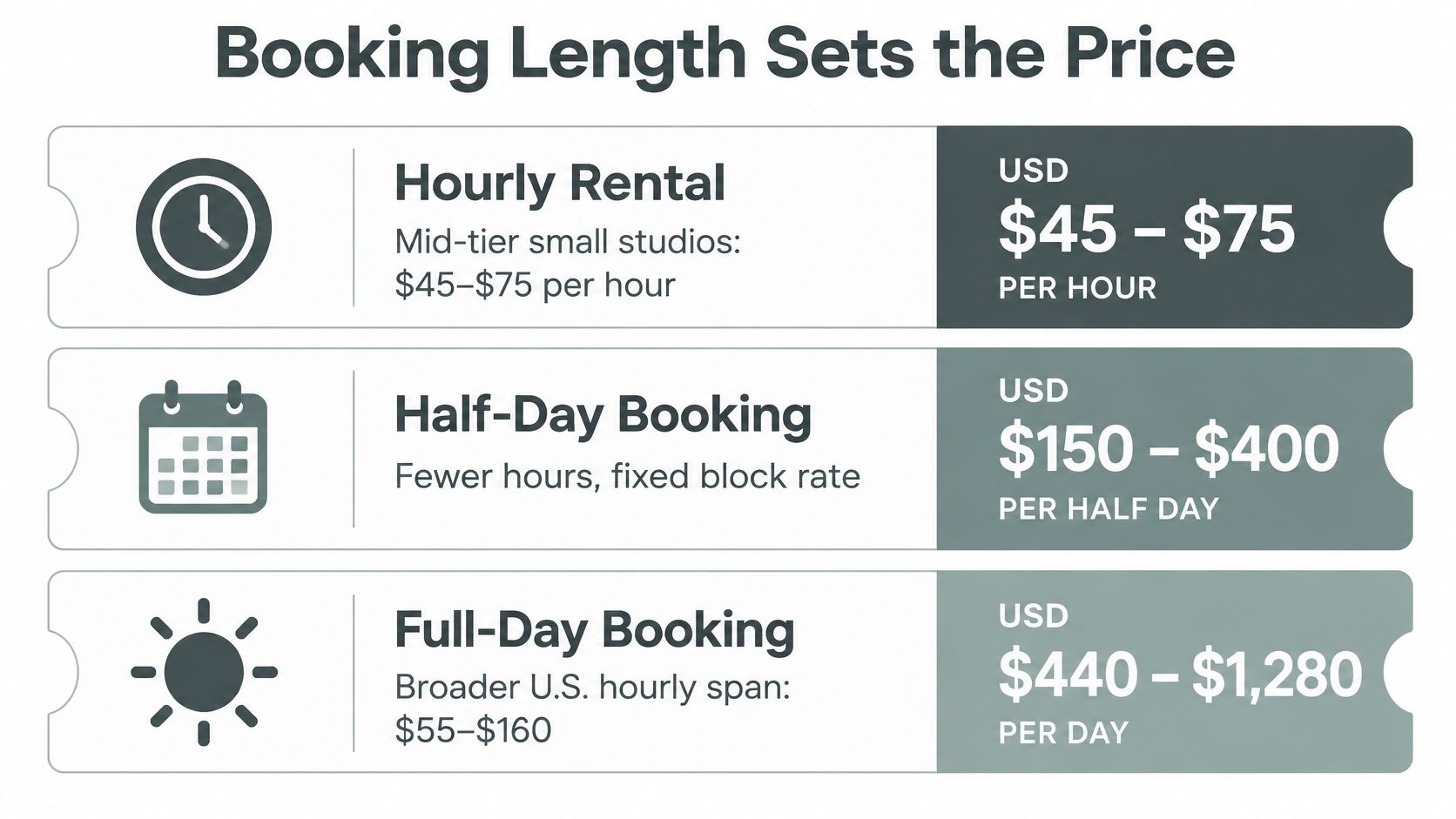
Lightz Out Studios placed 2025 hourly rentals at about $45–$75 for small studios in mid-tier cities, with a broader U.S. span of roughly $55–$160 per hour. Half-day bookings commonly ran $500–$1,000, and full-day bookings $800–$1,750. One cited pattern put an $800 full day against $1,000 for eight separate hourly bookings of the same block.
Booking block | Typical price | Best fit | Value note |
|---|---|---|---|
Hourly, small mid-tier studio | $45–$75 per hour | Short creator or test sessions | Low-commitment entry point |
Hourly, broader U.S. range | $55–$160 per hour | Mixed production needs | Compare inclusions before multiplying hours |
Half day | $500–$1,000 | Portraits and small commercial jobs | Room for setup, not only shooting |
Full day | $800–$1,750 | Brands, teams, and event producers | Often cheaper than buying the same hours separately |
Eight separate hours vs one full day | About $1,000 vs $800 | A day that would otherwise be hourly | Cited full-day discount on the same block of time |
A headshot or product test can stay hourly. Wardrobe changes usually need a half day so the changes don't eat the paid time. A brand day chopped into hours still bills the load-in. Ask whether breaks and reset sit inside the block. Price the hours you will occupy, not only the minutes the shutter is open.
What Moves a Studio Quote Up or Down
Think of an empty kitchen rental versus a staffed dinner. The empty room is cheaper. The staffed version buys back setup time and cuts the chance the night fails because a pan, a burner, or a power drop is missing. A studio quote works the same way. The room is the ticket. Five levers change what that ticket is worth.
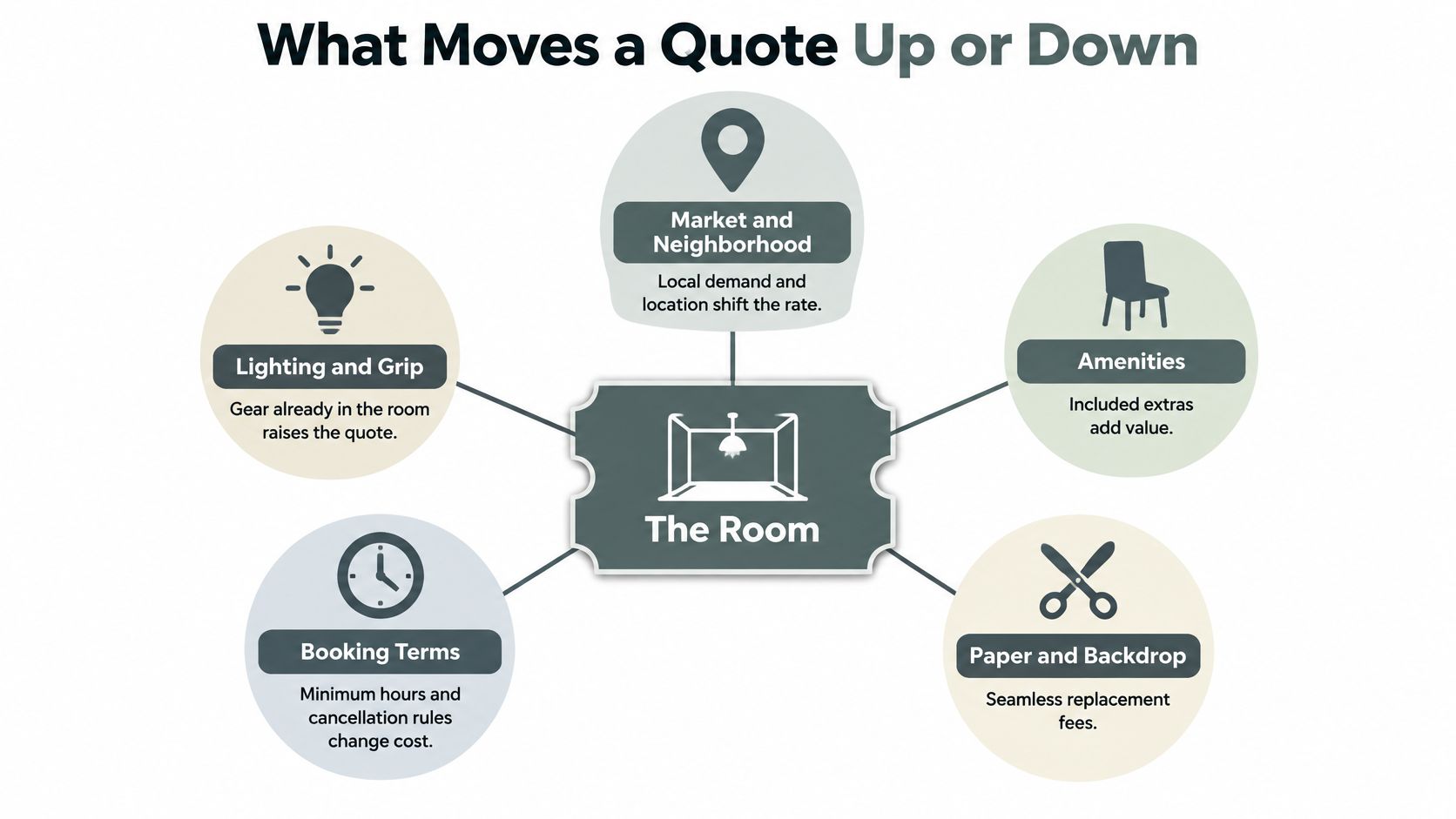
The five levers, in order
Market and neighborhood come first. A room near clients, parking, and other vendors can hold a higher rate than the same footprint on a hard-to-reach edge of town. You are paying for who can get there on time, not only for walls.
Lighting and grip already in the room come next. Strobes, stands, and modifiers that stay on site remove a second rental and a car full of cases. If you are still choosing a plot, a plain-language pass through lighting choices for a working studio shows which fixtures a job needs before you pay for gear you won't use.
Backdrops and props are the third lever. A plain paper backdrop, a styled corner, or a surface you don't have to haul can be the difference between a one-bag call and a van. Ask what is in the room on the day you book, not what the gallery showed last spring.
An assistant or technician is the fourth. Self-service fits a client who brings skill and some gear. An assisted tier, with preconfigured light and someone on site, costs more because it shortens setup and lowers the odds of a reshoot. That is labor, not square footage.
Access, parking, and load-in finish the list. A freight elevator, a ground-floor door, or a lot out front saves a paid hour that would otherwise vanish in the stairwell. A beautiful room with a three-block carry can be the more expensive day.
Why Tuesday and Saturday are not equal
Operators build a rate from rent, utilities, insurance, staffing, maintenance, and gear depreciation, then divide by hours they can realistically sell and add margin. A quiet Tuesday has fewer of those hours to spread the same bills across. A booked Saturday does not. That is why a fair quote can move by day even when the room does not change.
A higher rate can be the fair one when it removes a second rental, a last-minute assistant, or a reshoot.
Before you argue the hour down, ask which of the five levers are already inside the number. If the answer is "the room only," budget the missing pieces yourself. If the answer is "light, paper, and a tech," you are comparing a staffed dinner to a staffed dinner.
The Real Price After Add-Ons and Overtime
A two-hour block advertised at $82 per hour is $164 of room time. Lightz Out Studios notes that the same session can reach about $240 after a backdrop and continuous LED lighting. The room stayed the same. The ticket moved.
The posted hour works like a menu price. You see the entrée. Lighting, paper, cleaning, a deposit, parking, a minimum, insurance, and overtime sit underneath, the way sides and tax sit under a dinner total. Two studios can print the same hourly number and finish far apart once those lines land. A New York median is a poor yardstick for that math in a smaller market such as Tulsa or Jenks. It was never the local starting line, and it still leaves the add-ons out.
Cost line | Typical amount | When it shows up |
|---|---|---|
Two hours at $82 per hour | $164 | Advertised room time only |
Two hours plus backdrop and continuous LED | About $240 | Short portrait or content session |
Equipment add-on | Charged on top of the room rate | Strobes, modifiers, or stands not in the base rate |
Short-term production insurance | A separate daily charge | Client has no existing policy |
Overtime | A higher multiple of the base rate | Shooting or teardown runs past the booked block |
Stack two of those extra lines on a short block and the cheap hour stops being cheap. Gear you do not own, a one-day policy when you have none, and time past the booking are usually billed on top of the room. They are not a rounding error.
Four shoots, same gap
Headshots may only need a backdrop and a short block. If paper and a simple light are already in the rate, the all-in number stays close to the ad. If they are not, you are in the $240 pattern before anything else is added.
Product work often adds modifiers and a surface. A sweep, a table, and a grid you do not own are equipment lines, not part of the hour. Count them before you multiply hours.
Portraits add wardrobe time that triggers the minimum. You may pay for a block you do not shoot because the change happens inside the clock. That clock time is still a real cost.
Podcast or talking-head content can need sound treatment and a longer setup than the on-camera minutes suggest. The recording might be twenty minutes. The room might be two hours. Price the room.
Independent creators and small client businesses are the bookers most likely to compare headline rates and miss the total. If you are building a client business around these sessions, the production math belongs next to the sales math in a step-by-step path for growing a photography business.
An all-inclusive room often finishes as the lower total when the bare listing sends you shopping for the same pieces on shoot day.
Write three lines before you call anyone:
Base block. Hours or half day times the posted rate, including load-in.
Known add-ons. Gear, paper, insurance, parking, and deposit rules you already know.
Overtime contingency. A slice of time at the overtime multiple, in case teardown runs long.
That sheet is the number you compare. The hour in the ad is only the starting line.
Why New York Rates Mislead Smaller Markets
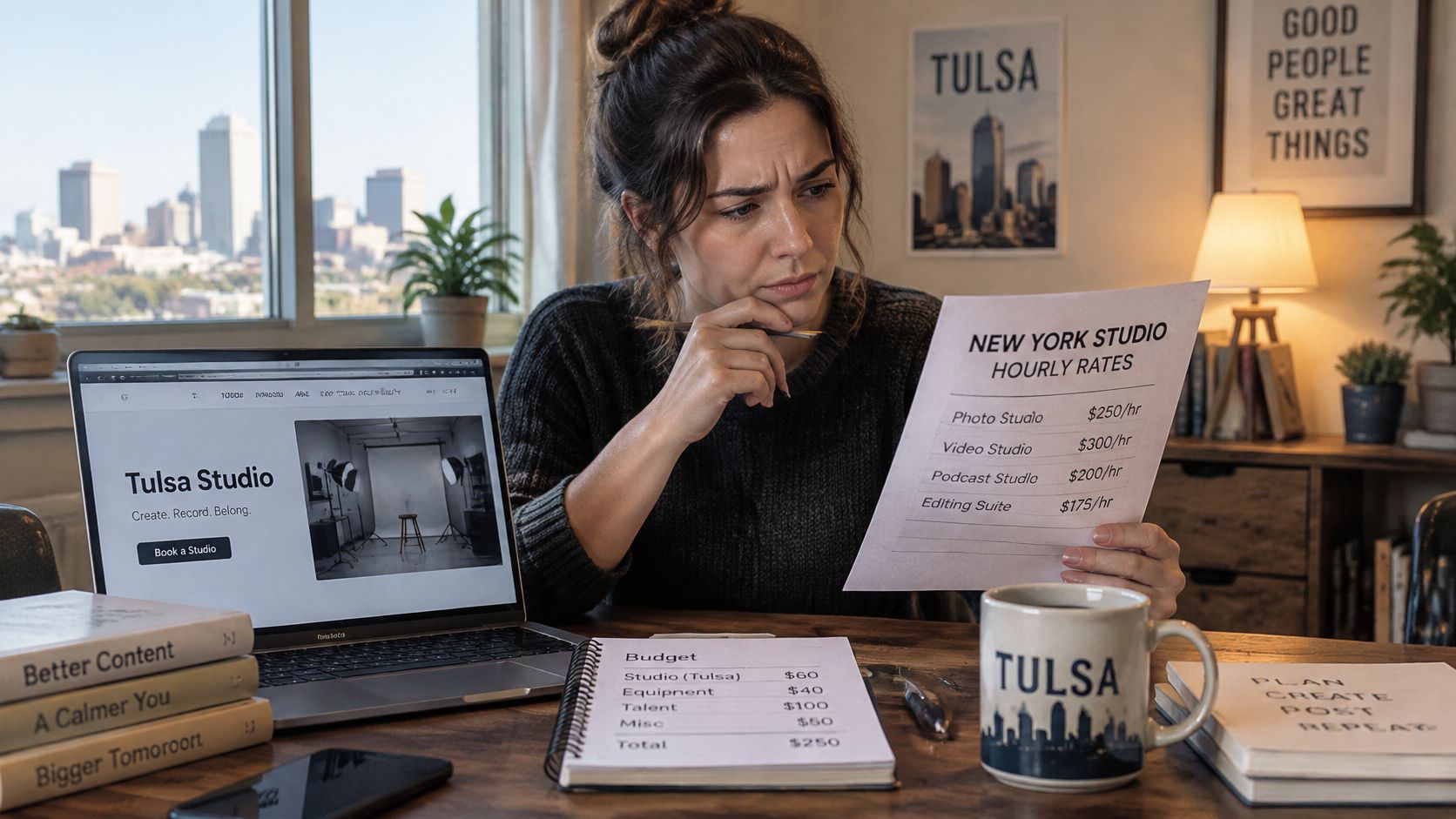
A New York studio's hourly rate can be several times higher than a local listing, but that gap does not tell you what a Tulsa or Jenks session should cost. City medians reflect the market they measure. Use them as context, not as a local price target.
What the New York list actually measures
Match Studios' overview of New York photo studio rental costs describes reported prices from approximately $27 to more than $400 per hour. A separate analysis of 134 New York listings reported a citywide median of $64 per hour, with a $90 Manhattan median versus $40 in Brooklyn and Queens. Those figures describe New York listings, not the cost of renting a room in a smaller market.
A 2025 industry survey cited in the Match Studios piece reported that photographer business costs increased by roughly 6%–10% in 2024, while 30%–37% of photographers raised prices. Rising operating costs can affect local quotes too, but they do not make New York prices a suitable benchmark for Tulsa or Jenks.
Three local booking cases
The New York research contains no Tulsa or Jenks studio listings, so it cannot establish local rates. Compare local quotes on their own terms.
A two-hour headshot session may fit an hourly local rental, but its cost depends on the terms of that booking. A New York median cannot tell you whether a local room's rate includes the items your shoot needs.
A half-day product shoot has a different cost profile. One studio may include the surfaces and modifiers you need, while another may quote them separately. The hourly rate alone cannot show which option costs less for the full session.
A membership or bundled-content option may suit someone who shoots regularly. Compare the total cost of using the space with the number and type of sessions you expect to book. A New York hourly target does not determine whether a local option makes sense.
Use coastal rates as context, not as the number to copy. Compare local offers against the requirements of the shoot and the value each booking includes.
Amenities and Booking Terms to Confirm
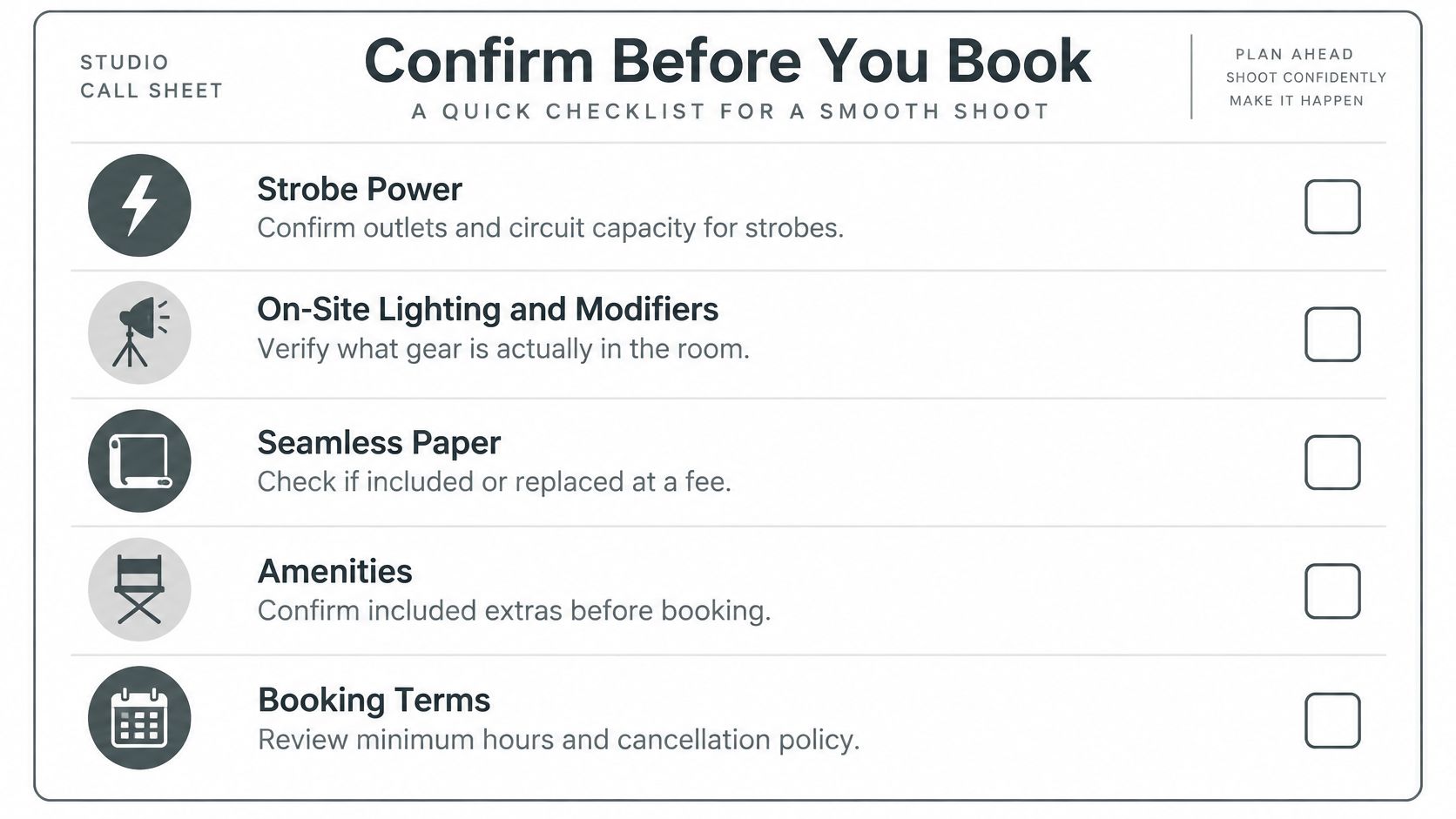
A low room rate still fails if the studio can't support the light the job needs, or if teardown is billed in a surprise block. Walk a listing in the order you'd verify it on a call.
On the room
Strobe power: Confirm outlets and circuit capacity before you pack four heads. A tripped breaker mid-portrait is lost time you already bought.
On-site lighting and modifiers: Ask for the inventory that will be in the room that day, not a general "we have lights." Softboxes, grids, and stands should be named.
Backdrop paper: Check whether a roll is included, which colors, and whether a tear or a color change is replaced at a fee.
Makeup, changing space, and a client corner: If a subject needs a mirror and a place to wait, a bare cyc is the wrong room.
Wi-Fi, bathroom, load-in, parking, and cleanup: Map the path from the car to the set. Ask who sweeps, and whether cleanup sits inside the block.
Self-service or an assistant: Know whether you are alone with the gear. Props or a styled set should be listed if you are counting on them.
If you are building a room of your own rather than renting, the same checks show up in a photography studio setup before the first client walks in. Power and paper policy are not decorations.
On the paperwork
Minimum hours: A two-hour job inside a four-hour minimum is a four-hour job.
Refund and cancellation window: Know the cutoff in writing, including what a client no-show does to your fee.
Damage deposit: Ask what it covers, when it returns, and what counts as damage versus normal wear on paper and floors.
Insurance proof: Confirm the limit they require and whether a one-day certificate is acceptable.
Overtime rule: Get the multiple and the increment. Fifteen minutes and a full extra hour are not the same surprise.
House rules: Quiet floors, no-call areas, and shared access during your block change how the work feels. A shared hallway during a whisper interview is a production problem.
If two studios land close on the all-in number, choose the one whose inclusions, access, and overtime rule are written down before the deposit. A verbal "we usually include that" is not a line item.
Price the Session Then Visit Freeform House
Finish the three lines before you contact anyone. Base block, known add-ons, overtime contingency. Use that written total to compare any Jenks or Tulsa quote. Don't compare it with a coastal hourly median.
For creators, podcasters, and small teams around Jenks and Tulsa, we built Freeform House as a membership-based club in the 10 District of downtown Jenks. It is a central gathering spot, closer in spirit to a place like SoHo House than to a bare room rental. Members get co-working spaces and a community hub meant to foster a creative, cooperative local scene, with rooms that should look realistic and authentic rather than like a clip-art set.
Members can use in-house facilities at First North for podcast and photography rentals. The Rise is a 1,300 sq ft studio that holds a maximum of 20 people, with soft, even natural light from north-facing windows. We don't publish a one-size session rate in place of your sheet. Prospective members can book a personalized consultation to learn pricing structures, opening dates, and how to join. Bring the shoot type, the headcount, and the hours, and ask what is included before you compare the quote.
Freeform House gives members a place in downtown Jenks to work together and to book photography and podcast time without treating a New York hourly list as the local price. Bring your three-line session total to a consultation and see how the room, the light, and the booking terms line up. Visit Freeform House and book that conversation.
Comments