How to Grow Photography Business: A Step-by-Step Path to Thriving

Growing your photography business means you have to start wearing two hats: the artist and the entrepreneur. It’s a big shift, moving from just creating beautiful photos to building a rock-solid business that actually brings in consistent clients and, you know, pays the bills. This is all about laying the strategic groundwork that turns your passion into a profitable, sustainable career.
Building Your Business Beyond the Lens
I've seen so many incredibly talented photographers struggle, and it’s almost never because their work isn't good enough. The real problem? They haven't built the business structure to support their art. The very first step is to stop thinking like a freelancer getting paid gig-to-gig and start acting like a CEO. That means you’re the one setting the direction, understanding your market, and making the tough calls that will fuel your growth for years to come.
This whole journey kicks off with picking your niche. What are you truly passionate about shooting? The teary-eyed moments at a wedding? The crisp, clean look of corporate headshots? Or maybe the beautiful, authentic chaos of family life? Getting specific doesn't box you in—it makes you an expert.
Defining Your Niche and Unique Value
Let's be real: a "photographer for everyone" is a photographer for no one. When you specialize, you can fine-tune your marketing, your style, and your entire client experience for a very specific group of people. Suddenly, you become the obvious choice for them.
Think about where you might fit:
Weddings & Elopements: High-stakes, high-reward work that’s all about emotion.
Family & Newborns: Always in demand and powered by word-of-mouth referrals.
Corporate & Branding: A B2B focus that can lead to steady, recurring projects.
Product & E-commerce: An absolute boom-town for photographers as businesses move online.
Once you’ve found your lane, you have to figure out your unique value proposition (UVP). What makes you different from the other photographers in Tulsa or Jenks? It’s not just your editing style. Your UVP is the entire experience you deliver, from that first email to the final photo gallery. Maybe you promise a 48-hour sneak peek gallery, or perhaps you offer clients access to an exclusive wardrobe for their session. Your UVP is your promise.
The photography market is massive—it was valued at $105.2 billion in 2023 and is expected to hit $161.8 billion by 2030. That’s a huge pie to get a slice of, especially in booming niches like e-commerce photography, which is projected to more than double by 2028.
Crafting Packages and Pricing for Profit
Pricing is where so many photographers get stuck. The secret is to stop trading your hours for dollars and start selling the value you create. Forget the simple hourly rate. Instead, build tiered packages that solve your clients’ specific problems.
For example, a branding photographer could structure their offerings like this:
The Starter: Just the essentials—professional headshots and 20 edited images.
The Professional: A more robust option with headshots, behind-the-scenes content, and 50 images.
The Authority: The all-in package, featuring multiple locations, video content, and a complete brand image library.
This approach naturally guides clients toward the options that provide more value and clearly lays out what they're getting. Your pricing needs to account for your expertise, your cost of doing business, and the unique experience you deliver. It's about having the confidence to charge what you're worth.
A huge part of building a strong business is creating a professional environment. Having a physical space can seriously elevate your brand, giving you a polished setting for client consultations, content creation, or even collaborating with other local creatives.
This professional image is a non-negotiable part of your brand. For photographers here in Oklahoma, spaces like Freeform House offer an incredible chance to network and establish a premium presence. Free Form House is envisioned as a premier, membership-based club in the heart of Jenks, Oklahoma's 10 District downtown. Comparable to the renowned SoHo House, it offers more than just a social club. Members can take advantage of co-working spaces and a dynamic community hub designed for collaboration and connection. It's a central gathering spot aimed at fostering a creative and cooperative spirit within our local community.
Your Website: A 24/7 Client Magnet
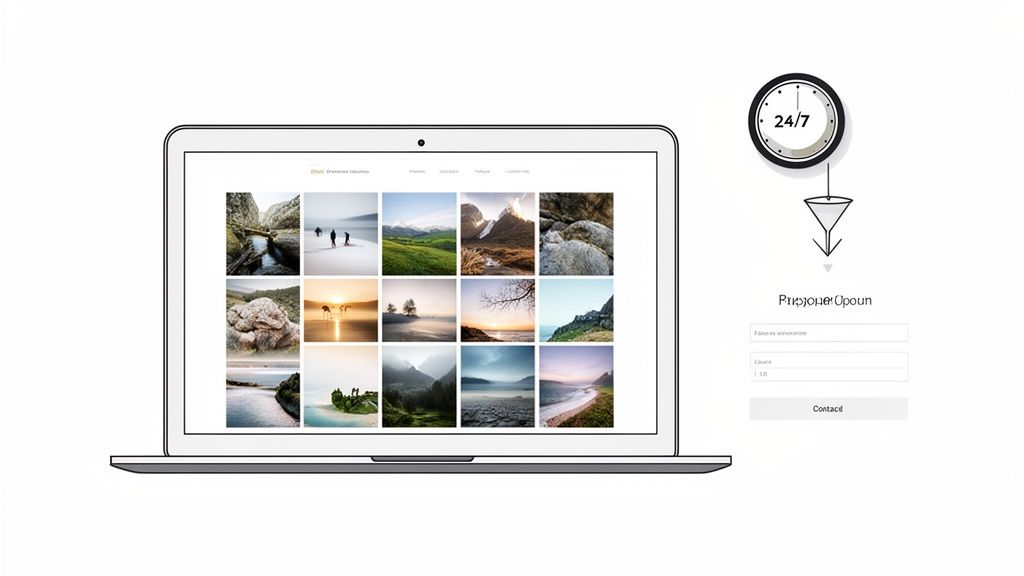
Think of your website as your hardest-working employee. It’s on the clock 24/7, never calls in sick, and is constantly working to show off your talent and land you new clients. But for it to actually do its job, it needs to be more than a digital art gallery. It has to be a finely tuned machine, built from the ground up to turn casual visitors into paying customers.
That all starts with being absolutely ruthless when curating your portfolio. The biggest mistake photographers make is dumping every decent photo they've ever taken onto their site. Don't do that. Your online portfolio should be a small, powerful collection that speaks directly to the exact clients you want to work with. If you want to book $10,000 weddings, your site should be overflowing with elegant, emotional wedding photography—not pictures of your cousin's dog.
This deliberate curation is the secret sauce to growing your business online. Every single image needs to scream your specialty and show a potential client exactly what they can expect from you. Your portfolio isn't about showing everything you can do; it’s about showing what you will do for them.
Designing a User Journey That Just Works
With your killer portfolio in place, the next job is to build a website experience that feels completely effortless. When someone lands on your page, they should know who you are, what you do, and how to hire you within seconds. A clunky, confusing website is the fastest way to lose a lead.
The best photography websites have a clear, logical structure. You’re not trying to reinvent the wheel here. Just guide people where they need to go.
Essential Website Pages for Photographers
Every page on your website has a specific job to do in the sales process. Here's a breakdown of the must-have pages that will guide a visitor from being curious to becoming a client.
Website Page | Primary Purpose | Key Elements to Include |
|---|---|---|
Homepage | Make a killer first impression. | A stunning hero image, a clear headline ("Jenks Wedding & Family Photographer"), and obvious calls-to-action. |
Portfolio | Showcase your best, most relevant work. | Galleries organized by session type (weddings, newborns, etc.). Make it incredibly easy for people to find what they're looking for. |
About Page | Build trust and a personal connection. | Your story, your "why," and a professional photo of yourself. People hire people they like. |
Services/Investment | Pre-qualify leads and set expectations. | Clearly defined packages and starting prices. Transparency here saves everyone time. |
Contact Form | Make it ridiculously easy to get in touch. | Keep it simple: Name, email, event date, and a message box. Don't ask for their life story. |
This structure isn't just a suggestion; it's a proven roadmap that builds confidence in your brand with every click.
Your website’s professionalism is a direct reflection of your service. In a crowded market, a smooth, polished online experience isn't a luxury—it's the bare minimum. It should feel as premium and well-designed as a beautiful workspace like Freeform House.
The Technical Stuff You Can't Ignore
Beyond how it looks, your website's performance is make-or-break. There are two things that are absolutely non-negotiable: site speed and mobile responsiveness.
A slow website is a death sentence. People have zero patience. You need to optimize your images for the web so your pages load almost instantly. No excuses.
Just as important, your site must work perfectly on a phone. A huge chunk of your traffic will come from mobile devices, and if they have to pinch and zoom to read your text, they’re gone. Test your site on every screen size you can get your hands on.
Finally, you need to start thinking about local SEO (Search Engine Optimization). This is how people in Jenks or Tulsa find you on Google when they search for a photographer. A great first step is to sprinkle location-specific keywords naturally throughout your site. Adding a simple phrase like "downtown Jenks headshot photographer" to your homepage or a blog post can make a massive difference in getting the right kind of local traffic and turning your website into the client magnet it's meant to be.
Marketing That Fills Your Calendar
Let's be real: a gorgeous portfolio and a slick website are table stakes. They're essential, but they won't magically fill your calendar. To actually grow a thriving photography business, you need a marketing plan that brings a steady stream of your ideal clients to you. This isn't about shouting into the void; it's about smart, strategic moves that put your work in front of the right people, right when they're looking.
The secret is diversifying. Relying on a single source for new leads is a fast track to a stress-filled, feast-or-famine cycle. Instead, we're going to build a few solid pillars that work together, creating a consistent flow of inquiries that keeps you busy doing what you love.
Dominate Your Local Search Results
Think about it. When someone in your town needs a photographer, what’s the very first thing they do? They Google it. Showing up on that first page isn't just luck—it’s local search engine optimization (SEO). The goal is straightforward: when a potential client searches for "Jenks family photographer" or "branding photography in Tulsa," you need to be one of the first names they see.
Your starting point is your Google Business Profile. This free listing is basically your digital storefront on Google Search and Maps, and it’s incredibly powerful.
Fill Out Everything: Don't skip a single section. The more complete your profile is, the more Google trusts and recommends you.
Speak the Local Language: Naturally weave in keywords like "photographer in Jenks, OK" into your business description and service listings.
Keep It Fresh: Regularly upload high-quality images from recent sessions. This shows you're active and gives clients a reason to look.
Rally for Reviews: Make it a habit to ask every happy client for a review. Those gold stars are one of the biggest factors in ranking higher than your competition.
Beyond Google's own tools, your website and blog are your SEO workhorses. The best way to attract local clients is by creating genuinely helpful content. For example, a blog post on the "Top 5 Outdoor Locations for Family Photos in the Tulsa Area" does two things: it provides real value to a potential client and signals to Google that you're the local expert.
Build a Community on Social Media
Visual platforms like Instagram are tailor-made for photographers, but it's not just about posting your best shots. It's your chance to build a real community around your brand. People hire photographers they feel a connection with—someone they know, like, and trust. Social media is where that relationship starts.
Instead of only posting perfectly polished final images, show the real stuff. Share behind-the-scenes clips from a shoot, post a client's emotional reaction to their gallery reveal, or talk about the "why" behind your work.
The game changes when you stop selling and start sharing. Let your personality show. In a sea of talented photographers, you are the unique selling proposition. Let people connect with the human behind the lens.
Remember, consistency beats frequency. Pick one or two platforms where your ideal clients actually hang out and commit to being present there. Whether that's through Instagram Reels or engaging Facebook Stories, find a sustainable rhythm that feels authentic to you and doesn't lead to burnout.
Forge Powerful Local Partnerships
One of the absolute fastest ways to grow is to tap into existing networks. By connecting with other local businesses who serve the same type of clients, you create a powerful referral machine that works for you 24/7.
Just think about the other professionals your clients might be working with:
Wedding Photographers: Team up with wedding planners, venues, florists, and bridal shops.
Newborn Photographers: Build relationships with doulas, local baby boutiques, and OB-GYN offices.
Branding Photographers: Network with web designers, marketing agencies, and co-working spaces.
For creative entrepreneurs in the Jenks area, a hub like Freeform House is a goldmine for these kinds of connections. It’s a space filled with a dynamic community of business owners, professionals, and event hosts—all of whom are potential clients or referral partners. Building genuine relationships in a cooperative environment like this can unlock doors to high-value projects and collaborations you simply wouldn't find on your own. To get more ideas for creating useful local content, check out our guide on the Freeform House blog.
Despite what you might hear, the US photography market is holding strong. Employment is projected to rise 4% from 2023 to 2033, which means about 13,700 job openings every year. In such a fragmented market, savvy photographers can find huge opportunities in niches like product and aerial photography. In fact, the product photography segment is forecasted to more than double to $275 million by 2028. You can find more of these photography industry statistics and trends to spot opportunities. By combining smart local SEO, authentic social media, and strategic partnerships, you can claim your piece of this growing pie.
Creating an Unforgettable Client Experience
Let's be honest: exceptional service is your single most potent marketing tool. Full stop. It’s what turns happy clients into your own personal sales force, generating the kind of word-of-mouth referrals that you just can't buy. We're not talking about big, expensive gestures here. It's about building a smooth, professional, and confidence-inspiring journey from their first email to the final photo delivery.
A solid client workflow is the backbone of this whole experience. It takes the guesswork out of the equation for everyone involved, making every single interaction feel polished and purposeful. Think of it as your roadmap to consistently delivering a premium service that justifies your prices and keeps people coming back for more.

When you've got your marketing humming—integrating SEO, social media, and local partnerships—you'll have a steady stream of leads. Your job is to guide them into this carefully crafted experience.
From First Contact to Signed Contract
The client experience kicks off the second someone reaches out. How you field that initial inquiry sets the tone for everything that follows, and it's a make-or-break moment.
Speed and professionalism are everything. I always aim to respond to inquiries within 24 hours, but sooner is always better. An immediate reply shows you're on top of your game and serious about your business. But don't just be fast—be helpful.
Instead of a generic "Yep, I'm available," give them some real value right away:
Acknowledge their vision: Show them you actually read their message and are genuinely excited about their plans.
Give them a clear next step: Nudge them toward a consultation call to dive deeper into what they're looking for.
Share something useful: Send a link to a relevant blog post or a gallery that mirrors the style they mentioned.
Once you get them on a call, your primary job is to listen. Seriously, listen more than you talk. Ask open-ended questions to uncover what they truly want from their photos. What feelings do they hope to remember? What's the most important part of the day for them? This deep understanding is what allows you to craft a proposal that feels like it was made just for them, not pulled from a template.
After the call, send over a clean, professional proposal and contract that spells out every detail. No room for confusion.
"A good experience makes people want to rave about you—and honestly, your clients deserve that. Think about the little touches that would feel special to you as a client. When you go the extra mile, people remember it—and they tell their friends."
Crafting a Relaxed and Confident Photoshoot
The shoot itself is the heart of the experience. Your technical skill behind the camera is a given, but your ability to make clients feel comfortable and confident is what they'll actually remember. Most people feel a little awkward having their picture taken; it's on you to be their guide.
Create a relaxed vibe the moment they walk in. I like to have some music playing, offer a drink, and just chat for a few minutes before even picking up the camera. Throughout the session, give clear, gentle direction. Instead of just saying "smile," give them prompts that bring out natural reactions. Ask a couple to tell each other about the moment they first met—you'll get a real smile every time.
The Final Delivery and Follow-Up
Your work isn't done when you pack up your gear. The way you deliver the final images is the grand finale. Present their photos in a beautiful, professional online gallery that’s easy for them to navigate and share. This polished presentation reinforces the premium quality of your entire service.
A few weeks after they’ve received the gallery, send a personal follow-up email. Thank them again for trusting you, and if they were happy with everything, gently ask for a review. This final touchpoint closes the loop perfectly, encourages future bookings, and strategically turns a satisfied client into a powerful advocate for your brand.
Scaling From Photographer to Business Owner
There comes a point in every successful photographer's career where you have to make a choice: stay a photographer who owns a job, or become the CEO of a company. The real growth, the kind that lasts, happens when you make that leap.
This is the shift away from trading your time directly for money and toward building systems that generate revenue whether you're behind the camera or not. It's the classic move of learning to work on your business, not just in it. Making this transition is all about creating a sustainable brand that has value beyond your personal ability to shoot and edit.
Reclaim Your Creative Energy by Outsourcing
Let’s be honest: your time is your most valuable asset. Every hour you sink into repetitive tasks like culling, basic edits, or bookkeeping is an hour you can't spend on things that actually move the needle—like high-level networking, client consultations, or that creative passion project.
Outsourcing isn't a sign of weakness; it's a strategic investment in your own sanity and your business's future. Start by pinpointing the tasks that drain your energy and don't require your unique creative touch.
Photo Editing: A good private photo editor can learn your style inside and out, handling the bulk of post-production. This can free up dozens of hours every single week.
Bookkeeping & Accounting: Handing this off to a professional not only saves you a headache but ensures your finances are clean. This is absolutely critical for making smart business decisions down the road.
Client Management: A virtual assistant can take over initial inquiries, scheduling, and follow-ups, making sure every potential client gets a polished and prompt response.
By delegating these tasks, you free up the mental space and creative bandwidth you need to focus on the big picture.
Build Resilient Revenue with Diversified Income
Relying solely on client shoots is a recipe for the classic feast-or-famine cycle we all know too well. To build a more resilient business, you need to create income streams that aren't tied directly to the hours you spend shooting. This is how you start making money even when you're not on a job.
Think about adding some of these to your business model:
Print and Album Sales: This is low-hanging fruit. Integrate an online store with your client galleries to offer high-quality prints, canvases, and beautifully designed albums.
Digital Products: You're an expert! Package that expertise into sellable assets. Think Lightroom presets, posing guides, or even business templates for other photographers just starting out.
Educational Content: Offer online workshops or in-person mentoring sessions for aspiring photographers who want to learn from your experience.
The photography industry is booming, with projections showing it will hit $15.8 billion in revenue by 2025. What's interesting is that this growth is happening even with a slight dip in marriage rates. This just highlights how crucial it is for photographers to diversify beyond a single niche like weddings. The massive demand for visual content from social media and e-commerce is fueling the market, and you can capitalize on it. You can explore more about these market trends and find your next big opportunity.
Thinking like a CEO means making data-driven decisions. You have to move past gut feelings and start looking at the hard numbers. Your profit margins, client acquisition cost, and conversion rates are the true health indicators of your business.
Grow Your Capacity With an Associate Team
Eventually, if you do things right, you'll be fully booked. Instead of turning away good clients and valuable revenue, you can expand your capacity by building an associate team. This model allows you to book multiple events on the same day, with trusted photographers shooting under your brand's style and quality standards.
A successful associate program requires airtight systems. You'll need to create comprehensive training on your shooting style, client interaction protocols, and brand values. When you do this right, every client gets the same premium experience, regardless of who is behind the lens. It’s one of the most powerful ways to scale your revenue without having to clone yourself.
Navigating Your Photography Business Growth: Common Questions Answered
As you start turning your passion into a real, profitable business, you're going to hit some roadblocks. It’s totally normal. Here are some of the most common questions I hear from photographers trying to find their footing, along with some straight-up, practical advice to help you push through.
What's the Best Way for a New Photographer to Market Themselves?
When you're just starting out, your best bet is a two-part strategy: create an absolutely killer online portfolio and get out there to do some real, old-fashioned local networking.
Your website is your digital storefront, and it needs to be magnetic. This isn’t the place to show off every photo you’ve ever taken. Be ruthless. Only showcase your absolute best work, and make sure it’s laser-focused on the exact kind of client you want to attract. If you want to shoot high-end weddings, don't fill your portfolio with pet portraits. Specialization is your best friend.
At the same time, you've got to plant your flag in your local community. Get to know the people who run complementary businesses—I’m talking about wedding planners, florists, boutique owners, real estate agents, or interior designers. For example, a photographer in the Tulsa area could find incredible opportunities by connecting with the community at a place like Freeform House. This gives you a direct line to a whole network of entrepreneurs who need great headshots, branding photos, or event coverage.
A polished online presence combined with genuine local connections is the most powerful engine for getting clients when you're new.
How Should I Price My Services When I'm Just Starting?
This is where so many new photographers shoot themselves in the foot. The absolute biggest mistake you can make is pricing yourself dirt cheap just to land your first few gigs. It feels like a good idea, but it sets a terrible precedent and is a fast track to burnout.
Don't just guess or copy someone else. Start by calculating your Cost of Doing Business (CODB). I mean everything—your cameras, lenses, software subscriptions, insurance, marketing spend, gas, and taxes. Get it all down on a spreadsheet.
Next, decide what you actually want to pay yourself for the year. Add your desired salary to your CODB, and that number is the bare minimum you need to earn to have a sustainable business. Sure, glance at what other photographers in your area are charging to get a feel for the market, but don't let their prices dictate yours. Your rates should reflect the unique value and specialized skill you bring.
A smart way to frame your value is by offering tiered packages—think Bronze, Silver, and Gold. This isn't just about giving clients options. It’s a psychological tool that guides them toward the higher-value packages and clearly spells out the expertise and results you deliver.
When Is the Right Time to Pick a Niche?
It's totally fine to be a generalist when you're first getting your feet wet. Shoot everything! But your goal should be to specialize as soon as you find that sweet spot where three things overlap: what you absolutely love to shoot, what people will consistently pay good money for, and what you’re naturally great at.
Picking a niche is one of the most powerful business decisions you can make. It immediately sets you up as an expert, which makes your marketing ten times easier and gives you the credibility to charge premium rates.
So, when's the right time? It's when you start seeing a pattern. Maybe you notice that 80% of your inquiries are for newborn sessions, and you genuinely get excited about that work. That's your sign. In a crowded market, the specialist always wins against the jack-of-all-trades.
How Can I Get a Consistent Flow of New Clients?
To keep your calendar full, you need several different avenues for finding clients. Never put all your eggs in one basket.
Here’s a multi-channel plan to get you started:
Dominate Local Search: Get serious about local SEO. This means sprinkling keywords like "Jenks corporate photographer" or "Tulsa wedding photography" naturally throughout your website, blog posts, and especially your Google Business Profile. This is how high-intent local clients find you.
Be Social (Consistently): You don't need to be on every platform. Pick one or two where your ideal clients hang out and commit to being active there. The magic is in the consistency, not just posting randomly.
Turn Past Clients into Fans: Create a simple referral program. A small gift card or a discount on their next session can turn happy clients into your most powerful sales team. Seriously, don't sleep on this.
Network with a Purpose: Don't just go to events to hand out business cards. Join local business groups or attend community meetups with the goal of building real relationships that can lead to mutually beneficial partnerships.
The idea is to build several independent systems for lead generation that all work together. That’s how you create a business that doesn't just survive, but grows year after year.
Ready to plug into a vibrant community of local entrepreneurs and take your professional presence to the next level? Freeform House in Jenks offers the perfect backdrop for networking, hosting client meetings, and sparking creative collaborations. See how a membership can open up new opportunities for your photography business by visiting https://freeform.house.
Comments