8-Step Offsite Meeting Checklist for Productive Teams

A team leaves a two-day offsite with a group photo, a whiteboard full of arrows, and a follow-up meeting nobody books. By Monday, three people remember three different versions of the single decision that got made. The room was fine. The failure happened three weeks earlier, when nobody wrote down what the two days had to produce, when the space was booked without asking for a floor plan, and when lunch landed twenty minutes into the afternoon session and took the room with it.
Offsite problems are almost always preparation problems wearing a disguise. The day itself rarely fails on its own. It inherits the gaps from the four weeks before it, and it hands those gaps to the four months after.
This checklist runs in planning order, not alphabetical order. Each of the eight steps names the decision it forces, the point on the countdown when it has to be settled, and the specific failure mode you get if you skip it. Work backward from the event date. If you only have three weeks, you'll see exactly which steps compress and which ones don't.
Start with the one that costs nothing and saves the most.
1. Define Clear Meeting Objectives and Desired Outcomes
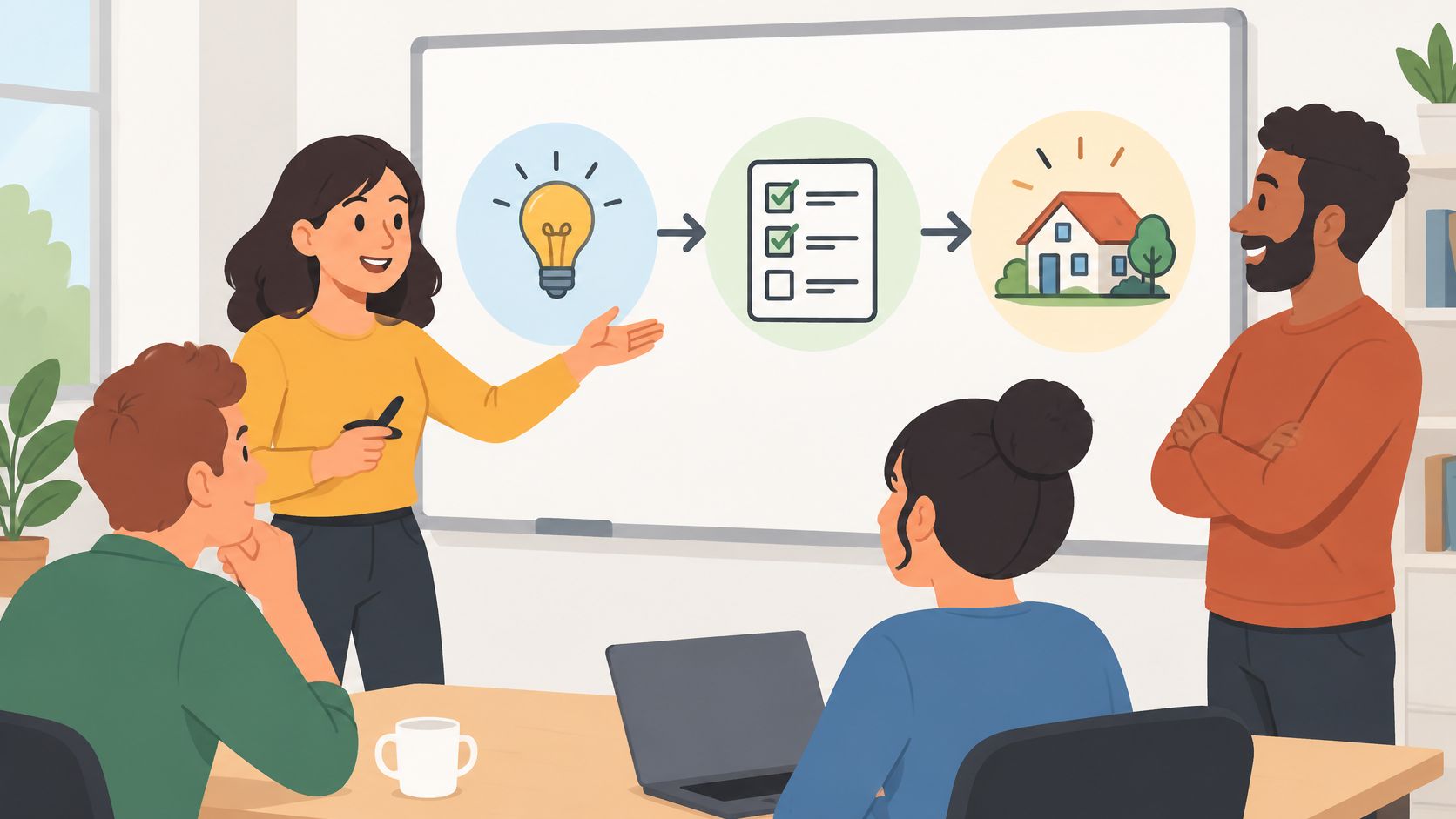
Before you look at a venue, a date, or a single agenda slot, write one sentence that says what has to be true when people walk out. "Agree the three annual priorities and assign an owner to each" is a sentence that shapes every decision after it. "Leadership offsite" is a venue booking with a purpose-shaped hole in it.
Research on 69 team gatherings found that the higher-performing offsites defined concrete deliverables in advance and reserved time to document decisions and next steps, as Atlassian's review of team offsite research reports. The same work found that gatherings raised team connection by 27% on average, and that the gain faded over roughly four months. It also found that groups of 5 to 10 people meeting for two to three days performed more effectively than larger or longer gatherings.
A two-day event that produces warmth and no operating change is a four-month loan against your next offsite. Cap the headcount while the purpose is still a sentence rather than a compromise.
The decision this step forces
Choose one primary mode. A decision meeting, a workshop, and a relationship retreat need different rooms, different people, and different endings.
Decision meeting. Few people, one hard question, a named owner for every outcome before anyone leaves.
Workshop. A defined artifact, such as a finished campaign concept, presented and defended at the end of the session.
Retreat. Relationships as the deliverable, with the work discussed rather than decided.
Draft the objectives with the executive sponsor and get them confirmed in writing at least four weeks out. Then put them in the calendar invitation, not in a document nobody opens.
Failure mode, the feel-good offsite. Everyone leaves energized, nobody leaves with an assignment, and the same conversation reopens in six weeks. If you can't finish the sentence, don't book the room.
2. Select and Confirm the Right Venue and Layout
Say you book a handsome room for fourteen and discover on arrival that the only table is bolted to the floor. Your breakout becomes a corridor conversation, and the afternoon loses an hour to furniture.
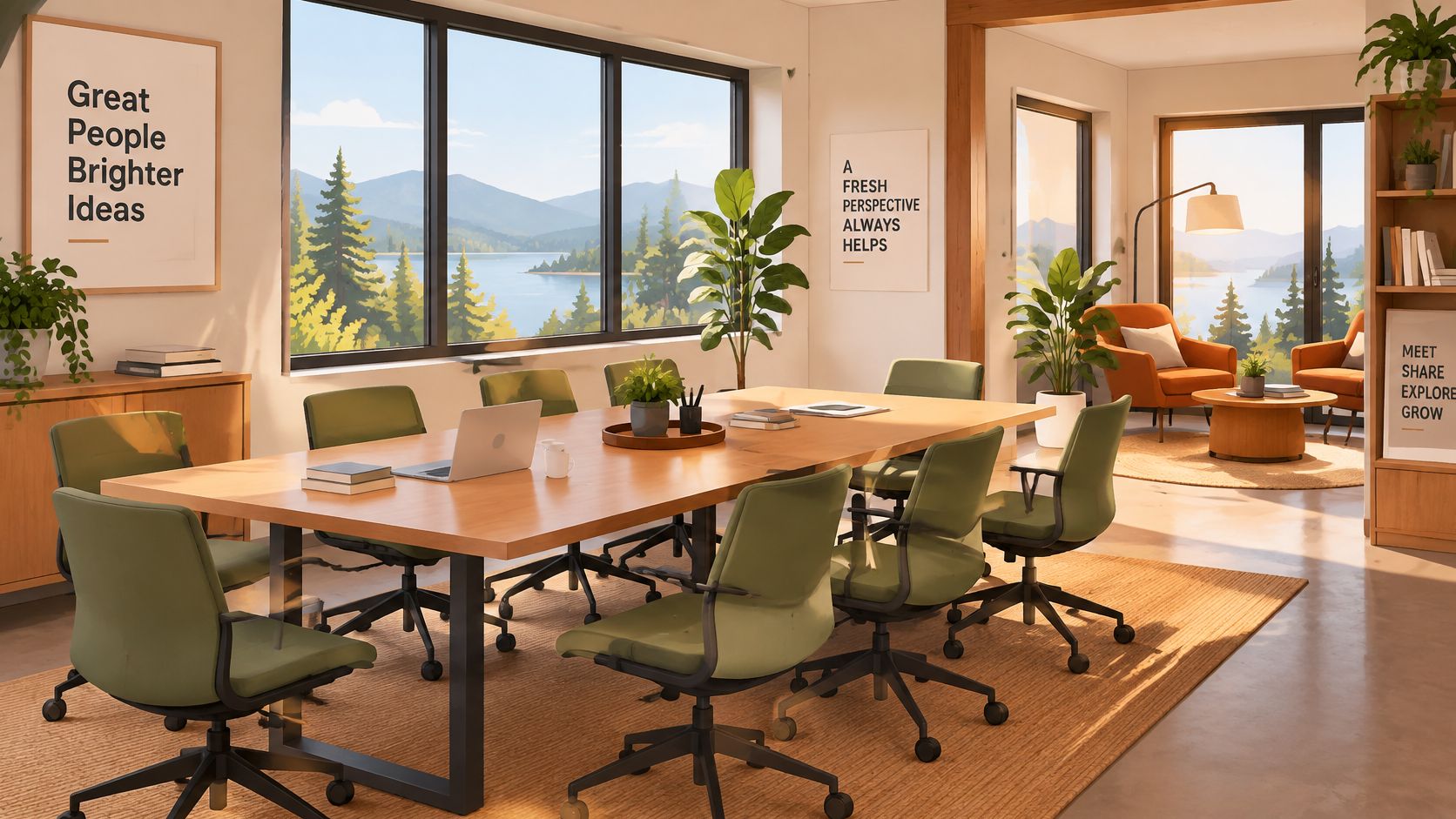
Layout is not decoration. A 2024 scoping review of coworking research summarized a survey of 193 users that reported environmental layout significantly influenced productivity, with a coefficient of 0.336 and p < .01, and social interaction with a coefficient of 0.846 and p < .001. The review names bright lighting and worktables near windows as positive environmental features.
For planning, that translates into three asks: movable furniture, daylight in the main session room, and the shared table positioned near the glass instead of in the dark corner behind the screen.
The decision this step forces
Whether one room carries the whole day or you need two. A plenary in the morning followed by four small discussions is a different booking from a single boardroom with a projector.
Freeform House answers that with four distinct rooms, the Hall of Fame Room, the Freeform Room, the Executive Room, and the Thomas Room, so a group can hold a full session in one space and split into pairs or trios in another. Our guide to meeting room layout options covers which configuration suits which format.
Get three things in writing before you sign: a floor plan with dimensions, an inclusion list covering Wi-Fi, A/V, furniture, and setup time, and a reset window between sessions so your team can rearrange the room without eating the break.
A walkthrough at the same hour of your event tells you more than any brochure, especially about noise from the street and the temperature of the room by mid-afternoon.
Failure mode, the pretty room. High ceilings, gorgeous light, one immovable table, and fourteen people doing strategy in a horseshoe nobody can change.
3. Build a Realistic Budget and Timeline
Budget trouble rarely arrives as a missing number. It arrives as a decision made late: the venue held before the sponsor approved the tier, the catering headcount confirmed before registration closed, the AV rental added in the final week at whatever the price happened to be.
The decision this step forces
The per-head ceiling. Take the approved total, carve out a contingency you promise not to spend, and divide the rest by headcount. I hold back ten percent on anything with travel involved. Once that number exists, every later choice fits inside it or the choice changes. When a venue quote blows the ceiling, you move the venue tier down, not the contingency.
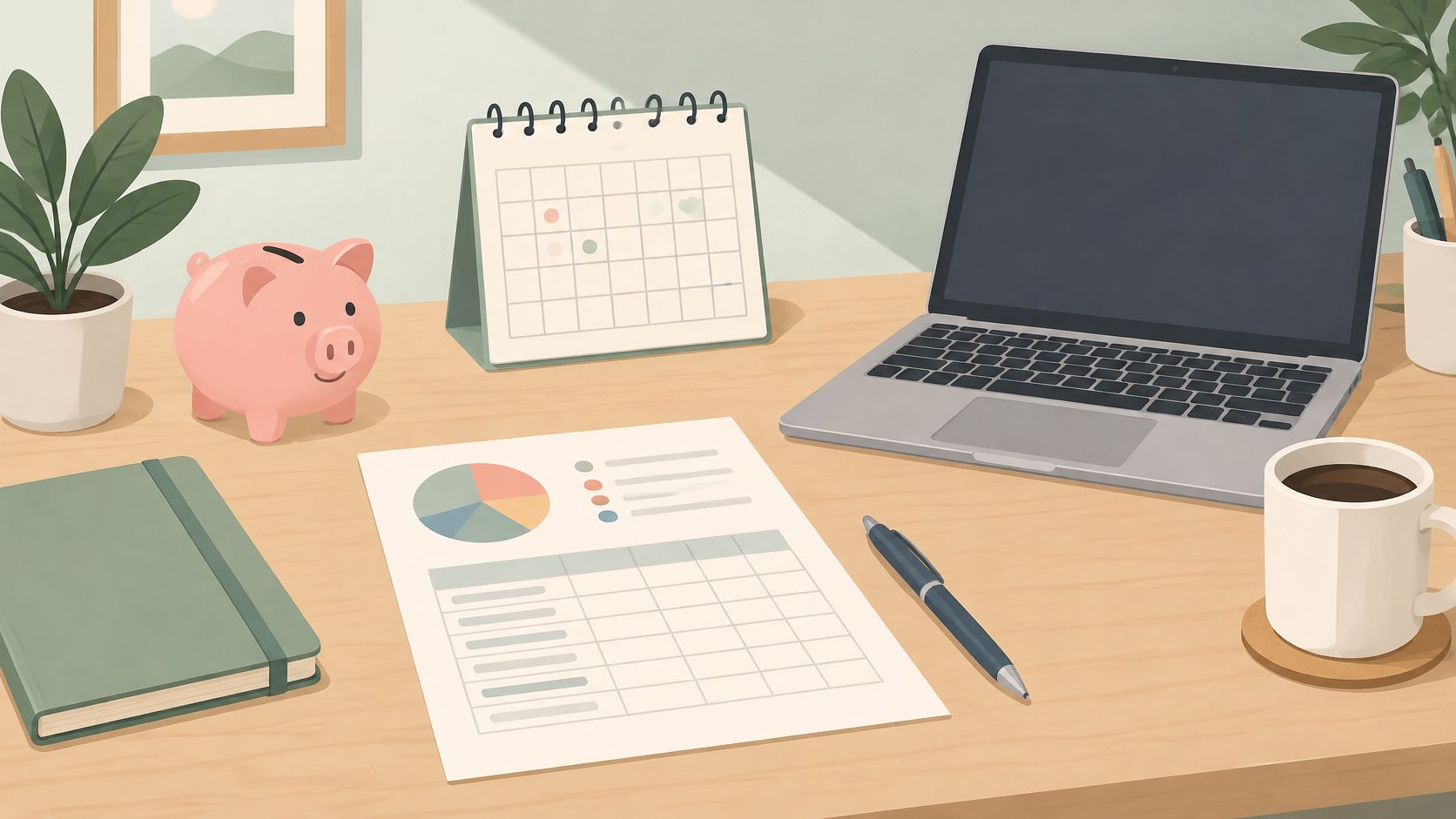
Build the timeline backward from the date and put a name against every line.
Six to eight weeks out. Collect quotes from two or three venues and compare total cost, not room rate. A cheaper room with paid setup, paid cleanup, and an hourly overtime charge is rarely cheaper.
Four weeks out. Budget approved, venue contracted, deposit paid, objectives locked.
Three weeks out. Invitations out, pre-work assigned, catering parameters and minimums agreed.
Two weeks out. Headcount firm enough to order against, dietary needs collected, AV requirements confirmed.
One week out. Logistics email sent, arrival times confirmed, delivery windows agreed with the caterer.
Keep every commitment in one shared document with a column for who approved it and when. Most invoice disputes start with an approval that lived in an email thread.
Multi-day events change the shape of this, and our guide to planning a corporate retreat covers the lodging and transport lines a single-day budget never has to carry.
Failure mode, the invisible line item. Setup fees, cleanup fees, extended-hour charges, delivery minimums, and cancellation windows all live in the contract, and all of them land after the budget is signed off as done.
4. Plan Catering, Dining, and Beverage Service
Food is a scheduling decision wearing a catering invoice.
The decision this step forces
Whether meals happen inside the room or outside it. A working lunch buys you forty minutes of the day and costs you the mental break. A seated lunch in another room costs an hour and returns a group that can concentrate. For a one-day offsite built around three hard questions, I take the working lunch and protect a twenty-minute walk outside. For a two-day event, day one gets a real table away from the screens.
Collect dietary requirements at registration, close the field a week out, and confirm the numbers with the caterer in writing. A form that stays open until the morning of the event means you're counting vegetarians at 8:45 with the first session waiting.
Timing beats menu. Schedule delivery for ten to fifteen minutes before a break, not at the start of a session, so the food is set when people walk in and the room doesn't fill with the smell of lunch during a decision.
Freeform House handles this through curated partnerships with local restaurants and coffee shops, delivering meals and beverages on demand with no extra delivery cost, which keeps the group in the building instead of losing half an hour to a walk and a wait. In the Executive Room, local dishes and coffee arrive directly at the room.
Ask three questions before signing any catering agreement: what the minimum order is, how wide the cancellation window is, and whether delivery, setup, and clearing are included.
Practical rule, caffeine has a schedule. Coffee before the hardest block, water through the afternoon, and no fresh espresso after 2 pm. Most groups lose concentration in the early afternoon, and a heavy plated lunch makes the slide steeper.
Failure mode, the lunch that ate the afternoon. Delivery arrives at 12:40 for a 1:00 decision block, the room clears, and the block finally starts at 1:35 with half the group still in the lobby.
5. Arrange Technology, AV, and Hybrid Connectivity
A distributed teammate joins your offsite by video and spends two days as a face on a wall. That's a design choice, not a technology problem.
The evidence on hybrid deserves a hard look. Research published in the ACM proceedings on computer-supported cooperative work found that fully remote meetings were perceived as more inclusive and effective overall than hybrid meetings, and that remote participants became less engaged during longer meetings. Active roles improved engagement, while larger meetings and afternoon sessions reduced it.
That is uncomfortable for anyone who assumes adding a video call makes an offsite inclusive. A remote attendee with no speaking role, no access to documents, and no route into the hallway conversation is present in name only.
The decision this step forces
Whether remote participants get decision rights or an audience seat. Pick one and say it in the invitation. If they're deciding, they need a named speaking slot, the documents before the session, and a specific person in the room whose job is to bring them in.
The technical checklist is shorter than most planners expect.
Test everything a day early. Screen share, camera, microphone, the actual meeting link, from the actual room, at the actual hour.
Name one AV owner. Not the facilitator. The facilitator is busy with the room.
Add a second microphone for groups over six. Ceiling audio picks up the air conditioning better than it picks up your quietest colleague.
Carry a backup. A charged hotspot and a dial-in number solve most failures in five minutes.
Freeform House equips the Executive Room with a Jamboard for shared visual work, and the in-house podcast booth has professional-grade microphones, soundproofing, and editing software if you're recording sessions for people who couldn't travel.
If you're renting rather than using what's already in the room, our guide to AV equipment rental covers what to specify in the contract.
Failure mode, the two-tier offsite. Remote attendees hear the decisions after lunch, in a summary, from someone who was in the room.
6. Coordinate Transportation, Lodging, and On-Site Logistics
Arrival is where goodwill gets spent. One person circles the block twice, another can't find the entrance, and the first session opens twelve minutes late with half the room still typing directions into a phone.
The decision this step forces
Whether you own the journey or hand it to attendees. A single logistics email one week out, with a map, a photo of the entrance, parking instructions, and one phone number, removes most of the friction. Assign one on-site point of contact and put their number in that email.
Accessibility belongs in the same message, not in a compliance appendix. PCMA's 2024 Meetings Market Survey found that 66% of respondents said they had prioritized diversity, equity, and inclusion initiatives at their events, per PCMA's survey coverage. The operational version of that priority is a registration form that asks about step-free access, accessible parking, dietary needs, and quiet space before the event rather than on the morning of it.
For out-of-town attendees, book the hotel block before you announce the date, and walk the route from hotel to venue yourself. A ten-minute walk in a brochure can be twenty-five minutes with a laptop bag and a coffee.
Freeform House sits in downtown Jenks, with the Freeform Room at the rear of the building where parking is easiest, serving as the club's welcoming entrance. Members also get a secure, self-serve, fully automated Amazon Hub Locker system for deliveries and a rentable golf cart fleet for getting around downtown. There's a secluded covered patio in the private back alleyway when a group needs air between sessions.
Failure mode, the missing email. People arrive at the wrong entrance, the catering is delivered to the front door, and the day opens with an apology instead of a purpose.
7. Design an Agenda with Balanced Sessions, Breaks, and Networking
An agenda is a design document, not a list of topics with times attached.
The decision this step forces
How many questions the day can answer. Three is realistic. Twelve is a schedule pretending to be a plan. Everything else goes on a parking lot list with an owner and a date to bring it back.
The evidence on agenda design is modest but real. An evidence review of productive meetings published by CIPD reports a statistically documented relationship between use of a formal agenda and meeting effectiveness, with correlations ranging from r = .14 to .18, and notes that meeting effectiveness is strongly associated with meeting satisfaction at r = .60 in one study. That's the honest version: an agenda helps, and it isn't the whole story. What moves the needle is what each block produces.
Every block needs a facilitator, a timebox, an input, a decision or deliverable, and a documentation method. A block with none of those is a presentation.
Hardest decisions before lunch. Debate after a break, never straight off a meal.
Sixty to ninety minutes, then a real break. Not a "stretch" where three people answer email.
A closing block that records decisions, owners, deadlines, and unresolved issues. That's a session, not a courtesy.
Networking time isn't filler. MIT Sloan Management Review described research involving more than 200 U.S. coworkers and found that 84% cited interaction with other people, 82% cited random discoveries and opportunities, and 77% cited knowledge sharing as reasons for choosing coworking, as reported in its analysis of coworking. The informal hours are the part people came for, which is why dinner usually earns its cost and the fourth slide deck usually doesn't.
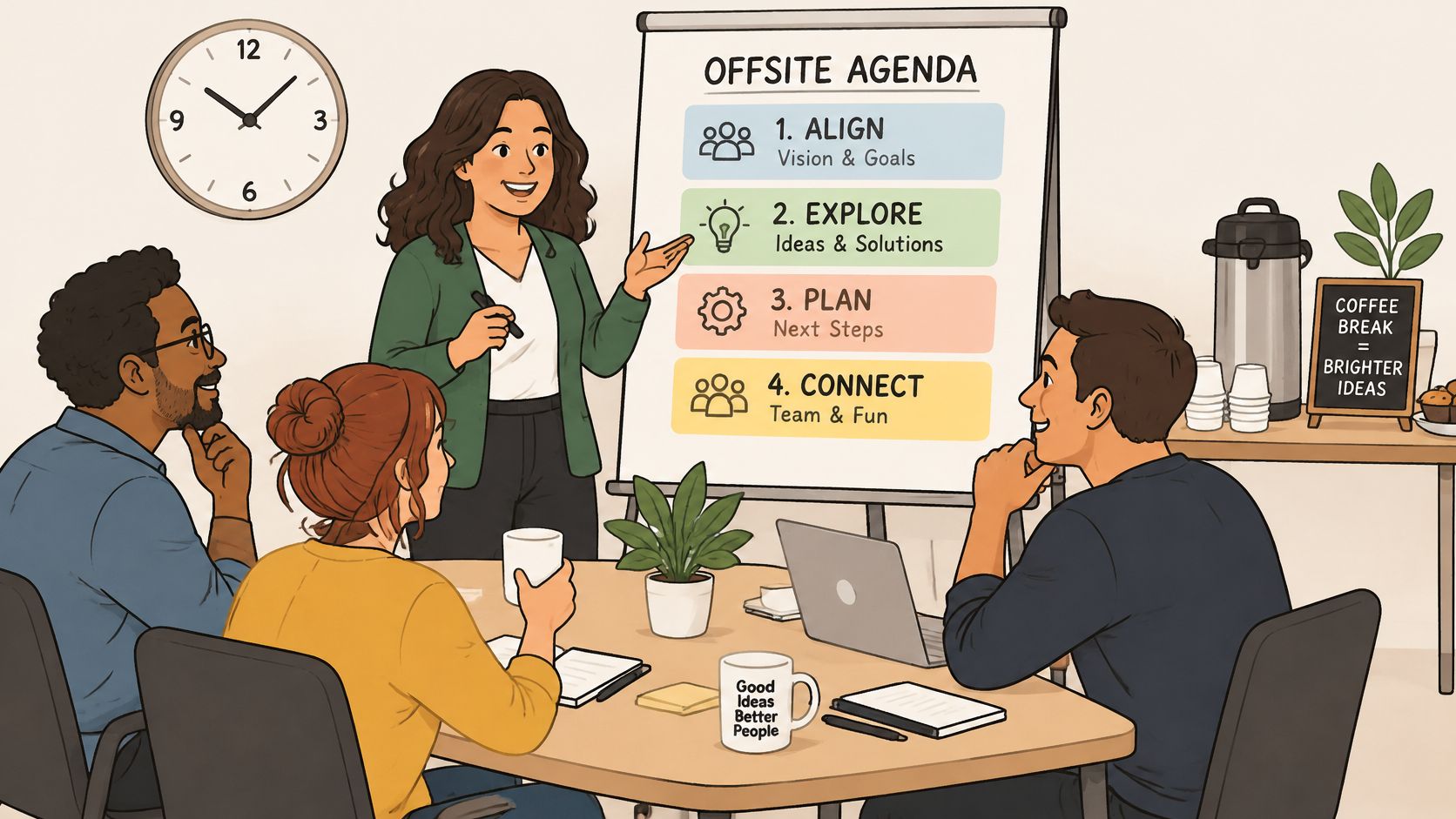
Keep one shared decision log with a row per decision: the question, the alternatives considered, the decision, the rationale, the owner, the due date, and the status. Book a 30-minute follow-up within a week of the event, and confirm that action owners received the log within 72 hours.
Failure mode, the packed agenda. Every minute scheduled, no decision finished, and the most useful conversation of the day happens in the parking lot.
How each offsite planning step compares on lead time, ownership, and risk
Item | Typical Lead Time | Main Owner | Biggest Risk | Best For |
|---|---|---|---|---|
Define Clear Meeting Objectives and Desired Outcomes | Before venue, date, or agenda selection | Planning team and executive sponsor | Vague or overly ambitious objectives | Focused decisions and measurable outcomes |
Select and Confirm the Right Venue and Layout | Book well ahead; popular venues may fill months in advance | Event planner | Venue limitations or unavailability | Teams needing suitable meeting and breakout spaces |
Build a Realistic Budget and Timeline | Plan backward from the event date, with milestones | Event planner or budget owner | Estimates changing as details are confirmed | Controlling costs and coordinating planning tasks |
Plan Catering, Dining, and Beverage Service | Confirm dietary needs during registration | Event planner or catering coordinator | Late food delivery or catering costs | Keeping attendees comfortable and energized |
Arrange Technology, AV, and Hybrid Connectivity | Test equipment at least one day before the event | Event planner and AV lead | Poor audio or unreliable technology | Presentations, hybrid participation, and recording |
Coordinate Transportation, Lodging, and On-Site Logistics | Commit early; send logistics details one week ahead | Event planner or logistics coordinator | Confusing parking or transport arrangements | Events with out-of-town attendees or complex arrivals |
Design an Agenda with Balanced Sessions, Breaks, and Networking | Share the agenda at least one week ahead | Facilitator and event planner | Overpacked schedule or discussions drifting off topic | Structured work balanced with breaks and connection |
Communicate with Attendees and Prepare Materials in Advance | Send reminders two weeks, one week, and one day ahead | Event planner or communications lead | Overwhelming attendees with too much pre-work or email | Helping attendees arrive informed and prepared |
Turn Your Offsite Checklist Into a Repeatable Process
A checklist earns its keep the second time you run it, and only if you update it while the event is still fresh. Within a week of the offsite, sit down with the planner, the facilitator, and whoever held the AV cable and write down three things: what worked, which deadline slipped and why, and which vendor delivered exactly as promised. Then edit the checklist before the next cycle starts, not after the next date is chosen. Teams often skip this and rebuild the same mistakes on a new calendar year.
The follow-through matters as much as the plan. Review the decision log at your next team meeting, not in a separate document nobody opens, and keep the 30-minute follow-up on the calendar as a real commitment. If the offsite was built as the first step in a four-month operating cycle, that follow-up is where the cycle shows whether it holds.
If you're evaluating a premium membership-based venue for the next round, it helps to know how established clubs structure access. Soho House's published house rules state that its Membership Committee makes the final membership decision, that membership lasts for a minimum of one year, and that renewals are reviewed annually rather than renewed automatically, with applicants asked for a recent profile picture, payment-card details, and information about their interests and occupation, as set out in Soho House's terms and policies. Use that as a benchmark for the questions to ask any club: who approves members, how long a term runs, and what happens at renewal.
For a team planning locally, downtown Jenks has options that keep travel short and the day intact. Freeform House offers a personalized consultation to walk through pricing structures, opening dates, and membership options before you commit, which is a sensible first conversation for an executive team booking a decision meeting rather than a party.
Run the eight steps in order, name a failure mode for each, and the next offsite leaves with decisions instead of a group photo.
Freeform House is a members-only club and workspace in a restored 1920 building in downtown Jenks, built for the kind of focused offsite this checklist describes. Four distinct rooms, including a private Executive Room with a Jamboard and room service from local restaurants, let a team move between plenary sessions and small-group decisions without leaving the building. Book a personalized consultation at Freeform House to walk through the rooms, membership options, and opening dates for your next planning cycle.
Comments