How to Run a Workshop: Plan, Facilitate and Follow Up

The usual advice on how to run a workshop starts with icebreakers, sticky notes, and an engaging presentation. Start somewhere less entertaining: decide what participants should do differently afterward, and how you'll check whether they did it. A lively room is useful, but it isn't the same as a changed process, a usable customer offer, or a decision someone implements.
Treat the workshop as the beginning of an implementation cycle, not an event that ends when everyone leaves. Plan backward from the work participants need to complete, protect time for practice, and put follow-up on the calendar before you send the invitation.
The Four Phases of a Workshop at a Glance
Use this suggested planning schedule as a working map, adjusting the lead time to the complexity of the session.
Workshop phases, timing and outputs
Phase | When | Main work | Output |
|---|---|---|---|
Goal setting | 4-6 weeks before | Define one measurable outcome and the audience | One-sentence objective |
Activity design | 2-3 weeks before | Build the agenda around one real problem | Run-of-show with timings |
Facilitation | Event day | Alternate short input with practice and feedback | Completed work samples |
Follow-up | 30, 60 and 90 days after | Check application and measure results | Evidence of behavior change |
Planners can spend their entire preparation budget on the event day. The neglected work is usually clarifying the outcome beforehand and helping people apply it afterward. As a planning heuristic, reserve roughly a third of your effort for preparation, a third for delivery, and a third for follow-through, rather than treating the final email as administration.
Fix the cheapest problem first
A vague objective is cheap to rewrite. Discovering during an exercise that nobody has the information, authority, or workspace to complete it is much harder to fix.
Say a team of six operations staff spends three weeks building slides about improving handoffs. They design no exercises, assign no process owner, and find a month later that everyone still uses the old approach. That hypothetical session needed less presentation development and more rehearsal of the actual handoff.
Planning check: Can you state, in a sentence, what a participant will be able to do by the end?
If you can't, return to goal setting before booking a room. Your first planning call should produce an outcome, not merely a date and a topic.
How to Set One Clear Goal and Audience
Planning content before deciding the outcome produces an overloaded agenda. A topic such as marketing strategy tells you what you might discuss; it doesn't tell participants what they'll leave able to do.
Ask instead: What should be different for participants when they leave? Use an observable verb, such as draft, record, compare, demonstrate, or decide. Producing a customer-offer draft is assessable; understanding customers better is too vague to guide an exercise.
Use a visible outcome to keep the audience and task connected.
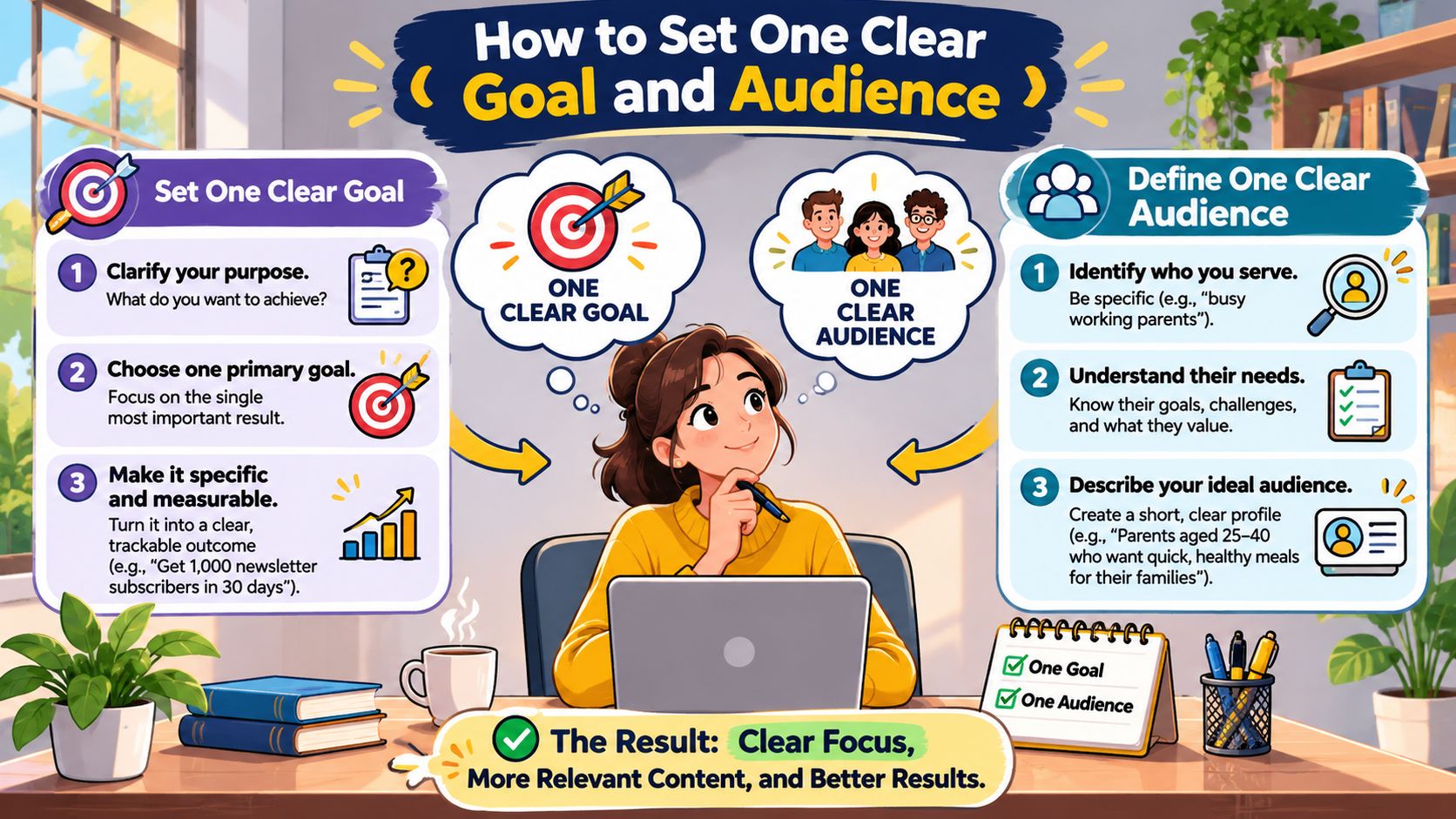
Name the problem, not just the job title
Small-business owners isn't a sufficiently precise audience. Owners who struggle to explain why customers should choose their offer gives you a problem to design around. Likewise, executives facing unclear decision ownership need a different session from executives reviewing an agreed strategy.
Ask about current practice before you build materials. Request a sample offer, an anonymized handoff document, or a description of the decision participants keep postponing. You'll learn whether the barrier is missing knowledge, inadequate practice, or lack of authority, and only some of those barriers can be resolved in the room.
Match the goal to the evidence
Donald Kirkpatrick's framework, introduced in November 1959, distinguishes reaction, learning, behavior, and results, as documented in the Kirkpatrick four-level evaluation overview. These levels help you choose evidence that matches your promise:
Reaction: Ask whether participants found the session relevant and useful.
Learning: Assess a demonstration, work sample, or before-and-after task.
Behavior: Check whether participants use the skill at work.
Results: Review the agreed organizational outcome, such as quality or execution speed.
Don't promise increased sales when the session only teaches participants to draft an offer. You can assess the draft immediately; commercial results require implementation and may depend on factors outside the workshop.
Apply two practical tests before approving the objective. Could a stranger inspect the finished work and judge whether it meets the standard? Does the objective address the audience's actual problem?
For example, ask participants to leave with a customer-offer draft that identifies the buyer, problem, proposed value, and next step. Put that outcome on the invitation, along with any preparation required, so attendance begins with a clear expectation.
How to Design the Agenda Step by Step
Build the agenda around a task participants need to perform, not the order of your slide deck. The OSHA adult-learning facilitator manual supports an application-first sequence with two to four observable outcomes and a practical allocation of approximately 35% explanation and 65% application plus feedback. Use that split as a design guide, not a reason to interrupt useful practice precisely when a timer expires.
The sequence below keeps explanation connected to a decision and a finished piece of work.
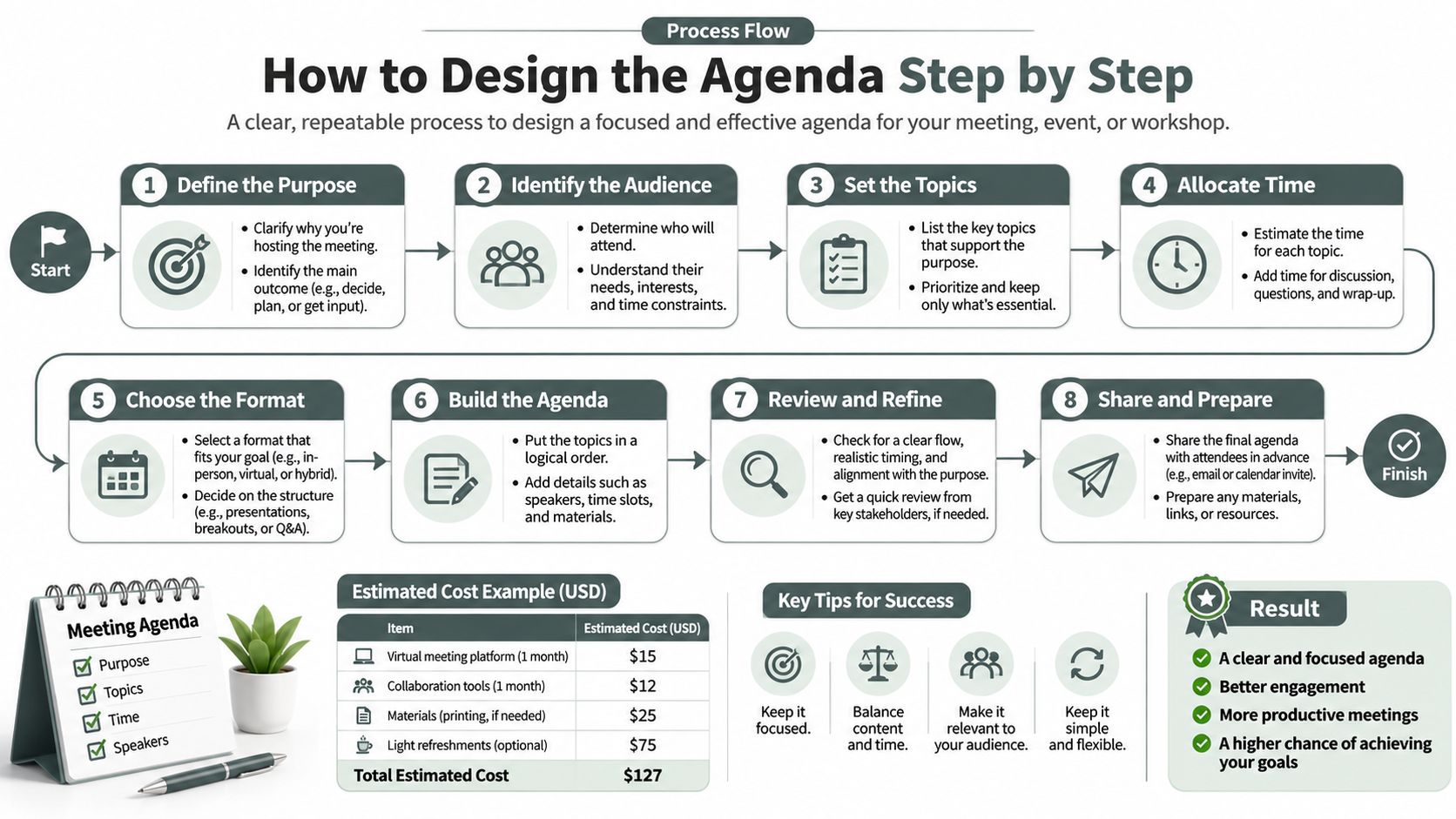
Build a practice loop
State observable outcomes. Break the main objective into checkable parts, such as identifying an offer's buyer, drafting its promise, and selecting a next step. Avoid a separate outcome for every concept you intend to mention.
Open with a realistic decision. Present an anonymized customer request, conflicting priorities, or an incomplete project brief. Participants should recognize why the task matters before you introduce terminology.
Ask participants to predict an answer or describe their current approach. Capture their reasoning without immediately correcting it, so you can distinguish an unfamiliar concept from a familiar habit that needs changing.
Teach only what improves the decision. Use a worked example and explain the choices behind it. Put supporting detail in a reference document rather than reading it aloud.
Move into individual or small-group practice on the same problem. Give participants a template, relevant information, and a clear definition of finished work.
Give specific feedback against a visible standard. Say that the offer names a customer but leaves the next step unclear, rather than calling it weak. Participants need a revision they can make, not a verdict.
Repeat with added complexity, such as a competing priority or a tighter constraint. Keep the core skill recognizable so participants can apply the feedback rather than start an unrelated activity.
Close with retrieval, reflection, and a workplace action. Ask participants to explain the method without their notes, identify what they changed, and write where they'll use it next.
Put the timings on a working page
Your run-of-show should list the activity, its duration, materials, facilitator prompt, and expected output. Include a contingency beside optional content so you know what to cut when an exercise needs longer.
Protect practice before protecting slides.
A long opening talk usually leaves the facilitator choosing between rushed exercises and an overrun. Cut background explanation first. For a leadership group, adapt a strategy offsite agenda around decisions that need working time, not a succession of departmental updates.
Before finalizing, rehearse the instructions aloud. If explaining an exercise requires a complicated speech, simplify the task or provide a worked example.
Keeping Everyone Engaged During the Session
Engagement is a design choice, not a personality test. Match the method to the group and the sensitivity of the task. Asking an unfamiliar group to debate pricing publicly calls for different safeguards from asking established colleagues to review a draft.
Set up the room so participants can see instructions and work without constantly turning toward a screen.
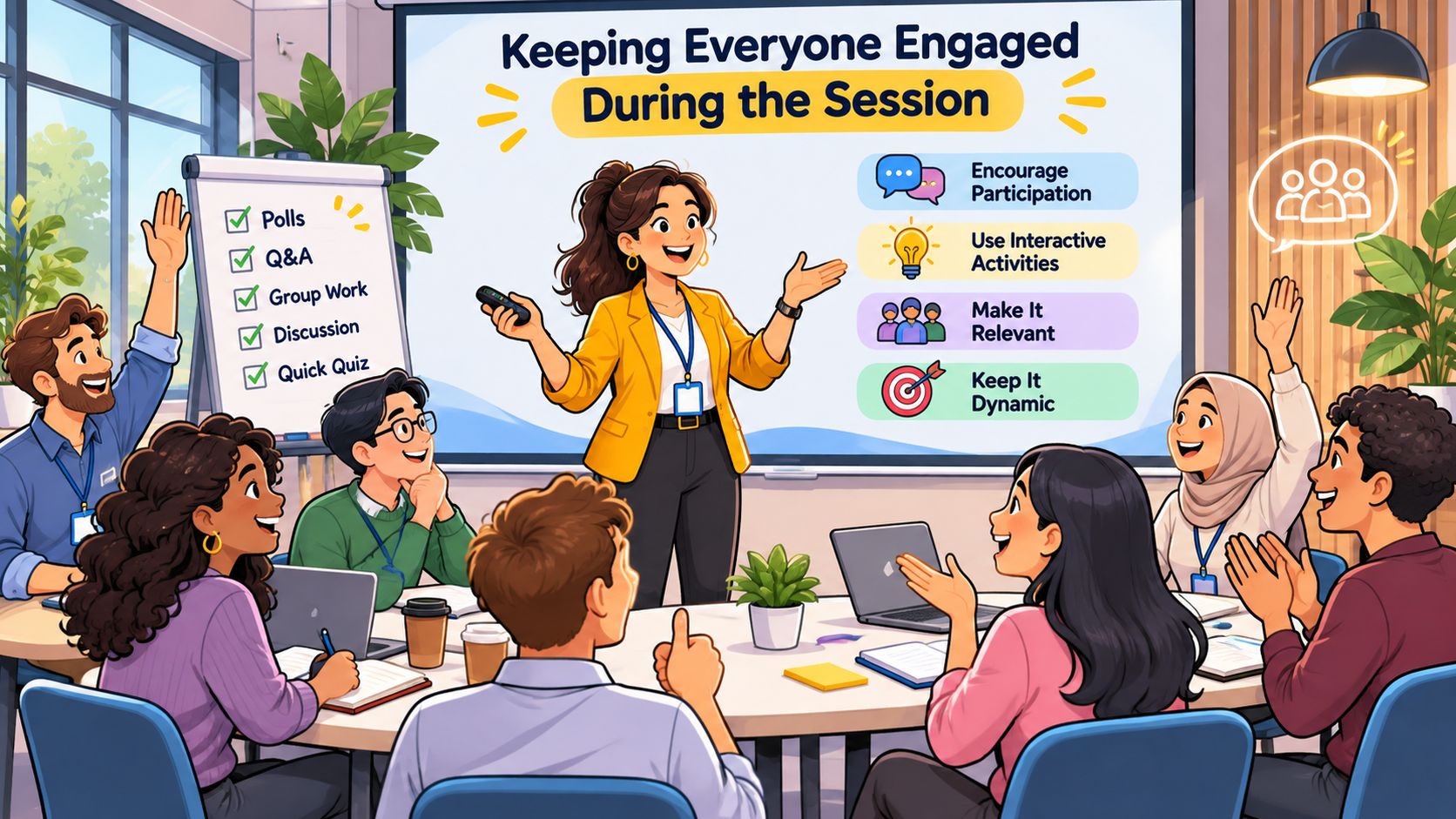
Participation methods and when to use them
Technique | Best for | Watch for |
|---|---|---|
Silent writing, then share | Quiet or new participants | Writing time can run long; set a timer |
Pair work on one problem | Quick practice and peer feedback | Pairs may drift off topic without a prompt |
Anonymous input cards or chat | Sensitive topics such as pricing or conflict | Harder to follow up; ask for themes instead |
Small-group case work | Applied problem solving | Dominant voices can take over; rotate the note-taker |
Open group discussion | Sharing experience across the room | Often favors the most talkative people |
Give people a written prompt before opening discussion. Silent preparation prevents the first confident answer from setting everyone else's direction. When selecting workshop activity ideas, choose the method that produces the required evidence, not the activity that looks most entertaining.
Manage load as carefully as airtime
Participatory work can impose cognitive, creative, and emotional burdens, and Frontiers in Sociology's participatory-workshop study supports adapting session length, participation modes, pauses, and follow-up. More visible activity doesn't automatically mean more equitable participation.
Ask about access needs privately before the session, without requiring a public explanation. Offer speaking, writing on a card, or typing into a shared document as legitimate ways to contribute. Provide captions in a hybrid room and accessible materials participants can review at their own pace.
As a starting schedule, plan a short break every 45 to 60 minutes, then adjust to the task and participants. Heavy practice may need a pause after each block rather than a single break at the end. Keep timings visible, but don't introduce a new concept while participants are still struggling with an unfinished exercise.
Use this video as an additional facilitation resource when preparing your delivery.
Watch for checked phones, flat answers, and repeated requests to restate instructions. Check whether the prompt is unclear or the workload excessive before assuming people aren't interested.
A shorter session with meaningful contributions is better than a packed agenda people can't process.
Offer a quieter route through the task: listen and annotate, use a large-print or spoken brief, or complete the essential step and leave the extension. A 15-minute check the next day can be a better accommodation than extending the whole session until everyone disengages.
Following Up So Learning Sticks After the Day
End-of-session satisfaction tells you how participants experienced the workshop. It doesn't establish that they changed their work. In a 2025 evaluation of implementation-research training in East Africa, 98% of participants said they intended to apply their learning, while application was examined through follow-up at least six months after training, according to the implementation-training evaluation.
Before closing, ask each participant to commit to one to three observable actions, with named owners and deadlines. Replace improve our handoffs with a specific commitment to test the revised handoff checklist on the next eligible project.
Use the timeline to make the transition from learning to implementation explicit.
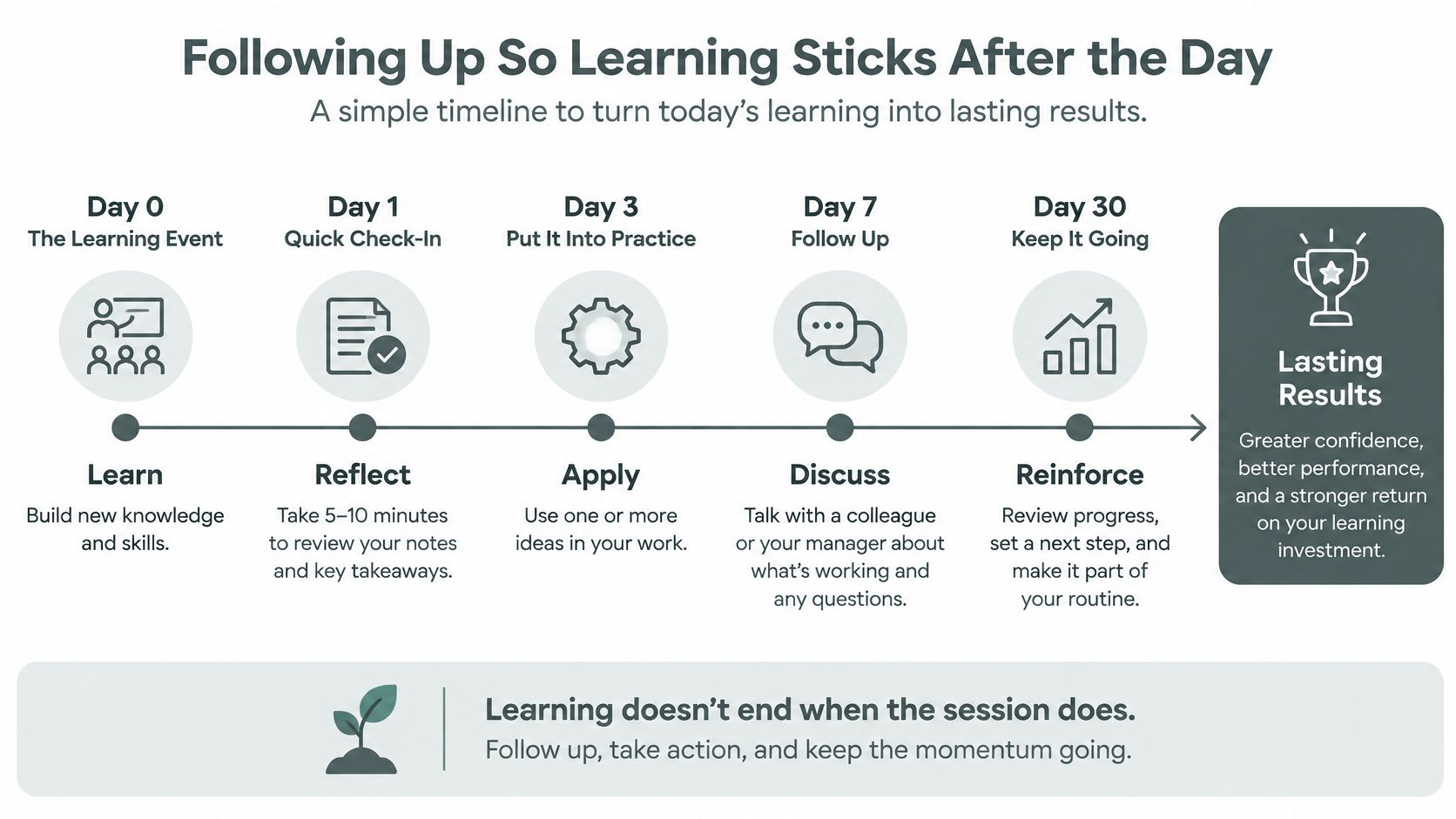
Follow-up checkpoints after a workshop
Checkpoint | Question to ask | Evidence to collect |
|---|---|---|
Closing session | Who owns each action and by when? | Named owners and dated deadlines |
Day 30 | Has the first action started? | Short status note from each owner |
Day 60 | Has the behavior changed in daily work? | Manager observation or a finished draft |
Day 90 | Which agreed result has moved? | The metric set at the goal stage |
Separate delivery from organizational support
The facilitator controls the clarity of instructions, the usefulness of the work produced, and whether participants leave with explicit commitments. A department leader may control the budget, permission, systems access, or process changes required to act.
Record those dependencies alongside the action. If implementation stalls, ask what blocked it and who can remove the obstacle. Repeating the training won't resolve an approval bottleneck.
Keep follow-up requests small and concrete. Ask for a revised document, a completed trial, or an observation of changed practice, rather than another broad confidence survey. Compare the evidence with the baseline you captured before the session, and acknowledge other changes that could have influenced results.
Include this ownership in your event-hosting plan, rather than leaving it with whoever happens to send the thank-you email. Schedule the first follow-up message before participants leave the room.
Run Your First Workshop This Month
A workshop judged only by comments at the door is unfinished work. Pick a session already on the calendar and run the full cycle, even if only six people attend.
This week, write the outcome and the audience problem on the invitation draft. Build a one-page run-of-show. Before you add decorative slides, put three reviews on the calendar: a status request, a behavior check, and a result review. Good remarks on the day do not show that anything changed in the work. Those later checks do.
Match the room to the work
Quiet pair work belongs in a reservable conference room or a private workspace. When people need to move between tasks, an open collaboration area is the better fit. Hot desks suit drop-in prep, not a facilitated session with materials spread across a table. Freeform House offers private workspaces, open collaboration areas, hot desks, and reservable conference rooms. The Hall of Fame Room can be booked for evening events such as charities or small weddings, so it is a poor match for a daytime working session.
Freeform House is a members-only club and workspace in a restored 1920 building in downtown Jenks, designed for collaboration, focused work, and networking.
Finish the plan: Write the outcome, timings, and first follow-up question before sending the invitation.
Keep the materials real: Use photographs of people and working materials rather than clip-art.
Choose a workable date and a room that fits the activity. Do not delay useful practice while you hunt for a perfect setting.
Freeform House offers workspaces and gathering areas for focused workshops, collaborative exercises, and the conversations that continue afterward. Visit Freeform House to book a personalized consultation about membership, pricing structures, and opening dates, and discuss which setting fits the work your participants need to complete.
Comments