How to Improve Collaboration Skills That Actually Work

You're ten minutes past the hour, the planning meeting still hasn't produced a decision, and two people who clearly disagree haven't said a word. Someone will reopen the whole thing in chat tomorrow. That's not a personality problem. It's a design problem, and it's the starting point for How to Improve Collaboration Skills in a way that survives a busy week.
Why Most Teams Get Collaboration Wrong
The meeting was scheduled for an hour. It ran long because the founder kept returning to a launch date nobody else had agreed to, operations stayed quiet after being talked over twice, and the person with the customer data waited for an invitation that never came. Everyone left polite. Then the conversation happened in side threads for three days, and the decision got made twice.
That pattern isn't fixed by telling people to listen better. The team had listeners. It had no decision owner, no rule for when discussion closes, and no safe way to challenge the loudest voice in the room.
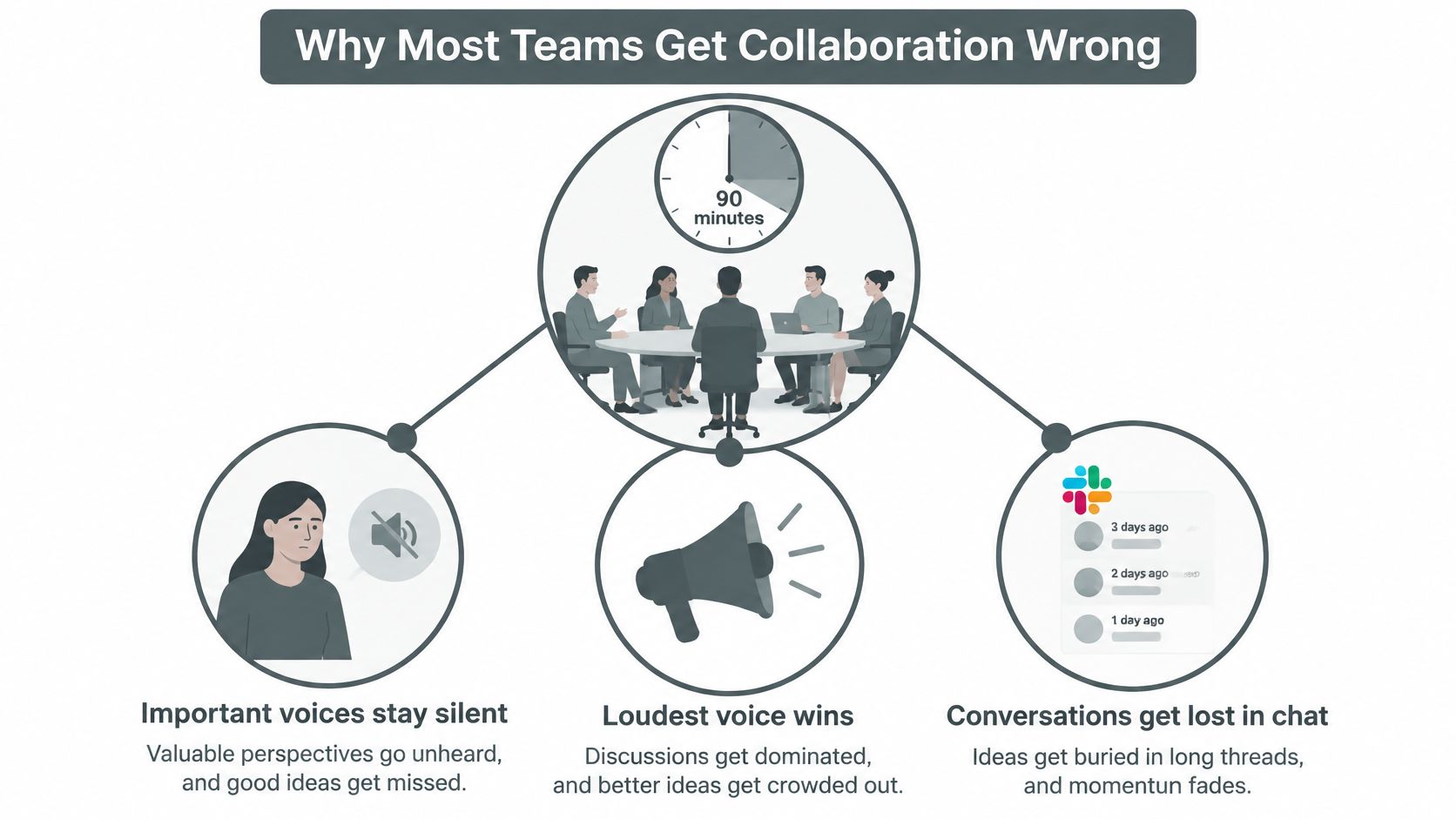
Three Assumptions That Keep Teams Stuck
Better tools will fix coordination: A new chat app or project board doesn't clarify who decides, who documents, or how fast anyone should reply. It just moves the confusion to a cleaner interface.
More meetings mean more alignment: Extra syncs often signal that written updates and decision rules are weak. People meet to compensate for information they can't find or trust.
Collaboration belongs to individuals: Treating collaboration as a soft skill owned person by person ignores the conditions around them. Silent members may be responding rationally to status, unclear roles, or past pushback that went nowhere.
A team doesn't collaborate poorly because its members lack goodwill. It collaborates poorly because its defaults reward speed, volume, and private follow-up over clear, shared decisions.
Four shifts change the defaults. Teams write a lightweight operating agreement, practice specific moves that make disagreement safer, run structured exercises instead of open-ended discussion, and work in spaces that support focus, encounter, and honest conversation. None of that requires a reorganization. It requires leaders to stop hoping good intent will do the work of good structure.
Build a Lightweight Operating Agreement First
A six-person leadership team I worked with spent three months arguing about responsiveness before anyone defined the word. The founder expected chat replies within the hour. Her operations lead treated anything inside a day as fast. Both were enforcing private rules in public, and every missed expectation read as disrespect.
Plenty of collaboration advice starts with individual behavior. Listen actively, communicate clearly, share responsibility. Those behaviors matter, but they collapse when nobody has agreed on response times, availability, or who owns a call. A formal collaboration plan gives behavior somewhere to land.
Gallup research on hybrid work productivity found hybrid teams with a formal collaboration plan are 66% more likely to be engaged and 29% less likely to experience burnout than teams without one. Gallup also identified scheduled check-ins, availability guidelines, and procedures for communicating unavailability as common practices. Small teams rarely have any of these written down.
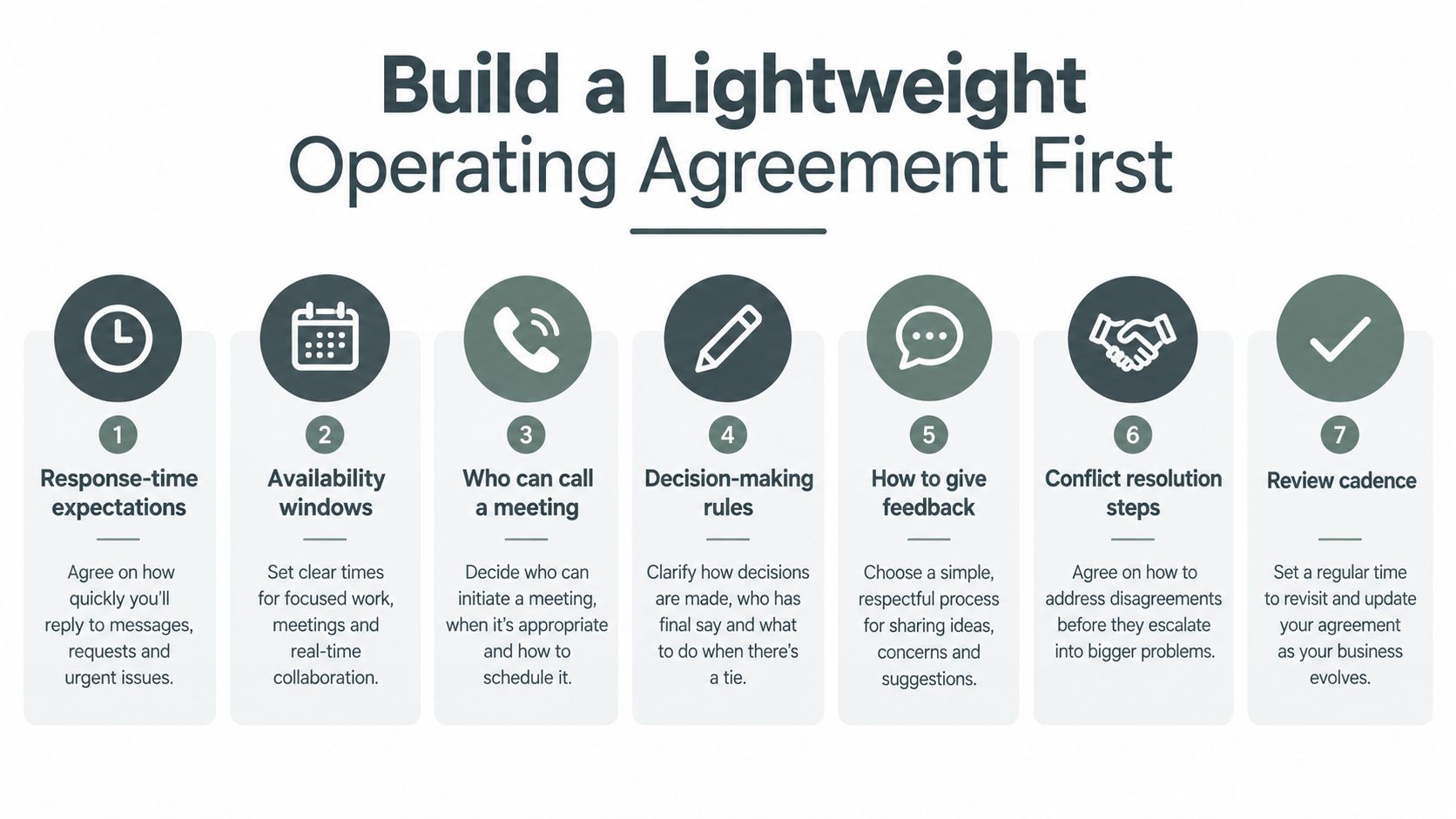
What Belongs on the Page
Everything fits in a single document, and each row answers a question the team is already litigating informally.
Element | What it should answer |
|---|---|
Response times | What counts as a normal reply window for chat, email, and urgent issues, so silence doesn't get read as disengagement |
Availability | Core hours, focus blocks, and how someone signals they're unavailable without apologizing for it |
Meeting rights | Anyone can request a meeting, but it needs a purpose, a decision, and prework when input matters |
Decision ownership | For recurring decisions, the owner, the contributors, and who only needs to be informed |
Documentation | One home for decisions in one format (decision, owner, date, next step), because chat isn't an archive |
Escalation | What counts as blocked, how long someone waits, and who receives it |
Sync versus async | Live time reserved for conflict, ambiguity, and relationship repair; status and routine approvals move to writing |
The page takes one 90-minute working session to draft. Spend the first half listing recent friction, the second half turning each friction point into a rule, and the last stretch assigning an owner who reviews it monthly. Expect pushback on response times. That's useful. It means you're surfacing expectations people were already enforcing privately.
The payoff runs against instinct. Clear protocols shrink the number of interactions, because they remove check-in pings, status chases, and meetings held only to confirm nothing changed.
Don't laminate it and call it culture. If the agreement doesn't change a calendar invite, a document, or a decision within two weeks, it's a values poster with better formatting.
Communication Moves That Make Disagreement Safer
A product lead says launch is Friday. A junior engineer says the API fails under load. The founder looks up, and every face in the room turns toward the junior engineer to see whether pushback gets treated as evidence or as attitude.
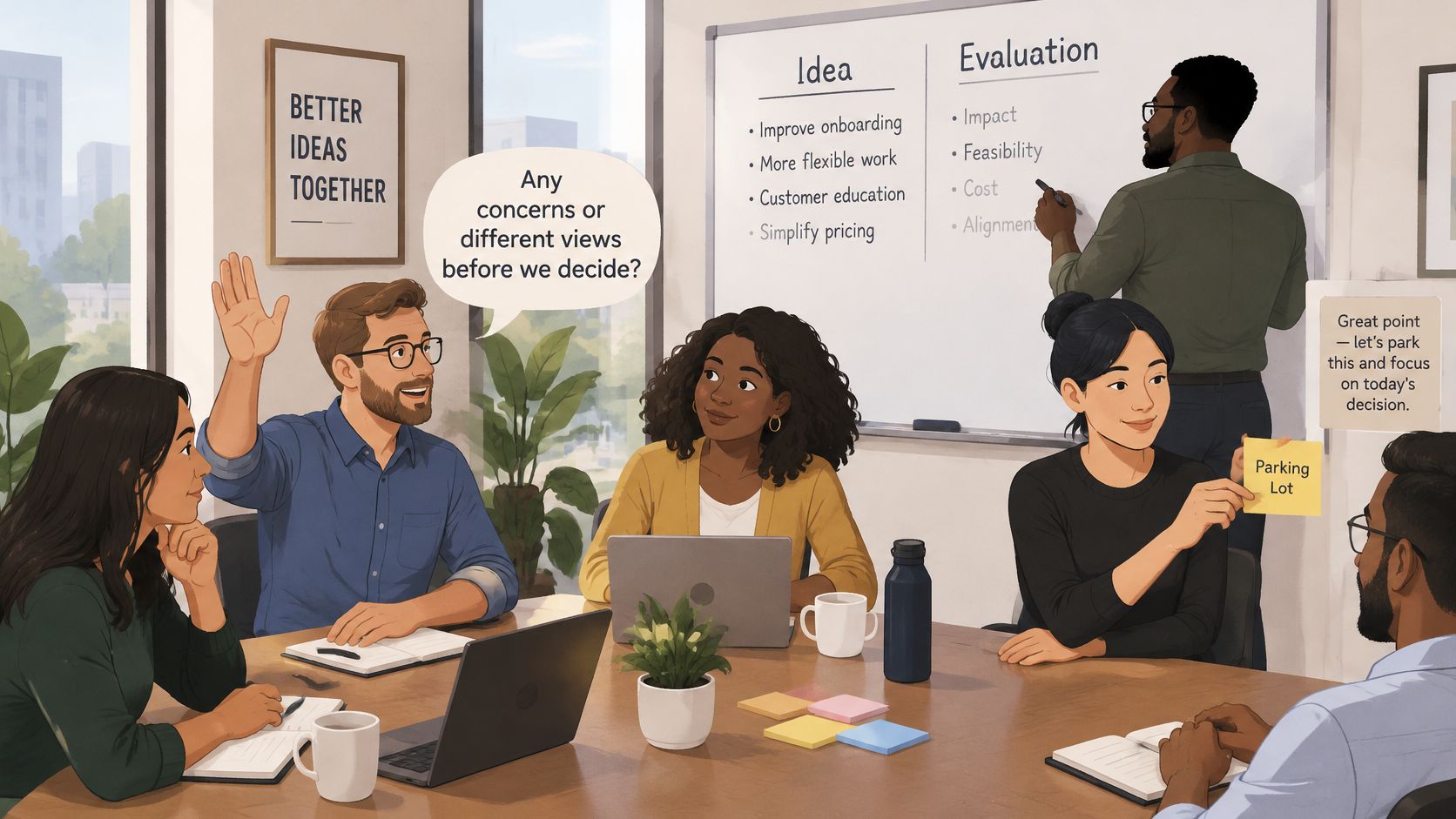
Psychological safety has a narrow meaning in that moment: people can report errors, ask for help, and challenge a plan without being punished or embarrassed. Agreeable rooms often move slowly because concerns surface after work has hardened around a weak assumption. A 2025 cluster-randomized study in a pharmaceutical company found a short intervention focused on psychological safety and communication increased safety with supervisors and teams, increased willingness to consult others, and reduced intimidation and bullying while sustaining engagement. The useful reading is plain: safety responds to repeatable behavior, so a facilitator can train it like a protocol.
The protocol I run has four prompts, used in order and out loud:
What would make this fail, and who sees it differently? What evidence sits behind the concern? Can the person proposing the plan restate the objection accurately? What happens next, even if the answer is no?
The first prompt forces dissent into the open before status settles the question. The second separates the claim from the person by making proof carry the argument. The third slows down senior rebuttals. The fourth keeps input from disappearing, which is why people keep speaking after they lose one.
Watch how small facilitation choices change who talks, who gets interrupted, and whether disagreement arrives early enough to be cheap.
Take the junior marketer challenging a founder's go-to-market call. A weak facilitator lets the founder answer immediately, and the room learns to stay quiet. A stronger one pauses, asks the marketer to name the customer evidence, asks the founder to restate it accurately, then puts both claims on a board everyone can see. The junior voice may still lose. The argument gets heard on its merits. Pair that sequence with practical business meeting etiquette on agendas, turn-taking, and closing decisions, and the meeting stops rewarding polish over truth.
Exercises and Templates Worth Running This Quarter
unstructured brainstorms feel collaborative and usually produce the first ideas from the fastest talkers. Structured formats work better because they equalize airtime, force evidence into the room, and end with an owner. Pick based on the team's actual problem, not what's fun to facilitate.
Formats That Earn Their Time
Context icebreakers work when they surface useful working information in twenty minutes. Ask each person for their best focus hours, preferred feedback channel, and one recurring bottleneck others can help remove. Skip trivia rounds for established teams. They consume goodwill without changing how anyone works on Monday.
Role-play from real situations suits teams that avoid hard conversations. Rebuild a recent customer escalation or stakeholder disagreement, assign roles people don't normally hold, and debrief on what each side needed but didn't say. Prep takes a facilitator and a one-page scenario. New teams should use lower-stakes cases first, while stale teams benefit from the discomfort of a familiar pattern played back to them.
A retro template with three columns, what worked, what blocked us, what we'll change, only helps if the third column produces one or two owned changes. I've watched teams generate long lists for months and change nothing. Cap the commitments. Review them at the next retro before adding more.
A decision-review ritual after major calls asks what we expected, what happened, and what signal we missed. It builds judgment without turning every miss into blame. Run it close enough to the outcome that people still remember their reasoning.
Long personality quizzes and open brainstorms are the two formats teams most often overuse. Both generate conversation. Neither reliably changes a decision, a handoff, or a conflict pattern.
For more formats to rotate through the quarter, these workshop activity ideas give facilitators options beyond the default sticky-note session.
Format | Best for | Time needed | Skip if... |
|---|---|---|---|
Context icebreaker | New or reforming teams | 20 minutes | The team already knows working preferences |
Role-play | Avoided conversations, stakeholder friction | 45 to 60 minutes | Trust is too low for honest debrief yet |
Three-column retro | Recurring delivery bottlenecks | 45 minutes | Nobody will own the changes identified |
Decision review | Learning from major calls | 30 minutes | The outcome is still unknown |
Hybrid and Remote Collaboration Without Meeting Overload
Distributed teams don't fail because people are remote. They fail because in-person habits get copied into video calls, and every uncertainty becomes a meeting. The operating agreement has to do more work when hallway repair isn't available.
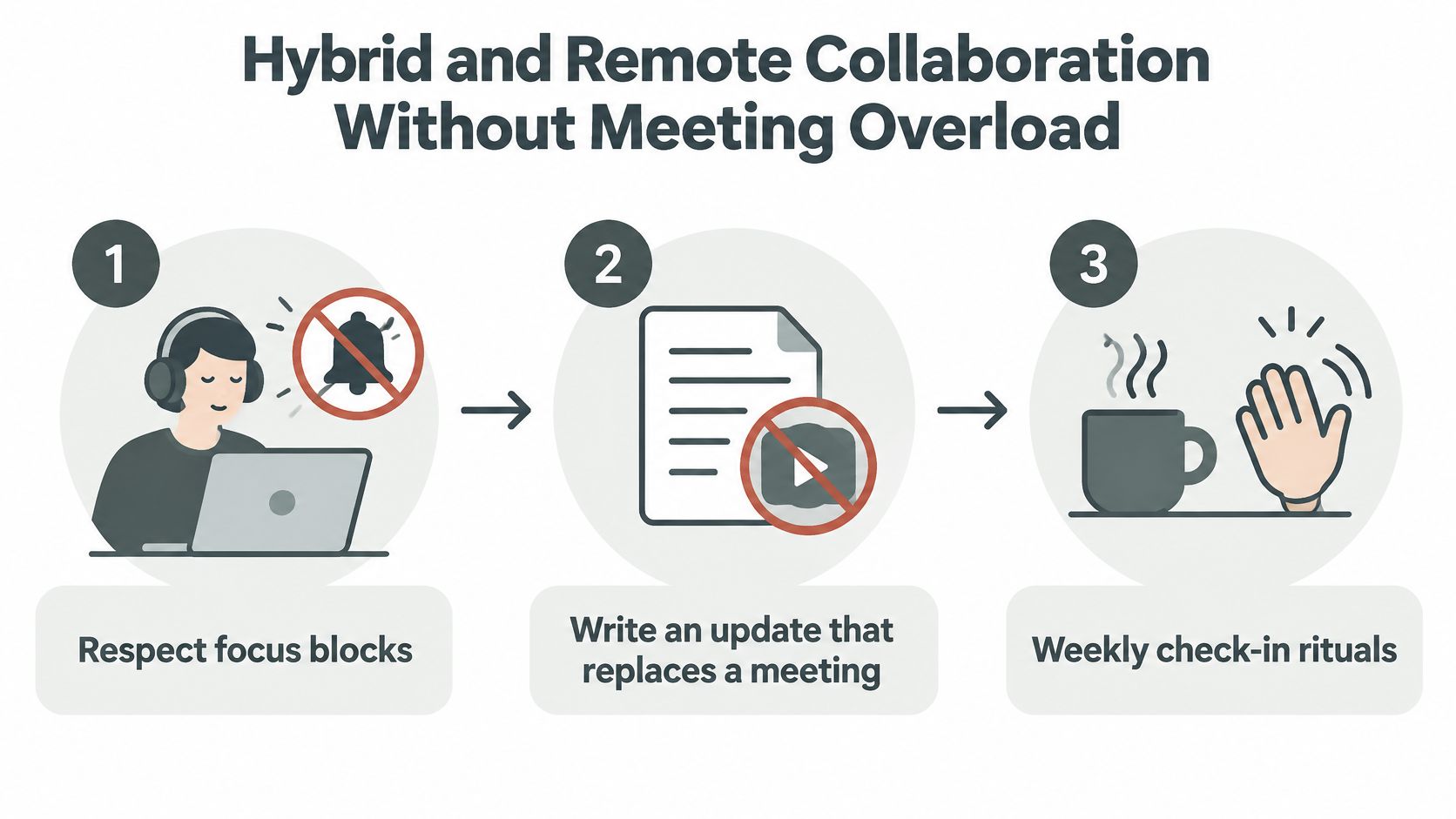
Write Updates That Replace Meetings
An async update that earns its place contains four things: what changed, what it means, what decision or input is needed, and by when. Anything less invites a follow-up call. Anything much longer doesn't get read.
Async standups suit teams with stable work and clear blockers. Each person posts progress, next step, and blockers in writing, and the lead resolves blockers directly.
Sync standups suit fast-moving, interdependent work where a blocker needs live negotiation between owners. If nobody negotiates anything, it should've been written.
Response-time norms protect deep work when they distinguish urgent from routine and give people permission to answer routine messages in batches.
Small rituals keep connection from depending on crisis contact. Weekly written wins show progress people would otherwise miss. A monthly show-and-tell lets members teach something real from their work. Quarterly in-person offsites handle the trust building and contested planning that video handles poorly. For the live sessions that remain, sound best practices for video conferencing around audio, facilitation, and participation keep remote members from becoming spectators.
Documentation Hygiene and Drift
Every decision made on a call gets written into the shared decision log before the day ends, by the decision owner, not by whoever took the neatest notes. If it lives only in chat, it will be relitigated by whoever missed the thread.
Watch for two cultures forming. In-person members start deciding in hallways, remote members learn outcomes late, and jokes, context, and influence concentrate in one location. The fix isn't mandating attendance. It's moving the decision and its rationale back into the shared record, every time, until nobody needs proximity to stay informed.
A Workspace Designed for Collaboration in Practice
A leadership team can use Freeform House in downtown Jenks, Oklahoma as a working diagram: arrive inside the Ten District, draft decision rules in a quiet room, break into pairs where movement is easy, record a candid recap, then end the day around other members instead of disappearing into a sealed suite. The point is design, not decor. It is a premium, membership-based club, comparable in spirit to SoHo House, combining coworking with a community hub for connection.
Room | Collaboration mode it supports |
|---|---|
Executive Room | A focused offsite where a leadership team drafts its operating agreement away from daily interruption |
Freeform Room | Facilitated workshops and breakouts where groups move, regroup, and work at shared surfaces |
Thomas Room | Smaller working sessions and the in-house podcast setup, where a recorded leadership conversation can double as structured reflection |
Hall of Fame Room | Community events and larger gatherings where informal encounter matters as much as the agenda |
Place still carries weight. Downtown Jenks and the Ten District trace the Midland Valley Railroad selecting the Arkansas River location between 1904 and 1905, Jenks being platted on July 15, 1905, and population growing from 465 in 1907 to 1,508 by 1920 after the Glenn Pool discovery. A restored 1920 building inside that story gives a team an address with memory, useful when people are asked to disagree and then eat lunch together.
Match the room to the work. Put contested planning where interruptions cannot leak in. Put workshop energy where bodies and ideas can move. Put reflection somewhere small enough that nobody performs for the room.
Those choices align with evidence rather than atmosphere alone. A 2024 scoping review of 11 coworking studies found collaboration and networking positively associated with social interaction and mutual support, with physical proximity, bright lighting, and worktables near windows supporting those outcomes. A two-study investigation of coworking communities classified 178 coworker interactions into informal social interaction, information exchange, practical support, and project collaboration, and found 83% of respondents identified social interaction as the main reason for working in a coworking space.
Visual credibility matters for a place selling trust. Getty Images VisualGPS research across more than 30,000 adults in 25 countries found 98% said authentic imagery and video are necessary for earning trust, while 78% said an AI-generated image cannot be considered authentic because of its origin. Show the building, members, natural light, and recognizable Jenks surroundings. Manufactured scenes weaken the exact credibility the space is built on.
Before booking any venue, ask whether breakouts can happen without shouting over neighbors, whether daylight and shared tables exist, and whether your team will meet other professionals or sit sealed off all day. The room will not fix weak protocols. It can stop fighting them.
Measure Collaboration Progress Over 30, 60, and 90 Days
You don't need a survey platform to know whether collaboration is improving. You need a short list of observable signals and the discipline to check them on schedule.
What to Watch and When
First 30 days: Track meeting length, time spent chasing follow-ups, decisions closed without a second call, and whether junior members speak in working sessions without being prompted twice.
At 60 days: Check whether the operating agreement is being cited in real moments or has become wallpaper. Ask two people to find last week's decisions in the log. Time how long it takes.
At 90 days: Run a retro on the rituals themselves. Keep what changed behavior, modify what's clumsy, and drop anything the team performs out of habit.
Vanity signals include meeting count alone, chat volume, and generic satisfaction scores with no behavior attached. Predictive signals are boring. Decisions stay decided, blockers surface earlier, and follow-up threads get shorter.
If you can only pin one page to the wall, pin the decision rules and the escalation path. Teams consult those under pressure, and pressure is where collaboration either holds or doesn't.
Print the checklist: agreement reviewed this month, decision log current, one retro change owned and dated, dissent invited before the last major call. Review it monthly with the same seriousness you'd give a budget, because the cost of skipping it shows up in rework either way.
If your team needs a setting built for this kind of work, Freeform House offers membership-based coworking, bookable meeting rooms, workshops, and event space inside a restored 1920 building in downtown Jenks. Bring your operating agreement draft, run your first retro in a room designed for it, and see what changes when the environment supports the protocols.
Comments