Business Meeting Etiquette That Wins Every Room

You've just joined a meeting where everyone is present, yet nobody seems ready. One person is answering messages, another is searching for a document, and the chair is trying to remember why the group gathered. Fifteen minutes pass before the first useful question surfaces. By the time the conversation becomes productive, the schedule is already under pressure.
A polished meeting feels different. The host welcomes people, states the purpose, and gives the discussion a clear route. Participants know when to speak, remote colleagues aren't treated like spectators, and food, technology, and room setup support the work instead of competing with it. Business meeting etiquette is not decorative politeness. It's workflow design for people, attention, and decisions.
Introduction Why Business Meeting Etiquette Still Decides Outcomes
A meeting can lose momentum before anyone reaches the main decision. One late arrival needs a recap, a notification divides attention, and an interruption cuts off a concern that could have prevented rework. Each moment is small. Together, they make the meeting work like a poorly arranged room, with people, tools, and decisions competing for the same limited space.
Business meeting etiquette is workflow design for people, attention, and decisions. The host sets the route, participants understand how to enter the conversation, and the venue supports the work. Clear objectives and agendas matter because they give the group a shared map, while turn-taking and listening keep that map usable.

Consider two versions of the same planning meeting. In the first, the invitation is vague, the organizer starts late, and the most senior person speaks first on every topic. The group leaves with several opinions but no shared decision. In the second, attendees receive a concise purpose statement, the facilitator names the desired outcome, and each topic closes with a named next step. The subject is similar, yet the meeting produces a different result because its workflow is easier to follow.
That design becomes more important as meetings grow shorter, hybrid, and more common in premium coworking and club environments. A remote participant needs a fair way to hear and speak. A shared screen may require consent before private material appears. A hospitality-minded host also considers room access, refreshments, acoustics, and privacy, so venue service supports concentration rather than interrupting it.
Good manners therefore have a practical job. They protect attention, make useful disagreement safer, and give decisions a clear path from discussion to action. The meeting feels polished because its moving parts have been arranged with care.
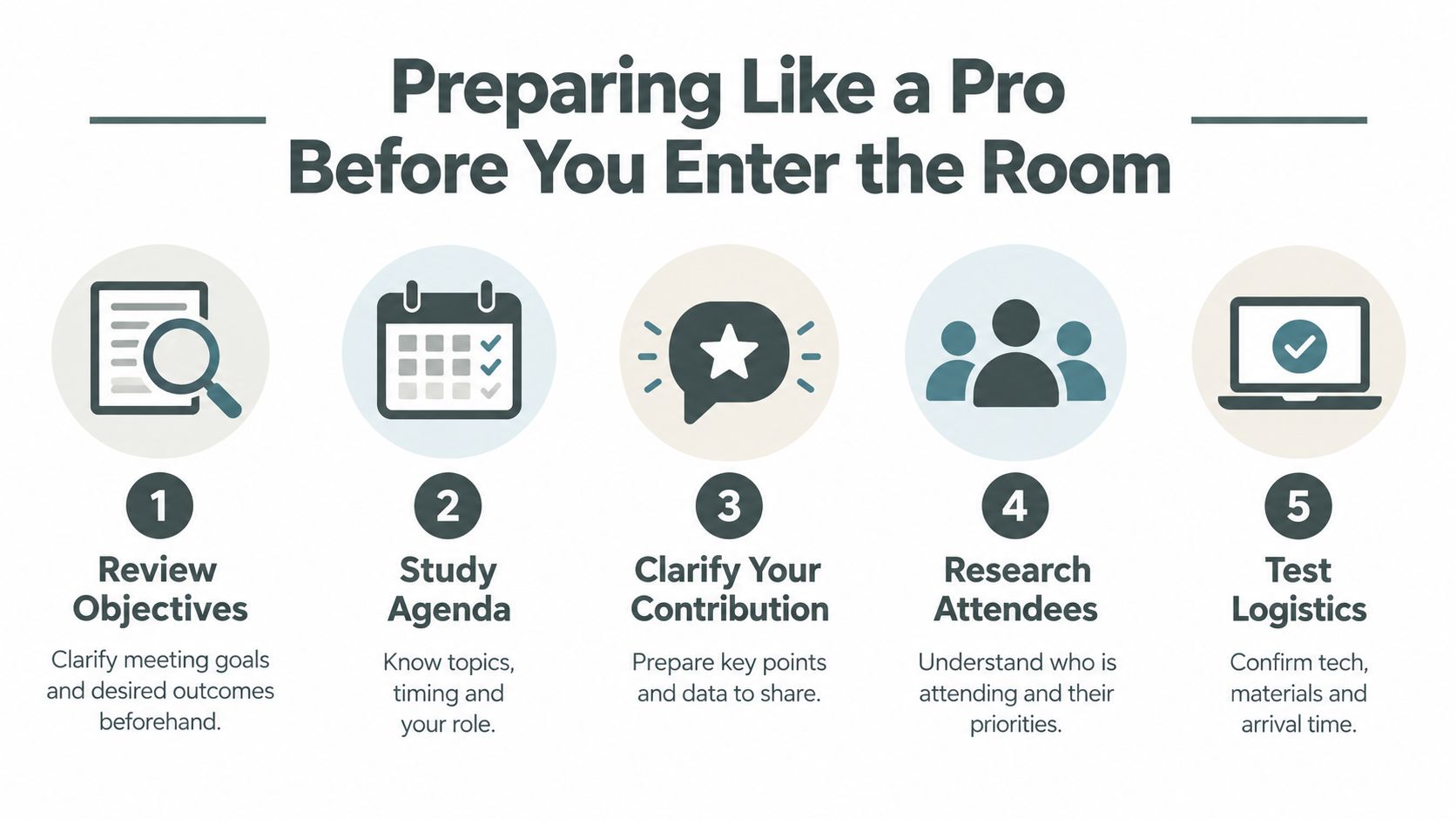
Preparing Like a Pro Before You Enter the Room
Preparation starts before you open the door, join the video call, or take a seat at the table. Reviewing the agenda, identifying your role, and arriving ready to contribute are measurable efficiency controls, because unprepared attendees create more clarification turns, slow transitions between topics, and lower the meeting's signal-to-noise ratio, as explained in meeting etiquette guidance from the University of Aberdeen.
Begin with the meeting's job
Ask what the meeting must accomplish. Is the group making a decision, reviewing information, solving a problem, or building alignment? These purposes require different preparation. A decision meeting calls for recommendations and trade-offs. An information session calls for focused questions. A workshop needs active creation, not passive attendance.
Read the agenda for sequence as well as subject. Notice which items concern you, where your expertise is relevant, and whether the chair expects a presentation, approval, critique, or simple awareness. If the purpose isn't clear, send a short note before the meeting: “Could you confirm the decision this session needs to reach and what you'd like me to bring?”
Arrive with a useful contribution
Use a compact routine:
Write one point. Prepare the observation or recommendation you most want the group to hear.
Identify one decision. Know what you can approve, reject, recommend, or clarify.
Verify one fact. Bring a figure, document, assumption, or source you can confirm.
Study the attendees. Consider who owns the work, who will be affected, and whose perspective may be missing.
Check logistics. Confirm the location, access instructions, presentation materials, and technology you'll use.
This routine keeps your contribution specific. You won't need to improvise a long explanation when the chair calls on you, and the group won't have to spend valuable time reconstructing context.
Practical rule: Enter the room ready to add information, make a decision, or ask a question that moves the agenda forward.
Preparation also includes emotional readiness. If you disagree with a proposal, separate the issue from the person before you arrive. Bring language such as, “I see a risk in the current approach because…” rather than, “That won't work.” The first invites examination. The second can make the discussion personal before the evidence is considered.
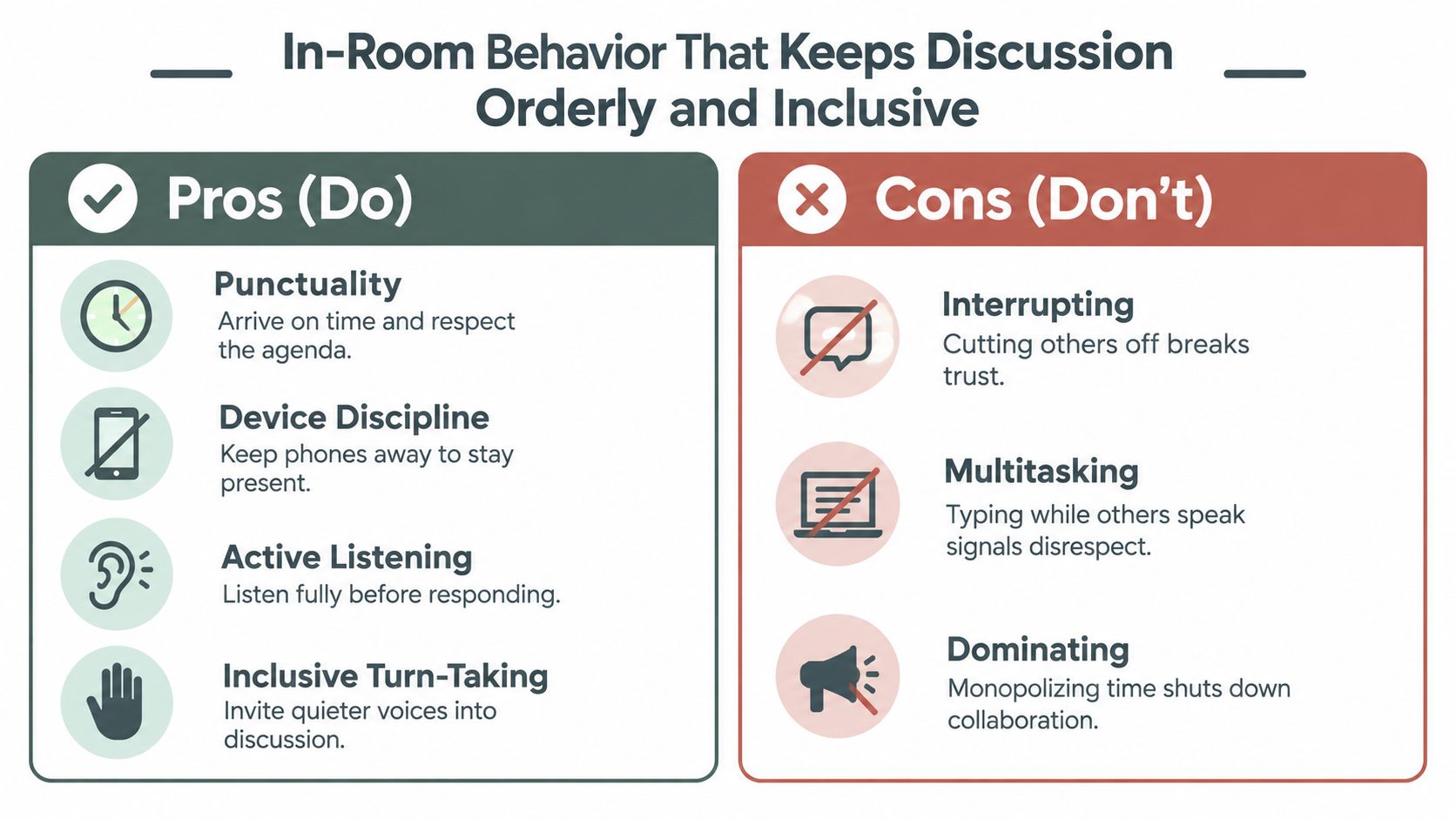
In Room Behavior That Keeps Discussion Orderly and Inclusive
Once people take their seats, etiquette becomes visible in the meeting's rhythm. A well-hosted room works like a carefully served dinner. The chair sets the sequence, participants listen for meaning, and a pause gives the current speaker room to finish. That rhythm protects attention and leaves more space for sound decisions.
Earlier findings on meeting etiquette point to a practical lesson: orderly participation protects the quality of information the group receives. Clear turn-taking, attentive listening, and respectful handling of devices help the group hear concerns before they become rework or private resistance.
Make attention visible
Arrive on time, settle your materials before the opening, and silence devices that are not part of the work. Keep a laptop open only when it supports the discussion, such as reviewing the shared agenda or recording an assigned action. If an urgent call cannot wait, tell the chair briefly and leave without making the interruption a group event.
Listening has both physical and verbal signals. Look toward the speaker when appropriate, let the person complete the thought, and reflect the point before challenging it. “I understand the concern about timing. I'd like to test the assumption about staffing” shows comprehension while keeping disagreement focused on the work.
Room design can reinforce those habits. Use meeting room layout options to match seating and sightlines to the meeting's purpose. A discussion layout keeps faces visible and makes hand signals easier to notice. A presentation arrangement may suit a briefing, yet make collaborative exchange feel unnecessarily formal.
Let the chair manage the queue
Wait for a natural pause. In a smaller room, raise a hand slightly or make eye contact with the chair. In a larger meeting, follow the agreed speaking order. If someone is interrupted, the facilitator can say, “Let's let Maya finish, then we'll come back to that point.” A short intervention restores the queue without embarrassing either speaker.
The chair should also create deliberate openings for quieter participants. “Jordan, you've worked closest to this process. What are we missing?” gives a clear reason to contribute and links the invitation to relevant experience. In a hybrid or upscale coworking venue, the host should check sightlines, microphones, and room acoustics before discussion begins, because hospitality includes making participation physically easy.
Use concise challenge language:
“Could we examine the customer impact before deciding?”
“I'm not aligned yet. My concern is the implementation risk.”
“What evidence would change our view?”
“Let's separate the decision from the open question.”
Research on business meetings and organizational silence indicates that speaking order, silence, and interruption patterns influence whether people contribute meaningfully or self-censor. The research repository publication on meetings and organizational silence supports active listening, controlled turn-taking, and respectful challenge.
A polished participant does not compete for the most airtime. They help the room hear the right voices, test ideas fairly, and leave with clearer decisions.
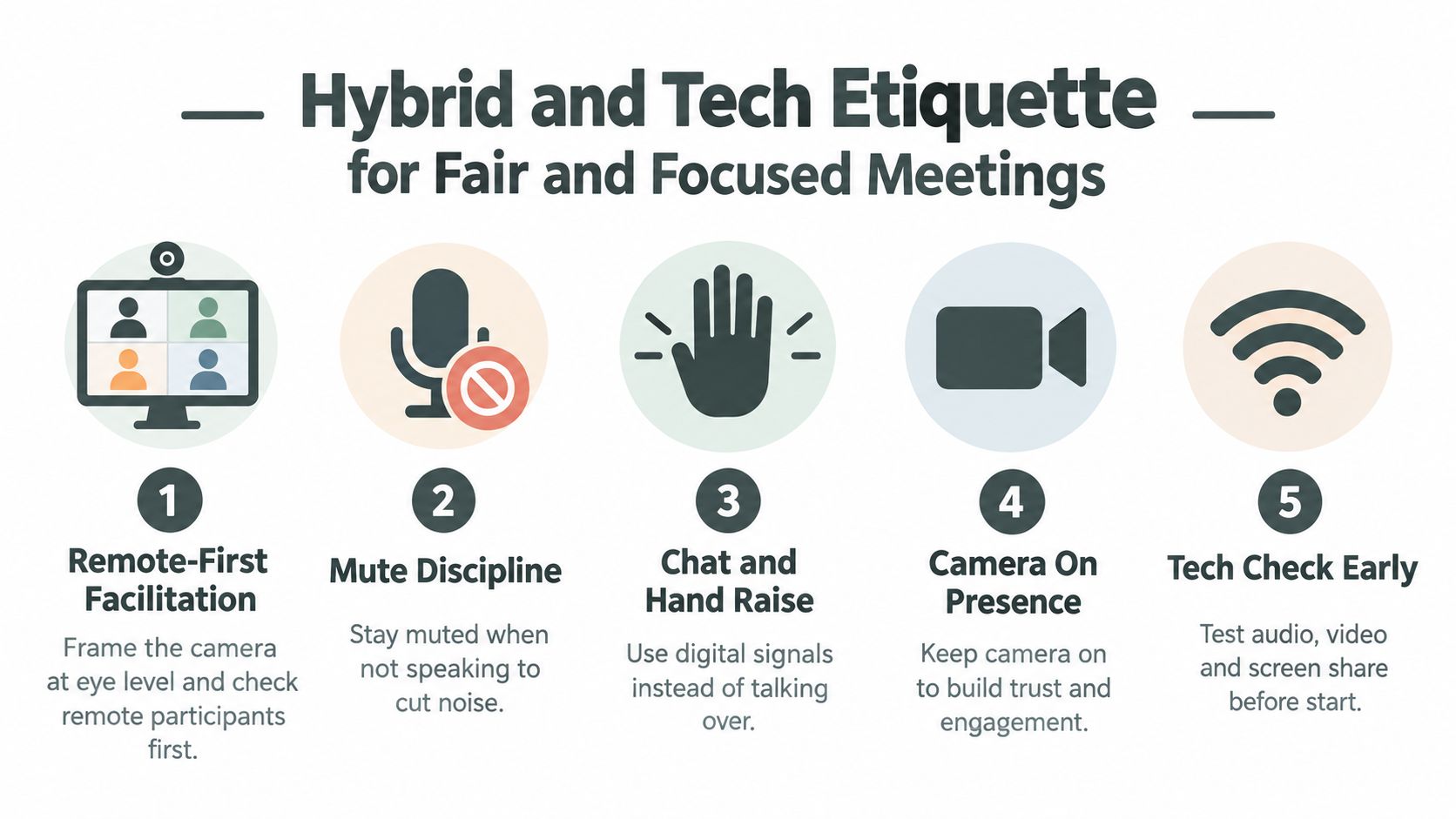
Hybrid and Tech Etiquette for Fair and Focused Meetings
Hybrid meetings fail when the room becomes the main conversation and remote attendees become an afterthought. A remote participant may see faces clearly but miss a comment made away from the microphone, a gesture across the table, or a decision reached through side discussion. Fairness requires deliberate facilitation, not merely a functioning video link.
Several recent guides recommend inviting remote participants first, repeating in-room comments for the microphone, and assigning a bridge person to watch chat, raised hands, and connection quality. Those guides also report that 43% of remote participants feel excluded when hybrid etiquette norms aren't enforced, as detailed in virtual meeting etiquette guidance.
Give remote participants a real seat
Open with a technology check, then ask remote attendees whether they can hear and see the room. When discussion begins, invite them first: “Before we take comments from the room, I'd like to hear from anyone joining remotely.” This prevents the first response from setting an in-room pattern that remote colleagues struggle to enter.
Assign a facilitator or bridge person to monitor digital signals. That person can say, “I see Priya has her hand raised,” or, “Alex posted a question in chat that we should address.” If someone in the room speaks away from the microphone, repeat the comment before moving on. A small act of translation can prevent a major information gap.
Use a shared speaking protocol:
The facilitator names the next speaker.
The speaker identifies the topic they're addressing.
The facilitator pauses for chat or hand-raise responses.
The bridge person confirms that remote participants have been heard.
The chair records the decision and any unresolved concern.
Treat recordings as consent, not convenience
Recording and transcription introduce a privacy question that ordinary meeting manners often overlook. Tell participants in advance if the session will be recorded, transcribed, or summarized by a note-taking tool. Explain who will receive the material, how it will be used, and how long it will be retained according to the organization's policy.
Cross-border meetings deserve extra care. Follow the most restrictive applicable jurisdiction when participants are subject to different consent standards, and don't assume that joining a call means agreeing to recording. The online meeting etiquette guidance on recording and transcription describes this shift from simple politeness toward responsible data handling.
For room-specific technology preparation, consult conference room technology guidance before guests arrive. Test the microphone, camera, display, screen sharing, and backup connection early enough to fix problems without making attendees wait.
Food Catering and Shared Space Norms That Support Hospitality
Food can make a meeting feel generous and considered, or it can create noise, delay, and a table full of competing priorities. Hospitality works best when it follows the meeting's rhythm. Serve refreshments before the opening, place a meal at a planned pause, and keep active papers and shared devices away from spills and plates.
Meeting time carries a real operational cost. A recent compilation reports that a typical employee spends about 11.3 hours per week in meetings, roughly 28% of a 40-hour workweek, and cites estimates that an oversized meeting can cost an organization about $28,000. These figures appear in Fellow's meeting statistics report. The practical lesson isn't to avoid hospitality. It's to make every service decision support the purpose of the gathering.
Match service to the agenda
A short decision meeting may need coffee, water, and a quiet arrival rather than a full spread. A workshop may benefit from food placed outside the active work zone so participants can take a break without interrupting a discussion. An executive offsite may need discreet service with clear dietary information and a host who knows when to refresh the room.
Tell the venue or catering partner when food should arrive and whether the group will pause. Don't let delivery staff enter during a sensitive discussion without coordination. If someone is presenting, avoid opening packages, moving chairs, or passing plates across the speaker's sightline.
Leave the shared room better than you found it
Guests should keep beverages on designated surfaces, use coasters when provided, and report spills promptly. Hosts should identify waste, recycling, water, and restroom locations at the start without turning the welcome into a facilities briefing. In a members' club, these details show respect for the next group as well as the current one.
Use local service thoughtfully. At Freeform House, partnerships with local restaurants and coffee shops support meals and beverages on demand without an extra delivery cost, which can help a host keep service coordinated rather than sending attendees away for supplies. The guidance on food during meetings offers a useful reference for keeping catering aligned with movement and meeting flow.
The best hospitality is almost invisible. People have what they need, the room stays calm, and nobody has to choose between participating and managing the meal.
Follow Up That Turns Conversation Into Action
A meeting ends well when everyone can answer three questions: what was decided, who owns the next move, and what remains unresolved. Follow-up works like closing a well-packed suitcase. Each item has a place, and nothing important is left behind.
Good notes also protect participation. Speaking order, interruptions, and silence can shape whether people contribute or hold back, as discussed earlier. A written record gives quieter concerns a visible place after the room clears and prevents the loudest interpretation from becoming the unofficial decision.
Record decisions, not a transcript
Build the summary around four elements:
Decision: State what the group agreed to do, approve, defer, or investigate.
Owner: Name the person responsible for the next action.
Timing: Record the expected completion point or next review.
Open issue: Preserve the question, risk, or dissent that still needs attention.
A useful entry might read: “Approve the revised onboarding sequence. Taylor owns the draft. Product reviews the customer-impact assumption before the next planning session.” That gives the team a handle for action, unlike several paragraphs describing who spoke and when.
Send the summary while the discussion remains fresh. Ask owners to correct factual errors, while keeping settled decisions closed unless new information changes the situation. If the meeting was recorded or transcribed, confirm where the material is stored and who can access it. Consent and access should be clear, particularly when people joined remotely or used a shared venue system.
The follow-up should be easy to scan on a phone or between appointments.
Keep disagreement professional after the room
Written language can preserve trust or weaken it. Use task-focused wording such as, “I'm recording this risk for review,” or, “I support the decision, with the implementation concern noted.” Describe the issue and its effect, not a colleague's motives. Keep private messages from becoming a second decision channel that excludes the wider group.
The chair or organizer should review action items at the next relevant touchpoint. Participants should report progress early when a commitment is at risk. Accountability is more respectful when people can see the expectation clearly and raise problems before a deadline becomes a surprise. A clear owner, timing, and open issue turn a polished conversation into work the team can complete.
Making the Most of Upscale Coworking and Event Venues
A premium meeting venue should do more than provide attractive chairs. It should help the host choose the right setting, protect the conversation from avoidable friction, and make guests feel expected. That standard is especially relevant to Free Form House, envisioned as a premier, membership-based club in the heart of Jenks, Oklahoma's 10 District downtown.
The concept is comparable to the renowned SoHo House, but it extends beyond a social club. Members can use coworking spaces and a dynamic community hub built for collaboration and connection. The setting is intended as a central gathering spot for a creative, cooperative local community, so venue etiquette becomes stewardship of a shared resource, not merely compliance with house rules.
Choose the room for the work
Different meeting jobs call for different environments. A confidential executive discussion needs controlled access, clear sightlines, and minimal foot traffic. A workshop benefits from flexible furniture and writable surfaces. A creative production session may require a podcast booth or loft studio rather than a formal conference table.
Freeform House provides four distinct rooms, the Hall of Fame Room, the Freeform Room, the Executive Room, and the Thomas Room, along with The Rise loft studio and an in-house podcast booth. A host should match the room to the interaction before inviting guests, then confirm seating, display needs, privacy, and arrival instructions with the venue team.
Make hospitality part of the operating plan
Premium service only helps when someone owns the details. Confirm the room layout, AV setup, water placement, catering timing, cleanup expectations, and access to shared amenities before the first attendee arrives. Keep the setup realistic and authentic in visual materials as well. Business meeting photography should show real people, natural expressions, and a credible room, never clip art or cartoon-like graphics. Collections from Getty Images' meeting photography library, Unsplash's meeting image collection, FreeImages' office meeting library, and Shutterstock's meeting etiquette assets demonstrate the commercial demand for documentary-style meeting visuals.
Use the venue's practical features without letting them interrupt the gathering. Curated partnerships with local restaurants and coffee shops can support meals and beverages on demand, while Amazon Hub Lockers and a rentable golf cart fleet can simplify daily logistics for members. The host's responsibility is to coordinate these conveniences so guests experience them as ease, not activity.
Freeform House's restored 1920 building combines historical character with modern functionality across a three-story, 10,000-square-foot hub. That kind of setting can support executive meetings, workshops, private events, and informal networking when hosts respect booking norms, protect shared spaces, and leave room for the community around them.
Freeform House offers members coworking access, distinct meeting rooms, creative production resources, coordinated food and beverage partnerships, and a community hub in downtown Jenks. Visit Freeform House to explore a setting where thoughtful business meeting etiquette can become part of a polished, welcoming experience.
The contrast between a chaotic meeting and one where the host states the purpose upfront is spot-on. A simple agenda and a document-ready checklist can save those first 15 minutes—I've been using https://3daistudio.pro