What Is a Boardroom: Features, Uses and Key Differences

A boardroom is the room, physical or virtual, where a company's board of directors makes formal governance decisions. Structured agendas are common, yet many directors still rate the quality of board discussions as only moderate.
If the calendar, the packet, and the chairs are already in place, why does the meeting still feel like a status update? The common image involves a long table and a city view. That picture misses the point. A boardroom works like a council chamber for a company: the furniture matters less than the authority exercised inside. The same test applies to a public company and to a three-person advisory board at a growing local firm. Did the people in the room exercise independent judgment, and can someone prove it later?
A team can reuse a handsome room every Tuesday and still not be in a boardroom. What is a boardroom, then, is less about prestige and more about a governance process that a physical build and a meeting workflow are meant to support.
A Boardroom Defined in Plain Terms
A boardroom is the setting where a company's board of directors makes formal, legally authorized decisions about the organization.
The word names a function as much as a room. The forum can be a physical space, a video meeting, or a hybrid of both. A boardroom relates to a company the way a council chamber relates to a city. The furniture matters less than the authority exercised inside.
A family company spends a decade with the founder signing every check. Growth forces a change. The owners stop running the daily work and hand it to directors and a hired manager. The meeting that used to be a kitchen-table argument becomes the place where those owners review management and approve major decisions. That is the origin of the modern boardroom, compressed into one firm.
Historical corporate-law research identifies the nineteenth century as the major transition. Earlier American corporations often gave shareholders direct managerial authority, while directors exercised only powers the owners explicitly delegated. As companies grew more complex, statutes increasingly granted directors and professional executives greater authority. The room became the institutional point where shareholder representatives review management, approve major decisions, and oversee corporate affairs.
Early American companies sometimes formed shareholder review committees to examine annual reports alongside their formal management structure. The functions that grew from this shift are still recognizable: accountability, review of management performance, supervision of strategy, and communication between owners and leadership. The boardroom gained importance as the distance widened between dispersed shareholders and the professional managers running daily operations.

A modern boardroom is a physical or virtual forum for legally authorized collective decision-making. A project team can occupy the same space every day and never hold one. Only a board meeting produces binding resolutions and a recorded decision trail.
How you recognize one
Scheduled meeting: Directors are called for a set date, not pulled into an ad hoc huddle.
Formal agenda: Items are decisions and risks, not a tour of everyone's week.
Minutes: Someone writes what was decided, not a loose recap in a chat thread.
Votes: Directors, not the loudest manager in the room, cast them.
None of these markers depends on headcount or budget, which is why a founder's small advisory board can meet the same test as a listed company's full board. A boardroom is where a company's accountability is exercised collectively.
Core Functions Every Boardroom Supports
Under the G20/OECD Principles of Corporate Governance, the board's remit covers strategy and policies, management and organizational performance, financial operations, risk-management systems, and major capital expenditures, acquisitions, and divestitures. Each function should leave a document someone can point to later. If a session ends with no paper trail, it was a briefing, not governance.
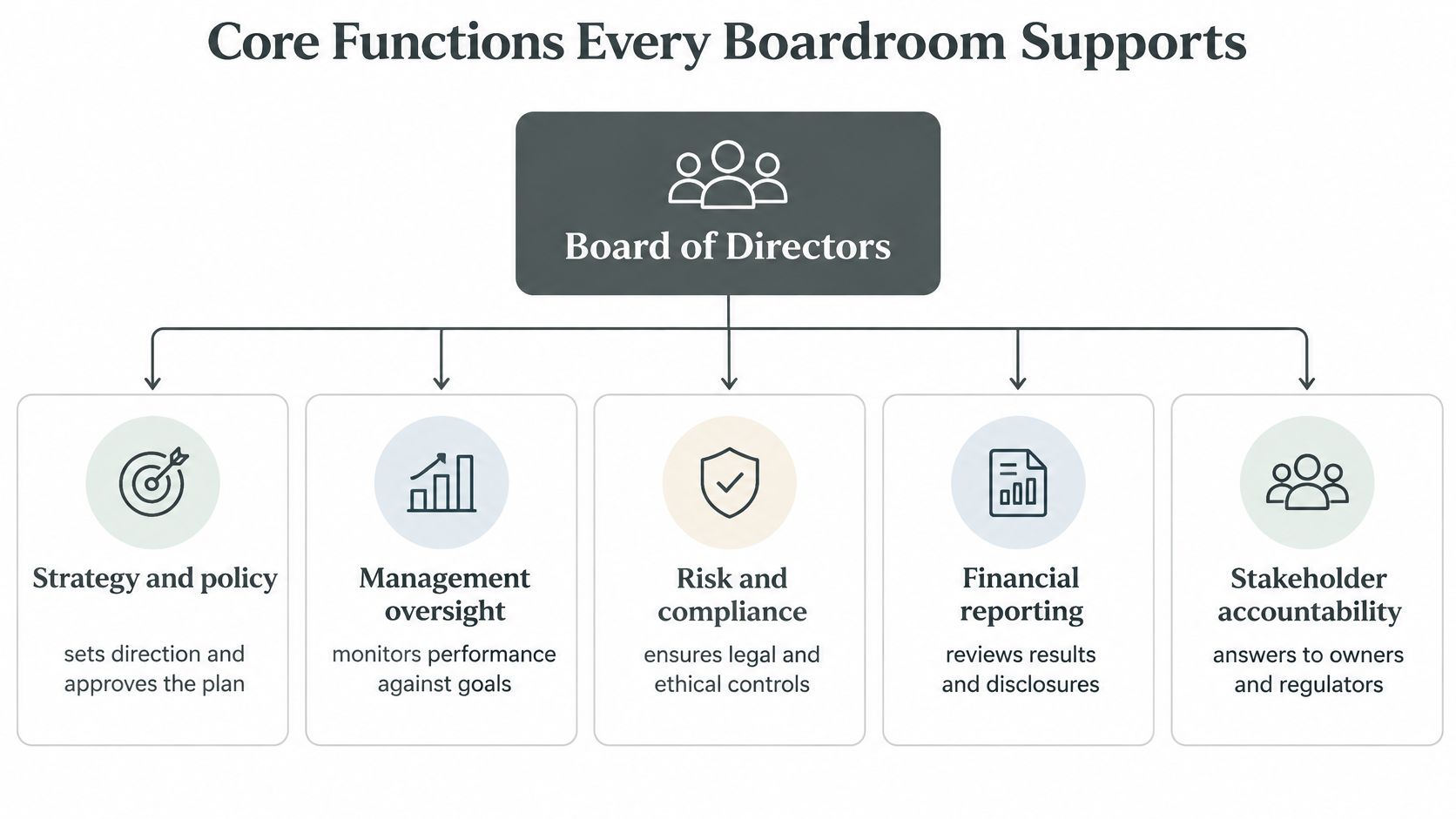
Board function | What directors decide | Typical output |
|---|---|---|
Strategy and policy | Sets long-term direction and approves key policies | Approved strategic plan |
Management performance | Assesses executives against agreed targets | Performance review and succession decisions |
Financial operations | Oversees budgets, reporting and financial controls | Approved financial statements and budget |
Risk management | Reviews risk systems and the company's key exposures | Risk register with named owners |
Capital decisions | Supervises major spending, acquisitions and divestitures | Approval or rejection resolutions |
Strategy and policy is the direction-setting job. Directors test whether the plan still fits the market, then approve or send it back. The output is an approved strategic plan, not a slide the chief executive liked.
Management performance is the evaluation job. Directors compare results with agreed targets, name what is off track, and decide whether succession needs to start. Passive praise isn't a review.
Financial operations is the control job. Directors look at budgets, reporting, and the checks that keep numbers reliable, then approve the statements and the budget. A dashboard on a screen isn't approval until the minutes say so.
Risk management asks which exposures can hurt the company and who owns each one. The useful output is a risk register with named owners, not a heatmap nobody updates.
Capital decisions cover major spending, acquisitions, and divestitures. Directors approve or reject. A verbal "sounds fine" doesn't authorize a purchase.
What a real session looks like
In a typical session, directors test the plan against risks, question executives on results, and approve or reject spending. Each vote goes into the minutes, with the action, the owner, and the date it comes back. Directors should challenge assumptions, evaluate management, spot conflicts of interest, and turn talk into resolutions and monitoring obligations. Listening to updates isn't the job.
The same five functions fit a small company's advisory board or an investor oversight group. The dollars are smaller. The outputs aren't optional. A clear board meeting format keeps those outputs from dissolving into conversation.
The room has to support that work. Secure circulation of materials, a reliable view of financial and risk dashboards, controlled participation, confidential talk, and a documented decision trail are the practical requirements. Treat the space as decision infrastructure, not an upscale conference room.
A short video walks through how directors separate oversight from day-to-day management.
List the five functions, then mark your last six agendas. Any function that never appeared is a gap to raise at the next meeting.
Boardroom Versus Conference Room and Coworking Space
Criterion | Boardroom | Conference room | Coworking meeting room |
|---|---|---|---|
Primary use | Formal board decisions and oversight | Team meetings and client calls | Bookable meetings for members |
Who meets | Directors, chair and company secretary | Staff, visitors and clients | Freelancers, small teams and members |
Decision authority | Resolutions can be binding and recorded | Informal, not binding | Informal, not binding |
Confidentiality | Closed sessions and controlled materials | Moderate, within the company | Low to moderate, shared building |
Record kept | Minutes, resolutions and action log | Optional notes | Usually none |
Booking | Scheduled through the governance calendar | Booked by any employee | Hourly, day or membership rate |
When a conference room is enough
A conference room fits a team review or a client call, where tomorrow's meeting can revisit the call. Nobody needs a resolution to change a campaign headline. Use a conference room when the decision can be undone without a formal record.
When you need the boardroom standard
You need a boardroom when the decision binds the company, changes ownership or spending, or must be proven later. Closed materials, a chair, and minutes are the difference, not the quality of the chairs. If you can't show who voted and what they approved, you weren't in a boardroom.
What a coworking room is actually for
A coworking meeting room gives members privacy and a professional setting without pretending to be a board. A global survey of 819 office workers found that third places, including coworking sites, cafés, hotel lobbies, and similar settings, were perceived as more socially fulfilling than conventional offices by 64% of respondents and more socially fulfilling than working from home by 67%. The researchers tied that to "relational job crafting", the chance to choose where to work and which people to see. That suits freelancers and small teams. It doesn't replace a board's controlled process. Our meeting office space options follow the same split between a booked room and a governed meeting.
Practical rule: If the meeting needs a recorded resolution, use a boardroom. If it needs a room and a shared table, a conference room or a coworking room works.
A founder can book a coworking room, pitch a client, and leave within an hour. The same founder's advisory board, approving a loan, needs a formal record, named voters, and a copy that still makes sense next year.
Features That Make a Boardroom Work
The build has to carry confidential, high-stakes talk. A pretty room with thin walls fails that test before the first vote.
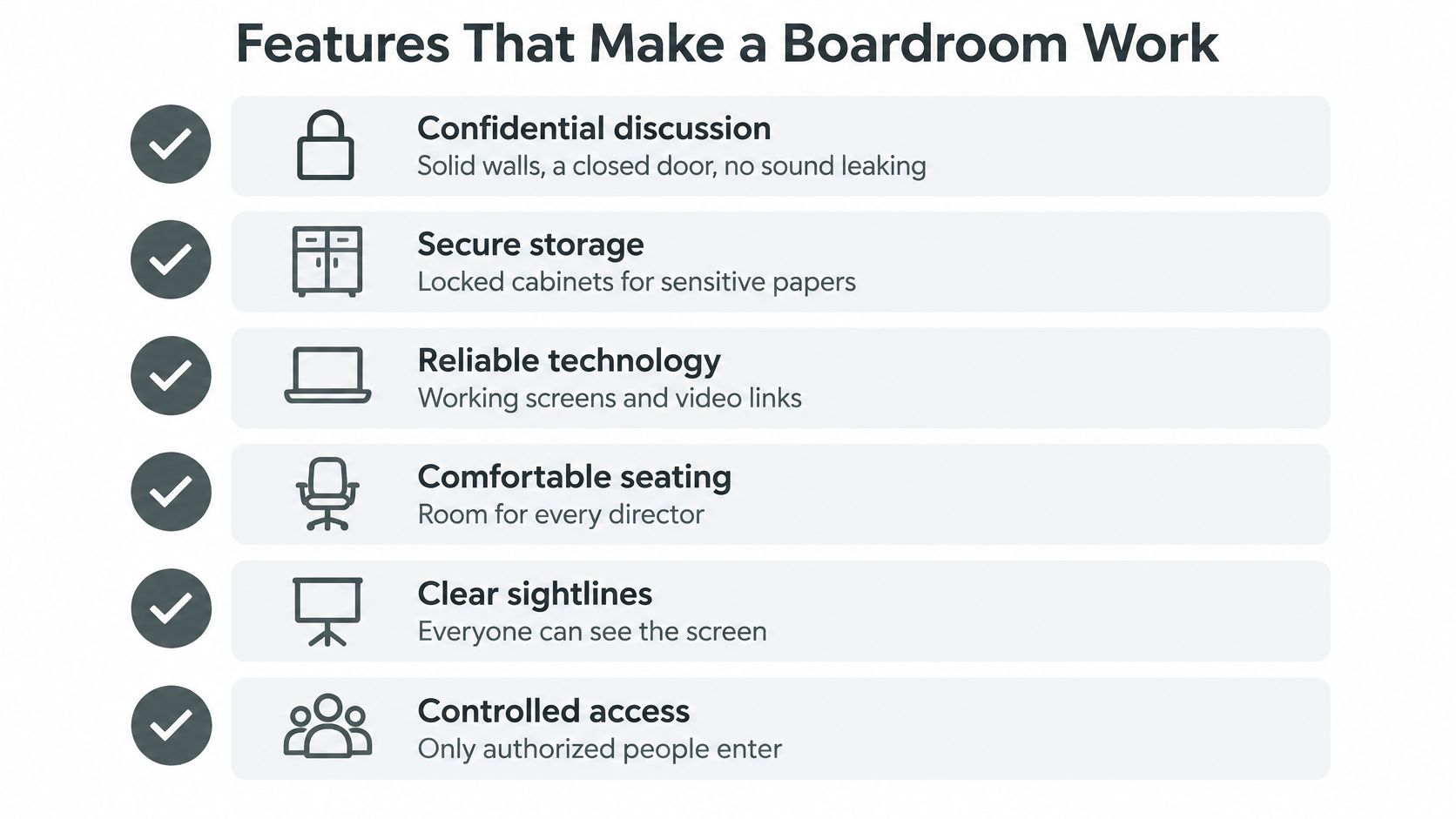
Confidential discussion. Solid walls, a closed door, and no sound leaking into open-plan areas. Side comments about a sale or a person shouldn't reach the hallway.
Clear sightlines. Every director can see the chair, the screen, and each other. If someone is hidden behind a laptop lid, they drop out of the debate.
Reliable display. Financial and risk dashboards stay readable for the whole table, not just the person nearest the projector.
Secure access to board materials. Packets aren't forwarded through personal email or left on a shared drive with the whole staff.
A space for executive sessions. Management can step out without the meeting relocating to a corridor.
A layout for votes and debate. A single table, with the chair able to see every face, supports both a formal vote and a candid argument.
The workflow that makes the room productive
Directors should get financial statements, strategic updates, and board books before they sit down, so live time goes to trends, assumptions, and alternatives instead of reading aloud. Harvard governance guidance reports one board that cut meeting materials from 300 pages to 80, which freed the meeting for higher-value discussion.
Send version-controlled materials in advance so everyone argues from the same draft. Organize the agenda around decisions and risks, or the hour fills with updates. Set a time limit on each item so a late topic isn't rushed into a bad vote. Name the decision owner before debate starts, so the room knows who must leave with the action. Record the resolution, any dissent or open issue, the responsible person, and the deadline. Circulate minutes promptly, while memories still match.
The chair is an operational control. That person manages speaking turns, draws out quieter directors, and stops the discussion from drifting. Better preparation cuts presentation time. Structured facilitation widens who speaks. Immediate action tracking is what makes accountability real between meetings.
For hybrid sessions, redundant connectivity, a backup dial-in, on-call IT support, shared digital documents, and visual dashboards cut interruptions and keep remote directors on equal footing.
Minutes that wait a month aren't a record. They're a reconstruction.
When a Hybrid Boardroom Works and When It Does Not
A hybrid board meeting works like a dinner party where one guest joins by phone. They hear the main toast, but the side comments, the raised eyebrows, and the note passed hand to hand all stay inside the room. Hybrid boards are common now. Inclusive ones still take deliberate design.
In Nasdaq's 2025 Global Governance Pulse survey, 51% of respondents said board members and presenters should attend in the same manner whether a meeting is virtual or in person. Organizations have steadily moved toward virtual participation, so the standard a hybrid session has to meet keeps rising.
The risk people skip
Remote directors who can't hear side comments, read the same materials, enter the discussion, or vote on the same terms aren't fully participating. They can miss a qualification muttered across the table, vote on a page they never opened, or wait out a conversation that never comes back to them. That's a governance failure, because their judgment never had the same inputs as everyone else's.
What equal participation requires
Equal audio and visibility for every participant, including people who aren't in the room.
The same board materials, reached through secure access, not a screenshot in a chat.
One record for votes and minutes, so a remote vote isn't a side note.
Accessible tools for participants with disabilities, planned before the meeting, not improvised at the start.
Explicit rules for speaking and interruptions, so the people on site don't own the floor by default.
Notice what this list leaves out: expensive hardware. Equality is a workflow standard first. The room and its technology exist to serve that standard, the same way a boardroom exists to serve the governance process rather than the other way around.
In-person sessions still build deeper discussion and relationships. Hybrid formats cut travel and widen who can attend. Both can be right. The deciding question is whether every director can exercise informed, independent judgment under the same conditions.
That test matters for entrepreneurs, executives, and community organizations around Jenks and Tulsa choosing a venue, including a small advisory board where a single remote member dials in. A room with a screen isn't enough if half the table is guessing. A workable board meeting room setup starts from equal conditions, not from whichever link happens to connect.
Who Needs a Boardroom and How to Decide
A boardroom works like a courtroom. The furniture matters less than what the room makes possible: informed judgment, a formal decision, and a record that stands up later. In Harvard Law School's guide to board performance, 72% of directors surveyed named the quality and flow of management information as a top-three driver of board effectiveness, while 62% cited board culture and dynamics. A room earns boardroom status by cutting friction around preparation, participation, confidentiality, and follow-through. Prestige is optional.
Five situations that need the standard
A public company board that must hold formal, recorded votes.
A private company board where directors and shareholders divide authority.
A small-business advisory board reviewing strategy and debt.
A lender or investor meeting where terms are discussed and documented.
A strategic offsite where leaders set the year's priorities.
Apply one test to each. Does this decision need to be formal, recorded, and defensible later? If yes, you need boardroom conditions, even when the group has three people and no ticker symbol.
When a conference room is enough
Weekly operating reviews, project kickoffs, interviews, and client presentations produce no resolutions. An owner-led company with a three-person advisory board needs boardroom conditions for the annual budget review, while its monthly updates can stay in a conference room. Nothing in those updates binds the company.
That last point confuses people. The room follows the weight of the decision, and the attendee list never changes that.
A short checklist
Choose a boardroom when the meeting produces binding decisions, must keep minutes, or includes outside investors or lenders.
Choose a conference room for routine updates and reviews.
Choose a hybrid setup only when every remote participant gets equal audio, visibility, and materials.
Confirm confidentiality before the meeting starts, including who may stay in the room.
List your last five meetings and mark which ones produced a binding decision. Run the next one through the checklist before you book a space.
For readers in downtown Jenks, Freeform House is a members-only club with private workspaces, open collaboration areas, hot desks, and reservable conference rooms across three floors of curated spaces. Prospective members can book a personalized consultation to learn about pricing structures, opening dates, and how to become a member, and use that conversation to test real meetings against the checklist. When a session needs confidentiality, equal participation, and a clear decision trail, the room and the workflow have to be chosen together.
Comments