Board Meeting Format That Actually Works

A board meeting starts with good intentions. Directors arrive with a packet, the chair follows a familiar agenda, and everyone expects to leave with clear decisions. Instead, the meeting turns into a four-hour tour through routine reports, unresolved questions, and presentations that could have been read beforehand. By the end, people disagree about what was approved, who owns the next step, and whether the most important issue received enough attention.
The fix isn't a prettier template. A reliable board meeting format treats the meeting as a governance-control system. It matches the meeting mode and agenda structure to the judgment required, separates information from discussion and decision, and creates a visible record of what happens afterward.
Why Most Board Meeting Formats Fall Apart
A board meeting can lose its value before the chair calls it to order. Directors receive a large packet late, skim different sections, and arrive with uneven preparation. The chair then follows the template, moving through financial reports, committee updates, and operational presentations in sequence. The strategic question appears near the end, when attention is limited and the scheduled finish is close.
A 2025 U.S. bank-governance survey reported median board meetings of four hours, median board packets of 200 pages, and only 61% of directors receiving materials more than four days in advance. These figures do not show that every long meeting or large packet fails. They do reveal a design risk: additional material and meeting time can displace the judgment the board was convened to provide. The survey findings and board-work practices support a more selective format.
Treat each item according to its purpose
Label every agenda item as information, discussion, decision, or follow-up. The label gives the chair a different operating instruction:
Information: Directors review the material in advance. Live time addresses material variance, unanswered questions, or emerging risk.
Discussion: The board needs competing views, judgment, or challenge before a later decision.
Decision: The agenda states the recommendation, authority required, supporting evidence, and proposed resolution.
Follow-up: The board checks progress against a previous resolution, owner, deadline, or success metric.
“Operations report” gives directors little direction. “Approve revised hiring authority after reviewing forecast variance” identifies the judgment required and the preparation that matters.
IESE research found that 83.19% of surveyed directors considered agendas and preparation information appropriate, while only 63.56% rated discussion quality high or very high. Roughly 35% wanted more interaction with the CEO and senior management before meetings. The IESE board effectiveness research supports a practical conclusion: an adequate packet does not automatically produce a useful conversation.
Use a three-phase control cycle
A reliable format runs through three phases:
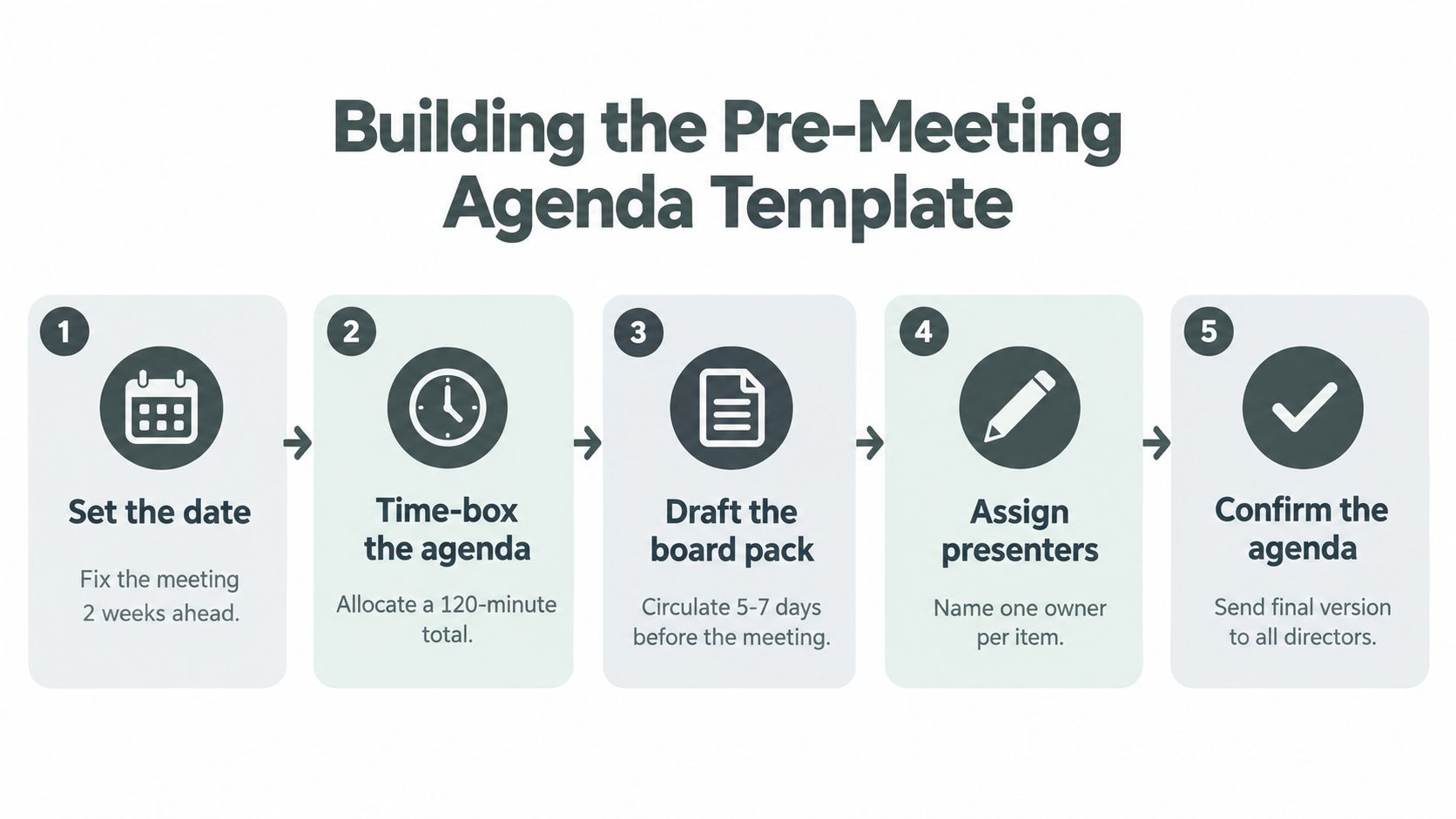
Pre-meeting design: Define the decisions, classify agenda items, assign an owner, set a time box, and distribute a concise board pack at least 5 to 7 days ahead.
Meeting execution: Confirm quorum and conflicts, handle routine matters efficiently, address high-value decisions while attention is strongest, and close each item with a resolution or explicit next step.
Post-meeting governance: Record resolutions, owners, deadlines, dissent or abstention, and follow-up actions. Return unfinished work as named agenda items.
Practical rule: An agenda item needs a decision question, owner, time box, and intended outcome before it is ready for the board.
A premium executive venue such as Freeform House can support this discipline by protecting in-room time for strategy while routine reporting and clarification move into the pre-read process. The room affects the experience, but the operating rules determine whether the meeting works. A polished setting cannot rescue an agenda that asks directors to read, debate, decide, and document the same issue without clear transitions.
Choosing Between In-Person, Virtual, and Hybrid Formats
Meeting mode is a governance decision, not a calendar preference. The right question isn't whether directors like video calls. It's whether the judgment required by the agenda depends on candor, relationship, rapid exchange, physical presence, or geographic access.
A 2023 Society for Corporate Governance survey of members representing more than 150 public and private companies found that 45% of small-cap companies had shifted to virtual-only board meetings. The same survey found that 52% of mid-cap companies, 38% of large-cap companies, and 28% of private companies had implemented or planned a combination of in-person-only and virtual-only meetings. Hybrid attendance was most common among large-cap companies at 40%, and stood at approximately 27% for small-cap, mid-cap, and private companies. The Deloitte-hosted survey summary distinguishes fully virtual meetings from hybrid participation, which shouldn't be treated as the same experience.
Agenda Category | Best Mode | Why It Works |
|---|---|---|
Consent agenda and routine approvals | Virtual | Directors can resolve noncontroversial matters without spending travel time or live attention. |
Routine reporting and preparation | Virtual | Dashboards and questions can be handled efficiently when the board doesn't need extended interaction. |
Strategy workshop | In-person | Directors can read body language, explore alternatives, and stay with a complex issue without the friction of remote turn-taking. |
Conflict-rich decision | In-person | Sensitive disagreement benefits from direct engagement and a chair who can manage the room dynamically. |
Geographically dispersed board | Hybrid | Directors retain access, provided the chair gives remote participants equal visibility, speaking rights, and voting access. |
Sensitive personnel or executive session | In-person where possible | Confidentiality and candor are easier to protect when side channels and recording risks are controlled. |
Virtual meetings work well for consent agendas, routine reporting, preparation sessions, and focused updates. They work less well when directors need to develop trust, challenge an executive team, or work through a decision with multiple plausible outcomes.
Hybrid meetings offer access, but they also create a hidden participation risk. Remote directors can miss side conversations, fail to see who is seeking recognition, or become passive observers while the room reaches consensus. A video link isn't equivalent participation unless the chair sets a speaking order, checks remote reactions, confirms voting mechanics, prohibits private side conversations during active decisions, and explains what happens if technology fails.
Use these video-conferencing practices as a technical baseline, then add governance protocols. The format should state who may attend remotely, how confidential documents are handled, how executive sessions work, and how the chair pauses the meeting when a participant loses access.
Building the Pre-Meeting Agenda Template
A board can receive a polished pack and still reach the room without a usable decision path. The agenda prevents that failure by answering four questions for every item: Why is this item here? What decision or recommendation is required? What evidence should directors review? How much live time does it deserve?
Send the board pack at least 5 to 7 days before the meeting. Include an executive summary, decision memos, the dashboard, and the risk register. Major items should use a two-page decision memo covering context, options, recommendation, consequences, and the proposed resolution. The chair should reject material that merely turns an email attachment into a presentation.
Build the agenda around protected time
Classify every item as strategic, oversight, informational, or consent, then attach an owner and a defined result. A practical agenda row might read:
Field | Example |
|---|---|
Objective | Decide whether to approve the expansion plan. |
Decision or recommendation | Approve the recommended option, subject to stated conditions. |
Evidence required | Forecast variance, risk assessment, cash impact, and management recommendation. |
Time box | 24 minutes. |
Owner | Chief executive, with finance lead available for questions. |
Deadline | Resolution effective immediately, with implementation update at the next meeting. |
Success metric | Delivery against the approved milestone and budget assumptions. |
For a 120-minute executive meeting, allocate approximately 60 minutes to strategy, 36 minutes to risk and performance oversight, and 24 minutes to approvals, reports, and closing actions. These blocks are a control, not a rigid script. They stop routine reporting from consuming time reserved for judgment.
Put the consent agenda near the beginning and batch routine items into one approval. Any director should be able to remove an item for discussion. A previously approved item still belongs in discussion if its risk, recommendation, or consequence has changed.
Compress the board pack
Limit the dashboard to material variances. Each variance should state what changed, why it matters, and what action the board must take. A red-amber-green risk register should identify the risk owner, current status, mitigation, and escalation trigger.
The chair also needs a parking lot. It should list questions requiring separate analysis, committee assignment, or a later decision, rather than hide difficult issues. Name the owner and next review point before moving on.
Preparation needs a visible control. A 2024 cooperative-governance study found that only about 65% of respondents said their boards were prepared, including 12% saying all directors and 53% saying most directors typically arrived prepared. The governance guidance on improving board meetings supports requiring a pre-read acknowledgment and creating a 24-hour clarification window before the meeting. Questions raised during that window can improve the pack and preserve live time for discussion and decisions.
Running the Meeting for Maximum Decision Quality
A board can reach the end of its agenda with several unresolved decisions. The chair protects decision quality by matching each item to the judgment required. Confirm quorum, record conflicts, and identify any director who must recuse themselves. Approve prior minutes and a routine consent agenda in one clear motion.

Move from the CEO and financial variance review to the decisions with the greatest strategic or risk consequences. Routine reporting belongs in the pre-read or later in the meeting unless a material change could alter the board's judgment. Before discussion starts, ask the item owner to state the recommendation, summarize the evidence, and name the decision required.
A one-page dashboard can keep information distinct from judgment. For each material variance, show:
Variance: What changed against the approved plan?
Implication: Why does the change matter to risk, performance, or strategy?
Requested action: Should the board approve, reject, direct, or monitor something?
If a presenter reads from the packet, interrupt respectfully: “The board has the report. Please take us to the variance and the decision you need from us.” This returns the meeting to governance work without embarrassing the presenter.
Keep discussion and resolution distinct
Protect disagreement before calling for a vote. Invite directors who have not spoken, ask the owner to answer the strongest objection, and test whether the proposed resolution addresses the stated risk. Discussion should produce a tested choice, a defined request for more information, or a deliberate deferral.
The boardroom seating guidance can inform the physical setup, while behavioral controls keep the meeting clear. Directors should know whether they are exploring options, advising management, or taking formal board action.
Executive session belongs after the relevant evidence has been heard or at a defined point on the agenda. Use it for CEO evaluation, conflicts, audit matters, sensitive personnel questions, and other confidential governance work. Management should remain involved when its factual input is needed. Executive session should not become a substitute for a well-framed decision.
For a remote-inclusive executive session, confirm who is present, prevent unapproved recording, verify that every remote participant can hear and speak, and restate confidentiality expectations before discussion begins.
Here is a practical sequence for a 90-minute executive session at Freeform House:
5 minutes: Confirm attendance, confidentiality, and the purpose of the session.
15 minutes: Review the decision question and the evidence already supplied.
35 minutes: Discuss options, objections, and governance implications.
20 minutes: Draft and test the resolution.
10 minutes: Assign owners, deadlines, and communication responsibilities.
5 minutes: Confirm the record and close the session.
Preparation should be visible during the meeting. Ask directors to identify unanswered questions early, distinguish missing evidence from disagreement, and record any information needed before a vote. That practice prevents the chair from treating silence as readiness.
End each item with a decision or a deliberate deferral. A useful closing script is: “The resolution is approved as stated, with the finance lead accountable and an update due at the next meeting.” If the board is not ready, state what is missing, who will provide it, and when the issue returns. “We'll discuss it later” leaves the governance work undefined.
Closing the Loop After the Meeting
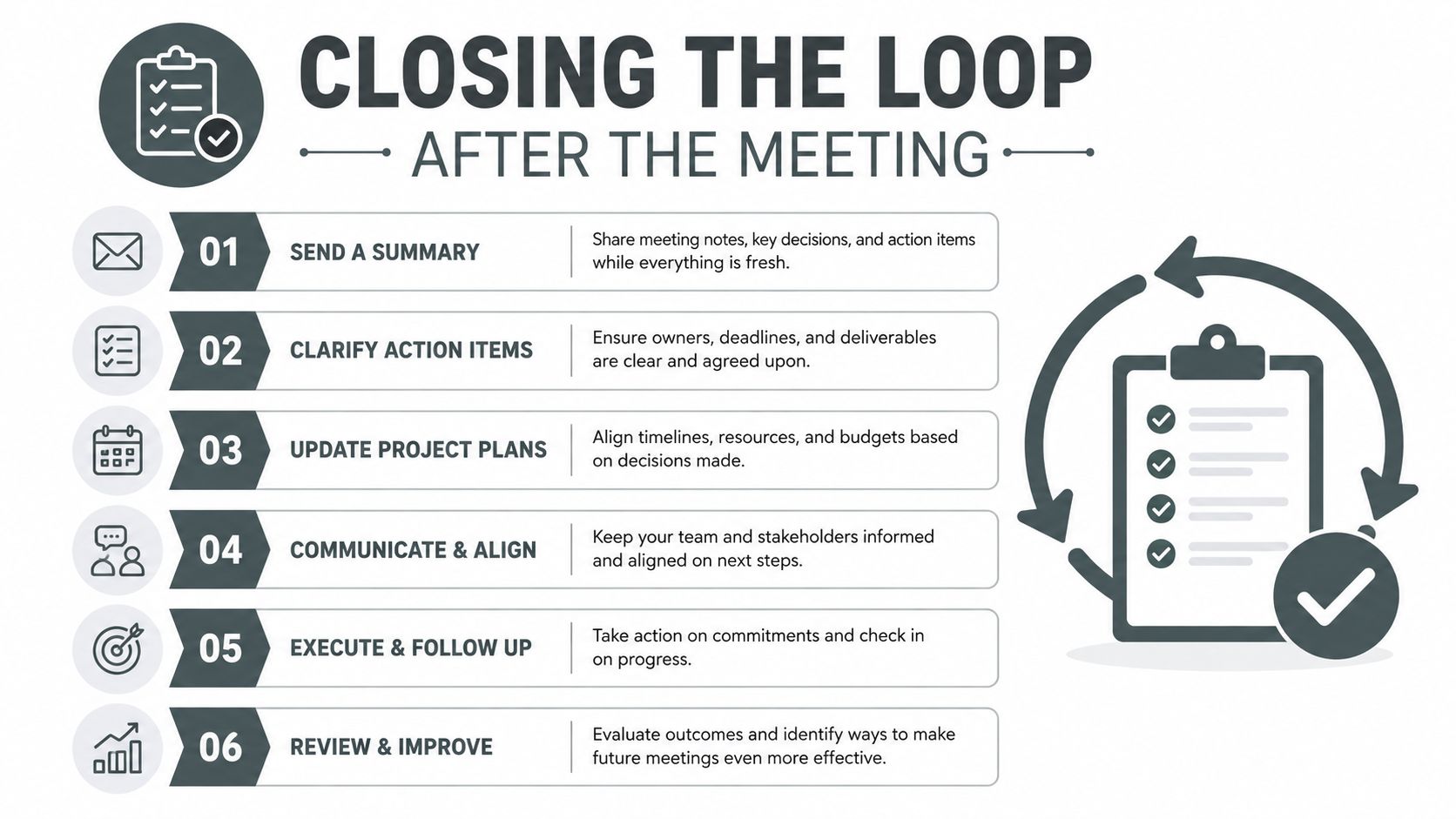
A meeting isn't complete when the chair says the meeting is adjourned. It's complete when the organization can identify what the board decided, who must act, when progress is due, and what happens if the work slips.
The action log should mirror the agenda. For each decision, record the resolution, accountable owner, deadline, success metric, and any dissent or abstention. Keep confidential executive-session minutes separate from the open board record where appropriate, and limit access according to the organization's governance and legal requirements.
Turn minutes into a control record
Minutes should capture actions, not a transcript of every comment. The approved record should make it possible for a director, executive, auditor, or successor chair to understand the board's authority and intended result without reconstructing the whole conversation.
Use this post-meeting checklist:
Resolution: Record the exact action approved or the precise reason for deferral.
Owner: Name one accountable person, not an undefined department.
Deadline: Set the date or meeting by which the action must be completed or reported.
Success metric: State what evidence will show that the action worked.
Dissent or abstention: Record it when applicable and required by the governing process.
Follow-up: Put unfinished work back on the next agenda under the owner's name.
Circulate draft minutes within a defined internal window while the discussion remains fresh. Don't wait until the next meeting to discover that the record doesn't explain what the board authorized.
Measure whether the format works
A board meeting format should be reviewed with evidence, not defended because it has been used for years. Track decision-cycle time, the percentage of actions closed on schedule, strategic-time share, attendance and pre-read completion, and a post-meeting score for clarity of decision and quality of discussion.
Harvard Law School Forum on Corporate Governance reported that S&P 500 boards held an average of 8.3 meetings in 2021, compared with 7.8 in 2019. In 2021, 11% of S&P 500 companies and 13% of Russell 3000 companies held more than 12 board meetings. The Harvard analysis of board leadership, meetings, and committees shows why cadence should reflect complexity rather than follow a rigid annual habit.
Review the measures quarterly. If decision-cycle time is rising, the agenda may be asking for too much information before reaching the decision. If action completion is weak, resolutions may lack owners or realistic deadlines. If strategic-time share is falling, move more reporting into the pre-read and protect decision blocks at the start of the meeting.
The chair should also ask directors two direct questions after each cycle: “Was the decision clear?” and “Was the discussion useful?” Those answers expose problems that attendance alone can't reveal.
A Practical Format Checklist for Your Next Board Meeting
Before the agenda goes out, the chair or CEO should test the format against the judgment each item requires:
Is every item classified? Mark it as information, discussion, decision, or follow-up. Items without a clear purpose should be rewritten or removed.
Does every item have an owner and time box? Without ownership, an agenda item usually becomes a presentation rather than a decision.
Is at least half of live time reserved for strategy and decisions? In a 120-minute meeting, protect roughly 60 minutes for that work.
Does the meeting mode fit the judgment? Use virtual sessions for routine work and preparation. Choose in-person meetings for strategy, sensitive matters, and difficult decisions. Use hybrid only when participation rules are explicit.
Are major decisions reduced to two-page memos? A packet approaching 200 pages can overwhelm directors, particularly when materials arrive late. The bank-governance survey illustrates the risk.
Does every decision end with a resolution, owner, deadline, and success metric? Discussion becomes governance only when the resulting commitment can be tracked.
Will you review the format quarterly? Measure decision-cycle time, action completion, strategic-time share, and decision clarity.
For a small Jenks or Tulsa executive team, the Hall of Fame Room at Freeform House can host an in-person strategy block. The Executive Room offers a more private setting for an executive session. Select the room after defining the judgment required, rather than letting the room determine the meeting.
A board meeting format is a control system; the template is only its visible surface. Its value appears when clear classifications, time limits, and ownership prevent a quiet decision from slipping through.
Freeform House offers members and executive teams rooms for strategy meetings, executive sessions, workshops, and focused collaboration in downtown Jenks. Visit Freeform House to explore the spaces.
Comments