Small Business Workspace: Types, Costs and How to Choose

You've got a client call coming up, someone at home is using the dining table, and your teammate needs somewhere to finish a proposal without café noise. A permanent office feels expensive, but improvising every workday is starting to cost you time and credibility.
The right small business workspace solves those problems without adding overhead you won't use. Judge it by focused hours completed, meetings delivered professionally, and total cost per useful hour, not by the lobby, coffee machine, or advertised desk price.
Small Business Workspace Types Side by Side
A small business workspace is somewhere a small firm works beyond the owner's kitchen table, from a shared desk to a private suite. A dedicated home office also belongs in the comparison because it can be a deliberate operating choice rather than a temporary compromise.
Small business workspace types compared
Type | Best for | Privacy | Commitment | Main trade-off |
|---|---|---|---|---|
Coworking hot desk | Freelancers, solo founders, early teams | Low, open shared area | Monthly or day pass | Noise and less control over your seat |
Private office in a flex building | Teams of 2 to 10 that need confidentiality | High, lockable door | Monthly, often with a set term | Higher cost per seat and fixed capacity |
Hybrid hub or membership club | Founders and creatives who host clients and need varied spaces | Medium to high, mixed zones | Monthly membership | Fees for amenities you may not use |
Home office | Firms that meet clients rarely | Low to medium | No cost beyond household expenses | Blurred work-life boundary and no client meeting room |
Traditional lease | Firms with fixed headcount and daily on-site work | High | Multi-year lease with deposit and build-out | Large fixed commitment before revenue is steady |
Treat these as shopping categories, not promises about individual providers. A hot desk gives you a place to land, but not control over nearby conversations. A private flex office buys separation, while a membership club makes sense when you'll move between work, meetings, and community activities.
A home office works best when you can protect it from household interruptions. A conventional lease gives you control over layout and access, but also makes you responsible for operating the space.
Start with privacy and commitment
Privacy and commitment usually decide the shortlist. Confidential work can rule out an open desk immediately; uncertain staffing can make a long lease unsuitable even when its advertised rent looks attractive.
This decision matters to very small operating units: the U.S. Census Bureau's small-business overview counted approximately 5.52 million small employer firms in 2022 and found that 55.7% of employer establishments had fewer than five employees.
Practical rule: The cheapest seat isn't necessarily the cheapest place to complete useful work.
Write down your headcount, weekly client meetings, and required privacy. Circle the workspace types that meet those needs before comparing finishes or amenities.
Why Small Teams Are Moving Into Shared Workspace
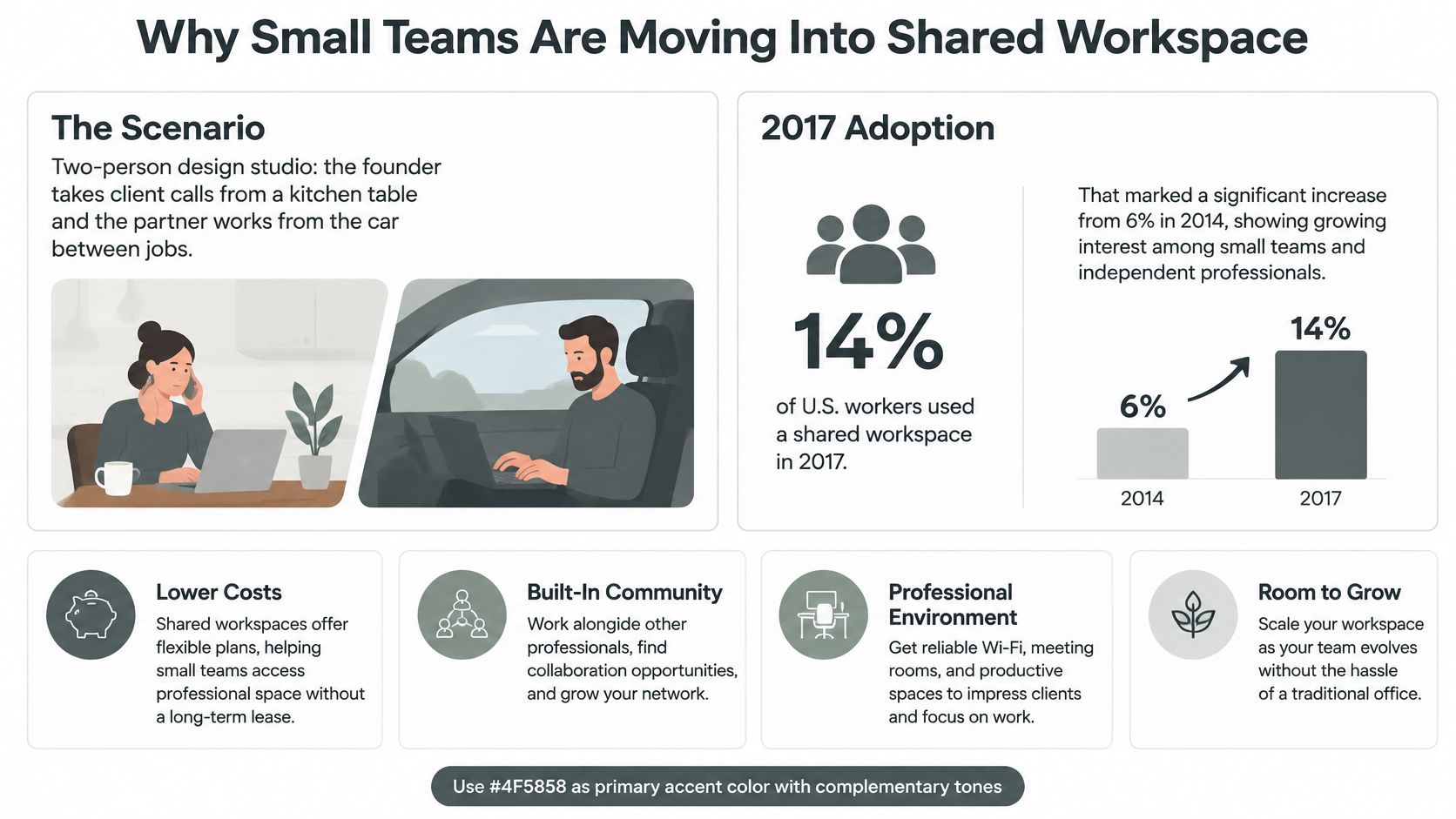
A two-person design studio can outgrow its makeshift routine before it needs a leased office. One partner takes client calls at the kitchen table; the other works from a car between jobs. Their problem is not a lack of desks. It is that work requiring focus or a client-ready setting keeps getting interrupted.
Coworking users often report better productivity and organization after moving from traditional offices, and some say they work with others more often. These are self-reported benefits, not evidence that a shared workspace causes higher earnings.
Buy relief from a specific constraint
For the studio, a professional meeting room can remove the scramble before a presentation. A reliable work destination can separate business hours from domestic life. Contact with other operators may lead to useful advice or introductions, but treat referrals as a possible benefit, not expected revenue.
The value depends on use. Someone who visits occasionally needs convenient booking and an easy arrival process. A daily user needs a workstation that supports sustained work. The same membership can suit one schedule and waste money for another.
Test the case against your own week:
Client readiness: How often do you need a room to welcome a client, present work, and discuss details privately?
Concentration: When does focus break down at home or in cafés, and which task gets delayed?
Working relationships: How often would another operator's perspective help you make a decision or move a project forward?
Community has value only if you take part. Decide whether you'll attend, introduce yourself, and follow up. Count the hours when the workspace helps you complete work that would otherwise stall, then compare that value with the membership cost.
A paid workspace earns its place by improving useful work hours, not by adding a change of scenery. An already-effective home routine may not need replacing.
Selection Criteria That Decide the Right Fit
Sort your requirements into must-haves and nice-to-haves before touring. For a business that regularly discusses client finances, a bookable room with a door is a must-have. A rooftop terrace isn't a substitute.
Use the same criteria for every option. Otherwise, you'll judge one building by its parking and another by its furnishings, then struggle to explain your choice.
Workspace selection criteria and red flags
Criterion | What to check | Red flag |
|---|---|---|
Location and access | Distance from clients, team and home, parking, transit | Commute longer than the meetings it supports |
Privacy and sound | Doors on meeting rooms, quiet-zone rules, booking policy | Only open tables available for calls |
Meeting capacity | Rooms bookable at your team size on the days you need them | Booking windows longer than a week when you need short-notice access |
Internet and equipment | Stated speeds, backup connection, printing and power at each seat | No backup line or unclear speed commitments |
Contract terms | Notice period, minimum term, day-pass and upgrade rules | Automatic renewal without clear notice |
Community and access | Opening hours, after-hours access, deliveries, events that fit your trade | Weekday daytime access for a team that works evenings |
Test the working conditions, not the tour
Visit at the hour you'd normally work. Sit in the actual room you'd use, open your laptop, and check whether you can connect power without moving furniture. During a short observation period, note nearby conversations, passing traffic, and whether anyone enforces the posted rules.
Ask the operator to demonstrate the booking system. A room shown on a tour isn't useful if members can rarely reserve it. Get clear answers about advance reservations, cancellations, recurring bookings, guest access, and charges when a meeting runs late.
For internet, distinguish guaranteed service from best-effort access. Test your normal video-call and file-transfer workflow, and ask what happens during an outage. A speed test alone won't tell you whether support is available when the connection fails.
Weight the trip you actually make
Location should reflect your most frequent journey. A prestigious address can still be a poor choice if your team spends its working time crossing town or clients can't find the entrance.
Contract flexibility matters especially while staffing and attendance patterns are unsettled. Read the renewal clause, notice method, deposit conditions, and upgrade rules rather than relying on a verbal assurance.
Write down your highest-priority criteria before visiting. A pleasant lobby shouldn't outweigh a missing meeting room.
Working Out Whether Membership Pays Off
Consider a hypothetical three-person consultancy that meets clients twice a week and hosts a monthly workshop. Its workspace calculation should start with those activities, not an assumption that every consultant needs a permanent desk.
Cost cuts both ways: CBRE's 2025 Americas Office Occupier Sentiment Survey found that half of small-company respondents with fewer than 500 employees didn't currently use flexible office space, and identified cost as both a reason to use it and a major deterrent. Flexible fees bundle expenses that a conventional tenant would otherwise pay separately.
Build an activity-based comparison
List the work. Log monthly solo-focus hours, client meetings, workshops, and preparation time.
Value travel. Add each option's travel hours multiplied by your chosen hourly value. Keep this opportunity cost separate from cash spending.
Price home working. Include business-related internet, equipment, and rooms rented for client visits.
Price a lease completely. Include furniture, internet, insurance, build-out, and deposit requirements. Show refundable deposits separately as cash tied up, not recurring expense.
Quote actual attendance. Price membership and pay-as-needed rooms around client days and room use, not just headcount.
Compare useful outputs. Calculate monthly totals, cost per client meeting, and cost per useful working hour.
Pilot before committing. Run the preferred arrangement for a three-month trial where terms allow, then compare actual use with your assumptions.
Monthly cost worksheet for each workspace option
Cost item | Home office |
|---|---|
Monthly base fee | Household costs only |
Internet, furniture and equipment | Business share of internet plus equipment purchases allocated over expected use |
Deposit, insurance and build-out | None for a new commercial lease; record any home-business insurance adjustment separately |
Client meeting room for client days | Rented per visit |
Commute time per month at your hourly rate | Travel hours for room visits × hourly value |
Cost per client meeting | Monthly client-facing workspace costs ÷ completed client meetings |
Duplicate the worksheet for each quoted option. Our guide to the true coworking space cost for your business can help you identify charges to request.
An unused membership is the cost mistake to guard against first.
Flexible space can make financial sense for sales meetings, recruiting, workshops, and recording without replacing every home-working hour. Buy access to valuable activities, not attendance you hope to achieve.
Setting Up Quiet, Meeting and Creative Zones
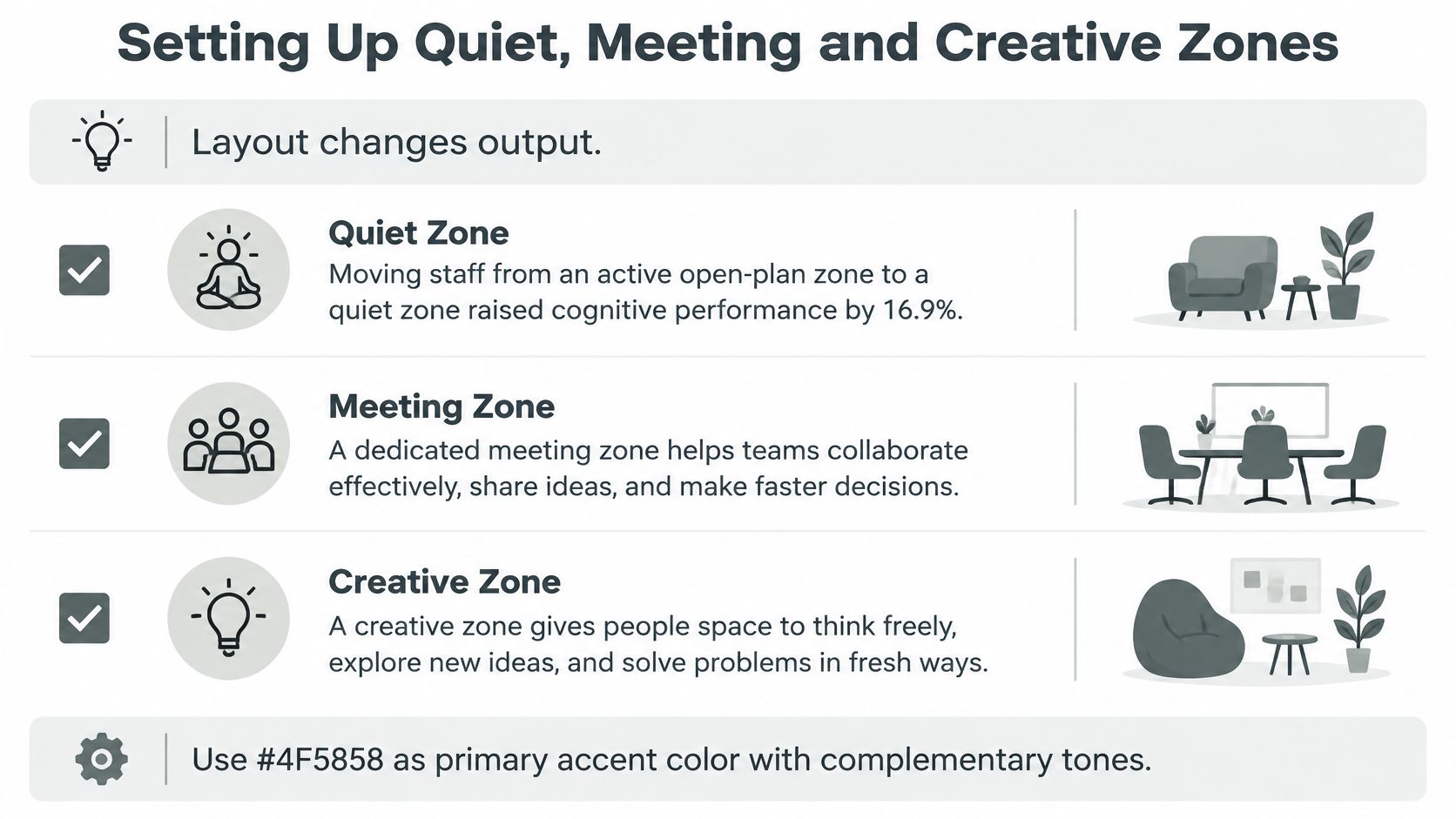
Layout changes output. In a controlled activity-based-workplace study available through PubMed Central, moving employees from an active open-plan zone into a quiet zone increased cognitive performance by 16.9%, while moving into individual workrooms increased it by 21.9%. The findings support matching room conditions to tasks rather than treating every seat as interchangeable.
Separate focus from conversation
Reserve enclosed rooms for finance, writing, coding, and confidential client calls. A lockable door protects access, but it doesn't establish acoustic privacy. Test whether ordinary speech remains intelligible outside before discussing sensitive information.
Give the quiet area explicit rules: no calls, no speaker audio, and conversations moved elsewhere. Place it away from entrances, kitchens, and the route to meeting rooms. Screens can reduce visual distraction, but they won't stop speech traveling over them.
Put group work in a collaboration room with absorptive ceilings or wall panels, appropriate door seals, and a whiteboard. Absorption reduces reflected sound inside the room; isolation limits sound passing into adjoining spaces. Decorative felt alone won't turn a meeting room into a recording booth.
Design creative space around the medium
For podcasting, prioritize sound isolation, quiet ventilation, microphone positioning, and monitoring through headphones. For photography, prioritize controllable light, safe equipment clearance, and suitable backgrounds. Natural light near windows helps visual production, but exterior noise may make the same position unsuitable for recording.
Consider professionally tuned sound masking for adjacent work areas rather than playing music to cover conversations. Validate both discussion comfort and individual concentration after installation. Our flexible office layout guide provides another way to think through room placement and circulation.
Noise deserves an operating budget, not just a design discussion: randomized experiments published by the American Economic Association found that a 7-decibel increase in workplace noise reduced productivity in a Nairobi textile training course by 3%, without changing measured effort.
Equip and measure each zone
Provide reachable power, monitor-ready desks, lockable storage, delivery lockers, printing, and whiteboards where meetings happen. Keep the coffee point away from focus desks so routine hospitality doesn't interrupt concentrated work.
Run a weekly room check:
Log conditions: Record background sound with a sound-level meter, occupancy, and booking type.
Check reverberation: Track room-acoustic measurements, using a qualified acoustician for dependable assessment.
Ask about distraction: Use the same short feedback questions so responses remain comparable.
Act on deterioration: Move the team, change adjacent bookings, or adjust room treatment when concentration falls.
Measure completed tasks and errors alongside comfort. A room can look calm while its users struggle to work.
Community Habits That Make Shared Space Work
More attendance doesn't automatically create better culture. Gallup's 2025 global findings put engagement at 31% for fully remote employees, compared with 23% for hybrid workers, while fully remote employees were more likely to report loneliness, sadness, and anger.
A shared workspace should offer useful contact without making constant sociability the price of entry. Someone finishing a difficult proposal shouldn't have to defend their decision to skip a networking session.
Make participation predictable and optional
Protect sensitive conversations. Keep performance reviews, pricing negotiations, and personal discussions in private rooms rather than communal lounges.
Schedule purposeful gathering. Set predictable collaboration days around decisions, project reviews, or workshops. Don't summon people just to recreate individual laptop work.
Give newcomers a host. Assign someone to explain room etiquette, make relevant introductions, and answer practical questions on arrival.
Make events accessible. Publish clear start and finish times, explain the format, provide seating and a quiet corner, and consider disability access before inviting people.
Include contractors and solo founders in relevant programming. They may need professional connection without belonging to an employer's internal team. Avoid events that assume everyone can stay late, drink alcohol, or participate in noisy group activities.
Measure useful connection
For hybrid meetings, share documents in advance and make sure remote participants can hear everyone, contribute, and access the same decisions. Rotate inconvenient meeting times where possible rather than repeatedly asking the same person to absorb the disruption.
Our guide to collaboration effectiveness focuses on making shared time produce useful work. Apply that discipline to community programming too: record introductions that led to follow-up, projects started, and referrals received, without turning private relationships into public scoreboards.
A full room tells you people attended. It doesn't tell you whether attending helped.
After a month, ask members which room helped them most, whether they met someone useful, and what prevented participation. Use the answers to change the schedule, hosting approach, or room allocation, not just to push for more attendance.
How Freeform House Applies These Criteria in Jenks
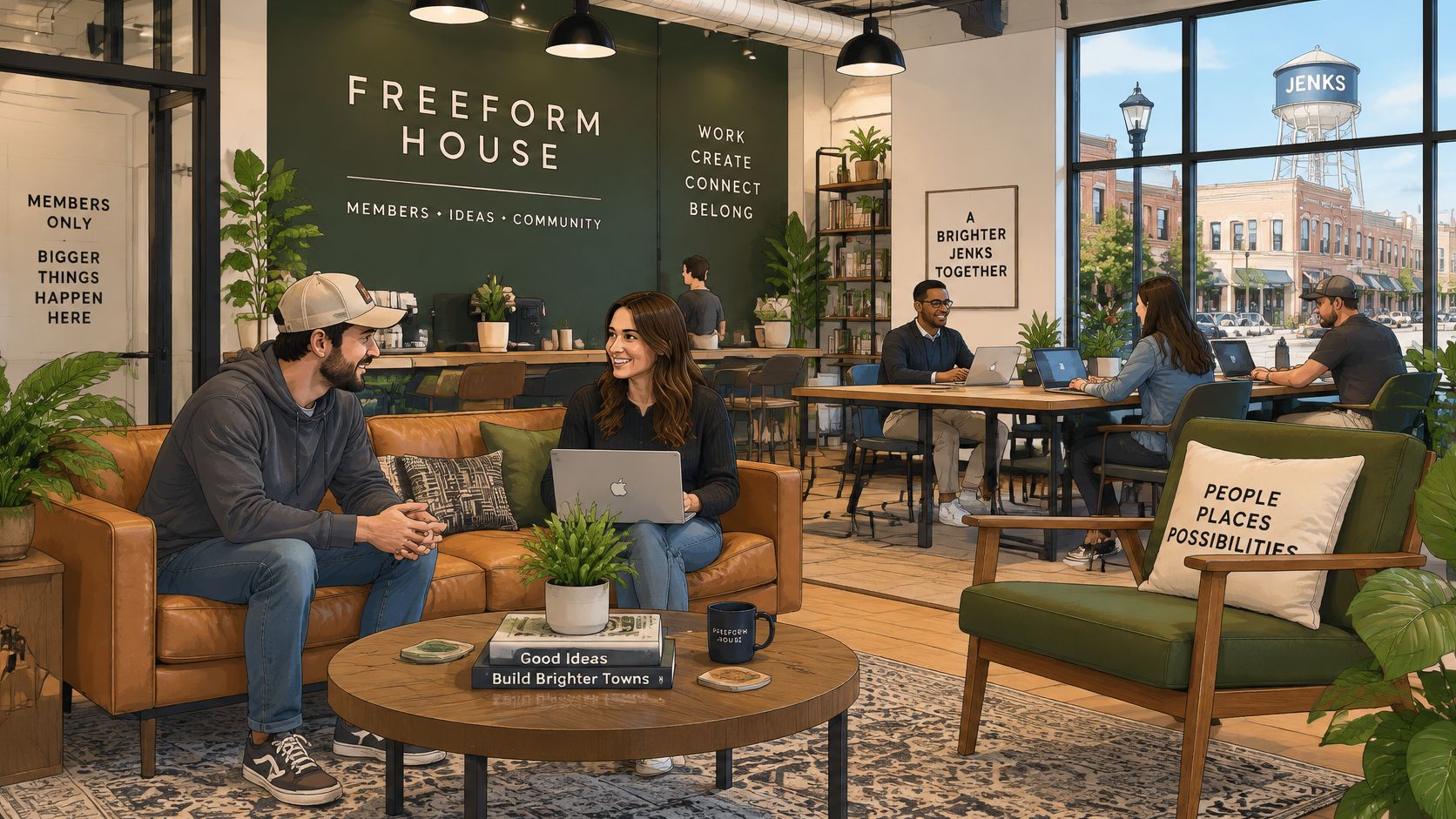
A workspace earns its cost through useful working hours, focused work, and meetings that run well. In downtown Jenks, Freeform House offers members private workspaces, open collaboration areas, hot desks, and reservable conference rooms across three floors of curated spaces. The right fit depends on which of those spaces your team will use.
Apply the criteria to an actual visit
Location and access start with your route, not a downtown label. Travel from your usual starting point, locate parking, and walk the entrance route a first-time client would take. A local address may be convenient, but your own journey is the useful test.
Privacy and sound require an occupied-space check. The main area of The Thomas Room has a no-call or picture policy for enhanced focus. Ask how the policy applies during the hours you expect to work, and consider whether the room's rules suit your team's calls and photography needs.
For meeting capacity, compare your calendar of client visits with conference-room availability. For internet and equipment, bring the laptop, adapters, and presentation setup you normally use. For contract terms, read the membership agreement and clarify renewal, cancellation, guest, and booking charges.
Community and access also affect value. Review the event calendar and after-hours arrangements, then weigh them against the time your business can realistically commit.
Look beyond the building
Creative teams should check production needs in person rather than assume a room's appearance guarantees suitable recording or photography conditions. Freeform House members can rent in-house podcast and photography facilities at First North. Its podcast booth has professional-grade microphones, soundproofing, and editing software. Confirm that the equipment and booking arrangements fit your intended project.
Freeform House's mission is to rejuvenate Main Street America by blending technology with physical spaces and local retail. Its member offering combines dining, accommodations, workspaces, and social events, with food and coffee delivered from local establishments to members' spaces. Judge these features by the practical outcomes they support: time saved, focused hours gained, and meetings or creative work completed.
Treat Freeform House as one option to assess against your team's needs. A good-looking room or a long amenity list matters less than whether the space supports your actual work at a cost your business can justify.
Choose and Test Your Workspace This Month
Make the decision from evidence you can collect, rather than continuing to browse attractive interiors.
Shortlist the best-fitting types. Pick two options that match your headcount, client-meeting pattern, and privacy needs.
Complete the worksheet. Use real spending and logged activity from your last three months, including travel and client-meeting days.
Visit during working hours. Test each shortlisted location at the time you'd attend and score it against your top three criteria.
If downtown Jenks fits, include Freeform House. We offer private workspaces, open collaboration areas, hot desks, and reservable conference rooms. Our Freeform Room has bathrooms and lockers for DoorDash, Amazon, mail, or personal storage, and can serve as a secondary address.
Leave with written answers
Confirm which rooms are enclosed and bookable, reservation lead times, protection from nearby conversation, after-hours access, and the event schedule. Get the applicable room policies, fees, and membership terms in writing rather than inferring them from room names or photographs.
Decide within two weeks, then reassess after 90 days using your room logs, completed meetings, and useful working hours. These are decision deadlines, not reasons to accept a contract that fails your requirements.
Freeform House combines workspaces, meeting facilities, and a members-only community for professionals who need more than a desk. Visit Freeform House to arrange a walkthrough, test the rooms against your working routine, and confirm the access and booking terms that matter to your business.
Comments