What Is the True Coworking Space Cost for Your Business

When you first start looking into coworking, the pricing can feel a bit like a new language. You’ll see everything from day passes to private offices, and the costs can seem all over the map.
In reality, a typical coworking space cost runs anywhere from $30 for a day pass to about $225 per month for a flexible "hot desk" membership. Of course, the final price tag always comes down to your specific needs, where you're located, and the kind of amenities you’re getting.
Understanding the True Cost of a Coworking Membership
Think of choosing a coworking plan like picking a phone plan—you wouldn't pay for unlimited international data if you only make local calls, right? The cost of a coworking space isn't just one number; it's a whole spectrum of options designed to fit how you actually work.
Whether you're a freelancer who just needs to escape the house a few times a month or a growing startup in Jenks that needs a private home base, the goal is to find a workspace that genuinely fuels your productivity.
A Look at National Averages
So, what should you expect to pay? Let's ground ourselves with some real numbers. The market has become surprisingly stable and accessible, putting great workspaces within reach for more people than ever.
Across the U.S., the median cost for a standard hot desk membership has settled around $225/month. If you just need a place for the day, expect to pay about $30 for a day pass. Need to book a professional spot for a client meeting? That’ll typically run you $45/hour. These figures show a healthy, balanced market, meaning you can find a quality space without worrying about wild price swings.
This infographic breaks down those common price points visually.
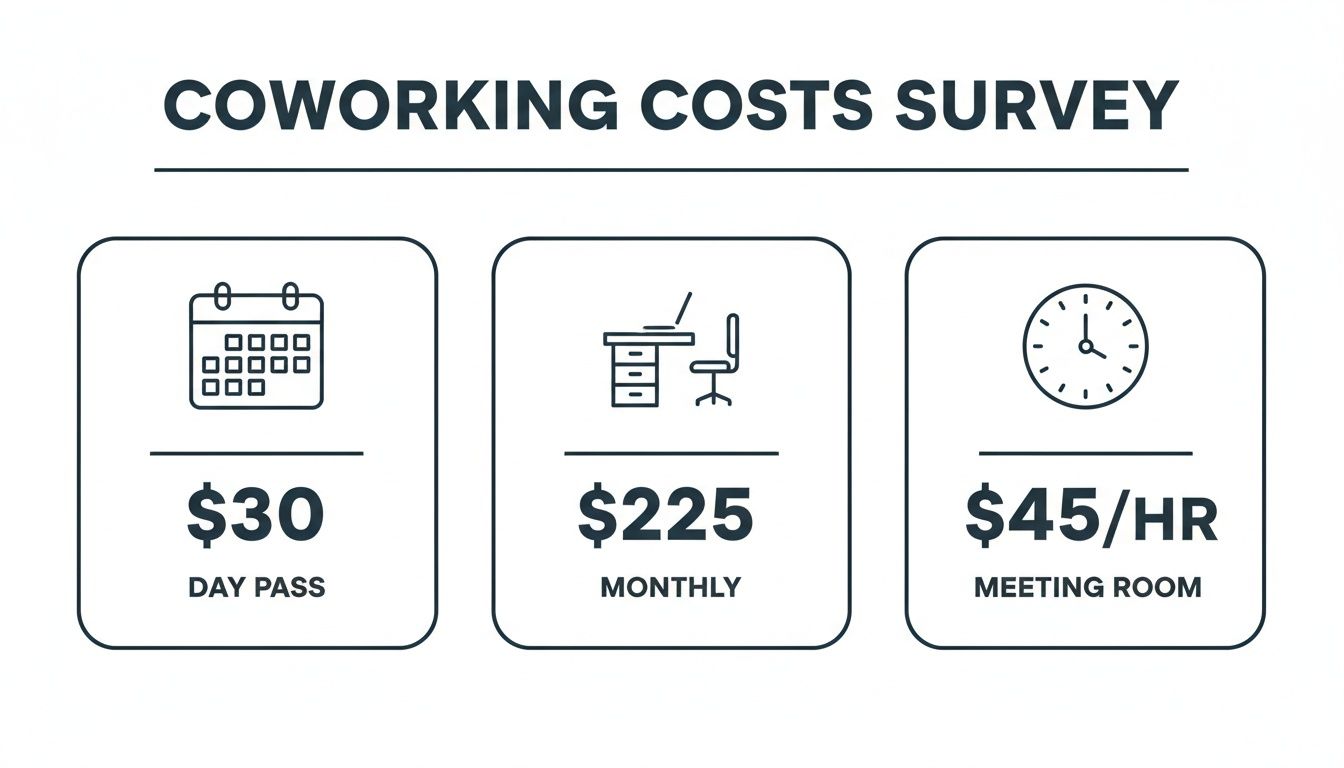
These three entry points—daily, monthly, and hourly—are the core of the coworking model. Understanding these benchmarks is your first step in figuring out if a space is priced fairly and what kind of value you're getting for your money.
For a deeper dive into the most flexible option, check out our guide to the co-working space day pass. It’s the perfect way to test the waters.
Coworking Membership Tiers at a Glance
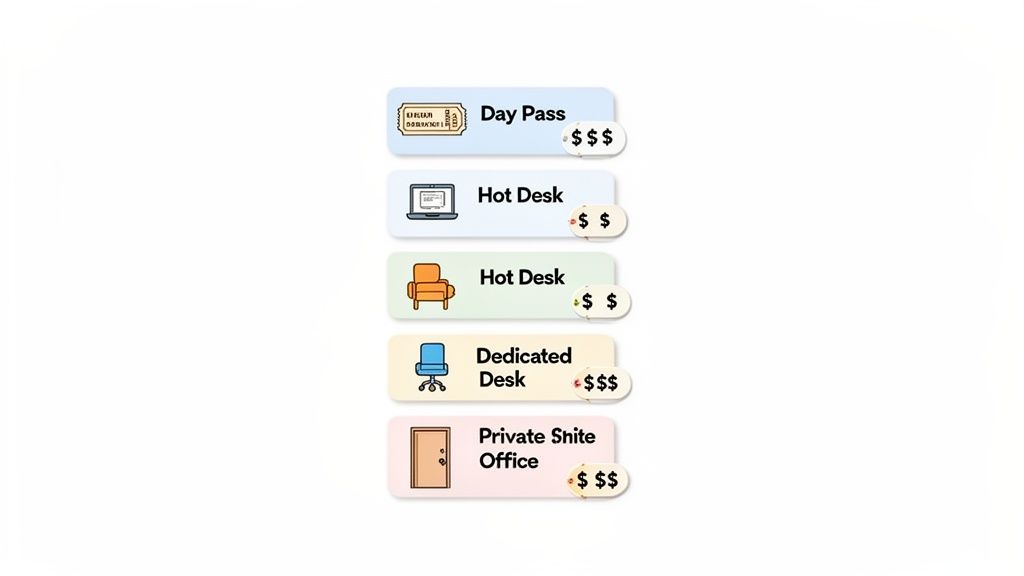
To make it even clearer, here's a quick rundown of the common membership types and their national median costs. This should help you quickly pinpoint the best fit for your work style and budget.
Membership Type | Best For | Typical National Median Cost |
|---|---|---|
Day Pass | Freelancers, remote workers, or anyone needing a temporary workspace. | $30 per day |
Hot Desk | Individuals who need regular office access but don't require a fixed spot. | $225 per month |
Dedicated Desk | Professionals who want a permanent, personal desk in a shared space. | $385 per month |
Private Office | Small teams, startups, or businesses needing a secure, enclosed workspace. | $400 - $1,500+ per month |
Each of these tiers is built for a different kind of professional. Knowing where you fit helps you avoid overpaying for features you'll never use while making sure you get exactly what you need to do your best work.
Choosing Your Perfect Workspace Model
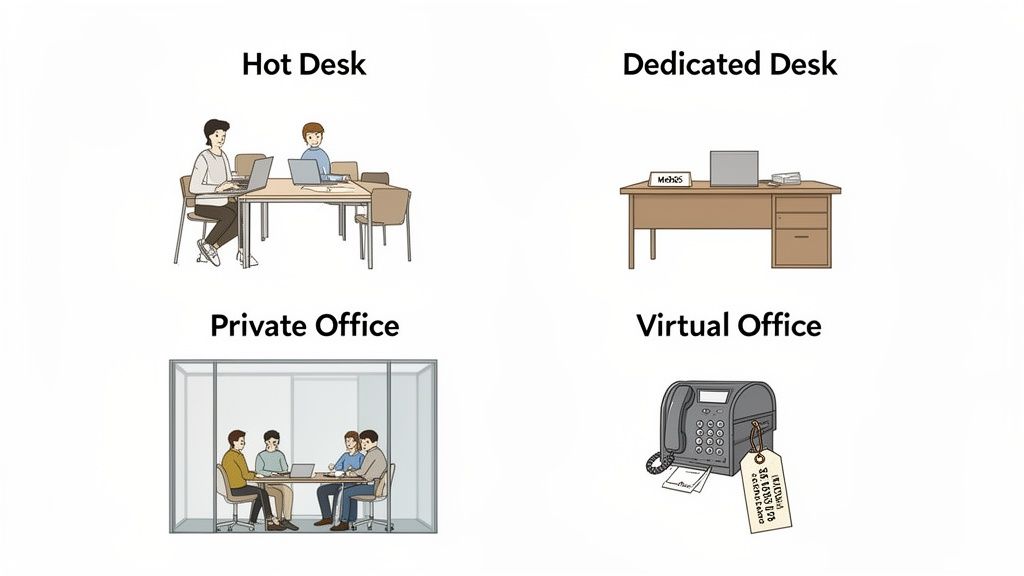
Before you can figure out the coworking space cost, you first need to decide which type of workspace actually fits your professional life. Not all memberships are created equal, and the best choice is always the one that matches how you work, collaborate, and plan to grow. Picking the right model means you only pay for what you'll genuinely use.
Think of a Hot Desk membership like a flexible pass to a really great gym. You get to use all the top-notch shared equipment and common areas whenever the mood strikes, making it perfect for dropping in to get some focused work done. It’s a fantastic choice for freelancers, remote workers, or anyone who doesn't need a permanent spot but loves the energy of being around other people.
This setup usually comes with the lowest monthly cost while still giving you access to premium amenities and a professional setting. You can pick a new seat every day, which is great for finding fresh perspectives and sparking those random, valuable connections with other members.
Securing Your Personal Spot
For those of us who need a bit more consistency, a Dedicated Desk is like having a reserved seat at your favorite theater—it’s always yours, every single time. This option gives you a permanent home base inside the shared workspace where you can leave your monitor, family photos, and favorite pens.
A dedicated desk offers the perfect balance between the community benefits of an open-plan office and the stability of having your own personal workspace. It's a powerful step up for professionals building a routine.
This model is practically built for the solo creative in Jenks or the consultant who needs a reliable setup without fail. It cuts out the daily hassle of finding a spot and getting everything plugged in, so you can walk in and get straight to work in a space that feels like your own.
Options for Teams and Remote Presence
As your business gets bigger, your workspace needs will change. That’s where Private Offices come into the picture. These are fully enclosed, secure spaces made for teams of two or more, offering the privacy to hash things out without distraction while still being part of the larger community vibe. A growing Tulsa startup, for example, could use a private office as its first real headquarters, getting the best of both worlds—focused collaboration and access to networking events.
And for those who just need a professional mailing address without a physical desk, a Virtual Office is the perfect solution. This kind of membership typically includes:
A prestigious business address to put on your website and marketing materials.
Mail handling services to keep your business mail sorted and secure.
Access to meeting rooms at a member discount for when you need to impress a client.
Each of these models—from the drop-in hot desk to the established private office—serves a unique purpose. Our guide on finding the perfect co-working space can help you dive deeper into which option really clicks with your business goals. When you match your workflow to the right membership, you make sure every dollar you spend is an investment in your own success.
Understanding What Drives the Price Tag
Ever wonder why a coworking space in a bustling downtown costs more than one tucked away in a quiet suburb? The coworking space cost isn’t just a random number. It’s shaped by a few key factors that directly tie into the value you get. Once you understand these variables, you can see beyond the monthly fee and recognize the true return on your investment.
When you're comparing your options, three things consistently drive the price: location, amenities, and how long you plan to stay. It’s just like a premium coffee shop in a prime spot charging more for a latte. A workspace in a sought-after area offers more than just a desk—it provides access, prestige, and a whole lot of convenience.
This dynamic plays out on a global scale. The worldwide coworking market is on track to hit a staggering US$20.96 billion in 2025. You’ll see major hubs like NYC charging anywhere from $250–$400 per month just for a hot desk. Meanwhile, prices in growing cities are more moderate, and suburban spots often dip to between $100–$200.
This explosive industry growth, pushed forward by the 77% of companies now using a hybrid work model, really highlights how location creates different tiers of value. You can dive deeper into these key trends shaping the flexible workspace industry.
The Big Three Price Influencers
Let's break down the core components that determine what you'll actually pay for a membership.
Location, Location, Location: It’s the oldest rule in real estate for a reason. A workspace in a central, high-traffic area like Jenks' 10 District simply costs more to operate. That premium gets passed on to members, but it comes with real-world perks like walkability, being closer to clients, and having a business address that carries weight.
Amenities and Services: The quality and range of amenities are huge differentiators. Sure, basics like high-speed Wi-Fi and coffee are pretty much standard these days. But premium spaces go way beyond that.
Contract Length: How long you commit to a space almost always impacts your monthly rate. Longer agreements typically come with some nice discounts because they give the operator stability—a classic win-win.
Beyond the Basics: Amenities That Add Real Value
Free Form House is envisioned as a premier, membership-based club in the heart of Jenks, Oklahoma's 10 District downtown. Comparable to the renowned SoHo House, it offers more than just a social club. Members can take advantage of co-working spaces and a dynamic community hub designed for collaboration and connection. A premium workspace like this justifies its cost by providing an environment that actively helps you get work done.
The real value of a premium workspace isn't just in the physical space, but in the curated atmosphere that fosters productivity, creativity, and connection. It’s an investment in your professional image and output.
Think about the unique offerings that can make a real difference in your day-to-day:
An in-house podcast studio for creating professional-grade content.
On-demand meal and coffee delivery from top-notch local partners.
An authentic, inspiring atmosphere that genuinely impresses clients.
These are the kinds of features that transform a simple membership fee into a strategic business advantage. When you choose a space that provides a clear return through better productivity and a stronger community, you’re making a smart investment in your own growth.
Coworking vs. a Traditional Office Lease
Choosing where your business calls home is a massive decision. For a long time, the traditional office lease felt like the only real option, but coworking spaces have completely changed the game. The choice is no longer just about square footage; it's about the total cost, the commitment, and the kind of flexibility your business actually needs.
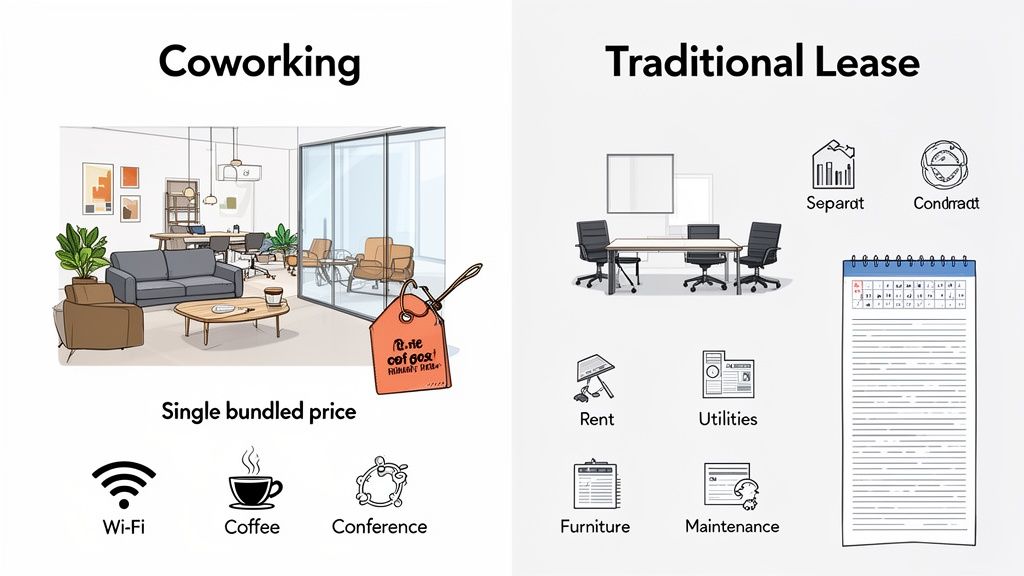
A traditional lease seems simple enough on the surface—you sign on the dotted line and pay rent for an empty box. But that monthly rent check? It's just the tip of the iceberg. It’s the entry fee to a long list of separate, often unpredictable expenses that can quickly pile up and tie up your cash.
The Hidden Costs of a Traditional Lease
Signing a conventional office lease means you're not just a tenant; you're suddenly a building manager. Beyond the base rent, you're on the hook for a whole slew of responsibilities, each one a separate bill and a new vendor to manage.
Just think about what it takes to get that empty space up and running:
Utilities: You’re paying for electricity, water, heating, and cooling. Good luck predicting what those bills will look like six months from now.
Internet and IT: Setting up and maintaining a reliable, business-grade internet connection is surprisingly complex and expensive.
Furniture and Fit-Out: Every single desk, chair, and lamp has to be bought and brought in. That's a huge upfront capital expense before you've even opened for business.
Maintenance and Repairs: When the AC breaks in July or a pipe starts leaking, that's your problem—and your expense—to solve.
These extra costs can easily tack on another 30-50% to your base rent every single month. This model not only requires a ton of upfront cash but also locks you into an inflexible agreement, usually for three to five years. If you're curious about breaking free from that kind of long-term lock-in, check out the ultimate guide to month-to-month office space.
The All-Inclusive Advantage of Coworking
Coworking flips that entire model on its head. Instead of a dozen different bills, you get one predictable monthly payment that covers almost everything. This radically simplifies your budget and frees up your time and money to focus on what really matters—growing your business. A premium membership club like Free Form House isn't just about renting a desk; it's a smarter financial strategy.
The real power of the coworking model is its ability to transform a dozen unpredictable operational costs into one clear, consistent investment in your productivity and professional presence.
To really see the difference, it helps to put the two side-by-side. The table below breaks down how a coworking membership offers a much more streamlined and agile solution for modern businesses.
Cost and Commitment: Coworking vs. Traditional Lease
Expense Category | Coworking Membership | Traditional Office Lease |
|---|---|---|
Initial Outlay | First month's fee | Large security deposit + first/last month's rent |
Monthly Costs | One all-inclusive fee | Base rent + separate bills for utilities, internet, etc. |
Furniture | Fully furnished and included | Significant upfront purchase required |
Maintenance | Handled by the space operator | Your responsibility and cost |
Contract Term | Flexible (monthly to yearly) | Rigid (typically 3-5+ years) |
Amenities | Included (coffee, meeting rooms, etc.) | Must be sourced and paid for separately |
When you look at it this way, the choice becomes clearer.
Ultimately, choosing coworking is about more than just trimming your overhead. It's about gaining financial predictability and operational agility. It allows businesses in communities like Jenks and Tulsa to thrive without being weighed down by the heavy, inflexible burdens of a traditional lease.
Calculating the Strategic Value of Your Space
Cost is what you pay. Value is what you get. When you're looking at the coworking space cost, the real conversation isn't about the number on an invoice; it's about the return on your investment. The most powerful benefits often aren't line items at all, but strategic advantages that fuel growth, creativity, and connection.
The right workspace becomes an active partner in your business. It provides a professional backdrop that elevates your brand, an energetic atmosphere that boosts productivity, and a built-in community that can lead to some truly unexpected opportunities. These are the intangible returns that define a space’s real worth.
Suddenly, that monthly fee transforms from a simple expense into a strategic investment—one that pays dividends long after the invoice is filed away.
Beyond the Desk: The ROI of Community and Collaboration
One of the biggest—and hardest to quantify—benefits of a great coworking space is the power of spontaneous collaboration. Working from home or a coffee shop can feel like you're on an island, but a shared workspace puts you in the room with other ambitious professionals.
A graphic designer might strike up a conversation with a web developer over coffee, and just like that, a new client referral is born. An accountant could offer some quick advice to a startup founder, sparking a long-term professional relationship. These are the kinds of connections that simply don't happen in isolation.
The true value of a shared workspace lies not just in the amenities it offers, but in the community it builds. This environment turns a simple membership into an engine for new business, creative energy, and a stronger professional network.
For a Jenks-based marketing agency, a membership at a premier spot like Free Form House is so much more than just office space. It’s a central hub to host client meetings in an impressive setting, record podcast episodes in a professional studio, and connect with other local entrepreneurs. That single fee directly translates into new business leads and a stronger foothold in the local community.
Measuring the Intangibles
So, how do you actually put a number on things you can't easily measure? Start by asking strategic questions that connect the membership cost to real business outcomes.
Productivity Gains: How much more focused work can you accomplish in a professional environment, free from the distractions of home life? Even a 10% increase in efficiency can have a huge impact on your bottom line.
Brand Perception: What’s the value of meeting a high-profile client in a beautifully designed space versus a noisy coffee shop? A strong first impression can be the deciding factor in landing a major contract.
Networking Opportunities: If your membership leads to just one new client or collaborative project per year, has it paid for itself? For many professionals, the answer is a resounding yes.
When you look at the coworking space cost through this lens, you move beyond a simple price comparison. You start to see your workspace as a critical tool for building your business, enhancing your brand, and becoming a more integrated part of your local professional ecosystem.
How to Find the Best Coworking Value
Getting the best workspace at the right price isn’t just about finding the cheapest option. It’s about being smart and informed. The best value is the one that gives your business the biggest strategic boost, and figuring that out starts long before you ever sign on the dotted line.
The single most important thing you can do? Take a real tour. In person. A website can show you pretty pictures, but it can't tell you what a space feels like. A visit lets you experience the atmosphere, check the Wi-Fi speed, and see if the community's vibe matches your own. This is your chance to ask the nitty-gritty questions that go beyond the marketing brochure.
While you're there, don’t be shy. Ask about any introductory offers or discounts for committing to a longer membership, like a full year. Space operators often reward loyalty with better rates because it gives them predictable income.
Do Your Homework Before You Sign
You need to understand the full picture of your investment. That means digging into the membership agreement to spot any extra fees that might not be obvious at first glance.
Usage Overage: What's the penalty if you go over your allotted conference room hours?
Printing Costs: Are printing and scanning included, or are they pay-per-page?
Guest Policies: Will you be charged for bringing a client or collaborator into the space for a meeting?
Thankfully, the coworking market is no longer the Wild West. Prices have stabilized, with national medians holding steady at around $225 per month for an open membership and $30 for a day pass.
This means a premium space like Free Form House, with its unique amenities, is right in line with national trends, offering a touch of affordable luxury for professionals in Jenks and Tulsa. You can learn more about these coworking statistics and see how they point to a balanced market. Arming yourself with this knowledge lets you negotiate confidently and find a membership that truly works for your budget.
Still Have Questions About Coworking Costs?
You've got the basics down, but a few questions always pop up when you're getting serious about choosing a space. Let's tackle the ones we hear most often so you can move forward with confidence.
Are There Hidden Fees I Should Watch Out For?
The best coworking spaces are built on trust and community, so they’re usually upfront with all-inclusive pricing. That said, it's always smart to ask. Some spots might have extra charges for things like printing beyond a certain limit, booking conference rooms after you've used your included hours, or even mail handling.
Before you sign anything, just ask the community manager for a clear breakdown of what’s included and what’s not. A transparent space will have no problem walking you through every detail.
Can I Negotiate the Price of a Membership?
It depends. For a single monthly hot desk, the price is usually firm. But if you’re looking at a longer commitment—say, a 12-month contract or a private office for your team—there’s often room to talk. Operators value the stability that comes with long-term members.
It never hurts to ask about a discount for paying for a full year upfront or for bringing in a team of three or more. The worst they can say is no, but you just might get a better deal.
A coffee shop feels free, but the hidden costs—daily purchases, unreliable Wi-Fi, lack of privacy, and constant distractions—can harm your productivity and professional image. A coworking membership is a far more cost-effective choice for serious work.
Is Coworking Cheaper Than Using a Coffee Shop?
On the surface, posting up at a café seems like a freebie. But when you really compare the coworking space cost, the story changes. Those daily lattes and lunches add up fast, the Wi-Fi is a gamble, and trying to take a professional call with a barista shouting drink orders is next to impossible.
A real coworking membership gives you a secure, professional home base with business-grade internet and all the amenities you need to actually get work done. When you factor in the massive boost to your focus and professional image, the value is a no-brainer.
Ready to find a workspace that gives you more than just a desk? Come see what the creative and collaborative spirit at Free Form House is all about. It's a central gathering spot aimed at fostering a creative and cooperative spirit within our local community. Check out our memberships and find your new professional home at https://freeform.house.
Comments