Boost Collaboration Effectiveness in Local Teams

A local team can look busy all day and still finish with no clear decision, no accountable owner, and no protected time to do the work. A Jenks business owner might move between Slack notifications, a video call, a client request, and a shared document, only to discover that three people solved the same problem while an important follow-up disappeared.
That gap is the heart of collaboration effectiveness. Effective collaboration isn't about adding more meetings or making every workspace more social. It's about creating the right conditions for people to share useful information, make decisions together, complete agreed actions, and still have enough uninterrupted attention to produce quality work.
For executives, small-business owners, and creative professionals in Jenks and the Tulsa area, the practical question is simple: How can a team connect intentionally without turning every hour into coordination time? The answer involves better operating agreements, clearer measures, and spaces designed for both conversation and concentration.
A Tuesday in Jenks and the Real Cost of Disconnected Work
By midmorning, a local entrepreneur has already answered messages from a sales partner, joined a Zoom meeting, checked a client revision, and moved between several projects. The team discussed a launch date, but nobody wrote it down. One person assumes the client approved the copy. Another is waiting for design files. The owner notices the problem only when the rescheduled client call arrives and no one knows who should lead it.
The visible symptoms are familiar:
Dropped decisions: People leave the same conversation with different interpretations.
Duplicated effort: Two colleagues create overlapping work because ownership stayed vague.
Delayed follow-through: A task appears in a chat thread but never becomes an accountable action.
Quiet isolation: Each person works hard while missing the context needed to make good decisions.
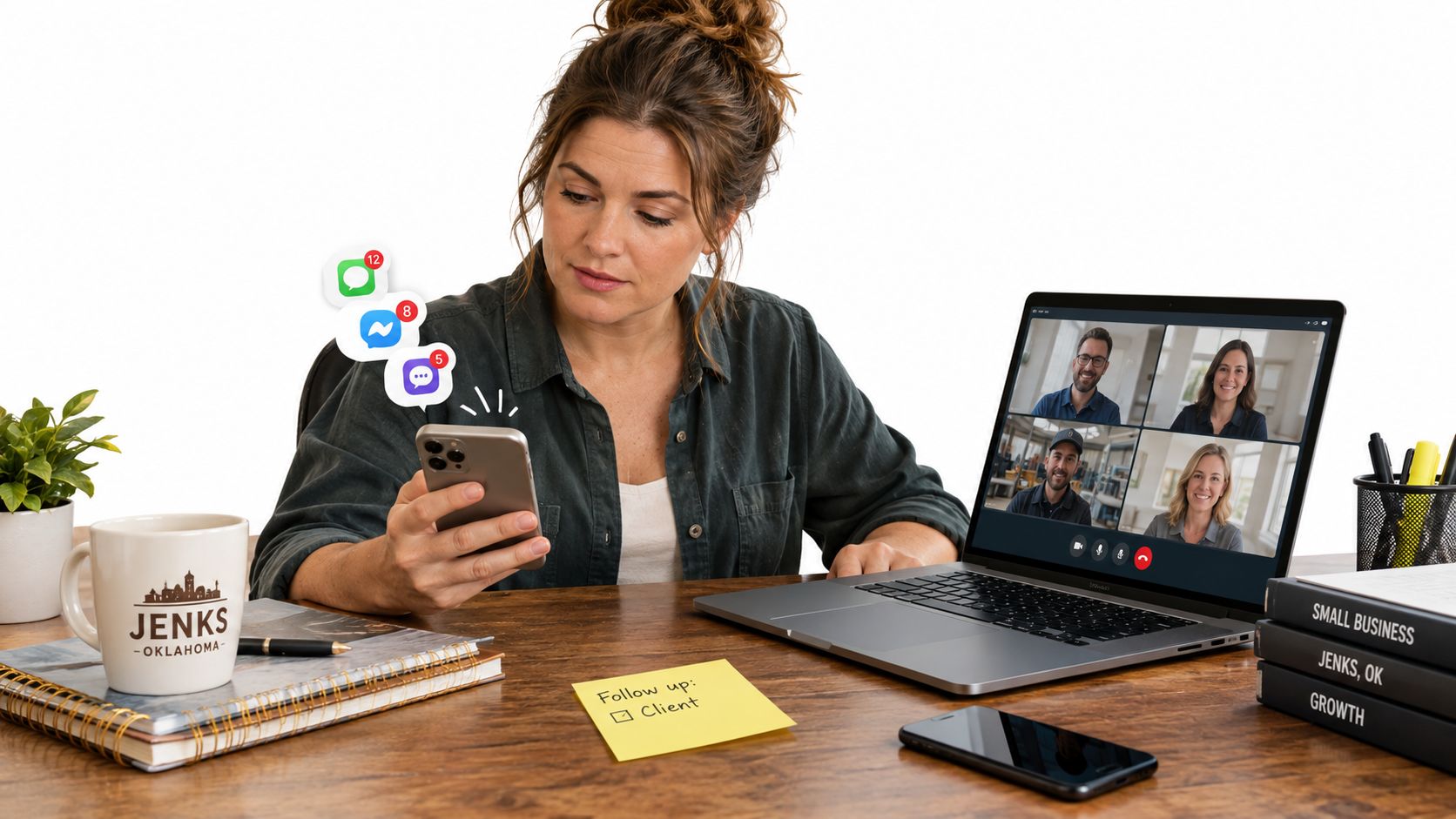
The problem isn't a lack of effort. People in this situation are generally trying to be responsive. The problem is that responsiveness has replaced shared understanding. A quick reply can move information, but it doesn't always explain how that information changes priorities, decisions, or next steps.
Practical rule: If a conversation doesn't produce a decision, an owner, or a useful exchange of knowledge, it may be activity rather than collaboration.
Local teams often need both a professional setting and a repeatable social rhythm. A shared gathering place can help people build relationships, but networking works best when introductions lead to useful conversations and future action. See local networking events in Jenks for one example of how recurring community contact can support that rhythm.
The rest of the work is deliberate. Define collaboration effectiveness in observable terms, measure its quality, protect focus, and design physical or virtual environments around the task at hand. The aim isn't to fill a calendar. It's to help a team produce decisions, complete work, and maintain the relationships that make future cooperation easier.
What Collaboration Effectiveness Actually Means
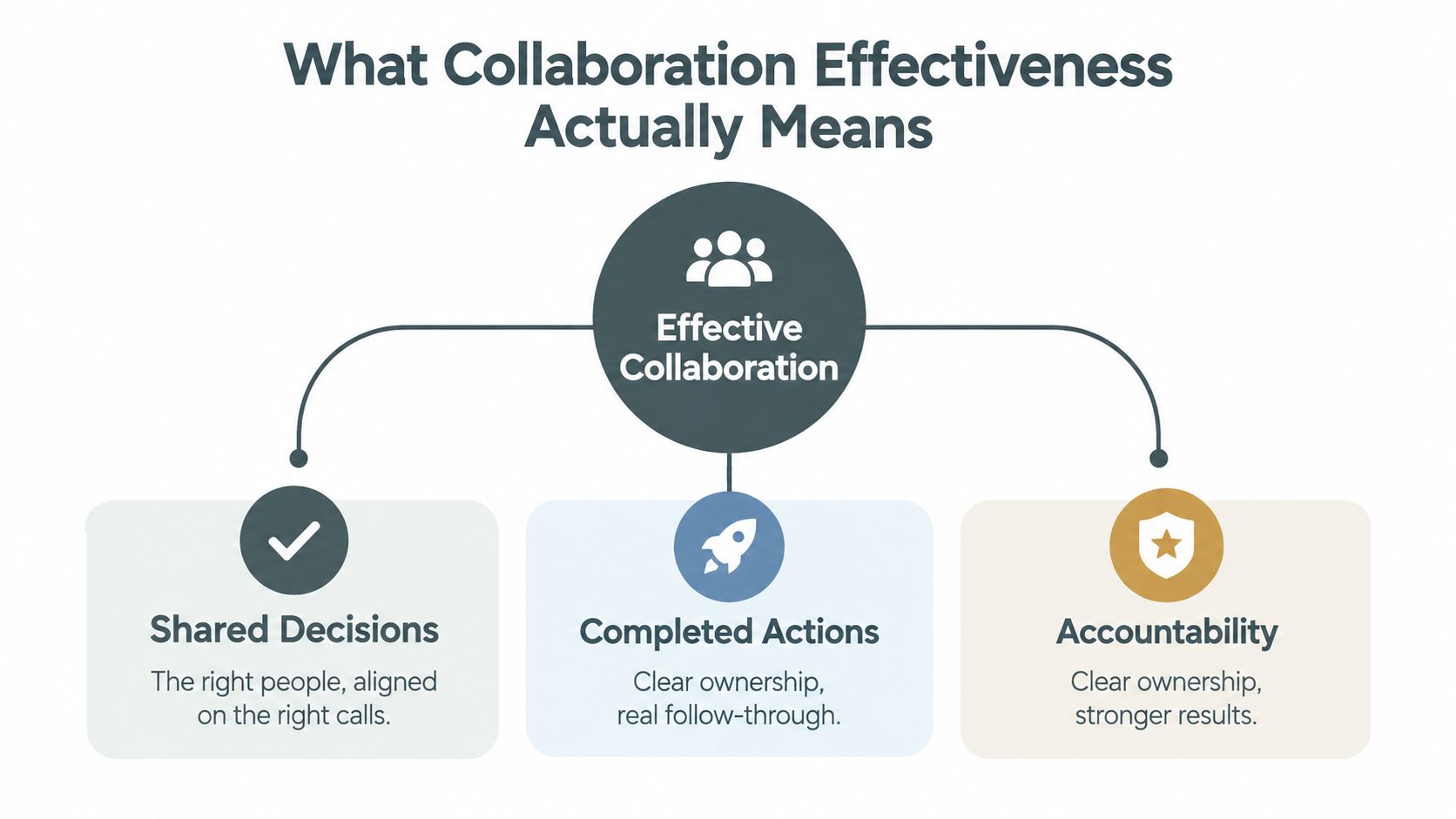
Collaboration effectiveness is the reliable production of shared decisions, completed actions, and mutual support among people who depend on one another. The definition matters because message volume can look impressive while outcomes remain weak.
Consider a kitchen brigade. Each person needs to understand the menu, the timing, the order of service, and the substitutions available when an ingredient changes. The kitchen doesn't succeed because every cook speaks constantly. It succeeds because the team shares a working mental map and knows how new information affects execution.
A strong team does the same thing. Someone brings customer feedback, another explains a production constraint, and a third connects both facts to the launch plan. The group doesn't merely exchange information. It explains, integrates, and applies that information.
The two forces every team must balance
Intentional connection gives people access to context, expertise, encouragement, and challenge. Protected focus gives them the mental space to turn that context into finished work. A team that has only connection spends its energy coordinating. A team that has only focus can miss important information and lose the trust built through regular contact.
You can test the balance with three questions:
Shared decisions: Do the relevant people understand what was decided and why?
Completed actions: Does each decision become visible work with a clear next step?
Accountability: Can everyone identify the person responsible for moving that step forward?
If the answer to any question is no, adding another channel probably won't solve the problem. The team needs a better format, clearer ownership, or a setting that supports the work.
Watch the explanation here:
A useful collaboration design therefore starts with the job, not the room or the software. A workshop needs synthesis. A private call needs concentration. An executive decision needs candor and a reliable record. A community gathering needs enough openness for relationships to form without forcing every interaction into a business transaction.
The Three Indicators That Predict Real Results
A small team doesn't need a complicated dashboard to understand collaboration effectiveness. It needs indicators that reveal whether people are making sense of information, communicating candidly, and retaining enough attention to act on decisions.
Communication quality
The strongest signal isn't how often people communicate. A meta-analysis of team-communication research found that information elaboration, meaning the process of explaining, integrating, and applying task-relevant information, predicts team performance more strongly than communication frequency. The relationship was stronger in familiar, face-to-face teams, as reported in the team communication meta-analysis.
A useful diagnostic asks: Did the team explain what the new information means for the decision? A status update says that a client changed the brief. High-quality communication connects that change to scope, timing, resources, and ownership.
Planning sentence: “We will judge communication by decision clarity and rework, not by messages sent or meetings attended.”
Psychological safety
People collaborate effectively when they can challenge an assumption, admit uncertainty, share an unfinished idea, or report a problem before it grows. Psychological safety is therefore an operating condition, not a vague feeling.
A randomized controlled trial involving approximately 7,000 employees across 1,000 teams found that a leadership intervention focused on individual employee needs increased team psychological safety by 1.82 points, equivalent to a 2.2% increase relative to the control-group baseline, according to the published study on psychological safety and cooperation. Leaders can make this practical by inviting dissent, responding constructively, and recognizing useful corrections.
Planning sentence: “We will make it safe to raise risks early by inviting every voice and recording how concerns change the decision.”
Protection of focus
Collaboration has an interruption cost. Available recent data indicates that heavy collaboration users can experience roughly 275 interruptions per workday, while more than 10 weekly meeting hours correlate with lower engagement, less deep-work time, and longer workdays, as summarized in research on cross-team collaboration metrics.
Track whether people can complete meaningful work after the meeting ends. Count protected focus blocks, note after-hours spillover, and ask whether urgent requests are being confused with optional participation.
Planning sentence: “We will protect uninterrupted work and treat interruption cost as part of collaboration performance.”
Teams can also make this visible through member-support practices that help people find expertise without creating another recurring meeting. A simple member support service approach can connect a question to the right person while preserving attention for everyone else.
Why More Collaboration Is Not Always Better
More interaction feels safe because it signals involvement. More meetings suggest alignment. More channels promise access. Yet a team can increase all three and still make slower decisions, interrupt focused work, and exclude people who aren't in the room.
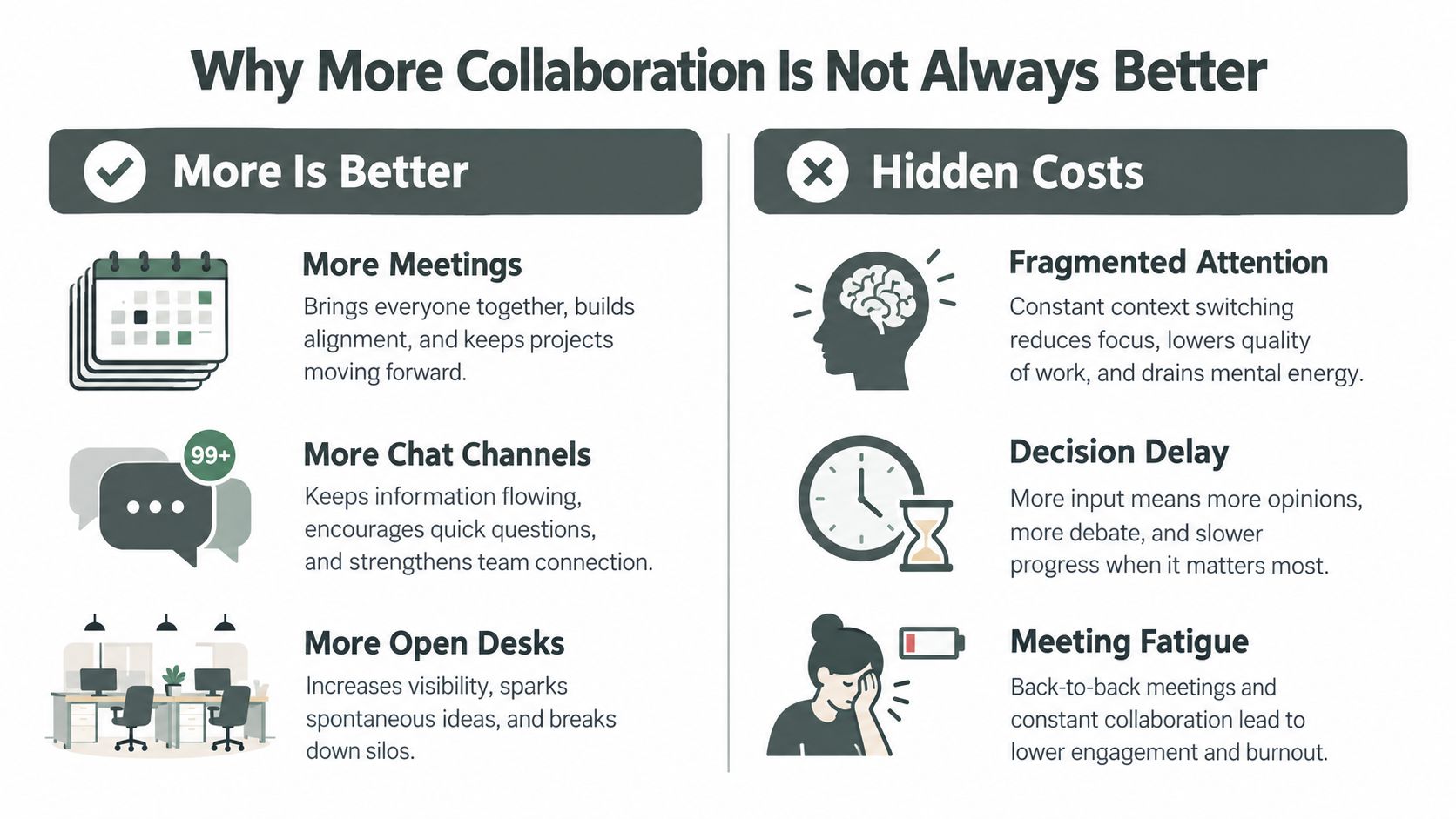
The useful mental model is a rising curve followed by a tipping point. Early interaction can improve context and trust. After enough information has been shared, the next invitation may add little value while still taking attention away from execution.
Separate three kinds of interaction
Urgent coordination: A decision or issue needs a prompt response because delay creates a real operational problem.
Intentional collaboration: People need to compare evidence, solve a problem, or create something together.
Optional social contact: The interaction builds relationships but doesn't require attendance or immediate action.
Each category deserves a different norm. Urgent coordination needs a clear escalation route. Intentional collaboration needs preparation and a decision record. Optional social contact should remain genuinely optional, especially for remote workers, caregivers, quieter contributors, and people working across time zones.
Hybrid teams face a trust and planning challenge as well. Gallup reports that in 2024, 48% of hybrid workers said their team hadn't discussed any formal or informal plan for collaborating effectively in a hybrid environment. The same Gallup report states that in 2025, only 54% of managers of remote workers strongly agreed they trusted those employees to be productive.
Those figures point to an operating gap, not a simple location problem. A team needs explicit rules for which decisions require synchronous discussion, how absent members contribute, when responses are expected, and how meeting notes become accountable actions.
A quiet calendar block isn't a sign of disengagement. It can be the condition that lets a good collaborative decision become finished work.
Before scheduling another interaction, ask what it must produce. If the answer is unclear, send a concise written update, offer an optional social invitation, or protect the time for focused execution instead.
Evidence-Based Strategies You Can Apply This Quarter
Good collaboration habits become easier when a team turns them into small operating experiments. Each practice below connects to one of the three indicators: communication quality, psychological safety, or focus protection.
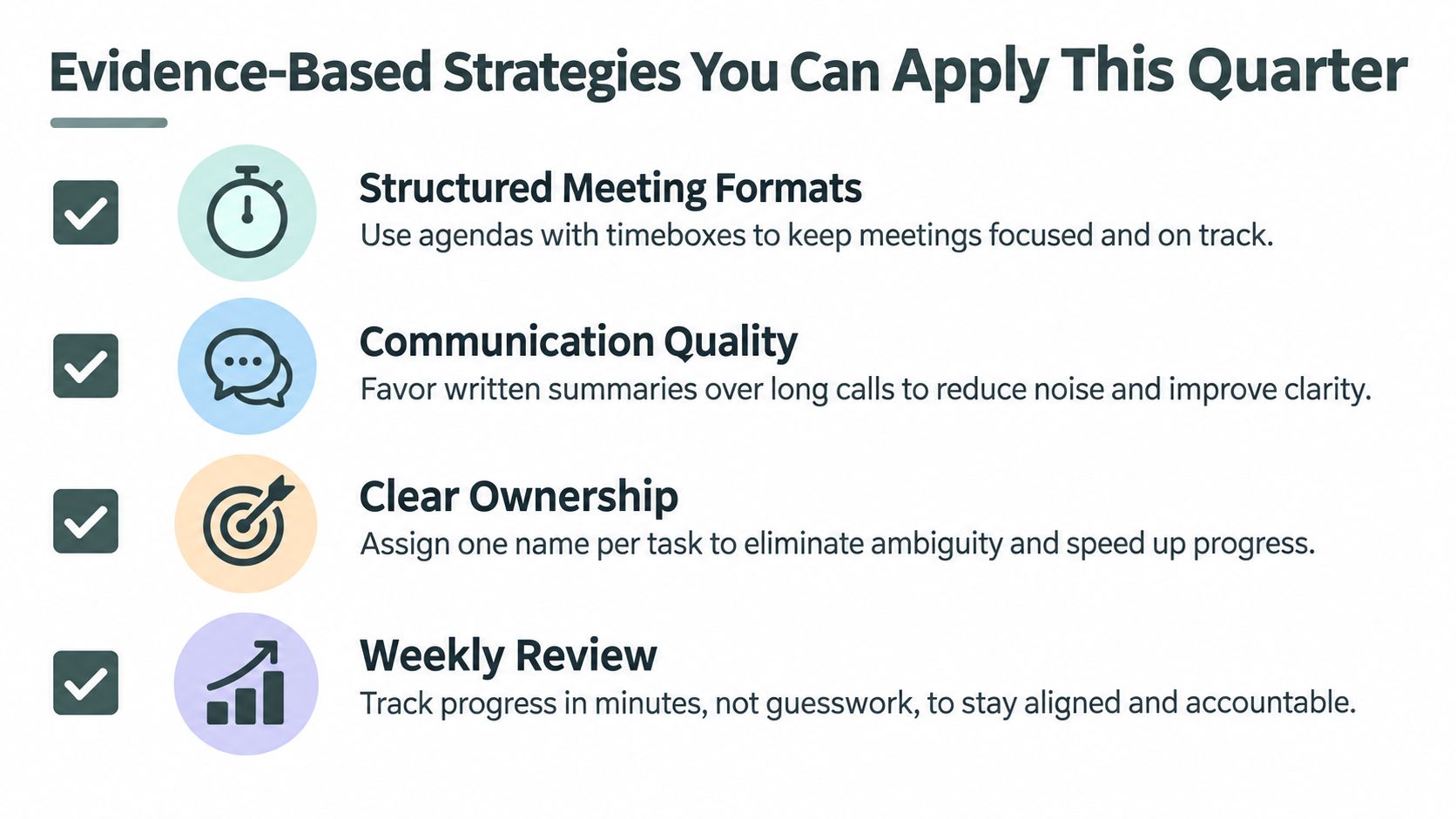
Use formats that make thinking visible
Communication quality: Send a short pre-read before a decision meeting. Ask participants to identify evidence, name assumptions, and state what they recommend. During the discussion, compare interpretations rather than reading the document aloud. Close with a decision, an owner, and a date for review.
This format turns information exchange into information elaboration. It also makes a strategy offsite agenda more useful because the group arrives ready to synthesize rather than spending the session reconstructing background.
Invite contributions before the room gets loud
Psychological safety: Add an anonymous question field to the pre-read, use a facilitated round-robin, and ask directly, “What are we missing?” Leaders should respond to disagreement with curiosity before defending a preferred answer.
The goal isn't equal speaking time in every conversation. It's meaningful access to the decision. A quieter contributor who identifies a delivery risk may add more value than a confident speaker who repeats information the group already has.
Name the owner and protect the work
Focus protection: Put a named quiet block on the shared calendar and establish a response-time expectation for nonurgent requests. Write down which decisions require a live meeting and which can move through an asynchronous note.
A team can also build social connection without making every work period interactive. A 2024 scoping review found that, in a study of 193 coworking users, social interaction had a statistically significant positive effect on productivity, with a reported coefficient of 0.846 and p < 0.001, as described in the coworking research review. The practical lesson is to create intentional opportunities for useful exchange, then let members choose when to return to private work.
Review the system every week
Use a short weekly review to ask:
Decision quality: Which decision required rework, and what information was missing?
Action completion: Which agreed actions moved forward, and which stalled?
Safety: Who raised a concern, and how did the team respond?
Focus: Which interruptions were necessary, and which could have been asynchronous?
Frequent engagement with third places has also been associated with social capital, with a reported β = 0.15 and p < 0.05 in a 2025 study of recurring community spaces, according to research on third places and social connection. That supports a balanced approach: build recurring community contact, but give each gathering a clear social or working purpose.
How a Physical Hub Like Freeform House Maps to Each Job
A workspace becomes more useful when its rooms support different kinds of attention. A high-stakes executive decision shouldn't happen in the same setting as an open networking conversation, and a private client call shouldn't compete with a workshop's energy.
Freeform House is a restored three-story, 10,000-square-foot building in the heart of Jenks' 10 District, comparable in spirit to a SoHo House. Its membership-based model combines coworking, community programming, meeting rooms, a podcast booth, and The Rise loft studio. The room choice can follow the collaboration job.
Collaboration Job | Best-Fit Room | Supporting Amenity |
|---|---|---|
High-stakes executive decision | Executive Room | Private setting for focused discussion and decision records |
Workshop and evidence synthesis | Hall of Fame Room | Room for group dialogue, shared materials, and structured participation |
Intimate networking | Freeform Room | Social environment for introductions and relationship-building |
Small-group work or private calls | Thomas Room | More contained setting for concentrated collaboration |
Professional content production | Podcast booth or The Rise loft studio | Dedicated creative resources for recording and production |
The value isn't the room name. It's the match between environment and task. Teams need a place where conversation can be active without making focus impossible, and a quiet option where a member can complete work after a collaborative session.
Practical conveniences can remove friction around the workday. Curated partnerships with local restaurants and coffee shops provide meals and beverages on demand at no extra delivery cost. Amazon Hub Lockers and a rentable golf cart fleet can simplify errands, helping members keep their attention on meetings, projects, and relationships.
External benchmarks can help a team set expectations without treating them as guarantees. In a survey of 500 U.S. adults who worked in coworking spaces at least one day per week, 47% said collaboration with colleagues had improved, 46% reported better business connections, and 47% reported improved work quality, according to the coworking survey findings. A local team can use those categories as questions: Are colleagues collaborating better? Are useful business relationships forming? Is the quality of work improving?
A Measurement Template and a 30-60-90 Day Action Plan
A useful measurement template is small enough to maintain and specific enough to change behavior. Put these fields in a spreadsheet, project tool, or shared document.
Area | Metric | Definition and data source | Target band |
|---|---|---|---|
Communication quality | Decision rework rate | Decisions reopened because essential information or ownership was missing, reviewed from decision logs | Downward trend |
Communication quality | Action completion rate | Agreed actions completed by the review date, checked against the action log | Upward trend |
Psychological safety | Five-question pulse | Anonymous responses about voice, dissent, uncertainty, support, and error reporting | Stable or improving |
Psychological safety | Speaking-time distribution | Meeting notes or facilitator observation showing whose perspectives entered the discussion | No repeated exclusion |
Focus protection | Protected focus blocks | Calendar blocks reserved for uninterrupted work | Consistent weekly practice |
Focus protection | After-hours spillover | Work completed outside normal hours because coordination displaced focused work | Downward trend |
The first 30 days
Baseline the measures without judging the team. Write a one-page collaboration charter covering decision rights, response expectations, meeting preparation, documentation, quiet periods, and remote participation.
Days 31 through 60
Run two experiments. Use a pre-read meeting format for one recurring decision forum, and introduce a named quiet block for focused work. Review the measures and collect brief comments from participants.
Days 61 through 90
Keep the norms that improved decision quality, follow-through, safety, or focus. Retire the ones that created work without producing value, then schedule a quarterly collaboration review.
Avoid three predictable traps:
Measuring attendance: A full room doesn't prove that people made a decision.
Displaying the charter: A document has no effect if leaders don't use it during real tradeoffs.
Skipping review: Unexamined norms gradually become habits, even when they no longer serve the team.
Designing Collaboration That Actually Produces Results
Collaboration effectiveness isn't a personality trait or a workplace perk. It's an operating outcome that teams can design by balancing intentional connection with protected focus.
The right environment makes that balance easier. A shared hub can provide rooms for executive decisions, workshops, private calls, creative production, and informal relationships. A virtual team can create the same distinction through meeting rules, decision logs, response norms, and visible focus blocks.
Take one question into your next meeting: What decision did we make, who owns the next step, and when will we know it worked? If the group can't answer all three, the conversation needs a clearer finish.
Small changes compound. A better pre-read, a more inclusive invitation to speak, a room chosen for the task, and a protected quiet block can help local teams produce stronger decisions while preserving the deep work that gives those decisions value.
Freeform House offers membership-based coworking, distinct meeting rooms, creative production spaces, and community-focused opportunities for teams that need both intentional connection and protected focus. Visit Freeform House to explore a shared setting for executive meetings, workshops, private work, and relationship-building in downtown Jenks.
Comments