Onsite vs Offsite Meetings: Costs, Trade-offs and Choices

By fall 2022, office workers averaged 3.5 days per week in the office, about 30% below pre-pandemic norms, according to Gallup's hybrid work indicator tracking office attendance patterns. That single shift reframed onsite vs offsite from a company policy decided once into a planning choice you now make for almost every gathering.
Why Onsite Versus Offsite Is Now a Recurring Decision
The five-day office week isn't the default it once was. In that same Gallup data, only 37% of respondents reported going to the office every day, while 56% followed hybrid schedules involving one to four office days per week and 7% worked fully remotely. Those numbers describe a workforce that's already sorting work by place, whether leadership planned it that way or not.
The pattern isn't uniform everywhere, and that matters for how you read it. Some markets stayed more office-centered, which is a reminder that local norms, commute patterns, and team expectations shape attendance more than any global headline does.
What the Terms Mean Now
Onsite used to mean your company's office, full stop. Today it increasingly functions as a purpose-driven activity. People come in for a reason: focused collaboration, a decision that needs the room, relationship-building, or access to amenities they don't have at home.
Offsite now covers two different things. It can mean working remotely, usually alone. It can also mean deliberately gathering outside your ordinary office, in a neutral setting chosen for a specific outcome. Confusing those two meanings is where most planning mistakes start.
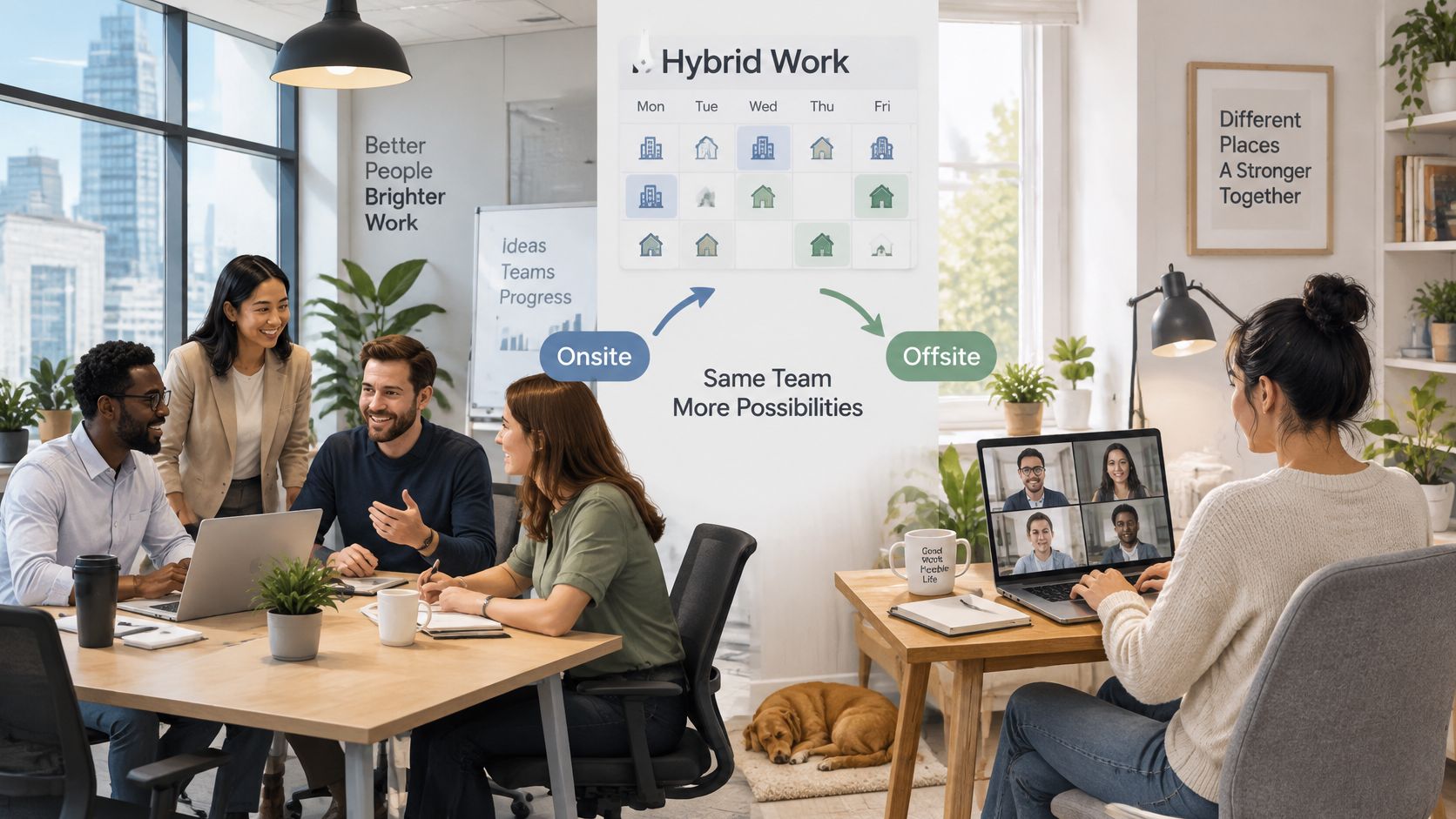
That distinction changes the question you should ask. It's no longer whether your team is an onsite team or an offsite team. It's which work belongs in which setting, and how often.
A workplace now has to justify attendance. If the day could've been handled on a screen, people notice, and they stop showing up with the same energy.
The Recurring Operating Choice
Think of it as a calendar problem, not a culture slogan. A weekly status update, a quarterly planning session, and a first meeting with a prospective client all ask different things of a room. Treating them as interchangeable wastes either money or attention.
Hybrid participation also means remote attendees are a permanent feature, not an exception. Following best practices for video conferencing in hybrid meetings keeps remote participants from becoming spectators when part of the group is physically together. That detail sounds technical. In practice it's what determines whether hybrid sessions feel fair.
For executives, entrepreneurs, and creative professionals, the practical task is sorting. Routine individual work rarely justifies a commute. Work that depends on trust, reading a room, or building something together often does.
Comparing Costs, Logistics and Attendee Experience
Start with the trade-off that's hardest to argue with. Verizon's Meetings in America whitepaper on meeting format trade-offs summarizes it plainly: onsite sessions minimize travel time, scheduling friction, and direct expense, while offsites carry a higher coordination cost but suit activities that depend on trust, persuasion, networking, problem-solving, or team formation. Neither side wins in the abstract. The cost you save onsite can be spent in lost attention, and the money you spend offsite can be wasted on a meeting that didn't need a venue.
The visual below lines up the four planning criteria that drive most of the differences.
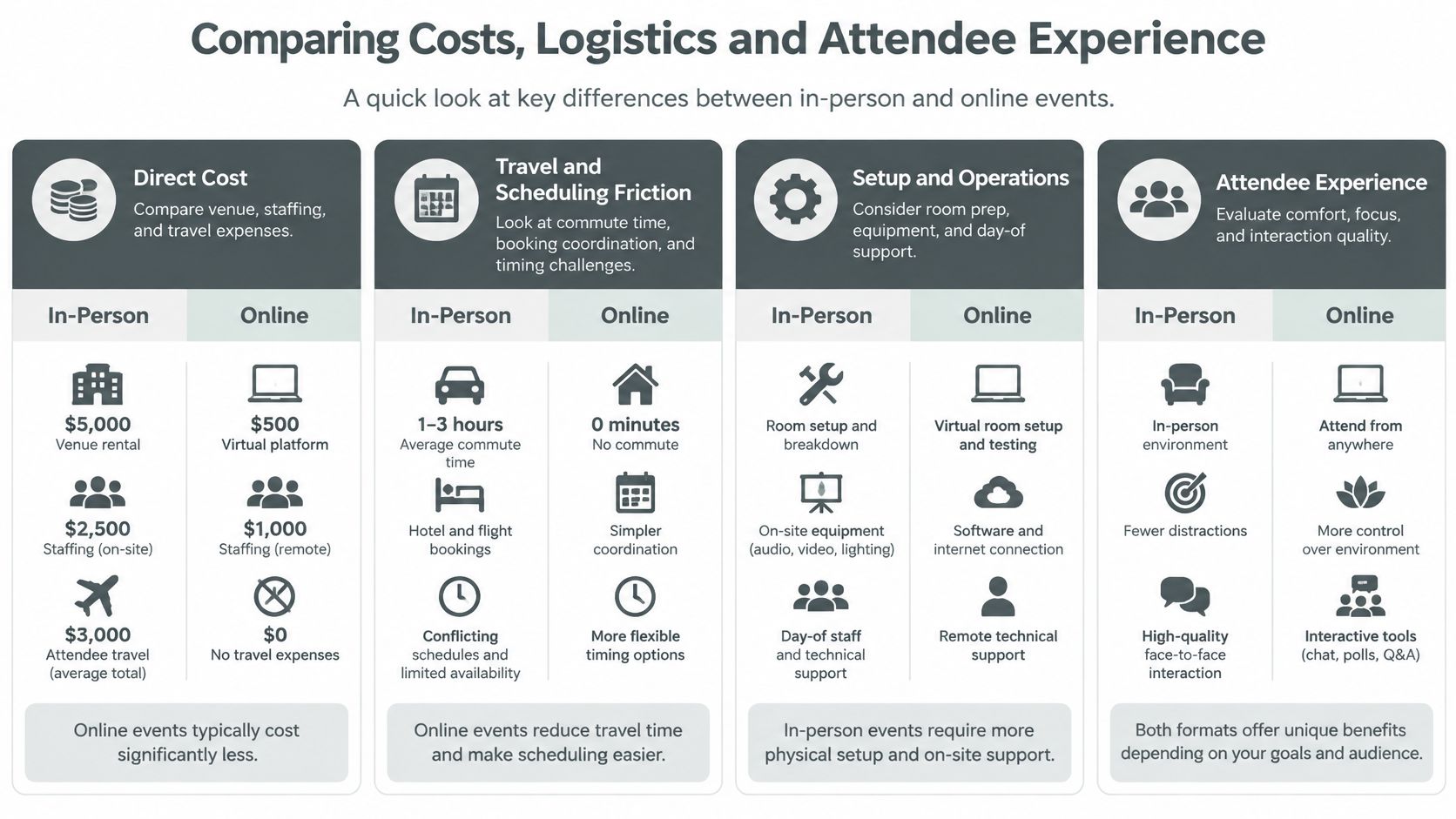
Onsite and Offsite Trade-offs by Planning Criterion
Criterion | Onsite | Offsite |
|---|---|---|
Direct Cost | Low marginal cost, existing space and equipment | Venue, catering, and travel added per participant |
Travel and Scheduling Friction | Minimal, people are already there | Higher, requires coordination and lead time |
Setup and Operations | Familiar rooms, known technology, quick resets | Needs room checks, equipment, and day-of support |
Attendee Experience | Convenient but interrupted by normal routines | Deliberate context shift, fewer everyday distractions |
Where the Costs Actually Show Up
Onsite costs are mostly fixed. You've already paid for the space, the screens, and the coffee. That makes onsite the right default for recurring work, because the marginal cost of one more meeting is close to zero.
Offsite costs are variable, and they scale with headcount and distance. Venue fees are the visible part. The easy-to-miss parts are coordination time, travel time, and the hours people lose getting oriented in an unfamiliar space. Budget for those or the comparison is rigged from the start.
There's also a hidden onsite cost worth naming. When a high-stakes session happens in the usual conference room, people drift back to email, side conversations, and the next meeting down the hall. You didn't pay for a venue. You paid in attention instead.
Choosing a business meeting venue that fits the purpose of the session is the point where the onsite vs offsite decision becomes concrete. Room size, acoustics, natural light, and how easily people can break into small groups all change what a day produces.
The short video below walks through how experienced planners weigh format choices before committing a budget.
Attendee Experience Is Not a Soft Factor
People read a setting as a signal. Bringing a client into a borrowed corner of a busy office says something different than hosting them in a quiet, well-run room. Neither is automatically right, but you should choose the signal on purpose.
Virtual and onsite formats still win on several practical grounds, including saving time and money, easier scheduling, and avoiding unnecessary travel. That's a real advantage, and it explains why routine sessions shouldn't be moved offsite just because a nicer room exists.
Practical rule: Pay for a context shift only when the context is part of the work. If the room doesn't change behavior, it isn't earning its cost.
Matching Meeting Types to the Right Setting
The most useful decision rule is task-first. Ask what the meeting needs most: continuity and quick access to people and information, or concentration away from normal routines. That answer, not habit, should place the session.
Keep It Onsite or Virtual
Status updates: These need speed and low friction. Run them where people already are, and keep them short.
Routine reviews: Recurring operational checks benefit from familiar tools, shared files, and the ability to pull someone in quickly.
Individual focus work: Deep, solitary production rarely improves in a group setting. Protect it wherever the person concentrates best.
These sessions share a trait. The outcome depends on information exchange, not on relationships or persuasion. Moving them offsite adds cost without changing what happens in the room.
Take It Offsite
Quarterly planning and leadership alignment: These need uninterrupted time, honest disagreement, and decisions that stick.
Client pitches and negotiations: Setting signals seriousness, and a neutral room removes home-turf distractions.
Creative production: New surroundings, proper equipment, and room to spread out change the quality of what's made.
Culture-building and team formation: Shared time outside routine is the mechanism, not a side benefit.
The networking evidence helps explain why. In an eight-year analysis of annual offsites covering formal working relationships, participants received 24% more new incoming collaborative-work requests after attending an offsite, with especially strong effects among employees at the firm for fewer than five years. The same analysis found each offsite generated more than $180,000 in revenue from new collaborations during the first two months, and 17% of newly formed connections remained active two years later.
The value of an offsite isn't the change of scenery. It's the encounters between people who rarely interact during normal office routines, and the visibility that follows.
Read those figures as organizational case-study evidence, not a universal law. One firm's offsites were clearly designed to mix people across groups. A badly designed offsite, where the same people sit with the same colleagues and hear presentations all day, won't produce the same effect.
That's why design matters more than the venue label. If you're planning a multi-day gathering, working through how to plan a corporate retreat with clear outcomes helps you build in the unstructured time and cross-group mixing that make the format pay off. Presentations can happen anywhere. New working relationships usually can't.
Some meeting types run either way. Workshops with a skilled facilitator, for example, can succeed onsite if you can protect the room from interruptions and give people space to work in small groups. If you can't guarantee either condition, that's your answer. Move it.
Who Benefits Most From Each Setting
Treat your team as one group with one preference and you'll get the policy wrong. Age, career stage, and the kind of social contact someone needs all change what a physical gathering is worth to them.
Gallup's 2025 data on generational differences in remote work preference makes the split concrete. 49% of millennials considered themselves most productive at home or offsite, while only 19% chose onsite work. Gen Z was much more divided, with 37% favoring remote work, 32% onsite, and 31% saying location made no difference.
A Team You Probably Recognize
Consider a small Jenks or Tulsa firm with a founder, two experienced operators mid-career, and a recent hire in their first professional role. The experienced operators have established networks and full calendars. For them, mandatory onsite days mostly interrupt focused work they could finish faster at home.
The recent hire is in a different position. They learn by overhearing how a client call gets handled, by asking a quick question instead of booking a meeting, and by being seen doing good work. Fully remote arrangements disadvantage that person, because informal learning doesn't schedule itself.
The founder's needs are different again. Client trust, partner relationships, and the occasional hard conversation all go better in person. That's not nostalgia. It's about reading hesitation, building rapport, and handling nuance that a video call flattens.
The Equity Question
Mandatory attendance isn't neutral. It can burden caregivers, long-distance commuters, and people whose best work is solitary and uninterrupted. Requiring presence for work that doesn't need it spends goodwill you'll want later.
The opposite extreme has its own cost. Newer employees, people changing roles, and anyone building a network from scratch lose the most when nobody gathers. Mentoring, meeting new people, collaboration, and managing others are the activities where physical presence earns its keep.
Segment before you mandate: Sort by task, career stage, and the social outcome you're after. A single rule for everyone is simpler to announce and worse in practice.
A workable middle path is to reserve premium in-person gatherings for relationship-intensive moments such as new-team formation, mentoring, client trust-building, workshops, and strategic decisions. Preserve offsite flexibility for concentration and individual production. That split respects both the person who needs the room and the person who needs to be left alone.
How Freeform House Supports Both Formats
A membership club can do something a conventional office and a rented hotel ballroom both struggle with. It can serve as a regular home base for everyday work and as a neutral, polished setting for gatherings that need to feel distinct from the office. That dual role is what makes the onsite vs offsite choice easier rather than harder.
Freeform House is envisioned as a premier, membership-based club in the heart of Jenks, Oklahoma's 10 District downtown, comparable in spirit to the renowned SoHo House. It's housed in a restored 1920 building with three stories and 10,000 square feet, blending historical character with modern functionality. It's more than a social club. Members get co-working spaces and a dynamic community hub designed for collaboration and connection, a central gathering spot built to foster a creative and cooperative spirit in the local community.
The setting reads as realistic and lived-in rather than staged, which matters when you're hosting people who can tell the difference.
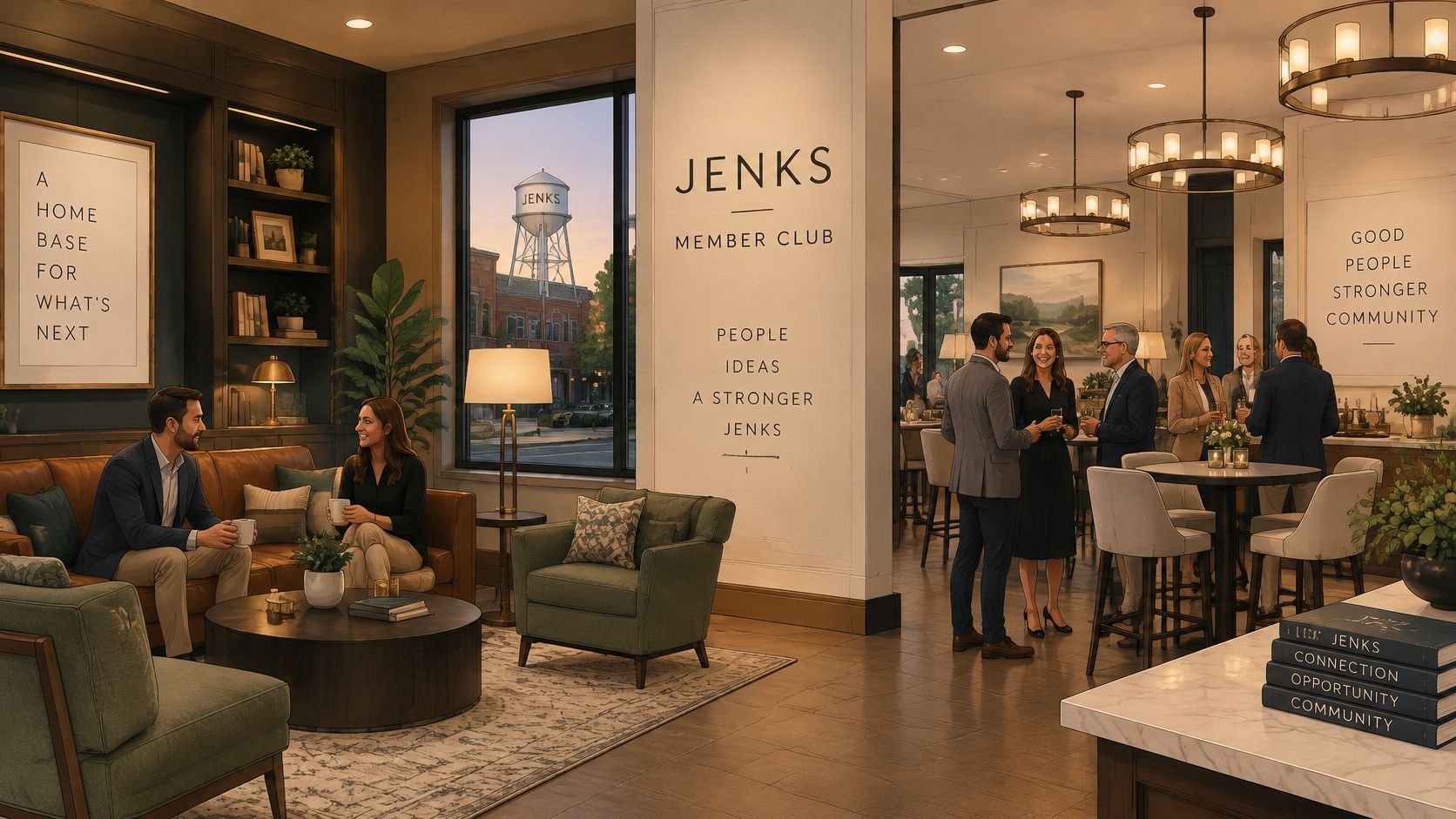
Rooms Matched to Different Kinds of Work
Members can book four distinct rooms, each suited to a different format:
The Hall of Fame Room: Suits larger gatherings and community events where presence and atmosphere carry the occasion.
The Freeform Room: Works for flexible collaboration, workshops, and sessions that need to be rearranged as the day develops.
The Executive Room: Fits leadership meetings, negotiations, and client conversations that need privacy and a composed setting.
The Thomas Room: Handles smaller, focused sessions where a quieter room helps people settle into the work.
Creative Production and Everyday Convenience
Beyond meeting rooms, The Rise loft studio and an in-house podcast booth support professional content production without a separate studio booking. For creative professionals, photographers, and podcasters, that turns a workday into a production day in the same building.
Curated partnerships with local restaurants and coffee shops deliver meals and beverages on demand at no extra delivery cost, which removes one of the friction points that usually makes offsite hosting tedious. Amazon Hub Lockers and a rentable golf cart fleet handle the small logistics of a downtown day.
Framed against the earlier comparison, this kind of setting fits specific situations best. Executive meetings, strategy workshops, private events, client hosting, and creative production all benefit from a room that's neutral, well serviced, and separate from someone's everyday office. Routine internal updates don't need it, and hosting them there would be the same mistake as booking any premium venue for work that a video call handles fine.
Measuring Results Across Both Formats
Don't assume a better room produced a better outcome. Measure both formats with the same indicators, or you'll keep choosing based on whoever argued most recently.
Start with the evidence that in-person time can carry commercial weight. A business-travel evidence review from CBI Economics and the Business Travel Association reported that 92% of firms agreed in-person meetings build stakeholder bonds faster and more strongly than virtual meetings. The same review cited an estimated return of $12.50 in incremental revenue and $3.80 in profit per dollar invested in business travel.
Treat those ROI figures as planning inputs, not benchmarks you can claim for your own event. They're estimates from business-travel research, not a universal causal law. Validate them against your own event costs and commercial outcomes.
A Tracking List That Works for Both Formats
Decisions reached: Count actual decisions, not discussions. Note how long each one took.
Action-item completion: Track what percentage of agreed actions close by their deadline.
Decision-cycle time: Measure how long an issue takes from first discussion to resolved.
Qualified opportunities created: For client-facing sessions, record new opportunities that enter your pipeline.
Proposal-to-close conversion: Compare close rates after in-person pitches against virtual ones.
Stakeholder satisfaction: Ask attendees directly, while the session is still fresh.
Add two efficiency measures so cost stays honest: attendee utilization and travel cost per participant. A session that produces strong outcomes for half the invited list while the other half sits idle isn't a success. It's an over-invited meeting.
Compare formats on outcomes per hour and per dollar, not on how the day felt. A pleasant offsite that produced no decisions is an expensive lunch.
Run this tracking for several gatherings in each format before drawing conclusions. One strong onsite session and one weak offsite tells you more about facilitation and agenda design than about location. Over time, patterns by meeting type become clear, and your onsite vs offsite choices stop being arguments and start being allocations.
Next Steps for Your Next Gathering
You don't need a company-wide policy to make the next decision well. You need four questions answered before you book anything.
A Short Pre-Booking Checklist
Purpose: What's the single outcome this gathering must produce, a decision, a relationship, a deliverable, or information shared?
Attendee mix: Who's coming, what career stage are they at, and who benefits most from being physically present?
Budget honesty: Have you counted coordination and travel time, not just the venue invoice?
Follow-up metrics: Which indicators from the tracking list above will you check afterward, and who owns them?
If the purpose is information sharing and the attendee mix is experienced and dispersed, keep it onsite or virtual and spend nothing on a room. If the purpose is trust, alignment, persuasion, or new relationships, and newer team members or external stakeholders are involved, the offsite case gets strong quickly.
Watch for two common errors. The first is booking an impressive setting for a routine session, which trains people to see offsites as perks rather than tools. The second is forcing a high-stakes conversation into a noisy, interruption-prone office because it was free. Both errors come from deciding by location instead of by task.
For local entrepreneurs, executives, and event planners in Jenks and Tulsa, the practical next step is specific. Contact Freeform House through its website to ask about tours, room options, and hosting availability for a particular meeting or event you're already planning. Bring the checklist answers with you. A tour with a real agenda in hand tells you far more than a general look around, and you'll know within one visit whether the setting matches the work.
If your next onsite vs offsite decision involves client hosting, a leadership session, a workshop, or creative production in downtown Jenks, Freeform House offers bookable rooms, co-working space, The Rise loft studio, and a podcast booth in one restored building. Visit the site to ask about tours, room options, and availability for the specific gathering you're planning.
Comments