How to Plan a Corporate Retreat That Actually Works

A founder is staring at a November calendar, six weeks out from the quarterly offsite, trying to choose between a hotel room block and a converted warehouse. The venue search feels urgent, but it isn't the decision. The question is what the team must accomplish together, and whether the retreat format gives them enough focused time to accomplish it.
A corporate retreat works when the setting, schedule, people, and follow-up all serve one business outcome. It fails when the host books attractive space first, adds generic icebreakers to fill the agenda, and hopes useful decisions emerge by the final dinner. The practical approach is to treat retreat planning as a decision problem before treating it as a travel or event project.
Why Most Retreats Disappoint Before They Start
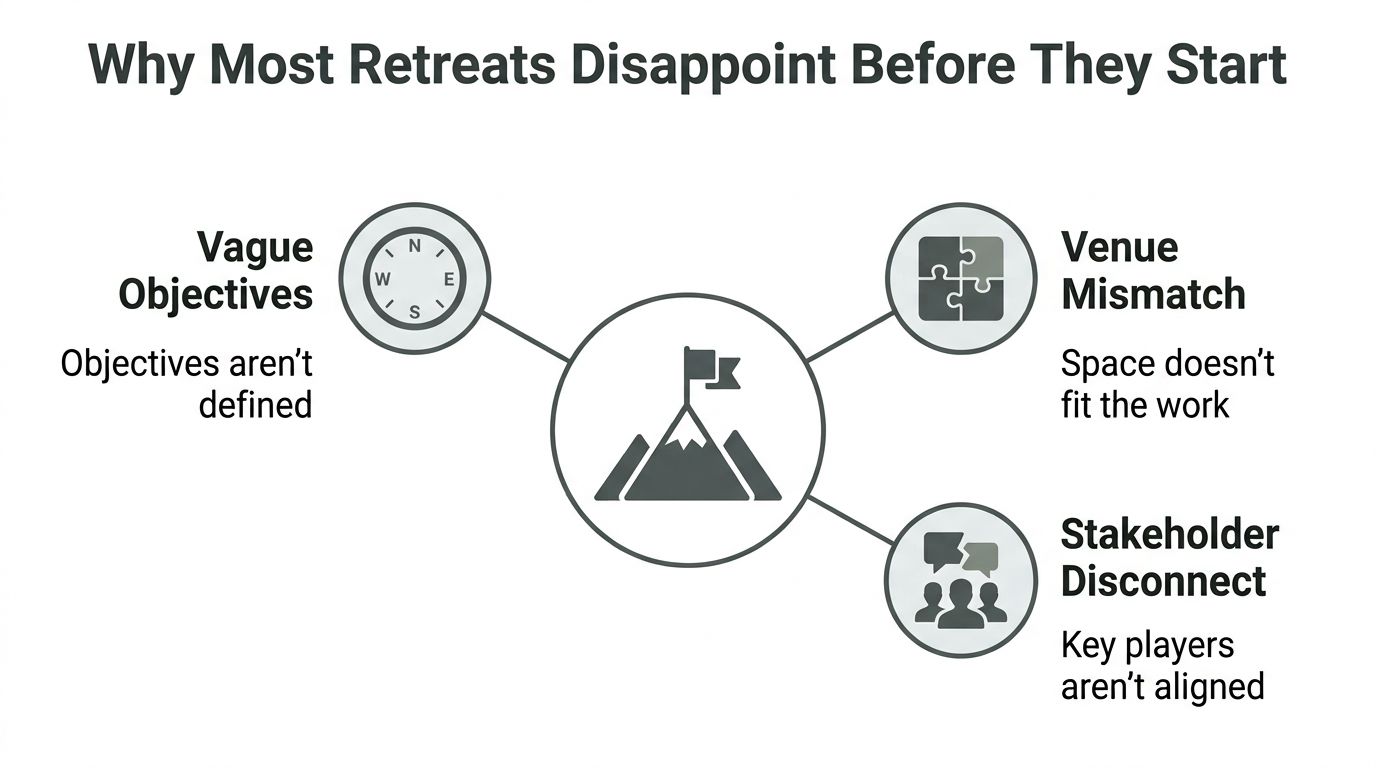
Most disappointing retreats go wrong before anyone boards a plane. The host chooses a venue before defining the outcome, then discovers that the room is too large, the layout separates people, or the space supports socializing but not the work the team needs to finish.
A vague objective creates predictable problems. “Improve collaboration” can mean a leadership decision, a relationship reset, a planning exercise, or a morale-building experience. Those require different time commitments, room arrangements, facilitation styles, and measures of success. Without a specific answer, the agenda fills with activities that sound positive but don't move a decision forward.
The venue can be beautiful and still be wrong. An oversized room makes a small group feel scattered. A hotel ballroom may support presentations but discourage the candid conversation needed for strategy. A converted warehouse may offer character but lack quiet breakout space, reliable audio, or a practical meal flow. The right venue isn't the one with the most amenities. It's the one that makes the intended work easier.
The failure pattern to avoid
Watch for these early warning signs:
Unclear goals: Nobody can complete the sentence, “By the end of this retreat, we will have…”
Format mismatch: The team needs a decision sprint, but the schedule is built like a vacation.
Oversized space: People split into informal clusters, and quieter participants disappear from the discussion.
No decision capture: Conversations end without owners, deadlines, or a document the team can use afterward.
A useful industry survey found that 85% of employees said offsites strengthened their connection to their organization and its goals, while employees attended an average of 2.6 offsite events in 2024 versus 2.4 in 2019. The same dataset reported that 61% believed their company's offsite budget had increased in 2024, and another meeting-industry survey found 59% of organizations increased offsite budgets since 2019. These findings, reported in Business Wire's corporate offsite coverage, support a practical conclusion: retreats are increasingly treated as recurring operating expenses, so teams expect more than pleasant memories.
Practical rule: Don't ask which venue is available first. Ask which outcome deserves everyone's time together, then choose the smallest format that can produce it.
Get that sequence right and the retreat becomes a working instrument. Get it wrong and the business pays for wasted budget, fractured alignment, and an executive team that dreads the next offsite.
Locking Down the Core Decisions Before You Book
Before contacting a venue, create a one-page brief with five decisions. These decisions prevent attractive options from pulling the retreat away from its purpose.
Start with one outcome
Write one sentence that names the result, not the mood. “Ship the 2026 pricing model” is stronger than “align on pricing.” “Align the leadership team on the Q1 hiring plan” is stronger than “discuss hiring.” Then define what proof will exist within 30 days, such as a signed decision document, a published plan, or an approved owner-and-deadline list.
The retreat may include connection and downtime, but those should support the primary outcome rather than compete with it. A 2023 retreat report found that 45.3% of respondents used a three-day, two-night format, while 48.4% planned events within one to three months. Larger events with more than 101 participants needed four or more months in 63.1% of cases, according to the PlanRetreat 2023 report. The planning window should reflect the complexity of the decision, not just the preferred travel date.
Set the window, headcount, and budget
Choose a date window roughly 6 to 10 weeks out, avoiding Monday morning and Friday afternoon when possible. Reserve at least one full day for preparation. Count the people who must be in the room separately from those who could join by video, and use 12 attendees as a hard cap when the retreat depends on one-room discussion.
Build the budget in three lines:
Venue and food and beverage: Plan for roughly 50% to 60% of total spend.
Travel and lodging: Include rooms, mileage, rideshare, parking, or shuttle costs.
Production or facilitation: Include AV, a facilitator, recording, and any specialist support.
For local teams, a working planning range is $400 to $1,200 per attendee per day. Keep that range in the brief as a planning assumption, not a promise. The corporate event planning guide from Freeform House can help you translate the brief into venue questions about layout, service, and event requirements.
Decision | Target Range | Done When |
|---|---|---|
Business outcome | One specific result | The leadership owner approves the wording |
Success metric | Observable result within 30 days | Someone can verify it without asking how the retreat felt |
Dates | 6 to 10 weeks out | The required attendees confirm availability |
Headcount | Hard cap of 12 for one-room work | Required participants and remote options are identified |
Budget | $400 to $1,200 per local attendee per day | The ceiling and three main cost lines are approved |
Don't send a venue email until all five fields are complete. A venue can answer capacity and pricing questions, but it can't decide what your team needs to accomplish.
Choosing the Right Format for Your Goal
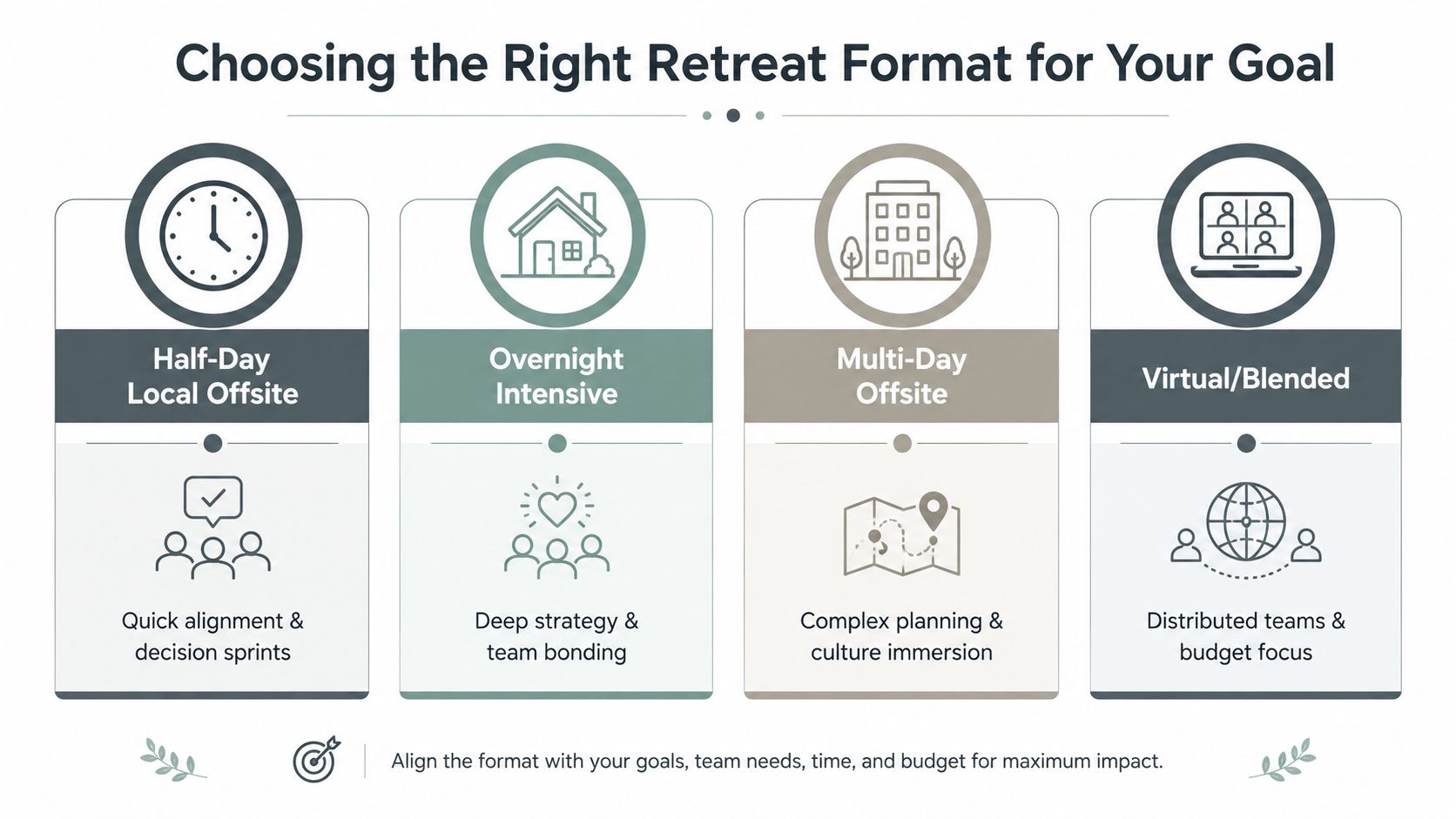
The right retreat isn't automatically a three-day event. Choose the shortest format that gives the team enough time to produce the intended result.
Format | Best fit | Intimate headcount | Trade-off |
|---|---|---|---|
Half-day local offsite | Quick alignment, quarterly review, decision sprint | Core team in one room | Limited time for reflection or relationship repair |
One-night local retreat | Team reset, deep strategy, uninterrupted morning | Small leadership or project group | Requires lodging and tighter evening boundaries |
Two-to-three-day offsite | Complex strategy, whiteboarding, synthesis | Small to mid-sized working group | Costs more and demands a genuinely useful agenda |
Hybrid format | Distributed teams or essential voices who can't travel | Small in-room group plus remote participants | Requires a dedicated producer and tested microphones |
A half-day local offsite works when the team already understands the issue and needs to make a decision. Use one focused three-hour working block followed by lunch. Don't add an elaborate activity just because the schedule looks short. The constraint is useful if it forces preparation.
A one-night retreat earns its cost when the team needs evening connection plus one uninterrupted morning. Keep the evening social and optional. The next morning should carry the serious work, while the small venue footprint protects conversation from becoming a series of presentations.
A two-to-three-day offsite suits strategy that requires divergent thinking, whiteboarding, synthesis, and a later decision pass. It only works when those working sessions are real. Optional activities, long meal breaks, and unstructured time should support the work, not replace it. Survey data places the average retreat length at 3.78 days and the median at 4 days, with 81% of surveyed companies using stays of three nights or longer, according to PlanRetreat's 2022 report. That provides a market baseline, not a rule for every team.
A hybrid retreat can preserve access for people who can't travel, but remote attendees can't be treated as an audience on a laptop. Give one person responsibility for the remote experience, test the microphone and camera, and build chat monitoring into every working block.
Team-building is often included, but it shouldn't determine the format by default. In the same 2022 survey, 100% of companies cited team-building as the main goal, which is a useful reminder to test whether the activity serves the actual business problem rather than assuming every retreat needs a large programmed experience.
For a practical look at how space can support connection without overwhelming the working agenda, watch this overview:
The team-building space guide is another useful reference when comparing a local, intimate format with a larger destination-style event.
Configuring Rooms, Flow, and Tech for a Local Venue
A local retreat succeeds or fails through movement. People need to know where the opening session happens, where smaller groups can work, where meals arrive, and where they can step away without interrupting the meeting. A venue with several distinct rooms can support that flow more effectively than one large room that must be flipped repeatedly.
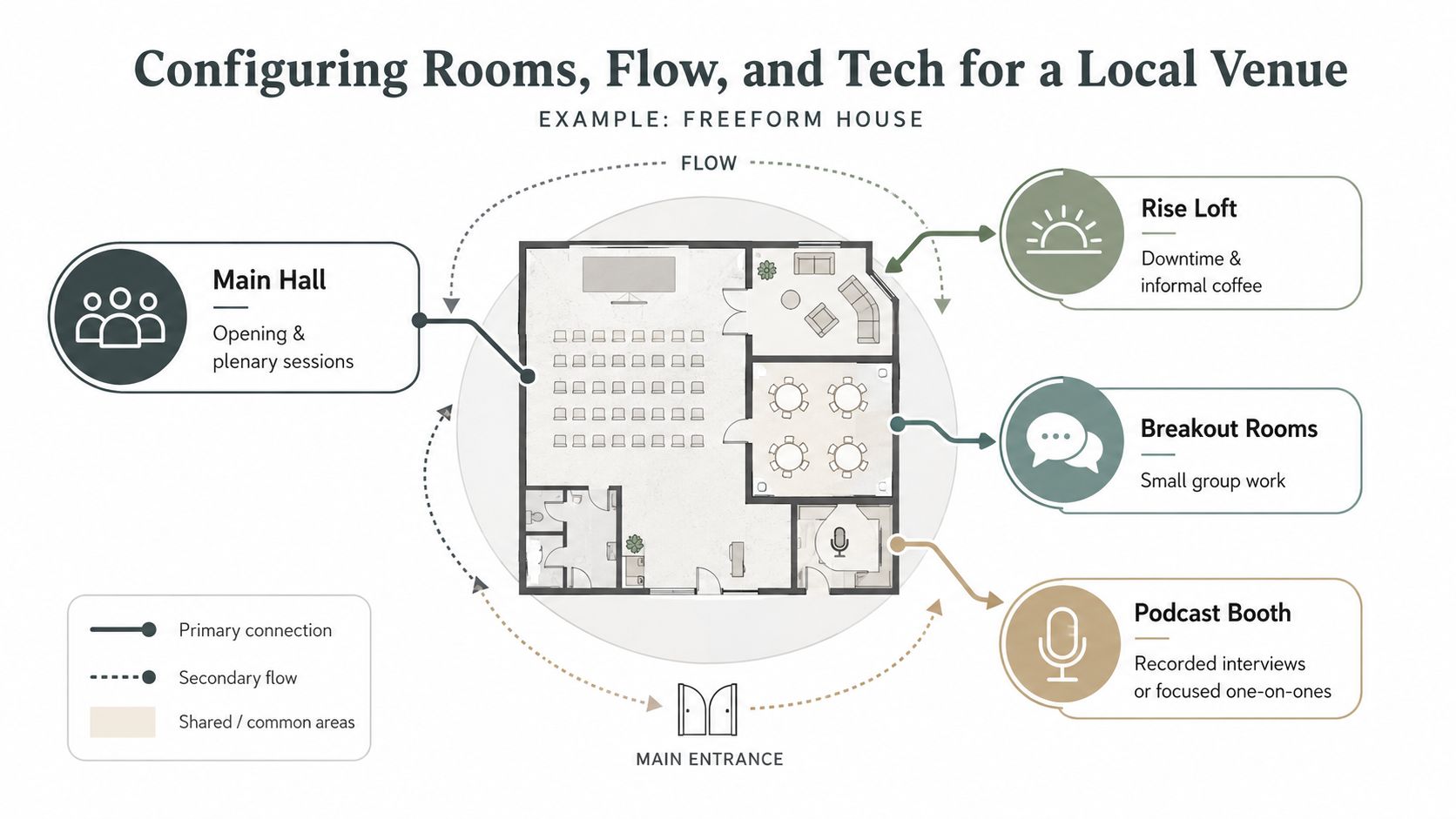
Freeform House provides a working example through its four rooms, the Hall of Fame Room, Freeform Room, Executive Room, and Thomas Room, along with The Rise loft and an in-house podcast booth. The exact setup should be confirmed with the venue, including capacity, furniture, catering, and AV, but the planning logic is straightforward.
Assign every space a job
Use the largest suitable room for the opening and closing plenary, not automatically the largest available room. The Executive Room or another appropriately sized room can hold a leadership discussion when sightlines and intimacy matter more than maximum capacity. The Freeform Room and Thomas Room can serve as parallel breakout spaces, allowing two groups to work without moving the entire retreat.
The Hall of Fame Room can function as the common anchor for welcome remarks, shared meals, or a decision review. The Rise loft gives attendees a place for informal coffee, decompression, and conversations that shouldn't be forced into the formal agenda. The podcast booth fits recorded interviews, leadership updates, or focused one-on-one content that would be difficult to produce in an active meeting room.
Protect the transitions
Route arrivals through a visible welcome point rather than placing registration beside the first working session. Keep meals and service access away from the facilitator's sightline so staff can reset without breaking concentration. If two breakout groups need different furniture, arrange the flip before the session begins or use rooms that can remain configured.
Technology changes the room choice. Video calls need controlled lighting, a clean camera background, stable sound, and a sightline that lets the facilitator see both in-room and remote participants. A room that feels warm for conversation may create echo or backlighting on camera. Test the actual setup with the camera in position, not just with a laptop placed on a table.
A room can hold the group and still fail the meeting. Capacity, acoustics, sightlines, light, and access to adjacent spaces all affect whether people can do the work.
Use the podcast booth for content that benefits from sound control, not as a novelty. Record a short leadership interview, a project update, or an asynchronous message for colleagues who couldn't attend. Keep the main agenda in the rooms where discussion can happen.
Downtown Jenks' Ten District was founded in late 2021 to support the revitalization of Downtown Jenks and spans ten blocks from the Arkansas River to the historic Midland Valley Railroad tracks, as described by Downtown Jenks. That defined setting matters for a local retreat because the venue becomes part of an active district rather than an isolated conference box.
Designing the Agenda and Coordinating Vendors
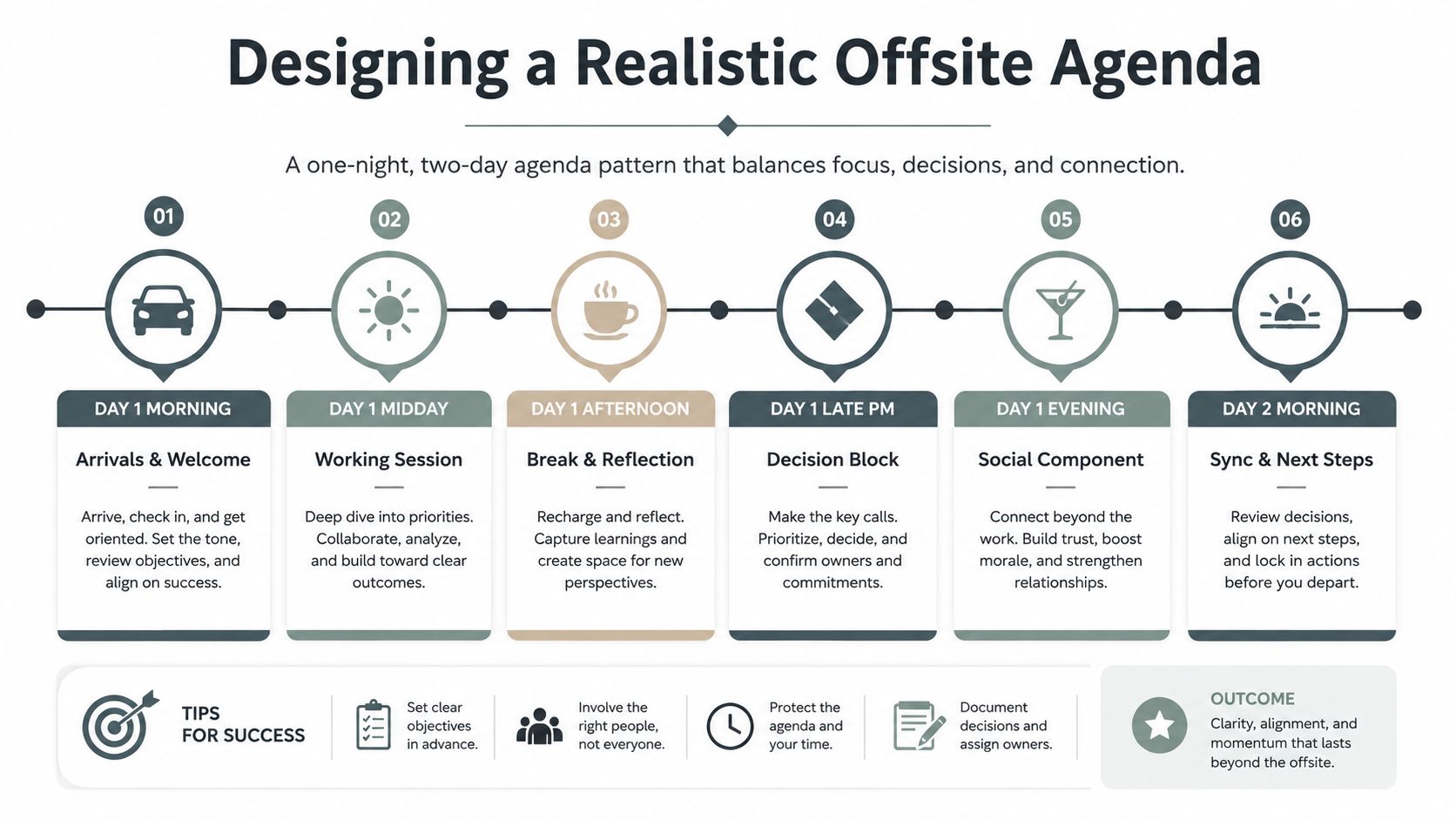
A one-night retreat needs an agenda with enough structure to produce decisions and enough space for people to arrive as humans. The following pattern works for a small executive or project team because it separates arrival, working time, social time, and next-step confirmation.
Use a two-day arc
Day 1 morning or early afternoon should be for arrivals and welcome. Give people time to park, check in, put down bags, and understand the purpose of the retreat. Open with the outcome statement, the decision rules, and the evidence the group needs.
Day 1 midday should hold the first working session. Use the group's shared context to define the problem, surface constraints, and identify disagreements. A short break is more useful than another presentation.
Day 1 afternoon should move into reflection and a decision block. Let participants review notes independently before asking for a decision. The facilitator should capture the decision, unresolved questions, owner, and deadline in the room.
Day 1 evening should provide a social component. A shared meal can build connection, but it shouldn't become mandatory emotional programming. Give people a clear end time and an easy way to step away.
Day 2 morning should confirm the decision and convert it into work. Review what changed, assign owners, set deadlines, and identify the first communication that must go out after departure. Finish early enough that travel doesn't erase the value of the final session.
Put vendor promises in writing
The caterer needs the menu, dietary counts, service windows, beverage plan, and final headcount cutoff. Don't settle for “we can accommodate allergies” without documenting how those meals will be identified and served.
The AV or production partner needs the microphone plan, projector or display requirements, camera position, streaming platform, backup files, and a test window for hybrid attendees. Confirm load-in and strike times, power requirements, who troubleshoots during sessions, and who owns the recording files.
A facilitator should receive the objective, attendee profile, desired decision, available materials, and definition of success. A photographer needs a shot list and privacy boundaries. If any part of the event is outdoors, the written agreement should include the weather decision time, indoor alternative, and communication owner.
Confirm these details in every vendor agreement:
Headcount guarantees: State the date by which attendance becomes billable.
Meal counts: Document the cutoff for changes and how dietary needs are handled.
Hybrid testing: Confirm the test date, equipment, producer, and fallback.
Load-in timing: Record arrival windows, parking, storage, and breakdown access.
Contingency plans: Identify the alternative for weather, equipment failure, or vendor delay.
The corporate retreat checklist from Travel Connects Agency describes a two-to-four-day planning structure and a compressed eight-week timeline with two or three people sharing venue, logistics, activity, and communication responsibilities. That division is practical. One person should own the run of show, another should own attendees and vendors, and a third should be available for approvals and on-site issues.
Travel, Lodging, and Attendee Logistics
Local doesn't mean effortless. An executive team can lose the first working block to hotel check-in, parking confusion, or a missing shuttle. Treat the short drive as a logistics advantage, not a reason to skip planning.
Negotiate a hotel block within a short drive of the venue and ask for the full cost, rooming deadlines, cancellation terms, parking policy, and accessible room availability. For a small group, rideshare may be simplest. For a coordinated arrival, define shuttle windows and a backup contact. Drivers need clear parking instructions, including where to unload and whether overnight parking is available.
Communicate in a predictable rhythm
Send a save-the-date when the date window is approved. Follow with a logistics memo one week before arrival, then send final details 48 hours before the retreat. The final message should include the address, parking, check-in contact, room information, dress guidance, meal notes, emergency number, and what to do if travel changes.
Ask attendees privately about:
Step-free routes: Verify the route from arrival and parking to each working room.
Accessible rooms: Confirm room features directly with the lodging provider.
Dietary accommodations: Record allergies, religious requirements, and preferences separately.
Quiet spaces: Identify where someone can take a low-stimulation break or private call.
Participation alternatives: Offer equivalent options when an activity creates a physical or sensory barrier.
Don't make an attendee explain an accommodation repeatedly to the hotel, caterer, and venue. Assign one coordinator to carry the information securely and confirm the final arrangement with the person who requested it.
The on-site coordinator needs a compact checklist:
Room flips: Confirm furniture, displays, microphones, markers, and water before each block.
Signage: Mark arrival, restrooms, breakout rooms, meals, and quiet areas.
Welcome packets: Include the agenda, contact details, parking notes, and any required materials.
Vendor contacts: Name one point of contact for catering, AV, lodging, transportation, and facilitation.
Attendance: Track arrivals without making late participants feel penalized.
Use the event logistics management guide as a reference for assigning ownership and documenting operational details. A retreat should feel simple to attendees because the coordinator has made the complexity visible to the planning team.
Measuring Whether the Retreat Was Worth It
A retreat's value isn't established by a full room, a good dinner, or enthusiastic comments on the drive home. Measure the outcome you defined before booking, then check whether the decisions survived contact with normal work.
Start within 48 hours. Send the decision record, action list, owners, deadlines, and a short pulse survey while the experience is still fresh. The survey can ask whether the retreat achieved its stated purpose, which session created the most value, where the agenda lost focus, and whether attendees had enough time to participate comfortably.
Use four measurement layers
Quantitative movement connects the retreat to operational work. Depending on the objective, track revenue pipeline added, product decisions shipped, or progress against an existing OKR. Don't invent a new metric just because it sounds measurable. Use the indicator that already represents the business outcome.
Session output tests whether the team produced usable work. Count decisions logged, open questions assigned, and action owners paired with deadlines. A whiteboard full of ideas isn't an outcome until someone can act on it.
Attendee feedback captures inclusion, clarity, energy, and usefulness. An NPS-style question or short pulse survey can reveal friction, but don't let one vocal attendee represent the whole team. Read scores alongside open responses and participation patterns.
30/60/90-day follow-up tests durability. At each check-in, ask what happened, what changed, what remains blocked, and whether the original decision still holds. If the team skips this step, accountability often dies during the first busy week back.
Success Metric | Target | Actual Result | Follow-Up |
|---|---|---|---|
Metric defined before booking | Specific business result | What occurred | Owner and next review |
Decision output | Signed document or approved plan | Completed, partial, or missing | Resolve open questions |
Action ownership | Every action has an owner and deadline | Completion status | Escalate blocked work |
Attendee pulse | Agreed response pattern | Survey result and themes | Change the next format |
Longer-term outcome | Progress at 30, 60, and 90 days | Current operating result | Continue, revise, or close |
The common traps are easy to recognize. Teams confuse activity with outcomes, celebrate a packed agenda, let the most senior voice dominate the survey, and skip follow-up because regular work resumes immediately. A retreat doesn't earn its budget by making people busy. It earns it by producing a result that remains visible after everyone returns.
Run a one-page retrospective with these prompts:
What decision would still have happened without the retreat?
Which conversation required in-person time?
Where did the format slow the work?
Which room or transition created friction?
Did the social component support the business goal?
Which vendor detail should be documented earlier?
What commitment was completed, delayed, or abandoned?
What should the next retreat stop doing?
Use those answers to decide whether the next event should be a half-day reset, an overnight intensive, a multi-day strategy session, or no retreat at all. A recurring offsite program deserves recurring scrutiny.
Freeform House offers private rooms for executive meetings, workshops, breakouts, and intimate offsites, with additional creative space including The Rise loft and an in-house podcast booth. Visit Freeform House to evaluate a local Jenks setting for a focused retreat, then ask the team to confirm room layouts, catering, AV, and logistics against your defined outcome.
Comments