How to Plan a Workshop: A Step-by-Step Guide for 2026

You've been asked to organize a workshop. Someone has suggested a room, a speaker is available, and invitations need to go out. But nobody has agreed on what participants should finish, or how people joining remotely will contribute.
Knowing how to plan a workshop starts with those decisions, not the slide deck. Decide what people will produce, what they need to participate, and how you'll check whether they used the result. Then build the logistics around that work.
Planning Timeline From Eight Weeks Out
Workshop planning timeline by phase
Phase | When | Key decisions | Done when |
|---|---|---|---|
Outcome and audience | 8 weeks before | Goal, headcount, final deliverable | Outcome written as one sentence |
Format and venue | 6 weeks before | In-person, hybrid or split; room size and layout | Room held with written confirmation |
Agenda and materials | 3-4 weeks before | Timed blocks, pre-read, handouts, templates | Agenda and brief sent to facilitators |
Access and registration | 3 weeks before | Access signals, staffing, food, transport | Every access item has a named owner |
Reminders and setup | 1 week before | Confirmations, room layout, technology test | Run-of-show printed and checked |
Follow-up | Within 1 week after | Closing survey, action list, check-in date | Next steps assigned with dates |
For a hypothetical workshop of 15 to 30 people, I'd use eight weeks as a comfortable planning runway. A compressed turnaround of one to two weeks is workable only when the outcome and venue are already fixed. Otherwise, you're making commitments before you know what you need.
The order matters. Your venue hold follows the format decision, your detailed agenda follows the room assessment, and your access arrangements respond to the people registering. Start access planning before registration opens, then refine it as answers arrive.
A common failure is booking a room first, then discovering during the final fortnight that remote participants can't join the exercises. A video connection doesn't fix a room where nobody can hear the tables or read the wall.
Separate provisional decisions from commitments
Hold a room provisionally while you investigate layout, access and equipment. Don't sign an agreement until you understand cancellation terms, setup access and what the quoted hire includes.
Keep a working budget with separate lines for facilitation, venue, materials, access support, technology and refreshments. If money gets tight, simplify the catering or presentation production before removing the support someone needs to participate.
Planning rule: A phase is finished when its decision is documented, not when someone says it's probably sorted.
Use these exit tests before moving forward:
Outcome: Can the sponsor describe the finished work without listing presentation topics?
Venue: Does written confirmation cover the layout and equipment you need?
Agenda: Can another facilitator run the session from your notes?
Access: Does every requested adjustment have an owner and deadline?
Setup: Has someone tested the complete participant experience?
Follow-up: Does every action have a responsible person and a date?
Define the Outcome, Audience and Deliverable
A workshop needs a task that benefits from people working together. If participants only need information, a briefing or recorded presentation may be cheaper and easier to access. Reserve workshop time for practice, decisions, feedback or joint production.
A faculty-development workshop study published in 2021 tracked 116 participants across five years, with 114 reporting that the session was useful; participants particularly valued facilitators modeling effective practice and attendees collaborating on an actual workshop plan. That's a useful design principle, not a promise that every business workshop will get the same response.
Write the working brief
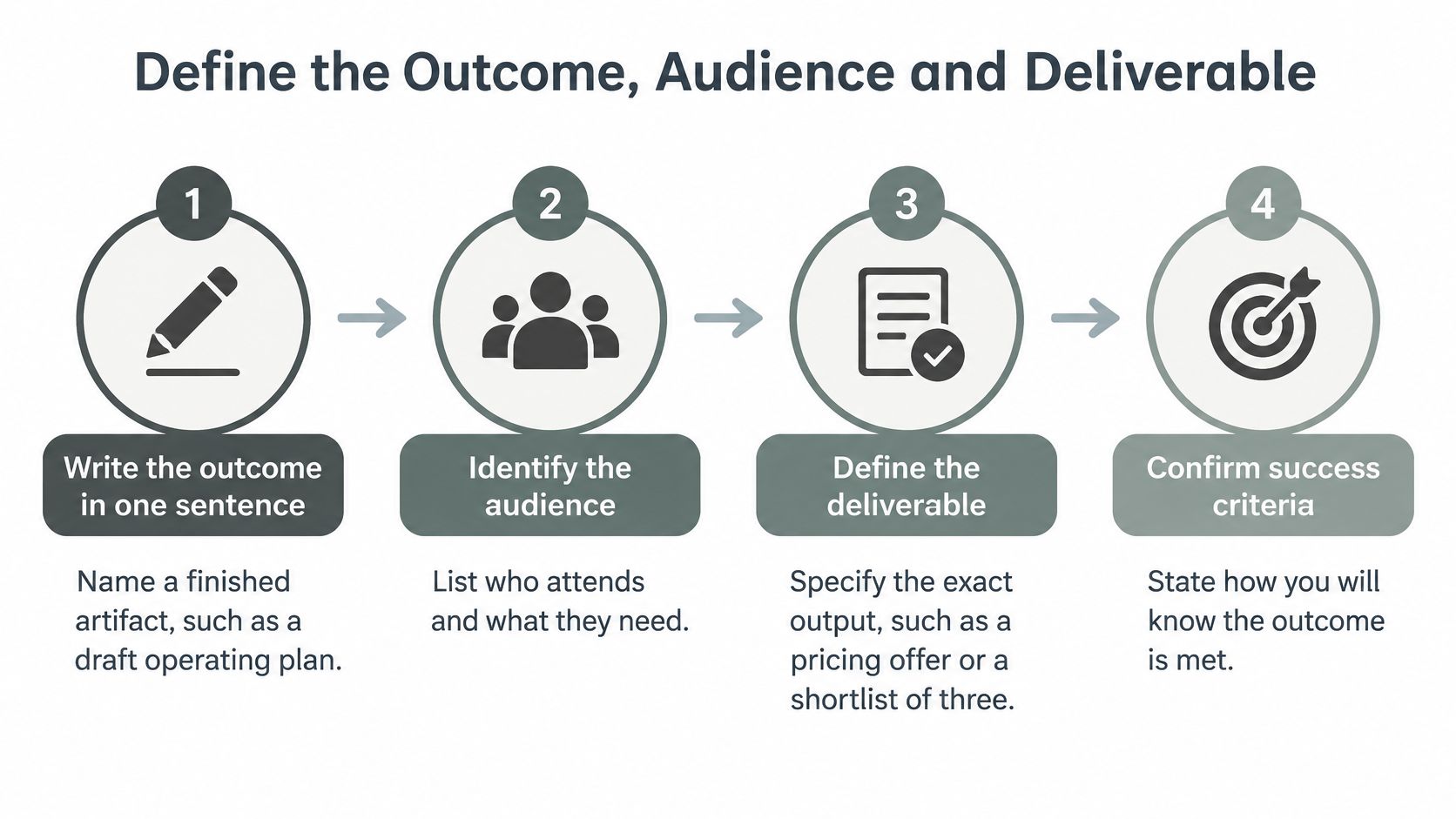
Write the outcome in a sentence that names a finished artifact. Choose a draft operating plan, a pricing offer or a shortlist of three partners, rather than a broad ambition such as improving strategy. A visible output gives participants a shared definition of finished.
Name the decision the group must reach. For a pricing workshop, that might be choosing which offer to test, not settling the entire commercial strategy. Identify who can approve that decision so the group doesn't produce recommendations nobody can authorize.
Define who attends and why they're needed. Include the people who hold relevant knowledge, will do the work or have decision authority. Cap attendance at the size the task requires, rather than inviting everyone who might be interested.
List what participants already know and must read beforehand. Separate essential background from optional reference material. If the exercise depends on customer feedback or cost information, assign someone to bring it rather than assuming it will appear.
Choose a measurable sign of success. Count completed drafts against agreed requirements, record an approved decision, or check whether participants can perform the intended task. Satisfaction is useful feedback, but it isn't evidence that the deliverable exists.
Use the visual flow to keep the planning conversation focused on the work.
Make the promise achievable
Say a small-business owner in Jenks invites five members to a marketing workshop. Their outcome is a one-page offer, with an owner assigned to test it with two customers before the next session.
The onsite deliverable is the completed offer and test plan. Customer testing is a follow-up commitment, not something the facilitator should claim the workshop has already achieved.
Demonstrate how to turn a customer problem into an offer, then let participants work on their own version. Don't spend the available time explaining every marketing framework you know.
Write acceptance criteria on the template: intended customer, problem, promised result, price assumption and next test. If you can't picture what participants will hold at the moment the session ends, rewrite the outcome before going further.
Choose a Format and Venue That Fit the Outcome
Workshop formats compared
Format | Best for | Main risk | Staffing and equipment |
|---|---|---|---|
In-person only | Hands-on practice and team building | Excludes remote staff | One facilitator, room, printed materials |
Hybrid in one room | Mixed teams with a few remote members | Remote people become observers | Paid moderator, camera, audio, captions |
Split sessions | Large groups or different time zones | Two sessions must still reach the same outcome | Two facilitators and a shared digital board |
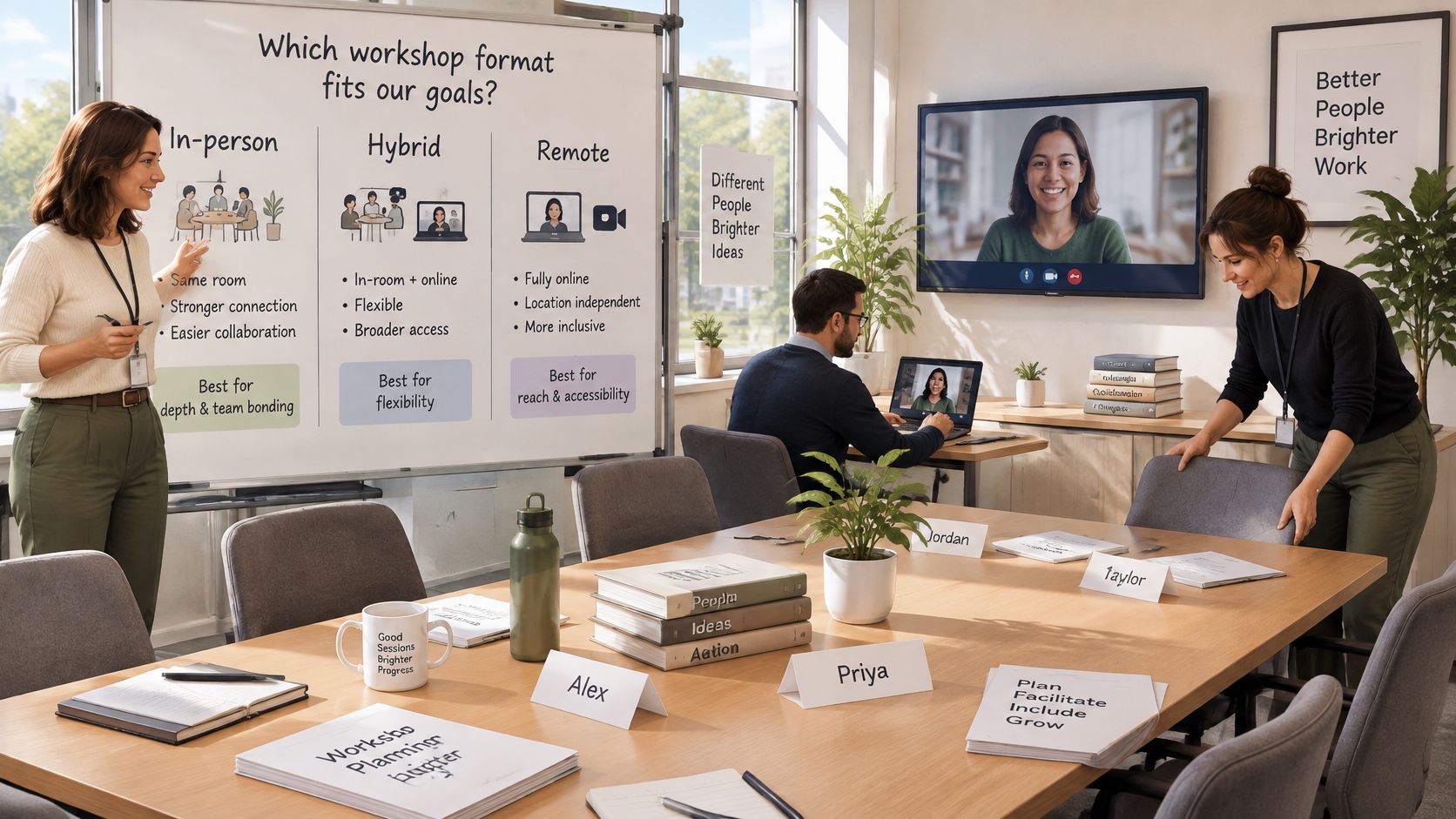
Choose the format before choosing the room. In-person delivery keeps physical materials and demonstrations straightforward, but it makes travel and scheduling part of the participation requirement. Hybrid delivery avoids that requirement for remote attendees, while adding staffing and technical work.
Split sessions can be the better compromise when you can't support both audiences properly at once. They require consistent instructions, equivalent feedback and a shared way to collect outputs, rather than an improvised online repeat.
The University of Sheffield's inclusive event facilitation guidance calls for trained, paid moderators and appropriate equipment, alongside provisions such as captions, translation, consent-based recordings and asynchronous materials. Treat that support as a delivery cost, not an optional upgrade.
A collaborative room should let participants face their work and each other.
Inspect the working layout
Check capacity for the actual furniture arrangement, not the maximum advertised occupancy. Round tables need more floor space than theatre seating, and participants need somewhere to put laptops, templates and materials without blocking circulation.
Inspect breakout space, a usable wall or whiteboard, screen visibility, Wi-Fi and power. Listen for sound leakage from neighboring rooms and check whether daylight creates glare on screens. A beautiful room that prevents groups from hearing each other is the wrong room.
Use a written event venue requirements checklist during the walkthrough. Record what's included, what must be hired separately and who handles setup.
For example, consider a team of twelve with three remote members. Equip the room with a camera and microphone, assign a separate moderator to remote chat, and place the working template on a shared digital board. Test whether remote participants can speak, practice and receive feedback, not merely watch.
If the budget can fund a stream but not remote participation, choose separate sessions instead of calling the stream a hybrid workshop.
Match the setting to the community
Freeform House is envisioned as a premier, membership-based club and community gathering point in downtown Jenks, Oklahoma, comparable in concept to SoHo House but intended for more than social connection. We offer private workspaces, open collaboration areas, hot desks and reservable conference rooms, supporting co-working and a creative, cooperative local community.
The surrounding 10 District, also known as The Ten District, comprises 10 downtown blocks, extending west from the Arkansas River to the former Midland Valley railroad tracks, according to The Ten District's organizers. That gives local workshop hosts a specific downtown setting rather than a vague location promise.
Prospective members can book a personalized consultation to discuss pricing structures, opening dates and membership. For workshop planning, bring your outcome and layout requirements to that conversation.
Follow this walkthrough sequence:
Write the outcome.
Confirm headcount.
Choose the format.
List known access needs.
Book the walkthrough.
Fix the format before you sign anything.
Build a Timed Agenda and Materials List
A timed agenda is where a workshop plan becomes testable: if the blocks do not fit the room booking, nothing downstream matters.
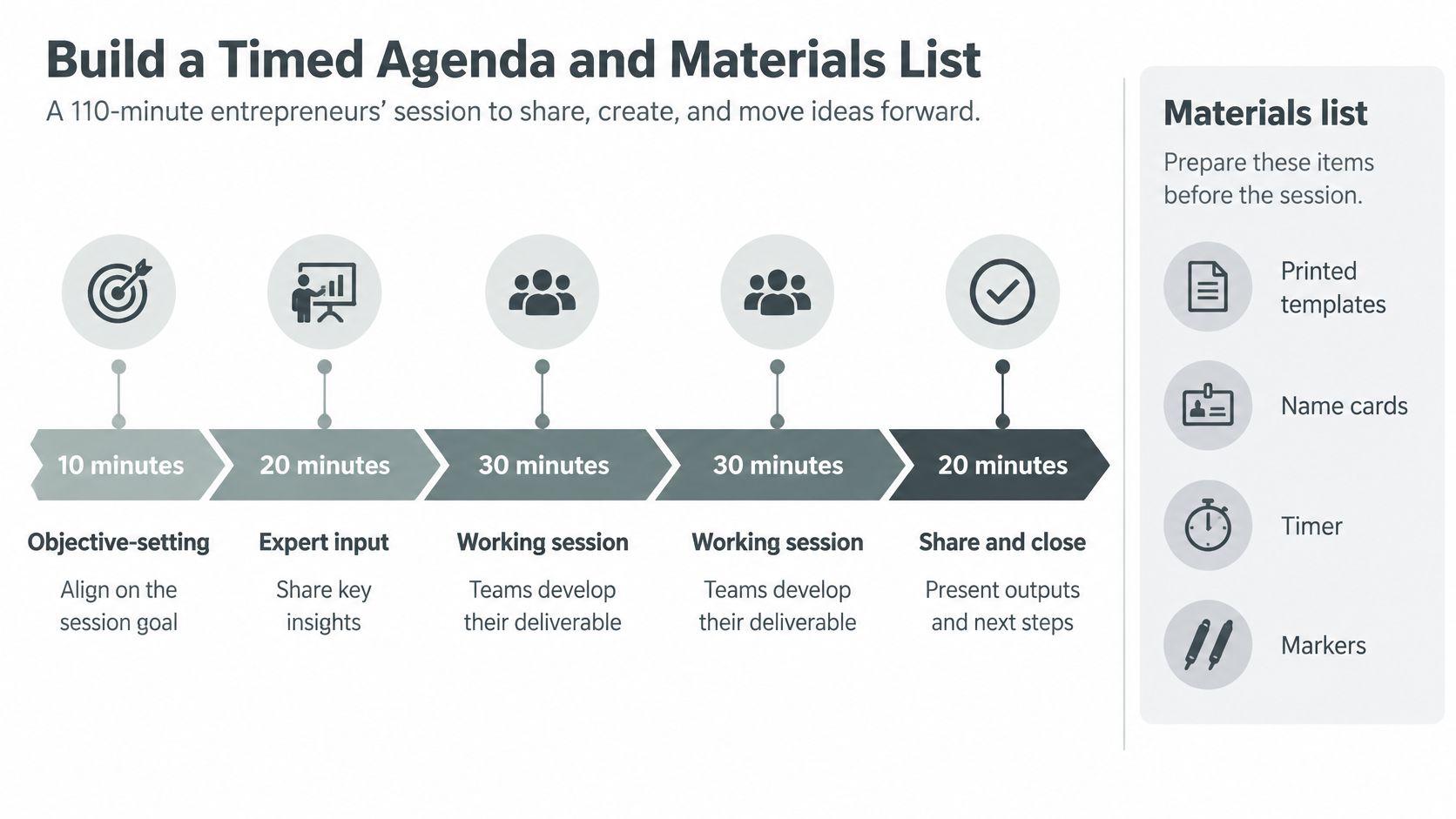
Timed agenda for a 110-minute session
Block | Minutes | Purpose |
|---|---|---|
Objective setting | 10 | Confirm the outcome and show the deliverable template |
Expert input | 20 | Brief input that feeds the exercises |
Structured exercise 1 | 30 | Apply the method to a real decision |
Structured exercise 2 | 30 | Build the deliverable |
Commitment round | 15 | Each participant names a next action |
Evaluation | 5 | Short closing survey completed onsite |
Total | 110 | Complete the deliverable, assign actions and evaluate |
These blocks total 110 minutes of working time. Any planned break belongs on top of that figure, added to the room booking rather than absorbed inside it. If the venue slot runs shorter than the agenda, shorten the expert input to 15 minutes rather than removing the evaluation block.
A mixed-methods evaluation of pharmacogenomics workshops in the International Journal of Pharmacy Practice found that participants who completed pre-reading were better positioned to engage meaningfully, while excessive unstructured time could lead to disengagement. Facilitators also observed stronger engagement when activities had an obvious practical application.
An agenda should therefore name the task participants perform in every block, not only the topic a speaker covers. Replace a block called customer strategy with a task such as comparing customer objections and revising the offer.
The visual below presents a compact agenda and materials overview; use the detailed run-of-show to control the actual booking length.
Prepare participants and facilitators
For a sample preparation schedule, send the participant brief five to seven days ahead. Include a one-page summary, the reading that matters most, what to bring and the decision they will help make.
Keep the reading necessary.
A large folder just shifts the work of finding the important document onto the attendee, and attendees who arrive underprepared tend to burn the objective-setting block catching up. Before the brief goes out, finish the facilitator run-of-show. Give each block a named lead, exact instructions, an expected output and a fallback if the activity stalls.
Printed brief: Keep instructions readable without a device.
Working materials: Pack sticky notes, legible markers and spare pens.
Deliverable template: Place it on tables before the opening exercise.
Room aids: Prepare name cards and a visible timer.
Digital workspace: Set up a shared board with tested editing permissions.
Protect working time
Use workshop activity ideas selectively. An activity earns its place only when it helps participants produce the agreed output.
I would schedule a short break after roughly 60 to 75 minutes in a session this length, adding it to the booking on top of the 110 minutes rather than pretending it takes no time. When a speaker overruns, protect the exercise and closing blocks first. A shorter explanation is usually a better compromise than an unfinished deliverable.
Plan Access Before Registration Closes
Access planning matrix
Barrier | Registration question | Owner | Backup |
|---|---|---|---|
Mobility and transport | Do you need step-free access or transport? | Logistics lead | Accessible pick-up point and seat near exit |
Captions and interpretation | Do you need captions or interpretation? | Facilitator with booked provider | Live captioning with recording shared afterwards |
Language | Which language do you prefer for materials? | Facilitator | Plain-language slides and translated brief |
Schedule and caregiving | Which times work, and do you have caregiving needs? | Organiser | Shorter sessions and asynchronous task |
Technology and internet | Do you need a device or stable connection? | Technology host | Dial-in option and printed materials |
Participation style | Would you prefer anonymous input or an opt-out from speaking? | Facilitator | Written input option and individual reflection time |
Use this matrix as a menu, not a form to copy in full. In a sample registration form, select five relevant questions, combining related needs where appropriate and offering a private contact route for anything else.
The University of Kansas Community Tool Box workshop guidance identifies language, technology, internet access, transportation, caregiving, scheduling, sound, visibility, captions, interpretation, pace and instructions as participation considerations. Asking about needs is only useful if someone converts the answers into operational decisions.
Explain why you're collecting access information, who can see it and how participants can update it. Ask what support would help, not for a diagnosis or unnecessary personal history.
Turn an answer into a funded arrangement
Suppose a registrant uses a wheelchair and requests transport support. The logistics lead needs to confirm the step-free route, accessible toilet access, table clearance and an appropriate pick-up arrangement with that person.
The transport budget must be provisioned before the venue commitment, even if the passenger details are finalized later. A seat near an exit isn't a substitute for a usable route, and a recording isn't a substitute for live interpretation when someone needs to contribute.
Add cost, booking deadline and confirmation status to your internal matrix. Test backups with the participant rather than assuming that any alternative will work.
Include social and psychological access
Give participants quiet reflection time before group discussion. Offer anonymous written input, plain-language instructions and an explicit opt-out from public speaking without requiring an explanation.
For mixed-location groups, a hybrid meeting preparation guide can help translate access decisions into moderator duties and technology checks. Also check microphone use, instruction pace and whether remote participants can read the materials.
Access commitment: Any answer that changes the room, food, timing or materials goes into the plan that same day, with a named owner.
Close registration early enough to fulfill arrangements, but keep a contact route open for needs that change. The deadline is for organizing support, not for making late disclosures someone else's problem.
Run the Session and Measure What Changed
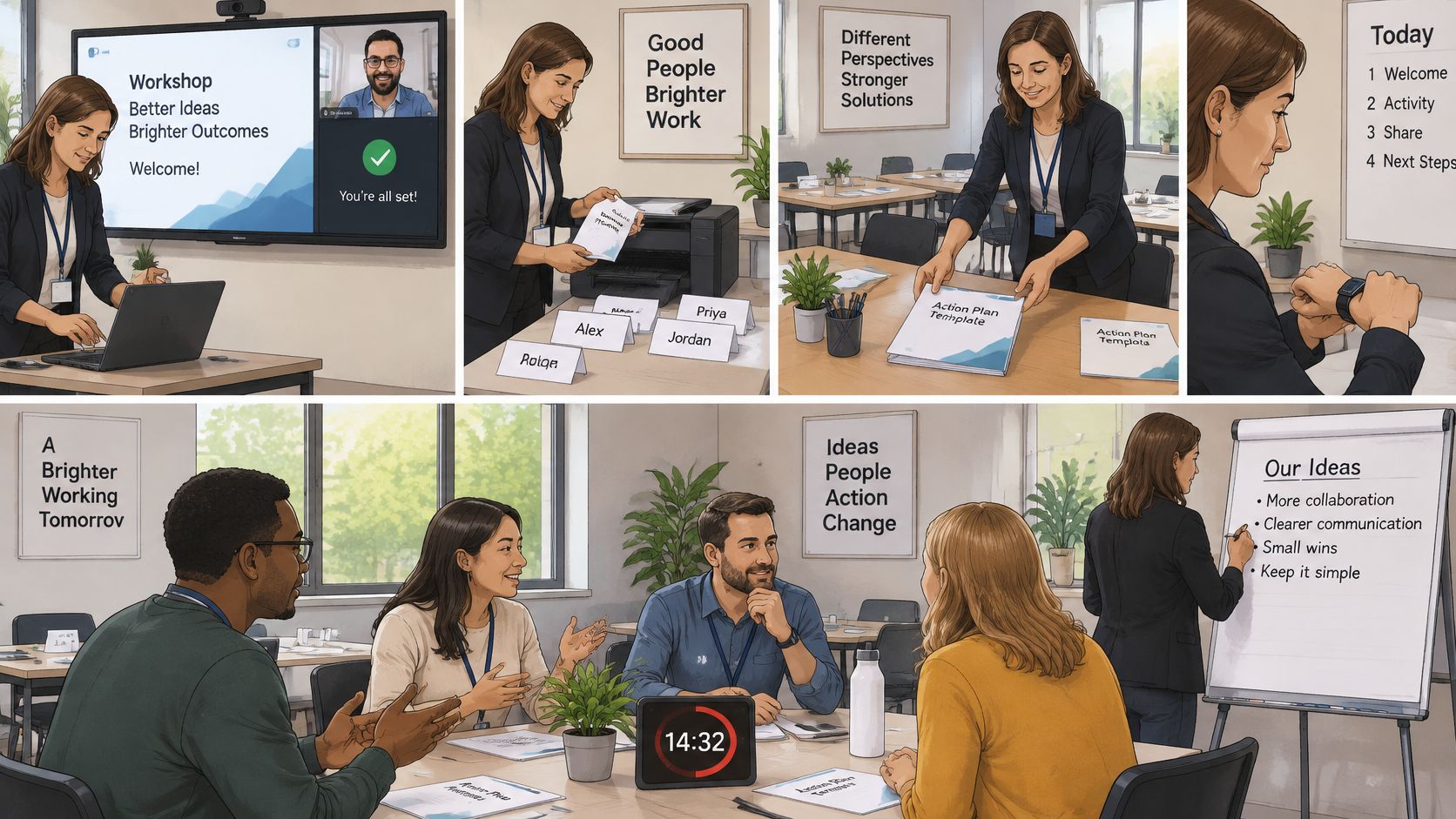
Arrive an hour early on a standard delivery day. Test the screen and remote connection, print name cards, place deliverable templates on tables and check the timer. Walk the arrival route as a participant would, including the route to refreshments and toilets. Anything that fails now still has a fix. Anything that fails at start time has an audience.
The facilitator's job is to keep participants working toward a usable result.
Manage the work in real time
Take the creative team developing a campaign shot list. State the outcome in the opening two minutes, show the template and identify who can approve the final priorities. If the approver is not in the room, name the person who can speak for them before the first exercise starts.
Keep a visible clock. If discussion runs long, announce the trade-off and shorten an optional discussion rather than taking time from drafting. Cutting drafting time to protect a debate is how teams leave with opinions instead of deliverables.
The team should leave with a shot list and a named editor for the next draft. Specify authentic photographs of real people, places and activities, not clip art or generic visuals that merely look polished. Confirm photography permissions before adding people to the plan.
For an additional facilitation resource, use the video below.
Check application, not just satisfaction
Design the evaluation before registration opens: a baseline question about confidence or priorities, a closing form that takes under five minutes in this sample workflow, and a 30-day application check. Collect the closing form onsite. Completion typically drops once participants leave, and a follow-up email survey reliably draws fewer responses than a form filled in before the closing remarks. Run the closing form before the final break if the schedule allows, since early departures start before the official end.
For the creative-team example, send the shot list, action owners and check-in date within a proposed 48-hour follow-up window. At the 30-day check, ask whether the team used the list, what changed and what prevented implementation. Compare those answers with the baseline question to see whether confidence turned into action or stayed at intention.
Measure the artifact and its use, not attendance alone. A full room doesn't tell you whether anyone can act differently afterward.
Freeform House offers private workspaces, open collaboration areas, hot desks and reservable conference rooms for focused team sessions. Bring your workshop outcome, participant needs and preferred format to a personalized consultation about membership, then visit Freeform House to discuss the setting for your next working session.
Comments