How to Improve Focus at Work and Achieve Deep Work

Trying to improve your focus at work isn't just about willpower. It's about getting strategic with your day, taking control of your surroundings, and actively training your attention. The first step is admitting that your focus is your single most valuable asset—especially when it feels like every ping and notification is designed to chip away at it.
The True Cost of Distraction in the Modern Workplace
Let's be real: staying focused at work feels like a constant battle. The non-stop flow of emails, Slack messages, and open-office chatter puts us in a state of "continuous partial attention," where deep, meaningful work feels just out of reach.
This isn't just a feeling, either. It's a measurable drain on our productivity and our mental energy. Each interruption, no matter how quick, yanks you out of your flow. This constant task-switching comes with a heavy hidden cost.
The High Price of a Simple Interruption
The real damage isn't the interruption itself—it's the time it takes to get back on track. Research shows it takes an average of 23 minutes and 15 seconds to fully regain your concentration after being distracted.
Think about that for a second. If you're a professional in Jenks or Tulsa dealing with just 8-10 interruptions a day, that's 3-4 hours of fragmented, less effective work. You're busy, but are you actually moving the needle?
Every notification, every "quick question," is a small tax on your attention. Over the course of a week, these small taxes accumulate into a massive debt, leaving you feeling busy but not productive.
The infographic below really puts the compounding effect of these daily interruptions into perspective.
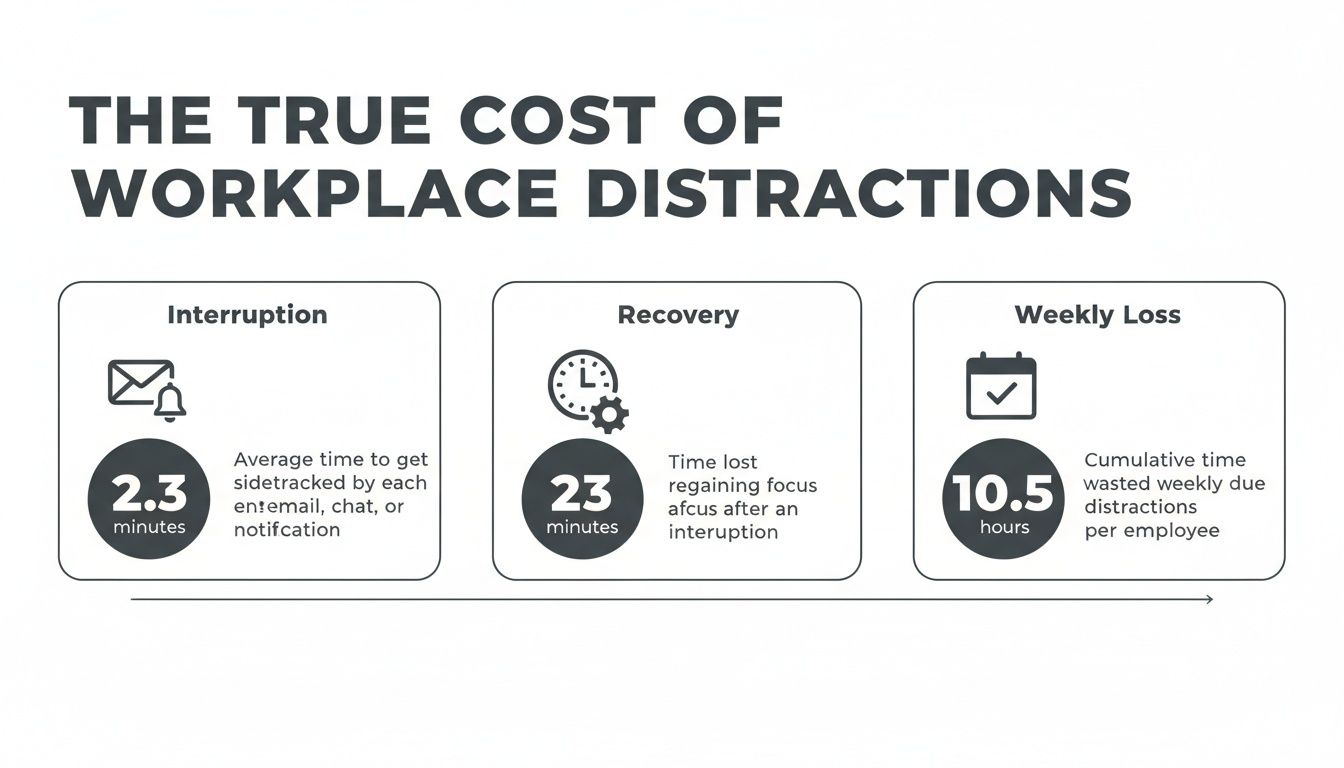
This table breaks it down even further, showing how a few "harmless" interruptions can quietly sabotage your entire week.
How Interruptions Quietly Steal Your Week
Daily Interruptions | Daily Time Lost to Recovery | Weekly Time Lost (5-day week) |
|---|---|---|
5 | 1 hour, 55 minutes | 9 hours, 35 minutes |
8 | 3 hours, 5 minutes | 15 hours, 25 minutes |
10 | 3 hours, 52 minutes | 19 hours, 20 minutes |
As you can see, even a handful of interruptions per day can cost you nearly a full workday by the end of the week. That lost time hits everything from project deadlines to your own well-being.
Even things that feel productive, like meetings, can turn into major distractions if they aren't managed well. If you're ready to reclaim that time, check out our guide on how to run effective team meetings that boost productivity.
Mastering Your Schedule with Proven Focus Techniques
A productive day doesn't just happen—it's designed. If you really want to improve focus at work, you have to move past a simple to-do list and start structuring your time with frameworks that actively shield your attention. It's all about taking control of your calendar before the day takes control of you.
These techniques create clear, non-negotiable boundaries for different kinds of work. Instead of getting pulled in a million directions by notifications, you decide upfront what deserves your focus and when. That small shift from a reactive to a proactive mindset is where deep, meaningful work begins.

The Power of Time Blocking
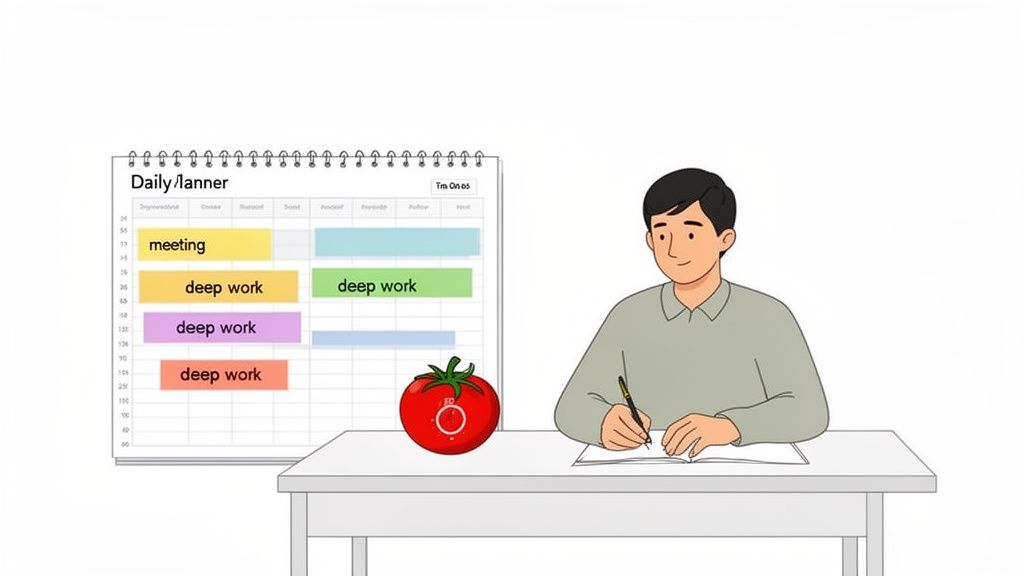
Time blocking is exactly what it sounds like: you schedule every part of your day by assigning specific "blocks" of time to particular tasks. Think of an entrepreneur in Tulsa who needs to hammer out a critical business plan. Instead of just "hoping" for a quiet moment, they block out a 90-minute "Deep Work" session from 9:00 to 10:30 AM.
During that block, their phone is silenced, email is closed, and they treat it like an unbreakable appointment with their most important client: their business. This simple act walls off their most demanding work from the constant stream of calls and team questions that will inevitably pop up later.
Time blocking transforms your calendar from a simple record of appointments into a strategic plan for your attention. It's a commitment to yourself that your big priorities deserve protected, uninterrupted time.
For a Freeform House member, this is as simple as booking the Executive Room for that exact 90-minute block. Having a dedicated space reinforces the commitment, providing a quiet, professional environment built for concentration—a world away from the distractions of a home office or a bustling coffee shop.
Intense Focus with the Pomodoro Technique
Have a task that feels so big you don't even know where to start? The Pomodoro Technique is your best friend. It breaks down your work into focused, 25-minute sprints separated by short breaks. It's surprisingly effective because it creates a sense of urgency while giving your brain regular moments to recharge, helping you stay sharp for hours.
Here’s the basic rhythm:
Pick one single task to work on.
Set a timer for 25 minutes and go all-in, no interruptions.
When the timer goes off, take a 5-minute break. Stretch, grab water, look out a window.
After four "Pomodoros," you've earned a longer break of 15-30 minutes.
This method is a game-changer for remote professionals who need to add some structure to their day. If you're looking for more ways to organize your workday, check out our guide on 8 essential remote work productivity tips for professionals in 2025.
Prioritize with the 'Eat the Frog' Principle
The "Eat the Frog" principle, inspired by a classic Mark Twain quote, is brilliantly simple: do your hardest, most important task first thing in the morning. That task is your "frog." It’s the one you’re most likely to put off, but it’s also the one that will have the biggest positive impact on your day.
Knocking it out first thing creates a huge wave of momentum and a sense of accomplishment that fuels you for the rest of the day. It ensures your peak mental energy is spent on what actually matters, not wasted on clearing out trivial emails or other busywork. Combine this with time blocking, and you've got a powerful one-two punch for a wildly productive day.
Designing Your Environment for Deep Concentration
Your ability to really zero in on your work is tied directly to the environment around you. It’s not just about willpower. Both your physical desk and your digital workspace can either fuel deep concentration or actively sabotage it with a thousand tiny distractions.
Taking control of these spaces is one of the most powerful moves you can make.
This isn’t just about convenience, either. The American Psychological Association’s 2023 Work in America Survey found that 81% of workers were satisfied when they had control over their work arrangements. Even more telling? 79% of those satisfied workers rated their mental health as good or excellent, a huge jump from the 44% who felt they lacked control.
Good mental health is the foundation for focus. When you're stressed or overwhelmed, your brain is far more susceptible to distraction. You can dive deeper into the connection between autonomy and well-being in the full 2023 Work in America report.
Optimizing Your Physical Workspace
Let’s start with what’s right in front of you. A cluttered desk isn't just visually chaotic; it bombards your brain with extra stimuli, forcing it to work harder just to filter out the noise. The goal here is to create a "focus sanctuary."
Here's how to get started:
Declutter Ruthlessly: Clear anything from your desk that isn’t essential for the task at hand. A clean space really does promote a clear mind.
Invest in Noise Control: If you're in an open office or a busy home, a good pair of noise-canceling headphones is non-negotiable. They create a personal bubble where you control what you hear.
Ergonomics Matter: An uncomfortable chair or a monitor at the wrong height creates a low-grade physical ache that constantly chips away at your concentration.
Your workspace should be a signal to your brain that it's time for deep work. Every object should have a purpose or be put away. This isn't just about being tidy; it's about reducing cognitive load.
Taming Your Digital Environment
Your digital space is just as critical. Unmanaged notifications and the siren song of social media are the modern-day equivalent of a constantly ringing phone on your desk. You have to set some firm boundaries.
A simple but effective tactic is to use app and website blockers during your dedicated work blocks. These tools physically prevent you from accessing your biggest time-wasters, which means you don't have to rely on sheer willpower to stay on track. This bit of digital friction can make a huge difference in your productive output.
This kind of intentional design is what separates a makeshift home office from a purpose-built workspace. For example, a member at Freeform House might need to spend two hours analyzing complex financial data. They can book the private Thomas Room, a space designed specifically for quiet, heads-down work. Later, they might move to a more collaborative area for networking.
This ability to match your environment to your task is a game-changer for productivity. If you're looking to upgrade your own work setting, explore our guide on how to rent personal office space and find your ideal workspace today.
Training Your Brain to Sharpen and Sustain Focus
Improving your focus at work goes way beyond just organizing your calendar or tidying up your desk. While those external fixes are a great start, lasting concentration is really an inside job. It helps to think of your ability to focus not as some fixed trait you’re born with, but as a mental muscle—one you can absolutely strengthen with consistent training.
This is all about building the mental stamina to resist distractions and get into what author Cal Newport famously calls "deep work." We're talking about those long, uninterrupted stretches of high-value thinking where real breakthroughs happen. This is the engine for the kind of complex problem-solving that actually moves the needle.

Embrace the Discipline of Single-Tasking
The modern workplace seems to celebrate multitasking, but neuroscience paints a very different picture. When you think you're doing two things at once, your brain isn't really multitasking—it's just switching between tasks at a frantic pace. This constant context-switching is a huge cognitive drain, leads to more mistakes, and leaves you feeling busy but not very productive.
The antidote is surprisingly simple: single-tasking. Commit to doing one thing, and only one thing, at a time. Close all those extra browser tabs. Put your phone on silent. Give the task in front of you your full, undivided attention. It might feel weird at first, but it’s the most direct route to producing better work in less time.
Deep work is the professional equivalent of a high-intensity workout. It's challenging and requires your full effort, but it's also where you build the strength to achieve your most ambitious goals.
This skill is becoming more valuable by the day. The World Economic Forum’s Future of Jobs Report 2023 tagged analytical and creative thinking as the most critical skills for today's workers. The report found that employers expect 44% of workers’ skills to be disrupted in the next five years, making these deep-focus abilities non-negotiable for staying relevant.
Build Awareness Through Mindfulness
You can't reclaim your focus if you don't notice it's gone missing in the first place. That's where mindfulness meditation comes in. It isn't about emptying your mind of all thoughts; it’s about learning to observe your thoughts without getting swept away by them and gently guiding your attention back to a single point, like your breath.
Even just five to ten minutes a day can make a massive difference in your ability to spot and handle distractions during the workday. You're essentially training your "attention muscle" to stay on task longer and bounce back faster from interruptions.
Use Your Environment as a Training Ground
Every time you deliberately choose a place that supports deep work, you're reinforcing your focus training. For creative professionals in Jenks, this could be as simple as booking a session in a space that’s built for high-value output.
For example, a member at Freeform House can use:
The Rise Loft Studio: A dedicated space for photography or video production that strips away the external chaos, forcing you to zero in on the creative task at hand.
The Podcast Booth: An acoustically treated room that demands your complete attention on crafting a compelling story, free from all the little sounds that pull you away.
Using these kinds of specialized resources isn't just about having access to cool equipment. It’s an active form of focus training. You’re creating a ritual where your brain learns to associate a specific place with deep, productive work, building the mental stamina you need for your most important projects.
Where Environment and Productivity Come Together
Everything we've talked about—from mastering your schedule to designing your workspace and training your brain—really clicks into place when you have the right environment. These strategies aren't just abstract ideas. They’re practical tools that become so much more powerful when you use them in a space that’s actually built for the job.
This is the secret to truly improving your focus at work: integrating proven techniques with a setting that’s designed for them.
Freeform House is envisioned as a premier, membership-based club in the heart of Jenks, Oklahoma's 10 District downtown. Comparable to the renowned SoHo House, it offers more than just a social club. Members can take advantage of co-working spaces and a dynamic community hub designed for collaboration and connection. It's a central gathering spot aimed at fostering a creative and cooperative spirit within our local community.
Making a Real-World Strategy Work
Imagine a typical day for a Jenks professional at Freeform House. Instead of wrestling with the distractions of a home office or the loud unpredictability of a coffee shop, their day flows seamlessly between different kinds of work.
For Deep Work and Concentration: When a critical proposal is due, they don't just "try" to focus. They book a private, distraction-free space like the Thomas Room. That simple act combines time blocking with environmental design, creating a powerful ritual that signals to the brain: it’s time for intense concentration.
For Structured Collaboration: A team workshop needs a dedicated space. By reserving a collaborative room, they contain the meeting, turning it into an intentional, productive session instead of a series of scattered interruptions that derail everyone's focus for the rest of the day.
For Creative Skill Development: To sharpen creative thinking—a skill that absolutely demands sustained attention—they might use The Rise loft studio or our in-house podcast booth. These specialized areas are basically focus-training grounds, helping them build the mental stamina needed for high-value projects.
A membership at Freeform House is a direct investment in your ability to focus. It's about trading a chaotic, reactive workday for a structured, proactive one where you control your attention and, as a result, your outcomes.
An Investment in Your Most Valuable Asset
At the end of the day, the ability to concentrate is what separates simply being busy from producing high-impact results. By providing the ideal setting to implement these focus-enhancing techniques, Freeform House helps bridge that tricky gap between knowing what to do and actually doing it.
You aren’t just getting access to a beautiful space in the heart of Jenks' 10 District. You’re plugging into an infrastructure designed for peak performance. It’s a central gathering spot that encourages connection and collaboration while deeply respecting the quiet, deep work that drives real progress.
This intentional blend of community and concentration is the key to unlocking your full professional potential.
Still Have Questions About Staying Focused at Work?
Putting new focus strategies into practice is a bit like building a muscle—it takes time, and you're bound to run into some challenges along the way. I get it. It's one thing to read about these techniques, but it's another thing entirely to make them stick when the pressure is on.
Let's walk through some of the most common hurdles people face. Think of this as the troubleshooting section for your brain.
"I Feel Totally Overwhelmed. How Can I Get My Focus Back Right Now?"
When you're drowning in tasks, the first step is to get out of your head. Grab a piece of paper and do what I call a "brain dump." Just spend five minutes writing down every single thing on your mind—tasks, worries, half-baked ideas, everything. It’s messy, but it’s liberating.
This simple act clears up so much mental bandwidth. Once it's all out, don't try to tackle the whole list. Just pick one thing. It could be the most urgent item or just the easiest one for a quick win.
Set a timer for 25 minutes (a single Pomodoro) and work only on that one task. This small, focused sprint is incredibly powerful. It breaks the cycle of paralysis and starts rebuilding your momentum.
This is where a change of scenery makes a huge difference. At Freeform House, you could grab a quiet pod or a private office for just that 25-minute sprint. The physical act of moving to a dedicated "focus zone" sends a powerful signal to your brain that it's time to get down to business.
"What Do I Do When My Own Thoughts Are the Biggest Distraction?"
This one is tough because you can’t exactly put your brain on 'Do Not Disturb.' Internal distractions are often the hardest to manage. The trick is to stop fighting them. Trying to force a thought away usually just makes it stronger.
Instead, just acknowledge it. Keep a notepad (a "distraction pad") on your desk. When a random thought about your grocery list or that email you forgot to send pops up, quickly jot it down. You’re essentially telling your brain, "I see you, I’ve captured this, and I’ll deal with you later."
This frees you up to gently guide your attention back to your actual work. It feels a little strange at first, but with practice, it becomes a powerful way to stay on track.
"Are There Any Apps That Actually Help with Focus?"
Yes, but with a big caveat: you have to use them to build walls, not open more doors. The best focus apps aren't about adding another thing to check; they're about enforcing the boundaries you've decided to set for yourself.
Here are a few types that genuinely work:
Website and App Blockers: Tools like Freedom or Cold Turkey are non-negotiable. They physically block you from accessing your biggest time-wasting sites and apps during your scheduled focus blocks.
Smart Task Managers: A good system like Todoist or Asana isn't just a list; it’s a plan. It helps you get thoughts out of your head and decide what truly deserves your attention before you start working.
Dedicated Timers: A simple Pomodoro timer is fantastic for structuring your work into sprints and, just as importantly, reminding you to take those crucial recovery breaks.
Technology should be your assistant in creating deep work sessions, not the thing that constantly pulls you out of them.
"How Can I Stay Focused When My Team Is So Collaborative (and Loud)?"
This is a balancing act, and it all comes down to clear communication and shared respect for each other's time. You can't just expect people to know when you need to concentrate; you have to create clear signals.
This could be as simple as putting on headphones, setting a specific "Focusing" status in your team chat, or physically moving to a designated quiet area.
Encourage a team culture where people batch their non-urgent questions. Instead of a constant stream of "quick questions," try having a couple of scheduled check-in times throughout the day. When you do need to collaborate, make it intentional.
A team at Freeform House might book a conference room for a two-hour brainstorming session. That time is locked in for productive, collaborative energy. But just as importantly, when that session is over, everyone can retreat to their own space, knowing their individual focus time is protected.
Ready to trade distraction for deep work? Discover how the purpose-built environment at Freeform House can provide the structure and focus you need to achieve your professional goals. Explore membership options and book a tour today.
Comments