Creative Workspace for Rent: A Practical Renter's Guide

You're comparing two creative workspace listings. One looks polished, has an attractive monthly rate, and photographs well. The other costs slightly more, but includes usable meeting access, reliable internet, parking, quiet rooms, and a neighborhood where clients won't struggle to find lunch. Six weeks later, the cheaper space is costing you more in day passes, coffee runs, room fees, and lost concentration.
That's the mistake I see most often across Oklahoma. Founders shop for rentable square footage when they should be pricing the full experience of showing up, working, meeting, creating, and hosting. A creative workspace for rent only works when its access, privacy, services, location, and contract terms match the way you operate.
Mapping Your Real Needs Before You Tour a Single Space
A founder moving out of a home office usually starts with a browser tab full of rates and square footage. That's backwards. Before you tour anything in Jenks or Tulsa, determine what your workweek demands from the room.
Start with a short self-audit. Write down:
Physical attendance: How many days each month will you be there?
Work pattern: Are you on calls all day, producing content, meeting clients, or doing heads-down work?
Visitors: How often will prospects, vendors, collaborators, or employees visit?
Privacy: Do you need a door, a reservable room, or only a quieter corner?
Arrival friction: Will parking, coffee, lunch, security, or after-hours access affect whether you come in?
Production needs: Do you need podcast equipment, lighting, a photo-ready setting, or screen casting?
The point is to separate what sounds attractive from what controls your weekly behavior. A beautiful lounge won't compensate for nowhere to take a confidential call. A private office won't justify its price if you work from home most days and only need a professional room for client meetings.
Turn the audit into a one-page brief
Translate your answers into requirements an operator can answer directly. For example: “I need access on workdays, a quiet place for focused writing, reservable meeting space for client conversations, dependable video calls, and easy parking for guests.” Add your preferred term, guest frequency, storage needs, and any production requirement.
Acoustics deserve a higher place on that list than most renters give them. Seventy-five percent of employees said managed noise levels matter in an effective workplace, while only 30% were satisfied with noise levels where they worked, according to a global workplace survey cited in an acoustics report. If phone calls dominate your day, test the room during active hours rather than trusting a quiet morning tour.
Practical rule: Don't tour a space until you can describe your ideal Tuesday there.
Use this guide to finding office space for rent to pressure-test your brief, then send the same document to every operator. You'll get comparable answers instead of collecting polished but unrelated sales pitches. The right listing is the one that satisfies your actual week, not the one with the most impressive lobby.
Coworking, Private Suites, or Members-Only Club
The model matters more than the furniture. Open coworking, private suites, and members-only clubs solve different problems, and choosing the wrong one creates a monthly irritation you won't fix with better coffee.
Open coworking makes sense for a solo professional who values flexibility and social energy more than control. You share the environment, accept some turnover, and usually trade privacy for access. It can be efficient for independent work, but it becomes frustrating if you spend half your day taking calls or regularly need a client-ready room.
Private suites are the better choice for a small team, a consultant handling sensitive conversations, or a business that needs a consistent branded setting. You get more control over noise, storage, and presentation, but you may pay for space that sits empty and interact less naturally with other members.
A members-only club adds another layer. You aren't only buying a desk or office. You're paying for curated access, hospitality, events, meeting environments, and a community that may help you build relationships. That premium only makes sense if you will use the network and shared amenities. If you want a silent room and leave immediately, buy privacy instead.
Use the decision matrix honestly
Model | Privacy | Community | Typical Cost | Best Fit |
|---|---|---|---|---|
Open coworking | Low to moderate | Broad, informal | Variable membership | Solo founder or remote professional |
Private suite | High | More limited, often team-based | Higher commitment | Executive team or client-facing operator |
Members-only club | Varies by room and access plan | Curated and relationship-driven | Premium access model | Founder, host, creator, or professional who values community |
Soho House provides a useful reference point for the club concept. Its membership page says Every House members can access 48 Houses in 19 countries, along with amenities including 22 gyms, 11 spas, 29 pools, and 18 screening rooms, plus more than 2,400 monthly events. Those benefits show how a club can make access broader than a workstation, although you still need to verify what a local workspace membership includes.
Soho Works is a separate coworking layer within that ecosystem. An academic review states that it launched in 2015, is available to Soho House and Soho Friends members, and had monthly fees ranging from $200 to $700 in 2024, depending on location and membership status, as described in the review of Soho Works. Treat those figures as a reference point, not a quote for Jenks.
Before signing, ask yourself one blunt question: are you buying square footage, or are you buying a better way to work and connect? If the answer is square footage, compare private suites. If the answer is access and relationships, investigate the club model. This private coworking space guide can help you frame the privacy decision before you tour.
The Tour Checklist That Separates Good Spaces From Bad Ones
A lobby tells you almost nothing. Tour a creative workspace for rent as if you were testing a production environment, because that's what you're buying.
Bring a notebook and score every space against the same categories. Don't let an operator lead you only through the photogenic rooms.
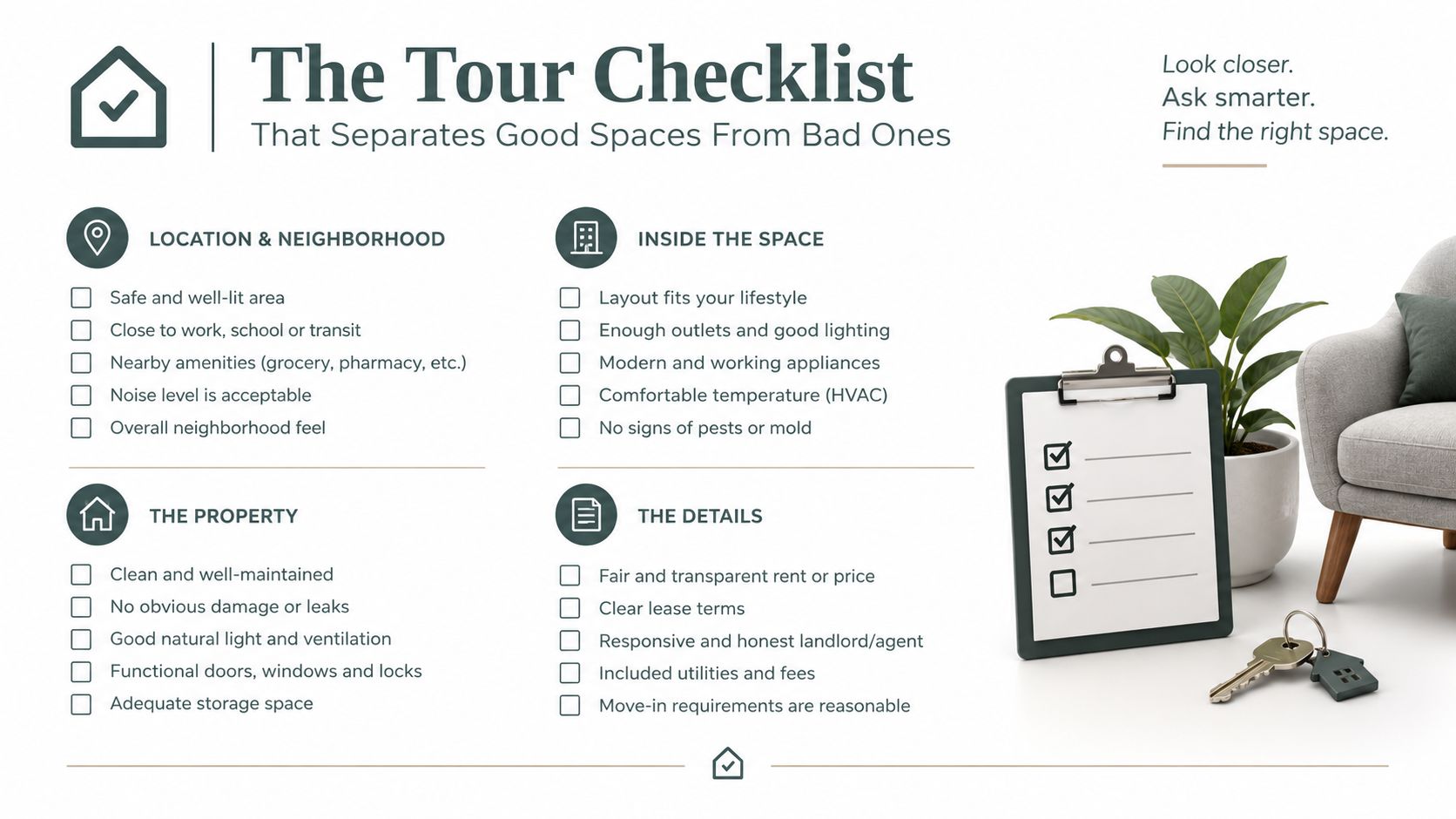
Test daily operations
Ask whether internet performance is consistent during busy periods, not merely whether Wi-Fi exists. Check the printer, coffee setup, kitchen, mail handling, package policy, and cleaning schedule.
Connectivity: Can the operator show you the network setup and explain what happens if service fails?
Mail and packages: Where do deliveries go, and who handles oversized or sensitive items?
Daily supplies: Are printing, coffee, kitchen access, and basic office supplies included or billed separately?
Don't taste one impressive coffee and assume the whole experience is managed well. Look at the details members encounter when nobody is selling to them.
Test creative and meeting technology
Open every room you may reserve. Check the camera position, microphone pickup, lighting, outlets, whiteboards, display connections, and whether a remote participant can hear the room clearly.
Ask how reservations work and what happens when a meeting runs late. If the space offers a podcast booth, loft studio, or content room, ask about setup time, equipment responsibility, booking limits, and whether you can bring a client or production partner.
Listen before you admire
Stand still for a minute in the open workspace. Then test a phone booth and a meeting room while other people are working nearby. Speech noise and open-plan spillover can undermine concentration, even when the interior looks refined.
Check whether quiet areas are genuinely quiet, whether doors seal, and whether monitors face glare from windows. Lighting should support long work sessions, not only flattering photographs.
Inspect arrival and access
Walk from the parking area to the entrance. Confirm building hours, after-hours entry, security procedures, elevator access, restroom access, and ADA routes. Ask how a first-time client gets inside without calling you from the sidewalk.
A strong operator answers directly and shows you the relevant systems. Evasion is data. If you can't get a clear answer during the tour, expect more friction after you join.
Budgeting the True Monthly Cost of Renting Creative Space
The advertised membership is only the starting line. Your real monthly cost includes every payment and recurring behavior required to use the space comfortably.
Build a simple comparison sheet with these lines:
Base access: Desk, suite, club, or workspace membership.
Connectivity and utilities: Internet, power, climate control, and technology fees.
Access friction: Parking, transportation, after-hours charges, and guest access.
Room usage: Meeting rooms, conference rooms, podcast rooms, studios, and event space.
Operating extras: Printing, mail, storage, setup, cleaning, and booking fees.
Hospitality spending: Coffee, lunch, catering, delivery minimums, and client refreshments.
Entry costs: Deposit, initiation fee, furniture, signage, and other setup charges.
The national benchmark gives you a useful reference, not a substitute for a local quote. The median U.S. membership rate for open workspace and dedicated desk products was $220 per person per month in Q1 2026, while the average site size was 17,945 square feet, according to the Q1 2026 national coworking report. A Jenks or Tulsa quote can differ based on privacy, hospitality, room access, and the building's operating model.

Compare access bundles, not sticker prices
Suppose one operator quotes a low base membership but charges separately for meeting rooms, guest access, coffee, and event use. Another operator quotes more but includes the services you use every week. The second space may be cheaper for your actual workflow.
Don't invent usage assumptions. Track your expected room bookings, client visits, parking needs, and hospitality spending from the needs brief. Then ask each operator to quote the same bundle.
Use this breakdown of private club membership fees to identify questions the headline rate may not answer. Ask whether deposits are refundable, whether setup charges recur, how room credits expire, and whether unused benefits carry forward.
A $250 membership with $40 in room fees and $60 in hospitality commitments is a $350 workspace for your budget.
Month-to-month terms can also distort the comparison. Neutral industry guidance notes that flexibility often comes with higher pricing and stricter deposit terms, so a longer-term headline discount can disappear after add-ons. Your spreadsheet should show the cost of the term you want, not the cheapest number in the brochure.
Negotiating Perks, Deposits, and Contract Terms That Actually Matter
Most operators won't cut the base rate just because you ask. They may have pricing rules, capacity targets, or membership tiers that make a discount difficult. That doesn't mean the agreement is fixed.
Negotiate the items that affect how often you can use the space. A room credit, guest pass, event-hour allowance, waived setup fee, or deposit adjustment can be more valuable than a small reduction in monthly dues.
Ask for usable value
Bring a specific request tied to your operating pattern:
“I'm comfortable with the membership rate if you can include meeting-room credits, clarify guest access, and reduce the upfront deposit.”
That is stronger than saying, “Can you do better?” Operators can approve a defined package more easily than an open-ended discount.
Prioritize these terms:
Deposit: Ask whether it can be reduced, waived, or replaced with a different form of security.
Room access: Request credits or a clear included allocation for meetings, calls, studios, or events.
Guests: Confirm how many guests you can bring, during which hours, and whether clients count differently.
Partnerships: Ask whether the operator can arrange preferred access to parking, gyms, restaurants, coffee, catering, or delivery.
Events: Clarify whether setup, teardown, staffing, furniture, and cleaning are included.
A partnership only has value if it solves a recurring problem. A lunch arrangement is useful when it reliably serves your meetings. A vague promise to “make introductions” belongs nowhere in the budget unless the operator explains what they will provide.
Read the exit language
Don't sign until you understand auto-renewal, notice deadlines, rate changes, early termination, subletting, desk sharing, room cancellations, and damage responsibility. Ask for every verbal promise in writing, including guest privileges and included room time.
Month-to-month access can be the right choice when your attendance is uncertain, but it often trades convenience for higher pricing and stricter deposit terms, as explained in this industry guide to renting creative workspace. Compare the total cost of flexibility against the value of commitment before choosing.
Use this script if the operator resists:
“I'm choosing based on total access, not just the base rate. If the rate can't move, which combination of deposit relief, room access, guest privileges, or event time can you include?”
That conversation reveals whether the operator understands your business. It also keeps the negotiation focused on benefits you'll use.
A Jenks and Tulsa Example You Can Walk Through This Week
A founder comparing creative workspace for rent in Jenks should price the full cost of access, not just the advertised membership. The building, meeting rooms, production areas, hospitality, parking, and client experience all affect what the space is worth. The Ten District is a downtown redevelopment zone in Jenks, Oklahoma covering exactly 10 blocks west of the Arkansas River. It was founded in 2021 to transform downtown Jenks into a mixed-use destination, according to coverage of The Ten District. That location gives a workspace practical value when clients, collaborators, restaurants, and events are part of your workweek.
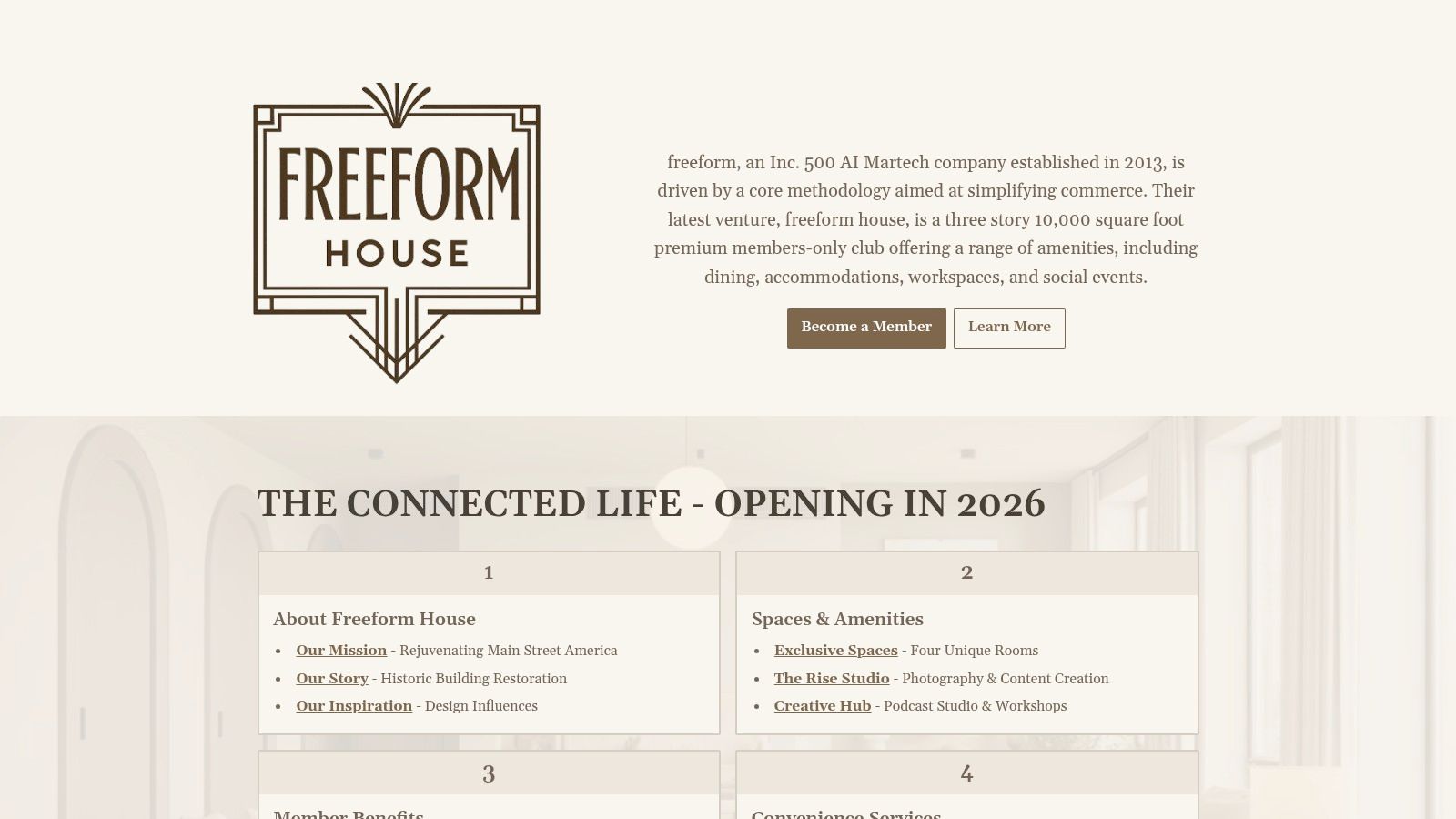
Freeform House provides a clear local example of the members-only club model. The club was planned for the heart of Jenks' Ten District, combining coworking, meeting access, creative production, and community space in a restored 1920 building with three stories and 10,000 square feet. Its listed amenities include four named rooms, The Rise loft studio, an in-house podcast booth, local restaurant and coffee partnerships, Amazon Hub Lockers, and a rentable golf cart fleet. Treat those features as a starting point for comparison. Ask which ones are included, how often you can use them, and what access costs beyond membership.
Match the room to the workflow
A Jenks entrepreneur leaving a home office needs a reliable work base and a credible client setting. Review the Freeform Room or comparable shared workspace for daily use, then check whether meeting access is sufficient for prospects and partners.
An executive team planning an offsite should inspect the Executive Room. Test screen sharing, sound control, privacy, catering logistics, arrival instructions, and the transition from formal work to a meal or informal discussion.
Production users should focus on infrastructure rather than décor. The in-house podcast booth supports recorded conversations, while The Rise loft studio provides a separate setting for content or photography. Confirm booking windows, equipment, lighting, setup time, storage, and collaborator access before assigning those amenities a value.
For an event, compare the Hall of Fame Room and Thomas Room by guest count, movement, privacy, food service, and teardown needs. Local restaurant and coffee partnerships may reduce hospitality work more than another lounge feature.
Freeform House is one Jenks option to compare with Tulsa alternatives. Walk the rooms, test acoustics, calculate the total access cost, and ask which flexible term arrangement fits your attendance pattern before signing. Then decide whether the membership structure supports the way you work.
Your 30-Day Plan to Lock In the Right Workspace
Don't browse listings indefinitely. Give yourself a month and assign one decision to each week.
Week one
Complete the needs audit. Record attendance, call volume, client visits, production requirements, parking needs, preferred access hours, and the maximum all-in monthly cost you can justify. Turn that into a one-page brief and shortlist spaces that answer it directly.
Week two
Book two tours. Bring the checklist, test the internet, stand in the quiet areas, inspect arrival routes, open the meeting technology, and ask for a written fee schedule. Tour at a realistic working time, not only during a polished preview.
Week three
Request comparable proposals. Negotiate room credits, guest access, deposits, event inclusions, and partner benefits before pushing for a lower base rate. Read the renewal, escalation, cancellation, and termination clauses with the same attention you gave the design.
Week four
Move in with a written baseline. Track how often you use the desk, rooms, studio, hospitality services, and community benefits. At the end of the first month, compare reality with your original brief and address gaps while the operator still wants to earn your renewal.
The most underrated signal is whether members are still there at 4 p.m. on a Wednesday.
That tells you more than a staged photograph. Stop comparing listings from your laptop. Book two tours this week, bring the brief, and choose from the room, the contract, and the actual Tuesday-to-Thursday experience.
Freeform House combines membership-based coworking, private rooms, The Rise loft studio, an in-house podcast booth, and local hospitality partnerships in downtown Jenks. If that mix fits your work, meetings, or creative production needs, visit Freeform House and evaluate the full cost of access in person.
Comments