8 Essential Remote Work Productivity Tips for Professionals in 2025

The shift to remote and hybrid work offers incredible flexibility, but maintaining peak productivity presents a unique challenge. Distractions at home, the blurring of work-life boundaries, and a sense of isolation can quickly erode focus and output. Moving beyond generic advice, this guide provides a collection of concrete, actionable remote work productivity tips designed to help you reclaim your focus and elevate your professional performance.
We will explore powerful techniques like time blocking and the Pomodoro method, alongside practical strategies for creating strong work-life boundaries. This is not just a list of ideas; it's a blueprint for structuring your day for deep work, minimizing digital interruptions, and creating effective accountability systems. For ambitious professionals in Jenks and Tulsa, these strategies are essential for thriving.
Furthermore, you will learn how leveraging a dedicated third space can be a game-changer. Discover how the curated, premium environment of a place like Freeform House can amplify your focus, creativity, and connection. This listicle will equip you with the tools to master your workflow, whether you're at a home desk or utilizing a professional hub designed for collaboration and peak performance, transforming your entire work experience.
1. Establish a Dedicated Workspace (and Know When to Escape It)
One of the most foundational remote work productivity tips is creating a clear boundary between your personal and professional life. A dedicated workspace, whether it's a converted spare bedroom or a quiet corner of your living room, signals to your brain that it’s time to focus. This physical separation helps minimize household distractions and primes you for deep work.

However, even the best home office can become monotonous, leading to creative slumps and burnout. The next-level strategy is adopting a “third space” - a professional environment outside the home that eliminates domestic distractions entirely.
The Power of a Third Space
A third space provides a crucial change of scenery that can reset your focus and spark new ideas. It removes you from the temptations of household chores and the interruptions of daily life, allowing for uninterrupted concentration. This hybrid approach, combining a dedicated home base with a professional third space, offers ultimate flexibility.
For instance, you might use your home office for routine administrative tasks but escape to a more dynamic environment for high-stakes projects or collaborative sessions. A space like Freeform House, a premier, membership-based club in the heart of Jenks, Oklahoma's 10 District downtown, offers a powerful alternative. Comparable to the renowned SoHo House, it offers more than just a social club. Members can take advantage of co-working spaces and a dynamic community hub designed for collaboration and connection. It's a central gathering spot aimed at fostering a creative and cooperative spirit within our local community. If you're looking for the right environment, you can explore options to rent personal office space and find your ideal workspace.
How to Implement This Strategy:
Invest in Ergonomics: Equip your primary workspace with a supportive chair, proper monitor height, and good lighting to prevent physical strain.
Set Clear Boundaries: Communicate your work hours to family or roommates to minimize interruptions.
Schedule Your "Escape": Plan specific days or tasks to handle at your third space. For example, use it for deep work on Tuesdays and creative brainstorming on Fridays.
Pack a Go-Bag: Keep a bag with your laptop, chargers, notebook, and other essentials ready to go, making the transition seamless.
2. Use the Pomodoro Technique
Maintaining focus over long stretches is one of the biggest challenges of remote work. The Pomodoro Technique is a powerful time management method designed to combat mental fatigue by breaking work into focused intervals. Developed by Francesco Cirillo, it uses a timer to structure work into 25-minute sessions, called "pomodoros," separated by short five-minute breaks.

This cyclical approach creates a rhythm that keeps your mind fresh and engaged. After four pomodoros, you take a longer, more restorative break of 15-30 minutes. This structured cadence helps you tackle large tasks without feeling overwhelmed, making it one of the most effective remote work productivity tips for preventing burnout.
Applying Pomodoro for Deep Work
The technique’s true strength lies in its ability to train your brain to concentrate in short, intense bursts, which is ideal for deep, complex work. It forces you to dedicate a specific block of time to a single task, eliminating multitasking and distractions. This is especially useful for professionals like software developers debugging code or writers drafting a complex report.
For example, a content creator can dedicate one pomodoro to outlining an article, another to writing the first draft, and a third to sourcing images, with breaks in between to reset. At a place like Freeform House, you can amplify this effect. Imagine dedicating your pomodoros to a single project in one of the quiet, dedicated work zones. The professional environment eliminates home distractions, allowing you to fully immerse yourself in each 25-minute sprint and maximize your output.
How to Implement This Strategy:
Choose a Task: Decide on the specific task you will work on.
Set a Timer: Use a physical or digital timer for 25 minutes. Commit to working solely on that task until the timer rings.
Work Until the Timer Rings: Once the timer goes off, mark your progress and take a five-minute break. Use this time to stretch, grab water, or look away from your screen.
Take Longer Breaks: After completing four pomodoros, take a longer break (15-30 minutes) to fully recharge before starting the next cycle.
3. Implement Time Blocking
A reactive workday, driven by notifications and a sprawling to-do list, is the enemy of productivity. Time blocking is a proactive method for taking control of your schedule. Instead of simply listing tasks, you assign specific blocks of time in your calendar for everything, including deep work, emails, meetings, and even breaks. This approach transforms your calendar from a record of appointments into a strategic plan for your day.
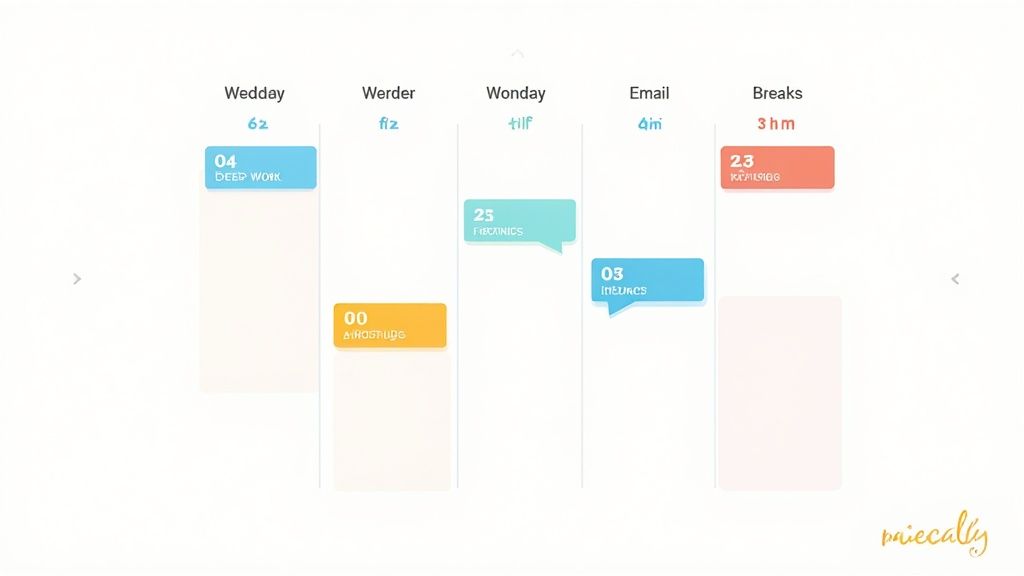
Popularized by thought leaders like Cal Newport, this technique reduces decision fatigue by pre-determining what you'll work on and when. It ensures that your most important, high-impact tasks receive dedicated, uninterrupted attention, making it one of the most effective remote work productivity tips for staying on track.
The Power of a Structured Schedule
Time blocking provides the structure that remote work often lacks. It creates a clear roadmap, preventing you from drifting between tasks or getting pulled into low-priority activities. By treating your work blocks with the same seriousness as you would an external meeting, you protect your focus and build momentum throughout the day.
For example, a consultant might block 8-10 AM for client project deep work, knowing this is their peak focus time. They can then batch all their communication into a 1-2 PM block. At a place like Freeform House, you could reserve a quiet room specifically for your most critical deep work blocks, ensuring that your protected time is truly protected from any potential home-life interruptions. This level of intentionality guarantees that your most valuable work gets the attention it deserves.
How to Implement This Strategy:
Identify Your Priorities: At the start of each week, define your most important tasks and estimate the time needed for each.
Block Your Peak Hours: Schedule your most demanding "deep work" during the time of day you feel most energetic and focused.
Batch Similar Tasks: Group administrative tasks like answering emails or making calls into a single, consolidated block to avoid context-switching.
Schedule Buffers and Breaks: Add 15-minute buffers between blocks for transitions and schedule intentional breaks to recharge and avoid burnout.
Use Color-Coding: Assign different colors to task categories (e.g., blue for deep work, green for meetings) in your digital calendar for a quick visual overview.
Review and Adjust: Treat your time block schedule as a living document. Review it at the end of each week to see what worked and adjust for the week ahead.
4. Minimize Distractions and Digital Interruptions
In a remote setting, your biggest productivity hurdle is often the constant stream of digital and physical interruptions. Every notification, email alert, or social media ping pulls you out of your flow state. Minimizing these distractions is one of the most effective remote work productivity tips for reclaiming focus and producing high-quality work.

The cost of a simple interruption is higher than you think; research shows it can take over 20 minutes to fully refocus on a task after being distracted. A truly productive environment is one where you have deliberate control over these potential disruptions, allowing for sustained periods of deep work.
The Power of a Controlled Environment
Creating a distraction-free zone is less about willpower and more about strategic environment design. This means actively removing temptations and building systems that protect your attention. Top performers, from software developers to authors, intentionally disable notifications and block distracting websites to create an airtight container for their most important work.
This strategy is particularly crucial for complex projects that demand your full cognitive resources. Instead of fighting a losing battle against digital noise at home, you can leverage a professionally curated space designed for concentration. The private, sound-dampened rooms at Freeform House offer a sanctuary from both home and digital interruptions. Imagine working in an environment where you can silence your phone and close unnecessary tabs, knowing the physical space itself is engineered for focus.
How to Implement This Strategy:
Use Focus Modes: Activate "Do Not Disturb" on your Mac or "Focus" on Windows during dedicated work blocks to silence all non-essential alerts.
Batch Your Communications: Schedule specific times to check email and messages, such as 10 AM and 3 PM, rather than reacting to them as they arrive.
Install a Website Blocker: Use tools like Freedom or Cold Turkey to block access to social media and other distracting sites for set periods.
Create Physical Distance: Place your smartphone in another room during deep work sessions to completely remove the temptation to check it.
Communicate Your Availability: Let your team know when you will be in a focus block and unavailable for immediate responses.
5. Establish Clear Work Hours and Boundaries
Without the natural rhythm of an office commute to signal the beginning and end of the day, remote work can easily bleed into personal time. Establishing strict work hours is a non-negotiable strategy for long-term productivity and well-being. This creates a psychological boundary that prevents burnout and trains your brain to be highly focused during designated work periods.
This principle, championed by figures like Basecamp co-founder Jason Fried, argues that a constrained workday fosters efficiency. When you have a hard stop, you prioritize ruthlessly and avoid procrastination. This structure also communicates professionalism to clients and colleagues, setting clear expectations for your availability.
The Power of a Shutdown Ritual
A shutdown ritual is a sequence of actions you perform at the end of each workday to formally transition from "work mode" to "personal mode." This could involve reviewing tomorrow's calendar, tidying your desk, and closing all work-related tabs. This habit reinforces your boundaries and helps you mentally disconnect, leading to more restorative evenings and better sleep.
This disciplined approach is crucial for maintaining a professional image, even without a physical storefront. When clients know your hours, they respect them. For entrepreneurs looking to solidify this professional presence, services like a virtual office can provide a business address and receptionist, further reinforcing these boundaries. By setting a clear structure, you can learn more about how a virtual office and receptionist can support a modern business and its operational hours.
How to Implement This Strategy:
Communicate Your Hours: State your working hours clearly in your email signature and team communication channels.
Block Your Calendar: Use your calendar to block off time before and after your official workday to prevent meetings from being scheduled.
Create an End-of-Day Ritual: Spend the last 15 minutes of your day planning for tomorrow, organizing your digital files, and formally logging off.
Disable Notifications: Turn off all work-related notifications on your phone and computer outside of your set hours to protect your personal time.
6. Use Productivity and Project Management Tools
In a remote setting, staying organized and aligned with your team can be a major challenge. Digital tools provide the necessary structure, helping you manage tasks, track progress, and maintain accountability without constant meetings. Project management platforms, task managers, and note-taking apps act as a central hub for your work, reducing mental clutter and ensuring nothing falls through the cracks.
The right tech stack serves as an external brain, storing and organizing crucial information so you can focus on high-value work. This is one of the most essential remote work productivity tips for teams, as it creates a single source of truth that keeps everyone on the same page, regardless of their location.
Choosing the Right Tools for the Job
The goal is not to adopt every popular tool, but to build a lean, integrated system that fits your specific workflow. A marketing agency might use Monday.com to manage complex client campaigns, while a software startup might rely on Asana for agile project coordination. The key is to select tools that streamline communication and provide clear visibility into project timelines and responsibilities.
For example, a team could use a shared project board to manage a product launch, breaking down large goals into specific, assigned tasks with deadlines. This digital environment fosters a sense of shared ownership and clarity. At a space like Freeform House, fast and reliable internet ensures these cloud-based tools run smoothly, allowing you to manage your digital workflow without interruption whether you're in a private office or a collaborative lounge.
How to Implement This Strategy:
Start Simple: Begin with one core tool (like a task manager) and only add others as a clear need emerges.
Prioritize Integration: Choose tools that connect with your existing software (e.g., Slack, Google Drive) to create a seamless ecosystem.
Establish Conventions: Maintain consistent naming and tagging systems across all platforms to keep information organized and searchable.
Customize Your Workflow: Adapt the tool to your team's processes, not the other way around. Use custom fields, templates, and automations.
Schedule Regular Reviews: Set aside time daily or weekly to review your dashboards, update progress, and plan your next steps.
7. Practice Regular Breaks and Movement
Chaining yourself to your desk for hours on end is a direct path to burnout, not a badge of honor. One of the most counterintuitive yet effective remote work productivity tips is to intentionally step away from your work. Integrating scheduled breaks and physical movement throughout your day is crucial for maintaining focus, preventing physical strain, and preserving your mental energy.
Without the natural interruptions of a traditional office, like walking to a meeting or grabbing coffee with a colleague, remote workers can become dangerously sedentary. Purposeful breaks act as a cognitive reset, allowing your brain to recharge and return to tasks with renewed clarity.
The Science of a Strategic Pause
Strategic breaks aren't about procrastination; they are a tool for sustained performance. Techniques like the Pomodoro Method, which involves focused work sessions followed by short breaks, are popular for a reason. These pauses combat decision fatigue, reduce eye strain, and improve circulation, directly contributing to higher-quality output over the long haul.
A short walk, a few minutes of stretching, or simply stepping outside for fresh air can completely shift your perspective on a challenging problem. For members of Freeform House, this could mean taking a break from a task in one of the quiet rooms to enjoy the vibrant, communal atmosphere of the lounge. This change of pace provides both a physical and mental reset, preparing you to dive back into your work with greater efficiency.
How to Implement This Strategy:
Use the 20-20-20 Rule: Every 20 minutes, look at something 20 feet away for at least 20 seconds to combat digital eye strain.
Schedule Movement Alarms: Set a recurring timer to remind you to stand, stretch, or walk around for five minutes every hour.
Reclaim Your Lunch Break: Make it a strict rule to step away from your desk for lunch. Eat in a different room or, better yet, get outside for some natural light.
Vary Your Break Activities: Alternate between different types of breaks to keep them refreshing. Try a short walk, simple desk yoga, breathing exercises, or a quick chat with a family member.
8. Create Accountability Systems
Working alone can make it easy to procrastinate or lose momentum. One of the most powerful remote work productivity tips is to build systems of accountability that create external motivation and structure. When you know you need to report your progress to someone else, your commitment to the task naturally increases, driving you to stay on track.
Accountability can be as formal as a daily team stand-up or as informal as a weekly check-in with a peer. The core principle is the same: making your goals and progress visible to others creates a psychological incentive to follow through. This external feedback loop helps you identify roadblocks, celebrate milestones, and maintain consistency even when motivation wanes.
Fostering Shared Commitment
An accountability system transforms solitary goals into shared objectives. Whether you join a mastermind group of fellow entrepreneurs or find an accountability partner with similar ambitions, you create a dedicated support network. These regular touchpoints provide structure and a sense of shared responsibility that is often missing in a remote setting.
For teams, this can be implemented through structured, purposeful meetings. Instead of aimless check-ins, these sessions become focused progress reports and problem-solving opportunities. You can use a dedicated, professional space at Freeform House for these crucial meetings, ensuring the environment is free from distractions and conducive to honest, productive conversations. To get the most out of these sessions, you can learn how to run effective team meetings that boost productivity.
How to Implement This Strategy:
Find an Accountability Partner: Connect with a colleague or peer who has similar goals and schedule regular, brief check-ins.
Define Clear Goals: Be specific about what you want to achieve. Use measurable metrics for both your process (e.g., "work for 2 hours on the project") and outcomes (e.g., "complete the first draft").
Establish a Cadence: Decide on a check-in frequency that matches your project's pace, such as daily for fast-moving projects or weekly for long-term goals.
Celebrate Progress: Acknowledge and celebrate wins together, no matter how small, to reinforce positive momentum and build morale.
8-Point Remote Work Productivity Comparison
Strategy | Implementation Complexity (🔄) | Resource Requirements (⚡) | Expected Outcomes (⭐ 📊) | Ideal Use Cases (💡) | Key Advantages (⭐) |
|---|---|---|---|---|---|
Establish a Dedicated Workspace | Moderate 🔄 — planning and physical setup required | High ⚡ — ergonomic furniture, equipment, lighting | ⭐📊 Improved focus, clearer work–life separation, fewer interruptions | Remote professionals, frequent video meetings, freelancers with space | ⭐ Consistent environment; better ergonomics; easier organization |
Use the Pomodoro Technique | Low 🔄 — start with a timer and basic discipline | Low ⚡ — timer or app | ⭐📊 Short-term focus boosts; reduced fatigue; measurable progress | Solo tasks, writers, coders, short-focus work sessions | ⭐ Makes large tasks manageable; enforces breaks; simple tracking |
Implement Time Blocking | Moderate–High 🔄 — requires planning and calendar management | Low–Medium ⚡ — calendar app; time to plan | ⭐📊 Structured days; less context switching; improved time estimates | Managers, knowledge workers, people balancing multiple projects | ⭐ Protects deep work; reduces decision fatigue; clearer priorities |
Minimize Distractions & Digital Interruptions | Moderate 🔄 — habit change and tool configuration | Low–Medium ⚡ — blockers, Do Not Disturb, policies | ⭐📊 Longer uninterrupted focus; higher work quality; fewer errors | Deep work roles (design, writing, coding), anyone attention-sensitive | ⭐ Dramatically increases focus; reduces task-switching costs |
Establish Clear Work Hours & Boundaries | Low–Moderate 🔄 — communication and personal discipline | Low ⚡ — calendar settings, communication tools | ⭐📊 Better work–life balance; reduced burnout; predictable availability | Distributed teams, remote employees needing structure | ⭐ Prevents overwork; sets team expectations; improves wellbeing |
Use Productivity & Project Management Tools | Moderate–High 🔄 — selection, setup, and onboarding | Medium–High ⚡ — subscriptions, integrations, training | ⭐📊 Improved coordination, transparency, and progress tracking | Teams, complex projects, asynchronous collaboration | ⭐ Centralizes work; increases accountability; reduces email clutter |
Practice Regular Breaks & Movement | Low 🔄 — schedule reminders and habit building | Low ⚡ — timers, minimal space for movement | ⭐📊 Sustained focus, better physical/mental health, reduced fatigue | Sedentary workers, long workdays, high-focus roles | ⭐ Prevents burnout; boosts creativity; improves circulation |
Create Accountability Systems | Moderate 🔄 — set processes, partners, or reporting cadence | Low–Medium ⚡ — meeting time, simple tracking tools | ⭐📊 Higher completion rates; sustained motivation; early issue detection | Teams (scrum), entrepreneurs, long-term individual goals | ⭐ Increases follow-through; provides feedback; builds cohesion |
Design Your Ideal Work Life in Jenks
Mastering remote work productivity isn't about adopting a rigid, one-size-fits-all formula. It's about designing a flexible, personalized system that aligns with your professional goals and personal rhythms. Throughout this guide, we've explored a collection of powerful remote work productivity tips, from the structured focus of the Pomodoro Technique to the strategic clarity of time blocking. Each strategy offers a piece of the puzzle, empowering you to build a work life that is not only efficient but also sustainable and fulfilling.
The journey to peak productivity begins with intentionality. It requires moving beyond simply reacting to tasks and instead, proactively engineering your day for success. This means consciously creating a dedicated workspace that signals your brain it's time to focus, whether that’s a well-organized home office or an inspiring, purpose-built environment. It means setting firm boundaries to protect your time and energy, ensuring that your work hours are truly productive and your personal time remains restorative.
From Theory to Action: Building Your Productivity System
The true power of these concepts emerges when they are combined into a cohesive system. Think of it as building with a set of reliable tools. You might use time blocking to structure your week, the Pomodoro Technique to tackle demanding projects within those blocks, and accountability partnerships to stay on track with your long-term goals.
Your action plan should start small and build momentum. Choose just one or two tips from this list to implement this week.
If you struggle with focus, start with the Pomodoro Technique. Commit to just four focused 25-minute sessions tomorrow.
If your days feel chaotic and unstructured, implement time blocking. Map out your ideal schedule for the next three days, assigning a specific purpose to every hour.
If you feel isolated and uninspired, seek out a professional community. Changing your environment can be one of the most effective ways to reset your mindset and boost your creative output.
Ultimately, achieving remote work mastery is about creating the right conditions for your best work to flourish. It’s about recognizing that productivity is deeply intertwined with well-being, community, and environment. For entrepreneurs and professionals in the Jenks and Tulsa area, this means leveraging local resources that are designed to foster connection and innovation. Places like Freeform House serve as a cornerstone for this new way of working, providing not just a desk, but a dynamic hub for collaboration, creativity, and commerce right in the heart of our community.
Ready to elevate your work environment and connect with a community of driven professionals? Discover how the amenities and collaborative spaces at Freeform House can transform your productivity and help you build your ideal work life. Explore membership options and book a tour today at Freeform House.
thoitiethomnay.org so với mấy app thời tiết mình từng dùng thì mở ra nhanh hơn, ít phải lướt, nhìn phát là nắm được tình hình; mình hay check theo tỉnh nên cái phần chọn tỉnh thành đặt ngay trên trang khá tiện, bấm cái là sang đúng trang địa phương, khỏi tìm trong menu lòng vòng; số liệu hiển thị kiểu thẳng thắn, có nhiệt độ hiện tại kèm “cảm giác như” và vài chỉ số cơ bản nên quyết định mặc gì cũng nhanh; mình để ý dữ liệu được cập nhật liên tục trong ngày nên lúc quay lại xem lại không bị cảm giác đang đọc thông tin từ sáng; chữ số nhiệt độ để to, dễ…
keonhacai 5 hôm bữa mình thấy vài người nhắc nên cũng tò mò bấm vào xem thử giao diện thế nào. Mình không có ngồi soi nội dung hay chọn từng mục cụ thể đâu, chỉ lướt qua cho biết họ sắp xếp trang ra sao thôi. Cảm giác đầu tiên là bố cục nhìn khá thoáng, các phần được chia thành từng khối rõ ràng nên kéo xuống không bị “ngợp” chữ. Mình thích kiểu họ trình bày thông tin theo dạng cột gọn gàng, nhìn một phát là hiểu chỗ nào là số liệu chỗ nào là tiêu đề, đỡ rối mắt. Thanh menu cũng đặt dễ thấy nên chuyển qua lại vài mục khá nhanh, không phải…