Beyond the Cubicle: 10 Different Types of Office to Know in 2026

The traditional office is evolving. Today’s professionals have more choices than ever, moving beyond rows of cubicles to spaces designed for collaboration, focus, creativity, and community. Choosing the right environment is a critical business decision. The proper workspace can directly boost productivity, enhance company culture, and attract top talent. This guide explores 10 different types of office setups, breaking down their unique benefits and ideal use cases to help you make an informed choice.
We will examine everything from open-plan layouts and private suites to innovative hybrid hubs and wellness-focused environments. As we'll see, premier destinations like Freeform House—a premier, membership-based club in the heart of Jenks, Oklahoma's 10 District downtown—are redefining the workspace by blending several of these models into one dynamic, community hub designed for collaboration and connection. Comparable to the renowned SoHo House, it offers more than just a social club, providing co-working spaces and a central gathering spot aimed at fostering a creative and cooperative spirit within our local community.
Whether you're a solopreneur, a growing startup, or an established corporate team, understanding these options is the first step toward finding a space where your work can truly thrive. This roundup will provide the actionable insights needed to select the perfect setting for your professional goals.
1. Open Plan / Collaborative Workspace
An open-plan or collaborative workspace is one of the most recognizable and dynamic types of office environments. It features an unobstructed floor layout with minimal to no interior walls or private offices, encouraging a high degree of transparency and interaction. This design intentionally removes physical barriers to foster spontaneous communication, quick problem-solving, and a strong sense of community among team members.
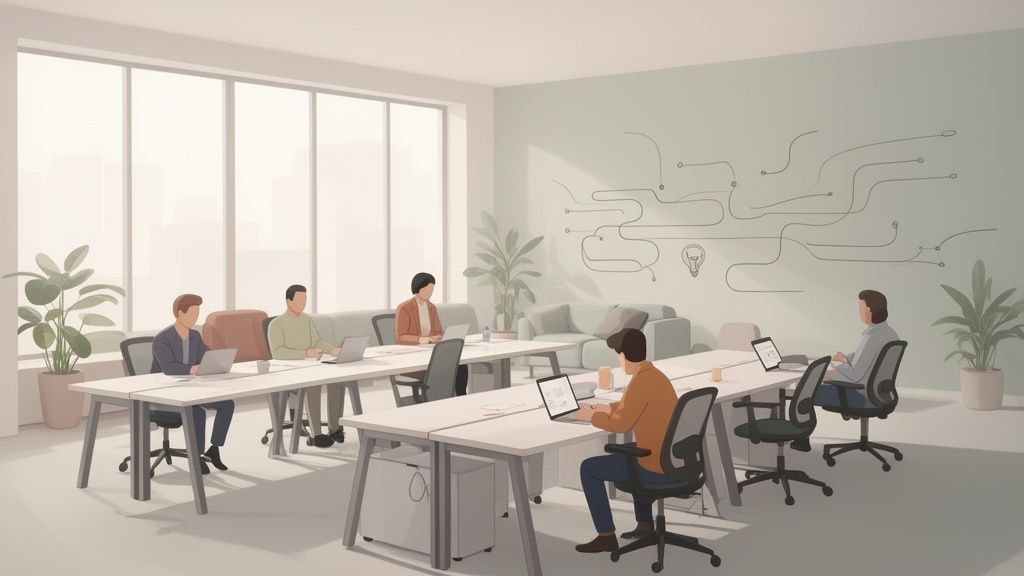
This model has been championed by tech giants like Google and Facebook to accelerate innovation and is a staple in creative agencies like IDEO. The core principle is that great ideas can come from anywhere, and an open layout makes those serendipitous encounters more likely.
Best For:
Startups and tech companies focused on rapid growth and iteration.
Creative teams (design, marketing, advertising) that thrive on group brainstorming.
Organizations aiming to break down departmental silos and improve cross-functional teamwork.
Implementation Tips:
Create Zones: Designate specific areas for different activities. Combine collaborative hot-desking areas with quiet zones for focused work, phone booths for private calls, and soft seating for informal chats.
Manage Acoustics: Noise is a common challenge. Use sound-absorbing materials like acoustic panels, carpets, and high-backed furniture to minimize distractions.
Set Clear Etiquette: Establish and communicate norms around interruptions, speakerphone use, and when to wear headphones. This ensures everyone can work productively.
Enhance Teamwork: For a deeper dive into fostering a cooperative spirit, explore our guide on how to improve team collaboration for real results.
Freeform House Connection: Our coworking spaces are designed with this collaborative spirit in mind. It's the perfect setup for Main Street entrepreneurs and local professionals in Jenks who want to connect with peers, find informal mentorship, and feel the energy of a shared mission.
2. Private Executive / Boardroom Suite
A private executive or boardroom suite is a dedicated, enclosed space designed for high-level meetings, confidential discussions, and executive decision-making. Among the different types of office setups, this one projects authority and professionalism through premium furnishings, advanced audiovisual technology, and sophisticated aesthetics. It is the ideal setting for making a powerful first impression.
These spaces are staples in corporate headquarters like JP Morgan Chase and consulting firms like McKinsey & Company, where privacy and presentation are paramount. The core purpose is to provide a controlled, impressive environment for critical business functions, free from the distractions of a more open office.
Best For:
High-stakes client pitches and sensitive contract negotiations.
Formal board meetings and strategic planning sessions.
Confidential interviews with executive-level candidates.
Implementation Tips:
Test Technology Early: Always check all audiovisual equipment at least 15 minutes before the meeting starts to avoid technical glitches.
Provide Premium Refreshments: Stock the room with high-quality coffee, water, and snacks. Partnering with local Jenks businesses can add a unique and impressive touch.
Ensure Seamless Connectivity: Use high-quality video conferencing tools to create an inclusive experience for remote participants. Have IT support on-call to assist virtual attendees.
Reflect Local Character: Displaying art from local artists or historical photos of the area can give the space a distinct, memorable personality. For a deeper look, check our guide on finding a boardroom near me in 2025.
Freeform House Connection: Our Executive Room and Thomas Room are meticulously designed for these exact purposes. They provide Jenks entrepreneurs and business leaders with a premier, private setting to host impactful meetings and close important deals right here on Main Street.
3. Hot Desking / Flexible Workspace
A hot desking or flexible workspace model eliminates assigned seating, allowing professionals to choose an available workstation each day. This dynamic system optimizes space utilization and empowers individuals with the freedom to select an environment that best suits their daily tasks, from a focused desk to a collaborative lounge area. This approach is built on agility, efficiency, and employee choice.
Pioneered by consultancies and adopted by tech leaders like Microsoft for its "hoteling" system, this model drastically reduces real estate costs by removing underutilized desks. It’s an essential component of modern hybrid work strategies and is a foundational feature of most coworking spaces, including WeWork and Regus.
Best For:
Hybrid teams with members who are not in the office every day.
Consultants, freelancers, and remote workers who need a professional base of operations.
Companies aiming to maximize real estate efficiency and reduce overhead costs.
Implementation Tips:
Invest in Technology: Use a user-friendly digital booking system for reserving desks, rooms, and other resources. This prevents confusion and guarantees a spot.
Provide Premium Amenities: Offer secure, powered lockers for personal belongings. Ensure every workstation has easy access to power and high-speed Wi-Fi.
Vary the Environment: Include a mix of standing desks, quiet tables, comfortable lounge seating, and private phone booths to accommodate different work styles and needs.
Encourage Connections: To learn how this model enhances teamwork, explore our insights on how a flex working space can boost productivity and business agility.
Freeform House Connection: Our flexible memberships are designed for the modern professional in Jenks and Tulsa. Consultants and remote workers can access a premium, unassigned workspace whenever they need it, enjoying the benefits of a prestigious office without the commitment of a permanent desk.
4. Activity-Based Working (ABW) / Zoned Workspace
Activity-Based Working (ABW) is a dynamic office strategy that empowers employees to choose the best environment for their specific task at any given moment. Rather than assigning permanent desks, an ABW design provides a variety of "zones" tailored to different activities, such as deep focus, collaborative brainstorming, private calls, and informal meetings. This model prioritizes flexibility and employee autonomy, allowing individuals to move freely between spaces as their work demands change throughout the day.
This approach has been famously adopted by forward-thinking companies like Microsoft and Unilever to boost productivity and employee satisfaction. The core idea is that no single workspace is optimal for every type of task, and providing choice leads to better performance and well-being.
Best For:
Agile teams with diverse daily tasks, from individual coding to group strategy sessions.
Companies looking to optimize their real estate by moving away from a one-desk-per-person model.
Organizations that want to foster a culture of trust, responsibility, and results-oriented work.
Implementation Tips:
Design Distinct Zones: Use furniture, lighting, and even different flooring to visually and functionally separate zones. Create quiet pods for concentration, open tables for collaboration, and comfortable lounges for relaxed conversation.
Communicate Purpose Clearly: Label each zone and establish clear guidelines for its intended use. This ensures the quiet area remains quiet and collaborative spaces are used effectively.
Provide Essential Tech: Ensure every zone is equipped with the necessary technology, including accessible power outlets, reliable Wi-Fi, and booking systems for high-demand spaces like meeting rooms.
Gather Employee Feedback: Regularly survey your team to understand which zones are most popular and what might be missing. ABW is not a static design; it should evolve with your team’s needs.
Freeform House Connection: Our venue is designed with ABW principles at its core. Members can use the focused, private atmosphere of the Executive Room for deep work, book the Thomas Room for a creative podcasting session, or leverage the Hall of Fame for a large-group collaborative workshop. It’s the ideal setup for professionals who need the right space for the right task.
5. Creative Studio / Maker Space
A creative studio or maker space is a specialized work environment designed for hands-on production and content creation. Unlike traditional offices focused on administrative tasks, these spaces are equipped with the specific tools, technology, and facilities that artists, designers, podcasters, photographers, and other makers need to bring their ideas to life. This type of office bridges the gap between a desk job and a full-scale production facility.
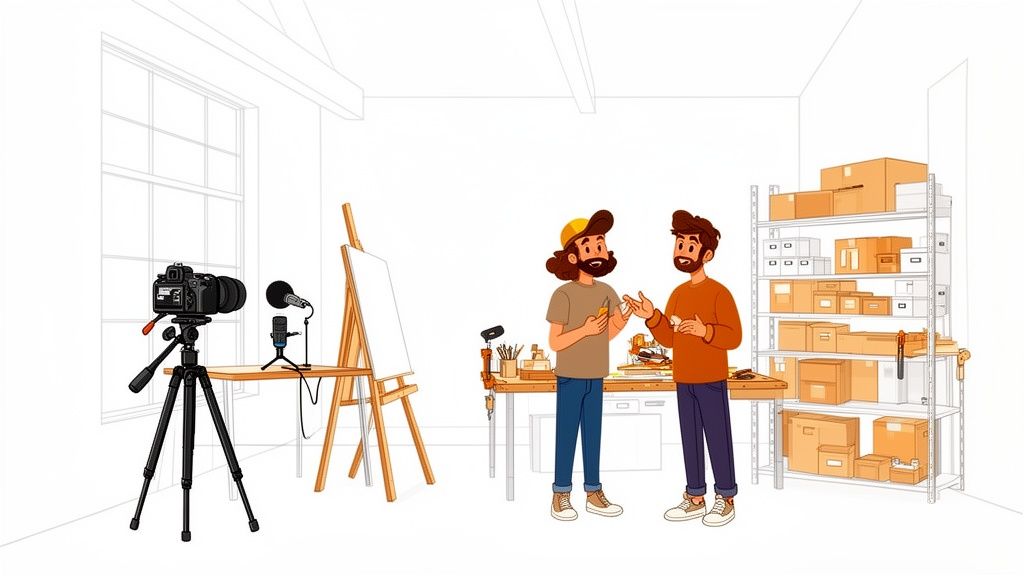
This model has been popularized by facilities like WeWork Creator Studios and various shared production houses that provide access to high-end equipment without the prohibitive cost of ownership. The core concept is to provide a professional-grade, functional environment where creative work can be executed efficiently, from podcast recording to product prototyping.
Best For:
Content creators (podcasters, YouTubers, photographers) needing professional-grade equipment.
Artisans, product designers, and engineers who require tools for prototyping and building.
Marketing agencies and freelance creatives who need a dedicated space for project-based work.
Implementation Tips:
Invest in Quality Gear: To attract professionals, provide industry-standard equipment like high-quality cameras, microphones, lighting, and specialized software.
Establish Clear Systems: Create an easy-to-use booking system for studios and equipment. Clearly post usage guidelines to ensure resources are respected and maintained.
Foster Community: Host skills-sharing workshops, expert panels, and networking events to help members connect and collaborate on new projects.
Provide Technical Support: Having on-site staff who can assist with equipment setup and troubleshooting adds immense value and helps creators maximize their time.
Freeform House Connection: Our professional-grade Podcast Booth and versatile Rise Loft studio are prime examples of this concept. We provide Jenks-area creators with the high-end audio and visual tools needed to produce top-tier content, all within an inspiring and collaborative community environment.
6. Wellness-Integrated / Biophilic Office
A wellness-integrated or biophilic office is a workspace designed to prioritize employee health, mental well-being, and a connection to nature. This approach goes beyond basic ergonomics by incorporating elements like abundant natural light, indoor plants, living walls, and natural materials like wood and stone. The core philosophy is that a healthy environment leads to healthier, happier, and more productive employees, directly impacting creativity and retention.
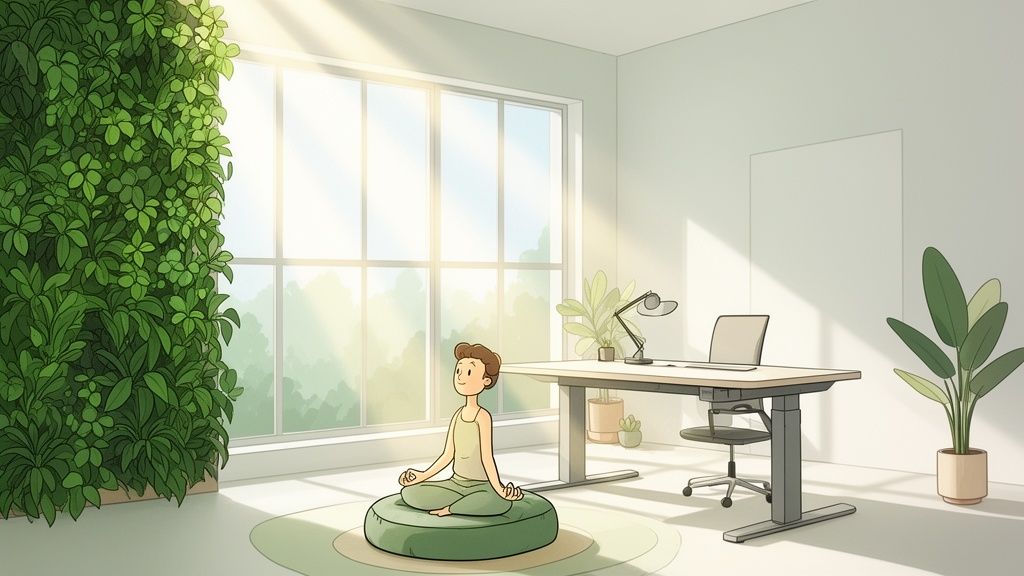
This design principle is famously embodied by tech campuses like Apple Park, which integrates vast green spaces, and companies like Patagonia, which encourage outdoor activity. By intentionally blurring the line between the built and natural environment, these spaces reduce stress and boost cognitive function, proving that office design can be a powerful tool for well-being.
Best For:
Companies with a strong focus on employee well-being and a sustainable culture.
Creative and high-stress professions where mental clarity is crucial.
Businesses looking to attract and retain top talent by offering a premium, health-conscious work environment.
Implementation Tips:
Maximize Natural Light: Arrange desks and common areas to take full advantage of windows. Use light-colored paint and reflective surfaces to amplify daylight.
Incorporate Greenery: Add low-maintenance plants, install a living wall, or place planters to divide spaces. Even small touches of nature can reduce stress.
Create Quiet Zones: Designate a tech-free meditation or quiet room for employees to decompress. Ensure it's separate from high-traffic collaborative areas.
Prioritize Ergonomics: Offer standing desks, adjustable chairs, and conduct ergonomic assessments to prevent physical strain.
Freeform House Connection: We embrace a wellness-focused approach by maximizing the incredible natural light within our historic 1920s building. Our thoughtfully designed spaces provide a calm, inspiring atmosphere for Jenks professionals, perfect for deep work or quiet reflection away from the hustle.
7. Hybrid Hub / Hub-and-Spoke Model
The hub-and-spoke model is a strategic approach to hybrid work, blending remote flexibility with a central, high-value office location. This setup establishes a primary "hub" that serves as the company's cultural and collaborative core, while employees, or "spokes," split their time between the hub, home offices, and smaller satellite locations. This model is one of the most sophisticated different types of office because it requires a deliberate balance of in-person and remote infrastructure.
This model has been adopted by global companies like Microsoft and Salesforce, who use their headquarters to host major collaborative events and team-building activities, while supporting day-to-day work from anywhere. The hub consolidates expensive amenities and fosters deep connection, without demanding a full-time, in-office presence.
Best For:
Established companies transitioning to a flexible work policy without losing their cultural identity.
Organizations with geographically distributed teams that need a central point for key meetings.
Businesses looking to reduce their overall real estate footprint while retaining a premium central space.
Implementation Tips:
Design for Purpose: Make "hub days" count. Structure in-office time around collaborative workshops, all-hands meetings, and social events rather than solo desk work.
Invest in Inclusivity: Equip the hub with state-of-the-art video conferencing technology to ensure seamless communication between in-person and remote team members.
Support the Spokes: Offer stipends or resources for home office setups to ensure all employees have an ergonomic and productive workspace, regardless of location.
Build Excitement: Use hub days as an opportunity to reinforce company culture. Host catered lunches, happy hours, or special guest speakers to make the commute worthwhile.
Freeform House Connection: For local Tulsa and Jenks businesses adopting a hybrid model, Freeform House is the perfect premium "hub." Instead of leasing a large, underutilized office, companies can provide memberships for their teams to collaborate, meet clients, and connect with the broader professional community right here on Main Street.
8. Event & Experience Space / Multi-Function Venue
An event and experience space is a highly versatile venue designed to transform for various purposes. These spaces move beyond traditional office functions to host everything from executive board meetings and training workshops to private events, weddings, and community gatherings. They are characterized by flexible layouts, premium audiovisual equipment, and elegant finishes suitable for both professional and celebratory occasions.
This model is exemplified by exclusive member clubs like SoHo House, which seamlessly blend professional networking with social events, and dedicated corporate retreat centers. The core idea is to provide a single, premium location that can adapt to a client’s specific needs, offering a memorable experience regardless of the event type.
Best For:
Businesses hosting off-site meetings, corporate retreats, or client appreciation events.
Organizations that need a professional setting for workshops, training, or product launches.
Individuals and groups planning private celebrations like intimate weddings, parties, or community functions.
Implementation Tips:
Invest in Versatile AV: Ensure your audiovisual setup is high-quality and can accommodate different formats, from corporate presentations to live music or DJ sets.
Develop Signature Packages: Create pre-set packages for common event types (e.g., "Executive Off-site," "Micro-Wedding," "Workshop Day") to simplify the booking process for clients.
Build Vendor Relationships: Establish a list of preferred local caterers, florists, and other event vendors to offer clients a full-service, seamless experience.
Prioritize Efficient Setup: Train staff to quickly and efficiently reconfigure the space between events, maximizing booking potential and ensuring a flawless transition for every client.
Freeform House Connection: Our four distinct, fully equipped rooms are designed for exactly this. They serve as the ideal backdrop for everything from executive retreats and creative workshops to elegant weddings and private parties, offering a premier experience for professionals and residents in Jenks.
9. Neighborhood Third Place / Community Living Room
A "third place" is a social-professional hybrid that exists beyond the primary environments of home (the first place) and the traditional office (the second place). It serves as a community living room, an informal hub where local professionals, entrepreneurs, and residents can connect, work, and build relationships in a welcoming, non-corporate atmosphere. This model prioritizes comfort, community, and local culture over sterile productivity.
This concept is famously embodied by the local coffee shop culture in places like Brooklyn and the community-focused lounges of Soho House. The goal is to create an anchor point for a neighborhood, fostering organic connections and a strong sense of local identity. It's less about desks and chairs and more about creating a magnetic environment people want to be a part of.
Best For:
Freelancers, remote workers, and entrepreneurs seeking a sense of belonging and community.
Local businesses aiming to embed themselves in the neighborhood fabric.
Organizations focused on Main Street revitalization and local economic development.
Implementation Tips:
Design for Comfort: Use comfortable, residential-style furnishings like sofas, armchairs, and warm lighting to create a home-like feel rather than a corporate one.
Host Community Events: Organize regular gatherings like networking breakfasts, member happy hours, or workshops to actively foster connections.
Celebrate Local Culture: Showcase local art, partner with nearby restaurants or coffee shops, and integrate the building's history into the design and branding.
Establish a Clear Culture: Create and communicate community guidelines that encourage mutual respect, collaboration, and a welcoming atmosphere for everyone.
Freeform House Connection: This is the very heart of our mission. By restoring a historic 1920s building, Freeform House is designed to be the definitive "third place" for Jenks. It’s a membership-based community hub where Main Street professionals can gather, create, and drive the revitalization of our downtown.
10. Premium Membership Club / Private Club Model
A premium membership club blends the functionality of a workspace with the exclusivity and lifestyle benefits of a private social club. This model operates on monthly or annual fees, granting members access to curated, high-end spaces, exclusive events, and a vetted professional network. It goes beyond desks and Wi-Fi, emphasizing community, status, and access to a valuable network of peers.
This type of office is epitomized by brands like Soho House, which merges creative workspaces with social venues, and CORE Club, which offers a luxury environment with concierge services. The core value lies in the curated community and the blend of professional resources with personal enrichment, creating an environment where business and social life seamlessly intersect.
Best For:
Established entrepreneurs and executives seeking a prestigious and private environment.
Professionals who value high-level networking and community-building as much as a place to work.
Individuals and companies that host clients and need an impressive, full-service setting.
Implementation Tips:
Establish Clear Criteria: Develop a vetting process for membership to maintain the quality and focus of the community. This ensures alignment among members.
Curate Exclusive Events: Host regular, high-value events like speaker series, workshops, and social mixers that are only accessible to members.
Develop Strategic Partnerships: Form alliances with local luxury brands, restaurants, or services to offer exclusive perks and add tangible value to the membership.
Create Tiered Options: Offer different levels of membership to accommodate varying needs and budgets, from social-only access to dedicated private office space.
Freeform House Connection: This model is the heart of Freeform House. We provide a premier, membership-based club experience in the heart of Jenks, Oklahoma. Our focus is on curating a dynamic community of local professionals and entrepreneurs, offering an exclusive hub for collaboration, connection, and prestige on Main Street.
10 Office Types Comparison
Workspace Type | Implementation Complexity 🔄 | Resource Requirements ⚡ | Expected Outcomes 📊 | Ideal Use Cases & Tips 💡 | Key Advantages ⭐ |
|---|---|---|---|---|---|
Open Plan / Collaborative Workspace | Low–Moderate: simple layout changes, noise control needed | Moderate: flexible furniture, acoustic treatments | High collaboration and visibility; potential focus loss | Creative teams, startups, brainstorming. Combine with quiet zones. | Encourages serendipity; flexible and cost-efficient |
Private Executive / Boardroom Suite | Moderate: soundproofing, AV integration, booking systems | High: premium furnishings, advanced AV, dedicated support | Confidential decision-making; polished client impressions | Board meetings, pitches, negotiations. Test tech before use. | Ensures confidentiality; projects authority and professionalism |
Hot Desking / Flexible Workspace | Moderate: booking systems and locker logistics | Moderate: varied desks, booking software, secure storage | Improved space utilization; transient community, less personalization | Remote/hybrid workers, consultants. Provide easy booking + lockers. | Space efficiency; networking opportunities; lower commitment |
Activity-Based Working (ABW) / Zoned Workspace | High: strategic planning, signage, cultural change | High: diverse furniture, zone-specific tech and signage | Task-matched productivity gains; higher autonomy and satisfaction | Teams with varied tasks; hybrid offices. Label zones clearly. | Optimizes performance per activity; supports varied work styles |
Creative Studio / Maker Space | High: specialized layouts, safety, scheduling systems | Very High: pro equipment, maintenance, trained staff | High-quality creative output; attracts specialist talent | Photographers, podcasters, makers. Implement strong booking rules. | Access to expensive tools; fosters interdisciplinary collaboration |
Wellness-Integrated / Biophilic Office | Moderate–High: design, plant care, lighting strategy | High: plants, ergonomic furniture, wellness amenities | Improved health, mood, retention, and creativity | Organizations prioritizing wellbeing. Partner with local wellness pros. | Boosts wellbeing, retention, and employer brand |
Hybrid Hub / Hub-and-Spoke Model | High: coordination, policies, hybrid meeting design | Moderate–High: central hub tech, remote support, stipends | Balanced flexibility with connection; scalable and cost-aware | Distributed teams and hybrid workforces. Schedule hub days strategically. | Balances cost-efficiency with culture and collaboration |
Event & Experience Space / Multi-Function Venue | High: modular systems, event logistics, staffing | High: premium AV, movable walls, catering, event staff | Diversified revenue; memorable experiences; complex scheduling | Workshops, weddings, corporate events. Invest in reliable AV. | Maximizes utilization; generates revenue and marketing buzz |
Neighborhood Third Place / Community Living Room | Moderate: community curation and programming | Moderate: lounge furnishings, F&B partnerships, programming | Strong local ties; increased foot traffic and serendipity | Main Street hubs, local entrepreneurs. Host regular community events. | Builds community, accessibility, and local commerce |
Premium Membership Club / Private Club Model | High: membership curation, events, concierge ops | High: exclusive amenities, staffing, partnerships | Predictable recurring revenue; strong member loyalty and prestige | High-value professionals seeking exclusivity. Offer tiered memberships. | Recurring revenue, curated community, premium positioning |
Your Next Chapter: Designing Your Ideal Work Life at Freeform House
The traditional concept of a single, monolithic office is rapidly becoming a relic of the past. As we've explored through the ten distinct models in this guide, from the buzzing energy of collaborative workspaces to the focused quiet of a private suite, the modern professional landscape is defined by choice and adaptability. The journey through these different types of office environments reveals a powerful truth: the most effective workspace is not a static location but a strategic tool that aligns with your specific goals, team dynamics, and work style.
The key takeaway is that you no longer need to compromise. You can demand an environment that fosters productivity, creativity, and well-being simultaneously. Whether you’re a solopreneur needing a flexible hot desk, a growing team adopting a hub-and-spoke model, or a creative professional requiring a specialized studio, the ideal solution exists. The challenge lies in identifying which elements from these diverse office types will best serve your unique professional narrative.
From Blueprint to Reality: Building Your Perfect Workday
Mastering this knowledge empowers you to make intentional decisions about where and how you work. Instead of passively accepting a default office setting, you can actively design a work life that amplifies your strengths. This strategic approach moves beyond simply finding a desk; it's about curating an ecosystem of spaces that support every facet of your business.
Consider these actionable steps as you move forward:
Audit Your Workflow: Map out a typical week. How much time is spent on deep focus tasks, collaborative meetings, creative brainstorming, or client-facing interactions?
Identify Your Non-Negotiables: What are the absolute must-haves for your productivity? Is it high-speed internet, access to professional meeting rooms, soundproof areas for calls, or a vibrant community for networking?
Embrace Hybrid Thinking: Your ideal "office" might not be a single place. It could be a blend of a premium membership club for client meetings and focused work, a home office for administrative tasks, and a creative studio for specific projects.
This thoughtful evaluation is the first step toward unlocking a more efficient, inspiring, and fulfilling professional life. At its core, the evolution in office design is about empowering you to build a career on your own terms, in a space that truly works for you.
At Freeform House, we've built our foundation on this very philosophy. We are not just one type of office; we are a carefully curated collection of the best ones, housed within a premier, membership-based club in the heart of downtown Jenks. Our space is a living example of how different types of office models can coexist to create a powerful, flexible ecosystem. We are the private executive suite for your board meeting, the creative studio for your podcast, and the vibrant community hub for collaboration and connection. We are the "third place" where work, life, and community converge, all within a beautifully restored historic building designed to inspire your best work.
Ready to experience the future of work firsthand? Discover how the versatile spaces at Freeform House can provide the perfect backdrop for every chapter of your professional journey. Explore our membership options and book a tour today at Freeform House.
Comments