Your Guide to Coworking Space Prices and Finding True Value

Figuring out how much a coworking space costs can feel a bit like trying to pin down a moving target. Prices can swing from as little as $30 for a day pass all the way up to $1,000+ per month for a dedicated private office. What you'll actually pay boils down to your city, the type of membership you need, and the perks that come with it.
Decoding Coworking Space Prices
Think of it like a gym membership. You can grab a drop-in pass when you need it, sign up for a monthly plan for regular access, or go all-in on a premium package with your own private, dedicated space. Each tier comes with a different level of access and benefits, and the price reflects that.
And just like with real estate, the biggest driver of cost is always location, location, location. A desk in a major hub is going to cost more than one in a smaller city—no surprise there. National median prices for a basic membership sit around $225 per month. But here in the Tulsa area, you can find a dedicated desk for $200–$350 per month. Compare that to the $400–$700 you’d pay for the same thing in New York City or London, and you start to see the value. This gives local professionals a serious advantage, letting us tap into top-tier work environments without the big-city price tag. You can read more about these pricing trends and what drives them.
A Quick Look at Typical Costs
To give you a better idea of what to budget for, let's break down the common membership types and what they usually cost. This should help you see how different markets stack up and which option might be the best fit for your work style.
The real secret is to look past the sticker price and think about the total value you're getting. A space like Freeform House in Jenks isn't just an office; it's a premier, membership-based club. We’ve modeled it more after a SoHo House experience, where your investment gets you more than just a place to work—it's access to a curated community, exclusive events, and high-end amenities designed to help you and your business grow.
This table gives you a general idea of what to expect financially in different cities.
Typical Coworking Membership Price Ranges
Membership Type | Typical Small/Mid-Market Price (e.g., Tulsa) | Typical Major Metro Price (e.g., NYC) | Best For |
|---|---|---|---|
Hot Desk | $100 - $250 / month | $250 - $500 / month | Freelancers and remote workers needing flexibility and a professional environment. |
Dedicated Desk | $200 - $350 / month | $400 - $700 / month | Individuals who want a permanent, personal workspace within a shared office. |
Private Office | $500 - $1,200+ / month | $1,000 - $3,000+ / month | Small teams and businesses that require privacy, security, and a branded space. |
As you can see, costs vary widely, but this gives you a solid baseline for comparing your options and deciding what makes the most sense for your goals.
Comparing The Four Main Pricing Models
Figuring out coworking space prices is about more than just a single monthly fee. You have to look at the different ways you can actually join and use a space. Not all memberships are built the same, and the right one for you comes down to your work style, your budget, and what you actually need to get stuff done.
Think of it like picking a vehicle. A scooter is great for quick, solo trips around town. But if you're hauling a team and their equipment, you're going to need an SUV.
The four main pricing models you'll run into each serve a different kind of professional. Whether you're a freelancer who needs flexibility or an established team needing a home base, there’s a setup designed for your workflow. Picking the right one means you won't overpay for space you don't use or find yourself without the tools you need to succeed.
This diagram breaks down the big-picture factors that play into the final price tag.
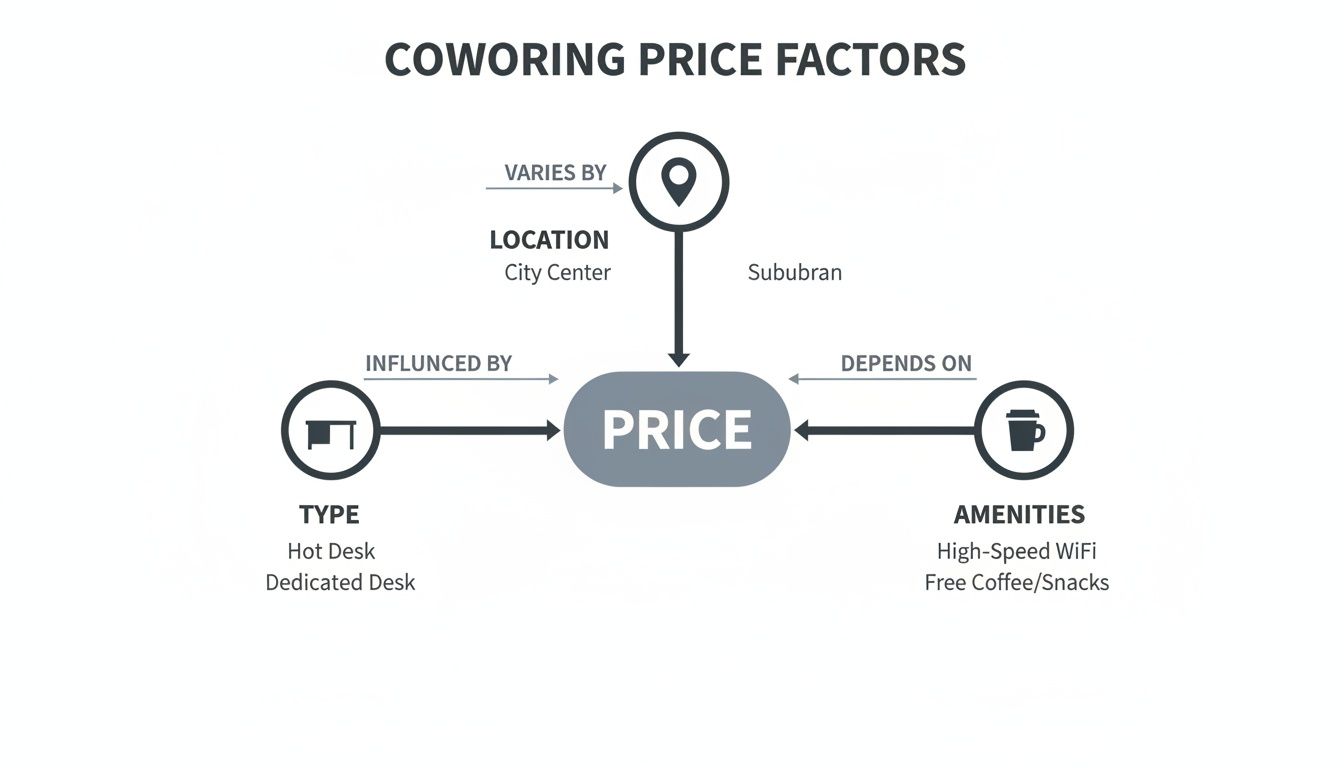
As you can see, the membership type is a huge piece of the puzzle, right alongside the building's location and how great the amenities are.
Hot Desks: The Ultimate Flexibility
A hot desk membership is your ticket to ultimate freedom. It gives you access to any open desk in a common area. You just walk in, find a spot that feels right for the day, and plug in. It’s the most affordable and flexible model, which is why it’s a massive hit with freelancers, remote workers, and digital nomads who don't need a permanent station.
Who it’s for: The solo pro who loves a change of scenery and doesn't want to be tied to one spot.
Pros: It’s the cheapest option, offers maximum flexibility, and is perfect for casual networking.
Cons: You can’t leave your gear overnight, and your favorite spot might be taken tomorrow.
Dedicated Desks: Your Personal Anchor
If you're someone who needs a bit more consistency to get in the zone, a dedicated desk is for you. This is your personal, reserved spot in the shared workspace. You can set up your big monitor, leave your notebook and pens, and make your little corner your own. This option perfectly blends the stability of a traditional office with the buzz of a coworking community.
This model really hits the sweet spot. It provides the structure so many of us need to be productive while still plugging you into a dynamic environment full of potential collaborators—a core feature of community-focused hubs like Freeform House.
Private Offices: Your Team Headquarters
When privacy and deep focus are non-negotiable, a private office is the clear winner. These are fully enclosed, secure spaces perfect for small teams or even individuals who deal with sensitive client information. A private office gives you all the perks of the bigger community—the great coffee, the events, the networking—but with a door you can close and lock.
Who it’s for: Startups, small businesses, and teams that need a confidential home base to collaborate and grow.
Pros: It’s secure, private, and gives your company a real, professional presence.
Cons: This is the most expensive option and usually requires a longer-term commitment.
Virtual Offices: A Professional Address
A virtual office gives your business a professional mailing address and mail-handling services without the physical desk space. This is a game-changer for home-based businesses looking to project a more established image or for companies testing the waters in a new city. Many virtual plans also throw in a few day passes or discounted meeting room rentals, giving you a physical connection to the space when you need it.
The Key Factors Driving Coworking Prices
Ever wonder why two coworking spaces, sometimes just a few blocks apart, can have wildly different prices? The monthly fee you see is shaped by a whole lot more than just a desk and a Wi-Fi password. To really compare your options, you have to look past the price tag and understand what you're actually getting for your money.
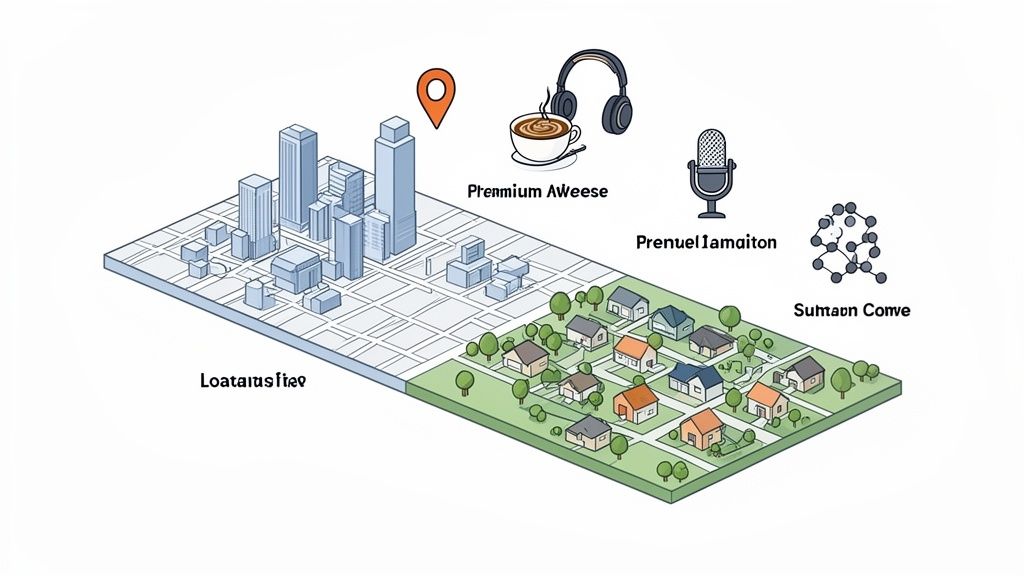
It’s about buying into an entire ecosystem. Some spaces are purely transactional—a place to work, and that’s it. Others, like Freeform House, are built as premier, membership-based clubs meant to be a central hub for connection and growth. That fundamental difference in purpose is always reflected in the price.
Location And Accessibility
Just like with buying a house, it all comes down to location, location, location. This is easily the single biggest factor driving coworking costs. A space in a prime downtown spot with tons of foot traffic and a subway stop out front will naturally cost more than one tucked away in a quiet suburb. You're paying for the prestige of the address and the sheer convenience of being right where you need to be.
For example, a spot in Jenks' buzzing 10 District is going to be priced differently than an office on the outskirts of Tulsa. That premium puts you at the heart of the action, surrounded by the best local shops, restaurants, and culture.
Amenities And Services
Next up are the amenities. Sure, almost every space offers the basics like Wi-Fi, coffee, and a printer. But premium spaces set themselves apart with a much richer lineup of perks. These aren't just little extras; they're tools designed to make your work—and your life—better and easier.
Think about the real-world value of premium amenities like these:
Professional Resources: Access to things you'd otherwise have to pay a fortune for, like an on-site podcast studio, a photography loft, or a high-tech conference room that impresses clients.
Convenience Services: Little things that save a ton of time, like mail handling, receptionist services, or even exclusive partnerships for food delivery.
Wellness and Lifestyle: Perks that go beyond work, from access to a fitness center to lounges and rooftop terraces perfect for unwinding or hosting events.
These features transform a simple office into a dynamic environment, and that value is baked into the membership fee.
Think of it like a gym membership. A budget gym gives you the weights and treadmills you need to get the job done. But a premium fitness club offers all that plus personal training, spa services, and nutrition classes. Both help you get fit, but one provides a far more complete and supportive experience.
Community And Networking Opportunities
Finally, there’s the quality of the community itself. This one is less tangible but can be the most valuable factor of all. A thoughtfully designed space does more than just house people; it encourages them to interact and collaborate. This is where a premier club like Freeform House really shines compared to a generic office rental.
Curated networking events, industry-specific workshops, and even a member vetting process all help build a powerful professional ecosystem. The opportunity to casually bump into potential clients, find a mentor, or spark a collaboration over coffee is an incredible asset. That investment in building a quality community is a core part of the price at high-end spaces—it ensures you’re surrounded by driven, like-minded people who can help you grow.
How To Calculate The True Cost Of A Membership
That monthly membership fee you see on a website? That’s just the starting line. To really get a handle on coworking space prices, you have to dig a bit deeper to find the true cost of what you’re getting. A plan that looks like a steal on the surface can quickly turn expensive if it doesn’t actually fit how you work.
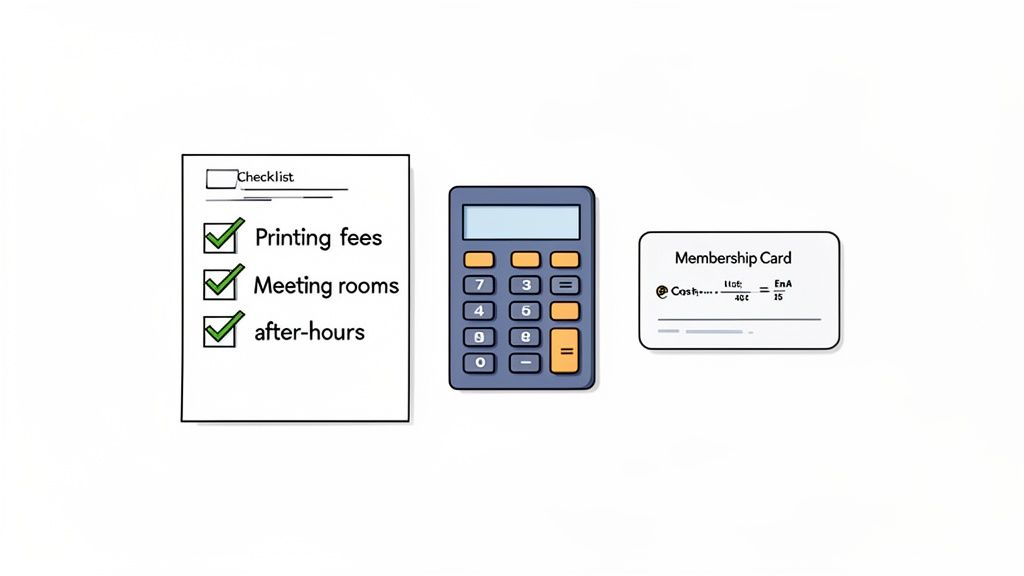
Think about it like booking a flight on a budget airline. The base fare is tempting, but once you add up the fees for your seat, a carry-on, and even a bottle of water, you realize you might have been better off with the all-inclusive ticket from the get-go. A lot of coworking spaces are built on a similar model, and the extra charges can really catch you by surprise.
Watch Out For These Common Hidden Fees
Before you even think about signing an agreement, make sure you ask for a full breakdown of any potential extra charges. You need that transparency to budget properly and avoid a nasty surprise on your first invoice. Here are a few of the usual suspects to keep an eye on:
Printing and Scanning: Most memberships throw in a certain number of pages each month. But if you’re a heavy printer, those per-page overage fees can stack up fast.
Meeting Room Credits: Your plan might include a few hours for meeting rooms, which is great. But what happens when you run out? Those pay-as-you-go rates can be steep, so if you host clients regularly, you need to know the cost upfront.
After-Hours Access: Some of the more basic plans only get you in the door during standard business hours. If you’re a night owl or a weekend warrior, you could be looking at an extra fee for 24/7 access.
Coffee and Snacks: Free coffee is pretty standard, but some places work on an honor system or have a mandatory "coffee fund." It’s a small thing, but it’s still a cost.
Event Fees: Don't assume every community event is free. Special workshops or premium networking nights often come with their own ticket price.
Calculating Your Cost Per Use
The smartest way to compare your options is to figure out your cost per use. It’s a simple formula that cuts through the noise and shows you the real value based on your actual work habits. Just divide the total monthly cost—including any extras you expect to pay for—by the number of days you’ll realistically be there.
A $150/month plan that you only use 10 times works out to $15 per visit. On the other hand, a $250/month all-inclusive plan you use 20 times is just $12.50 per visit—and it probably comes with way better amenities and community perks.
This little bit of math changes the whole picture. It’s exactly why a premium, transparent model like we have at Freeform House often ends up being a better long-term investment for serious professionals. When everything is included, your budget is predictable, and you can just focus on your work instead of sweating the small stuff.
When Is a Premium Coworking Space Worth the Investment?
Once you get past the sticker price of different coworking plans, the real question pops up: is a high-end, premium workspace a smart business expense or just a nice-to-have luxury?
The answer really hinges on what you need your environment to do for you. If it's just about a desk and decent Wi-Fi, basic will do. But if you’re looking for more, a premium membership stops being a simple rental fee and starts becoming an investment in a professional ecosystem. For a lot of people, the payoff comes from the intangibles—the things that quietly boost your bottom line over time.
It’s all about calculating the real-world value of the right connections, a polished brand image, and a focused state of mind.
Beyond the Desk: The ROI of Community
A top-tier space like Freeform House isn't trying to be just another office. It’s intentionally designed more like a private members' club, echoing the vibe of places like SoHo House. This approach naturally curates a community of established, driven professionals who are serious about their work.
When you're in that kind of room, the networking is just different. It’s more focused and frankly, more valuable than what you’ll find in a massive, high-turnover space.
This curated community pays dividends in a few key ways:
High-Quality Connections: You’re surrounded by potential clients, mentors, and collaborators who have also invested in a high-caliber professional environment. The conversations are just better.
Elevated Brand Perception: Bringing a client into a sophisticated, beautifully designed space for a meeting? It instantly says something about your brand and your standards, long before you even start your pitch.
Productivity Boost: When your workspace has everything you need—from quiet focus zones to a podcast studio—it removes friction from your day. You just get more done.
A premium workspace isn't a cost center; it's a strategic tool. The investment pays for itself when a single introduction leads to a major client or when the professional setting helps you close a critical deal.
Stability in a Volatile Market
Here's something most people don't realize: the coworking industry can be a financial rollercoaster. Despite all the buzz about growth, nearly 50% of coworking spaces are just trying to break even, and a startling 18% are operating at a loss.
This financial pressure, often fueled by sky-high real estate costs and a race to the bottom on pricing, can create a ton of instability. You can dig into the numbers in this analysis of coworking statistics. For members, that can mean declining quality, surprise closures, or a generally chaotic atmosphere.
This is where a premium hub, deeply rooted in its local community, has a massive advantage.
By focusing on a high-value experience instead of just competing on price, spaces like Freeform House offer a much more resilient and consistent environment. You can trust that the quality and services you signed up for will be there for the long haul. The higher price tag reflects that stability and commitment to excellence, ensuring your professional home base is secure, reliable, and always impressive.
Think of it as an investment in peace of mind.
Frequently Asked Questions About Coworking Prices
As you start seriously comparing coworking spaces, a few questions always seem to pop up. Getting straight answers is the only way you'll feel confident pulling the trigger on a membership. Let's tackle the big ones so you can make your final call without any guesswork.
The nitty-gritty of contracts, memberships, and even taxes can feel like a maze, but it doesn't have to be. Here are some straightforward answers to help you lock in the perfect space.
Can I Negotiate Coworking Space Prices?
More often than you’d think—especially if you're willing to commit. The sticker price for a month-to-month hot desk is usually set in stone, but the game changes when you’re talking about a dedicated desk for six months or a private office for a year. Landlords love the stability of a long-term tenant, and that gives you leverage.
Don't just ask for "a discount." Come prepared with specific scenarios. You could ask about paying for the year upfront, bundling in extra meeting room hours, or getting a group rate if you’re bringing in a few team members. Honestly, just building a good relationship with the community manager can open doors you won't find on a website.
What Is The Difference Between A Coworking Space And A Serviced Office?
Think of it as community versus convenience. A coworking space is built from the ground up around shared energy, collaboration, and networking. It’s for people and teams who want a dynamic environment where a random conversation over coffee could spark their next big idea. The community itself is the real product.
A serviced office, on the other hand, is basically a traditional office rental on easy mode. It’s a private, turnkey solution for an established business that just needs a headquarters with administrative support baked in. The private space and the included services are the main draw.
The real value of a premier coworking space like Freeform House is its curated community and collaborative spirit. A serviced office is all about giving you an isolated, fully supported private workspace.
How Do I Choose The Right Coworking Plan?
The best way to find the right plan is to do a quick audit of your own work habits. Before you even look at a pricing page, just track yourself for a week.
Ask yourself these questions:
How many days a week will I actually leave the house to work? Be brutally honest. If it’s only two, a bundle of day passes might be way smarter than a full-time membership.
What kind of vibe do I need to focus? Do you get energized by the background buzz of a busy café, or do you need pin-drop silence to get in the zone?
How often will I be bringing in clients or partners? If you host a lot of meetings, a plan with plenty of meeting room credits is non-negotiable.
Once you know what you need, go take a tour. Better yet, buy a day pass and test-drive the space. The right fit is just as much about the feel of the place and the people you meet as it is about the amenities on a checklist. You have to find a spot where you know you can do your best work.
Are Coworking Memberships A Tax Deductible Expense?
For almost every freelancer, independent contractor, or business owner out there, the answer is a big yes. Your coworking membership fees are typically a legitimate business expense, just like office rent or your internet bill. This can make a real dent in the effective annual cost of your membership.
That said, tax laws have their quirks depending on your business structure and where you live. It's always a smart move to run it by a qualified tax pro or your accountant. They’ll give you advice that’s specific to your situation and make sure you’re taking every deduction you’re entitled to, correctly and legally.
Ready to find a workspace that’s more than just a desk? At Freeform House, we’ve built a premier, members-only club right here in Jenks, designed for real connection and growth. Come see how the right community and environment can elevate your work.
Comments