Flex Working Space: Boost Productivity and Business Agility

Imagine trying to run your business without being chained to a restrictive, long-term office lease. That’s the simple idea behind a flex working space—a professional environment that works on your terms. It’s a modern way to think about your office, built for agility, smart spending, and getting real work done.
What Is a Flex Working Space Anyway?
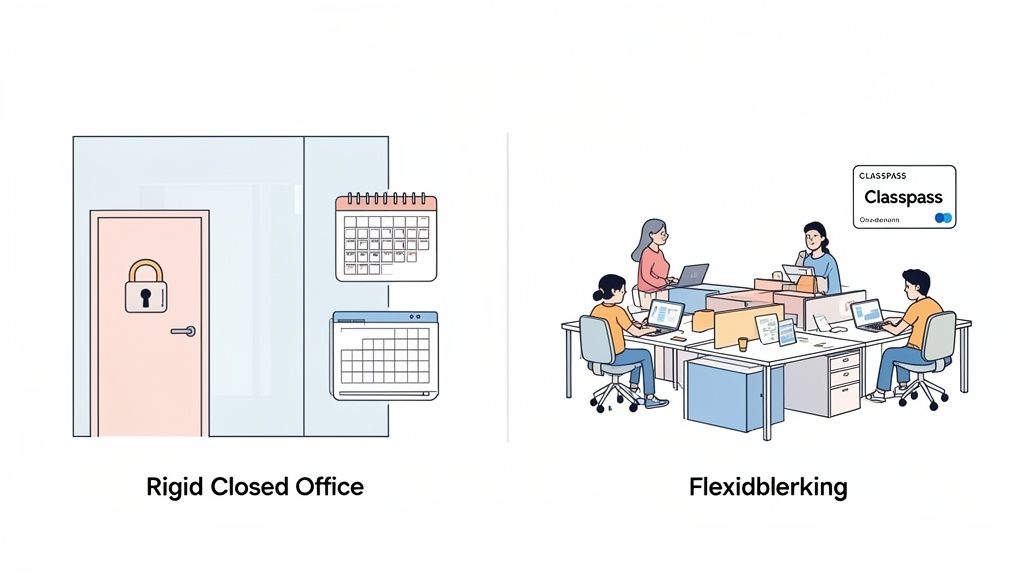
Let’s try an analogy. Signing a traditional office lease is like buying an annual gym membership you have to pay for, whether you show up or not. It’s a fixed, long-term commitment, period.
A flex working space, on the other hand, is more like a ClassPass. It gives you access to premium facilities and professional perks exactly when you need them, without getting locked into a rigid contract. For today's entrepreneurs, hybrid teams, and established pros, this model is a total game-changer.
This isn’t just about convenience; it’s about being smart. Instead of getting bogged down by huge upfront costs for furniture, utilities, and multi-year leases, you get a professional, move-in-ready space from day one. This lets you scale your physical footprint up or down as needed, tying your real estate costs directly to what your business is actually doing right now.
The Shift Toward Workplace Agility
This isn’t some niche trend; it's a fundamental shift in how we work. The worldwide flexible workspace market ballooned to USD 42.67 billion in 2023 and is on track to hit a staggering USD 130.86 billion by 2032.
What's driving this? The explosion of hybrid work models, now used by 77% of companies, is a big part of it. Plus, a full 59% of businesses that are expanding their physical presence are choosing flexible options over old-school leases. You can discover more insights about the flexible workspace market growth right here.
A flex working space is more than just a desk; it's an ecosystem. It provides the tools, environment, and community to help individuals and businesses thrive without the financial and logistical burdens of a conventional office.
This movement is also breathing new life into local economies by bringing dynamic professionals back to downtown districts. For communities like Jenks, Oklahoma, that means more opportunities for collaboration, connection, and growth.
More Than Just a Desk
A truly great flex working space goes way beyond just offering Wi-Fi and a chair. It’s all about creating an atmosphere that helps you focus and sparks creativity.
These spaces often include:
Diverse Work Zones: Options for quiet, heads-down work alongside vibrant areas built for collaboration.
Professional Amenities: Access to high-tech meeting rooms, secure internet, and business-class printers.
Community Hubs: Environments designed for networking and connecting with other local professionals.
Premium, curated clubs like Freeform House in the heart of Jenks' 10 District are redefining what a workspace can be. Comparable to the renowned SoHo House, it offers more than just a social club. Members can take advantage of co-working spaces and a dynamic community hub designed for collaboration and connection. It's a central gathering spot aimed at fostering a creative and cooperative spirit within our local community.
To really see the difference, it helps to put the two models side-by-side.
Flex Workspace vs. Traditional Office at a Glance
This table breaks down the essential differences between the flexible model and a conventional office lease. It gives you a clear, at-a-glance look at what sets them apart.
| Attribute | Flex Working Space | Traditional Office Lease || :--- | :--- | :--- | :--- || Commitment | Short-term, often month-to-month. | Long-term, typically 3-10 years. || Upfront Costs | Low. Usually a small deposit. | High. Security deposit, first month's rent, fit-out costs. || Scalability | High. Easily add or remove space as needed. | Low. Fixed space, difficult to change mid-lease. || Amenities | Included. Wi-Fi, furniture, utilities, coffee, etc. | Separate. Tenant is responsible for all services. || Move-in Time | Immediate. Often ready to use the same day. | Lengthy. Can take weeks or months for build-out. || Management | Professionally managed by the space provider. | Self-managed by the tenant. |
As you can see, the choice isn't just about a desk—it's about adopting a completely different mindset toward how and where work gets done. One is built for predictability; the other is built for agility.
What Are the Real Benefits of a Flex Workspace?
When you make the move to a flex working space, the benefits aren't just theoretical—they show up on your bottom line and in your day-to-day work life. It all boils down to three big wins: financial smarts, deeper focus, and genuine connection. These aren't just separate perks; they work together to create an environment where you can actually get your best work done.
Think about it. Instead of locking yourself into a rigid, multi-year lease that eats up cash, a flexible setup lets you manage costs on the fly. You immediately free up capital that would otherwise be collecting dust in security deposits or spent on furniture and building upkeep.
Financial Agility and Scalability
The most obvious win is how much you'll save on overhead. A flex working space rolls everything—utilities, blazing-fast internet, cleaning, and security—into one simple, predictable monthly payment. No more juggling a dozen vendors or getting hit with surprise bills. It just makes budgeting smarter.
This model is a game-changer for any business that’s growing. Need to add a few desks for new hires? Easy. Have to secure a private office for a month-long project? Done. You can scale your space up or down as needed, without the headache of renegotiating a long-term lease. Your workspace finally moves at the same speed as your business.
In fact, businesses that switch to a flexible model can slash their overall operational costs by as much as 30% compared to a traditional office. It's a strategic move that turns a fixed expense into a variable one you control.
That financial freedom means you can reinvest those savings where they actually matter—marketing, product development, or hiring that perfect candidate. It’s less about penny-pinching and more about spending smarter.
Enhanced Productivity and Focus
Working from home is great, until it isn't. The dog, the laundry, the doorbell—the distractions are endless. A professionally designed flex space is engineered specifically for focus, creating a clean break between your home life and your work life. That simple separation is a powerful mental cue to get down to business.
These spaces are also packed with amenities you just don't have at home or at the local coffee shop. We're talking about enterprise-grade Wi-Fi that never drops, soundproof phone booths for taking important calls, and bookable meeting rooms with pro-level A/V gear. All those little friction points that interrupt your flow? Gone.
Community and Connection
Beyond the desk and the free coffee, the most valuable asset of a great flex space is the people. When you're surrounded by other driven, creative professionals, the opportunities for organic networking and collaboration are everywhere.
A casual chat in the shared lounge can easily lead to your next client, a new business partner, or a fresh perspective on a problem you've been wrestling with for weeks. This is especially true in curated environments like Freeform House, which are intentionally designed to bring local innovators and leaders together. These are the kinds of chance encounters that build a real sense of community and can spark collaborations that push your business forward in ways you never expected.
Decoding Your Workspace Options
Figuring out the modern world of work can feel like trying to learn a new language. You hear terms like “flex space” and “coworking” thrown around, often as if they mean the same thing. They don't. Getting clear on the differences is the first step to finding a space that actually works for you.
Workspace Models Explained
On one end of the spectrum, you have the traditional office. This is the classic setup we all know: a long-term lease (think years, not months), a hefty upfront investment in furniture and tech, and you're in complete control of the space. It’s a permanent home base that gives you total autonomy, but it also locks you into a massive financial commitment with very little wiggle room.
Then you have coworking, which has exploded in popularity. It's best to think of coworking as a specific style of flexible workspace. These spaces are famous for their open-plan layouts, buzzing social energy, and a community often built around freelancers and brand-new startups. The real focus here is on shared resources and a collaborative, almost communal vibe.
And finally, we have the flex working space. This is the big umbrella term that covers everything from a simple hot desk in a coworking area to far more exclusive, private offerings. This broad category includes private offices for small teams, dedicated desks for individuals who want their own spot, and even high-end, club-style environments.
This diagram breaks down the core benefits that pull people toward flexible models—from smarter spending to building a powerful network.
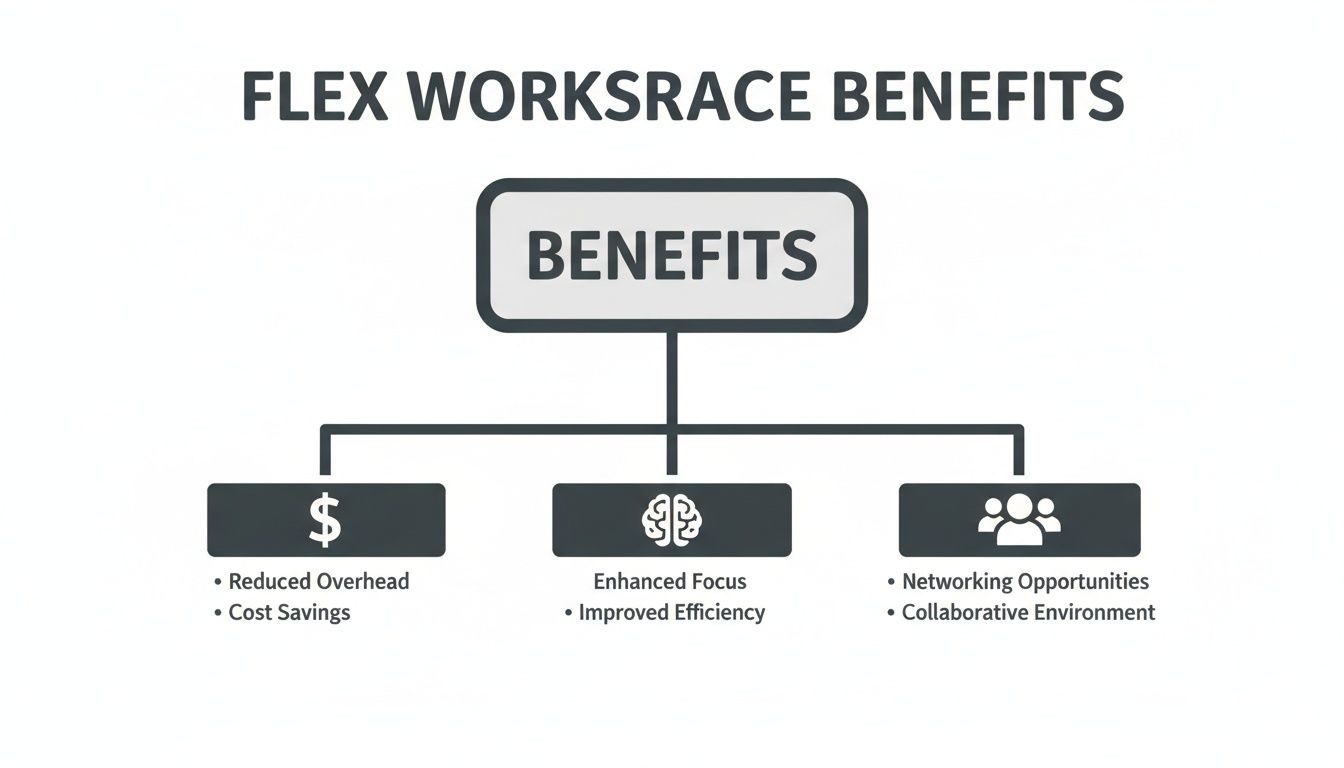
The key takeaway is pretty clear: financial agility, better productivity, and valuable human connections are the pillars holding up the entire flexible work movement.
Premium flex spaces cater to a different crowd entirely: established professionals, executives, and focused teams who need more than just a place to plug in a laptop. They're looking for sophisticated amenities, guaranteed privacy for sensitive calls and projects, and a more curated, professional network. A place like Freeform House in Jenks isn't just another coworking spot; it’s a premier, membership-based club that offers a full suite of flexible options in a thoughtfully designed, elevated environment.
To make these distinctions even clearer, let's break them down side-by-side.
Comparing Workspace Models
Feature | Flex Working Space | Coworking Space | Traditional Office |
|---|---|---|---|
Commitment | Low (monthly, daily) | Low to Medium (monthly) | High (multi-year leases) |
Cost | Variable, pay-as-you-go | Moderate, all-inclusive | High upfront & ongoing |
Community | Curated & professional | Open & social | Self-contained team |
Ideal User | Professionals, hybrid teams | Freelancers, startups | Established companies |
This table shows that while both flex and coworking spaces offer an escape from the rigid traditional lease, the experience, cost, and community can be worlds apart.
At the end of the day, it's about what you're trying to achieve. Coworking is often about finding a desk; a premium flex working space is about securing an asset for your business—a professional headquarters that reflects your brand and supports your growth.
If you want to dig deeper into the specific dynamics of shared work environments, our guide to co-working and finding the perfect space is a great next read. Understanding these nuances ensures you’re not just finding a place to work, but investing in a space that truly aligns with your ambitions.
Essential Features of a High-Quality Flex Space
Let's be honest: not all flex spaces are created equal. Once you get past the basic promise of a desk and Wi-Fi, the real differences start to show up. These are the features that separate a forgettable hot-desking spot from a place that genuinely helps you get your best work done.
Think of it like choosing a hotel. Any motel gives you a bed, but a great hotel anticipates your needs with a thoughtfully designed room, top-notch service, and amenities that make everything feel effortless. The same idea applies here. The best spaces are built around making your experience seamless.
The Non-Negotiable Foundations
Before we even get to the cool perks, a few things absolutely have to be in place. These are the fundamentals of any professional, productive flex working space. Without them, everything else is just window dressing.
Enterprise-Grade Secure Wi-Fi: Your connection has to be fast, stable, and secure—no exceptions. Consumer-grade internet just can’t handle business-critical tasks, glitch-free video calls, or sensitive client data.
Diverse Work Zones: Great work isn’t one-size-fits-all. A space needs to reflect that with a mix of environments, from library-quiet focus areas to collaborative lounges and private nooks for taking calls.
Secure 24/7 Access: Inspiration (and deadlines) don't stick to a 9-to-5 schedule. You need the freedom to get into your workspace whenever you need to, day or night.
These aren't luxuries; they're the bare minimum. A space that skimps on these will just add friction to your day.
Premium Features That Elevate the Experience
This is where the truly exceptional spaces pull away from the pack. The global flexible workspace industry is booming, hitting a market size of USD 20.96 billion with over 8,400 spaces in the US alone. To stand out, the best venues offer specialized amenities designed for ambitious professionals.
A perfect local example is Freeform House in Jenks. It’s a 10,000-square-foot club in a historic 1920 building that completely rethinks the workday. With unique rooms, a loft studio, a podcast booth, and on-demand local dining with no delivery fees, it's a glimpse into the future of work. You can read the full research about flexible workspace trends here.
A top-tier flex working space doesn't just provide a place to work; it provides an infrastructure for success. It offers tools and services that empower you to create, connect, and grow your business more effectively.
Keep an eye out for these elevated features that prove a space is serious about its members' success:
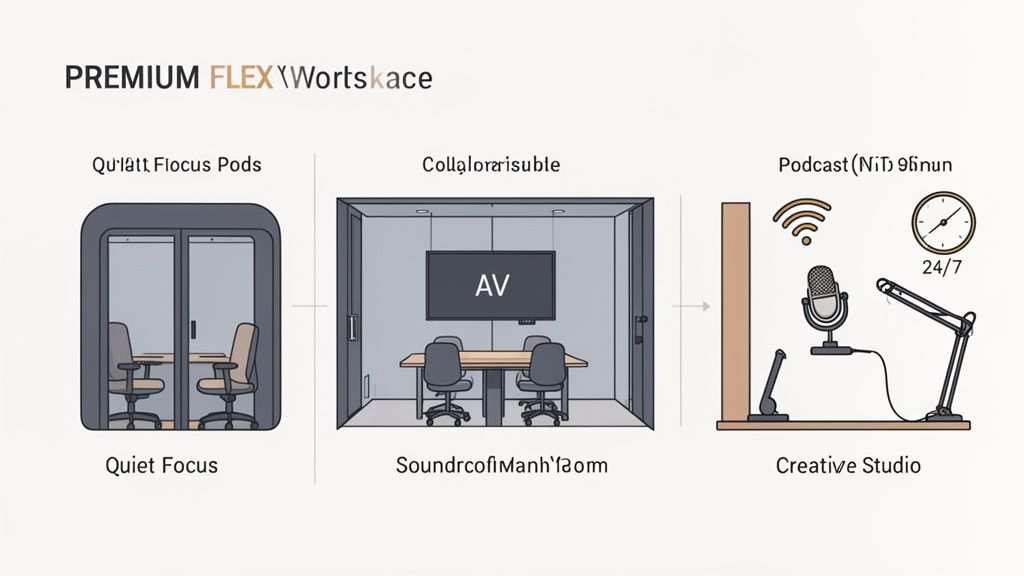
Professional Meeting Rooms: You need soundproof rooms with high-quality AV gear, whiteboards, and presentation tools to host clients or team meetings without a hitch.
Creative and Content Studios: So much of modern business is content. Having on-site access to a podcasting booth or a photography-ready studio is a massive advantage.
Seamless On-Demand Services: The best spaces remove the little hassles from your day. Think on-demand meal delivery from local restaurants, mail handling services, or even an Amazon Hub Locker for your packages.
Ultimately, it’s these thoughtful additions that turn a simple workspace into a powerful asset for your business. They show a real understanding of what it takes for professionals to thrive.
How Flex Work Is Breathing Life Back Into Local Communities
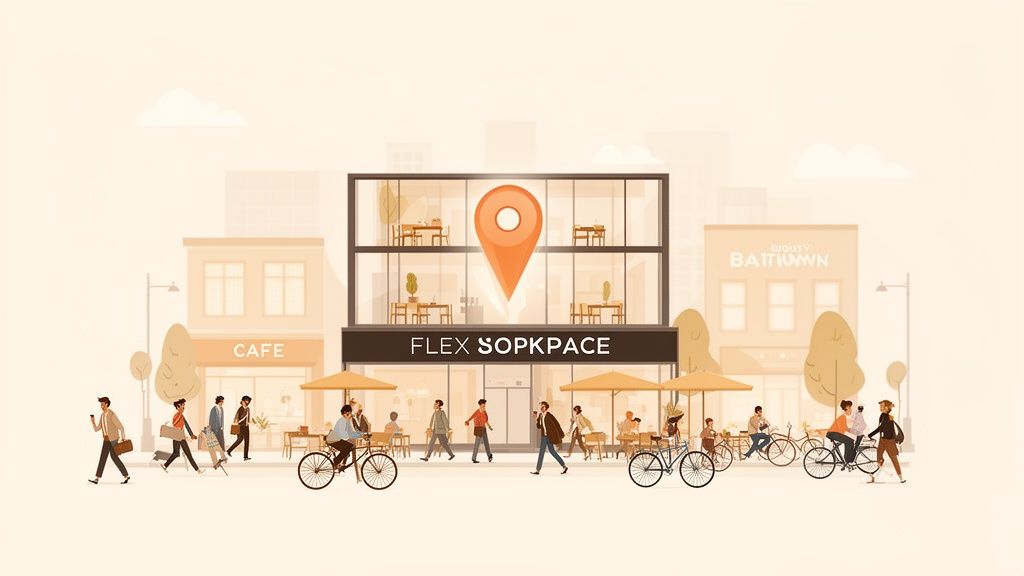
The shift to flexible working is doing a lot more than just tweaking our schedules—it's completely changing where we get our work done. And that change is having a huge, positive ripple effect on local economies in towns like Jenks, Oklahoma. It’s bringing professionals back downtown during the workday.
Instead of trekking out to some distant corporate campus, talented people are now looking for a place to plug in closer to home. A great flex working space becomes a magnet for that energy, pulling it right back into the heart of the community. This creates a buzzing little ecosystem that directly feeds nearby cafes, shops, and restaurants, turning what used to be a quiet weekday into a hive of activity.
Anchoring Local Growth
A well-placed, top-notch hub can be a powerful anchor for this entire movement. It’s not just a collection of desks; it becomes a central gathering spot for local innovators, leaders, and creators to connect and collaborate. When that happens, the ideas—and the money—stay right here in town.
And this isn't just a small-town trend. The global flexible workspace market is exploding, jumping from USD 33.23 billion in 2020 to a forecasted USD 73.03 billion by 2026. Businesses are all-in because these spaces offer agility and can slash operational costs by up to 30% compared to a traditional office lease. That's money they can pour back into growing their business. You can discover more insights about the flexible workspace market and see just how fast it's expanding.
This is about more than finding a place to work. It’s about plugging into a bigger story of local connection and economic revival. A thriving flex space becomes the new pulse of a downtown district.
This model is especially powerful in unique spots like Freeform House. Here, a beautifully restored historic building has been transformed into a modern center for commerce and creativity. By mixing premium amenities with genuine local character, it naturally attracts ambitious professionals who care as much about their community as they do about their work.
Creating a Cycle of Support
Think about it: when members of a flex space grab lunch, meet clients for coffee, or pop into a shop after wrapping up their day, they're actively fueling the local economy. It creates this beautiful, self-sustaining loop: the flex space supports the professionals, and those professionals turn around and support other local businesses.
This cycle strengthens the whole downtown area, making it a better place to live, work, and invest for everyone. It’s a real, tangible way to support local businesses and build a cooperative spirit that lifts all boats. For a deeper dive, check out our guide on simple steps to boost your community today.
Ultimately, choosing a local flex working space is an investment in yourself and your neighborhood. You get the productivity boost, and your community gets the prosperity.
Choosing the Right Flex Working Space for You
Picking a flex working space isn't so different from choosing the right tool for a big project. You wouldn't use a sledgehammer for a finishing nail, right? The same logic applies here—you have to know exactly what you need to get done before you can pick the right environment to do it in.
So, let's start by mapping out what you're really looking for. It all boils down to three core questions.
What's Your Work Style? Are you the type who thrives on collaborative energy and brainstorming sessions, or do you need a quiet corner for deep, focused work? Be honest with yourself about your ideal workflow.
What Are Your Must-Have Amenities? Think about your non-negotiables. Is blazing-fast internet a dealbreaker? Do you need access to private phone booths or professional meeting rooms to impress clients? Make a list.
What Kind of Community Vibe Are You After? The people around you matter. Are you looking for a vibrant, social atmosphere to network and grow, or something more professional and buttoned-up?
Your Self-Assessment Checklist
Once you have a clear picture of your needs, you can start touring spaces like a pro. Think of each visit as a fact-finding mission, not just a casual walkthrough. You're there to see how the reality on the ground stacks up against your checklist.
Here’s what to focus on:
Observe the Environment: Pay attention to the little things. What are the noise levels like? Is the lighting good? Do you see a variety of seating options, from comfy couches to ergonomic chairs? How does the overall design make you feel?
Talk to Current Members: Don't be shy. Strike up a conversation with someone working there and ask about their day-to-day experience. What are the community events like? Do they feel supported? This is where you get the real story.
Evaluate the Logistics: Practicality is key. Can you get 24/7 access if you need it? What's the parking situation? How easy is it to get in and out of the building during peak hours?
Tip: Treat your tour like a job interview—but you're the one doing the interviewing. You’re assessing whether this space is the right long-term partner for your professional growth.
A great way to test the waters is with a trial day. Many local professionals find this step invaluable. Here at Freeform House, for example, we offer a premium club atmosphere right in downtown Jenks, complete with curated amenities and community events designed to help you connect and succeed.
If you’re not ready to commit, you can always explore a shorter-term option. We break down how to do that in our article What Is a Coworking Day Pass and Is It Right for You?
Ultimately, finding the right flex working space is an investment in yourself. You want an environment that actively supports your goals and feels like a genuine asset, not just a place to plug in your laptop.
Now you’re ready to take the next step. Use this checklist on your tours, compare your options side-by-side, and try to schedule your visits early to get your pick of the best spots. Your ideal workspace is out there—go find it.
A Few Common Questions About Flex Working Space
As you start picturing your business in a new kind of workspace, a few questions are bound to pop up. Let's tackle some of the most common ones head-on.
Is It More Expensive Than a Traditional Office?
This is the big one, and the short answer is no—far from it. While a monthly membership might look similar to a small lease payment on paper, a flex working space is almost always kinder to your bottom line.
Think about it: your single payment covers high-speed internet, utilities, cleaning, and security. In a traditional lease, those are all separate, costly bills that add up fast. You also get to skip the massive upfront costs of furniture, security deposits, and office setup. This approach can slash your total operating costs by up to 30%, freeing up cash you can pour back into your business.
Can My Entire Team Work From a Flex Space?
Absolutely. The best flex spaces are designed for teams of all shapes and sizes. You’ll find everything from clusters of dedicated desks in a shared zone to entire private, lockable office suites built for deep, collaborative work.
This is a game-changer for hybrid teams. It gives you a central hub for those important in-person days, client meetings, or creative brainstorms, without forcing you to pay for a huge, empty office the rest of the week.
A flex working space hits that sweet spot between a fully remote setup and a rigid, traditional office. It gives you the structure you need to be productive and the freedom modern teams demand—a true home base, but on your terms.
How Is This Different From Working at a Coffee Shop?
A coffee shop has Wi-Fi and caffeine, but a flex working space offers a complete professional ecosystem designed to help you do your best work. The difference is night and day.
Here's what really sets them apart:
Secure, Enterprise-Grade Internet: No more fighting for bandwidth or worrying about security. You get a fast, reliable connection you can count on.
Professional Amenities: Need a quiet, soundproof room for a client call? Done. How about a business-class printer that actually works? It’s there.
A Curated Community: You're surrounded by other driven professionals, creating natural opportunities for networking and collaboration you just won't find at the corner café.
Top-tier spaces take it even further, offering exclusive resources like bookable podcast studios, professional event venues, and on-demand services that make your workday seamless.
Ready to feel the difference a premium, community-first workspace can make? Freeform House is a unique, membership-based club in the heart of Jenks' 10 District, designed to help you connect, create, and grow.
Comments