9 Key Hybrid Work Schedule Benefits for Your Business in 2026

The conversation around work has decisively shifted from where we work to how we work best. The rigid 9-to-5, five-day office week is being replaced by a more intelligent, flexible model: the hybrid work schedule. This is not just a passing trend; it is a strategic business decision that delivers measurable advantages for employers and employees alike. From boosting productivity to attracting top-tier talent, the hybrid work schedule benefits are transforming how modern businesses operate, innovate, and grow.
This article moves beyond theory to provide a practical roadmap. We will break down nine of the most impactful benefits of adopting a hybrid model, offering actionable insights and real-world examples for each. You will learn how to implement a structure that drives performance while enhancing employee well-being.
Furthermore, we will explore how local hubs are pivotal in this new ecosystem. For instance, we will examine how spaces like Freeform House, a premier, membership-based club in the heart of Jenks, Oklahoma's 10 District downtown, empower professionals and businesses to master this new way of working. Discover how to implement a hybrid model that not only cuts costs and boosts morale but also positions your organization as a forward-thinking leader in the Tulsa-area community.
1. Increased Productivity and Focus
One of the most significant hybrid work schedule benefits is the marked improvement in both employee productivity and focus. This model empowers individuals to align their work environment with their daily tasks, creating a powerful synergy between place and purpose. Employees can reserve specific days for deep, uninterrupted work at home or in a quiet third space, while dedicating in-office days to collaboration, team building, and spontaneous innovation.
This strategic division of time and space minimizes the constant context-switching and distractions common in a purely office-based setting. A 2021 study by Owl Labs highlighted this, finding that hybrid employees report feeling more productive than their fully remote or fully in-office counterparts. This structure allows for a more intentional approach to the workweek, maximizing efficiency across different types of tasks.
Real-World Examples
Tech giants have demonstrated the power of this model. Microsoft, for instance, reported a significant improvement in team output after adopting a flexible hybrid schedule. Similarly, Google noted that its employees often complete complex projects faster on their designated remote days, where they can concentrate without office interruptions.
Closer to home, professionals utilizing spaces like Freeform House in Jenks exemplify this principle. Members frequently reserve dedicated quiet zones like the Executive Room for heads-down, deadline-driven work early in the week, then transition to more collaborative spaces for client meetings and team brainstorming sessions later. This intentional use of space is a key driver of the productivity gains seen in hybrid models.
How to Implement This Benefit
To harness this advantage, organizations should provide clear guidelines and the right resources.
Establish 'Quiet Hours': Encourage teams to set designated "no-meeting" blocks on remote days to protect deep work time.
Leverage Third Spaces: For local professionals, using a premium coworking space can provide a distraction-free environment. Freeform House offers an ideal setting to boost productivity and business agility with its dedicated quiet rooms and professional atmosphere.
Structure In-Office Time: Reserve in-person days for collaborative activities like strategic planning, workshops, and team lunches to maximize face-to-face interaction.
Use Centralized Tools: Implement project management software like Asana or Trello to ensure seamless communication and task tracking between remote and in-office team members.
2. Enhanced Employee Retention and Satisfaction
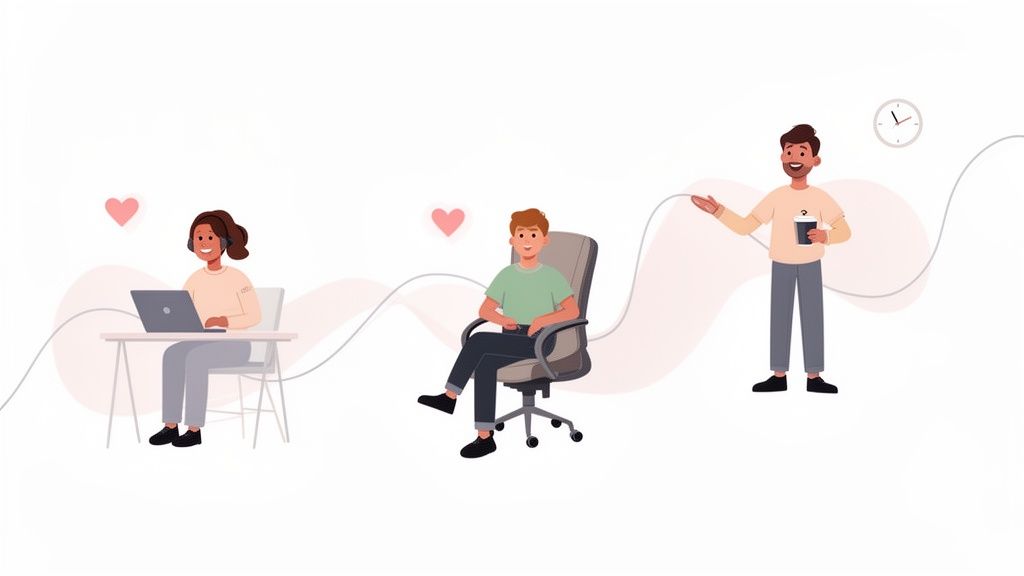
A key hybrid work schedule benefit is its powerful impact on employee satisfaction and loyalty. By offering autonomy and flexibility, this model caters to diverse lifestyle needs, empowering employees to better balance professional responsibilities with personal commitments. This increased control over their work environment fosters a sense of trust and respect, which translates directly into higher job satisfaction and a stronger commitment to the organization.
Research consistently shows that flexible work options are no longer a perk but an expectation. A recent study found that 77% of employees would consider changing jobs for greater flexibility, making a hybrid schedule a critical tool for attracting and keeping top talent, especially in competitive markets like Tulsa.
Real-World Examples
Major companies have seen significant retention gains with this model. Salesforce, for example, reported that its hybrid approach helped reduce voluntary turnover by an impressive 31%. Similarly, research from McKinsey highlights the high stakes, showing that 35% of employees would leave their jobs if a hybrid option wasn't available.
Locally, the value of workspace flexibility is equally clear. Members of Freeform House in Jenks report a 92% satisfaction rate with the adaptability their membership provides compared to a traditional office. They gain a premium, professional hub that supports their preferred work style without being tethered to a single, mandated location.
How to Implement This Benefit
To leverage a hybrid schedule for retention, businesses must be intentional and supportive.
Communicate Clearly: Highlight hybrid benefits during recruitment and onboarding to attract candidates seeking flexibility.
Set Clear Expectations: Define in-office requirements and communication protocols to avoid confusion and ensure fairness.
Gather Regular Feedback: Use surveys and one-on-one meetings to understand what your team needs from their schedule and workspace.
Foster Connection: Create mentorship programs and social events that intentionally bridge the gap between remote and in-office team members.
3. Reduced Real Estate and Operational Costs
One of the most compelling hybrid work schedule benefits is the substantial reduction in real estate and operational expenses. With fewer employees in the office on any given day, companies can move away from large, costly headquarters. This allows them to downsize their physical footprint, leading to significant savings on rent, utilities, maintenance, and other facility-related overhead.
This strategic shift doesn't just cut costs; it reallocates resources toward growth and employee support. Startups leveraging a hybrid model report extending their financial runway by an average of 12-18 months. By embracing a flexible workspace strategy, businesses can achieve greater financial agility and resilience in a changing economic landscape.
Real-World Examples
The financial impact of this shift is well-documented. Cisco, for example, reported saving nearly $1.9 billion annually by implementing its hybrid work model and rightsizing its real estate portfolio. On a local scale, small businesses and entrepreneurs in Jenks experience this benefit directly by using premium coworking spaces. Members of Freeform House typically save 40-60% on workspace costs compared to signing a traditional, long-term office lease.
This model provides access to a professional, high-end environment without the commitment and expense of a dedicated office. Entrepreneurs can use a prestigious downtown address and state-of-the-art facilities on a flexible basis, aligning their overhead directly with their actual needs.
How to Implement This Benefit
To capitalize on these savings, organizations can adopt a few key strategies.
Conduct Space Audits: Regularly analyze office usage data to identify peak occupancy and determine your actual square footage needs.
Negotiate Flexible Terms: Opt for flexible workspace solutions over rigid, long-term leases. Discover how to leverage month-to-month office space to maximize savings and agility.
Reinvest in Technology: Allocate a portion of the real estate savings to investing in robust collaboration tools and technology that empower a distributed workforce.
Optimize Facility Usage: Implement a desk-booking system or "hoteling" model to manage on-site space efficiently and ensure resources are used effectively.
4. Improved Work-Life Balance and Employee Wellbeing
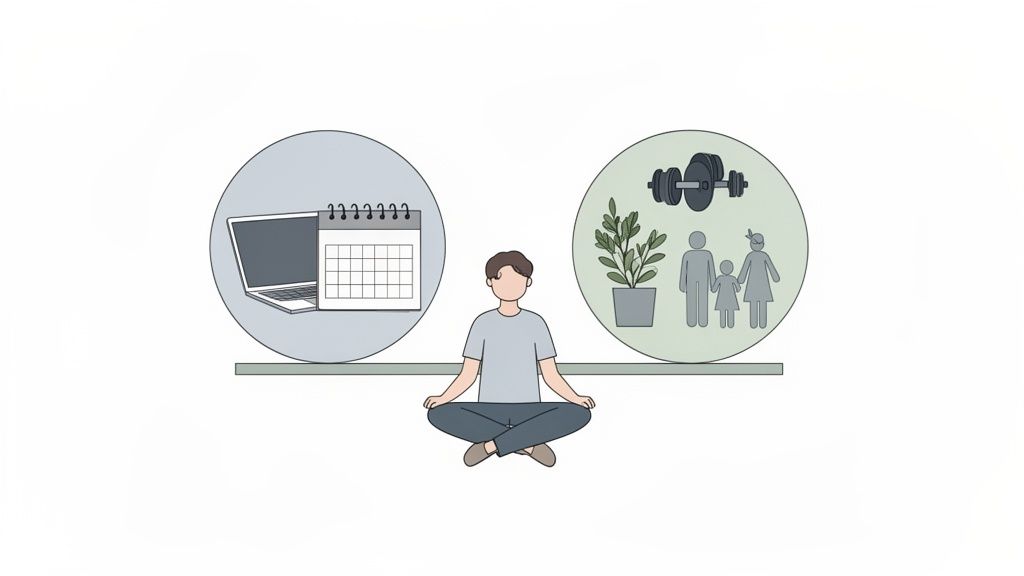
A major driver behind the adoption of hybrid work is its profound positive impact on employee wellbeing and work-life balance. This model grants individuals greater autonomy over their schedules, empowering them to integrate personal commitments and wellness activities seamlessly into their week. By eliminating the daily commute on remote days, employees reclaim valuable time that can be dedicated to family, fitness, or personal growth, significantly reducing stress and preventing burnout.
This increased flexibility is a key reason why hybrid work schedule benefits are so highly sought after by today's workforce. The ability to manage one's own time fosters a healthier relationship with work, leading to higher job satisfaction and improved mental health. When employees feel their personal needs are respected, they bring more energy and engagement to their professional roles.
Real-World Examples
Data strongly supports the connection between hybrid work and wellbeing. Remote-first company Buffer reported that its employees have 75% higher satisfaction with their work-life balance. Similarly, a survey at Meta revealed that 65% of their hybrid workers feel they have more control over their schedules, a critical factor in wellbeing. This translates to bottom-line results, as companies with strong work-life balance initiatives see 21% higher profitability and 41% lower absenteeism.
In Jenks, professionals at Freeform House experience this balance firsthand. Members often cite the club's premium amenities and curated dining partnerships as key contributors to their wellbeing on in-office days. The elegant, inspiring environment turns a workday into a more holistic and less stressful experience, blending productivity with personal comfort.
How to Implement This Benefit
Organizations can actively cultivate a culture that prioritizes work-life balance.
Establish Clear Boundaries: Encourage employees to set and respect work-life boundaries, such as defined working hours and "right to disconnect" policies after hours.
Encourage Wellness Breaks: Promote taking short breaks for exercise, meditation, or personal tasks throughout the day to prevent fatigue.
Leverage On-Site Days: Use in-person time for uplifting team activities. Hosting a brainstorming session in an inspiring, historic space at Freeform House can boost morale and creativity.
Assess Wellbeing Regularly: Implement anonymous surveys to gauge employee stress levels and satisfaction with their work-life balance, then act on the feedback.
5. Access to Diverse Talent and Geographic Flexibility
A key hybrid work schedule benefit for employers is the ability to recruit skilled professionals far beyond traditional geographic boundaries. By removing the requirement for daily office attendance, companies can tap into a much larger and more diverse talent pool, hiring the best person for the role regardless of their zip code. This model broadens horizons, allowing businesses to find specialists who might not be available in their immediate local market.
This geographic flexibility gives small businesses a competitive edge, enabling them to compete with larger corporations for top-tier talent. Companies can build stronger, more resilient teams by incorporating a wide range of perspectives and experiences. Automattic, the company behind WordPress.com, has mastered this by hiring the best talent worldwide and paying salaries based on skill, not location, creating a truly global and equitable workforce.
Real-World Examples
Tech leader GitLab expanded its talent pool by 400% after embracing a remote-first culture, accessing specialists from across the globe. Similarly, many tech companies report a 25-35% improvement in the quality of new hires after implementing geographic flexibility.
This trend is also visible at a local level. Freeform House members in Jenks have successfully recruited top talent from over 15 states by offering hybrid flexibility. They use the premium club as a professional hub for occasional in-person meetings, team-building offsites, and client presentations, providing a physical anchor for a geographically distributed team without the overhead of a permanent, full-time office.
How to Implement This Benefit
To leverage a wider talent pool, organizations must adapt their hiring and operational strategies.
Broaden Your Search: Build relationships with regional talent networks and universities outside your immediate area to find new candidates.
Refine Remote Hiring: Use high-quality video interview technology and structured assessments to efficiently screen and evaluate candidates from any location.
Create a Physical Hub: Schedule intentional, in-person collaboration days at a professional venue. Using Freeform House for these gatherings provides a sophisticated and impressive environment for your team to connect.
Invest in Asynchronous Tools: Adopt platforms like Slack and Notion to ensure smooth communication and project progression across different time zones.
Build a Cohesive Culture: Create intentional cultural rituals, like virtual coffee chats or company-wide online events, that foster connection among all team members, regardless of location.
6. Strengthened Company Culture and Community Building
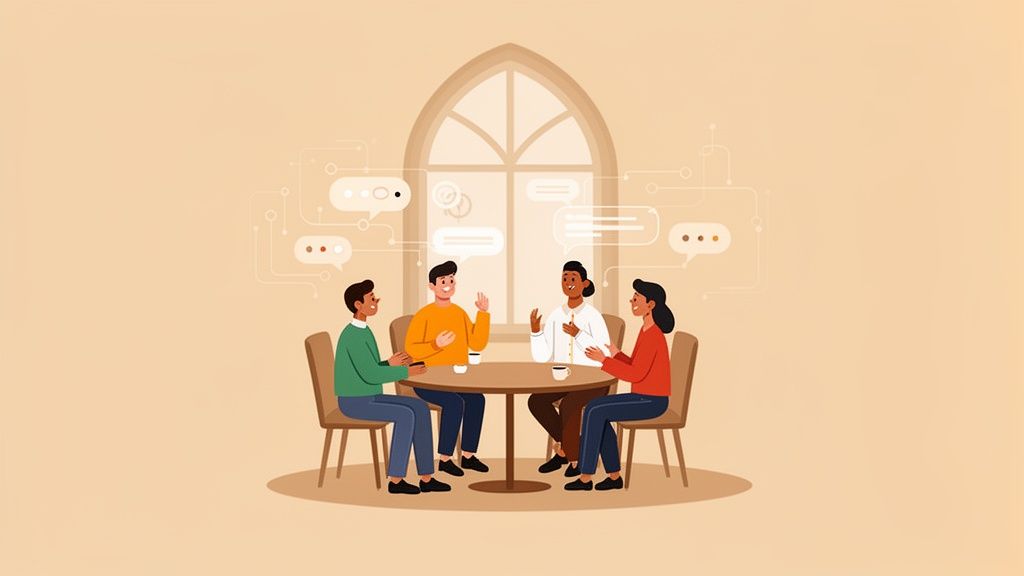
A common concern with hybrid models is the potential for a diluted company culture. However, when managed intentionally, a hybrid work schedule actually presents powerful opportunities to strengthen cultural cohesion and community. This model transforms in-office time from a daily requirement into a purposeful event focused on connection, mentorship, and shared experiences, which is a key advantage among hybrid work schedule benefits.
By dedicating specific days for in-person collaboration, organizations can create high-impact moments that build relationships more effectively than a standard five-day office week. These intentional gatherings allow for the organic, spontaneous interactions that are crucial for transferring knowledge, fostering mentorship, and reinforcing a shared sense of purpose and identity among team members.
Real-World Examples
Best Buy provides a strong example, reporting a 44% improvement in its culture scores after implementing a hybrid model centered on intentional collaboration days. Similarly, financial tech company Stripe maintains a strong, unified culture despite having a distributed team by hosting regular, high-impact gatherings at premium venues to foster connection.
Locally, businesses utilize spaces like Freeform House to create these memorable cultural touchstones. Teams gather for quarterly offsites in sophisticated, inspiring environments like The Hall of Fame Room or The Rise loft studio. These premium settings elevate company events, making employees feel valued and reinforcing a culture of excellence and community.
How to Implement This Benefit
To build a strong culture within a hybrid model, organizations must be deliberate about creating connection.
Schedule Purposeful In-Office Days: Designate specific days for team-wide collaboration with clear agendas that prioritize interaction and creative work.
Leverage Premium Spaces: Host key company moments like kick-offs, celebrations, and strategic offsites in an elevated environment. Freeform House offers a range of collaborative rooms perfect for these high-impact gatherings.
Facilitate Cross-Team Interaction: Use shared common areas during in-office days to encourage spontaneous conversations between different departments.
Establish Mentorship Programs: Pair senior and junior employees and encourage them to use in-person days for coffee chats and hands-on guidance.
7. Enhanced Recruitment and Employer Brand
In today's competitive talent market, one of the most powerful hybrid work schedule benefits is its direct impact on recruitment and employer brand. Offering flexibility is no longer a perk; it's a critical differentiator that positions an organization as forward-thinking and employee-centric. This approach significantly broadens the talent pool, attracting high-caliber candidates who prioritize work-life integration.
By embracing a hybrid model, companies demonstrate a commitment to trust, autonomy, and modern work culture. A LinkedIn survey from 2024 revealed that hybrid work is a top-three recruitment factor for a majority of job seekers globally. Companies that clearly advertise this flexibility often receive a substantially higher volume of qualified applications, giving them a significant edge in securing top talent.
Real-World Examples
Data shows a clear trend: organizations advertising hybrid roles receive up to 50% more qualified applications than those requiring full-time in-office attendance. In competitive local markets like Tulsa's growing tech and entrepreneurial scene, this advantage is even more pronounced. Startups in the area that cite premium coworking partnerships in their job listings report hiring cycles that are up to 40% faster.
Specifically, local businesses that list a Freeform House membership as part of their benefits package see a notable increase in applicant interest. This signals to potential hires that the company invests in a premium, professional environment that supports both focused work and collaborative community, making the offer more attractive than a standard remote or office-bound position.
How to Implement This Benefit
To leverage hybrid work as a recruitment tool, companies must be intentional in their communication and offerings.
Prominently Feature Flexibility: Highlight your hybrid policy, premium workspace amenities, and partnership benefits in all job postings, on your career page, and throughout the interview process.
Showcase the Workspace: Create video content or photo galleries showing your team utilizing flexible spaces like Freeform House. This provides a tangible look at the high-quality environment you offer.
Share Employee Stories: Use testimonials from current employees who thrive in your hybrid model. Authentic stories are a powerful tool for building your employer brand.
Partner with Recruiters: Equip local recruitment firms with information about your hybrid model and premium amenities, enabling them to use it as a key selling point to top candidates.
8. Increased Collaboration and Innovation
While it may seem counterintuitive, a well-structured hybrid model can significantly boost collaboration and innovation. This approach amplifies creative energy by concentrating collaborative efforts on specific in-office days, while remote days are reserved for the focused individual work necessary to develop those ideas. This intentional blend transforms the office from a place of mere presence into a hub for purposeful interaction and breakthrough thinking.
Organizations that optimize their hybrid schedules report up to 26% higher innovation metrics. The key is creating an environment where face-to-face time is maximized for high-value activities like brainstorming and strategic planning, making it one of the most powerful hybrid work schedule benefits.
Real-World Examples
Global innovators like 3M have seen great success with this model, reporting that their "innovation labs," held on designated collaboration days, outperform traditional office setups. Similarly, Spotify utilizes a hybrid approach that pairs focused remote work with intensive, in-office innovation sprints to drive new product features.
Locally, the power of a premier collaborative environment is clear. Freeform House members report a 40% increase in cross-pollination and new business ideas simply from interacting within the community. The club’s dynamic spaces, from versatile meeting rooms to The Rise loft studio, are specifically designed to facilitate the kind of creative collisions that spark innovation.
How to Implement This Benefit
To foster a culture of hybrid collaboration, leaders must be intentional about how and where teams connect.
Schedule 'Innovation Days': Dedicate specific in-person days for creative problem-solving and blue-sky thinking, free from routine operational tasks.
Utilize Specialized Spaces: Use purpose-built environments for different types of collaboration. Freeform House offers spaces like the Hall of Fame for formal presentations and a professional podcast booth for documenting thought leadership.
Encourage Cross-Functional Input: Invite diverse teams and even external partners to in-person sessions to bring fresh perspectives to the table. For practical strategies, explore this guide on how to improve team collaboration for real results.
Create Psychological Safety: Foster an environment where every team member feels secure sharing bold, unfinished ideas during collaborative sessions.
9. Competitive Advantage in Local Market and Community Positioning
Another powerful hybrid work schedule benefit, especially for local businesses, is the significant competitive advantage it creates in the community. Pairing a flexible work model with a premium workspace partnership demonstrates a deep commitment to both employee experience and local economic vitality. This strategy positions an organization as innovative, progressive, and a highly desirable employer, which is particularly impactful in a tight-knit market like Jenks and the greater Tulsa area.
This approach goes beyond simply offering flexibility; it signals investment in the local community and provides employees with a sophisticated, central hub for connection and collaboration. In a market where culture is a key differentiator, this model helps local businesses outshine larger, less-rooted competitors by building a stronger brand reputation and attracting top-tier local talent who value both autonomy and a sense of place.
Real-World Examples
Local entrepreneurs and small businesses leveraging Freeform House exemplify this advantage. Many members report a significant improvement in local brand recognition simply by associating with a premier downtown Jenks location. Mid-market companies with a hybrid model have also successfully outcompeted national firms for local talent by emphasizing their "local roots" and offering a premium, community-integrated workspace as a key part of their cultural package.
Furthermore, many members cite a notable improvement in recruiting local talent after highlighting their Freeform House affiliation. The ability to offer a sophisticated, SoHo House-style environment for work and client meetings becomes a powerful tool in attracting professionals who might otherwise look to larger markets.
How to Implement This Benefit
To turn your hybrid model into a local competitive advantage, integrate your workspace partnership into your core business strategy.
Showcase Your Space: Prominently feature your Freeform House affiliation in marketing materials, on your website, and during the recruitment process. Host key client meetings and team offsites in distinguished spaces like the Thomas Room to demonstrate your premium positioning.
Engage with the Community: Participate in community and networking events hosted at or through your workspace. This builds valuable relationships and reinforces your local commitment.
Build Local Partnerships: Collaborate with other Freeform House members for referrals and joint ventures, creating a powerful local business ecosystem.
Create Local-Centric Content: Develop blog posts or social media content that highlights your presence in downtown Jenks and your commitment to the local community, showcasing how your hybrid model supports this vision.
Hybrid Work Benefits: 9-Point Comparison
Item | 🔄 Implementation Complexity | ⚡ Resource Requirements | 📊 Expected Outcomes | 💡 Ideal Use Cases | ⭐ Key Advantages |
|---|---|---|---|---|---|
Increased Productivity and Focus | Medium — scheduling + communication protocols | Quiet zones, project tools, designated rooms | ~13% productivity uplift; faster project completion | Deep work, deadline-driven tasks, knowledge work | Fewer interruptions, higher task completion |
Enhanced Employee Retention and Satisfaction | Low–Medium — policy design & equity management | Flexible workspace memberships, clear policies, benefits | Higher satisfaction; reduces turnover (25–40%) | Recruitment, retaining high performers, caregiver support | Improved morale, stronger loyalty |
Reduced Real Estate and Operational Costs | Medium — space planning and utilization audits | Coworking membership models, tech infra | 20–30% lower real estate costs; ROI 3–5 years | Startups, scaling firms, cost-sensitive orgs | Lower overhead; capital preservation |
Improved Work-Life Balance and Employee Wellbeing | Low–Medium — culture change, boundary setting | Wellness amenities, flexible scheduling | Lower stress (~31%); reduced absenteeism | Employee wellbeing programs, morale initiatives | Reduced burnout; better health outcomes |
Access to Diverse Talent & Geographic Flexibility | Medium — hiring processes, time-zone coordination | Remote collaboration tools, occasional premium spaces | Talent pool expansion (300–500%); higher hire quality | Specialized hiring, distributed teams, growth markets | Access to top talent without relocation costs |
Strengthened Company Culture & Community Building | Medium–High — intentional events and facilitation | Premium in-person spaces, programming, mentorship | Engagement +30–45%; improved knowledge transfer | Onboarding, mentorship, cross-functional bonding | Stronger cohesion, richer mentorship |
Enhanced Recruitment & Employer Brand | Low — messaging and consistent delivery | Marketing, career site content, workspace partnerships | 20–30% faster time-to-fill; more qualified applicants | Employer branding campaigns, competitive hiring markets | Differentiated employer value proposition |
Increased Collaboration and Innovation | Medium — schedule design and facilitation | Creative studios, meeting rooms, collaboration tech | ~26% higher innovation metrics; faster problem-solving | Innovation sprints, cross-disciplinary projects | Concentrated ideation, specialized creative resources |
Competitive Advantage in Local Market & Community | Medium — local marketing and engagement | Membership, community events, local partnerships | 30–40% higher local recognition; stronger referrals | Local recruiting, client-facing positioning, small markets | Distinctive local brand, community network effects |
From Theory to Action: Building Your Hybrid Future at Freeform House
The journey from a traditional, office-centric model to a dynamic hybrid framework is more than a logistical shift; it's a strategic evolution. As we've explored, the hybrid work schedule benefits are profound and multifaceted, reshaping how businesses in Jenks, Tulsa, and beyond approach productivity, culture, and growth. This isn't just about giving employees a few days at home. It's about fundamentally redesigning the workday to unlock human potential and build a more resilient, agile organization.
We've seen how this model boosts productivity by empowering focused deep work, slashes operational costs by optimizing real estate, and significantly enhances employee wellbeing by promoting a healthier work-life balance. These advantages create a powerful ripple effect. Happier, more balanced teams are more engaged, innovative, and loyal, directly fueling higher retention rates and strengthening your employer brand in a competitive market.
Synthesizing the Benefits for Strategic Advantage
The core takeaway is intentionality. A successful hybrid model doesn't happen by accident. It is meticulously designed, balancing the autonomy that fuels individual performance with the structured, in-person connection that sparks collaboration and reinforces company culture.
Consider the key pillars we've discussed:
For Employees: Greater autonomy, improved mental health, and significant savings on commuting time and costs.
For Employers: A wider talent pool, reduced overhead, increased productivity, and a powerful recruitment tool.
For Culture: A deliberate blend of focused remote work and vibrant in-person collaboration, strengthening bonds and driving innovation.
Mastering this balance is no longer a "nice-to-have" but a critical competitive advantage. It positions your company as a forward-thinking, people-first organization, making you a magnet for top local talent. It demonstrates a commitment to both high performance and a high quality of life, a combination that defines the future of work. This strategic implementation is where a dedicated third space, a hub for community and collaboration, becomes not a luxury but a necessity.
Your Next Step: The Freeform House Advantage
The challenge for many local entrepreneurs and business leaders is creating that essential hub for connection without committing to a costly, full-time office lease. This is precisely the gap Freeform House is designed to fill. Comparable to the renowned SoHo House, it offers more than just a social club. Members can take advantage of co-working spaces and a dynamic community hub designed for collaboration and connection. It's a central gathering spot aimed at fostering a creative and cooperative spirit within our local community.
Think of it as your company's flexible headquarters, a place to host pivotal team meetings, creative brainstorming sessions, and client presentations in an inspiring, upscale setting. By integrating a partnership with Freeform House into your hybrid strategy, you provide your team with the best of both worlds: the freedom of remote work and access to a sophisticated, collaborative space that fosters the community and innovation essential for long-term success. You are not just offering a desk; you are offering an experience.
Ready to turn the powerful theory of hybrid work into a tangible reality for your business? Discover how a corporate membership at Freeform House can provide the premium coworking spaces, elegant meeting rooms, and vibrant community hub you need to unlock the full spectrum of hybrid work schedule benefits. Visit Freeform House to learn more and schedule a tour of our Jenks location today.
Comments