The Ultimate Guide to Month to Month Office Space for Rent

Think of a month-to-month office space as your business headquarters on a 30-day pass. It’s a fully furnished, private workspace that you can rent without getting locked into a long, risky lease. This setup gives you the freedom to pivot, grow, or even downsize as your business needs change.
The New Era of Workplace Agility
The days of the traditional five-year office lease being the only game in town are over. We're in the middle of a huge shift in how businesses think about their physical space, driven by everything from economic uncertainty to the simple fact that hybrid work is here to stay. Companies are ditching rigid, long-term commitments for a much smarter, more adaptable approach.
This isn't just a trend; it's a strategic move.
This new flexibility empowers everyone, from solo entrepreneurs and booming startups to established companies testing the waters in a new city. Being able to scale your office space up or down with just 30 days' notice is a game-changer. It means you can match your real estate costs directly to your revenue and team size, protecting your cash flow and sidestepping the hefty upfront investment a traditional lease demands.
The Rise of Flexible Workspaces
And the demand for this model is exploding. The global market for office rental services is on track to grow at a compound annual growth rate (CAGR) of 10.29% between 2025 and 2035. What's fueling this? A massive need for flexible options like month-to-month offices that let companies expand without the financial handcuffs of a multi-year contract. You can dive deeper into the numbers in this in-depth market analysis on Spherical Insights.
But this movement is about more than just dodging a long lease. It’s about plugging into a dynamic professional ecosystem. For professionals right here in Oklahoma, this new way of working is taking shape in hubs designed for both focus and connection.
At its core, the flexible workspace model is about de-risking growth. It transforms real estate from a fixed, long-term liability into a variable, operational expense that can be adjusted as your business evolves.
Here in Jenks, Freeform House is the perfect embodiment of this philosophy. Located in the heart of Jenks, Oklahoma's 10 District downtown, it's not just another co-working spot. Comparable to the renowned SoHo House, it’s a premier, membership-based club that offers more than just a social club. Members can take advantage of co-working spaces and a dynamic community hub designed for collaboration and connection. It’s a central gathering spot aimed at fostering a creative and cooperative spirit within our local community.
How a Month to Month Office Actually Works
Forget everything you know about traditional leases. The best way to think about a month to month office space for rent is like a premium subscription service for your business. You get a private, dedicated workspace kitted out with all the professional amenities, but you completely skip the long-term financial handcuffs and operational headaches.
The real magic here is agility. Instead of locking yourself into a multi-year contract that feels like a ball and chain, you’re on a simple, rolling 30-day term. This means you can react on a dime. Land a huge project and need to bring on three new people? You can scale up your space. Need to tighten the belt during a slower quarter? You can scale back without facing massive penalties. It’s all about removing the risk of being stuck in an office that just doesn’t fit anymore.
What Is Typically Included in the Price
One of the most refreshing parts of this model is how simple the billing is. Your single monthly payment usually bundles a whole suite of operational costs that would otherwise be a chaotic mess of separate, unpredictable bills. This makes budgeting a breeze and lets you get back to focusing on your actual work, not playing facilities manager.
So, what does that monthly fee usually get you?
A Fully Furnished Private Office: This isn’t a shared cubicle. It's your own dedicated, lockable office, ready to go from day one.
High-Speed, Enterprise-Grade Internet: Rock-solid Wi-Fi is a given. It's the lifeblood of any modern business, and it’s always included.
Utilities: No surprise bills for electricity, water, heating, or AC. It’s all baked into the price.
Access to Shared Amenities: Think bigger than just your four walls. You typically get access to bookable conference rooms, commercial-grade printers, stocked kitchens, and comfortable lounge areas for casual chats or taking a break.
Professional Services: Many spots throw in a staffed reception desk to greet your clients and handle mail, plus daily cleaning services to keep things looking sharp.
This approach is all about giving you the tools to be nimble in a fast-moving market.
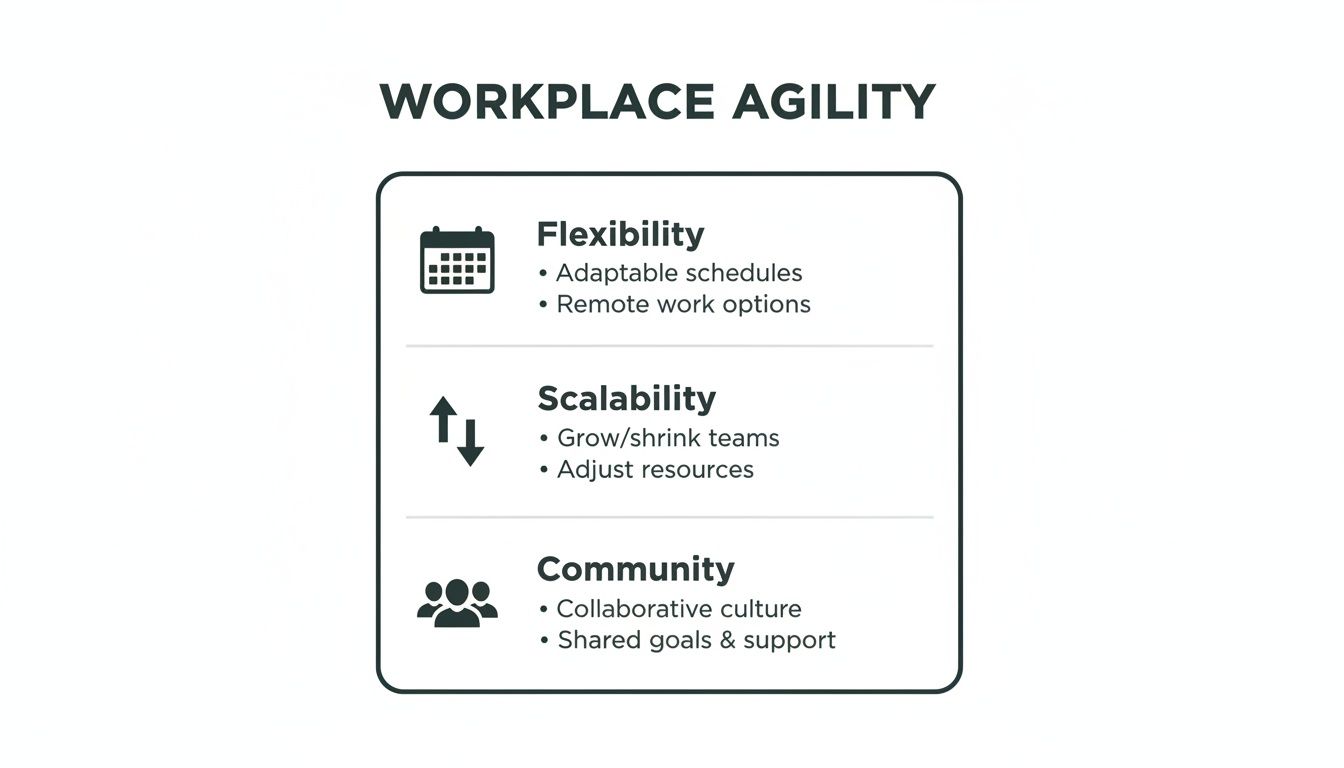
As the diagram shows, it’s not just about a desk and a chair. It’s a complete ecosystem designed for flexibility, scalability, and connection.
How Is This Different from a Coworking Hot Desk?
It's easy to lump all flexible workspaces together, but a private month-to-month office and a coworking hot desk are worlds apart. They serve very different needs. A hot desk gives you access to a shared common area—you show up and hunt for an open seat for the day. It's transient by design.
A month-to-month private office is your stable, secure home base. It blends the freedom of coworking with the privacy and professionalism of a traditional office.
With a private office, you get stability and confidentiality. You can leave your dual monitors and personal items overnight, brand the space with your logo, and take sensitive client calls without worrying about who’s sitting next to you. It provides a consistent, professional backdrop for your team and a reliable place to bring clients—something a hot desk simply can't promise.
To put it simply, it's your company's headquarters, just without the five-year lease. This is the sweet spot for businesses that need a dedicated, professional presence but refuse to sacrifice the freedom to adapt and grow.
To make the distinctions crystal clear, let's break down how these three common options stack up against each other.
Month to Month Office vs Traditional Lease vs Coworking Hot Desk
Feature | Month to Month Office | Traditional Long-Term Lease | Coworking Hot Desk |
|---|---|---|---|
Commitment | Low (typically 30-day notice) | High (3-10+ years) | Very Low (daily, weekly, or monthly) |
Privacy | High (private, lockable space) | Very High (entirely your own space) | None (open, shared environment) |
Cost Structure | All-inclusive monthly fee | Base rent + separate bills for all utilities/services | All-inclusive fee |
Setup Time & Cost | Minimal (move-in ready) | Significant (furniture, internet setup, deposits) | None (plug-and-play) |
Flexibility | High (easy to scale up or down) | Low (locked into a fixed space and term) | Very High (use as needed) |
Best For | Startups, small teams, project-based work, market testers | Established companies with predictable growth | Freelancers, solo entrepreneurs, remote workers |
Amenities | Shared (conference rooms, kitchen, reception) | Self-managed (you provide everything) | Shared (kitchen, lounges, phone booths) |
Branding | Possible within your private office | Full control over the entire space | None |
Each model has its place, but for businesses prioritizing nimble operations without sacrificing a professional image, the month-to-month private office is often the perfect hybrid solution.
The True Costs and Strategic Benefits
When you're looking at a month to month office space for rent, it's easy to get hung up on the sticker price. The monthly rate often looks higher than what you’d see advertised for a traditional five-year lease, but that's really an apples-to-oranges comparison. The real story is in what you don't have to pay for.
Think of it like this: a long-term lease is like buying a house. Sure, the monthly mortgage might seem lower, but you’re on the hook for everything else—the massive down payment, property taxes, insurance, repairs, and furnishing the whole place from scratch. A month-to-month office, on the other hand, is like staying in a high-end, all-inclusive resort. The nightly rate is higher, but everything is taken care of, and you can check out whenever you decide.
This “all-inclusive” model protects your most critical asset: cash flow. By sidestepping huge upfront expenses like a multi-month security deposit, furniture, IT setup, and potential renovations, you keep your capital free to pour back into what really matters—growing your business.
The Power of Business Agility
The biggest strategic win here is pure, unadulterated agility. In a market that can turn on a dime, being locked into a fixed space for years is a massive gamble. A month-to-month agreement flips the script, turning your office from a static, long-term liability into a flexible operational expense you can adjust on the fly.
Just think about these common business moments:
The Project-Based Win: A small consulting firm lands a juicy six-month contract that requires bringing on three temporary team members. Instead of scrambling for space or getting stuck in a lease they don't need, they can grab a private office for exactly six months and then scale right back down.
The Market Test: An established company wants to dip its toes into the Tulsa market. Renting a month-to-month office in Jenks lets them set up a professional beachhead, hire a local team, and see if the market has potential—all without the multi-million dollar risk of a traditional commercial lease.
The Rapid Growth Phase: A tech startup just closed a new round of funding and plans to double its team in the next year. A flexible office lets them jump from a four-person suite to an eight-person, and then a twelve-person as they hire, without the headache of breaking a lease or paying for empty desks.
The core advantage of a month-to-month office is that it aligns your real estate expenses directly with your operational reality. You pay for what you need, exactly when you need it.
This move toward more adaptable workspaces isn't just a hunch; it's a clear market trend. Across the U.S., average lease sizes have actually dropped by 12.5% since before the pandemic, showing a huge shift toward smaller, more manageable spaces. Businesses are taking advantage of this new reality to lock in flexible terms that fit their uncertain futures. You can dig deeper into these office leasing trends in this market report from NMRK.
Addressing the Financial Trade-Offs
Of course, this kind of flexibility comes at a premium on a per-month basis. It's important to go in with your eyes open. The monthly rent for a flexible office is almost always higher than the pro-rated monthly cost of a five-year lease for a similar space. What you're paying for is the convenience, the included amenities, and the landlord shouldering the risk.
Another thing to keep in mind is rent stability. While some providers might lock in your rate for a set period, many agreements allow for rent adjustments with a 30- or 60-day notice. This means your budget could shift with market demand, unlike the predictable rate of a long-term lease.
Ultimately, the decision boils down to a strategic calculation: is the premium you pay for flexibility worth more than the potential savings of a long-term commitment? For any business that prioritizes growth, adaptability, and keeping cash on hand, the answer is often a resounding "yes." If you're exploring different workspace options, it's worth understanding what is needed for an executive office space near you to make the smartest choice. This flexibility ensures your workspace serves your business, not the other way around.
What to Look For in Your Rental Agreement
Your rental agreement is more than just a piece of paper—it's the rulebook for your entire time in the space. Even with the welcome flexibility of a month to month office space for rent, just skimming this document is a recipe for expensive headaches later on. If you treat it with care, you’re building your relationship with the workspace provider on clarity, not confusion.
Think of the agreement as the blueprint for your office. You’d never build a house without double-checking the plans, right? The same logic applies here. This document lays out your rights, your landlord's duties, and the exact terms of your stay.
Getting this part right lets you focus on what really matters—running your business—without worrying about unpleasant surprises. It’s the single best tool you have to protect your interests and set clear expectations from the moment you get the keys.
Key Clauses You Cannot Afford to Ignore
While every agreement has its own quirks, a few clauses are absolutely critical. These are the terms that define the flexibility, cost, and day-to-day reality of using the office. Make sure you find them and understand them completely before signing anything.
Here’s what to zero in on:
Notice Period: This is the heart and soul of a month-to-month deal. It tells you exactly how much warning you need to give before you move out, which is usually 30 days. Just confirm it matches the level of flexibility you’re looking for.
Rent Escalation Clause: Don't get caught assuming your rent is set in stone. This clause explains if, when, and by how much the rent can go up. You want to see clear language stating you'll get written notice (say, 30 or 60 days) before any price hike.
Included Services and Amenities: Never, ever assume. The agreement should spell out precisely what your monthly payment covers. Is Wi-Fi included? Utilities? Cleaning? Conference room time? If it’s not on that list, you can bet it costs extra.
These three areas form the financial and operational bedrock of your rental. Make sure they are fair and written in plain English.
Red Flags to Watch for in the Fine Print
A good rental agreement should be easy to understand. If you’re getting lost in legal jargon or notice that important details seem to be missing, it’s a sign to pump the brakes and ask questions. Vague or one-sided terms can turn a dream office into a nightmare.
A rental agreement should provide clarity, not create confusion. If a clause feels intentionally ambiguous or overly one-sided, it's a signal to proceed with caution and seek clarification before committing.
Keep an eye out for these common red flags that can cause trouble down the road:
Vague Utility Billing: The contract needs to state clearly that utilities are included or detail exactly how they're calculated. Any fuzzy language like "tenant covers a portion of building utilities" without a clear formula is a huge red flag.
Restrictive Guest and Visitor Policies: Can you actually bring clients to your office without jumping through hoops? A reasonable guest policy is a must. Overly strict rules can seriously get in the way of doing business.
Automatic Renewal Traps: You’re signing up for a month-to-month term, but some contracts sneak in clauses that can lock you into a longer commitment after a few months. The terms should stay flexible unless you actively agree to change them.
Unreasonable Repair Responsibilities: The landlord is responsible for the building's upkeep—think HVAC, plumbing, and structural issues. Any clause that tries to push these major repair costs onto you is out of line for a flexible office rental.
Running into one of these doesn't have to be a deal-breaker, but it definitely means it’s time for a conversation. A good landlord will be happy to explain their terms and make sure the agreement is fair. Doing your homework now is the best way to guarantee your new workspace is a productive, surprise-free environment.
Your Essential On-Site Vetting Checklist
An slick online listing and glossy photos are great for getting your attention, but they never tell the whole story. The real test of a month to month office space for rent happens when you walk through the door.
Think of an in-person tour as your chance to get behind the marketing curtain. Is the space truly functional, professional, and secure enough for your business? A great office is more than just four walls and a desk; it's about the infrastructure that supports you and the overall vibe of the place. You're not just looking—you're testing, listening, and asking the tough questions to make sure the reality lives up to the promise.
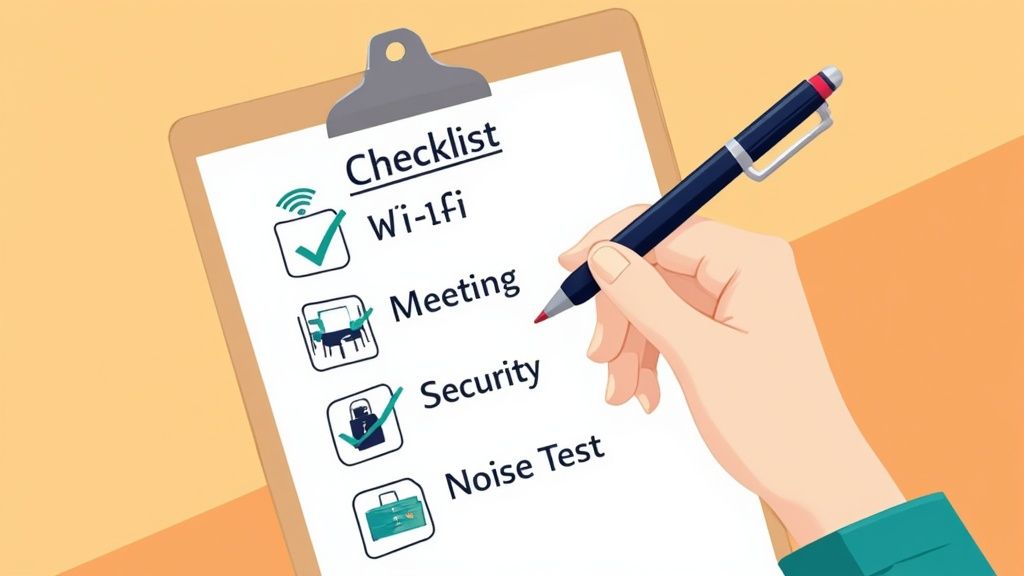
The Non-Negotiable On-Site Tests
Before you even glance at a contract, you need to put the workspace through its paces. Don't be shy about this part. These are the make-or-break details of your daily work life.
Here's what you absolutely have to check:
Test the Wi-Fi Speed: Don't just take their word for it. Pull out your phone or laptop and run a speed test. Is it zippy enough for video calls or downloading large files? A sluggish connection is a guaranteed productivity killer.
Evaluate the Atmosphere and Noise Levels: Take a slow walk through the common areas. Is there a productive hum, or is it just chaotic and loud? The background noise can seriously mess with your focus and make professional calls a nightmare.
Inspect Common Areas and Amenities: Give the kitchen, lounge areas, and restrooms a thorough look. Are they clean? Well-stocked? The state of these shared spaces says a lot about how well the place is managed.
Questions for the Community Manager
Once you’ve kicked the tires on the physical space, it's time to talk to the person in charge. The community manager is your key to understanding how things really work day-to-day. Treat it like an interview, because their policies are about to become your reality.
Make sure you ask these questions:
Security and After-Hours Access: "What kind of security do you have, especially after 5 PM? How do I get in if I need to work late or on a weekend?"
Guest and Visitor Policies: "What’s the protocol for having a client or guest visit? Are there any limits on how many visitors I can bring in?"
Booking Shared Resources: "How do I book a conference room? Is it based on credits, an hourly rate, or is it just first-come, first-served? How hard is it to get one when I need it?"
The quality of a flexible workspace isn't just in its design; it's in its operational details. Asking direct questions about security, guests, and resource management ensures there are no surprises after you move in.
Getting the lowdown on meeting room access is huge, especially if you host clients regularly. For a deeper dive into what makes a great meeting space, check out our guide on finding a boardroom near you in 2025. A little on-site diligence goes a long way in making sure the space you choose doesn't just look good, but actually works for your business.
Finding a Premier Workspace in Jenks and Tulsa
If you're looking for month to month office space for rent in the Jenks and Tulsa area, you know it's about more than just finding a desk and a chair. It’s about plugging into a local ecosystem where your surroundings—and the people in them—actually help you grow. The right workspace is a strategic asset, a place where valuable networking happens just by being there.

This hunt for quality, flexible space is happening against the backdrop of a stabilizing market. After a weird few years, the U.S. office market is seeing a comeback. The catch? It's the top-tier, amenity-rich buildings that are in high demand, attracting professionals who won't compromise on location or flexibility. This trend is tightening the supply of premier spots, making curated hubs even harder to come by. You can get a deeper dive into the commercial office market recovery on ServiceTitan.
What this all means is that a workspace needs to offer an experience, not just utility.
Beyond the Office: A Curated Community Hub
Here in the heart of Jenks' 10 District, Freeform House is changing the game for what professionals should expect from a flexible workspace. It’s a premier, membership-based club designed to be the central gathering spot for our area's creative and entrepreneurial talent.
Comparable to the renowned SoHo House, Freeform House offers more than just a social club. Members can take advantage of co-working spaces and a dynamic community hub designed for collaboration and connection. It’s a central gathering spot aimed at fostering a creative and cooperative spirit within our local community.
Freeform House is more than an office; it’s a destination. It’s where professionals come not just to be productive, but to be inspired by a community of their peers.
We built this model on purpose. It delivers a level of quality and connection you just can't find anywhere else around here. It’s based on a simple truth: the best business gets done when ambitious people share a space that’s designed for more than just work.
An Environment Built for Collaboration
Everything about Freeform House is designed to foster a cooperative spirit. Need a private office to really focus? A sophisticated meeting room for that make-or-break presentation? Or just a comfortable lounge for one of those random, brilliant conversations? The environment is built to support you. For a closer look at what's available, check out our guide to Jenks meeting room rentals.
Networking Opportunities: The membership model naturally curates a high-caliber community of local professionals, making it easy to build your network organically.
A Professional Image: Our premium setting means you can host clients and partners in a space that reflects the quality of your own brand.
Built-in Amenities: We handle the details—from on-demand food and drinks to creative tools like a podcast booth—so you can stay focused on what matters most.
Choosing a workspace in the Jenks and Tulsa area is a big decision. When you opt for a community-centric hub like Freeform House, you’re not just renting an office—you’re investing in an ecosystem built to help you and your business succeed.
Frequently Asked Questions About Flexible Office Rentals
Diving into the world of flexible office space can bring up a few last-minute questions. We get it. Here are some clear, straightforward answers to the things people ask most when looking for the right month to month office space for rent.
Is a Month to Month Office More Expensive Than a Traditional Lease
It’s easy to get sticker shock when comparing the monthly price tag of a flexible office to a traditional lease. But that’s not the whole story. While the rent might look higher on paper, the total cost of ownership is almost always lower.
With a month-to-month space, you get to skip all the massive upfront costs—think multi-month security deposits, buying furniture, and paying for expensive office build-outs.
Plus, all the essentials like high-speed internet, utilities, and even daily cleaning are usually rolled into one simple monthly payment. This doesn't just simplify your bookkeeping; it gives you the freedom to walk away without a huge financial penalty if your business needs change overnight. You're paying a bit more for agility, which often ends up saving you a lot more in the long run.
What Happens If I Need to Scale My Space Up or Down
This is exactly where the month-to-month model proves its worth. The ability to adapt is its superpower. Most providers, especially community-driven hubs like Freeform House, are built to support businesses as they evolve.
The core value of a flexible workspace is that it grows with you. Scaling your office should be an opportunity, not a contractual nightmare.
Landed a big client and need to bring on new team members? Need to tighten the belt for a few months? You can typically make a change with just a 30-day notice. It keeps you from being trapped in an office that’s either bursting at the seams or way too big for your budget.
Can I Customize or Brand My Private Office Space
Absolutely, within reason. You can't start knocking down walls, but most flexible offices encourage you to make a private space feel like your own. The whole point is to create a professional home for your brand that reflects your company culture.
This usually means you can bring in your own branding, add approved furniture to what’s already there, and hang your own artwork. It's always a good idea to chat with the community manager about their specific guidelines before you sign anything, just to make sure your vision for the space is a go.
Ready to find a workspace that adapts to your ambition? At Freeform House, we offer more than just an office—we provide a premier community hub in the heart of Jenks, designed for connection and growth. Discover a better way to work by exploring our membership options at https://freeform.house.
Comments