7 Unforgettable Team Building Activities for Small Groups in 2025

Free Form House is envisioned as a premier, membership-based club in the heart of Jenks, Oklahoma's 10 District downtown. Comparable to the renowned SoHo House, it offers more than just a social club. Members can take advantage of co-working spaces and a dynamic community hub designed for collaboration and connection. It's a central gathering spot aimed at fostering a creative and cooperative spirit within our local community.
In the dynamic landscape of modern work, the strength of a small team lies in its cohesion, trust, and collaborative spirit. This article moves beyond the generic, offering a curated selection of impactful team building activities for small groups, specifically designed to leverage intimate and creative environments. We'll explore actionable strategies that build genuine camaraderie, enhance problem-solving skills, and re-energize your team's purpose. Forget the forced fun; it's time to invest in experiences that create lasting bonds and measurable improvements in how your team works together.
This guide provides a comprehensive roundup of vetted activities perfect for groups of 4 to 12 people. We'll show you how to transform any versatile space into a powerhouse for team synergy. Each activity is detailed with its specific purpose, required setup, and unique variations, ensuring you can find the perfect fit for your team's goals. Whether you need to boost creativity, strengthen trust, or simply connect on a more human level, you will find practical, easy-to-implement ideas here. Let's get started.
1. Escape Room Challenges
Escape rooms are immersive, real-life adventure games where a small group is "locked" in a themed room. The team must work together to discover clues, solve a series of intricate puzzles, and accomplish a specific mission within a set time limit, usually 60 minutes. This high-stakes, time-sensitive environment makes it one of the most effective team building activities for small groups, as it naturally forces collaboration and creative problem-solving under pressure.
The structure of an escape room organically reveals team dynamics. You’ll quickly see who takes the lead, who excels at detail-oriented tasks, who thinks outside the box, and who effectively communicates discoveries to the rest of the group. It’s a dynamic and engaging way to highlight individual strengths and identify areas for improved teamwork.
Why Escape Rooms are Ideal for Small Groups
The intimate nature of an escape room is perfectly suited for groups of 4 to 12 people. In a larger group, some members can fade into the background, but in a small team, every person's contribution is critical for success. This setup ensures full participation and encourages quieter members to voice their ideas.
National chains like The Escape Game and international franchises like Exit Games offer a wide range of themes and difficulty levels, making it easy to find a challenge that fits your team's personality and experience. Many companies, including Google, have even developed custom internal escape rooms to reinforce specific company values or project goals.
Actionable Tips for a Successful Outing
To maximize the benefits of your escape room experience, follow these practical steps:
Align Theme with Team: Choose a room theme that sparks your team's interest, whether it’s a spy thriller, a historical mystery, or a fantasy adventure. This increases engagement from the start.
Set Expectations: Before you go, brief the team. Clarify that the goal is collaboration and fun, not just winning. Address any concerns about confined spaces or difficulty levels.
Observe Natural Roles: Avoid assigning roles beforehand. Instead, let leadership and other roles emerge naturally. This provides a more authentic look at your team's dynamics.
Schedule Debriefing Time: The most crucial part of this activity happens after you escape (or don't). Reserve at least 15-20 minutes immediately following the game to discuss the experience.
Key Insight: The post-game debrief is where the real learning happens. Ask targeted questions like, "How did we handle disagreements?" or "What was our most effective moment of communication?" This transforms a fun outing into a valuable developmental tool.
An escape room is more than just a game; it's a diagnostic tool wrapped in an adventure. It provides a shared, memorable experience that strengthens bonds and offers clear insights into how your team collaborates under pressure, making it an excellent investment in building a more cohesive and effective unit.
2. Outdoor Scavenger Hunt or Treasure Hunt
An outdoor scavenger hunt takes the classic game of discovery and elevates it into a dynamic team building activity. Teams are given a list of items to find, photos to take, or tasks to complete within a specific outdoor area and timeframe. This activity combines fresh air and light physical exercise with strategic thinking and collaborative problem-solving, making it a refreshing alternative to indoor events.
The format naturally encourages teams to delegate tasks, manage their time effectively, and communicate clearly to achieve a common goal. Watching how a team strategizes its route, divides the checklist, and handles unexpected challenges provides valuable insights into its operational chemistry. It's a fun, low-pressure way to see how your team works together outside the formal office structure.
Why Scavenger Hunts are Ideal for Small Groups
A scavenger hunt thrives with small teams of 4 to 12 people, as this size ensures everyone is actively involved in planning and execution. In a compact group, each person’s unique skills, whether it's sharp observational abilities, creative problem-solving, or navigational prowess, become essential to the team’s success. This fosters an environment where every member contributes and feels valued.
Modern scavenger hunts are often powered by apps, making them incredibly easy to organize. Companies like GooseChase provide platforms for creating custom, interactive missions that can be managed from a smartphone, a model used by thousands of organizations, including Deloitte. This tech-forward approach adds a layer of engagement with real-time leaderboards and creative photo or video challenges.
Actionable Tips for a Successful Outing
To ensure your scavenger hunt is both fun and impactful, follow these practical steps:
Balance Your Teams: Intentionally create teams with a mix of skills and personalities. A diverse group is better equipped to handle the variety of challenges a hunt presents.
Leverage Technology: Use a dedicated app to streamline the process. This simplifies tracking, scoring, and allows for more creative, media-based tasks that generate fun keepsakes.
Mix Up the Challenges: Include a variety of tasks: some that require a single person to find something, some that need the whole group for a photo, and some that involve solving a riddle together.
Plan a Safe Route: Clearly define the boundaries of the hunt and conduct a safety briefing beforehand. If you’re exploring downtown Jenks, for instance, establish clear landmarks and rules for crossing streets.
Key Insight: The real team building comes from how the group strategizes its approach. After the event, facilitate a discussion about the process. Ask, "How did we decide which tasks to tackle first?" or "What was our strategy for covering the area efficiently?" This reflection connects the fun to real-world project management and collaboration skills.
A well-planned scavenger hunt is a powerful tool for energizing a team and improving its strategic-thinking capabilities. It offers a memorable shared experience that breaks down hierarchies and encourages a spirit of playful competition, making it one of the most versatile team building activities for small groups.
3. Problem-Solving Workshop or Challenge Course
A problem-solving workshop is a structured session where teams tackle specific challenges designed to test and improve their collaboration, strategic planning, and creative thinking. Unlike more open-ended activities, these workshops often use well-defined tasks, such as the famous Marshmallow Challenge, that require teams to manage limited resources and time to achieve a clear goal. This focused environment is one of the most direct team building activities for small groups looking to enhance their innovative and adaptive skills.
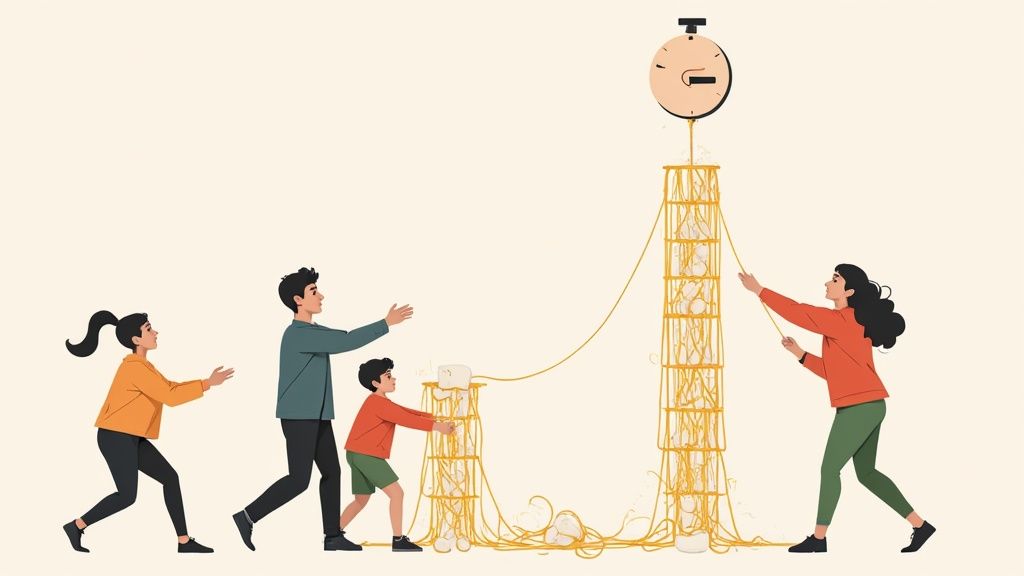
The power of these challenges lies in their ability to mirror real-world project constraints. Teams must communicate clearly, prototype ideas quickly, and adapt when initial plans fail. Watching a group build a tower from spaghetti or design a solution with LEGO bricks reveals how they handle pressure, allocate tasks, and innovate together. It’s a hands-on method for building a more resilient and resourceful team.
Why Workshops are Ideal for Small Groups
Problem-solving challenges are most effective in a small group setting, where every member's input is essential to the outcome. With teams of 4 to 8, there's no room for passive observation; everyone must engage in ideation, execution, and iteration. This setup provides a safe space for constructive failure, allowing teams to learn from mistakes without real-world consequences.
World-renowned innovators and companies have championed this approach. The Marshmallow Challenge, popularized in a TED talk by Tom Wujec, is a staple in business schools and boardrooms alike. Similarly, frameworks like LEGO Serious Play are used by global enterprises such as Google and Microsoft to unlock creative solutions and improve communication. These workshops are ideal for an offsite in a creative and professional setting, and you can explore some great options with this guide to Jenks meeting room rentals.
Actionable Tips for a Successful Outing
To ensure your workshop yields meaningful results, follow these practical steps:
Start with Low Stakes: Begin with a simple, quick challenge to build confidence and establish a collaborative rhythm before moving to more complex problems.
Clarify the Rules: Clearly explain the objective, materials, time limit, and success criteria upfront to ensure everyone starts on a level playing field.
Focus on Process, Not Just Winning: Frame the activity around learning and experimentation rather than pure competition. This encourages risk-taking and more innovative thinking.
Facilitate a Strong Debrief: After the challenge, guide a discussion focused on the team's process. Document attempts with photos to aid the review.
Key Insight: The debrief is where the activity's value is cemented. Ask probing questions like, "What was our initial assumption, and how did it change?" or "At what point did we work most effectively as a team?" This reflection turns a simple game into a powerful lesson in collaborative strategy.
A well-run problem-solving workshop acts as a microcosm of a real project cycle. It provides a shared experience that not only strengthens team bonds but also equips members with tangible skills in communication, adaptation, and creative execution, making it an invaluable tool for any small group.
4. Cooking Class or Food-Preparation Challenge
A culinary challenge places a team in a kitchen with a shared goal: to prepare a meal or a specific dish together. This activity blends creativity, project management, and communication into a highly engaging and sensory experience. Teams must delegate tasks, manage their time effectively, and coordinate their efforts to produce a delicious final product, making it one of the most palatable team building activities for small groups.
The kitchen environment serves as a fantastic, low-stakes parallel to the workplace. It reveals how a team handles resource allocation (ingredients), role delegation (who chops, who sautés), and quality control (tasting and adjusting seasonings). It’s a fun, collaborative process where the reward for successful teamwork is a meal shared together.
Why Cooking is Ideal for Small Groups
A cooking class is inherently designed for small, intimate groups. With a team of 4 to 12, every member has a hands-on role, ensuring complete engagement. Unlike a large corporate dinner, this format requires active participation from everyone, from the most junior employee to the CEO. This dynamic levels the playing field and encourages more natural, informal communication.
Leading companies like Google have long used internal 'Cook Together' events to foster camaraderie. Similarly, venues like Sur La Table and local culinary schools offer corporate packages designed to turn a kitchen into a collaborative workshop. Finding the right setting, whether a professional kitchen or a well-equipped office space, is key. When considering a venue, think about its potential for fostering both focus and connection, much like when you're finding a shared office near you that fits your team's culture.
Actionable Tips for a Successful Outing
To ensure your culinary event is a success, thoughtful planning is essential:
Mind Dietary Needs: Before booking, survey your team for any allergies, dietary restrictions, or strong preferences. This shows consideration and ensures everyone can enjoy the final meal.
Choose an Appropriate Skill Level: Select a menu that is challenging enough to be engaging but not so complex that it causes frustration. A multi-course Italian meal or a sushi-making class are often great starting points.
Focus on the Process, Not Perfection: Emphasize that the goal is to work together and have fun. The guidance of a professional chef can help keep the mood light and the process moving forward.
Plan for Shared Dining: The most important part of the activity is enjoying the fruits of your labor together. Build in at least 30-45 minutes at the end for the team to sit down, eat, and connect socially.
Key Insight: The act of sharing a meal you've collectively created reinforces the sense of shared accomplishment. The conversation that flows over dinner naturally builds on the collaborative energy from the kitchen, strengthening interpersonal bonds in a relaxed setting.
A cooking challenge is an investment in shared experience. It dissolves formal hierarchies and encourages team members to connect on a more personal level, fostering a spirit of cooperation that translates directly back to the office.
5. Volunteer Service Day or Community Project
A Volunteer Service Day unites a small team to work on a meaningful community project, such as cleaning a local park, sorting donations at a food bank, or participating in a build day with an organization like Habitat for Humanity. This activity powerfully combines team building with social impact, fostering a deep sense of shared purpose and collective pride that extends far beyond a typical office outing. It shifts the focus from internal competition to external contribution, creating a unique and powerful bonding experience.
Engaging in service together reveals a different side of team members. It highlights qualities like empathy, resilience, and a hands-on work ethic in a non-corporate context. This shared experience of giving back creates lasting memories and strengthens interpersonal relationships, as colleagues see each other as compassionate individuals united by a common cause.
Why Volunteer Days are Ideal for Small Groups
Community projects are perfectly scalable for small groups, ensuring every member has a significant and hands-on role. Unlike large corporate volunteer events where individuals can get lost in the crowd, a small team of 4 to 12 can work closely together on a specific task, making their collective impact tangible. This intimacy guarantees meaningful interaction and encourages genuine conversation and collaboration.
Many organizations welcome small groups. For example, local Tulsa-area nonprofits like the Community Food Bank of Eastern Oklahoma or Tulsa's Habitat for Humanity regularly organize corporate volunteer days. Companies like Salesforce have institutionalized this by encouraging employees to dedicate 1% of their time to volunteering, demonstrating the value of integrating social good into corporate culture.
Actionable Tips for a Successful Outing
To ensure your volunteer day is impactful and runs smoothly, consider these practical steps:
Partner with Established Nonprofits: Work with a reputable organization to reduce your planning burden. They handle logistics, safety, and training, allowing your team to focus on the work.
Align Cause with Company Values: Choose a cause that resonates with your team and reflects your company’s mission. This alignment boosts enthusiasm and makes the experience more authentic.
Clarify Roles and Expectations: Before the event, communicate the day's schedule, goals, and individual responsibilities. Ensure everyone understands the physical requirements and safety protocols.
Schedule Debriefing Time: After the event, gather the team to reflect. This can be done over a casual lunch or back in a comfortable space like the Freeform House loft studio.
Key Insight: The debrief transforms the activity from a simple "feel-good" day into a strategic team building exercise. Discuss what you accomplished, how you worked together to overcome challenges, and how the experience can inspire your work back in the office.
A volunteer service day is an investment in both your community and your team's culture. It builds character, strengthens bonds through shared purpose, and provides a powerful reminder of the positive impact a small, dedicated group can make together.
6. Improv and Comedy Workshop
An improv and comedy workshop is a professionally guided session where a team engages in theatrical exercises and spontaneous comedy games. The core objective is to move beyond scripted responses and embrace spontaneity, forcing participants to listen intently and build upon each other's ideas. By placing teams in low-stakes, playful scenarios, these workshops break down communication barriers and foster an environment of psychological safety.
The central principle of improv, "Yes, and...", teaches participants to accept and validate their colleagues' contributions before adding their own. This simple rule powerfully translates to the workplace, encouraging a more collaborative, less critical approach to brainstorming and problem-solving. It's a fun, dynamic method for boosting trust and making creative thinking a team habit.
Why Improv Workshops are Ideal for Small Groups
Improv games thrive on active participation, making them perfect for small groups where no one can hide in the background. In a team of 4 to 12, each person's input is essential to keep the scene or game moving forward. This creates a powerful shared experience where success is entirely dependent on mutual support and active listening.
Organizations like Second City Works and Improv Everywhere have built robust corporate training programs around these principles, proving their effectiveness for teams at major companies like Google and Facebook. The skills developed, from quick thinking to empathetic communication, are directly applicable to high-stakes business environments. For your next off-site, finding the right venue is key; learn more about finding a boardroom near you to host a session that inspires creativity.
Actionable Tips for a Successful Workshop
To ensure your improv session is both fun and impactful, consider these practical steps:
Emphasize "Yes, and...": The facilitator should repeatedly reinforce this core principle. It’s the foundation for building a non-judgmental and collaborative atmosphere.
Leader Goes First: To establish psychological safety, leaders should participate fully and be willing to look silly first. This signals that vulnerability is encouraged and safe.
Warm Up Intentionally: Start with simple, low-pressure exercises to get everyone comfortable before moving on to more complex or performative games.
Schedule a Debrief: Just like an escape room, the post-workshop discussion is vital. Connect the improv games directly to workplace scenarios to solidify the learning.
Key Insight: The goal of improv isn't to be funny; it's to be supportive. The humor is a natural byproduct of a team that is fully present and building on each other's ideas without fear of judgment. This focus on support over performance is what makes it a profound team building exercise.
An improv workshop is an investment in your team's communication software. It upgrades their ability to adapt, collaborate, and innovate by creating a shared language of acceptance and creativity, making it one of the most transformative team building activities for small groups.
7. Mini Golf, Bowling, or Recreational Games Tournament
Organizing a tournament around a fun, recreational activity like mini golf or bowling creates a relaxed, social atmosphere where teamwork and camaraderie can flourish organically. Unlike high-pressure strategic challenges, these games lower the stakes, allowing team members to connect on a personal level through light-hearted competition. The structured nature of the game provides a natural framework for conversation and interaction, preventing awkward silences and encouraging spontaneous engagement.
The focus shifts from intense problem-solving to shared fun, which can be just as powerful for building bonds. Activities like these reveal different facets of colleagues' personalities, fostering a more well-rounded understanding of each other outside of typical work roles. It's a fantastic way to celebrate a recent success, onboard new members, or simply blow off steam as a collective.
Why Recreational Games are Ideal for Small Groups
Low-stakes recreational games are perfectly suited for the intimate dynamics of a small team. The format ensures everyone is involved, whether they are a star player or a complete novice. In a group of 4 to 12, there's ample opportunity for shared laughter and friendly banter, which are essential ingredients for building genuine team cohesion.
Venues like TopGolf have mastered the corporate event, blending sport with a social lounge atmosphere. Similarly, local bowling alleys and board game cafes offer accessible and affordable options for a fun afternoon out. The simplicity of these games ensures that the primary focus remains on interaction and relationship-building, making them excellent team building activities for small groups.
Actionable Tips for a Successful Outing
To ensure your recreational tournament is a hit, focus on inclusivity and fun with these steps:
Mix Up the Teams: If playing multiple games or rounds, randomly reassign teams each time. This encourages employees from different departments or social circles to interact directly.
Keep Competition Light: Offer fun, quirky prizes for achievements like "Most Creative Shot" or "Best Team Spirit" in addition to the highest score. This keeps the focus on participation over winning.
Provide Socializing Time: Build in unstructured time for food and drinks. The game is the icebreaker, but the conversations that happen between turns or over a meal are where deeper connections are made.
Plan a Post-Game Gathering: Reserve a space, like a comfortable lounge area, for everyone to gather afterward. This allows for a collective debrief and a chance to celebrate the shared experience.
Key Insight: Use the activity as a catalyst for conversation, not the entire event. The goal isn't to find the best bowler but to create a shared positive memory that reinforces the idea that the team can succeed and have fun together.
A well-organized recreational tournament is a powerful, low-pressure way to improve team morale and strengthen interpersonal relationships. It reminds everyone that work is not just about tasks and deadlines, but also about the people you share the journey with, fostering a more supportive and connected workplace culture.
7-Option Comparison: Small-Group Team-Building Activities
Activity | Implementation complexity 🔄 | Resource requirements ⚡ | Expected outcomes 📊 | Ideal use cases 💡 | Key advantages ⭐ |
|---|---|---|---|---|---|
Escape Room Challenges | Moderate–High (venue setup, puzzle design) 🔄 | Venue, props, gamemaster; $25–60/person; 90–120 min ⚡ | Strong problem-solving & pressure teamwork; measurable success metrics 📊 | Small teams, offsite retreats, experiential bonding 💡 | Highly engaging and memorable; sharp collaboration under pressure ⭐⭐⭐ |
Outdoor Scavenger Hunt or Treasure Hunt | Low–Moderate (route/safety planning) 🔄 | Minimal gear; optional app/GPS; $0–500; 45–120 min ⚡ | Physical activity, creativity, flexible engagement; scalable impact 📊 | Large groups, outdoor spaces, wellness or campus events 💡 | Low cost, highly customizable, scalable to group size ⭐⭐ |
Problem-Solving Workshop / Challenge Course | Low–Moderate (facilitator design required) 🔄 | Basic materials or props; facilitator recommended; $0–200; 60–90 min ⚡ | Reveals team dynamics, measurable learning, strategic thinking 📊 | Leadership development, skill-building, remote adaptation 💡 | Highly measurable and repeatable; strong learning focus ⭐⭐⭐ |
Cooking Class / Food-Preparation Challenge | Moderate (kitchen/logistics/safety) 🔄 | Kitchen space, ingredients, instructor; $20–50/person; 90–120 min ⚡ | Inclusive bonding, tangible成果, cultural engagement 📊 | Social/team bonding, celebratory events, cross-level mixing 💡 | Immediate shared reward, inclusive and low-pressure ⭐⭐⭐ |
Volunteer Service Day / Community Project | Moderate–High (partner coordination, safety) 🔄 | Partner nonprofit, transport, safety gear; $15–50/person; 3–8+ hours ⚡ | High morale and CSR impact; meaningful shared purpose 📊 | CSR initiatives, large groups, cross-departmental team building 💡 | Authentic impact and pride; strong long-term engagement ⭐⭐⭐⭐ |
Improv and Comedy Workshop | Low–Moderate (depends on facilitator skill) 🔄 | Skilled facilitator, safe space; $50–150/person; 60–120 min ⚡ | Improved communication, spontaneity, psychological safety 📊 | Communication training, creative teams, confidence-building 💡 | Fast gains in listening and adaptability; energizing and fun ⭐⭐⭐ |
Mini Golf, Bowling, or Recreational Games Tournament | Low (venue booking, minimal planning) 🔄 | Venue booking, food/drinks optional; $15–40/person; 90–180 min ⚡ | Casual socializing and camaraderie; limited deep skill-building 📊 | Informal socials, large mixed groups, easy opt-in events 💡 | Very accessible, low-effort to organize, broadly familiar ⭐⭐ |
Turning Activities Into Assets: Your Next Steps to a Stronger Team
You now have a robust playbook of engaging, effective team building activities for small groups, from the cerebral challenge of an Escape Room to the creative chaos of an Improv Workshop. We've explored how each activity can be tailored to foster specific skills like communication, problem-solving, and trust. But selecting an activity, even the perfect one, is only the first step on the path to building a truly cohesive and high-performing team.
The real transformation doesn’t happen during the game or the workshop itself. It happens in the moments that follow. The true value is unlocked when you intentionally connect the energy and insights from the activity back to the daily realities of your work. A successful team-building event isn't just a fun day out of the office; it's a strategic investment in your company’s most valuable asset: its people.
From Shared Experience to Lasting Impact
The bridge between a fun activity and tangible business results is the debrief. This guided conversation is where individual experiences are woven into collective understanding. Without a structured debrief, you risk the lessons learned evaporating as soon as everyone returns to their desks. The goal is to move beyond "that was fun" to "here is what we learned, and here is how we'll use it."
To make this transition seamless, focus on three key stages:
Immediate Reflection: Directly after the activity, while the energy is still high, ask open-ended questions. What was the most challenging part? When did we feel most in sync as a team?
Connecting to Work: Guide the conversation toward workplace applications. How does the communication we used to solve that puzzle apply to our project management process? What can we learn from how we delegated tasks during the cooking challenge?
Commitment to Action: Solidify the insights into actionable commitments. What is one thing we will start doing differently in our weekly meetings based on what we learned today? How will we hold each other accountable?
Imagine hosting your team's problem-solving workshop in the Edison Boardroom at Freeform House. After the main event, you transition to the relaxed, inspiring atmosphere of the Loft Studio, overlooking the Jenks cityscape. Here, with fresh coffee from a local partner, you can facilitate this crucial debrief, turning a single event into a catalyst for continuous improvement.
Integrating Team Building into Your Company Culture
The most successful small teams view connection not as a one-off event but as an ongoing practice. The activities in this guide should not be isolated incidents but rather tools in a larger strategy to cultivate a culture of collaboration, psychological safety, and mutual respect.
Here are some practical next steps to embed these principles into your team’s DNA:
Schedule with Intention: Don't wait for a crisis to plan a team-building event. Proactively schedule quarterly or bi-annual activities to maintain momentum and reinforce your commitment to team cohesion.
Empower Your Team: Involve your team in the selection and planning process. This not only ensures the activity will be well-received but also gives them a sense of ownership over their collective growth.
Follow Up Consistently: In the weeks following an activity, reference the lessons learned. A simple "Let's use the same collaborative approach we used in the scavenger hunt for this new client pitch" can powerfully reinforce the experience.
Building a strong team is a marathon, not a sprint. It requires consistent effort, genuine investment, and the right environment to flourish. By thoughtfully selecting team building activities for small groups and, more importantly, integrating the lessons learned back into your daily operations, you are not just planning an event. You are strategically shaping a more resilient, innovative, and connected team ready to tackle any challenge together.
Ready to create an unforgettable team-building experience? Freeform House provides the perfect, elevated backdrop in the heart of Jenks for your next offsite, offering unique spaces like our podcast booth and loft studio to inspire creativity and connection. Book a tour today and discover how our premier amenities can help you turn a simple activity into a powerful asset for your team.
Comments