Finding a Shared Office Near Me A Practical Guide to Your Next Workspace

If you've found yourself typing "shared office near me" into a search bar lately, you're not alone. And you're probably looking for more than just a desk and some Wi-Fi. You're searching for a better way to work—a place that offers the flexibility, community, and growth opportunities a traditional office or your kitchen table just can't provide.
This guide is your roadmap to finding that perfect spot, a workspace that’s less about just renting a chair and more about being a launchpad for whatever you’re building.
More Than Just a Desk: Why You're Really Looking for a Shared Office
The constant search for a "shared office near me" points to a fundamental shift in how we think about our work lives. It's not just about escaping the laundry pile at home or the loneliness that can creep in with remote work. People are actively seeking out environments built for focus, connection, and real productivity.
This isn't just a feeling; it's a massive movement. The global shared office market is booming, expected to hit $30 billion by 2025. It’s a direct result of the post-pandemic hybrid work revolution. Everyone from freelancers to massive companies like Amazon is using flexible spaces to slash costs—sometimes by up to 30% compared to a stuffy, long-term lease. You can read more about the growth of the coworking market to see just how big this has become.
It's an Ecosystem, Not Just an Office
The best shared offices are true ecosystems. The real value isn't just in the physical space, but in the community and the unexpected opportunities that spark to life within its walls.
Think of it as a place where you can:
Find Your Next Collaborator: Working alongside other driven people often leads to spontaneous partnerships and fresh ideas you wouldn't have had otherwise.
Actually Get Work Done: A professional atmosphere with high-end amenities is designed to help you focus and be productive.
Build a Real Network: Connect with local entrepreneurs, creatives, and experts in a natural, collaborative setting.
This isn't a passing trend. It's a fundamental change in how we view the workplace. People are consciously choosing environments that support both their work and their well-being, ditching sterile cubicles for vibrant, community-first hubs.
Here in Jenks, Oklahoma's 10 District downtown, we're seeing this evolution take a unique and exciting shape. Free Form House is a premier, membership-based club comparable to the renowned SoHo House. It offers more than just a social club; members can take advantage of co-working spaces and a dynamic community hub designed for collaboration and connection. It’s a central gathering spot aimed at fostering a creative and cooperative spirit within our local community.
How to Find Spaces That Actually Match Your Work Style
A quick map search for a "shared office near me" is going to throw a million options at you, but let's be honest, quantity doesn't mean quality. To find a workspace that actually helps you get things done, you have to get a lot smarter than a generic search.
Start by thinking about what your ideal workday feels like. Instead of just looking for a pin on a map, use keywords that describe how you work best. A writer, for instance, might search for a "quiet coworking space with private booths," while a developer could try "shared office with 24/7 access and high-speed fiber." This simple tweak immediately cuts through the noise and filters out the spaces that just won't work for you.
Digging Deeper Than the Big Search Sites
Those big search engines and coworking aggregator sites are a decent starting point, but the real gems are often hidden. If you want the real story on a space, you need to go where the local business community is actually talking.
Check out local business forums, Jenks-area entrepreneurship groups on social media, or even industry-specific Slack channels. These are the places to ask direct questions and get unfiltered opinions from people who have actually worked there. You’ll get the truth about the internet speed, the real noise level during busy hours, and the overall vibe—details a polished website will never give you.
Following this path helps you build a solid shortlist of contenders that are truly a good fit, not just conveniently located.
The goal isn't just to find a desk; it's to find an environment that makes you more productive. A space built for quiet, focused work has a completely different energy than a loud hub designed for constant collaboration.
Finding Your Niche
As you narrow down your options, you'll start to see that different shared offices attract different crowds. Some are high-energy incubators for tech startups, packed with open tables and a loud, collaborative buzz. Others, like Free Form House, cultivate a more premier, club-like atmosphere for established professionals, executives, and creatives who need an elevated setting for deep work and high-level networking.
Figuring out this distinction is everything. For professionals who need a more private, high-end environment, our guide on finding an executive office space near me offers more specific advice for securing a workspace that projects professionalism and supports focused, confidential work. Pinpointing the right professional atmosphere means you're not just renting a space—you're joining a community that gets it.
Looking Beyond Perks to Find Real Value
That free beer and ping pong table might look great in the brochure, but will they help you land your next client? When you're searching for a "shared office near me," it’s way too easy to get distracted by flashy perks that don't actually add to your bottom line.
The real value is always in the details—the practical stuff that makes or breaks your productivity and comfort every single day. Let's cut through the marketing fluff and figure out what your membership fee really gets you.
Decoding Membership Models
Not all memberships are built the same, and the best fit for you comes down to your work style, budget, and how much privacy you need.
You'll usually run into a few common options:
Hot Desks: This is your classic flexible, budget-friendly choice. You grab any open spot in a common area. It's perfect if you're a freelancer or remote worker who thrives on a bit of variety and doesn't need to leave a permanent setup behind.
Dedicated Desks: Think of this as your personal home base in a shared environment. You get your own desk where you can leave your monitors, photos, and gear. It’s a great middle ground, giving you a sense of personal space while still being part of the community buzz.
Private Offices: If you're a small team or someone who handles confidential client info, this is the way to go. You get a secure, quiet space to focus, but you can still tap into all the shared amenities and networking opportunities just outside your door.
This kind of flexibility is a massive advantage over getting locked into a traditional lease. If you're on the fence, diving into a guide to month-to-month office space can really open your eyes to the financial and practical perks of staying agile.
To make things even clearer, here’s a simple table to help you decide.
Which Shared Office Membership Is Right for You
This quick comparison breaks down the most common membership types to help you find the perfect match for your work style and budget.
Membership Type | Best For | Typical Access | Cost Level |
|---|---|---|---|
Hot Desk | Freelancers, digital nomads, and remote workers needing occasional space. | Common areas during business hours. | $ |
Dedicated Desk | Professionals wanting a consistent workspace without a private office. | 24/7 access to your personal desk. | $$ |
Private Office | Small teams, startups, and individuals who require privacy and security. | 24/7 access to a lockable, private room. | $$$ |
Ultimately, the best choice depends on what you value most: flexibility, consistency, or privacy.
Scrutinizing the Must-Have Amenities
Once you’ve zeroed in on the right membership, it’s time to play detective and investigate the amenities that actually matter. These are the non-negotiables that separate a truly great workspace from a source of daily frustration.
Don't be shy about asking direct, technical questions. "High-speed internet" is a meaningless marketing phrase. Ask for the actual upload and download speeds. Do they have a backup connection? Your entire workday hinges on reliable internet.
A workspace should be an asset, not an obstacle. The quality of the ergonomic chairs, the availability of private phone booths, and the reliability of the printer are the details that determine whether a space truly supports your work.
Finally, think about the little things. How many phone booths are there per member? Are they actually soundproof? Is the coffee any good, and are the common areas kept clean throughout the day? These small details add up and have a huge impact on your daily experience, making sure the office you choose works just as hard as you do.
What to Look for During Your On-Site Tour
Online research and glossy photos can only tell you so much. The real test for any potential new workspace is how it feels when you walk through the door. An on-site tour is your chance to get past the marketing spin and see if the space truly fits how you work.
Think of yourself as a detective for an hour. You’re there to pick up on the small details that reveal the true character of the place and ask the tough questions a brochure will never answer.
This is the most critical step. You've done the online research, and now it's time for the in-person reality check before you can settle in and actually get to work.
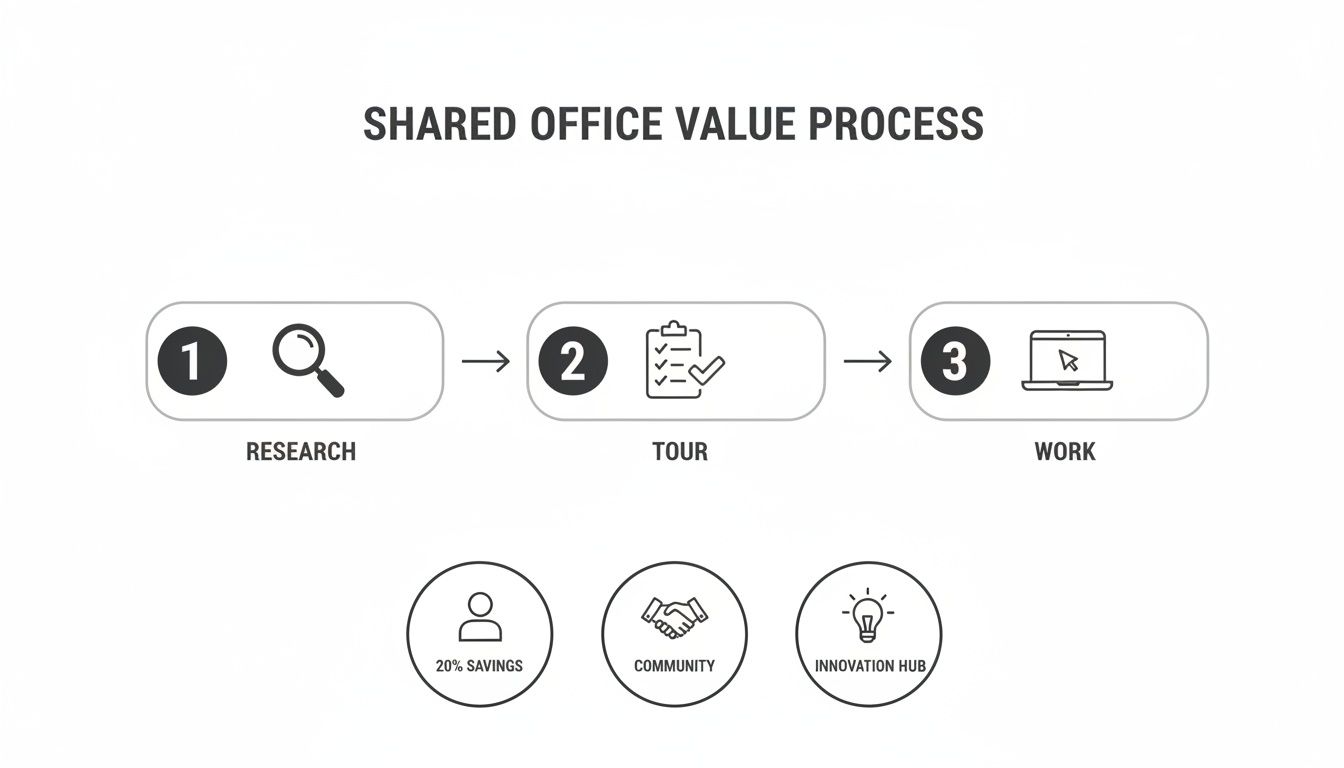
This process really drives home that finding the right space isn't just about a good location; it's about a careful, hands-on evaluation that leads you to an environment where you can do your best work.
Your Sensory Checklist
Before you even start talking to the community manager, just pause and take it all in. Use your senses to get a feel for the environment. These are the intangible qualities you can only assess in person.
Listen to the Soundscape: Is there a low, productive hum, or is it distracting, loud chatter? Pay close attention to the ambient noise level, especially in the exact spots where you imagine yourself working.
Check the Vibe (and the Thermostat): Does the space feel bright and energizing, or is it a bit dim and stuffy? Comfort is absolutely critical for focus, so take note if the climate control and lighting feel right to you.
Observe the Cleanliness: Take a quick peek at the kitchen, the common areas, and especially the restrooms. A clean, well-maintained space is a huge sign that the management team genuinely cares about the member experience.
These first impressions will give you an immediate gut feeling about whether you could see yourself here day after day.
The most crucial part of your tour is assessing the "vibe." Does the energy of the space match your work style? A high-energy, collaborative hub might be a nightmare for a writer who needs absolute quiet, while a silent, heads-down atmosphere could stifle a creative team.
Essential Questions for the Community Manager
Once you've soaked in the atmosphere, it's time to dig into the nitty-gritty with the community manager. Don’t be shy—their answers will reveal the hidden costs and day-to-day policies that can make or break your experience.
I always recommend coming prepared with a list of specific questions to get the full, unvarnished picture.
Key Questions to Uncover the Details:
Guest and Visitor Policy: "What are the exact rules for bringing clients or collaborators into the space? Are there fees, time limits, or specific areas where guests are allowed?"
Printing and Supply Costs: "Is there a monthly printing credit included, or is every single page an extra charge? I need to understand these small costs for my budget."
Security and Access: "How is the building secured after hours and on weekends? What's in place to protect members' belongings and tech?"
Meeting Room Booking: "Realistically, how far in advance do meeting rooms get booked up? If I need a room for a client call tomorrow afternoon, what are my chances?"
Walking in armed with this checklist transforms your tour from a simple walkthrough into a proper fact-finding mission. It gives you the power to gather all the info you need to make a confident, smart decision about your next shared office.
Finding a Community That Fuels Your Ambition
Let’s be honest, you can get reliable Wi-Fi and decent coffee in a lot of places. The real, game-changing value of a great shared office is something you can't put on a spec sheet: the network.
This is the element that can become your most powerful professional asset. The energy of a space comes from the people working in it, and finding the right cultural fit can be the difference between just having a desk and having a true professional home.
A vibrant, collaborative community can spark new ideas, lead to unexpected partnerships, and provide the exact support system you need when you hit a wall.
Gauging the Vibe During Your Tour
Your tour is your best chance to play detective and figure out the community dynamic. As you walk through the space, look around. How do people interact?
Is it a quiet, heads-down atmosphere where everyone is in the zone? Or is it a buzzing hub of conversation and collaboration?
Neither one is inherently better—it all comes down to what you need to do your best work. A writer or developer might kill for a quiet, focused environment. On the other hand, a sales pro or creative director might draw energy from a more social setting. The goal is to find a place where the culture matches your personal productivity style.
The community is the invisible amenity that can make or break your experience. A workspace filled with motivated, like-minded professionals can transform your workday from a simple routine into a source of genuine inspiration and professional growth.
Asking the Right Questions About Community
To get past the surface level, you need to ask the community manager some specific questions. You want to understand the professional makeup of the members and what kind of events they actually host. This is crucial for finding your "tribe."
Try asking a few of these:
"What kind of networking or social events do you typically host for members?"
"Could you describe the professional backgrounds of the people who usually work here?"
"Are there opportunities for members to collaborate or share their expertise with each other?"
The answers will tell you if the space is just a collection of individuals sharing an internet connection or a true, interconnected community.
The shared office model has exploded, with enterprise teams now driving massive growth. In fact, by 2025, 55% of global occupiers will be using flexible solutions. Why? Because they know a strong community can boost productivity by 20-30%. You can dig deeper into how coworking trends are shaping the modern workforce.
When your "shared office near me" search leads you to the right community, your workspace stops being a cost center. It becomes a genuine professional advantage—a place where you don't just work, you connect, grow, and thrive.
For professionals around Jenks, the hunt for the perfect "shared office near me" can feel endless. But what if the search ended with something more than just a desk?
At Free Form House, we're not just another office space. We are a premier, membership-based club in the heart of Jenks, Oklahoma's 10 District downtown. Comparable to the renowned SoHo House, we offer more than just a social club. Members can take advantage of co-working spaces and a dynamic community hub designed for collaboration and connection.

You'll find us in the heart of the vibrant 10 District downtown. We've blended the sophisticated feel of a social club with the practical amenities of a high-end co-working facility. We're intentionally building a curated community of Jenks' best—creatives, entrepreneurs, and established professionals who want something more out of their workspace.
We believe the right environment can be a catalyst for growth. Our space is intentionally designed to foster the kind of serendipitous connections and focused work that moves careers and businesses forward.
If you're looking for a place to not only get work done but also to connect, create, and find your next big opportunity, we invite you to see what makes our community different.
Our philosophy goes beyond individual desks. We also offer versatile spaces perfect for team meetings, client presentations, and creative sessions. You can learn more about those options in our guide to Jenks meeting room rental.
We provide the foundation for ambition—a central gathering spot aimed at fostering a creative and cooperative spirit within our local community.
Your Final Questions, Answered
Alright, you've narrowed down your options. Now you're probably wrestling with a few practical questions before you pull the trigger. Getting these last few details sorted out is what separates a good decision from a great one. Let's tackle the common hang-ups.
So, What's This Actually Going to Cost Me?
This is the big one, and the honest answer is: it depends. The price tag on a shared office can swing pretty wildly based on your city and what you need.
A flexible hot desk in a place like Jenks, for instance, might run you anywhere from $150 to $250 a month. Try to find that same setup in a major city, and you could easily be looking at $400-$700+. If you're eyeing a private office for yourself or a small team, expect the starting line to be around $800, climbing up from there.
The key is to always ask what’s baked into that monthly price. Does it include a certain number of free prints or a few hours of meeting room time? Those little perks can really add up.
Am I Going to Be Locked into a Long Contract?
Flexibility is the name of the game here, and it’s one of the best parts about coworking. Forget those scary, multi-year commercial leases. The vast majority of shared offices operate on simple month-to-month agreements.
Some might dangle a small discount if you're willing to commit to a longer term, like six or twelve months, but it's almost never a requirement. Just be sure to read the fine print on their cancellation policy. You'll want to know exactly how much notice you need to give if you decide to move on.
The absolute best way to know if a space works is to actually work there. Don't be shy about asking for a day pass. Spending a full eight hours in the environment will tell you more than any tour ever could. You'll get a real feel for the noise, the vibe, and the people.
How Do I Know if I'll Vibe With the People There?
This is where your tour becomes more than just a walkthrough. It's a fact-finding mission.
As you walk around, just observe. Does the place feel buzzy and collaborative, with people chatting and bouncing ideas off each other? Or is it more of a heads-down, library-quiet kind of place? There’s no right answer—it’s about what works for you.
Here at Freeform House, we’ve built something special in the heart of Jenks. We're more than just desks and Wi-Fi; we’re a premier, membership-based club for professionals who are looking for a curated community and an elevated place to grow.
Come see the difference for yourself. Learn more at https://freeform.house.
Comments