Workshop Events That Actually Work: A Practical Guide

You've booked the room, invited twenty people, and promised a practical workshop. Then you open the agenda and notice that most of it is slides, followed by a short question period. The space may look polished, but the event is drifting toward a seminar with name tags.
That moment is useful. It reveals the central question behind successful workshop events: what will participants do together that they couldn't accomplish by reading a presentation alone? The answer shapes the format, room layout, facilitation team, accessibility plan, and follow-up long after the chairs are cleared.
What Workshop Events Are Really Trying to Do
A workshop is a structured participation system. People arrive with relevant experience, questions, and constraints. The organizer creates conditions for them to examine a problem, practice a method, exchange knowledge, and leave with a useful result.
That makes a workshop different from several neighboring formats:
A conference distributes information across talks, panels, and networking.
A seminar usually centers on expert explanation and discussion.
A town hall gathers views, often with an emphasis on listening and public response.
A workshop asks participants to contribute to the work itself.
The distinction matters because a slide-heavy agenda gives most influence to the speaker. A participatory agenda gives participants defined opportunities to think, make, compare, question, and decide.
Start with the result, not the topic
“Marketing workshop” is a topic. “Each participant leaves with a prioritized list of customer segments and a next-step test” is an outcome. The second statement gives you something to design around.
Before choosing a venue or inviting speakers, write one sentence that answers three questions:
What problem will participants work on?
What must they produce, practice, or decide?
How will you recognize that the session achieved it?
The output might be a prototype, a decision log, a skills demonstration, a partnership plan, or a community commitment. It shouldn't be a vague feeling of having had a productive conversation.
Practical rule: If participants can attend without speaking, making, choosing, or applying anything, you're probably planning a presentation rather than a workshop.
Workshop events serve experienced professionals as well as students and early-career attendees. A study of the Dutch working population aged 25 to 65 found that 40% attended a workshop in 2011, nearly matching the 41% who took a short or long course and exceeding the 32% who reported informal learning, based on survey evidence from 3,036 respondents with a 56% response rate (study of workshop participation in the Dutch working population). Participation peaked around age 47, which reinforces the value of designing for mid-career professionals and business owners, not only learners at the beginning of their careers.
A Short History of Workshops as Participatory Spaces
The word “workshop” can sound like a recent event-industry label. Its modern meaning has deeper roots in adult education and participatory inquiry.
At Ruskin College in Oxford, the History Workshop began as an informal student seminar series on 19th-century English rural history in 1966. The group treated history as something people could investigate together, not receive from an established authority. Its first major day event, “A Day with the Chartists,” followed in 1967 and attracted about 50 participants.
Five years later, a workshop on “Workers' Control” drew more than 700 people, a fourteenfold increase from the initial event. By the mid-1970s, related gatherings had developed into history festivals attracting as many as 1,000 participants (history of the History Workshop movement).
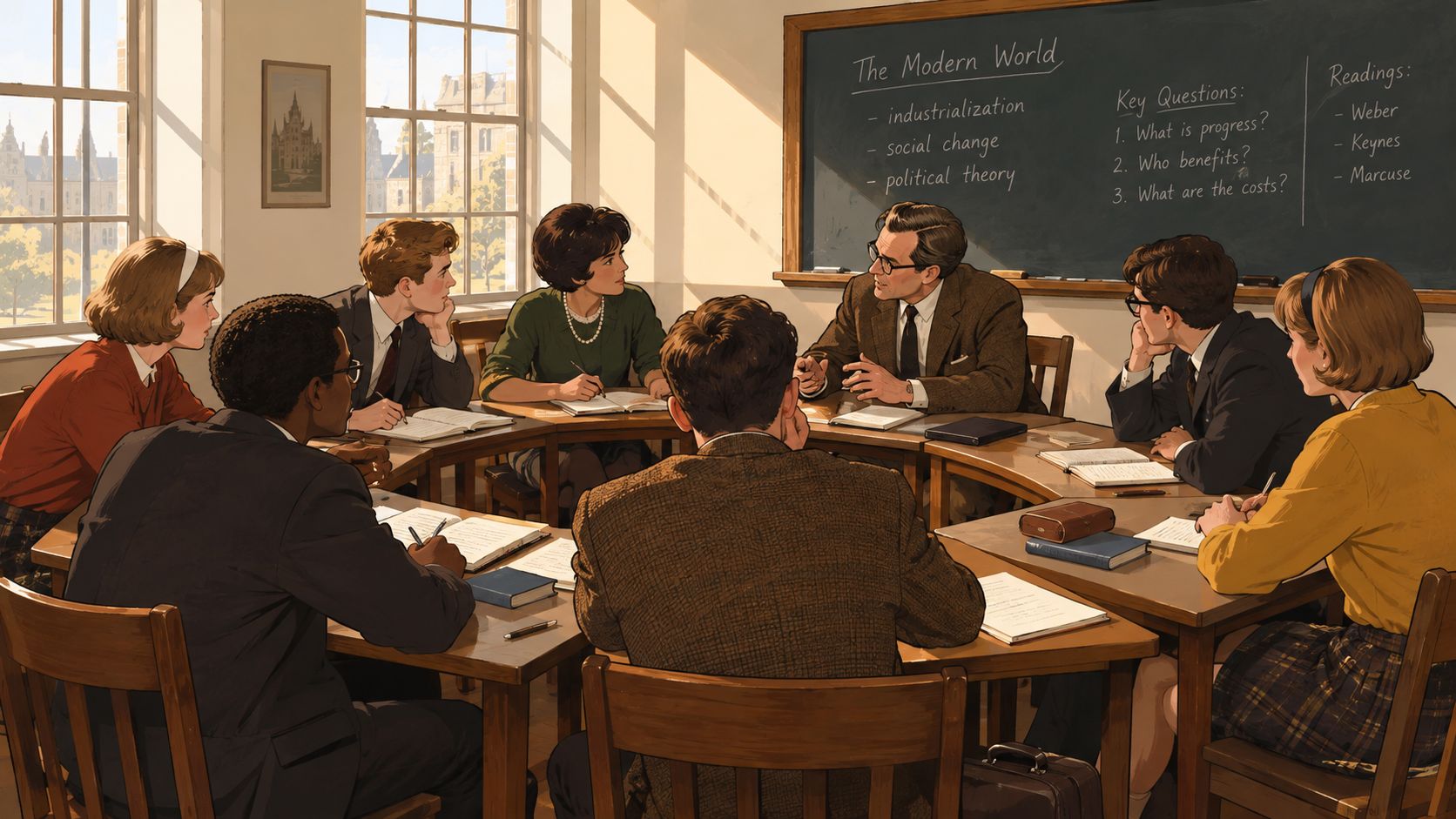
The scale changed, but the founding principle stayed consistent. Students, established historians, teachers, and members of the public contributed to the program. The movement later produced related workshops in Germany, France, Italy, South Africa, and the United States.
That history gives modern organizers a useful standard. A workshop doesn't become participatory just because the host adds a breakout exercise. Its design should give participants a meaningful role in shaping the inquiry, testing the ideas, or interpreting the result.
For a professional session, the subject may be pricing, cybersecurity, leadership, design, or local business development rather than rural history. The underlying pattern is the same: expertise enters the room, but it doesn't end the conversation. Participants connect knowledge to their own circumstances and help create something that matters beyond the event.
Matching Workshop Formats to Real Outcomes
Format should follow the deliverable. A hands-on training session makes sense when participants need to perform a task. A roundtable works better when the desired result is a shared view of a complex issue. A design sprint is appropriate when the group must move from a problem to a testable concept.
The wrong format creates predictable friction. A panel can't give every attendee enough practice with a new tool. A peer-led cohort may struggle if participants need a single authoritative demonstration. A hackathon can generate energy without producing a useful decision if nobody defines the selection criteria in advance.
Choose the work participants must complete
Hands-on training fits skill acquisition. Participants follow a demonstration, practice the method, receive feedback, and show what they can do.
Expert-led masterclass fits concentrated knowledge transfer. The facilitator should still include application, reflection, or a short diagnostic so attendees connect the material to their own work.
Facilitated roundtable fits strategic alignment and shared understanding. The host needs a clear question, a speaking structure, and a way to record areas of agreement and unresolved tension.
Hackathon or design sprint fits prototypes and experiments. Participants need a defined challenge, access to relevant materials, and a final review against agreed criteria.
Peer-led cohort fits community commitments and mutual accountability. Participants learn from one another through repeated exchange, practice, and follow-through.
The most important choice is often the boundary around the output. “Generate ideas” invites an unlimited conversation. “Select the strongest opportunities and assign an owner to test each one” gives the room a workable finish line.
Workshop Formats at a Glance
Format | Best-Fit Outcome | Attendees | Time | Primary Deliverable |
|---|---|---|---|---|
Hands-on training | Skill acquisition | Small cohort | Focused session | Demonstrated task or completed exercise |
Expert-led masterclass | Applied understanding | Small to medium group | Concentrated block | Individual application plan |
Facilitated roundtable | Strategic alignment | Small group | Focused discussion | Decision log or shared priorities |
Hackathon or design sprint | Prototype development | Cross-functional team | Extended working session | Prototype or test plan |
Peer-led cohort | Community commitment | Small cohort | Repeated meetings | Commitments, introductions, or peer actions |
A useful planning test is simple: if the event succeeds, what artifact will exist at the end? The answer should fit the format. When the deliverable and the structure disagree, participants feel the mismatch quickly.
Sizing the Room and the Facilitation Team
A room can be full and still fail as a workshop. Participants may speak over one another, wait too long for a turn, or lose the thread while one facilitator handles discussion, timing, and logistics. Room size is therefore a participation decision, not just a booking decision.
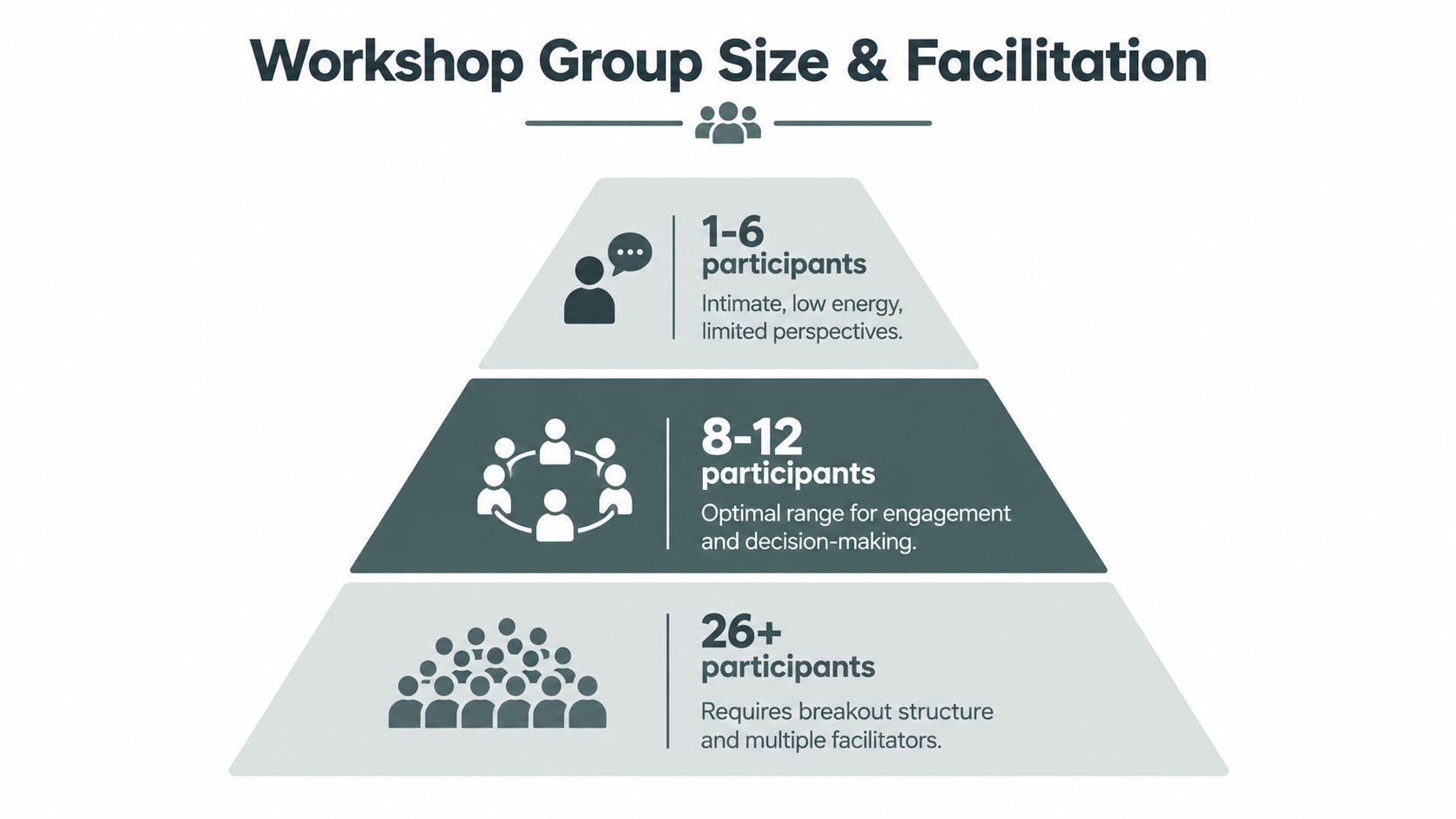
The University of Kansas Community Tool Box guidance on workshop structure identifies approximately 8 to 12 participants as a practical operating range. This size allows varied discussion while leaving enough space for questions and individual contributions. It works like a table where every person can still reach the conversation.
As attendance grows, divide participants into smaller working groups rather than asking one facilitator to manage every voice. Groups of approximately 2 to 4 people can work on a prompt before returning to the full room for synthesis. This arrangement gives quieter participants a clearer opening and gives the facilitator a manageable unit to observe.
Turn headcount into a room plan
Set the facilitation structure before registrations open. A lead facilitator can guide the shared purpose and transitions, while breakout facilitators watch participation, clarify instructions, and capture the agreed output. Each group should receive the same prompt and output template, so the final synthesis compares like with like.
A practical setup looks like this:
Up to 12 participants: Use one facilitated cohort with a shared table or circular arrangement.
A larger group: Add breakout facilitators and give each group the same task and capture method.
A very large event: Run parallel small groups, with one lead facilitator coordinating the common brief and final synthesis.
An intimate group: Use individual reflection and deeper questioning, while recognizing that fewer people bring fewer perspectives.
Research analyzing more than 650 workshops found a non-linear relationship between group size and interpersonal outcomes. Very small groups of 1 to 6 and large groups of 26 or more performed better on that outcome than intermediate groups of 7 to 25, so a medium-sized room is not automatically the best choice (study of workshop design variables and outcomes).
Arrange the room for three modes: quiet individual thinking, small-group work, and plenary synthesis. A boardroom table rarely supports all three without deliberate movement and clear transitions.
Designing an Agenda That Produces One Clear Output
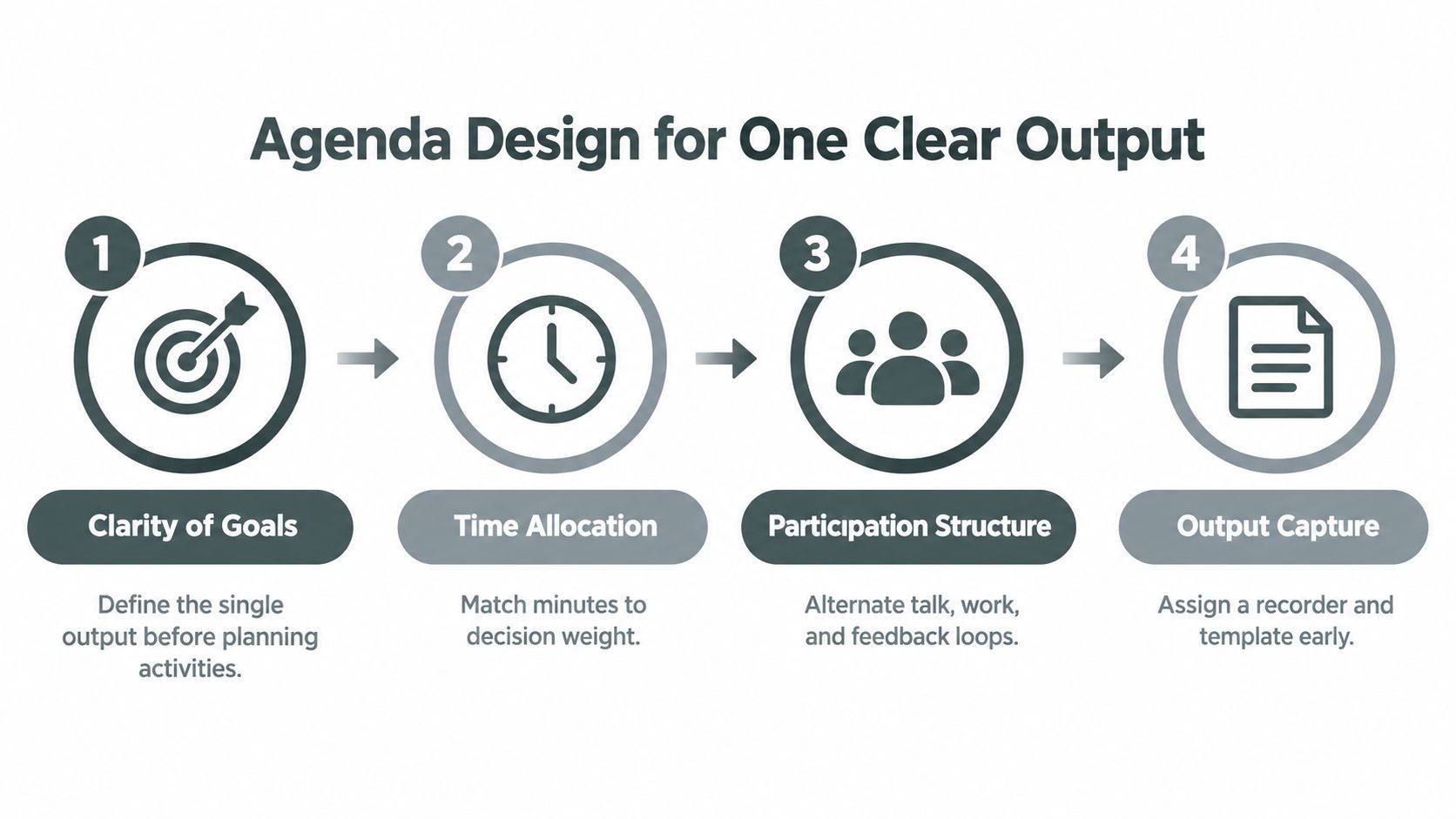
A room can feel energetic and still produce nothing usable. The organizer may select activities because they sound engaging, then try to fit a goal around them. Reverse that order. Define the output first, then give participants enough time and structure to create it.
The same 650-workshop research program cited earlier identifies four design variables that shape workshop outcomes: clarity of goals and purpose, routinization, stakeholder involvement, and cognitive effort. Each one points to a practical design test:
Goal clarity: Can participants describe the intended result in the same words?
Routinization: Does the session follow a repeatable process, with transitions that participants can understand?
Stakeholder involvement: Are the people affected by the decision contributing to the work?
Cognitive effort: Are attendees analyzing, prioritizing, creating, or practicing rather than only listening?
Build the sequence around the work
A half-day executive workshop might start with brief framing, move into individual reflection, and then use small-group comparison before a facilitated prioritization exercise. The closing segment should record the decision, assign owners, and list unresolved questions. Another presentation often consumes time without improving the output.
A two-hour skills session needs a different rhythm. Demonstrate the method, let participants practice it, pause for feedback, and repeat the application with a more realistic example. The final output might be a completed exercise or an individual action plan.
Facilitation language can protect equal participation while keeping the process natural:
“Take a quiet moment to write your initial view before we discuss it.”
“Compare your choices with the person beside you and identify one difference.”
“We'll hear from someone who hasn't spoken yet.”
“What evidence supports this priority?”
“What decision can we record today, and what still needs investigation?”
Assign a recorder before the session begins. Give that person a visible template with fields for the output, assumptions, decisions, owners, and next actions. Participants should leave with a result they can inspect and use, not impressions scattered across notebooks. That record also gives the wider community something concrete to revisit after the event.
Venue Requirements That Actually Shape the Workshop
The venue isn't a neutral container. Its acoustics, furniture, technology, food service, and arrival experience affect how easily people can participate.
Start with the work pattern. If attendees need to sketch, compare documents, or build a prototype, they need writable surfaces and furniture that can move. If they need confidential executive discussion, they need privacy, controlled entry, and reliable sound isolation. If the agenda changes from plenary discussion to small-group work, the room must support that transition without a long reset.
Apply the checklist to the building
For a premium membership-based club in downtown Jenks, Oklahoma's 10 District, Freeform House is envisioned as a community anchor rather than a generic event hall. The district spans exactly 10 blocks west from the Arkansas River to the historic Midland Valley railroad tracks and was founded in late 2021 to support downtown revitalization (research on the Ten District and place-based revitalization). That context matters when the event depends on local identity, accessible arrival, and authentic imagery.
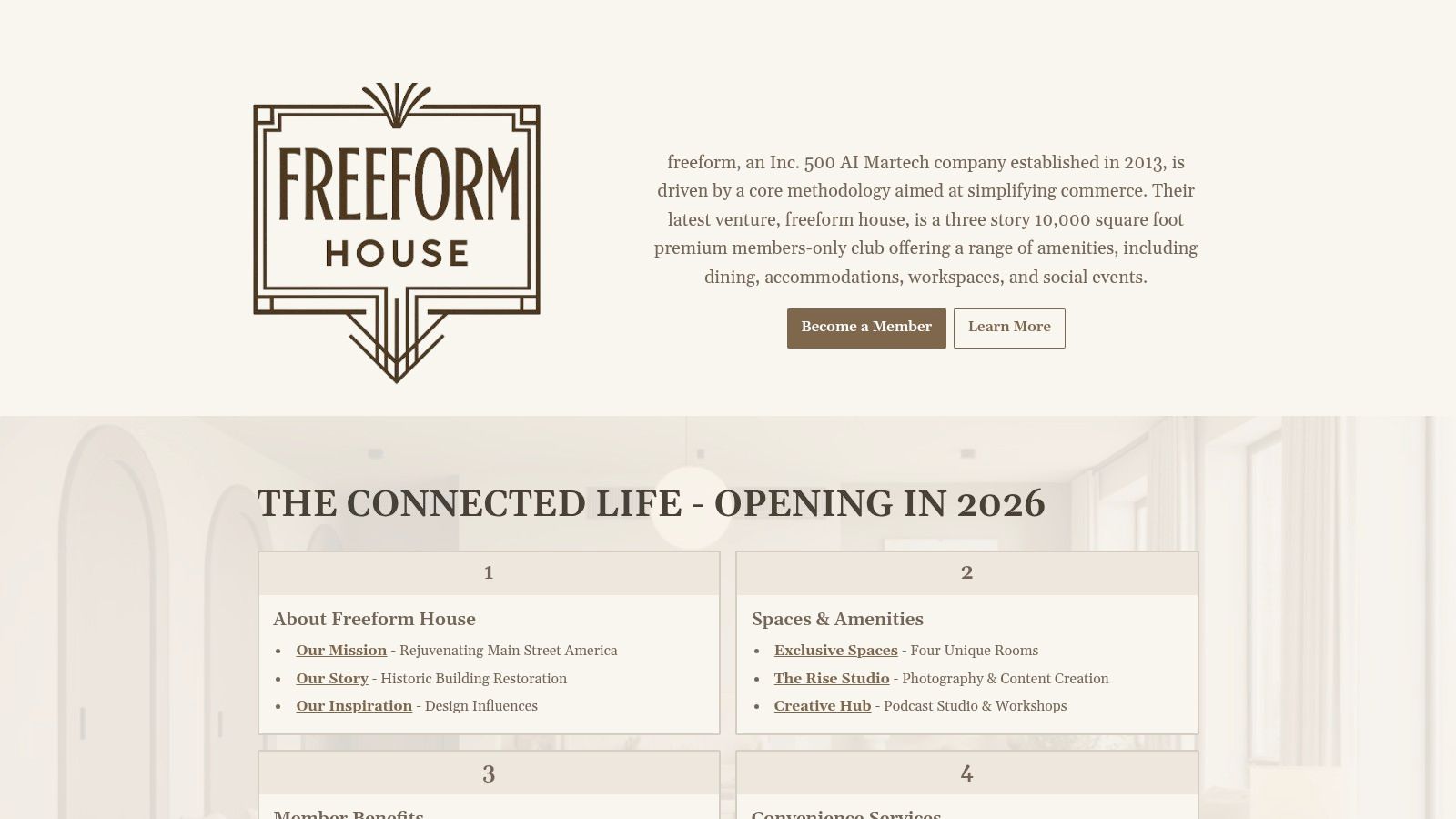
Freeform House occupies a restored 1920 building and combines coworking, meeting rooms, creative resources, and hosted gatherings. Its available spaces include the Hall of Fame Room, the Freeform Room, the Executive Room, and the Thomas Room, alongside The Rise loft studio and an in-house podcast booth. The Freeform Room can suit collaborative brainstorming, while a more private executive room may fit confidential decision work. Venue requirements should be mapped to the actual room, not assumed from the building's overall appearance.
Check these details before signing:
Layout: Can tables shift between a central group and smaller working clusters?
Noise: Will another event, hallway, kitchen, or recording session interrupt discussion?
Technology: Is there a backup microphone, display connection, power access, and stable connectivity?
Service: Can food and beverages arrive between activities without breaking concentration?
Arrival: Can guests find parking, enter easily, and understand where to go?
Reset: Can staff reconfigure the room while participants take a break?
Use this venue requirements checklist for an event to turn the brief into questions a venue team can answer directly. A polished room helps, but operational fit is what protects the workshop.
Accessibility as Equal Influence
Accessibility is often reduced to ramps, captions, dietary information, and accessible restrooms. Those features matter, but they don't answer the harder question: can attendees with different communication, processing, sensory, or mobility needs influence the work equally?
Inclusive workshop research points toward a broader participation system. Participants may need plain-language materials, visual prompts, chat-based instructions, live transcription, drawing, scribing, support workers, regular breaks, and alternative online or in-person options (research on inclusive workshop participation).
Design before the invitation goes out
Add an access questionnaire to registration. Ask what would help the attendee understand instructions, move through the space, communicate, take breaks, or contribute remotely. Don't make people disclose more personal information than necessary, and make it clear how the organizer will use the answers.
During the workshop, provide instructions in more than one form. Pair spoken explanations with written steps and visual examples. Allow people to contribute verbally, in writing, through chat, by drawing, or through a scribe. Build pauses into the agenda instead of treating breaks as a concession.
Co-facilitation by people with disabilities can improve the design because access needs are considered from inside the facilitation team. In the room, deliberately invite quieter voices into synthesis without forcing anyone to speak publicly.
Useful language includes:
“You can respond aloud, in the chat, or on the worksheet.”
“Take the time you need before we collect answers.”
“We'll pause here for a break and return to the same prompt.”
“Let's check whether this conclusion reflects the full range of views we heard.”
Online participation needs equal care. Auto-transcription may be inaccurate, and remote attendees may need captioning, interpreters, breaks, or alternative interaction methods. Use these video conferencing best practices alongside a post-event check that asks who influenced the outcome, whose contribution was missed, and what should change next time.
Measuring What Happens After the Room Closes
Registration counts and satisfaction scores tell you who showed up and how the experience felt. They don't tell you whether participants used the work, formed a useful relationship, made a decision, or returned to the community.
A stronger evaluation follows the workshop through 30, 60, and 90 days. The exact timing can be adapted to the type of event, but the principle is consistent: measure actions after the room closes.
Use a simple follow-up rhythm
At 30 days, ask what participants implemented, which introductions they completed, and whether the workshop output is still active. This catches stalled intentions while the event remains fresh.
At 60 days, look for collaborations initiated, prototypes tested, decisions carried forward, or partnerships that moved beyond an initial conversation. For an executive session, this may be a documented decision. For a peer cohort, it may be a concrete action taken with support from another participant.
At 90 days, assess repeat participation, ongoing relationships, revenue generated where attendees choose to disclose it, partnerships secured, and continued use of the community. The purpose isn't to force every outcome into a financial measure. A new supplier relationship, shared project, or sustained peer connection may be the result that matters.
Ask survey questions that produce usable answers:
Did you implement an idea from the workshop?
Did you form a useful connection?
Did you generate revenue or secure a partnership as a result?
Did you produce or advance a prototype or decision?
Would you return to this community or recommend another participant join?
Recent attendee evidence shows that people may value relevant content and confidence-building while still asking for more networking and interaction (attendee evaluation evidence on content, confidence, networking, and interaction). Treat networking as designed work, not leftover time. Give participants structured introductions, a reason to continue the conversation, and permission to identify what help they can offer.
For Jenks and Tulsa, that approach turns a workshop into community infrastructure. A local event can connect business owners, executives, creatives, and professionals in ways that continue through shared projects, referrals, and future gatherings. Authentic photos should show real members working, learning, and exchanging ideas in recognizable Main Street settings, not staged clip art or generic stock scenes. Coworking research defines these spaces through both usable work infrastructure and the possibility of beneficial encounters, while other research shows that community requires deliberate programming and norms rather than mere physical proximity (systematic review of coworking spaces and community encounters; research on community management in coworking spaces).
Before you close the next workshop, confirm that you have:
One observable output: Participants know exactly what they are producing.
A workable group structure: The cohort and facilitation team match the interaction required.
An accessible participation plan: Attendees can understand, contribute, and influence the result in different ways.
A recorded next step: Owners, decisions, and open questions are visible.
A follow-up owner: Someone will contact participants at the planned intervals.
A community pathway: Attendees know how to continue the relationship after the event.
Freeform House offers adaptable rooms, coworking infrastructure, creative resources, and a community setting for executive meetings, collaborative workshops, and private gatherings. Visit Freeform House to explore a venue where the room, service, and local context can support the participation system you're building.
Comments