What Is Professional Networking: A 2026 Guide to Career

You open LinkedIn to find someone who can make an introduction. Your profile has a respectable number of connections, yet the search feels strangely empty. You recognize names, but you don't know who would answer your message, who understands your work, or who would feel comfortable putting your name forward.
That gap explains why what is professional networking is a more useful question than “How do I meet more people?” Networking isn't a room full of business cards or a list of online contacts. It's a maintained system of relationships through which information, support, collaboration, and opportunities move. In hybrid work, where spontaneous conversations are less common, that system needs more intention.
Freeform House is envisioned as a premier, membership-based club in the heart of Jenks, Oklahoma's 10 District downtown. Comparable to the renowned SoHo House, it offers more than just a social club. Members can take advantage of co-working spaces and a dynamic community hub designed for collaboration and connection. It's a central gathering spot aimed at fostering a creative and cooperative spirit within our local community.
The path is practical. First, you'll define the mechanics of a working network, then match different networking spaces to different goals, identify outcomes you can observe, and build habits that keep relationships alive. You'll also see how a third place such as these networking tips for professionals can turn an abstract career idea into something you practice in ordinary weeks.
The Moment You Realize You Have No Network
Maya had spent years building a career in operations. Her LinkedIn account contained hundreds of connections from former employers, conferences, online groups, and occasional introductions. She knew how to accept a request, congratulate someone on a promotion, and add a thoughtful comment to a post.
Then her company reorganized.
A former colleague mentioned an opening at a growing firm. Maya wanted to ask for a warm introduction, so she searched her contacts. The names were there, but the relationships weren't. She couldn't remember the last conversation with most of them, didn't know what they were working on, and felt uncomfortable appearing only when she needed help.
The real test: A contact list shows who you can find. A network shows who knows you, trusts your judgment, and understands how to help.
This distinction matters because networking is an ongoing system, not a one-time event. Meeting someone at a conference creates a possibility. A follow-up message gives it continuity. A useful exchange, shared project, recommendation, or honest conversation gives the relationship substance. Without those later actions, the connection becomes dormant.
Hybrid work makes the difference easier to miss. You may collaborate successfully with people on screens while missing the small moments that once built familiarity, such as a hallway conversation, a quick lunch, or an informal introduction through a colleague. The answer isn't to collect contacts faster. It's to create repeatable opportunities for weak ties, strong ties, and new connections to develop.
A useful network also does more than support a job search. It can help you test an idea, find specialized knowledge, meet a collaborator, understand another industry, or offer support during a difficult professional decision. Once you view it as a living system, networking becomes less performative and more manageable.
What Professional Networking Is
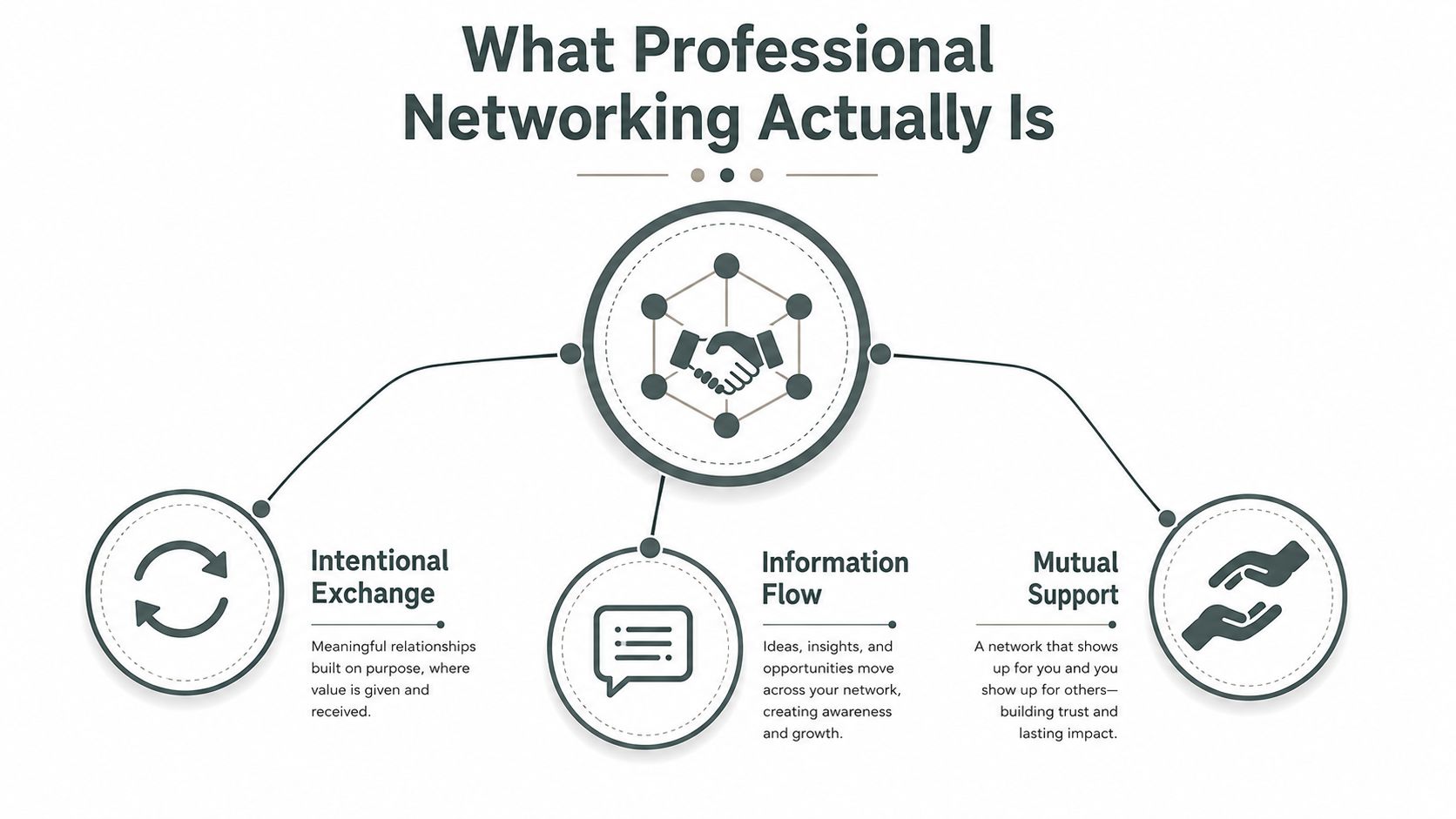
A useful way to understand professional networking is to follow what happens after an introduction. Someone shares information, a resource, a skill, an introduction, feedback, mentorship, or support. The other person responds, contributes, or stays available over time. Labor-market research describes networks as channels for tacit knowledge, mentorship, and access to opportunities.
A garden gives this system a practical analogy. Contacts are seeds. Relationships are plants. A network is the surrounding ecosystem, shaped by attention, timing, shared conditions, and care. Saving someone's details without reconnecting is like buying seeds and never planting them.
Four kinds of connection
Weak ties are acquaintances who connect you with circles you do not already inhabit. A former classmate in another field may know about a project, role, or market that close colleagues would never encounter. Britannica's overview of networking explains how weak ties bridge separate groups and carry new information between them.
Strong ties grow through trust and repeated interaction. A close colleague, mentor, former manager, or long-term client may offer context, encouragement, collaboration, or candid advice. These people often understand your working style, not only your job title.
Bonding takes place within a close circle. Founders who meet regularly may develop shared language, confidence, and practical support because they understand one another's pressures. Bonding creates depth.
Bridging connects people across functions, industries, backgrounds, or communities. An architect speaking with a hospitality operator, or a technology consultant meeting a local retailer, may find ideas that would not arise within one professional circle.
Freeform House can serve as a third place for both forms of connection. Repeated, informal contact gives weak ties room to develop, while shared conversations and projects can strengthen closer relationships.
Professional networking works when useful information, trust, and support keep moving in both directions.
A working network helps answer three questions: Who can help me understand this problem? Who could benefit from what I know? Which relationships need attention before I need anything from them?
Where Networking Happens in 2026
The best networking format depends on the outcome you want, not on the prestige of the venue. A direct message can reopen a dormant connection. A conference can expose you to a wide field of specialists. A small dinner can create the trust required for a sensitive conversation. A coworking club can provide the repeated contact that makes relationships feel natural.
Digital-first spaces include LinkedIn messaging, professional posts, private online groups, and industry Slack communities. They're useful when you want to exchange a specific insight, maintain visibility, or reach beyond your local area. Digital interaction also makes follow-up easier, but it can remain shallow if every exchange is reduced to a reaction or generic request.
Structured events offer scale and shared context. Conferences, trade shows, workshops, and association gatherings give you a reason to speak with people who already care about the same subject. Go with a defined objective, such as learning how another company handles a challenge or meeting people adjacent to your role, rather than trying to speak with everyone.
More intimate formats create room for depth. Curated dinners, peer circles, masterminds, and small roundtables are better suited to candid discussion, accountability, and collaboration. Ambient spaces work differently. Coworking clubs, cafés, and other third places allow relationships to grow through repeated, low-pressure encounters.
Format | Best For | Energy Level |
|---|---|---|
LinkedIn messaging | Reconnecting and making focused introductions | Low |
Industry Slack communities | Questions, knowledge exchange, and visibility | Low to moderate |
Conferences and trade shows | Broad discovery and industry access | High |
Curated dinners | Trust, perspective, and bridging ties | Moderate |
Masterminds and peer circles | Accountability and problem-solving | Moderate |
Coworking clubs and third places | Repeated contact and organic connection | Low to moderate |
The practical question isn't just where networking happens. It's which setting gives a relationship enough context and repetition to become useful. A guide to networking opportunities can help local professionals think beyond formal events and identify spaces that fit their goals.
The Measurable Benefits of a Strong Network
Networking can sound vague until you connect it to access. A relationship may lead to an introduction, an introduction may reveal an opportunity, and a trusted recommendation may reduce uncertainty for the person making a hiring or purchasing decision.
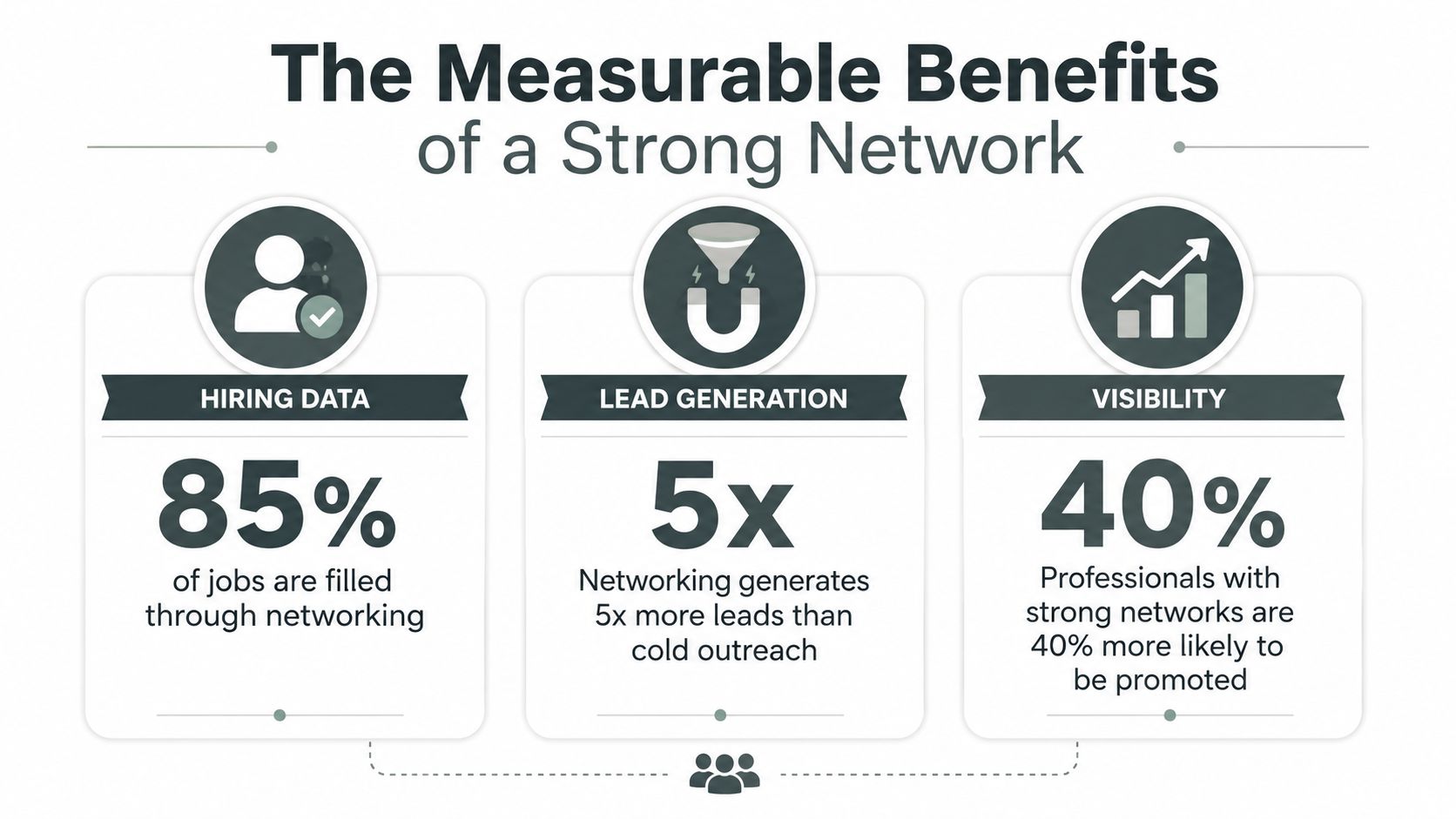
A LinkedIn global survey reported that almost 80% of professionals considered networking important to career success, while 70% of people in 2016 were hired at a company where they had a connection, according to this compilation of important networking statistics. Those figures don't mean every conversation produces a job. They show why relationships are treated as part of the labor market rather than as casual social activity.
Another compilation reports that 85% of jobs are filled through networking, although its methodology and context should be considered before applying the figure to every industry or role. The practical conclusion remains sound: referrals and personal knowledge can influence how opportunities are discovered and evaluated. Networking gives you access to information that may never appear in a public listing.
Business value beyond hiring
Networking also supports business development and learning. One business networking statistics compilation reports new business leads as a benefit for 87%, knowledge sharing for 72%, and increased business profile for 68% of respondents discussed.
These outcomes form a simple mental model:
Access: You learn about roles, projects, clients, suppliers, and ideas through people.
Introductions: Someone who understands both sides can reduce the friction of a first conversation.
Discovery: Regular interaction helps you notice opportunities before they become obvious to everyone.
Visibility: People are more likely to remember your work when they encounter it consistently and in context.
A useful network won't remove the need for competence, preparation, or a strong offer. It can make those qualities easier for the right people to discover. For a local owner, that might mean meeting a complementary business. For an executive, it might mean finding a trusted sounding board. For a creative professional, it might mean discovering a collaborator with skills your usual circle lacks. You can explore that local-business angle through local business networking guidance.
Best Practices and Habits That Make Networking Work
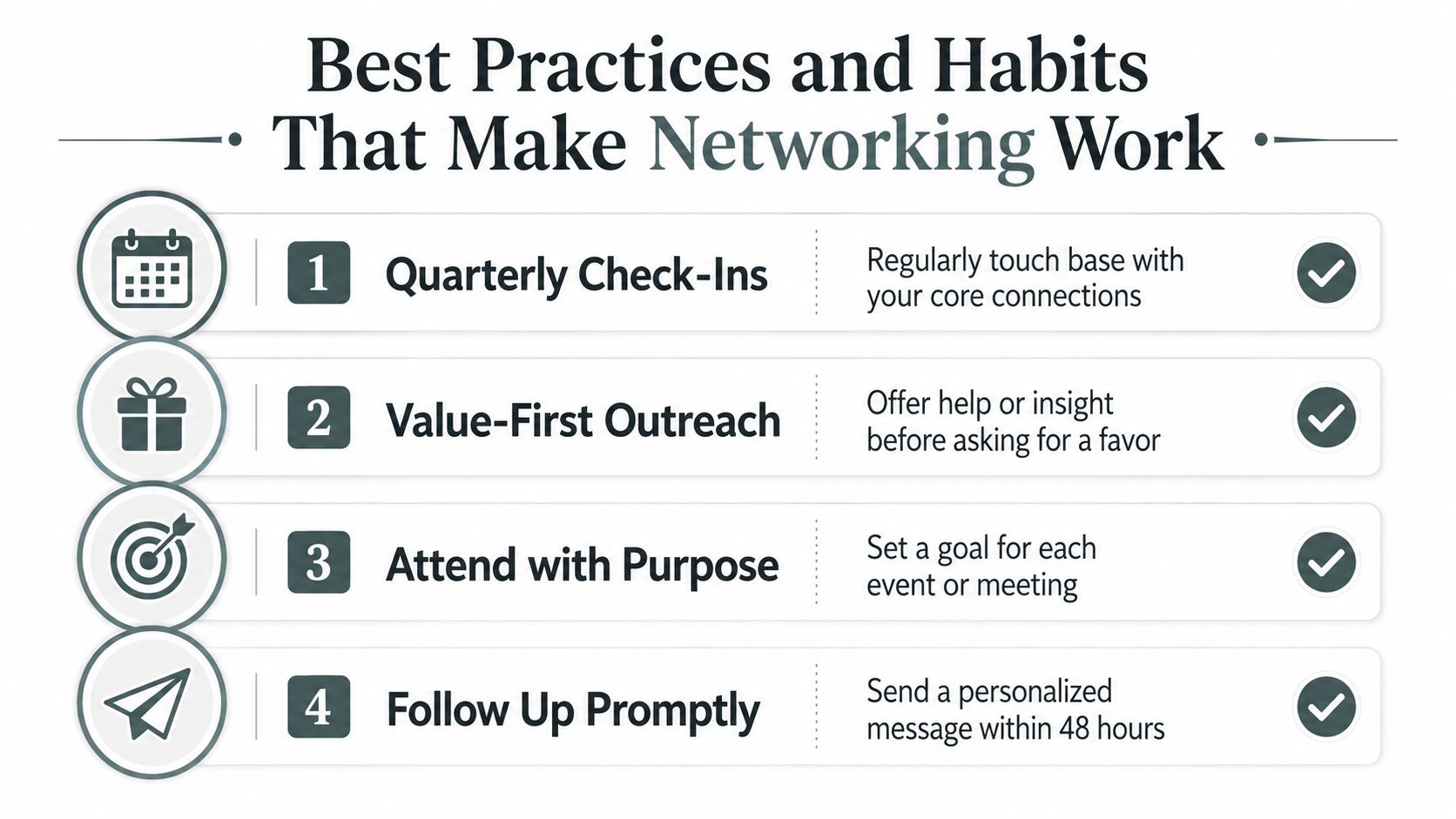
Networking becomes sustainable when you give it a small place on your calendar. The networking habits guide recommends different cadences by relationship type, including quarterly check-ins for mentors or advisors, monthly contact for peer professionals, and quarterly or situational contact for cross-industry connections. It also says most professionals can maintain a healthy network with 30 to 60 minutes per week.
Use that time as a maintenance window, not a frantic outreach session.
A simple weekly rhythm
Spend part of the window on micro-interactions. Reply to a meaningful post, congratulate a former colleague, send a relevant article, or thank someone who helped you. Use the remaining time for one deeper conversation, such as a coffee, video call, walk, or focused message exchange.
Your outreach should contain a reason. “I saw this and thought of your work on customer research” feels personal because it connects the message to the other person's interests. “Can you help me find a job?” may be reasonable in the right relationship, but it asks the recipient to do too much before you've re-established context.
Do more than collect names
Lead with curiosity: Ask what someone is working on, what problem they're solving, or what they've learned recently.
Offer useful context: Share an introduction, resource, observation, or practical suggestion before requesting a favor.
Follow up with memory: Mention the conversation you had rather than sending a generic thank-you.
Track lightly: Keep a short note in your calendar about interests, projects, and the next natural reason to reconnect.
Respect the answer: If someone can't help, thank them and leave the relationship intact.
Don't turn every interaction into a pitch. Don't promise introductions without checking first. Don't measure success only by immediate outcomes. A relationship often becomes valuable because you showed up consistently during ordinary periods, not because you made the perfect request during a crisis.
The Hybrid Work Blind Spot Most Guides Miss
A large network isn't automatically a strong network. A dormant connection may still matter, but it can't do much for you if neither person remembers the relationship, understands the other's current work, or has a reason to respond.
The shift to remote and hybrid work weakened many informal relationship rituals. People who once built familiarity through shared offices now move between video calls, project channels, and occasional in-person gatherings. They may know someone's responsibilities without knowing their interests, judgment, or working style.
That makes maintenance more important than counting. The most useful network may be smaller and more active than the largest network you can display on a profile. A regularly maintained peer relationship can be more practical than a distant connection you haven't contacted since an event.
Audit the network you actually have
Open your contact list and sort people into three groups:
Active relationships, where you exchange messages or meet with some regularity.
Valuable but quiet relationships, where trust exists but recent contact is limited.
Context-only contacts, where you remember the setting but not enough shared experience to make an immediate request.
Start with the second group. Send a message tied to something real, such as a new role, a shared project, a sector development, or a question about their work. Don't begin with a favor. Begin by restoring context.
Remote work also changes where connections form. A digital platform can expand your reach, but a shared physical space can supply the repeated exposure that online networking lacks. A coworking community can serve as a social anchor as well as a productive workplace, since coworking research identifies social interaction, community membership, and relief from work-related isolation as important reasons people join shared workspaces.
Putting It Into Practice at Freeform House
A member's networking routine becomes easier to maintain when useful interactions can happen during an ordinary workday. Freeform House is a members-only club and workspace in Jenks's 10 District downtown, housed in a restored 1920 building with a three-story, 10,000-square-foot layout. Its rooms and creative resources support different levels of privacy, focus, and social contact.
The Executive Room suits a high-trust conversation where privacy matters. A member could use it for strategy planning with a prospective partner, a mentoring discussion, or a small client meeting. The Hall of Fame Room supports the relationship-building side of networking, giving members room to gather, recognize one another, and become familiar through repeated contact rather than a single introduction.
The Freeform Room and Thomas Room offer other settings for meetings, workshops, private events, and focused work. The setting influences the interaction. A formal meeting can clarify a proposal, while a less structured gathering may uncover a shared interest or an unexpected connection.
A working day with more contact built in
A creative professional might use The Rise loft studio for a collaborative production session, then continue the conversation in shared areas. A podcaster could work in the in-house podcast booth while meeting members who understand publishing, marketing, or audience development.
Later, a curated restaurant partnership could make dinner easier to arrange without turning it into a formal networking event. A shared meal can create bridging ties when people from different local businesses compare challenges and discover overlapping needs. Convenience features such as Amazon Hub Lockers and a rentable golf cart fleet support daily use, leaving more attention for work and relationships.
The space gives earlier networking habits a physical setting. Members still need to listen, follow up, contribute, and return. Repeated attendance creates opportunities for weak ties to become familiar, strong ties to deepen, and cross-industry relationships to form without forcing every conversation into a pitch.
A member might arrive for a quiet work block, greet someone met at a previous gathering, ask about a current project, and later introduce that person to a visitor with a relevant need. That sequence shows professional networking in practice. Presence starts the relationship, attention adds value, and maintenance gives it durability.
The model also shows why a third place can matter to professional relationships. Freeform House combines coworking, meeting areas, creative production resources, and a membership community, so networking can occur alongside regular work instead of only at scheduled events. Members can choose a private room for a focused discussion, a shared area for casual contact, or a creative space where collaboration develops around a real project.
The video offers another view of the environment and how the space supports work, hosting, and connection.
If you're asking what is professional networking, start with the people you already know, choose a setting that encourages repeat contact, and give relationships a reason to continue. Freeform House offers coworking space, meeting rooms, creative production resources, and a membership community for professionals who want connection to become part of their regular work life. Visit Freeform House to explore the club and see whether its Jenks location fits the way you want to work and build relationships.
This was a great and insightful read on the value of professional networking. The practical tips make it clear how meaningful connections can open new opportunities and strengthen careers. I especially liked the focus on building genuine relationships. Association Expos can also be a great way to put these networking ideas into practice.