What Is Flexible Office Space in 2026

Flexible office space is now a multi-billion-dollar part of the office market, so the useful definition is practical. It separates two decisions a traditional lease bundles together: how long you are committed, and how much space you can use on a given day. Commitment flexibility means headcount is not locked into a multi-year footprint. Access flexibility means desks, private offices, and meeting rooms can expand for client week and contract when the calendar clears. The category spans hot desks, serviced offices, executive suites, meeting facilities, and hybrid arrangements. A lease optimizes for permanence. Flexible space optimizes for variance. Match the model to your busiest unavoidable day, not your average empty one.
What Flexible Office Space Actually Means
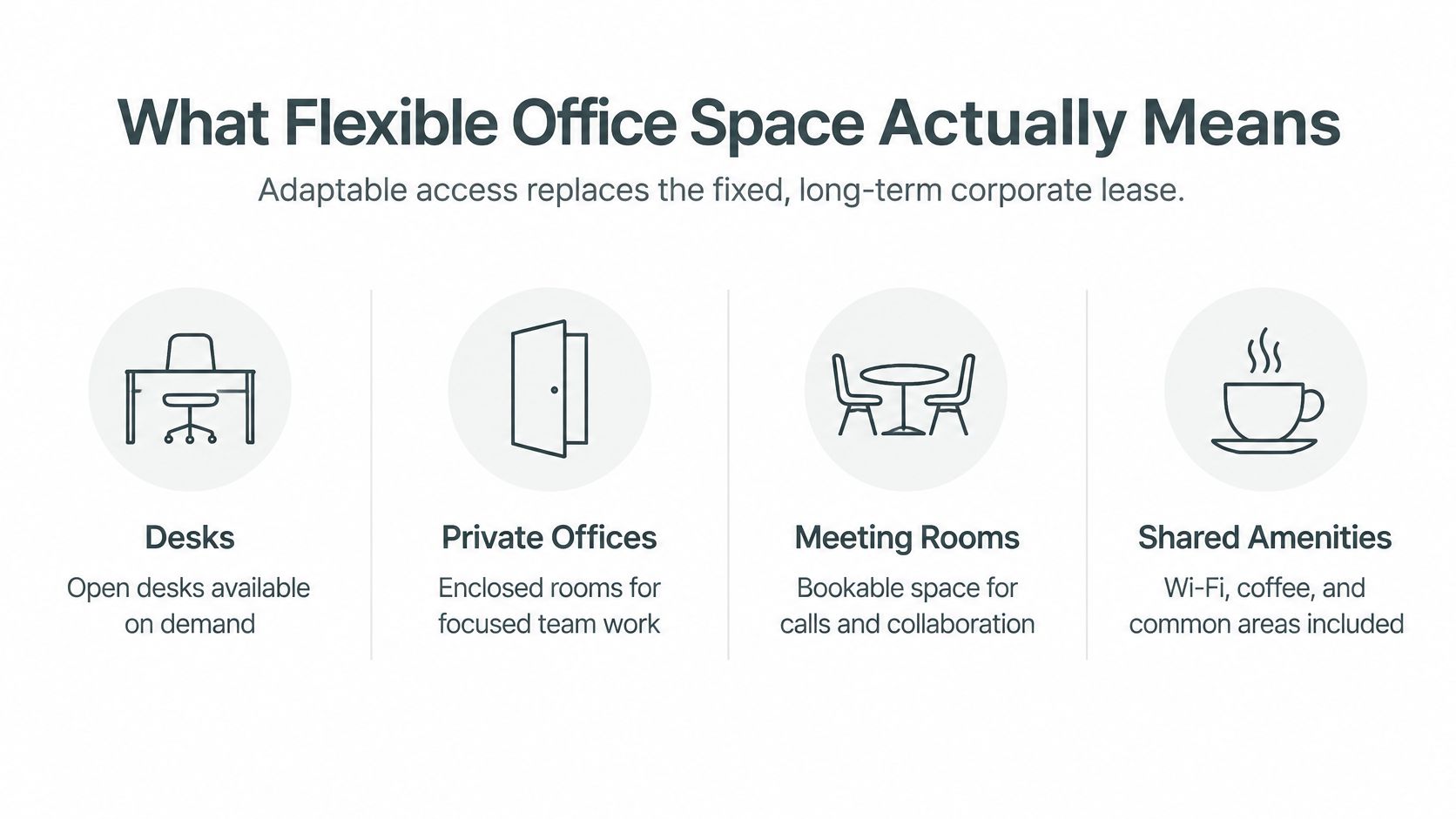
Flexible office space replaces the fixed, long-term corporate lease with adaptable access to desks, private offices, meeting rooms, and shared amenities. To make sense of the category, split "flexible" into two separate promises. The first is flexibility of commitment: how long you sign for, whether that is a single day, a month, or a rolling membership. The second is flexibility of access: how much of the building you can use, from one hot desk up to a private floor with reservable conference rooms.
A freelancer holds the first lever at one day and the second at a single workstation. A growing company pulls both at once, adding private offices as headcount rises and releasing them when a project ends. Same product family, different settings.
The model grew out of a practical frustration. Early coworking spaces answered two complaints about conventional work: home offices felt isolating, and traditional business centers offered desks without community. Their response bundled shared desks, Wi-Fi, collaborative sessions, and shared lunches into a single membership. That origin still explains the category. Flexible office space was never only about renting a desk. It combined access, services, and social connection from day one.
A market, not a niche
Flexible office space is now a measurable real-estate sector with buyers well beyond freelancers. Industry estimates from GII Research attribute 34.1% of global revenue to North America in 2025 and project the market to grow from $47.9 billion in 2026 to $134.1 billion by 2033, a 15.8% compound annual growth rate across that span.
Companies drive much of that demand because hybrid schedules mean many employees no longer need a permanently assigned seat. Occupancy in shared coworking areas and private offices has climbed in recent years, and attendance at flexible-workspace locations continues to rise.
Key contrast: Average office utilization worldwide runs well below the occupancy targets organizations set for their own space. Many companies hold more conventional capacity than their teams actually use.
That gap is the operating argument for flexible space. The useful question is how many seats your team needs on its peak day, the day everyone shows up, and how little you want to pay for the empty chairs on either side of it. Sizing to the busiest day, with a membership or license absorbing the quiet ones, turns flexibility from a marketing word into a budget line.
How the Main Formats Differ From a Lease and Coworking
You don't need three overlapping definitions. You need one scan that matches the model to your situation.
Model | Commitment | Best fit | What you get | Community |
|---|---|---|---|---|
Traditional office | Multi-year lease, often 3-10 years | Firms wanting a permanent branded address | Assigned desks and tenant-funded fit-out | Little programmed community |
Serviced or executive suite | Monthly or annual license | Small teams and visiting executives | Furnished private office and shared reception | Light, reception-led |
Coworking | Day, week, or month, often no long contract | Freelancers, startups, and small teams | Hot desks, some private offices, bookable rooms | Open-floor members and events |
Membership club workspace | Recurring membership, often tiered | Executives, creatives, and local owners | Work areas, dining, events, and reservable rooms | Curated member community |
Corporate flex portfolio | A share of a larger office portfolio | Hybrid companies keeping a core headquarters | On-demand desks and meeting capacity | Depends on the operator |
The commitment is what changes
A traditional lease locks you into a multi-year term and a tenant-funded fit-out. You own the build but also the downside if the team shrinks. A serviced office or executive suite keeps a private room and a staffed reception, but swaps the lease for a shorter license with furniture already installed.
Coworking sits at the open end. You pay by the day, week, or month with no long contract, and you share the floor with freelancers, startups, and small teams. A membership club workspace sells recurring access rather than a desk count. Members use work areas, dining, events, and reservable rooms, often on tiers that separate casual visitors from full users.
Corporate flex portfolios let larger firms add on-demand desks and meeting capacity next to a core headquarters. Adoption is climbing. In 2024, 42% of surveyed Americas corporate real-estate executives said flexible space represented more than 10% of their office portfolio, up from 36% in 2023, according to the CBRE 2024 Americas Office Occupier Sentiment Survey.
Compare quoted minimum terms, notice periods, and included services rather than rule-of-thumb monthly figures. A high headline rate with a two-year lock is less flexible than a modest rate with a 30-day notice.
If you want a lockable room with operator-managed amenities and no build-out, start with a private coworking space. It splits the difference between an open floor and a full lease.
How Much Flexibility a Team Actually Needs
Count the badges assigned to a floor and the office looks full. Count the people sitting in it at 10 a.m. on a Wednesday and it looks half empty. Both counts are real, and they measure different things. Occupancy tracks how many people are assigned to a space. Utilization tracks how much of that capacity is actively used at a given moment. A portfolio can score 100% on the first measure and well under half on the second, and the gap between them is where flexibility decisions go wrong.
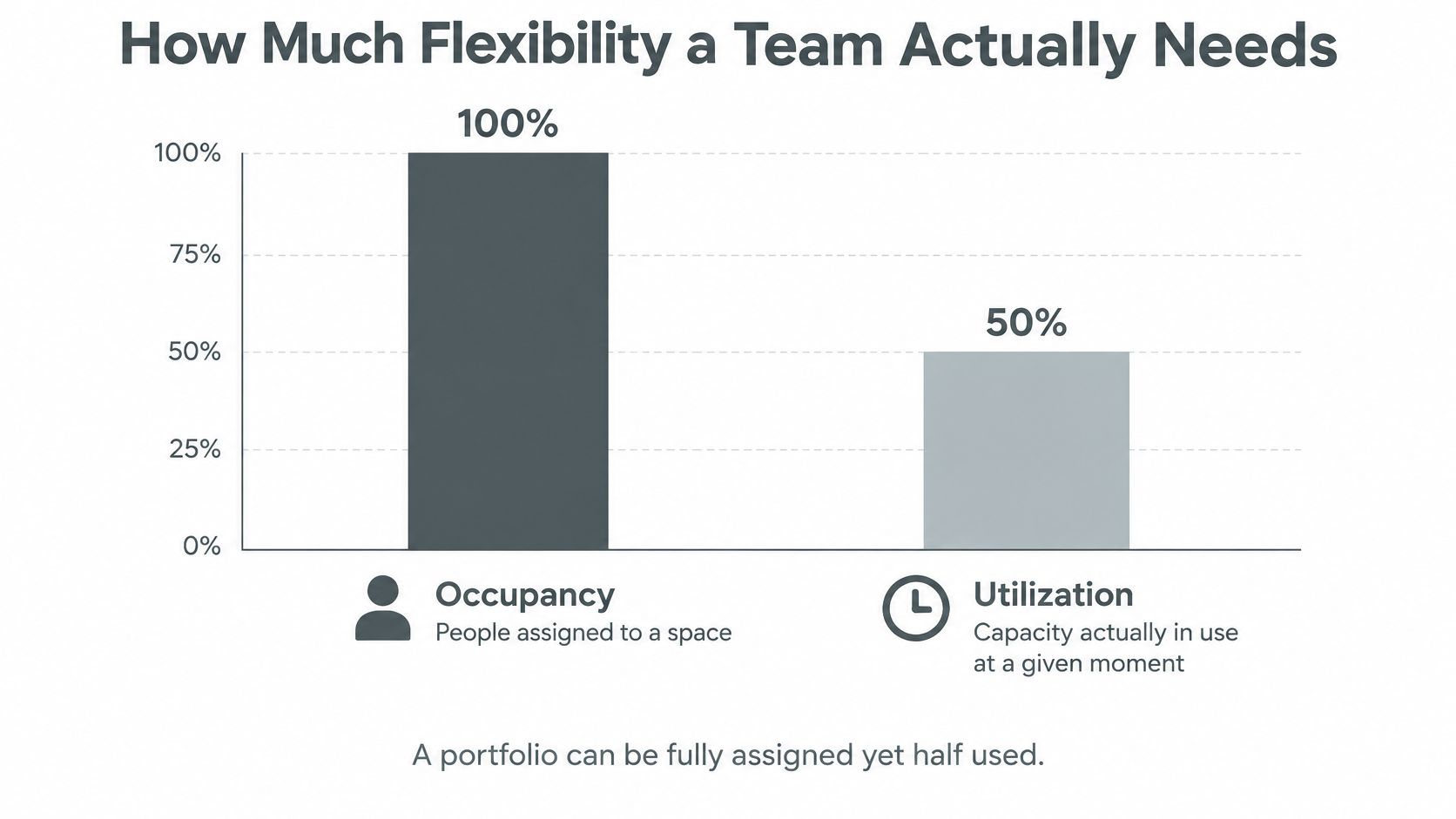
The gap is normal, not exceptional. Benchmarks put numbers on it:
Source | Average utilization | Comparison point | Other note |
|---|---|---|---|
56% | 74% target | Hybrid programs at 80% of organizations; fully flexible at 14% | |
Worked example, ten assigned desks | 40% on a typical day | 100% occupancy | Every desk has an owner; four people are in |
Two different kinds of flexibility
Flexible office space is really two separate products sold under one name. Commitment flexibility answers a simple question: can you leave or shrink without a multi-year penalty? Access flexibility answers a different one: will a desk or room be free when you arrive? You can hold the first and still fail the second.
A private office on a monthly license gives you commitment flexibility even if no shared table exists. A dedicated room on a long lock-in works the other way: it is always yours when you walk in, yet you cannot shrink it if the team does. An open day pass is the mirror image, easy to cancel but risky on a morning when the floor fills up.
The failure pattern shows up when members stack onto the same Tuesday, rooms get double-booked, and focus work has nowhere to go. Booking reliability, acoustic privacy, storage, a delivery point, and guest entry matter more than the membership count. For small or members-only environments, track room-hours and desk-hours, peak-day attendance, booking lead time, cancellations, and no-show rates instead of watching member numbers alone.
A small private office plus shared overflow often beats both a large lease and a fully open floor. You get guaranteed focus space during demand spikes while keeping the cost tied to actual use. For a practical breakdown of schedules that spread attendance across the week, see these 8 practical hybrid work schedule examples.
Practical rule: Size your space to the busiest day, not the average. The average hides the Tuesday morning when everyone shows up at once.
Formats You Will Actually Walk Into
The names blur until you test them on a calendar. A day pass is the smallest unit: an open desk, Wi-Fi, coffee, and a meeting room if one is free, with no lease behind it. A monthly hot desk keeps the same open-seat idea but adds a locker or a preferred zone. A private office inside a flex building is a lockable room for a team of two to ten, while reception, cleaning, and internet stay with the operator. The easy mistake is paying for a door you rarely close or saving money on a seat that is gone when the whole team shows up.
Meeting-only access fits firms whose staff already work from home and need a client room for a few hours a week. The useful question is whether the room can be booked on the one day the client can come.

What a membership club really charges for
A membership club sells a bundle, not a desk count. Soho House's SEC filing for the period ended December 29, 2024 reported about 271,500 total members, including about 212,400 Soho House members, across 45 Soho Houses and 8 Soho Works locations. Members typically choose either an "Every House" membership or a "Local House" membership, so access is tiered rather than universal.
Those member counts feed membership revenue and in-house spending when people use restaurants and other services. A lower-cost tier can widen the circle while withholding full House privileges, which lets a club stay busy without giving every member the work rooms, dining, and events. A smaller members-only club such as Freeform House runs on the same logic: a three-story, 10,000 square foot club can combine workspaces, dining, and events, then reserve fuller access for members who need it.
For a small company, test each format against the peak day. The same address should hold an all-hands, a client visit, and a quiet afternoon without forcing a second permanent floor. If a lockable door is required but a build-out is not, a managed office space is the closer reading of that problem.
Why People Leave the Home Desk for Shared Rooms
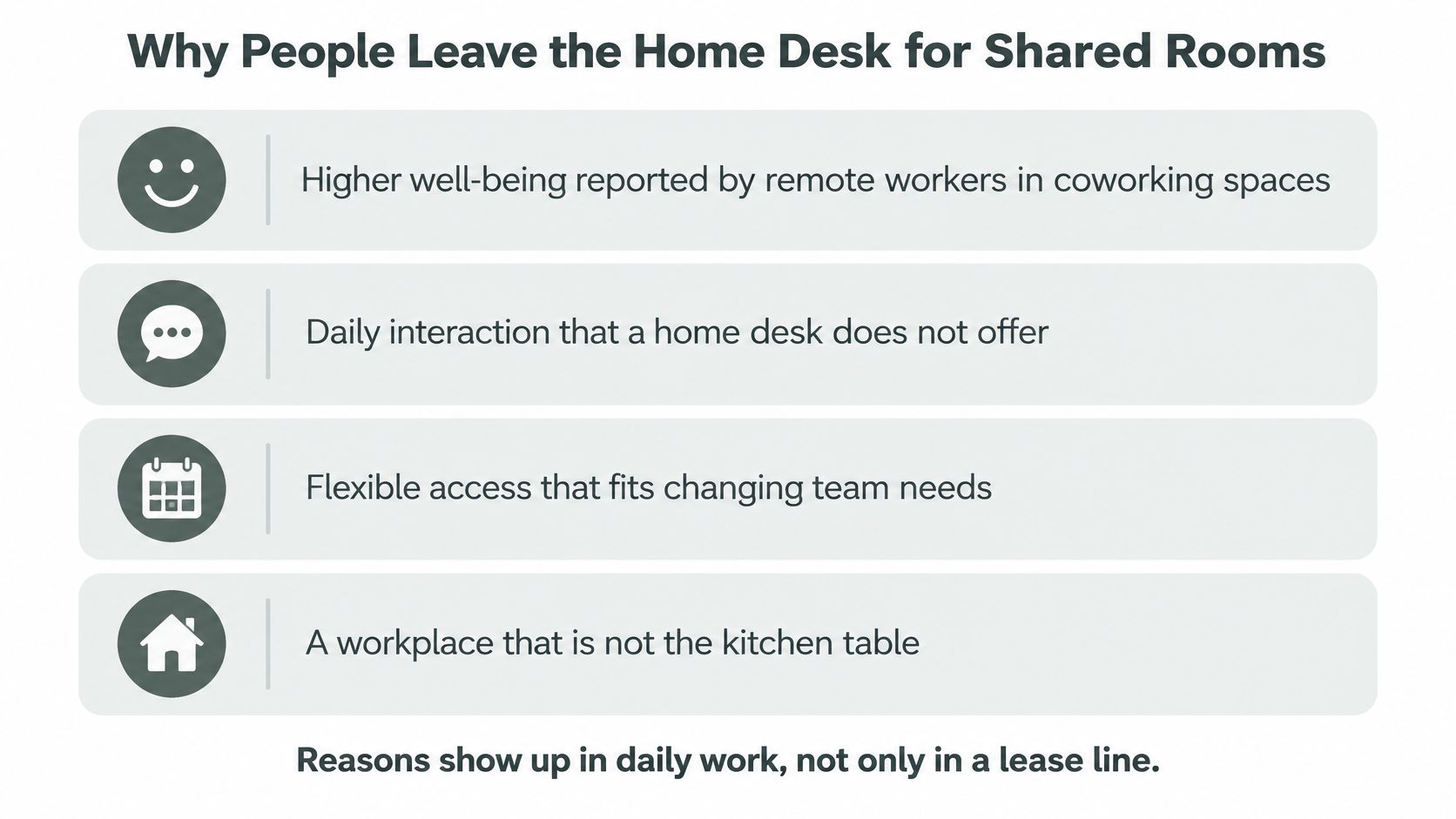
The reasons show up in daily work, not only in a lease line. A 2025 peer-reviewed study on remote workers compared home-based work with community-based coworking and found that coworking spaces produced higher well-being, work engagement, and productivity.
The gain wasn't the desk itself. Flexible access to more than one setting, plus chances to collaborate in person, did the visible work. Shared space and collaboration didn't help every task the same way, so one open room is a weak design. A useful floor mixes quiet focus, reservable meeting rooms, and a social zone.
A place to return to
The collaborative pull answers a wider scarcity. The Chamber of Connection reports that only 26% of people regularly visit a place outside home and work where others naturally gather. Meanwhile 30% belong to a community whose members do activities together, and 35% belong to one built on shared values. A University of Missouri Extension publication adds that only about one in four people visit a third place each week even when one is nearby.
Proximity doesn't create a habit. Recurring reasons to return do: a client meeting on Tuesday, focused work on Wednesday, a meal or workshop later in the week.
The benefits are a smaller unused lease, more than one kind of room, and a reason to see other people on a schedule. A stylish room with no programming stays empty.
Match the Model to the Day You Cannot Miss
Choose by the constraint you can't break. If you need a permanent address, a branded fit-out, and the same desk every day for years, a traditional lease still fits. If you need a private room for a small team without funding a build-out, look at a serviced office. If you work alone and want people nearby a few days a week, coworking is enough.
If you also want dining, events, and a room that can host a client or a small gathering, a membership club is the closer match. Whatever you choose, test it against your busiest day, not your quietest. Ask how rooms are reserved, whether guests can enter, how tiers differ, and what happens when you need less space next quarter.
The one-step preparation: Before any conversation with a membership club or operator, write down your average headcount and your peak-day headcount. Bring both so the membership question stays tied to real use, not a guessed monthly fee.
Freeform House is a three-story, 10,000 square foot premium members-only club opening in 2026 in downtown Jenks, Oklahoma. It pairs coworking, meeting spaces, and a community hub, so it's one option to test against the peak-day questions above. Prospective members can book a personalized consultation meeting to learn about pricing structures, opening dates, and how to become a member.
Freeform House is a premium, members-only club in the heart of Jenks, Oklahoma's 10 District downtown, designed for collaboration, focus, and connection. It combines coworking spaces, reservable conference rooms, dining, and social events in a restored 1920 building, so you get adaptable access without a fixed long-term lease. Visit Freeform House to see how membership fits your busy days, not just your average ones.
Comments