Wedding Venue Rental Cost in 2026: What You Really Pay

The national average reception venue cost was $12,900 for couples married in 2025, compared with about $8,000 for venue space alone and about $22,000 for a package including catering, alcohol, and rentals. Your wedding venue rental cost depends less on which headline figure looks closest to your budget than on which services you'll still need to buy.
For couples planning a wedding in 2026, those reported costs are benchmarks, not current quotes. The useful question isn't whether a venue is above or below average. It's whether its complete, usable offer costs less than the alternatives once you've priced the same celebration.
Typical Wedding Venue Rental Costs at a Glance
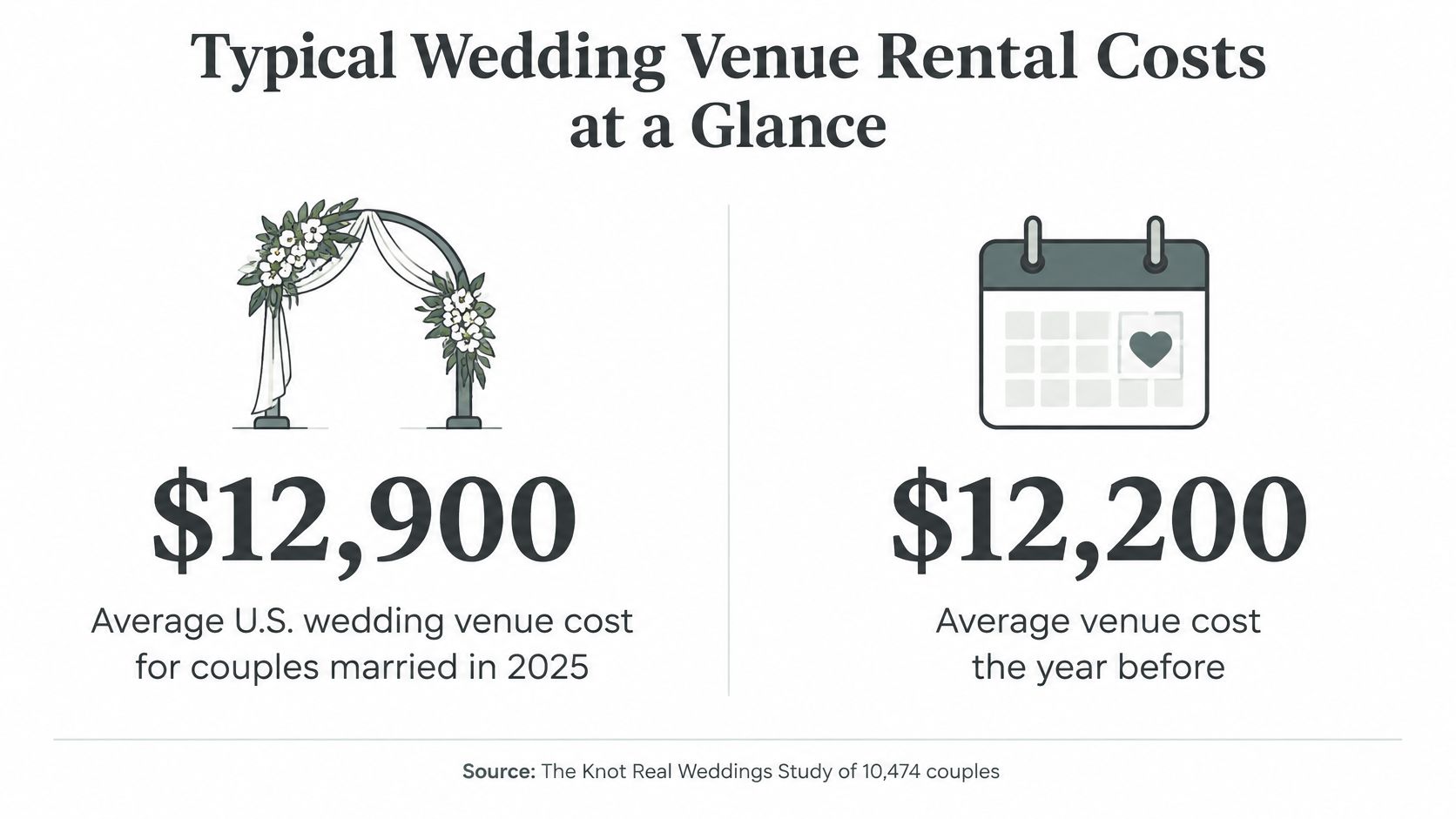
The Knot reported an average U.S. wedding venue cost of $12,900 for couples married in 2025, based on its Real Weddings Study of 10,474 couples, as summarized by Aisle's wedding venue pricing guide. For couples married in 2024, the reported average was $12,200, according to Kande Photo Booths' compilation of The Knot figures.
The distinction between rental and package spending is more revealing. The Knot's study announcement puts venue-space-only spending at about $8,000, compared with about $22,000 when catering, alcohol, and rentals were included.
Wedding venue cost benchmarks
Pricing scenario | Reported amount | Year | What it covers |
|---|---|---|---|
Venue space alone | About $8,000 | 2025 | Room only, without catering, alcohol, or rentals |
Venue package with catering, alcohol, and rentals | About $22,000 | 2025 | Full-service package |
National reception venue average | $12,900 | 2025 | Survey average across couples, definitions vary |
National reception venue average | $12,200 | 2024 | Survey average for 2024 weddings |
Venue location for a 127-guest wedding | $5,114 to $6,250 | 2025 | Estimate for one guest count |
The final row comes from The Wedding Report's U.S. wedding estimate, rather than a survey average.
Choose the benchmark that matches the offer
These rows don't describe interchangeable purchases. A survey average combines couples with different locations, priorities, and service arrangements. A guest-count estimate models a particular celebration. Neither tells you what a specific venue will charge for your date.
Nor do the space-only and full-service figures describe upgrades at the same property. They describe different purchasing arrangements across couples.
National averages are for positioning, not quotes. Find the row matching the service level you want, then check whether your expected attendance is close to the guest-count example before treating it as a useful starting point.
What Your Venue Quote Covers and What It Leaves Out
A space-only fee buys access to a place. A package fee may also buy the equipment, food, drinks, and labor needed to use it. The distinction matters because the cheaper room isn't necessarily the cheaper wedding.
In The Knot's venue-cost reporting, only 7% of couples had a reception-venue fee covering space alone, while 74% reported that rentals were included, according to The Knot's reception venue cost guide. Don't assume that another couple's reported venue spending represents a bare room rental.
Compare what you'll actually receive
Say you're evaluating a hypothetical $5,000 room rental against a $9,000 package. The room-only option requires separate furniture, catering, and bar arrangements, while the package includes those services. The lower room fee wins only if the excluded services, associated labor, and added charges fit within the difference.
That's a comparison method, not a market-price estimate. Get actual vendor quotes before deciding which arrangement is cheaper.
Venue quote line items to price in writing
Line item | What to check |
|---|---|
Room rental fee | Confirm the room, hours, and what the base fee excludes |
Tables, chairs, and linens | Confirm quantities, styles, and delivery fees |
Catering | Compare the per-guest meal price with outside caterer quotes |
Alcohol | Check bar staffing, licensing rules, and corkage fees |
Staffing, setup, and teardown | Confirm crew hours and who pays for overtime |
Service charges and taxes | Ask whether they are added on top of the quote |
Cleaning | Confirm whether it is included or billed separately |
Furniture deserves more scrutiny than a simple included checkbox. Ask whether the available inventory supports your seated dinner, ceremony layout, cocktail area, and vendor stations. Included chairs aren't a complete solution if you need additional seating or must pay someone to move them.
Likewise, distinguish venue supervision from event coordination. Identify who receives deliveries, directs setup, handles room changes, and checks that outside vendors leave on time. Assign each responsibility before you price the labor.
Separate flat charges from guest-based charges
Ask whether the package is a flat fee, a per-guest charge, or a combination. Then identify which components can change when attendance changes. A fixed room charge and a meal charge should appear separately so you can assess revisions without rebuilding the entire budget.
For a meal-centered celebration, our guide to private dining costs offers a useful companion to the venue comparison.
Comparison rule: Ask every venue to price the same written list of inclusions. Compare the resulting totals, not the starting fees.
Factors That Move Venue Rental Prices
Location, guest count, date, venue type, and included amenities all affect how useful a national benchmark is. Treat these as variables to test with written offers, not automatic surcharges or guaranteed opportunities for discounts.
The best comparison changes one variable at a time. If you change the date, room, menu, and attendance together, you won't know which adjustment made the offer affordable.
Test the main pricing drivers
Location. Downtown, metropolitan, and resort settings can carry higher asking prices than suburban or rural alternatives, so compare a central venue with a less central property while including transportation and parking arrangements.
Date and day. Peak-season Saturdays can command higher prices, while Friday, Sunday, weekday, or off-season dates may offer different terms; request alternative dates rather than budgeting for an assumed discount.
Guest count and capacity. A larger group can require a larger room, more tables, and additional service staff, so ask where the venue changes its room assignment or staffing requirements.
Venue type. A hotel may offer an in-house meal service, while a barn or outdoor property may require outside equipment and vendors; verify the operating arrangement instead of inferring it from the building style.
Amenities. Lighting, audio-visual equipment, a dance floor, getting-ready space, and parking can each affect the usable cost, so specify which facilities you need before accepting an estimate.
Exclusivity. Exclusive use can cost more than access within a shared property; confirm whether your booking controls the entrance, outdoor areas, restrooms, and other guest-facing spaces.
Negotiate the configuration, not just the fee
Ask for alternatives that change how the venue delivers the event. A shorter access window might reduce the offer, but it won't help if your rental company then needs an extra delivery trip. A smaller room might work beautifully until the dinner layout leaves no space for dancing.
Make date flexibility, guest-count tiers, and bundled versus à la carte service your primary comparison requests. Ask the venue to identify exactly what changes under each option.
Photos also need to document the setting you're evaluating. Stills' guide to authentic imagery distinguishes photographs of real places and events from generic or generated scenes that merely look realistic. Favor authentic room and event photographs over clip-art-style illustrations, and request the layout that corresponds to your proposed booking.
A beautiful photograph can help you assess atmosphere. It can't confirm capacity, access hours, or included equipment.
Venue Cost Examples at Different Guest Counts
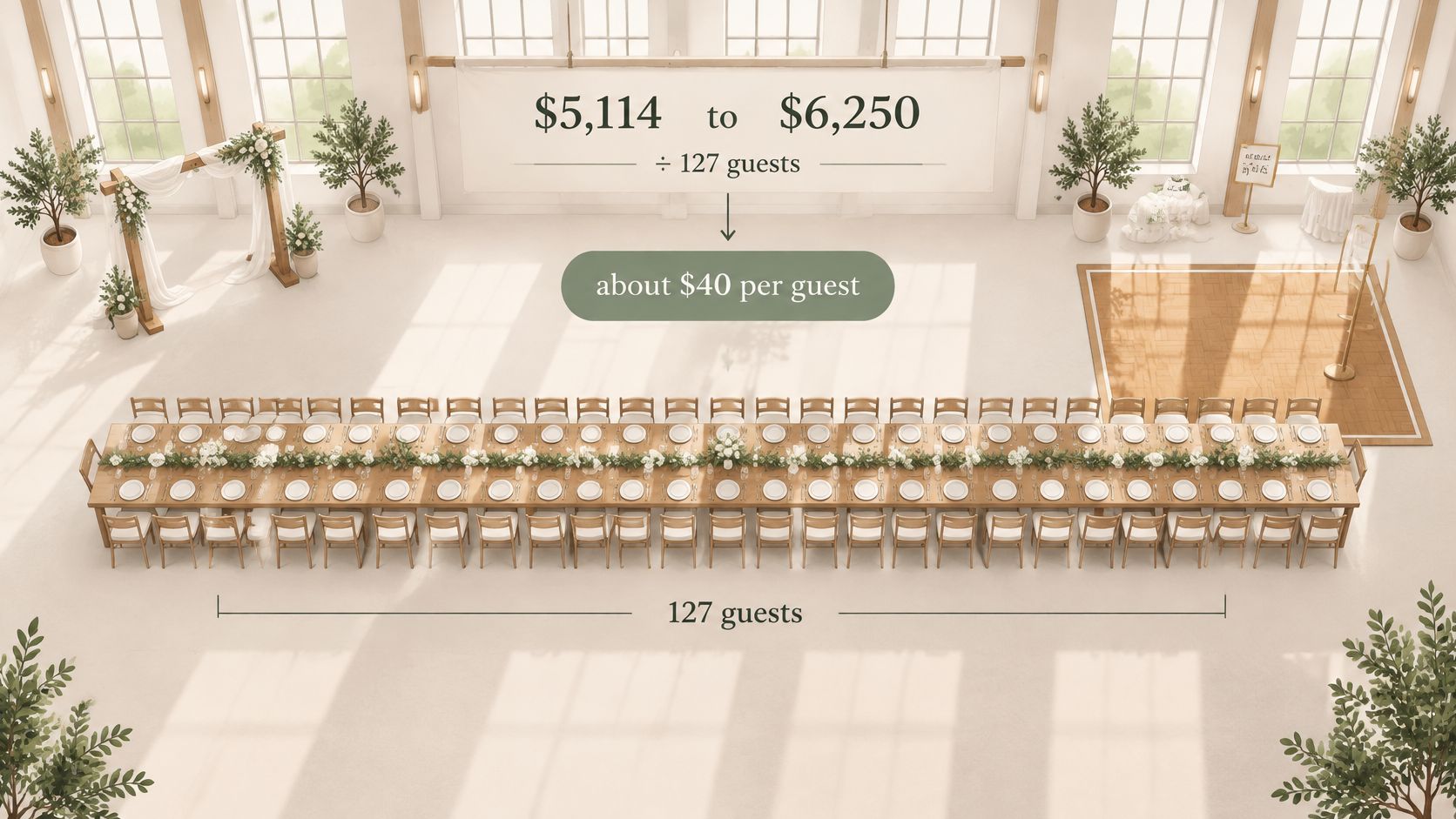
Using the national venue-location estimate above, dividing its endpoints by the modeled attendance produces about $40 to $49 per guest for the venue line alone. That calculation excludes any service the underlying location estimate doesn't cover, so it isn't a meal price or a complete wedding cost per person.
Use the visual as a reminder to connect seating arrangements with the cost calculation.
Venue location estimates per guest
Scenario | Venue location estimate |
|---|---|
127-guest wedding, 2025 | $5,114 to $6,250, approximately $40 to $49 per guest |
125-guest wedding in Brooklyn, New York, 2025 | $6,584 to $8,047, approximately $53 to $64 per guest |
The Brooklyn row uses The Wedding Report's estimate for a 125-guest Brooklyn wedding in 2025, with the per-guest figures calculated by dividing its venue-location range by attendance. The similar guest counts make this a useful regional comparison, but not proof that otherwise identical venues carry those prices.
Why smaller doesn't mean proportionally cheaper
A smaller wedding still needs a functioning event setup. If the room hire, minimum crew, and equipment commitments remain unchanged, fewer guests divide those fixed expenses. Your total may fall while your effective cost per guest rises.
Run hypothetical versions of your guest list with smaller and larger attendance. Ask which charges disappear, which merely shrink, and which stay fixed. Don't multiply an average per-guest venue figure by a new headcount and assume you've obtained a realistic quote.
For an intimate celebration, our small wedding reception ideas can help you choose a format before requesting room-specific pricing.
Here's a planning video to accompany your layout and guest-count review.
At Freeform House, members can host private events, including weddings and high school graduations, in our 1920s-era downtown Jenks building. Our Hall of Fame Room can be booked for evening events such as charities or small weddings.
Ask for capacity in the intended configuration, not the largest number the room can accommodate. A seated meal, ceremony, and reception may require different arrangements.
Price the room and attendance together. Compare competing offers at the same headcount and with the same event layout.
Contract Terms That Raise the Final Total
A quote describes the planned purchase. A contract determines what you owe when the plan changes. That makes the payment and adjustment clauses part of your venue selection, not paperwork to review after you've chosen a favorite.
Don't treat every potential charge as inevitable. Instead, identify which clauses apply to your event and what action triggers each charge.
Check the obligations before signing
Minimum-spend clauses. Identify any required food, beverage, or room-rental commitment, including whether eligible purchases can satisfy it across categories.
Guaranteed guest counts. Confirm whether you'll pay for the guaranteed attendance even if fewer guests arrive, and distinguish that guarantee from the venue's maximum capacity.
Deposits and cancellation. Record payment deadlines, the conditions under which payments become nonrefundable, and what happens if you postpone rather than cancel.
Overtime. Establish when the charge begins, who authorizes extra time, and whether vendor teardown must finish before the contracted end.
Outside-vendor fees. Check whether bringing your own caterer, bartender, florist, or other supplier creates a charge or requires approval.
Corkage. If you plan to supply alcohol, clarify bottle-related charges, permitted service arrangements, and who provides the bar staff.
Insurance. Determine whether you or your vendors must obtain coverage and include any required policy cost in the comparison.
A clause can affect your decision even when you never incur the charge. An inflexible attendance guarantee, for example, exposes you to a different financial risk than a booking that allows revisions closer to the event.
Our guide to choosing a venue can support the broader suitability review alongside these contractual checks.
Test the contract with specific questions
Request a sample final invoice. Look for categories that weren't visible in the initial proposal. A sample helps you understand the billing format, but your own signed agreement must establish the applicable charges.
Request a written exclusions list. Ask the venue to name what you must source independently. Compare that list with your rental, catering, and staffing proposals to locate gaps and duplicate charges.
Confirm the guest-count revision deadline. Establish the process for both reductions and late additions. Ask who must receive the update and how the venue confirms acceptance.
Ask about unused meal commitments. Find out whether you may convert them into upgrades or other services. Treat that as an available option only if the venue agrees in writing.
Before paying a deposit: Keep the proposal, exclusions, payment schedule, and agreed amendments together. Verbal reassurance isn't a substitute for matching written terms.
If a response contradicts the contract, request an amendment before signing. You shouldn't have to guess which document controls the price.
Build Your All-In Budget and Make the Call
A venue's advertised fee is only one part of its cost. Begin with your total wedding budget, then compare each venue's complete price for the space, services, and attendance you need.
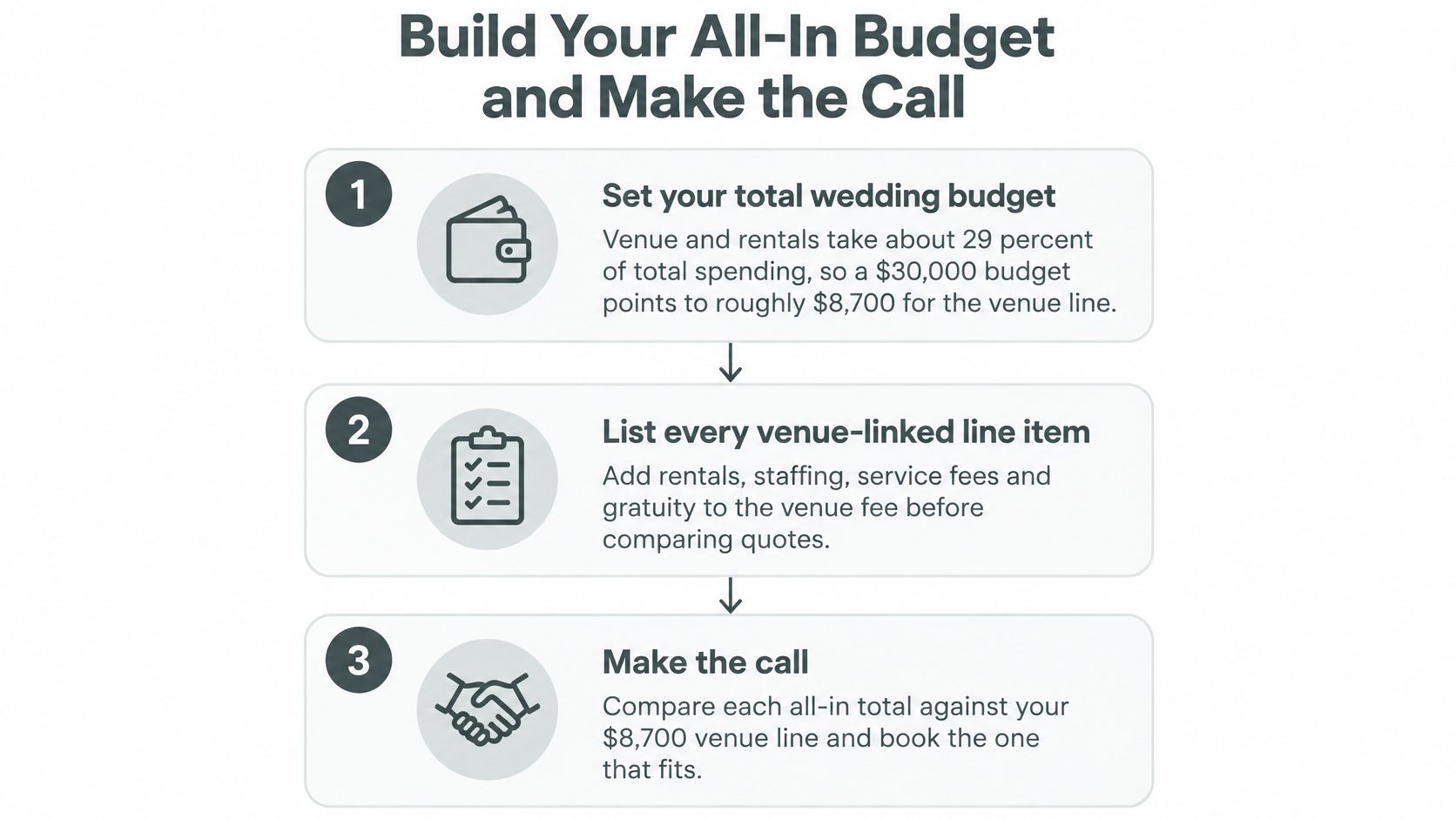
The Knot's wedding budget guide places venue and rentals at about 29% of total wedding spending. For a hypothetical $30,000 wedding budget, that suggests a starting allocation of $8,700. Treat it as a planning reference, not a spending requirement. If a venue package includes food or alcohol, account for those costs in the relevant budget categories rather than counting them twice.
Turn the proposals into a decision sheet
Set your total wedding budget. Base it on funds you can count on. Set an initial allowance for the venue and rentals, while keeping catering and alcohol visible as separate categories.
List every venue-linked expense. Create spreadsheet rows for room hire, ceremony space, furniture, lighting, meals, bar service, labor, cleaning, and required fees. Add a column to show who supplies each item.
Enter written prices for your attendance. Record the quote date, event date, room, access hours, and guest count beside each proposal. Mark any required but unpriced item as unresolved, not free.
Calculate the complete total and effective cost per guest. Add applicable fixed charges, attendance-based charges, taxes, and service fees. Divide the total by your planned guest count for comparison, but use the full total to judge affordability.
Normalize space-only and package offers. Match each included service to the corresponding spreadsheet row. Don't add an outside rental quote for items already included, and don't assign value to upgrades you wouldn't choose.
Set aside a contingency. Choose a reserve that reflects your contract exposure, such as possible overtime, late additions, or unresolved vendor charges. Keep known expenses outside the reserve so it doesn't disguise an incomplete budget.
Reconcile the invoice and contract. Compare sample invoice categories with your spreadsheet, then check that the payment schedule and adjustment terms align with the written proposal. Resolve discrepancies before paying a deposit.
Evaluate membership and event use separately
Freeform House is an existing premium, members-only club and workspace in a restored 1920s-era building in downtown Jenks. Members can host private events, including weddings, and the Hall of Fame Room can be booked for evening events such as small weddings. The club also offers workspaces, dining, accommodations, and social events, so its membership may involve a broader commitment than a single venue rental.
Keep that commitment separate from your wedding comparison. A workspace or club benefit doesn't establish what a particular event booking includes. Prospective members can book a personalized consultation meeting to learn about pricing structures, opening dates, and how to become a member.
Book only when the full event cost fits your budget with contingency intact. If it doesn't, compare a smaller room, another date, or a package with fewer exclusions.
Freeform House offers members private-event opportunities in downtown Jenks, including small weddings in the Hall of Fame Room. Visit Freeform House to arrange a personalized consultation about membership and pricing structures. Bring your guest count, preferred date, and inclusions checklist to discuss the full commitment.
Comments