8 Practical Hybrid Work Schedule Examples to Boost Flexibility in 2026
- Bryan Wilks
- Feb 13
- 15 min read

The modern workplace is no longer a single location but a dynamic ecosystem. As businesses and professionals in communities like Jenks and Tulsa embrace new ways of working, the one-size-fits-all office model has given way to more adaptable, effective solutions. The key to unlocking this new era of productivity lies in finding the right hybrid work model, a structure that balances essential in-person collaboration with focused remote work.
This article moves beyond theory to provide a strategic blueprint for teams ready to thrive. We will explore eight practical hybrid work schedule examples, breaking down the distinct advantages and potential challenges of each one. For local entrepreneurs and creative professionals, this isn't just about scheduling; it's about designing a more intentional work life.
We'll analyze who each model is best for, from project-based teams to role-specific structures, offering actionable takeaways you can implement immediately. Furthermore, we will demonstrate how a premier, membership-based club like Freeform House provides the perfect infrastructure to support any schedule you choose. As a central gathering spot aimed at fostering a creative and cooperative spirit in Jenks, Oklahoma's 10 District, it offers a dynamic community hub with co-working spaces designed for connection. Let's find the model that empowers your team to do their best work, wherever they are.
1. The 3-2 Hybrid Schedule (Three Days In-Office, Two Days Remote)
The 3-2 hybrid model is one of the most popular hybrid work schedule examples, structuring the week with three designated days in a central office and two days of remote work. This approach provides a consistent, predictable rhythm that balances structured, in-person collaboration with the autonomy of remote focus. It's a favorite among major tech companies like Google and Amazon, who use it to maintain company culture and facilitate teamwork while still offering flexibility.
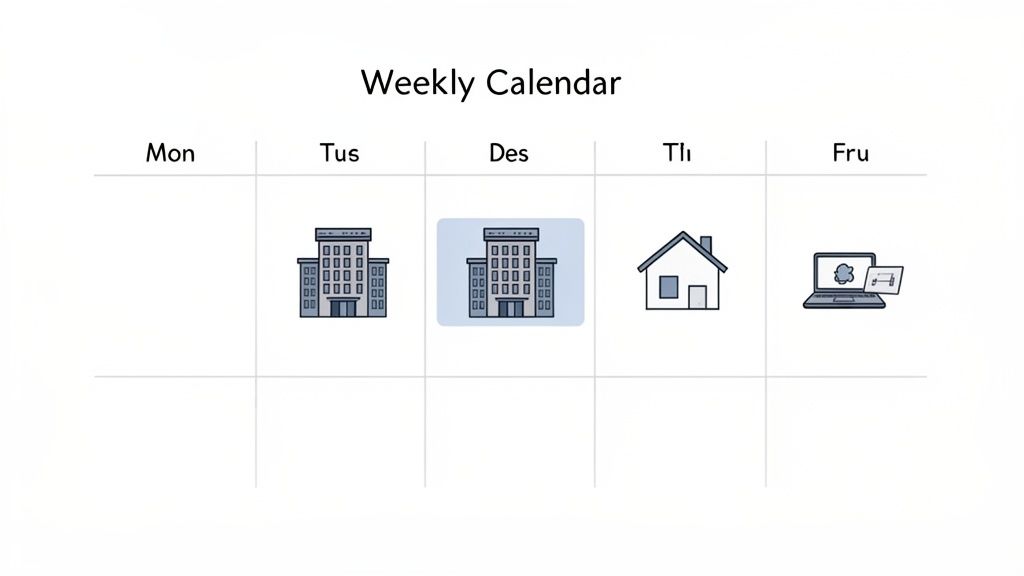
For teams that thrive on a regular cadence of face-to-face interaction, like executive leadership or creative departments, the 3-2 schedule is ideal. It carves out significant time for the high-bandwidth communication that drives innovation and strategic alignment. The key is to be intentional with how time is spent.
Strategic Implementation
To make the 3-2 schedule work, designate the same three days (e.g., Tuesday, Wednesday, Thursday) as "core collaboration days" for everyone. This predictability ensures that when employees come to the office, their key collaborators are there too, maximizing the value of their commute.
Office Days (Tue, Wed, Thu): Dedicate these days to activities that benefit most from in-person energy. This includes team meetings, brainstorming sessions, client presentations, and one-on-one mentorship.
Remote Days (Mon, Fri): Reserve these days for tasks requiring deep concentration. This includes report writing, data analysis, research, and project planning. This structure helps minimize context-switching and boosts productivity.
Using Freeform House for Your 3-2 Schedule
The 3-2 model is perfect for members of Freeform House, a premier club in the heart of Jenks' 10 District. Executive teams can book sophisticated meeting rooms for recurring weekly strategy sessions on their in-office days. Creative professionals can use these days to produce high-quality content in on-site production studios, capitalizing on premium amenities without needing to own the equipment. By structuring your week this way, you can fully leverage the key hybrid work schedule benefits for your business.
2. The 2-3 Hybrid Schedule (Two Days In-Office, Three Days Remote)
Flipping the popular 3-2 model, the 2-3 hybrid schedule prioritizes remote work, structuring the week with three days of remote focus and two designated days in a central office. This approach is one of the most compelling hybrid work schedule examples for companies embracing a remote-first culture. It grants maximum autonomy and flexibility to employees while still carving out dedicated time for essential in-person connection and team building.
This schedule is highly effective for roles that depend on long stretches of uninterrupted deep work, such as software development, writing, and design. Companies like Slack and Zapier have championed similar models, recognizing that focused remote time is a powerful driver of individual productivity, while intentional office days maintain cultural cohesion and collaborative energy.
Strategic Implementation
Success with the 2-3 schedule hinges on making the two office days count. Organizations must be disciplined about using this limited in-person time for high-value activities that cannot be replicated remotely. A common and effective strategy is to cluster the two office days mid-week.
Office Days (Tue, Wed): Reserve these days exclusively for high-touchpoint activities. This includes all-hands meetings, collaborative project workshops, client-facing presentations, and team social events. The goal is to maximize connection and collaborative energy.
Remote Days (Mon, Thu, Fri): Protect these days for focused, individual work. Encourage "no meeting" blocks and asynchronous communication to allow employees to dive deep into tasks like coding, content creation, and strategic planning without interruption.
Using Freeform House for Your 2-3 Schedule
The 2-3 schedule aligns perfectly with a flexible, asset-light business model. For your two in-office days, teams can book a sophisticated space at Freeform House for recurring high-impact meetings without the overhead of a full-time lease. Creative professionals can use these days to produce a week's worth of content in the professional studios, batching their collaborative and production-heavy tasks efficiently. As a membership-based hub comparable to SoHo House, it allows you to invest in a premier environment when you need it most, enhancing your brand image and team morale.
3. The Flexible/Needs-Based Hybrid (Event-Driven Scheduling)
The flexible or needs-based hybrid model moves away from a fixed weekly rhythm, empowering employees to determine their office attendance based on project needs and collaborative events. This approach, built on a foundation of high trust and autonomy, allows individuals and teams to decide their schedule week-to-week for maximum effectiveness. It's a hallmark of innovative cultures like those at Netflix and HubSpot, where responsibility and results are valued over mandated office presence.
This model is ideal for roles that are project-based or client-facing, such as consulting, sales, and creative agencies. The schedule is dictated by "trigger events" rather than fixed days, ensuring that time spent commuting to a physical space is always purposeful. It requires clear communication and robust digital tools to maintain team cohesion and transparency.
Strategic Implementation
Success with this model hinges on establishing clear guidelines for when in-person presence is required. Instead of leaving it entirely open, define key events that necessitate face-to-face interaction. This provides structure without sacrificing the core benefit of flexibility.
Trigger Events: Clearly define what constitutes a mandatory in-office event. This could include client presentations, project kick-off meetings, team-building offsites, or key final-stage brainstorming sessions.
Coordination System: Implement a shared, transparent calendar or booking system. This allows team members to see who will be in the office and when, facilitating spontaneous collaboration and planning. Require advance notice for planned office days to manage space and expectations.
Using Freeform House for Your Flexible Schedule
The needs-based model aligns perfectly with the flexibility of a Freeform House membership. Creative consultants can book an elegant meeting room exclusively for high-stakes client presentations, ensuring a professional and impressive environment. For teams that work remotely most of the time, scheduling a quarterly strategy day in one of these spaces helps maintain alignment and strengthen company culture. This "on-demand" approach to office space is one of the most powerful hybrid work schedule examples, and you can explore more options with the best daily office rentals near me.
4. The Staggered/Team-Based Hybrid (Rotating Schedules)
The staggered hybrid model ensures consistent office coverage by rotating which teams or departments work in-office on different days. This approach avoids having the entire company present simultaneously, managing office capacity while ensuring that key functions remain accessible in-person. It’s a pragmatic solution for industries like financial services and healthcare, where a constant physical presence is operationally necessary but full-capacity attendance is not.
This model is perfect for operational teams, like customer support or IT, and shared services departments like HR or marketing, that need to provide support to the entire organization. By staggering attendance, they can maintain service levels and collaborative oversight without requiring everyone to commute daily, making it one of the most practical hybrid work schedule examples for businesses with high-touch service demands.
Strategic Implementation
Success with a staggered schedule hinges on clear communication and meticulous planning. A master calendar that is visible to everyone is non-negotiable, as it prevents confusion and ensures employees know who to expect in the office on any given day.
Team Rotations (e.g., Team A: Mon/Tue, Team B: Wed/Thu): Assign specific in-office days to different teams. Team A (e.g., Sales) might take the beginning of the week for client prep, while Team B (e.g., Product) uses the latter half for development syncs.
Overlap and Asynchronous Days (e.g., Friday Remote): Designate one day, like Friday, as a fully remote day for everyone. This allows for focused individual work while providing a predictable break from the staggered office schedule. This also encourages teams to perfect their asynchronous communication skills.
Using Freeform House for Your Staggered Schedule
A staggered model at Freeform House ensures your business maintains a professional, staffed presence without leasing a full-time office. As a dynamic community hub designed for collaboration, a shared services team (HR, marketing) can rotate using a flexible co-working space as their base, providing a consistent point of contact.
When it's their turn in the office, different teams can book a private meeting room for their specific collaboration days, ensuring they have a dedicated, professional space. This approach helps maintain operational continuity and strengthens teamwork; you can discover more strategies on how to improve team collaboration with these focused sessions. This schedule allows each team to leverage the high-end amenities of a premier club like Freeform House on their designated days.
5. The Seasonal/Project-Based Hybrid (Cyclical Scheduling)
The seasonal or project-based hybrid model is one of the most agile hybrid work schedule examples, aligning in-office requirements with specific business cycles. Instead of a fixed weekly schedule, teams transition between intense in-office collaboration during critical project phases and focused remote work during quieter periods. This approach is ideal for industries with cyclical demands, such as advertising agencies during campaign launches or software companies nearing a product release.
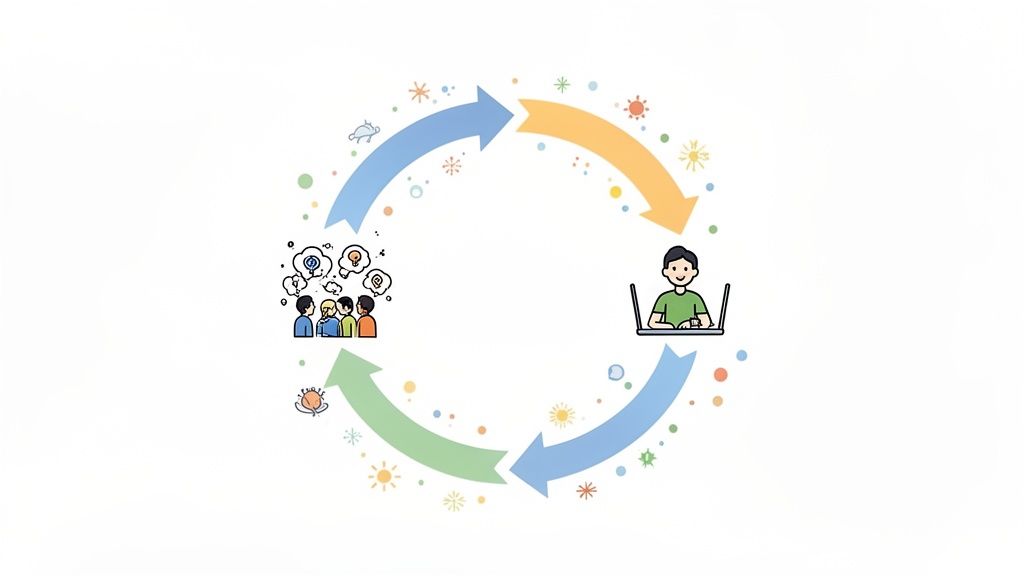
For dynamic teams like event planners or consulting firms, this model matches workspace investment with actual business needs. It avoids the rigidity of a fixed schedule, allowing the team to be physically present when collaboration is most valuable and remote when deep, individual work is the priority. The key is clear communication and forward planning.
Strategic Implementation
Success with cyclical scheduling depends on predictability and advance notice. Plan and communicate the cadence of in-office and remote phases at least 4-6 weeks in advance, using a shared annual or quarterly calendar. This transparency allows employees to plan their personal lives while ensuring the business has the right people in the room at the right time.
Intensive On-Site Phase: Designate specific "kickoff" or "launch" weeks that require a full in-office presence. These periods are for high-stakes activities like strategic planning, client workshops, campaign brainstorms, and final project sprints.
Flexible Remote Phase: Following an intense on-site period, transition to a remote-first or fully remote model. This phase is for execution-heavy tasks like coding, content creation, and administrative work that benefit from uninterrupted focus.
Using Freeform House for Your Cyclical Schedule
Freeform House is perfectly suited for the cyclical model, providing a premium, on-demand hub for your intensive collaboration phases. Marketing agencies can book a professional meeting space for multi-day campaign planning sessions. During a content-heavy launch phase, your team can utilize the on-site production studios to create all necessary assets efficiently in one inspiring, professional location. This allows you to scale your physical presence to match your project needs without the overhead of a permanent, oversized office.
6. The Role-Specific Hybrid (Differentiated by Position)
The Role-Specific Hybrid model is a nuanced approach that acknowledges not all jobs are created equal. It tailors hybrid work schedule examples to the unique demands of each position, recognizing that leadership, client-facing, and operational roles may need more in-office time than individual contributors like engineers or analysts. This model moves beyond a one-size-fits-all policy to optimize productivity and collaboration based on job function.
This differentiated approach is common in professional services and finance, with firms like Goldman Sachs and McKinsey implementing it to keep client-facing partners and traders on-site while allowing back-office or analytical roles more remote flexibility. The goal is to align presence with purpose, ensuring employees are physically present when their roles demand it most.
Strategic Implementation
Successfully deploying a role-specific model requires clear, documented expectations for each position or department. The framework must be transparent and equitable, explaining why certain roles have different requirements. This prevents perceptions of unfairness and ensures everyone understands the business logic behind their schedule.
Client-Facing & Leadership Roles: These roles (e.g., sales, executives, project managers) often require more in-office days to foster relationships, lead teams, and drive strategic initiatives. A 4-1 or 3-2 schedule is common.
Individual Contributor & Technical Roles: Positions focused on deep work (e.g., developers, writers, analysts) can thrive with more remote time. A remote-first or 1-4 schedule might be more effective, with in-office time reserved for specific project kickoffs or team-building events.
Using Freeform House for Your Role-Specific Schedule
Freeform House's variety of spaces is perfectly suited to this differentiated model. A boutique consulting firm, for example, can have its partners book an executive meeting room for their four in-office days per week to host client meetings and strategic sessions. Meanwhile, their analysts can utilize a co-working space or private studio once a week for collaborative data reviews and focused project work, creating a cost-effective and highly functional hybrid ecosystem. This ensures each role has access to the premier environment it needs to excel, without the overhead of a traditional office lease.
7. The Office Core Hours Hybrid (Flexible with Anchored Presence)
The Office Core Hours model provides a framework of anchored presence within a largely flexible schedule. This approach establishes specific, mandatory in-office hours, often during the middle of the day or on key midweek days, while allowing employees to manage the rest of their work time and location. It's an effective compromise, ensuring critical face-to-face collaboration without dictating the entire workweek. This model has been adopted by large corporations like Cisco and Siemens, who use it to maintain team cohesion while empowering individual autonomy.
This schedule is particularly powerful for teams that need guaranteed sync-up time but otherwise operate effectively on independent tasks. Professional services firms, financial teams, and cross-functional project groups can use core hours to ensure all key stakeholders are available for crucial meetings and decisions, preventing the communication delays that can plague more fluid hybrid work schedule examples.
Strategic Implementation
Success with this model hinges on making the core hours count. Define a window (e.g., 10 AM to 2 PM, Tuesday through Thursday) and reserve this block exclusively for high-value collaborative activities. This creates a predictable rhythm for teamwork and protects employees' focus time outside of this window.
Core Hours (e.g., 10 AM - 2 PM, Tue-Thu): This time is sacred for synchronous work. Schedule all-hands meetings, client-facing calls, brainstorming sessions, and team syncs. The goal is to maximize interaction and relationship-building.
Flexible Time: Outside the core hours, employees have the freedom to work from home, start early, or end late. This time is best used for deep work, individual tasks, and managing personal responsibilities, boosting work-life balance.
Using Freeform House for Your Core Hours Schedule
The Office Core Hours model aligns perfectly with the amenities at Freeform House. A professional services team can book a meeting room for their required Tuesday-Thursday gatherings, ensuring a premium, distraction-free environment for full-team collaboration. Members can leverage the booking system to guarantee space availability and even use our curated local partnerships to arrange team lunches, transforming mandatory office time into an engaging, community-building experience at Jenks' central gathering spot.
8. The Geographic/Hub-Based Hybrid (Regional Office Strategy)
The geographic or hub-based hybrid model moves beyond a single headquarters, establishing regional office hubs where distributed employees can work with local colleagues. Instead of commuting to one central location, employees work from their nearest hub two to three days a week and remotely the rest of the time. This approach, championed by companies like Slack and Spotify, is one of the most forward-thinking hybrid work schedule examples, enabling businesses to access a wider talent pool while maintaining physical touchpoints for collaboration.
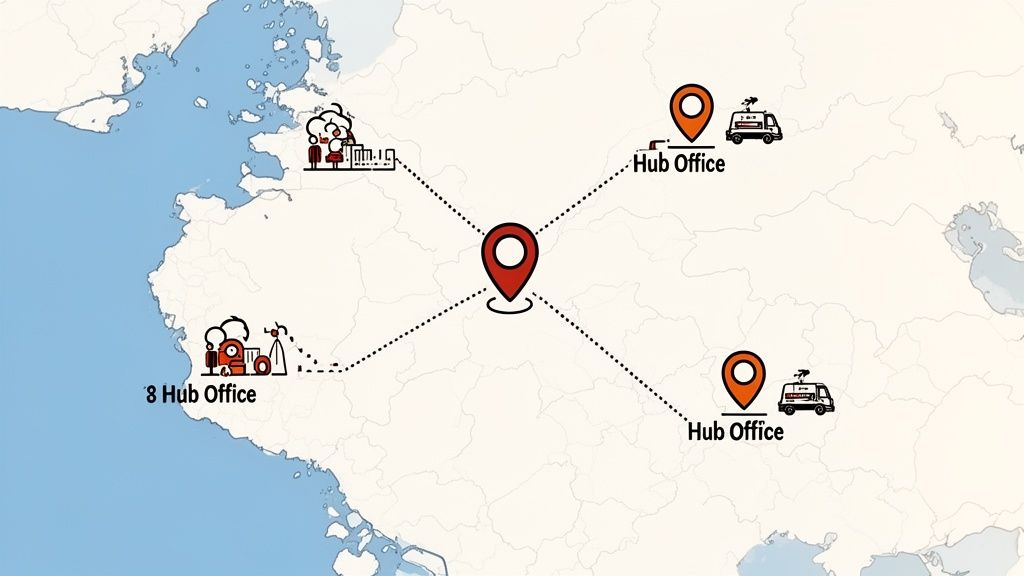
This model is ideal for companies with a geographically dispersed workforce or those committed to hiring the best talent regardless of location. It creates smaller, tight-knit communities within a larger organization, reducing commute times and fostering a strong sense of local team identity. It effectively blends the benefits of remote work with the community and resources of a dedicated office space.
Strategic Implementation
Success with a hub model requires creating consistency across locations while empowering local teams. Hubs should be established in areas with a significant density of employees or strategic market importance. This ensures the investment in physical space is maximized and provides a valuable resource for a meaningful number of team members.
Establish Hub-Specific Rhythms: Allow each hub to set its own core in-office days (e.g., Tulsa hub meets Tue/Wed, Dallas hub meets Wed/Thu) to accommodate local needs.
Facilitate Cross-Hub Connection: Designate specific times for company-wide virtual meetings and create projects that require collaboration between different hubs to prevent siloing.
Standardize Resources: Ensure every hub, regardless of size, has a consistent baseline of technology, amenities, and branding to create a unified employee experience.
Using Freeform House for Your Hub-Based Strategy
For businesses in Oklahoma and the surrounding region, Freeform House serves as a premier, ready-made professional hub. Instead of leasing a permanent office, companies can provide memberships for their Tulsa-area employees, giving them access to upscale coworking spaces, private offices, and state-of-the-art meeting rooms. A regional sales team could host quarterly planning sessions in an executive meeting room, while creative professionals can use the on-site production studios, ensuring every team member has access to the high-end tools they need to excel.
Comparison of 8 Hybrid Work Schedules
Model | 🔄 Implementation Complexity | 💡 Resource Requirements | 📊 Expected Outcomes ⭐ | 💼 Ideal Use Cases | ⚡ Key Advantages / Tips |
|---|---|---|---|---|---|
The 3-2 Hybrid Schedule (Three Days In-Office, Two Days Remote) | Moderate — fixed weekly days, predictable coordination | Medium — regular desk/meeting space, scheduling tools | ⭐⭐⭐⭐ — balanced collaboration + deep work; lower commute | Executive teams, small businesses needing routine in-person cadence | ⚡ Use office days for meetings/mentorship; reserve remote days for deep work |
The 2-3 Hybrid Schedule (Two Days In-Office, Three Days Remote) | Low — fewer mandatory office days, simpler rollout | Low — reduced occupancy, stronger digital tooling needed | ⭐⭐⭐ — high flexibility and satisfaction; culture risk if unmanaged | Creative professionals, knowledge workers, talent-attraction scenarios | ⚡ Maximize remote deep work; use in-office days for high-value collaboration |
Flexible/Needs-Based Hybrid (Event-Driven Scheduling) | High — dynamic planning and policy enforcement required | Variable — on-demand space, robust booking and comms systems | ⭐⭐⭐⭐ — high autonomy and satisfaction if accountability exists | Senior consultants, entrepreneurs, role-based flexible teams | 💡 Define trigger events for in-person attendance; use booking systems |
Staggered/Team-Based Hybrid (Rotating Schedules) | High — complex rotation planning and visibility needs | Medium — consistent coverage with lower peak density | ⭐⭐⭐ — reliable daily coverage; less full-team overlap | Client-facing teams, support, operations needing daily presence | ⚡ Maintain master calendar; align rotations so at least one rep present daily |
Seasonal/Project-Based Hybrid (Cyclical Scheduling) | Moderate — requires advance planning around cycles | Variable — scale resources up for peaks and down for lulls | ⭐⭐⭐⭐ — aligns workspace to demand; risk of intensive in-office peaks | Agencies, product launches, event-driven or project-based firms | 💡 Communicate cycles 4–6 weeks ahead; book intensive collaboration weeks |
Role-Specific Hybrid (Differentiated by Position) | High — multiple policies and ongoing role reviews | Medium — targeted allocation of rooms and resources by role | ⭐⭐⭐⭐ — optimizes productivity per role; may cause perceived inequality | Professional services, consulting, firms with diverse role needs | ⚡ Document role expectations; schedule cross-role overlap for visibility |
Office Core Hours Hybrid (Flexible with Anchored Presence) | Moderate — defining and enforcing core windows | Low–Medium — office available for core windows, booking tools | ⭐⭐⭐⭐ — guaranteed overlap for collaboration with flexible autonomy | Cross-functional teams, organizations needing predictable overlap | 💡 Reserve core hours for meetings; schedule recurring syncs within core window |
Geographic/Hub-Based Hybrid (Regional Office Strategy) | High — multi-site coordination and consistency challenges | High — investment in multiple hubs and localized resources | ⭐⭐⭐⭐ — reduces commute, expands talent reach; potential siloing | Distributed workforces, regional hiring growth, multi-city operations | ⚡ Standardize hub experience; host inter-hub connection days and specialized spaces |
Crafting Your Perfect Hybrid Week at Freeform House
The journey through these diverse hybrid work schedule examples reveals a fundamental truth about the modern workplace: there is no universal solution. The era of a one-size-fits-all, five-day-a-week office commute is over. In its place is an opportunity for businesses to architect a work model that is intentionally designed for their specific goals, culture, and team dynamics.
As we've explored, the "best" hybrid schedule is less about a rigid template and more about a strategic framework. Whether it's the consistent rhythm of the 3-2 split, the dynamic flexibility of a needs-based model, or the coordinated rotation of a staggered schedule, success hinges on intentionality. The key is to move beyond simply choosing days and start designing experiences. This means clearly defining the purpose of in-office time versus remote work and providing the right environment for each.
Core Takeaways for Building Your Hybrid Model
The models we've analyzed offer critical insights that can guide your strategy. Mastering these concepts is not just an operational task; it's a competitive advantage that can attract and retain top talent, boost innovation, and build a more resilient company culture.
Here are the most important principles to remember:
Purpose Over Presence: Don't mandate office days without a clear "why." The office should be a destination for high-value, synchronous activities like strategic planning, creative brainstorming, team-building, and client presentations. Remote days are best suited for deep, focused work, and asynchronous tasks.
Flexibility with Guardrails: True flexibility requires a clear structure. Whether it’s core collaboration hours, designated team days, or project-based sprints, establishing predictable patterns prevents confusion and ensures everyone can connect when it matters most.
Equity is Non-Negotiable: A poorly designed hybrid model can inadvertently create a two-tiered system favoring those in the office. To combat this, leaders must invest in technology that levels the playing field, establish clear communication protocols for all team members, and ensure career advancement opportunities are equally accessible to everyone, regardless of their location.
The Third Space is a Strategic Asset: The central office is no longer the only hub. A premier, flexible third space like Freeform House offers a powerful solution, providing a professional environment on demand. It's more than a social club; members can take advantage of co-working spaces and a dynamic community hub designed to foster a creative and cooperative spirit.
Ultimately, designing the perfect hybrid work schedule is an iterative process. It requires open communication, a willingness to experiment, and a commitment to adapting as your team’s needs evolve. By starting with a clear strategy and leveraging the right resources, you can create a work week that empowers your team to do their best work, fostering the connection and autonomy that define the future of business in our Jenks and Tulsa community.
Ready to find the perfect space to support your team's unique hybrid schedule? Explore the versatile meeting rooms, private studios, and collaborative spaces at Freeform House. Discover how our premium, membership-based club in the heart of Jenks can become the strategic anchor for your company's success by visiting us at Freeform House.
Comments