8 Networking Mixer Ideas That Build Real Connections

You're holding two calendars for the same month, and only one of them will still matter on Monday. The first is a crowded reception. People trade cards, shout over the bar, and forget names before the rideshare arrives. The second is a seated dinner where three guests leave with a referral and a follow-up call already on the books. The venue and the drinks rarely explain that gap. The structure does. People talk when the night gives them a reason, a partner, and a clock.
A longer invite list will not repair a format that asks strangers to self-organize. Extroverts orbit the host. Everyone else checks a phone by the exit. These eight networking mixer ideas start from the outcome you want, then set the guest mix, the room, and the timing that can deliver it. They belong in a restored downtown club, not a hotel ballroom with one bright floor and nowhere to sit.
Freeform House is built as a premier, membership-based club in the heart of Jenks, Oklahoma's 10 District downtown. Think of the SoHo House idea of a social home, then add coworking and a community hub for collaboration, not a velvet rope and a cocktail. Members get rooms for work and a central gathering spot meant to keep a creative, cooperative spirit inside the local circle. Pick one outcome for the first test. Deeper peer talk, a creative pairing, a local referral, or a community commitment each need a different night.
1. The Local Founder Table
A hosted dinner is the right networking mixer idea when you want peer relationships, not a scan of the room. Seat established operators at one table and emerging founders at another, both fed by a curated restaurant partner so a nearby kitchen earns the booking. A neutral host opens with a relevant fact from each registration profile. Two short spotlights let members describe what they sell, then the table takes the prompts.
In a randomized study of 2,820 young Chinese firms, owner-managers assigned to small groups that met monthly for a year increased revenue by 8.1%, with gains in profits, partners, borrowing, and management quality that still registered a year after the meetings stopped. Those managers had an average of 2.18 more peers acting as referrers for suppliers, clients, partners, and managers than a comparison group. One dinner will not copy that result. A recurring table can borrow the mechanism, which is repeated contact with stronger peers.
Say a Jenks food founder sits with a packaging designer and a bookkeeper who already serves food brands. You do not add a second, directly competing bakery to that table.

Practical rule: One guest from any directly competing category per table, and a profile at signup so introductions are not left to name cards.
For local business networking that outlasts the drive home, give every seat three topics: a business challenge, a local opportunity, and a live collaboration. Mix member tables with guest tables so a first-timer has someone to talk to before dessert. A short survey the next day tells you which pairs still need a warm introduction.
2. The Creator Collab Lab
Creative people do not find collaborators by describing their work across a noisy bar. Build a photographer-and-podcaster showcase. A photographer presents a short visual story. A podcaster records a live segment or a booth interview. Guests rotate through small stations, then stay for drinks.
Weak ties help careers only when contact is repeated and low pressure. A design-society paper on weak-tie interactions is a useful warning that chance mingling fails. Use groups of four to six, one prompt, and at least one switch so people leave their existing clique. A 60- to 90-minute run with an opening question, two rotations, and an optional coffee close is enough.
Rooms and consent
Use the Rise loft studio, the in-house podcast booth, and a flexible meeting room. The booth already has professional-grade microphones, soundproofing, and editing software, so you rehearse levels before guests arrive and keep the crew small. Post a written photo and recording consent policy, and mark opt-out areas people can see.
Getty Images' survey of more than 30,000 adults across 25 countries found that 98% of consumers considered authentic images and video important for trust. Shoot the actual loft and the people who came. Clip art and generic coworking stock make a production night look fake. Each creator closes with one ask: find one attendee whose work complements yours. A same-night headshot or a short edited sample gives guests a reason to stay. Our notes on how to network as a photographer cover the follow-up those files make easier.
A portrait photographer and a food podcaster can leave with a shared episode plan because the station reset was on the schedule, not improvised after the first guest arrived.
3. The Dealflow Exchange
Matchmaking fails when the pitch is a biography. Ask for one objective at registration, then build the pairs yourself. Short pitches open the night. One-to-one meetings follow in the Executive Room, the Freeform Room, or the Thomas Room. The Executive Room's Jamboard is there if a pair needs to sketch a scope instead of trading adjectives.
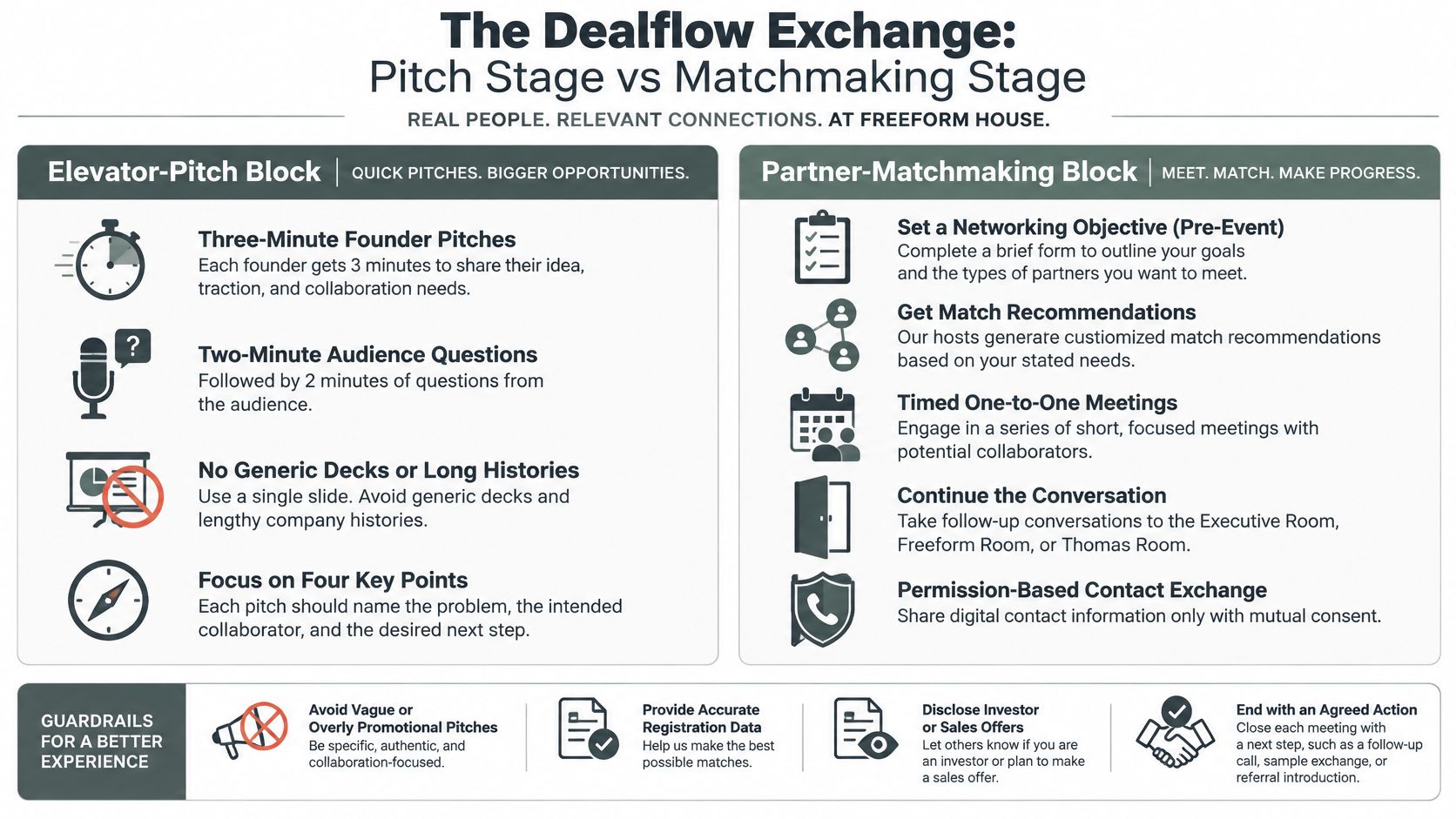
Freeman's 2025 relationship report shows organizers scoring networking ROI mainly through lead quality at 30% and pipeline at 23%, while post-event conversions or sales were only 5%. Busy rooms still struggle to connect activity with outcomes. I would rather produce fewer, better matches. Collect one "can help with" and one "currently needs" field, promise at least two relevant matches, and send a 48-hour recap that restates why those two people were introduced.
Problem, partner, next step: Those three lines are the whole pitch. One slide. No origin story.
A closed action: End every meeting with a call, a sample exchange, or a referral, not a vague "let's stay in touch."
No fake capital night: Do not call it an investment forum unless securities, legal, and disclosure duties are handled.
Say a Tulsa founder who needs payroll support meets a local HR firm, agrees to a sample employee file by Friday, and never sits through a seed-round monologue. You track completed follow-up meetings, not how many cards moved across the table.
4. The Neighbor-Maker Social
Referrals show up when neighboring businesses can see each other's actual ask. This Main Street mixer connects members with nearby restaurants, retailers, creatives, nonprofit leaders, and civic entrepreneurs. Host intros stay short. Guests move through themed areas for food, wellness, technology, and community impact.
Jenks Downtown's description of the Ten District defines it as exactly ten blocks of downtown retail and restaurant concepts in Jenks, Oklahoma, mixing historic structures with newer development. Build the guest list from those blocks and from complementary trades, not from three shops that sell the same thing. Every participant brings one collaboration request. A small printed directory should still be useful on Tuesday.
We route meals through local restaurant partners at no extra delivery charge, so the night can spend those credits instead of flying in a generic caterer. That keeps the food budget inside the district you are trying to connect.
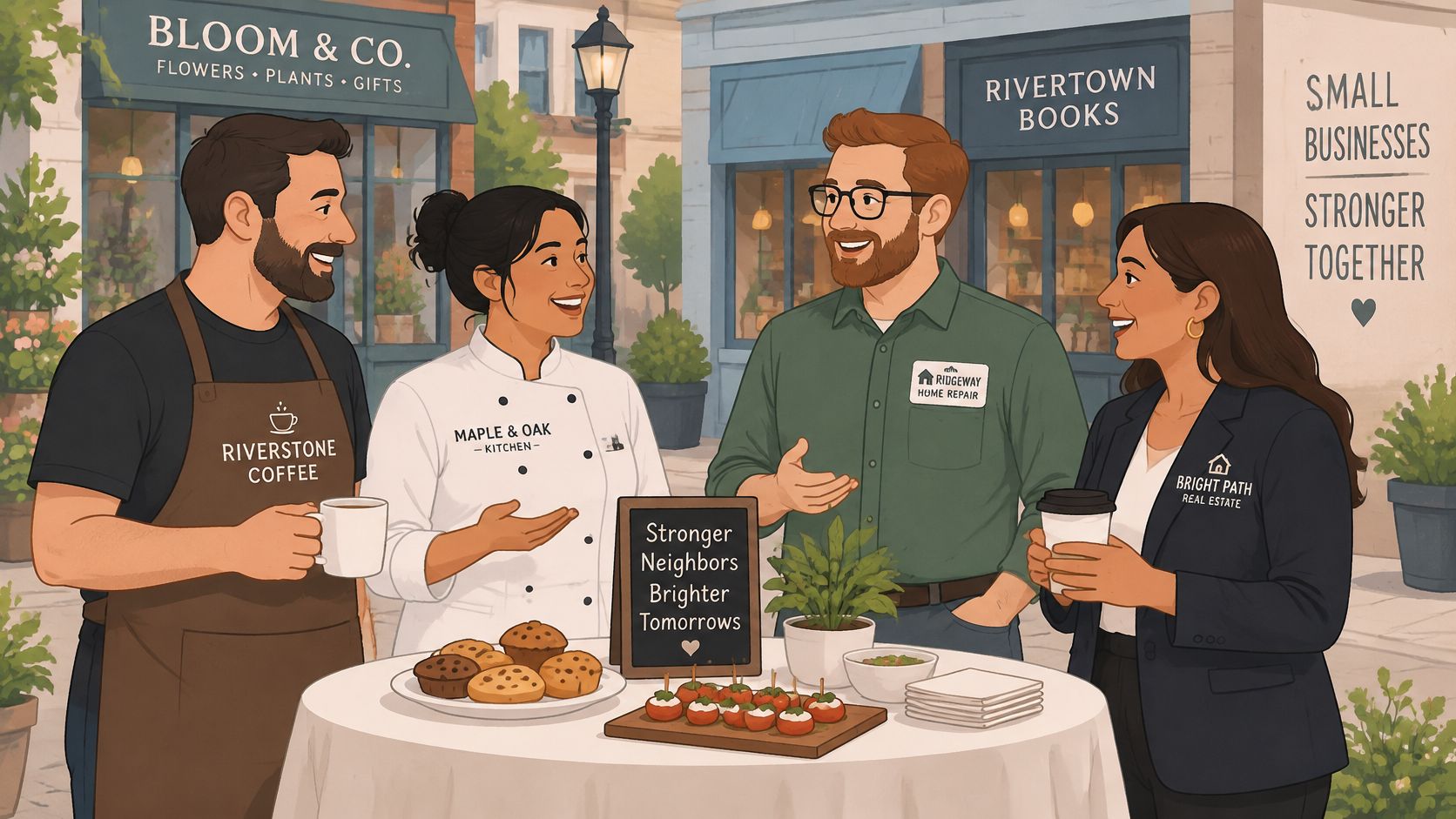
A retailer and a photographer should leave with one shared window promotion written on the directory line, or the themed corners were only decoration.
If the room fills and people ask for the next date, run a monthly micro version. Do not answer a good first night by doubling the headcount and losing the cross-sector mix.
5. The Executive Offsite Social
Hybrid leaders do not need another sponsor keynote. They need a roundtable small enough that a real management problem can be said out loud. Cap each table at six to eight. A facilitator states, before the first example, whether stories stay inside the group. Put vendor one-pagers in a side resource area so the discussion is not a disguised demo.
A 2025 experience-sampling study comparing remote workers at home with workers in community-based coworking spaces found higher well-being, work engagement, and productivity in the coworking setting, and the gain depended on the task. Shared rooms do not help every kind of work the same way. Hold the roundtable in a private room, and leave a quieter desk zone for the ten minutes before someone speaks.
Remote seats with a job
Pair each remote attendee with an on-site host and a task, such as recording one practical takeaway. Afterward, send an anonymized synthesis, not a transcript of who struggled with what.
Teams comparing corporate offsite ideas can use this social as the relationship layer around a work session. Four hybrid managers might compare Monday standups and leave with one written ritual. They should not leave with a software trial they did not ask for. Private workspaces and reservable conference rooms let you split deep talk from the reception without renting a second venue.
6. The Service-League Social
A giving mixer collapses when it tries to represent every cause in town. Choose one measurable local challenge. Open with that need, then move into a resource exchange. Nonprofits should name the help they want before they arrive: funding, volunteers, pro bono services, space, procurement, or expertise.
Participation is a design choice, not a personality test. All Along's field notes on inclusive networking recommend asking registrants how they network best and offering paths besides a public self-introduction. Written prompts, opt-in groups of three or four, and a visible conversation-pause area help disabled guests, first-timers, international guests, and people with limited social energy. Icebreakers alone do not do that work.
Transparent pledges: Record what was promised and report the result later. Skip pressure language and telethon staging.
A non-cash path: An hour of professional skill should count, so guests who cannot write a check are not spectators.
One cause card: If the agenda lists five missions, nobody leaves with a task they can finish.
Say a civic group needs Saturday bookkeeping. Two owners sign that skill line. You email both within two days with the contact and the exact task. The Hall of Fame Room can be booked for an evening charity gathering when you want the exchange to feel hosted rather than like a lobby drive.
7. The Member Spotlight Social
Members already have useful lessons. The failure mode is giving them ten minutes and a slide deck. Run a one-minute round. Each person shares a transferable insight. The next person answers with a connection or a question. A visible timer and a firm host protect the shy speaker from the confident pitcher. Send a two-minute prep card the day before, and ban company pitches outright.
Freeman's 2025 syndicated survey of 2,326 event attendees found that 56% define networking success as leaving with new ideas, while 75% prioritize connections that broaden their industry perspective. Subject-matter experts were the most important contributors for 63%. Invite entrepreneurs, operators, creatives, and service providers whose work is adjacent, not identical. A ten-minute local business briefing can open the round if you need a shared fact before the timer starts.

Track three outcomes separately: ideas gained, cross-industry contacts, and collaborations named. Five-point ratings plus counts of new contacts and follow-up intentions let you compare this round with a looser reception later.
A podcaster explains how she books guests. The retailer beside her asks whether the same script works for wholesale buyers. The reception after the round is where that pair keeps talking. Without that open social, the best minute of the night dies when the timer does.
8. The Sunset Supper Club
Wellness, hospitality, food, fitness, and local consumer brands network badly when the night turns into a product demo. Start with a short guided activity or a fireside-style host conversation, move to a locally curated supper, and leave the last stretch unstructured. Guests in this category already spend their days selling. They will stay if the host is supplier-neutral and the end time is predictable.
The modern cocktail party, a close ancestor of the mixer, emerged in the 1920s as a less formal alternative to teas, dinners, and balls, became a business-social habit after World War II, faded in the 1960s, and revived in the mid-1980s as entertaining moved outside the home, in the account of that roughly six-decade shift. The durable design is a hybrid room. Relaxed enough for spontaneous talk, structured enough for a real introduction.
Drinks without a penalty: Alcohol-free options should match the poured drinks in quality, not sit as an afterthought.
Diet notes up front: Collect restrictions at registration and state ingredient limits before plates go down.
A way home: Publish taxi and rideshare pickup, plus secure bicycle or golf-cart access. Our rentable golf cart fleet covers the short downtown hop when weather or heels make the walk a bad idea.
A fitness coach and a cafe owner can compare morning traffic and set a Tuesday tasting, because the opening activity ended on time. Stretch that opening and the supper becomes a captive audience. That is the trade-off. Hospitality builds trust only while guests can still leave.
How the eight networking mixer formats compare by group size, structure, and planning demands
Item | Group Size | Core Format | Best For | Main Planning Need |
|---|---|---|---|---|
The Local Founder Table: Curated Small-Business Dinner | 8–12 guests per table | Facilitated seated dinner with peer discussion and optional business spotlights | Local entrepreneurs and small-business owners | Curate balanced tables and plan dietary needs |
The Creator Collab Lab: Photographer-and-Podcaster Showcase | Small groups rotating between creative stations | Live demonstrations, collaborative production, and reception | Photographers, podcasters, filmmakers, and designers | Coordinate equipment, technical support, and recording consent |
The Dealflow Exchange: Elevator-Pitch and Partner Matchmaking | Not specified | Short pitches followed by curated one-to-one meetings | Founders and professionals seeking clients or partners | Collect clear attendee objectives and prepare relevant matches |
The Neighbor-Maker Social: Main Street Community Mixer | Open, cross-sector gathering | Category-based introductions, local sampling, and community exchange | Nearby businesses, nonprofits, and civic leaders | Coordinate local partners and keep business information current |
The Executive Offsite Social: Hybrid Leaders Roundtable | Small peer roundtables | Facilitated leadership discussions and hybrid-work demonstration | Executives, team leaders, and remote professionals | Protect confidentiality and facilitate inclusive participation |
The Service-League Social: Community Giving Mixer | Small-group action sessions | Community-need briefing, resource exchange, and optional giving | Businesses, nonprofits, and civic leaders | Define a measurable need and track commitments transparently |
The Member Spotlight Social: Ideas in the Round | Round-robin group | One-minute member insights followed by networking | Members seeking low-pressure introductions and peer learning | Enforce time limits and keep contributions useful, not promotional |
The Sunset Supper Club: Wellness, Lifestyle, and Networking Social | Curated guest list | Brief wellness activity or conversation, supper, and networking | Wellness, hospitality, food, fitness, and lifestyle professionals | Coordinate food, dietary needs, and inclusive beverage options |
Choose One Format and Test It Within 30 Days
Pick the single outcome your community needs most. Deeper peer conversations point to the founder table or the executive roundtable. Creative collaboration points to the collab lab. Local referrals point to the neighbor-maker social. Community impact points to the service-league night. Idea exchange points to the one-minute spotlight. Lifestyle ties point to the sunset supper. Confirm the guest mix, the room, and the follow-up step before you invite anyone. Then run it once.
A short post-event survey should ask who had a meaningful conversation, who intends to follow up within seven days, and what they will do next. Two weeks later, check who did. Attendance and social posts will flatter a weak format. Completed meetings, qualified referrals, and repeat guests will not.
A coworking study on social interaction and job productivity found significant positive relationships between the coworking environment, social interactions, and job productivity, with social interaction strengthening the tie between the setting and productivity. The room matters because people use it to trade knowledge, not because the furniture is impressive. Show genuine peer talk in how you host, and in any photos you publish afterward. Documentary shots of the actual building, members, and tables beat stock scenes.
Freeform House gives hosts a practical first test without a ballroom contract. Private workspaces, open collaboration areas, hot desks, and reservable conference rooms cover a working session before the social. The Hall of Fame Room can be booked for evening events, including charities or small weddings, when the mixer needs a hosted close. The Freeform Room, the Executive Room, and the Thomas Room let you split pitches, roundtables, and quieter follow-ups under one roof in our restored 1920 building in downtown Jenks.
A well-structured first gathering often does more for a local network than a large, unfocused reception. Choose the format, cap the list, and put the follow-up on the calendar before the doors open. If the survey is thin, change the prompt or the guest mix. Do not answer a weak night by inviting twice as many people.
Freeform House is a members-only club and workspace in a restored downtown Jenks building, with rooms for executive meetings, workshops, private gatherings, and the kind of hosted nights that turn introductions into follow-ups. If you are planning a mixer for founders, creatives, or neighboring businesses, start with the room and the guest list rather than a bigger bar order. Visit Freeform House to see the spaces and set a date for your first test.
Comments