Team Collaboration Examples: 8 Proven Workflows for 2026

It's 3 p.m., and your product team is still arguing a feature. There's no whiteboard, no private room, and two people are already dialing in from home. The stall isn't a talent problem. It's a setting that can't hold a decision.
You know the rest of the hour. Someone restates the same point, the remote teammate can't see the sketch, and the calendar shows twenty minutes left. Nobody owns the call. People leave with a vague plan to circle back, which means the debate starts again tomorrow.
A solid agenda still fails when the room can't hold the work.
The eight team collaboration examples below show how proven workflows stop that loop, and why the room you book matters as much as the method you use. Each one pairs a working format with the layout and timing that support it, from product builds and creative reviews to leadership planning. A sprint collapses on a noisy open floor. A stand-up bloats when everyone sits down in a boardroom.
You'll get the sequence, a concrete use case, and the trade-off that breaks the format when a team treats it as a mood instead of a system. If you run a small company around Jenks or Tulsa, match the workflow to the next decision on your calendar. Then put that session in a room that can hold it.
1. Google Design Sprint
A design sprint gives a small cross-functional team five days to move from a stuck problem to a tested prototype. Day 1 maps the challenge, Day 2 is individual sketches, Day 3 forces a decision, Day 4 builds something a user can click, and Day 5 puts it in front of real people. Jake Knapp developed the method at Google Ventures and documented it with John Zeratsky and Braden Kowitz in Sprint (2016). You trade a month of meetings for one focused bet.
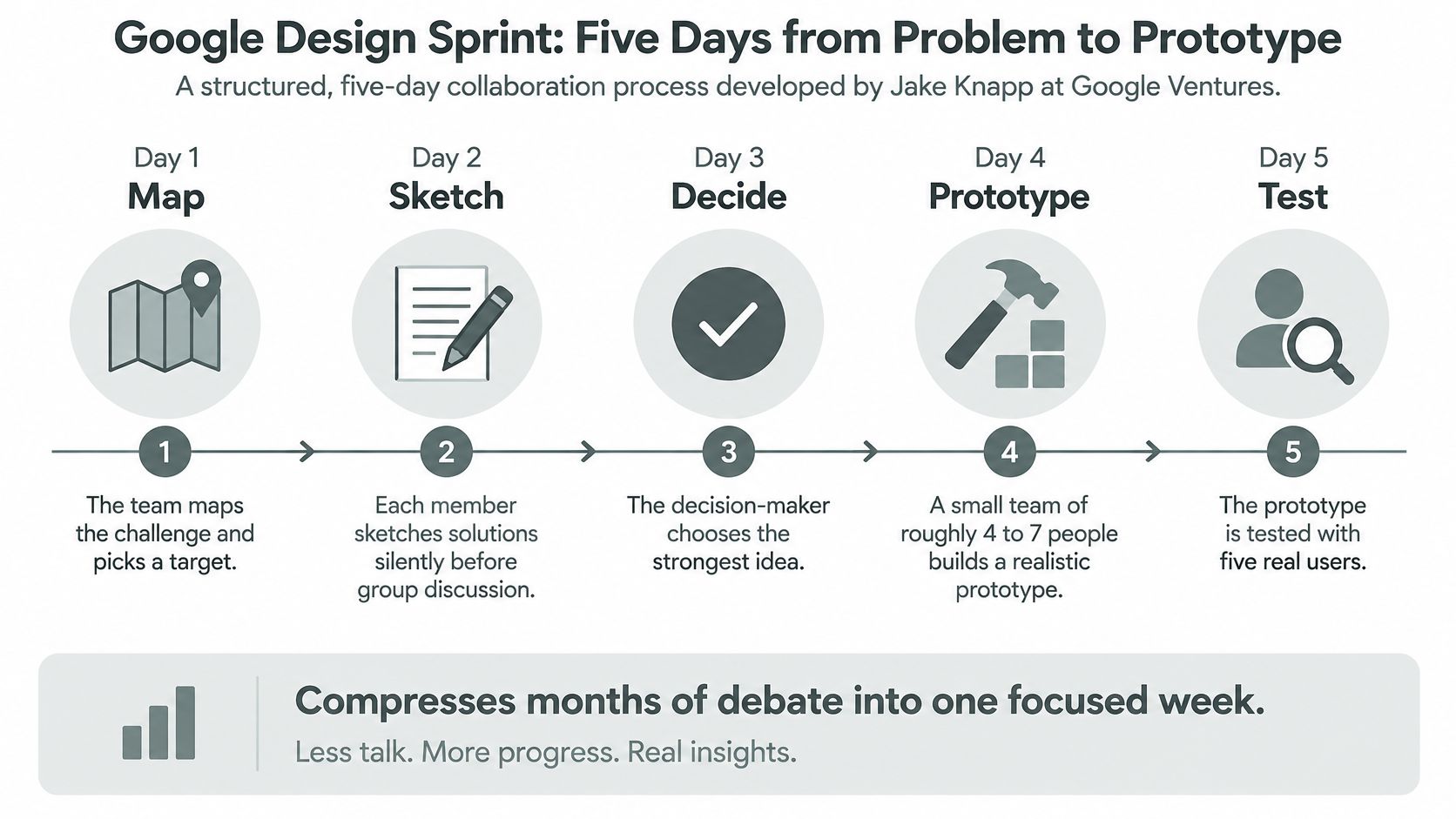
Say six people can't agree whether a booking flow should lead with price or with availability. Teams at companies such as Slack and Nest used sprints to test product concepts, as described in Sprint, and Google Ventures portfolio startups used the process to validate ideas before a full build. Your Friday output is five user tests and a yes, a no, or a narrow rewrite. It is not a roadmap.
Set the room before Monday
I recommend naming one decision-maker before Day 1. Without that person, Tuesday's sketches become another debate. Book a private room with whiteboards and wall space for the whole week. Our Executive Room fits the decision-heavy days, and the Freeform Room fits open sketching. Don't run this on hot desks. Interruptions kill the prototype.
A short film of the week makes the pace obvious before you block calendars.
2. Design Thinking Workshops
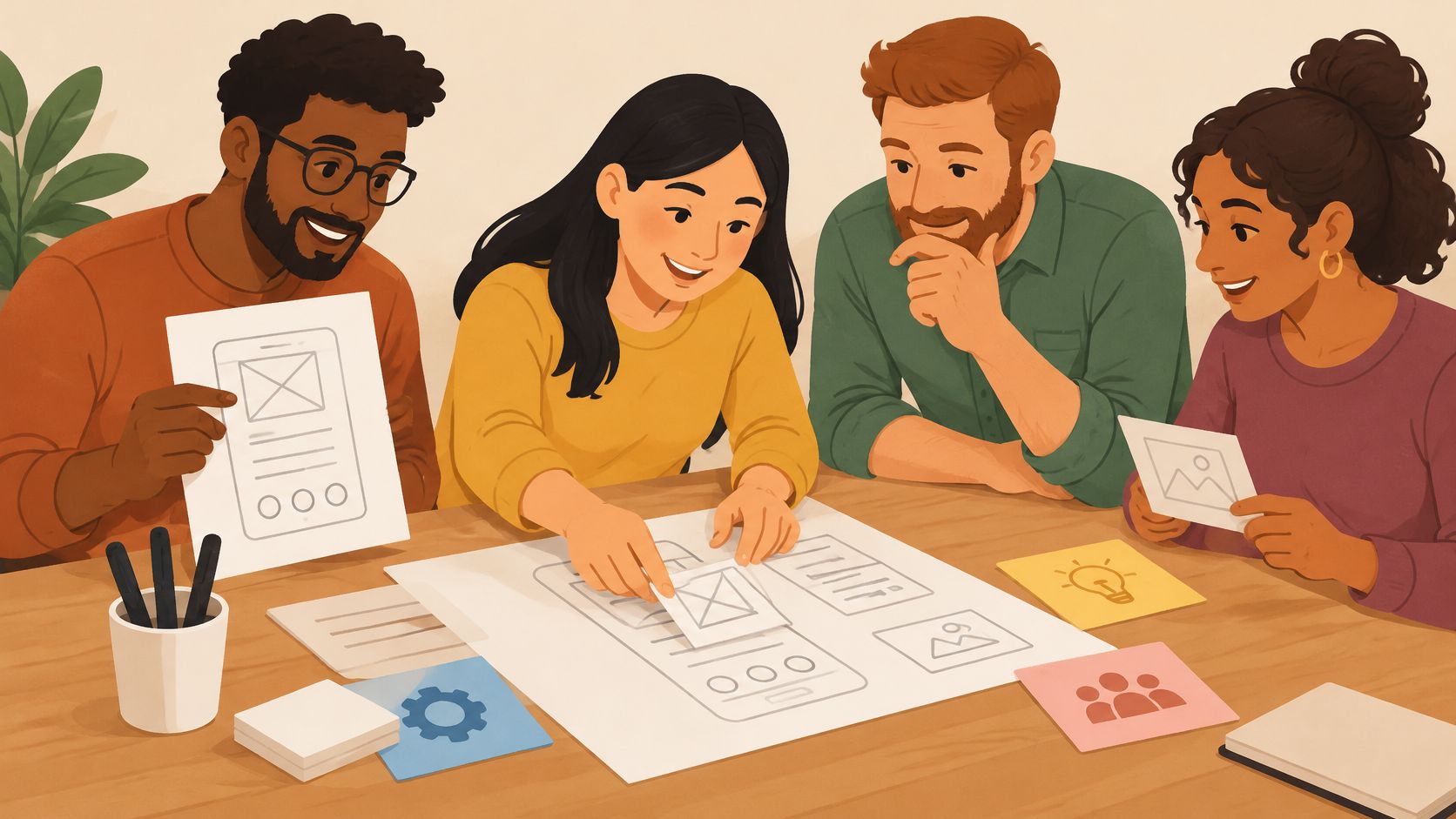
Start with two customers, not a stack of sticky notes. A design thinking workshop cycles through empathy, define, ideate, prototype, and test. IDEO popularized the approach through healthcare and consumer-product redesigns, and the Stanford d.school formalized it with student teams building solutions for community problems. Mixed expertise is the asset. It also slows you down if nobody frames the problem before the markers come out.
A 90-minute version that still works
Give the first 60 minutes to empathy. Interview two or three real customers, then write one how-might-we question so ideation stays open. Say a café owner and a bookkeeper disagree about a loyalty app. They spend the hour hearing why regulars forget punch cards, then sketch three paper screens. The prototype can be cardboard. The test is whether a regular would use it next Tuesday.
Keep decision reviews separate: Use the Executive Room when you must choose a direction, and the Freeform Room when the wall needs to fill with ideas.
Stop at one problem: Extra themes feel productive and leave you with nothing to prototype.
Borrow a fuller menu of exercises: Our workshop activity ideas are built for sessions like this, not for generic icebreakers.
What doesn't work is a half-day of brainstorming with no user in the building. You leave with posters and the same argument.
3. Scrum Daily Stand-Ups
The Scrum Guide defines the Daily Scrum as a 15-minute event. A common way to run it is to ask what each person completed yesterday, plans to do today, and what is blocking progress. Software teams use these huddles to coordinate releases; marketing and content teams can use them to manage daily production. Keep updates tied to the sprint goal, not a manager's inbox.
A 2025 experience-sampling study found higher well-being and work engagement in community coworking spaces than at home. Within those spaces, face-to-face collaboration was associated with significantly higher well-being and work engagement. Its productivity effect was only a positive trend, not statistically significant. A stand-up helps surface coordination needs, but it does not guarantee work will ship.
How a Tuesday huddle runs
Use an open collaboration area for a brief, standing check-in. Give each person a clear turn, and keep every update connected to the sprint goal:
Yesterday: One sentence on what moved.
Today: One sentence on what will move.
Blocker: Name who can help, then stop.
For a three-person studio cutting a client video, the editor might be waiting on a logo. Identify who can provide it before the team leaves, so the editor can return to the work. The trade-off is simple: a short huddle surfaces snags but leaves complex decisions unresolved. A seated, 40-minute status tour defeats the format. Book a separate slot when a blocker needs discussion; use the stand-up to name it and assign an owner.
4. Kanban Visual Workflow Boards
Kanban is a wall, not a philosophy lecture. Cards move across a few columns, usually To Do, In Progress, and Done. Toyota built the idea for production lines. David J. Anderson later adapted it for knowledge work and software. Support queues and agency production boards are the everyday versions. Limit work in progress or the board becomes a junk drawer with nicer labels.
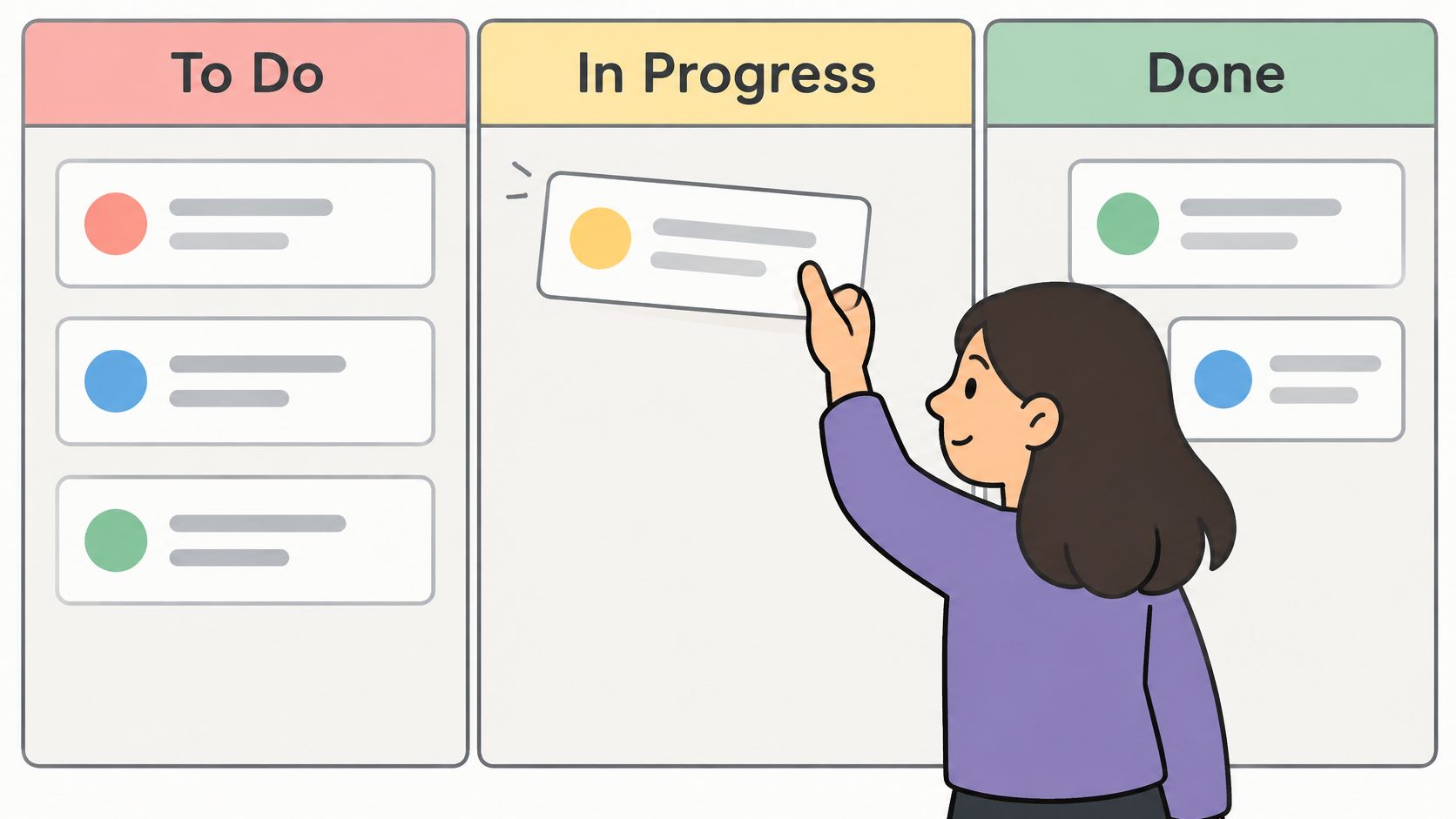
Atlassian's 2025 State of Teams research found that difficulty finding information was the number-one barrier to moving quickly, and 56% of knowledge workers said they often need to ask someone directly or schedule a meeting to get what they need. A physical board in a shared hub cuts that hunt for mixed teams who don't live in the same chat all day.
Practical rule: Start with three to five columns, and set a work-in-progress limit on each one.
Review the board once a week for 20 minutes and clear blockers there. Move that review to a wall people already walk past, not a slide deck nobody opens. Say a photographer, a writer, and a producer share client deliverables. The card sits in Review until the client file is attached. Duplicate decks and mystery versions are the failure mode. If the latest file isn't on the card, the column is lying.
5. Pixar's Braintrust
Ed Catmull describes Pixar's Braintrust in Creativity, Inc. (2014) as a recurring circle of directors and storytellers who watch unfinished work and speak plainly. The group critiques. The director decides. Toy Story 2 was reworked after those reviews, and creative studios now borrow the model for ads and content. The useful part isn't the fame. It's the split between feedback and authority.
Rules that keep the room honest
Critique the work: Say what's confusing before you pitch a fix.
State the problem, then offer ideas: A pile of suggestions without a diagnosis is noise.
Record the call: One person writes decisions and action items before anyone leaves.
Say a podcaster brings a rough episode to three peers. They name where the opening loses a listener. The host keeps or drops the cold open. Nobody votes the episode into a committee draft.
Our podcast booth and production spaces, including photography rentals through First North, suit this kind of review because the work is on a screen, not in a slide. A lobby is the wrong room. People soften the note when strangers can hear it. Candor needs a door. What doesn't work is a brainstorm dressed up as a review. If the maker has to defend every choice, you'll get politeness and a weaker cut.
6. Building Psychological Safety (Project Aristotle)
Google's Project Aristotle studied hundreds of internal teams and found psychological safety was the strongest predictor of effective collaboration. Amy Edmondson coined the term in the late 1990s, and her hospital work showed safety huddles helping staff speak up about errors. The practice is simple and uncomfortable. People must be able to ask a basic question, admit a miss, or challenge a plan without paying for it socially.

Appspace's 2025 U.S. and U.K. survey found that 48% of employees considered transitions between remote and in-person work disruptive, and 85% said their organizations could do more to improve employee experience. The same briefing also reports that 83% of leaders and 77% of employees struggle to find time on colleagues' schedules. More meetings won't fix a trust gap. Shorter, fairer ones might.
A ritual that fits hybrid weeks
Ask every person for one question or concern before you discuss the agenda. Run a short anonymous pulse each quarter. Small, regular gatherings beat a single offsite if the team is half remote. Our guide to team morale walks through habits that keep those gatherings from turning into lectures.
Say a founder and two contractors meet weekly. The contractor who spots a bad date in the proposal has to be able to say it in the room, not in a private text afterward. If only the people on-site talk, you don't have safety. You have proximity.
7. Sprint Retrospectives
A retrospective sits at the end of a cycle and asks what went well, what didn't, and what changes next time. Norman Kerth's Project Retrospectives (2001) and Esther Derby and Diana Larsen's Agile Retrospectives (2006) made the practice standard for agile teams. Software groups run it after a two-week sprint. Project teams use the same shape as an after-action review when a client job closes. Skip it and you repeat the same miss with new sticky notes.
A controlled Microsoft employee experiment split 60 people into Copilot and non-Copilot groups and asked them to summarize a difficult 35-minute recorded meeting. The assisted group finished in an average of 11 minutes 13 seconds, versus 42 minutes 34 seconds for the control group, about 3.8 times faster. They also reported feeling twice as productive and 58% less drained. Accuracy slipped. Assisted summaries captured 11 of 15 target details, versus 12 of 15 without the assistant.
Use the draft. Don't trust it as the record.
Cap the live retrospective at 60 minutes and leave with no more than three actions. Open the next one by checking whether those actions happened. Host it in a private room, away from the desks where the work went badly, so people will say the awkward part. Say a client launch missed a deadline because copy and design never shared a file. The action is one shared folder with a named owner, not a speech about communication.
8. Offsite Executive Strategy Retreats
An offsite is justified when leaders need a decision that daily interruptions keep killing. Patrick Lencioni has long pushed these sessions as a way for leadership teams to build trust and alignment. Annual planning offsites set quarterly objectives. A small business can do the same job in a half day if the pre-work is real. Travel isn't the magic. Uninterrupted time is.
A 2006 study in the Journal of Computer-Mediated Communication compared face-to-face teams, audio-only teams, and teams using a shared workspace. Face-to-face participants reported more teamwork behaviors and rated their performance more positively than people on audio alone. Distributed teams with a shared workspace also reported stronger teamwork behaviors than audio-only teams, and they committed fewer errors. Bring remote partners into the same materials, or the room will decide without them.
Before you book the day
Send a pre-read and a decision list at least one week ahead. End with owners and deadlines in writing. Our Executive Room and Thomas Room cover half-day or full-day sessions locally, so you don't burn the morning on a drive. A sample flow lives in our strategy offsite agenda.
Say three partners must choose which service to drop next quarter. If that choice isn't on the pre-read, the day becomes a tour of grievances. What fails is an offsite with no written close. People remember the lunch and forget the owner.
How the eight team collaboration examples compare on format, team size, and time commitment
Item | Core Format | Typical Team Size | Time Commitment | Best For |
|---|---|---|---|---|
Google Design Sprint | Five-day process from problem mapping to user-tested prototype | Small cross-functional team of 4–7, including a decision-maker | Five focused days | Testing a product idea quickly with user evidence |
Design Thinking Workshops | Human-centered cycle of empathy, problem framing, ideation, prototyping, and testing | Diverse team with technical, business, and creative skills | Flexible workshop cycle | Solving user-centered product, service, or organizational problems |
Scrum Daily Stand-Ups | Brief daily check-in on progress, plans, and blockers | Scrum team | About 15 minutes daily | Keeping teams aligned and surfacing blockers early |
Kanban Visual Workflow Boards | Visual task board with workflow stages and work-in-progress limits | Team managing a shared workflow | Ongoing, with regular reviews | Making workflow, workload, and bottlenecks visible |
Pixar's Braintrust | Peer review with candid feedback while the director retains final authority | Trusted group of experienced peers | Recurring review sessions | Improving creative work through candid feedback |
Building Psychological Safety (Project Aristotle) | Team norms that encourage questions, dissent, and learning from mistakes | Whole team | Ongoing practice | Encouraging open communication, learning, and collaboration |
Sprint Retrospectives | Structured review of what went well, what did not, and what to improve | Project or sprint team | At each cycle; typically limited to 60 minutes | Turning team experience into practical improvements |
Offsite Executive Strategy Retreats | Facilitated sessions for priorities, alignment, and strategic decisions | Leaders and key team members | Typically one to two days | Setting strategy and resolving cross-department priorities |
Turn These Team Collaboration Examples Into Your Next Session
Choose the workflow around the decision, review, or planning cycle ahead, then match the setting to the work. A sprint needs wall space and a clear decision-maker. A stand-up works best with an open floor and a firm stop time. A retrospective needs privacy and a short list of actions.
Gallup's meta-analysis covered more than 82,000 work teams, about 1.8 million employees, 230 organizations, 49 industries, and 73 countries. The association between engagement and performance held across industries, national environments, economic conditions, and periods of technological change. Engagement does not explain every gain, so assess collaboration through practical outcomes: problem-solving, retention, customer experience, and sustained productivity.
Freeform House is a members-only club and workspace in a restored 1920 building in downtown Jenks. Members can use private workspaces, open collaboration areas, and reservable conference rooms. The Executive Room has a Jamboard for sessions where everyone needs to see and work through ideas together. David D. describes the setting as useful for client meetings and strategic business discussions: “Freeform House offers Jenks executives a refined, upscale environment essential for impactful client meetings and strategic business discussions, projecting professionalism and success.”
Match the format to the clock
Use an in-person session for trust-building, creative synthesis, or a sensitive decision. Keep routine status updates async. Before the meeting ends, record the decision where the work is tracked, assign an owner, and set a deadline. If the context remains with one person after the session, the team has not captured what it agreed.
Survey data reported by the American Enterprise Institute found that 58% of Americans with nearby local amenities such as coffee shops, restaurants, parks, bars, or gyms said they felt close to their neighborhoods and neighbors, compared with 43% of those without a nearby third place. Among people who regularly visited a local third place, 64% said they recognized others in their community. A work hub that offers dining as well as shared work areas can create opportunities for informal contact alongside focused work.
Choose a room sized for the task, not the largest available. Bring the pre-read, and leave with named owners for the follow-up actions. That turns a collaboration format into a working session with a clear outcome.
Freeform House offers members workspaces, dining, and social events, with rooms suited to meetings and workshops. If your next session needs a private room, open collaboration space, or a place to continue conversation over a meal, visit Freeform House to explore its facilities.
Comments