Physical Address vs Mailing Address What Your Business Needs

The difference between a physical address vs mailing address boils down to a simple concept: one is where your business is, and the other is where you get your mail. A physical address is the actual brick-and-mortar spot for legal registration and day-to-day operations. A mailing address, on the other hand, is just for receiving mail and can be something entirely different, like a P.O. Box or a virtual mail service.
Defining Your Business's Official Location
Picking the right address for your business is more than just a line on a form. It's a strategic move that affects your privacy, legal standing, and the professional image you project to the world. Your physical address is your literal footprint—the place you meet clients, run your shop, or are officially registered with the state.
A mailing address is simply a destination for letters and packages. While your physical and mailing addresses can be the same, they absolutely don't have to be. This is a game-changer for home-based entrepreneurs in places like Jenks, Oklahoma, who need to keep their home life private while still looking polished and professional.
Physical vs Mailing Address at a Glance
Getting a handle on the core purpose of each address type makes it much clearer when you might need one, the other, or both. This separation is all about giving your business flexibility and security.
Here’s a quick breakdown of the fundamental differences.
Attribute | Physical Address | Mailing Address |
|---|---|---|
Primary Use | Legal registration, operations, in-person meetings | Receiving mail and packages |
Verification | Required for bank accounts, licenses, and GBP | Can be a P.O. Box or virtual service |
Privacy | Exposes the actual location of the business | Protects the physical location |
Package Delivery | Accepts packages from all carriers (USPS, FedEx, UPS) | May have carrier restrictions (e.g., P.O. Boxes) |
As you can see, each has a distinct job to do. Keeping them separate is more common than you might think.
Believe it or not, there are over 2 million non-USPS addresses in the United States—these are real, physical locations where the postal service simply doesn't deliver. This forces people to rely on alternatives like P.O. boxes just to get their mail, proving there's a built-in need for separate mailing solutions all across the country.
For businesses weighing their options, the goal is to strike the right balance between a physical presence and a practical, secure way to handle mail. If you're leaning toward a professional workspace, our guide to finding the perfect office space for rent in Tulsa can point you in the right direction.
The Indispensable Role of a Physical Address
While a mailing address gives you flexibility, a physical address is the non-negotiable bedrock of any legitimate business. Think of it as the tangible, verifiable spot on the map where your enterprise is legally anchored.
This distinction is critical from day one. When you register an LLC or corporation, government agencies require a physical street address—not a P.O. Box—for official business formation. The state needs a real location for your registered agent to receive legal notices and official mail. This address establishes your legal jurisdiction, which dictates the state and local laws your business must follow, influencing everything from tax obligations to zoning regulations.

Establishing Legitimacy and Trust
Beyond the paperwork, a physical address is fundamental to building operational trust. Financial institutions, for instance, won't let you open a business bank account using only a P.O. Box. They need a verifiable street address to comply with federal regulations designed to prevent fraud and money laundering.
Likewise, securing business loans or lines of credit often hinges on having a legitimate physical location. Lenders see it as a sign of stability and a lower risk profile. For local businesses right here in Jenks, this principle is woven into essential operational steps.
A physical address is your business's proof of existence in the real world. It's what allows you to get a city permit, hook up utilities, and prove to customers that you are a stable, trustworthy part of the community.
Imagine a new cafe on Main Street in Jenks trying to get a food service license from the city. That application requires a physical inspection at a real address. The same is true when setting up internet, electricity, and water—utility companies need a physical service location to connect to.
A Requirement for Marketing and Compliance
Your physical address also plays a surprising role in your marketing. The CAN-SPAM Act, which governs all commercial email, mandates that every single marketing message must include a "valid physical postal address."
Failing to do so isn't a small oversight. Each email sent in violation can result in penalties of up to $53,088, making it a costly detail to ignore. This isn't just about avoiding fines; it’s about transparency. Displaying a real address shows your audience you're a legitimate operation with nothing to hide.
For businesses that need a professional address without getting locked into a long-term lease, exploring different options is key. You can find flexible solutions in our ultimate guide to month-to-month office space for rent.
From legal formation and daily operations to customer perception, a physical address is an indispensable asset that legitimizes your business and enables it to function.
Why a Separate Mailing Address Is a Strategic Advantage
Your physical address might be where you're legally anchored, but a separate mailing address is one of the smartest tools you can have for privacy, professionalism, and just plain operational sanity. If you're a home-based entrepreneur or a remote worker, this separation isn't a small convenience—it's a critical security layer.
Putting your home address out there for your business means it's public. Anyone—clients, vendors, or just curious strangers—can look up your company online and find out exactly where you live. A P.O. Box or a virtual mailbox instantly shields your private life from your professional one, creating a boundary you'll be thankful for. It’s a simple move that goes a long way in protecting your family’s safety and your own peace of mind.
Elevating Your Professional Image
Beyond just keeping your home life private, a dedicated business mailing address gives your company an immediate credibility boost. An address in a known commercial district just feels more established than one on a residential street. It signals to potential clients and partners that you’re a legitimate, serious operation, which can be a huge differentiator in a crowded market.
For local businesses in Jenks, grabbing a commercial mailing address at a hub like Free Form House is an instant perception upgrade. You're swapping a suburban street for a well-regarded downtown location, aligning your brand with a community of other ambitious professionals and building trust right from the start.
A separate, commercial mailing address isn't just about where your mail goes. It's about crafting a professional identity. It tells the world you’re a serious business, distinct from your personal life, and ready to grow.
This professional front is backed by real logistical benefits, too. The explosion of e-commerce has really driven a wedge between physical and mailing addresses. US parcel volumes are soaring, and much of it is heading to alternative delivery points, not traditional homes. This matters because private carriers like UPS and FedEx often won't deliver to P.O. Boxes, demanding an actual street address for packages. You can learn more about the complexities of different address types and how they play out in modern logistics.
Solving Logistical and Delivery Headaches
A dedicated mailing address also smooths out a ton of common logistical bumps. If you operate in an area with spotty residential mail service, a commercial address ensures your important documents and packages actually arrive safely and reliably. It also brings all your business mail into one manageable stream.
Think about the practical wins here:
Secure Package Reception: A professional mail service or coworking space can sign for and hold your packages, which means no more worrying about porch pirates.
Mail Forwarding: Many services will forward your mail, which is a lifesaver for founders who travel often or run their business from the road.
Centralized Management: For teams, having a single mailing address just simplifies everything and ensures no critical communications get lost in the shuffle.
Ultimately, separating your mailing address from your physical one is a strategic play that pays off big time in privacy, professionalism, and operational smoothness.
Comparing Your Business Address Options
Choosing the right address for your business is a bigger decision than you might think. It’s a delicate balance of cost, privacy, and the professional image you want to project. When you get down to the physical address vs mailing address debate, you're really weighing how each option fits your day-to-day operations.
Let’s break down the four main contenders: your home address, a classic P.O. Box, a virtual mailing address, or a dedicated office space. Each comes with its own unique mix of pros and cons, and what works for one business might be a disaster for another.
Cost and Professionalism
Money talks, and for most new business owners, it's the first thing they look at. Using your home address is obviously the cheapest route—it’s free. But let's be honest, it can make your brand-new venture look a little less established, maybe even a bit amateurish.
A P.O. Box is a small step up in cost and a decent leap forward in separating your mail. It's a low-cost solution, but everyone knows what a P.O. Box is, and it screams "I don't have an office." That can still limit your professional image, especially if you're trying to land bigger clients.
This is where a virtual mailing address really shines. For a reasonable monthly fee, you get a real commercial street address. Suddenly, your business has a presence in a legitimate office building, giving your credibility an instant boost. Of course, at the top of the pyramid is a dedicated physical office or a membership at a coworking space. This is the gold standard for professionalism, offering a prestigious address and a place to actually work.
This decision tree gives you a simple way to think through the choice, especially if you're starting from home and privacy is a major concern.
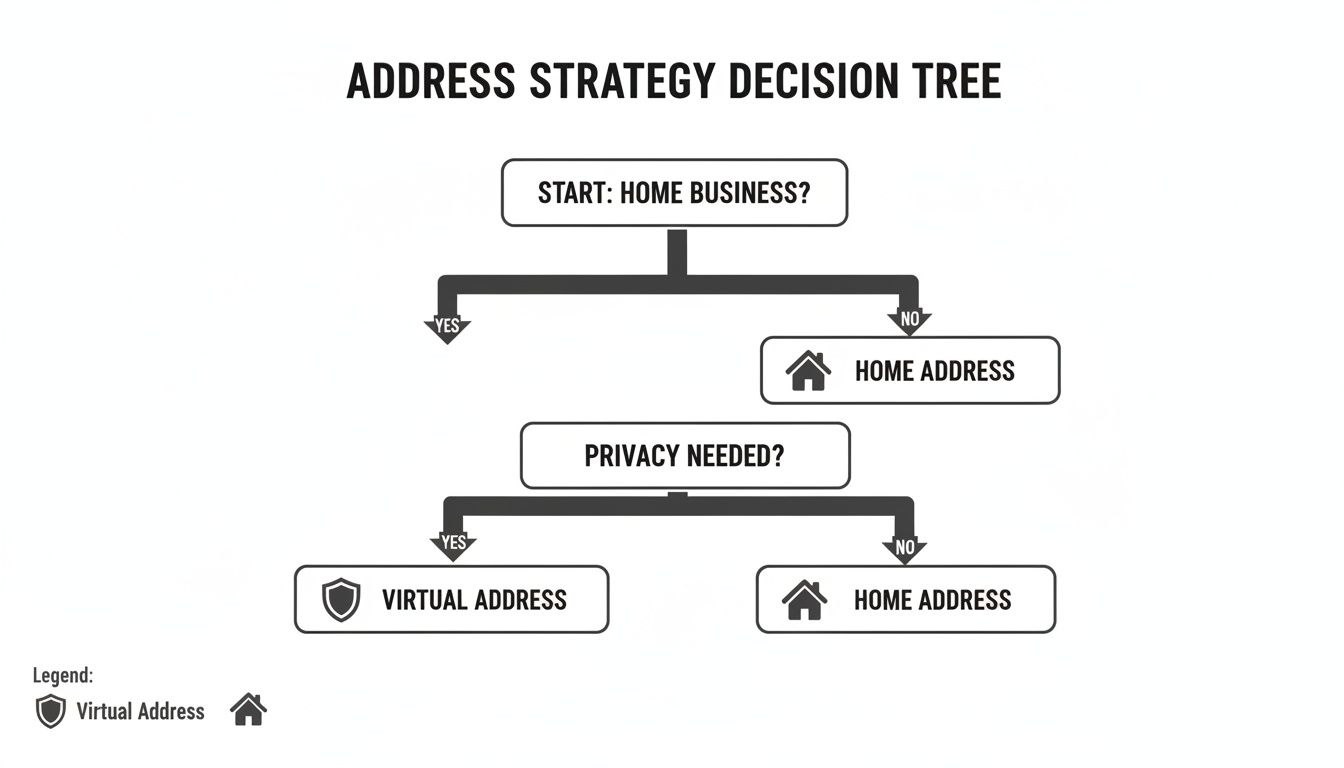
As the chart shows, if you’re running things from home but don't want your personal address out there, a virtual address is pretty much a no-brainer.
Privacy and Package Handling
Privacy is a huge driver for getting a separate business address. Putting your home address on your website, business cards, and legal documents is like handing out a map to your front door. It invites unsolicited sales visits and completely erases the line between your work life and your personal life.
A P.O. Box does a great job of shielding your home location, but it has one massive, glaring flaw: it generally only accepts mail delivered by the USPS. That means no packages from UPS, FedEx, DHL, or any other private carrier.
For any business that receives regular shipments from different couriers, this isn't just an inconvenience—it's a logistical nightmare. A virtual address completely solves this. You get a real street address with actual staff on-site to receive and sign for packages from any carrier. A dedicated office or coworking space naturally offers the same secure, all-carrier solution. If you're leaning toward a flexible workspace, our guide on finding a shared office near me is a great place to start your research.
A business address isn’t just a line on your website; it's a tool that manages your public image, secures your private life, and streamlines your daily operations. The right choice depends entirely on which of these functions you prioritize most.
Legal Compliance Considerations
Finally, don’t forget about the red tape. Legal and government requirements can often make the decision for you. As we touched on earlier, forming an LLC or a corporation requires you to have a physical street address for your registered agent. A P.O. Box is a non-starter here; it simply isn’t compliant.
While some states might accept a virtual address for this purpose, the rules can be murky and vary by location. A dedicated physical office is always the safest, most bulletproof option for legal registration.
To make things crystal clear, here’s a quick rundown of how these options stack up side-by-side.
Feature Comparison of Business Address Solutions
This table breaks down the key features of each address type, helping you see at a glance which one best fits your business needs and priorities.
Feature | Home Address | P.O. Box | Virtual Mailing Address | Coworking/Office Space |
|---|---|---|---|---|
Cost | Free | Low | Moderate | High |
Privacy | None | High | High | High |
Professionalism | Low | Low-Moderate | High | Very High |
Package Handling | All Carriers | USPS Only | All Carriers | All Carriers |
Legal Registration | Yes | No | Varies | Yes |
Ultimately, choosing the right address comes down to aligning your budget, business model, and long-term goals. There's no single "best" answer, only the one that's best for you.
How Your Address Choice Impacts Local SEO
When you're weighing a physical address vs. mailing address, it's easy to overlook a huge piece of the puzzle: local search engine optimization (SEO). For any business that relies on local customers, your address is far more than just a location—it's a critical signal to search engines like Google that you are a genuine, boots-on-the-ground part of the community.
Google is notoriously strict with its guidelines for a Google Business Profile (GBP), the powerful tool behind the local map pack that puts your business in front of nearby customers. One of its non-negotiable rules is that you must have a verifiable physical address where you conduct face-to-face business.
The Google Business Profile Requirement
This is where the distinction becomes absolutely critical. Google explicitly forbids the use of P.O. Boxes and most virtual office addresses for GBP verification. Why the hard line? Because those options don't represent a real place where customers can walk in and interact with you. Trying to use one is a fast track to getting your listing suspended, effectively making you invisible to local searchers.
For a business operating out of a professional hub like Free Form House, this rule is a massive advantage. Using our legitimate commercial address for your GBP not only checks all of Google's boxes but also anchors your business to a prime spot right in the heart of Jenks. That instantly boosts your relevance for all those "near me" searches.
Local SEO is built on trust, and a real, physical address is the foundation of that trust. It proves to both Google and potential customers that you are a stable, accessible, and authentic local business.
A consistent and accurate physical address across your website, GBP, and other online directories sends strong signals of legitimacy. This consistency, known in the industry as your NAP (Name, Address, Phone Number), is a cornerstone of ranking well in local search results.
Beyond GBP: Your Hyper-Local Marketing Foundation
Your physical address is also the bedrock for more advanced local marketing tactics. It unlocks the ability to run incredibly effective geotargeted advertising campaigns on platforms like Google Ads and Facebook, ensuring your marketing dollars are spent reaching potential customers within a specific radius of your location.
Think about what a real address enables:
Hyper-Local Targeting: You can serve ads specifically to people searching just a few blocks from your business.
Building Local Authority: A real address gets you listed in local directories and on community websites, strengthening your digital footprint where it matters most.
Customer Trust: When a potential customer sees a real street address, it provides a level of confidence that a P.O. Box simply can't compete with.
Ultimately, choosing a legitimate physical address isn't just a logistical decision; it's a strategic marketing move that directly impacts your ability to attract and win local customers.
What Happens When Your Business Goes Global?
The whole physical address vs. mailing address debate gets a lot more complicated when you start operating on a global scale. It’s not just a local quirk anymore; it's a massive challenge for any business with international ambitions. Companies quickly learn that a one-size-fits-all approach to addresses is a recipe for disaster.
Every country has its own unique postal rules and formatting standards, creating a tangled mess of logistical headaches. For anyone in e-commerce or logistics, this complexity is a direct threat to your operations. A single misformatted international address can easily cause failed deliveries, returned packages, and seriously unhappy customers—all things that hit your bottom line, hard. This is where a good address verification service becomes your best friend.
Why You Can't Afford to Ignore Global Address Verification
Address validation software is built to automatically check and standardize addresses against official postal data from all over the world. These systems can catch formatting mistakes on the fly, fill in missing details, and confirm an address is actually deliverable before a shipment even thinks about leaving your warehouse. It's a proactive step that helps prevent fraud and cuts down on those expensive delivery failures.
In a global economy, accurate address data isn't just a tiny detail—it's a core part of your supply chain and customer experience. Getting it right is non-negotiable for international success.
The sheer scale of this problem is staggering. There are 249 countries and territories worldwide, each with its own way of doing things, resulting in around 130 different postal address formats (and countless local variations). Manually checking these is practically impossible for any business handling a decent volume of orders. Throw in the constant churn of businesses moving or closing, and you're dealing with a landscape that never stops changing. You can learn more about the deep-seated complexities of global addresses to really grasp the scope of the challenge.
For any company with an international footprint, this isn't an optional task to get to later. Properly managing address nuances is a strategic imperative that protects your revenue, makes you more efficient, and helps build a brand that customers around the world can trust.
Unpacking the Fine Print: Your Top Questions Answered
When you're trying to sort out the difference between a physical address vs. a mailing address, a few key questions always seem to pop up. Let's get right to them so you can make the best call for your business or personal setup.
Can I Use a P.O. Box for My LLC or Corporation?
In a word, no. State and federal agencies are pretty strict on this one—they require a registered agent at a real street address. This is because legal notices and official documents sometimes need to be hand-delivered during business hours, and a P.O. Box just can't accept that kind of service. It’s purely a mail collection spot, not a place of business, so it won’t meet the legal requirements for service of process.
Is a Virtual Mailing Address a Legal Business Address?
Absolutely. A virtual mailing address gives you a legitimate street address, and it's a perfectly legal way to handle your business mail. The catch? Its acceptance isn't universal. While it’s a fantastic tool for protecting your privacy and projecting a professional image, some banks or government bodies might still need proof of a physical location where you actually conduct business. It’s always smart to double-check the specific requirements before you use a virtual address for any official registrations.
The best address for your home-based business is a strategic choice between cost, privacy, and professionalism. A virtual address or coworking membership often provides the ideal balance for growth-focused entrepreneurs.
What Is the Best Address for a Home-Based Business?
Honestly, this comes down to what you value most. If you're looking for maximum privacy and want to put your most professional foot forward, a virtual address or a coworking space membership is your best bet. If your budget is the main concern, using your home address is free, but it means your personal location becomes public information.
A P.O. Box is a low-cost way to keep your home address private, but it can look less professional and has a major drawback: carriers like UPS or FedEx often can't deliver packages to them.
Ready to establish a professional presence in the heart of Jenks? A membership with Free Form House provides you with a prestigious commercial address, premium workspace, and an instant community of local professionals. Explore membership options today.
Comments