The Intimate Wedding Checklist: 10 Steps for 2026

You've found a beautiful venue, and you can already see the ceremony happening there. Then you price dinner, rentals, and photography and realize you're planning for a much smaller guest list than the room was designed to hold. Nothing's booked yet, but you've already started making compromises around the wrong space.
Plan an intimate wedding in the order decisions happen. Agree on who's coming and what you can spend before choosing the setting. Confirm the legal requirements before treating the ceremony as settled. Work out who'll move the flowers, cue the music, and answer the caterer's questions before handing anyone a wedding-day schedule.
A small celebration gives you room to be selective, not permission to skip coordination. You might choose a remarkable dinner over elaborate décor, or candid photography over a long portrait session. Those choices work best when you make them deliberately, rather than using whatever money and time remain.
This intimate wedding checklist follows that decision order. Each step identifies when to start, what's hardest to reverse, and the practical details that deserve attention before you commit.
1. Set a Realistic Budget and Guest Count
Lead time: Before venue tours or deposits. Hardest decision to reverse: Inviting people beyond your agreed capacity.
Start with names, not an estimated headcount. Include partners, children, and anyone whose attendance would require travel or assistance, then agree on how you'll handle additional invitations.
For U.S. weddings held in 2024, celebrations with fewer than 50 guests averaged $15,000, compared with $42,000 for more than 100 guests, according to FOX 5 New York's reporting on The Knot's wedding-cost findings. That's context, not a quote for your wedding. Your menu, venue, and service choices still determine what you'll spend.
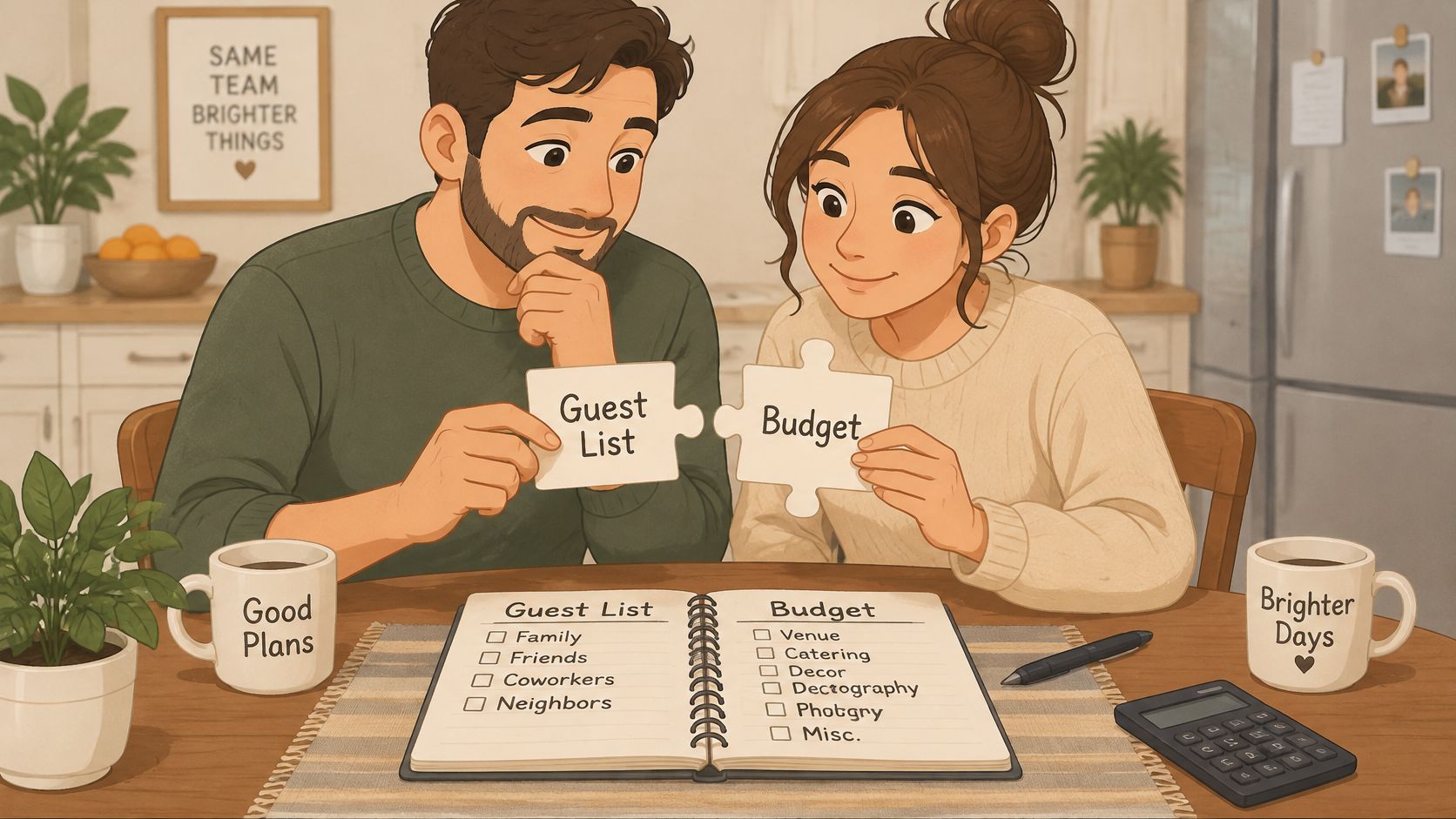
Build a shared spreadsheet with separate columns for estimates, signed prices, deposits, balances, and payment deadlines. Use a wedding venue rental cost breakdown to distinguish room rental from catering, staffing, equipment, and cleanup.
Confirm contributions: Ask family members to commit to an amount and clarify whether it comes with guest-list expectations.
Protect a reserve: Keep money unassigned for unavoidable changes rather than spending everything on initial bookings.
Choose priorities: Agree on what deserves premium spending and what you're comfortable simplifying.
Say you choose a private dinner instead of a ballroom reception. Put the savings toward the meal only after you've priced service, rentals, taxes, and gratuities.
2. Choose a Private, Flexible Venue
Lead time: Once the guest list and spending limit are approved. Hardest decision to reverse: The venue contract and its associated restrictions.
Look for a room that feels intentional with your actual attendance, not merely one that can accommodate it. A private dining room, restored building, or boutique event space can provide atmosphere without extensive decoration.
Consider the relationship between setting, privacy, and dining layout.

Ask to see a furnished floor plan showing the ceremony, dining tables, service routes, and reception seating. If the same room serves multiple purposes, establish where guests will go during the changeover and who'll do the work.
Compare the complete arrangement
Confirm outside-vendor rules, catering access, bar arrangements, setup windows, cleanup duties, and included equipment in writing. Visit at your intended ceremony time to assess natural light, street noise, and privacy.
For a downtown celebration, a single-location ceremony and dinner can simplify guest movement. It won't simplify staffing unless someone is responsible for resetting the room. Use these small-wedding venue considerations to compare practical fit rather than photographs alone.
Watch with those layout and atmosphere questions in mind.
Don't sign until you understand what happens if weather, attendance, or the event schedule changes.
3. Obtain the Marriage License and Confirm the Officiant
Lead time: Research requirements while confirming your date; obtain documents within the issuing office's permitted window. Hardest decision to reverse: Discovering that your ceremony arrangements don't satisfy the applicable requirements.
Treat the legal ceremony and the celebration as connected but separate workstreams. A beautiful venue, a willing friend, and a finished ceremony script don't establish that the paperwork is correct.
Contact the relevant court clerk or marriage-license office for current instructions. Don't assume you must obtain the license in the ceremony's county, or that another state's process applies to an Oklahoma wedding.
Create a paperwork handoff
Write down the office's instructions for identification, supporting documents, application procedures, timing, officiant authorization, signatures, and return of the completed license. Record who confirmed the information and keep any written guidance with your planning documents.
Confirm the officiant: Establish that the person can legally perform your ceremony in the applicable jurisdiction.
Assign document custody: Name who brings the license and who receives it afterward.
Plan the return: Confirm the recipient office, submission method, and applicable deadline.
Protect sensitive information: Store identification and legal documents separately from a broadly shared vendor folder.
For example, if a friend will officiate, verify their eligibility before printing their role in the program. Have them review the signing process alongside the ceremony script.
Paperwork rule: Assign responsibility for returning the signed license before the wedding, not during the send-off.
Keep copies where appropriate, but confirm what the office requires you to return.
4. Book Core Vendors Early
Lead time: After the venue and date are secure, before spending on decorative extras. Hardest decision to reverse: A nonrefundable commitment to the wrong service or coverage.
Book the services that determine whether the event functions: food, photography, ceremony leadership, and any essential sound or rentals. Add flowers and entertainment around those commitments.
The Knot Worldwide's study of U.S. couples married in 2025 reported an average of 13 wedding professionals, illustrating how many separate services a wedding can involve, even though your roster may be smaller (The Knot Worldwide's Real Weddings Study announcement).
Buy the right scope, not the smallest package
Ask vendors to describe deliverables, staffing, arrival and departure, substitutions, cancellation terms, and backup arrangements. A short photography package isn't good value if it ends before the family moments you care about.
For authentic imagery, review complete galleries rather than highlight reels. Timeless Productions' photography-style guide describes documentary coverage as observation-led, with minimal posing and primarily natural or ambient light.
Photography: Request realistic skin tones, genuine expressions, and editing that preserves the setting. Avoid clip-art-like effects and artificial-looking composites.
Catering: Establish who supplies service staff, equipment, and cleanup.
Flowers: Specify who moves arrangements between ceremony and dinner.
Music: Confirm equipment, power needs, and a playback fallback.
For example, choose documentary coverage with a concise family-portrait list rather than asking a photographer to stage every interaction. You'll protect both the visual style and the time available with guests.
5. Plan a Simple, Locally Sourced Menu
Lead time: Develop the service plan before signing the catering contract; finalize meals after dietary responses arrive. Hardest decision to reverse: A menu or service style the venue can't support.
Start with how dinner will happen. A plated meal needs a coordinated serving plan. Family-style dining needs room for platters. Restaurant delivery still needs someone to receive, hold, serve, and clear the food.
A local restaurant and café can make a strong combination for dinner and dessert. Confirm their event capabilities rather than assuming a familiar takeout order will scale into wedding service.

Keep choice manageable and service clear
Ask for a tasting or representative sample menu. Collect dietary requirements privately, distinguish allergies from preferences, and have the caterer explain how meals will be identified and delivered.
Specify quantities: Include vendor meals and a caterer-approved allowance for changes.
Confirm equipment: Assign responsibility for refrigeration, hot holding, serving utensils, glassware, and waste.
Clarify drinks: Establish venue rules, permitted service arrangements, corkage, and any applicable licensing requirements.
Price the whole service: Compare food alongside staffing, rentals, setup, and clearing.
Say you want shared platters down a long table. Reduce bulky centerpieces so guests can pass dishes comfortably, and provide separately plated meals where dietary safety requires it.
Explore small wedding reception ideas after choosing the service format. Décor should fit dinner, not force servers to work around it.
6. Design Invitations and Guest Communication
Lead time: Build the information hub before invitations; notify traveling guests as soon as the date and location are reliable. Hardest decision to reverse: Sending conflicting or incomplete event details.
Use a single wedding website or shared information page as the authoritative version of your plans. Printed invitations can be keepsakes, but guests still need a dependable place to find updates.
The Plumb Club's summary of The Knot's engagement and wedding survey reports that 49% of couples used QR codes on save-the-dates or invitations. A QR code is useful only when its destination works on guests' phones and contains current information.
Tell guests what they need to act
Include the full address, arrival instructions, dress guidance, parking, lodging suggestions, RSVP deadline, and a contact for questions. Choose the RSVP deadline by working backward from your caterer's and rental company's final-count requirements.
Test access: Open links on different devices and provide a readable alternative to the QR code.
Collect useful responses: Request attendance, meal selection, dietary needs, and optional accessibility information.
Limit private information: Don't publish guest health details or personal contact lists.
Follow up personally: Call guests who haven't responded rather than assuming silence means no.
For example, a printed card can direct guests to downtown parking instructions and a digital RSVP form. If parking changes, update the page and message affected guests directly.
Guests shouldn't have to compare an invitation, a text thread, and an old email to work out when to arrive.
7. Coordinate Attire, Hair, and Beauty
Lead time: Begin once the venue and event formality are settled; book around actual production and alteration schedules. Hardest decision to reverse: An outfit that can't be comfortably altered or delivered in time.
Choose clothing for the wedding you're holding. A formal gown can work beautifully at a private dinner, but a long train needs a practical plan for stairs, dining, and dancing.
Ask the retailer or tailor for ordering and fitting deadlines before purchasing. Book hair and makeup around the required departure time, not merely the ceremony start.
Test the complete look in motion
Wear the intended shoes and undergarments to fittings. Sit, walk, climb steps, and lift your arms so the tailor can identify restrictions while there's still time to fix them.
For a daytime ceremony in a historic downtown building, a classic suit and simple gown might need little additional styling. The useful test isn't whether they match the architecture perfectly. It's whether you can move, eat, and greet guests comfortably.
Trial the styling: Test hair and makeup with any veil, headpiece, or accessories you'll wear.
Consider conditions: Prepare a layer, alternate shoes, or weather-appropriate accessories.
Pack repairs: Include stain-removal supplies suitable for the fabric, sewing materials, pins, and blister protection.
Assign pickup: Give someone responsibility for collecting finished clothing and checking every component.
Don't leave steaming, garment transport, or dressing assistance unassigned. These small tasks can delay the entire departure even when appointments finish on time.
8. Plan the Ceremony, Vows, and Music
Lead time: Draft after confirming the officiant; finalize before the sound check and vendor briefing. Hardest decision to reverse: A ceremony layout or program that guests can't comfortably follow.
Write the ceremony as a sequence of actions. Identify entrances, readings, vows, ring exchange, any required elements, music cues, and the exit, then give each action an owner.
A personal ceremony doesn't need a crowded program. For example, handwritten vows, a family reading, and a solo guitarist can provide a complete emotional arc without repeated introductions or transitions.

Make participation possible
Check sightlines from seated positions and test speech volume with the room arranged for guests. Give the officiant a microphone when needed, and assign someone other than the couple to cue recorded music.
For loved ones attending remotely, design participation rather than opening a livestream. EventPlanet's coverage of hybrid wedding formats identifies livestreaming as part of wedding planning; your practical task is making that connection usable and personal.
Appoint a remote host: Have someone monitor audio and help participants connect.
Test the experience: Check captions, connection quality, and an audio-only fallback.
Include a contribution: Schedule a remote reading, toast, or guestbook message where appropriate.
Agree on privacy: Obtain consent before streaming or recording and define who receives access.
Keep printed vows and an offline music backup available. A dead battery shouldn't determine how the ceremony unfolds.
9. Arrange Transportation and Guest Logistics
Lead time: Audit access during venue selection; confirm individual arrangements after RSVPs. Hardest decision to reverse: Choosing a route or transport option that excludes a guest.
Walk the entire guest journey, from arrival through departure. Check parking, drop-off space, entrances, seating, restrooms, and the route between ceremony and dinner.
GuestReel's guidance on unconventional wedding venues identifies accessibility, bathrooms, transportation, power, weather backup, catering restrictions, and setup time as details to verify before booking. A charming setting isn't a substitute for a workable access plan.
Build a human access plan
Privately invite guests to share mobility, hearing, vision, sensory, and dietary needs. Ask what would help them participate rather than requiring them to disclose a diagnosis.
Verify the route: Check surfaces, thresholds, stairs, elevators, lighting, and restroom access.
Match the vehicle: Don't assume a golf cart or standard rideshare can accommodate every passenger.
Assign assistance: Name someone who can meet guests and explain where to go.
Prepare alternatives: Document covered arrival options and changes for weather or traffic delays.
Say dinner is a short walk from the ceremony. That distance may suit most guests while still requiring an accessible vehicle for someone else. Confirm the passenger's needs and the vehicle's capabilities before promising a solution.
Access check: A route is only useful if the guest can complete the whole journey, including the restroom visit and the trip home.
Publish clear directions, but keep individual assistance arrangements private.
10. Create a Day-Of Timeline and Assign Helpers
Lead time: Draft after the core bookings; distribute before final vendor confirmations and update when responsibilities change. Hardest decision to reverse: Leaving operational decisions with the couple on the wedding day.
Build the schedule backward from the ceremony and meal-service commitments. Include access to the building, deliveries, setup, dressing, photographs, guest arrival, room changes, dinner, and cleanup.
Give each entry a time, location, owner, and dependency. The caterer needs to know when the room is ready, not just when dinner appears on the guest program.
Delegate authority, not just errands
A trusted friend can coordinate a straightforward event if the responsibilities are realistic and agreed in advance. A hired coordinator is the stronger choice when you have complicated room changes, multiple locations, or substantial vendor management.
Name the decision-maker: Tell every vendor who can approve routine changes.
Add buffers: Allow recovery time around travel, dressing, photographs, and room resets.
List contacts: Include vendor mobile numbers, delivery instructions, and emergency contacts.
Track handoffs: Assign rings, documents, gifts, personal belongings, leftover food, and final cleanup.
For example, the coordinator can meet the florist while a family helper gathers people for portraits. Neither task should require someone to interrupt the couple for directions.
Review the schedule with vendors rather than emailing it. Ask each person to confirm their arrival, setup needs, service window, and departure responsibilities.
The final version should be readable on a phone and available offline. Keep an event-operations copy separate from any document containing sensitive guest information.
Lead Time, Guest Fit, and Cost Drivers for Each Intimate Wedding Task
Read this table in the order the decisions have to happen. Guest count and budget come first because they set the ceiling for everything below them. The hardest-to-reverse column tells you what to research before you sign anything.
Item | Typical Lead Time | Best Guest Count Fit | Hardest-to-Reverse Decision | Main Cost Driver |
|---|---|---|---|---|
Set a Realistic Budget and Guest Count | Before venue or vendor shopping | Fewer than 50; often 20–30 | Setting the guest limit | Per-guest spending |
Choose a Private, Flexible Venue | Early in planning, before booking vendors | 20–50 guests | Signing the venue contract | Venue rental and included amenities |
Obtain the Marriage License and Confirm the Officiant | Check local requirements early; apply within the license validity window | Small ceremony; any count permitted by venue | Choosing the ceremony date and location | License fees and officiant services |
Book Core Vendors Early | As early as possible after the date and venue are set | Small weddings; packages sized to the guest list | Paying deposits and signing vendor contracts | Vendor fees and minimum spending requirements |
Plan a Simple, Locally Sourced Menu | After venue selection; finalize headcount before the event | Small group suited to shared or family-style dining | Selecting the caterer and service style | Food and beverage per guest |
Design Invitations and Guest Communication | Save-the-dates 6–8 months ahead if guests travel | Any intimate guest list | Sending invitations and setting the guest list | Printing and postage |
Coordinate Attire, Hair, and Beauty | Book attire 4–6 months ahead | Any intimate wedding party | Ordering custom attire | Attire, alterations, and beauty services |
Plan the Ceremony, Vows, and Music | After confirming the date, venue, and officiant | Small group where everyone can see and hear | Choosing the ceremony format and music | Live musicians and sound equipment |
Arrange Transportation and Guest Logistics | Once the venue and guest locations are known | Any small group; especially guests needing accessibility support | Booking shuttles or other transportation | Shuttle or vehicle rentals |
Create a Day-Of Timeline and Assign Helpers | Share the timeline at least 2 weeks before the wedding | Any guest count | Assigning day-of responsibilities | Professional coordination, if hired |
Two patterns matter here. Per-guest spending appears in the budget, menu, and venue rows, so every name you add to the list raises costs in several places at once. I treat the guest limit as the single most consequential number in the whole plan for that reason.
The second pattern is timing. Deposits, contracts, and custom orders dominate the hardest-to-reverse column. Venue, vendors, and attire all sit in that category, which is why they need to happen early and only after the guest count is settled. Invitations, transport, and the day-of schedule are easier to adjust, so they can wait until the fixed pieces are locked in.
Turn This Checklist into a Working Timeline
Copy this intimate wedding checklist into a shared document and give every task an owner, a deadline, and a status. Link each line to its contract or confirmation email so nobody digs through separate inboxes during the wedding week.
Lock in guest count and budget first. Those two numbers constrain every later choice: room size, catering minimums, rental quantities, transport capacity. Then secure the venue, verify the legal process, and book the vendors that determine how the day runs. The checklist order reflects lead times, and it does not excuse postponing connected tasks. Accessibility questions belong inside the venue search itself, and travel communication starts the moment guests need reliable details to plan around.
Separate commitments from preferences
Mark every decision as committed, awaiting confirmation, or still flexible. A signed catering agreement is a commitment. A preferred napkin color stays flexible, and it should never draw attention away from missing dietary information or an unresolved shuttle booking.
Review the plan each time something significant changes. Adding ten guests affects seating, catering, rentals, transport, and the room layout. Moving the ceremony an hour affects light, sound, photography, and vendor access. Treat each change as a check against every dependent task.
Before paying: Confirm the scope and the cancellation terms.
Before communicating: Verify the date, address, arrival details, and next action.
Before finalizing: Resolve outstanding guest needs and vendor dependencies.
Before handing over: Make sure helpers know both their tasks and their decision authority.
For a downtown Jenks celebration, we host private events, including weddings, at Freeform House, and our Hall of Fame Room can be booked for evening events such as small weddings. Our restored 1920 building sits in downtown Jenks, Oklahoma, and combines co-working space with a members-only community hub.
Bring your approved guest count, preferred date, budget boundaries, and draft timeline to the initial conversation. Ask about availability early. Describe the complete event, including ceremony, meal, photography, and setup needs, so you can confirm fit before making connected commitments.
The most useful plan is the one that tells each person what happens next, shows what is still unresolved, and lets you stop managing once the celebration begins.
Freeform House offers a historic downtown Jenks setting for private gatherings, with the Hall of Fame Room available for evening events such as small weddings. Visit Freeform House to explore the space and start a conversation with your guest count, preferred date, and ceremony-to-dinner plan.
Comments