How To Monetize Your Podcast Profitably

So, you want to turn your podcast from a passion project into a revenue-generating machine. The good news? It's more achievable than you might think. We can boil down podcast monetization to a handful of core strategies: running ads and sponsorships, selling your own products or services, earning affiliate commissions, and getting direct support from your listeners.
The trick is knowing which path to take and when. It really depends on your audience size, how engaged they are, and the niche you're in. But you can absolutely start making money sooner rather than later with the right game plan.
Your Quick Podcast Monetization Blueprint
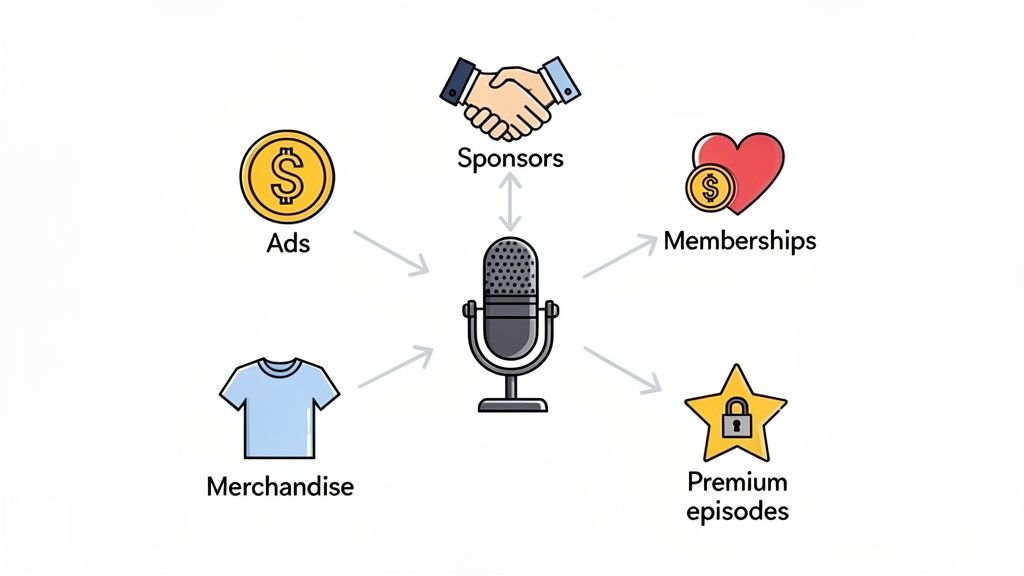
Making that leap from hobby to business feels huge, but you don't need a massive audience to get started. The key is to match the right income stream to where your show is right now. A lot of podcasters make the mistake of just waiting for sponsors to knock on their door, but the most dependable income often comes from the strategies you can control yourself.
Let's break down the main paths to revenue. Each one fits a different stage of a podcast's life.
Ads and Sponsorships: This is the classic model where brands pay you to talk about them. It works best once you have consistent downloads, usually over 1,000 per episode.
Listener Support: Think Patreon, memberships, or simple "buy me a coffee" donations. This is perfect for shows with a super loyal community, no matter the size.
Affiliate Marketing: You get a commission for promoting products you actually use and believe in. This is a fantastic place to start for new podcasters because there's no minimum audience required.
Your Own Products & Services: This is the long game. You can sell anything from digital courses and coaching to merch like t-shirts and hats. It's often the most profitable route because you're turning listeners directly into customers.
When Each Model Makes Sense
It's easy to get overwhelmed and try to do everything at once. That’s a fast track to burnout. Instead, pick one or two methods that play to your show's current strengths.
Imagine you have a new podcast about local Jenks history. You could start immediately with an affiliate link for a local coffee shop you love. As your audience grows, you could create a paid audio walking-tour guide (your own product). Down the line, with a solid listener base, you could approach the local history museum for a proper sponsorship. The strategy grows with you.
The smartest podcasters I know treat sponsorships as an endgame, not a starting point. They build a real business around their show first, creating multiple income streams that work whether they have 500 listeners or 50,000.
Assess Your Monetization Readiness
Before you jump in, it's a good idea to take a hard, honest look at where your podcast stands today. Getting clear on your assets—like your publishing consistency and audience engagement—will point you toward the easiest wins.
This checklist is a simple way to figure out your best starting point and see where you need to focus your energy next.
Podcast Monetization Readiness Checklist
Criterion | Minimum Standard | Action Item |
|---|---|---|
Consistent Publishing | At least 2-4 new episodes published per month on a predictable schedule. | Create a content calendar for the next 8 weeks to lock in your schedule. |
Engaged Community | Listeners actively comment, email, or interact on social media. | Start a weekly Q&A segment using listener questions to boost engagement. |
Clear Niche | You can describe your ideal listener and show topic in a single sentence. | Refine your podcast description to be laser-focused on your target audience. |
Website or Landing Page | A central online hub for show notes, transcripts, and calls-to-action. | Set up a simple one-page website listing all episodes and an email signup form. |
Use this as your guide. Once you can check off these boxes, you’re in a much stronger position to start generating real income from your hard work.
Building Your Foundation for Podcast Monetization
Before you even think about sponsorships or memberships, you have to start treating your podcast like a business. It’s a hard truth, but chasing revenue with an inconsistent show and a vague audience is like trying to build a house without a foundation. It’s just not going to work.
The most successful podcasters I know didn't stumble into profitability. They understood from day one that revenue is a direct result of providing real value, being incredibly consistent, and knowing exactly who they're talking to.
It’s not just about a download number. It's about creating a professional, predictable media property that both brands and listeners can trust and rely on. This is where you shift from a hobbyist mindset to building a long-term asset. The effort you put in now determines whether you can command premium rates or if you'll be stuck fighting for low-paying, generic ad spots.
Define Your Niche and Value Proposition
First things first: who is your podcast actually for? What specific problem are you solving for them? An answer like, "I help people live their best life," is far too broad to attract sponsors or paying members.
You need to get laser-focused. For instance, instead of a general "tech podcast," imagine a show specifically for non-technical founders trying to navigate their first software development project. That’s a niche. Suddenly, it becomes incredibly valuable to brands selling project management tools, freelance developer marketplaces, or business banking services.
Your value proposition should be a single, punchy sentence you can slap on your website and media kit. This clarity is your most powerful tool for attracting both your ideal listeners and your ideal sponsors. For a deeper dive, check out our guide on how to start a podcast business and turn your voice into a venture.
Establish a Consistent Publishing Rhythm
Consistency is everything. It's non-negotiable. Releasing episodes on a reliable schedule trains both your listeners and the podcasting algorithms to expect your content. This is how you build loyalty and download velocity—a key metric sponsors absolutely care about.
Whether you decide to publish daily, weekly, or bi-weekly, just lock in a schedule and stick to it. This signals professionalism and shows potential partners that you're serious. An erratic publishing history is a massive red flag for any brand considering investing money in your show.
A podcaster with 1,000 dedicated listeners who tune in every single Tuesday is far more valuable to a sponsor than one with 10,000 sporadic downloads from randomly released episodes. Predictability is a monetizable asset.
Track the Metrics That Actually Matter
Don't get caught up in vanity metrics like total lifetime downloads. They might look impressive, but they don't tell the full story. To really get a handle on monetization, you need to focus on the numbers that show true audience engagement and steady growth.
Key Monetization Metrics to Track:
Downloads per Episode (First 30 Days): This is the gold standard. It's the number sponsors use to judge the reach of any single episode.
Listener Demographics: Who are you talking to? Age, gender, location, interests. Most good podcast hosting platforms will give you this data.
Audience Retention: How much of your episode are people actually listening to? High retention means your audience is engaged and will hear those mid-roll ads.
Website Clicks & CTA Conversion: Are people clicking the links in your show notes? Are they using your promo codes? This proves your influence.
Tracking these numbers allows you to pitch sponsors with confidence. It's the difference between saying, "I think my audience would like your product," and stating, "I have 5,000 weekly listeners in the Tulsa area, and 73% of them are female homeowners between the ages of 30 and 45." The second one is the one that gets the check signed.
In a market where global podcast ad spending is projected to hit nearly $5 billion by 2026, having your data dialed in is critical. You can find more industry insights on podcast advertising growth over at Backlinko.
Choosing Your Core Monetization Models
Figuring out how to monetize your podcast isn't about finding one magic bullet. The most successful and resilient podcasters I know build a portfolio of revenue streams that grow right alongside their show. It’s tempting to chase those big-money sponsorships right out of the gate, but honestly, that’s one of the hardest places for a new creator to start.
A much smarter approach is to think in layers. Start with the models you can control from day one, which lets you generate real income while you build the audience and download numbers you need for the bigger deals. The goal is to create a balanced system where different income sources support each other, so you’re never dangerously reliant on just one.
Direct Listener Support: The Foundation of Community
One of the most immediate and powerful ways to make money is simply to invite your most dedicated fans to support you directly. This whole model is built on loyalty, not sheer numbers. A small, fired-up audience is often way more willing to chip in a few bucks than a massive, passive one.
This approach flips the script, turning listeners from just consumers into active stakeholders who are genuinely invested in your show's success. Platforms like Patreon or Supercast, and even built-in features on Apple Podcasts, make it incredibly easy to offer exclusive perks for a small monthly fee.
A few ideas for supporter-only content:
Bonus Episodes: Think behind-the-scenes content, full unedited interviews, or deep-dive sessions that don't make it into the main show.
Early Access: Let your paid subscribers get new episodes a day or two before they go public. It's a simple perk that feels exclusive.
Ad-Free Listening: Offer a clean, uninterrupted version of your regular episodes. This is a huge value-add for many listeners.
Community Access: Create a private Discord server or Facebook group where your superfans can connect with you and, just as importantly, with each other.
Let’s say you run a local history podcast. You could offer a $5/month tier that includes a bonus monthly episode about a forgotten story from Jenks, Oklahoma. If you get just 100 dedicated supporters on board, that’s an extra $500 a month from the people who already love what you do.
Affiliate Marketing: Earning from Authentic Recommendations
If you’re wondering where to start, affiliate marketing is arguably the best entry point for any podcaster. You don't need a minimum download count, and it works by cashing in on the trust you’ve already built with your listeners. All you do is recommend products or services you genuinely use and get a commission when someone buys through your unique link or promo code.
The absolute key here is authenticity. Promoting random junk will torpedo the trust you've worked so hard to build. Instead, think about the tools, books, or services that are a natural fit for your content.
The best affiliate marketing never feels like an ad. It’s just you sharing something you love. Early in my own journey, I casually mentioned a meal delivery service that was a lifesaver for my family. The response from my listeners was so strong that it literally paid for our groceries for a year. That's the power of a genuine, authentic recommendation.
Free Form House is envisioned as a premier, membership-based club in the heart of Jenks, Oklahoma's 10 District downtown. Comparable to the renowned SoHo House, it offers more than just a social club. Members can take advantage of co-working spaces and a dynamic community hub designed for collaboration and connection. It's a central gathering spot aimed at fostering a creative and cooperative spirit within our local community. Imagine you host a podcast for local entrepreneurs in Tulsa. You could become an affiliate for the accounting software you swear by, a local co-working space like Freeform House, or even the exact microphone you use to record. These are valuable, helpful recommendations, not forced, clunky advertisements.
Before we dive into the nitty-gritty of each model, here’s a quick comparison to help you see how they stack up against each other.
Comparing Podcast Revenue Models
Revenue Model | Best For | Effort Level | Potential Income |
|---|---|---|---|
Direct Listener Support | Shows with a small but highly engaged, niche audience. | Low to Medium | $$ |
Affiliate Marketing | Any podcaster, especially those just starting out. | Low | $-$$ |
Ads & Sponsorships | Established podcasts with consistent, high download numbers. | Medium | $$$$ |
Selling Own Products | Creators with specific expertise or a strong brand identity. | High | $$$$$ |
As you can see, there’s a path for everyone, no matter where you are in your podcasting journey. The trick is to pick the right strategy for your current stage and build from there.
Advertising and Sponsorships: The Classic Approach
When most people think of making money from a podcast, this is what comes to mind. Ads and sponsorships are a super lucrative model, but they usually require an established audience—we're talking 5,000 to 10,000 downloads per episode—before major brands will give you the time of day.
Sponsors pay based on a metric called CPM (Cost Per Mille), which is the cost per thousand downloads. A typical rate might be $25 CPM for a 60-second ad placed in the middle of your episode (a "mid-roll"). So, if your episode gets 10,000 downloads, that single ad spot could earn you $250.
The money in this space is no joke. The global podcasting market was valued at over $30 billion in 2024 and is projected to explode to $131 billion by 2030. That explosive growth signals a massive opportunity for creators who build a show that's ready for monetization. If you want to see the full scope, dive into these powerful podcasting market statistics.
Selling Your Own Products and Services
This is often the most profitable, long-term strategy of them all. Creating your own products puts you in complete control of your revenue, turning your listeners directly into your customers. Your podcast essentially becomes the ultimate marketing engine for your own brand.
And it doesn't have to be some massive, complicated undertaking. Your product can be anything that genuinely serves your specific audience.
A fitness podcaster could sell digital workout guides or meal plans.
A business podcaster might offer one-on-one coaching services or create an online course.
A true-crime show could sell branded merchandise like t-shirts, mugs, and notebooks.
This path definitely takes more upfront work, but it also has the highest ceiling for your income. You aren't just earning a small commission or an ad fee; you're building a real, sustainable business on the foundation of the community you’ve worked so hard to grow.
Finding and Pitching Your First Sponsors
So, you’ve built a solid foundation and chosen how you want to make money. Now you're probably thinking about the classic route: sponsorships. For many podcasters, this feels like the holy grail, but landing those first deals is a game of strategy, preparation, and just a little bit of guts.
The big secret? It’s less about having a massive audience and more about proving you have the right audience for a specific brand.
Too many creators just wait for sponsors to magically find them. That's not how it works. You have to be proactive. That means finding brands that are a perfect fit, putting together a professional pitch, and confidently explaining the value you bring. It's an art and a science, and it all starts with knowing what you’re worth.
This diagram breaks down the three main ways to monetize a podcast, including the direct advertising model we're diving into now.
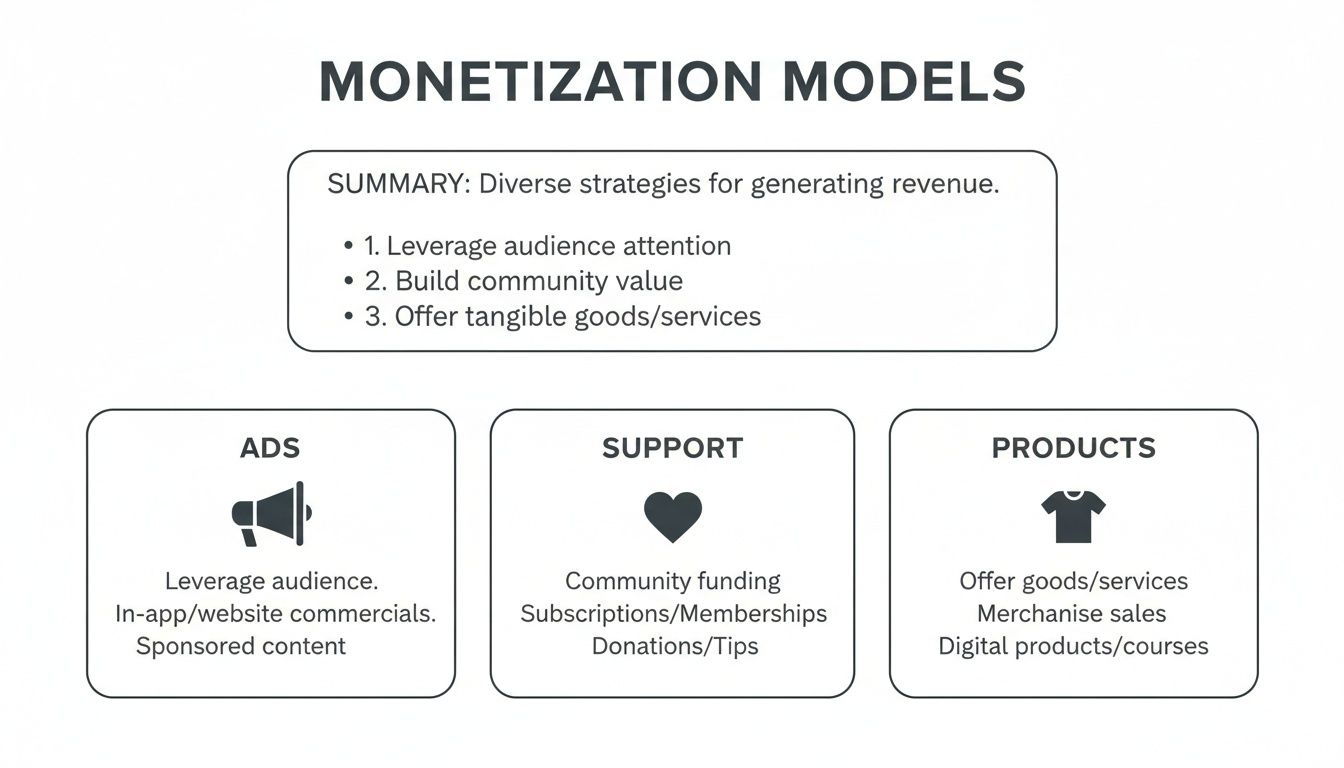
It shows how ads, direct listener support, and selling your own products can create a really balanced revenue stream, with sponsorships acting as a key pillar once your show is established.
Identifying Potential Sponsors
The best sponsorships feel natural, like an authentic recommendation from a friend, not a jarring commercial break. Your first move is to brainstorm a "dream list" of brands that vibe perfectly with your show's content and your audience's interests.
Don't just chase huge national companies. Your best—and most accessible—first partners are often right in your own community.
For instance, if your podcast is for local entrepreneurs in Jenks or Tulsa, your dream list might include:
Local coffee shops where your listeners are probably working or meeting.
Area marketing agencies that serve the exact same small business crowd.
Financial planners or accountants who specialize in services for founders.
A high-end co-working space like Freeform House that offers the resources your audience is already looking for.
Pay attention to other podcasts in your niche. Who is sponsoring them? Those companies are already believers in podcast advertising, making them prime candidates for your pitch.
Creating a Professional Media Kit
Before you send a single email, you need a media kit. Think of it as your podcast’s resume—a sharp, clean document (usually a 1-2 page PDF) that sells your show to potential partners. This is your chance to make a killer first impression and give a brand everything they need to say "yes."
Your media kit absolutely must include:
Show Overview: Your podcast name, cover art, and a quick, compelling summary of your niche.
Audience Demographics: Who's listening? Share key stats like age, location, and interests. The more specific, the better.
Key Metrics: Don't just list a vanity number. Highlight your downloads per episode (within the first 30 days), listener retention, and social media following.
Sponsorship Packages: Clearly lay out your offerings and prices. Create a few tiers, like a 30-second pre-roll spot, a 60-second mid-roll, or a bundle deal across several episodes.
Contact Information: Make it incredibly easy for them to get in touch.
A polished media kit instantly sets you apart from the hobbyists. It shows you're a serious creator who understands the business side and respects a sponsor's need for real data.
Crafting the Perfect Outreach Email
Your first email is your foot in the door. Keep it short, make it personal, and focus entirely on what you can do for them. Generic, copy-and-paste emails get deleted on sight.
A winning pitch email has a simple flow:
A Personalized Hook: Show them you've done your homework. Mention a product you genuinely use or a recent campaign of theirs you admired.
A Quick Intro: Briefly introduce your podcast and your audience, immediately drawing a line between your listeners and their ideal customers.
The Value Proposition: This is the heart of your pitch. Why does this partnership make sense? Drop a key stat from your media kit, like, "My show reaches over 2,500 engaged listeners in the Tulsa metro every month."
A Clear Call to Action: Don’t be vague. End by asking if they’d be open to seeing your media kit or scheduling a quick call to explore a partnership.
Here’s a real-world example: A Tulsa-based lifestyle podcaster wanted to partner with a local boutique. Her email opened by gushing about a new clothing line they’d just launched. She then explained how her audience of fashion-forward local women was a perfect match, attached her media kit, and suggested a quick chat. The owner replied within a day, and she landed the sponsorship in less than a week. That’s what a targeted, authentic pitch can do.
Nailing Your Tech and Payment Systems
You've picked your monetization models and maybe even started chatting with potential sponsors or your biggest fans. Now comes the crucial part: setting up a reliable backend to actually handle the money.
Getting this right isn't just about getting paid. It's about creating a smooth, professional experience for everyone involved, whether it's a brand partner or a listener signing up for your membership. A clunky system creates friction and headaches you just don't need.
Think of this as the operational heart of your monetization strategy. It's where the plan meets reality. Without a solid process for payment and content delivery, even the most brilliant ideas can fall apart.
Choosing Your Fan Support Platform
When you're relying on direct support from your listeners, you need a platform that makes it dead simple for them to subscribe and get their perks. Three main players stand out in this space, each with its own flavor.
Patreon: The big one. Patreon is a household name for creators, making it a familiar and trusted option for your audience. It's fantastic if you're offering a mix of things like bonus episodes, a private community, and behind-the-scenes content.
Memberful: This is your go-to if you want total brand control. Memberful integrates directly into your own website, so the entire experience feels like yours. It’s less of a discovery platform and more of a powerful, white-label membership engine.
Supercast: Built from the ground up for podcasters, Supercast is a dream for delivering premium audio. It lets you send private, ad-free, or bonus feeds straight to your supporters' favorite podcast app. That frictionless experience is a massive win.
So, which one's for you? If you want an all-in-one community hub, Patreon is a safe bet. If owning the experience on your site is the priority, check out Memberful. But for a pure-play premium podcast model, Supercast is tough to beat.
Managing Ad Delivery and Payments
For ad revenue, you have two main options: "baking in" the ads by editing them directly into your audio file, or using Dynamic Ad Insertion (DAI).
DAI technology is a game-changer. It inserts ads when the episode is downloaded, not when it's uploaded. This means you can update ad campaigns across your entire back catalog, target listeners based on their location, and keep old episodes earning you money.
And the audience is receptive. Data shows that 44% of weekly listeners have bought something after hearing a podcast ad, and a staggering 88% agree that ads are a fair trade for free content. You can get more powerful insights into podcast advertising effectiveness that prove this is a model that works. For a deeper look at the gear involved, our guide on the best podcast equipment for beginners covers tools that go beyond just microphones.
Imagine being able to swap an ad for a sold-out event with a new promotion for an upcoming workshop—across every single episode you've ever published. Dynamic ad insertion turns your archives from a static library into a living, revenue-generating asset.
Streamlining Payments and Fulfillment
No matter which path you take, you need a bulletproof way to process payments. This is where payment gateways and automation come in handy.
Payment Processors: Services like Stripe and PayPal are the industry standard for a reason. They integrate seamlessly with most membership and e-commerce platforms, taking care of the complex and secure work of handling credit card transactions.
Automated Invoicing: For direct sponsorships, stop chasing payments and creating invoices by hand. Use accounting software like QuickBooks or FreshBooks to set up recurring invoices that go out to your partners automatically. Set it and forget it.
Merchandise Fulfillment: Selling merch? Don't turn your home into a warehouse. A print-on-demand service like Printful can handle the printing, packing, and shipping for you. This frees you up to create your podcast instead of standing in line at the post office.
Getting these systems dialed in from the start builds a professional, automated workflow. It’s what allows your podcast monetization engine to run smoothly and scale up without burying you in admin work.
Using Freeform House to Your Advantage
If you’re a podcaster in the Jenks or Tulsa area, a Freeform House membership is more than just a key to a workspace—it's your secret weapon for making money. Let's move past the theory. This is where your strategy gets a physical home, giving you access to professional gear, a built-in network, and event opportunities that you just can't get working alone.
Instead of trying to figure everything out from a spare bedroom, you can plug directly into an ecosystem designed to help you grow. This is about turning your local membership into a real revenue driver and shifting from abstract plans to tangible, income-producing moves.
Nail Your Sound in the Podcast Booth
First things first: your production quality. Bad audio is the fastest way to lose listeners, and with them, any chance of landing sponsors. Our professional-grade, in-house podcast booth is here to give you that crisp, clean, studio-quality sound that screams credibility from the first second.
When you use this resource, you can pitch brands with total confidence, knowing your audio is up to their standards. It also makes premium content, like a paid audio course or guided meditation series, a much easier sell to your audience. To get a better feel for the process, check out our detailed guide on how to find, compare, and book a podcast studio rental near you.
Host Paid Live Events and Workshops
One of the quickest paths to a serious income bump is hosting live events. Your Freeform House membership gives you direct access to sleek event spaces perfect for ticketed live podcast recordings, audience Q&As, or hands-on workshops that tie into your show’s niche.
Just look at a few models our members are already using to make it happen:
A "Live Taping" Event: Sell tickets for an exclusive, in-person recording of a fan-favorite episode. A local business podcast, for example, could sell 50 tickets at $25 each, pulling in $1,250 in a single night. Bonus points for adding a local sponsor who gets to set up a table.
Niche-Specific Workshops: Does your podcast teach a skill like digital marketing or financial planning? Use our meeting rooms to host a paid, in-person workshop for your most dedicated local listeners.
Community Pop-Ups: One member with a food and culture show actually doubled her sponsorship income by hosting a series of "tasting" events with local restaurants right here in our space. She created a unique experience that sponsors were lining up to be a part of.
Think of your podcast as the top of your sales funnel. A live event is where you convert your most loyal local followers into high-value customers. It builds a real community and creates a powerful sense of exclusivity people are happy to pay for.
Tap Into a Built-In Sponsor and Guest Network
Probably the most overlooked asset of your membership is the community itself. The Freeform House member directory is basically a curated list of local entrepreneurs, executives, and creatives—exactly the people who could be your next sponsor or your most interesting guest.
Forget sending cold emails into the abyss. You can build real relationships right here. Strike up a conversation in the lounge, connect at a member happy hour, or just make a warm introduction. This is how you find local businesses that are a perfect match for your listeners.
Imagine you host a podcast for local founders. You could walk up to a fellow member who runs a marketing agency and pitch a sponsorship package on the spot. The connection is already there. The conversation feels natural, not forced. You're not just another pitch in their inbox—you're part of their community. That inside track is invaluable for landing those first crucial local sponsors that get your monetization engine running.
A Few Common Questions About Making Money Podcasting
Getting into the nitty-gritty of podcast monetization always brings up a few key questions. When you're ready to flip the switch from hobby to business, it’s totally normal to wonder about the real numbers, the right timing, and the best strategy. Let's clear up some of the most common hurdles podcasters face.
How Many Downloads Do I Really Need to Make Money?
This is, without a doubt, the question I hear most often. And the answer isn't as cut-and-dry as you might think.
Yes, it's true that major ad networks often want to see 1,000–5,000 downloads per episode within the first month before they'll even talk to you. But focusing on that number is a mistake because it only applies to one way of making money. You can and absolutely should start monetizing from day one, no matter how many people are listening.
Affiliate Marketing: You don't need a single minimum download. If you have just one listener who trusts your recommendation enough to buy something, you’ve made money.
Listener Support: Think about platforms like Patreon or Supercast. They run on loyalty, not listener volume. A small, fired-up audience of 100 "superfans" can easily bring in more revenue than thousands of passive listeners.
Your Own Products: Selling a digital course, a helpful template, or a coaching package is all about finding the right audience, not just a big one.
The real metric for monetization isn't your download count; it's the strength of your relationship with your listeners. A highly engaged, niche audience is a premium asset that has value, whether you have 500 downloads or 50,000.
What Should I Charge for Podcast Ads?
When it comes to ad rates, the podcasting world generally runs on a CPM (Cost Per Mille) model. That’s just a fancy way of saying "cost per 1,000 downloads." Rates can swing wildly depending on your show's topic, where the ad is placed, and if you read it yourself, but there are some solid industry benchmarks you can use to get started.
Here’s a look at a pretty standard pricing structure:
Ad Type | Ad Length | Typical CPM Rate |
|---|---|---|
Pre-Roll Ad | 15-30 seconds | $18 – $25 |
Mid-Roll Ad | 60 seconds | $25 – $50 |
Post-Roll Ad | 15-30 seconds | $10 – $18 |
Let's put that into perspective. If your episode pulls in 10,000 downloads and you run one 60-second mid-roll ad at a $30 CPM, you’ve just made $300 from that single ad spot. Of course, if you have a super-specific niche audience or a proven track record of driving sales for sponsors, you can push those rates much higher.
What Needs to Go in My Podcast Media Kit?
Think of your media kit as your podcast’s professional resume. It’s the first thing a potential sponsor will ask for, so it needs to be clean, sharp, and easy to skim—usually a one or two-page PDF that instantly shows them why your show is a smart investment.
Make sure yours has these essentials nailed down:
Show Info: Your podcast name, your killer cover art, and a short, punchy summary of what the show is about and exactly who it’s for.
Audience Demographics: This is where you go beyond just download numbers. Who is listening? Share their age, gender, location, and key interests. The better you know your audience, the more attractive you are to a sponsor.
The Numbers: Highlight your average downloads per episode (within the first 30 days), your social media following, and the size of your email list.
Sponsorship Packages: Don't make them guess. Lay out your offerings clearly. Create a few tiered options, like a simple pre-roll mention, a featured mid-roll spot, or a multi-episode package deal with clear pricing.
Contact Info: Make it ridiculously easy for an interested brand to reach out and give you their money.
Ready to give your podcast the professional sound and network it deserves? At Freeform House, our members get exclusive access to a fully-equipped podcast booth, versatile event spaces perfect for live recordings, and a built-in community of local entrepreneurs and potential sponsors. See how a membership can fast-track your podcast revenue.
Comments