How to Start a Podcast Business and Turn Your Voice Into a Venture

Sure, a good microphone is important, but a podcast business starts long before you ever hit record. It’s built on a strategic foundation. That means getting crystal clear on your specific niche, landing on a format that you can actually stick with, and mapping out a content plan that serves a very specific audience.
Defining Your Podcast Niche and Format
This is where the real work happens. In today's crowded podcasting world, just "winging it" is a recipe for disaster. Listeners have endless options, and they're looking for value and clarity. A successful show isn't just about a topic; it's about carving out your unique corner of the market.
Think of your show's concept as your North Star. It guides every single decision, from the episodes you create to how you market them. When you know exactly who you're talking to and what you're promising them, you attract a loyal audience that trusts your voice and actually looks forward to your next episode.
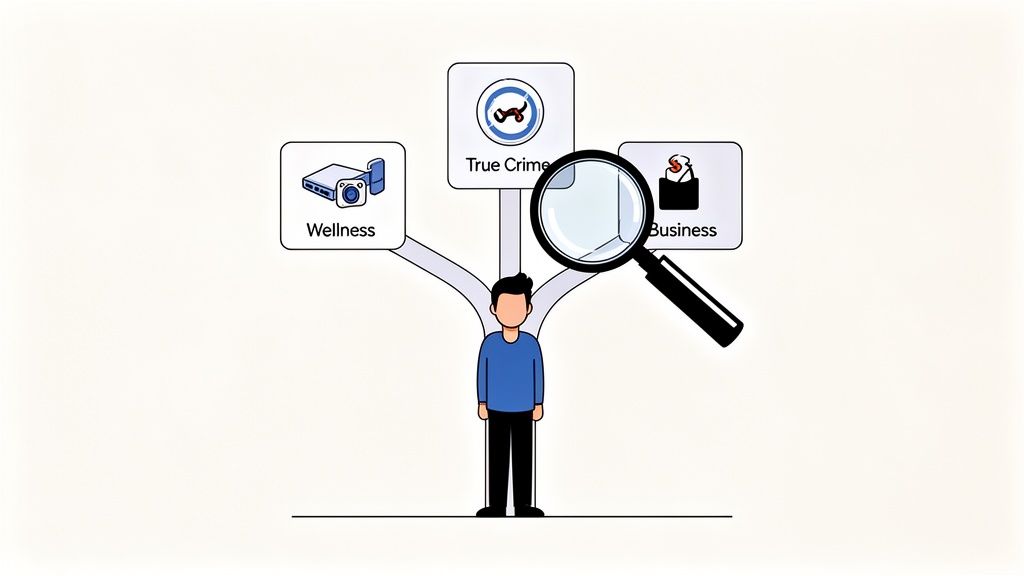
Finding Your Profitable Niche
One of the biggest mistakes I see new podcasters make is going way too broad. A podcast about "business"? Forget it. It's too vague to ever build a dedicated following.
But a podcast about "building a service-based business as a working parent in the Midwest"? Now you’re talking. That’s specific. It’s targeted. It speaks directly to someone's real-life challenges.
To dial in your own niche, ask yourself three questions:
Who is this really for? Get granular. Don't just think about demographics. What are their goals? What keeps them up at night? What does their day-to-day life look like?
What transformation will they get? People don't listen just to listen. They're looking for something. Will they learn a new skill, feel seen, get a dose of motivation, or just be entertained? Define your value proposition.
What makes my take unique? You don’t need to be the world's #1 expert, but you need a distinct angle. Your personal experiences, your personality, your unique way of explaining things—that’s your secret sauce.
Once you’ve got a couple of ideas, give them a quick stress test. Try to brainstorm ten potential episode titles for each concept. If the ideas for one topic flow effortlessly while the others feel like pulling teeth, you have your answer. That’s the niche with legs.
Choosing a Sustainable Podcast Format
Your show's format is its skeleton—it dictates the structure, your workflow, and the overall vibe. The right choice needs to align with your personality, your resources, and what your target audience actually wants to listen to. There’s no single “best” format; the only thing that matters is sustainability.
Your format should give you energy, not drain it. If you dread the production process, you're on a fast track to burnout. The most successful podcasts are the ones that are enjoyable for the creator to produce week after week.
Let’s break down the most common formats:
Solo Host: You’re the star of the show. This is a fantastic way to position yourself as an authority or thought leader. It gives you total creative control and makes logistics a breeze. The downside? All the pressure is on you to keep it engaging.
Co-hosted Show: This format lives and dies by the chemistry between the hosts. When it works, it can make content creation feel less like work and more like a fun conversation. The main hurdles are scheduling and making sure everyone stays committed for the long haul.
Interview-Based Show: Bringing on guests is a proven way to introduce fresh perspectives and, crucially, tap into their audiences to grow your own. Just know that it requires solid research, good outreach skills, and the ability to be a great interviewer.
Narrative Storytelling: Think highly produced, often-scripted shows that weave together narration, interviews, and sound design. These can be incredibly powerful and addictive for listeners, but they also demand the biggest investment in writing, production, and editing.
Be realistic about your time, budget, and skills. If you're a solopreneur with zero editing experience, a complex narrative show is probably a bad idea. But if you thrive on collaboration and conversation, a co-hosted or interview-based show could be the perfect engine for your new podcast business.
Building Your Home Podcast Studio
In podcasting, the clarity of your message is everything. Listeners can forgive a lot, but they won't stick around for bad audio. The good news is that creating a professional-sounding recording space doesn't demand a Hollywood-level budget—it just takes a smart approach.
The goal isn't to chase the most expensive gear but to build a reliable setup that captures clean, consistent audio. This is all about understanding the fundamentals, from how a microphone actually works to why a quiet room is your most valuable asset. Mastering these basics will establish your credibility from the very first episode you drop.
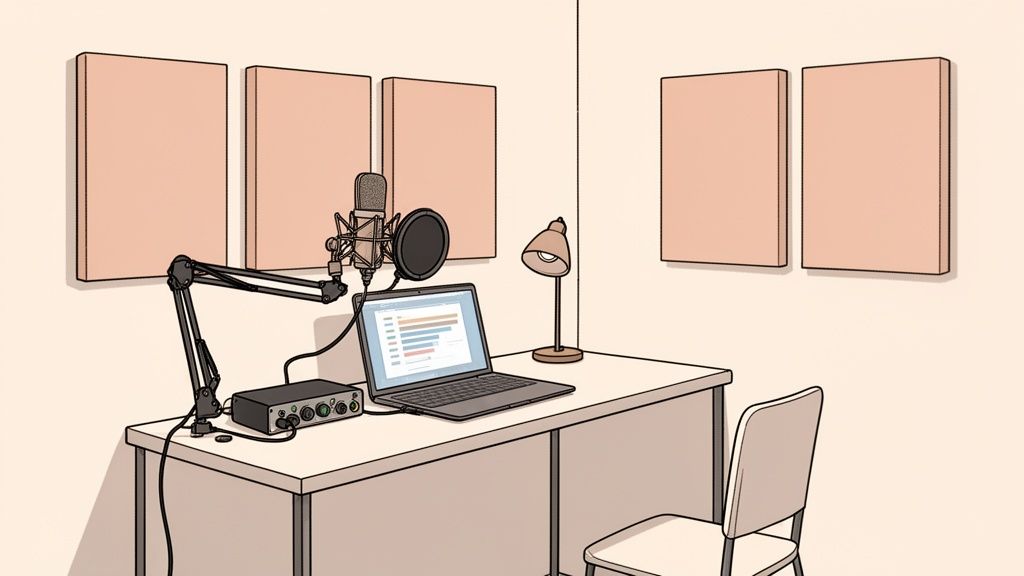
Selecting Your Core Recording Gear
The world of podcasting equipment can feel like a rabbit hole, but you only need a few key pieces to get started. The foundation of any great setup is a quality microphone, an audio interface to get that sound into your computer, and a good pair of headphones.
A classic rookie mistake is splurging on a sensitive condenser microphone that picks up every creak, hum, and dog bark in the neighborhood. For most home studios, a dynamic microphone is a much safer bet. It’s designed to capture sound directly in front of it while rejecting off-axis noise, making it incredibly forgiving in less-than-perfect rooms.
Your audio interface acts as the bridge, converting your mic's analog signal into a digital one your computer can understand. For a solo or two-person show, a simple one or two-channel interface is all you need.
Finally, don't forget closed-back headphones. They are non-negotiable. They stop audio from your headphones from "bleeding" into your microphone and let you monitor your levels in real-time, so you can catch issues before they ruin an otherwise perfect take.
The secret to professional audio isn't a single expensive piece of gear. It's the synergy between a decent microphone, a quiet recording space, and a solid understanding of basic microphone technique.
To help you get started, here's a look at what your initial investment might look like at different levels. You can absolutely start at the beginner tier and upgrade as your business grows.
Essential Podcasting Equipment Tiers
Equipment Tier | Microphone Example | Audio Interface/Mixer | Estimated Cost Range |
|---|---|---|---|
Beginner | Audio-Technica ATR2100x | Behringer U-Phoria UM2 | $150 - $300 |
Intermediate | Shure MV7 | Focusrite Scarlett 2i2 | $400 - $700 |
Professional | Shure SM7B | Rodecaster Pro II | $1,000+ |
Ultimately, your choice depends on your budget and how quickly you want to scale the production quality of your podcast business.
Creating an Acoustically Sound Space
The most advanced microphone in the world will sound terrible in a room full of echo. Your recording environment is just as crucial as your equipment. No need for a professional soundproof booth; you just have to tame the sound reflections in your space.
Hard, flat surfaces are the enemy—think bare walls, hardwood floors, and big windows. They cause sound waves to bounce all over the place, creating that hollow, amateur sound we all want to avoid. The fix is acoustic treatment, which just means adding soft materials to absorb those reflections.
Here are a few practical ways to treat your room on a budget:
Pick a small room: Walk-in closets are a cliché for a reason. The smaller the space, the fewer reflections you have to fight.
Add soft furnishings: A thick rug, heavy curtains, or a plush sofa can work wonders. Even a bookshelf filled with books helps break up and absorb sound waves.
Use acoustic panels: While you can buy professional foam panels, simply hanging thick blankets on the walls is a surprisingly effective DIY solution.
The idea is to create a "dead" sounding space where your voice is crisp and clear, without the room itself adding any distracting color. Many podcasters start in a quiet corner of their office, but for those who want a pro-level environment without the hassle, exploring a dedicated podcast studio rental near you is a fantastic option for recording marquee episodes.
Establishing a Simple Recording Workflow
Once your gear and space are dialed in, a consistent workflow will ensure you capture high-quality audio every single time. This pre-flight checklist removes the guesswork and lets you focus completely on your content.
First, always check your equipment before you hit record. Is your microphone selected as the input in your recording software? Can you see the audio levels jumping as you speak?
Next, do a quick soundcheck. Record yourself talking for about 30 seconds at your normal speaking volume. Listen back through your headphones. Do you hear any background hum, harsh "p" sounds (plosives), or clipping (distortion from being too loud)? Adjust your mic placement or gain levels as needed. You want your audio levels to be peaking somewhere between -12dB and -6dB.
This simple, repeatable process takes less than five minutes but can save you hours of headaches in post-production. It's the final piece of the puzzle to making your home studio a reliable asset for your podcast business.
Building Out Your Content and Monetization Playbook
So, you've got the studio dialed in. Now comes the real work: creating a show that not only grabs people's attention but also builds a sustainable business. This is where we move from a passion project to a profitable enterprise. A great podcast is a careful mix of compelling content and smart commercial strategy.
And the timing couldn't be better. The podcasting industry isn't just growing; it's absolutely exploding. The global market just hit a massive $39.63 billion, a huge leap from $30.72 billion the year before. With projections showing it could reach $131.13 billion by 2030—that's a wild 27% annual growth rate—the opportunity is undeniable for anyone ready to get serious. You can read more about the incredible growth in the podcasting industry.
Crafting a Content Plan That Clicks
In podcasting, consistency is everything. Your listeners weave your show into their lives—their commute, their gym session, their evening routine. If you publish erratically, you break that unspoken agreement, and they'll find someone else who shows up reliably.
To stay on track without burning out, you need a content plan. This isn't about scripting every word, but about creating a framework. A simple and effective way to do this is with content "buckets" or recurring themes.
For a business podcast, for instance, your buckets could look like this:
Expert Interviews: Bring on respected names in your field. This borrows their authority and introduces your show to their audience.
Case Study Deep Dives: Break down a real-world success story (or a spectacular failure) and pull out the lessons for your listeners.
Solo "Quick Hit" Episodes: Shorter, laser-focused episodes that solve one specific, nagging problem for your audience.
Audience Q&A: Answering questions directly from your listeners is a goldmine for content and builds an incredibly loyal community.
This system gives your show variety while making planning a breeze. Instead of staring at a blank document wondering what to talk about, you just decide which bucket to pull from this week.
The best podcasts are built on service. Before you hit record on any episode, ask one simple question: "How will my listener be better off after listening to this?" When every piece of content is genuinely helpful, growth becomes inevitable.
Thinking Beyond the Ad Read
Sponsorships are the most well-known way to make money from a podcast, but they are far from your only—or even best—option. The smartest podcasters build multiple revenue streams to create a more resilient business. Your expertise and the trust you earn are your real assets.
Let's break down a few powerful ways to monetize, even if you don't have a massive download count.
Affiliate Marketing
This is usually the easiest place to start. You simply recommend products or services you actually use and respect, earning a commission from any sales that come through your unique link.
Premium Memberships and Exclusive Content
Your biggest fans are often happy to pay for more from you. A membership model creates recurring, predictable revenue—the dream for any business owner. You can use platforms like Patreon or set up your own system.
Here’s what you could offer your members:
Ad-free episodes
Bonus "after-show" chats with your guests
Access to a private community on Discord or Slack
Monthly group Q&A calls
High-Ticket Services and Products
Think of your podcast as the ultimate lead magnet. It’s a platform for you to build trust and demonstrate your expertise at scale, warming up listeners for your own high-value offers.
Coaching & Consulting: A financial planning podcast is the perfect funnel for one-on-one consulting clients. The show acts as a free, ongoing workshop that perfectly pre-qualifies your ideal customer.
Digital Products & Courses: A show that teaches coding basics can naturally lead listeners to a comprehensive beginner's course. Each episode delivers value and points toward the paid solution.
Physical Products: A podcast centered on sustainable living could launch its own line of eco-friendly home products to a built-in audience that already trusts the brand's values.
To build a real podcast business, you have to think like a media company from the get-go. Combine a strategic content calendar with a diverse monetization plan, and you'll create a powerful engine for both your impact and your income.
Launching and Growing Your Podcast Audience
Creating a brilliant podcast is only half the battle. Getting it into the ears of your ideal audience is where the real work begins, requiring a thoughtful and sustained effort.
A powerful launch can create that crucial initial momentum, but long-term success is built on consistent strategies that turn casual listeners into die-hard fans. This is where you put on your marketer hat.
Your launch isn’t just about hitting "publish" on episode one. It’s about making a calculated splash. The goal is to rack up enough initial downloads and subscriptions to signal to platforms like Apple Podcasts and Spotify that your show is worth paying attention to. A strong start can seriously boost your visibility in those critical first few weeks.
This visual flow shows the core engine of a podcast business, moving from content creation to monetization and operations.
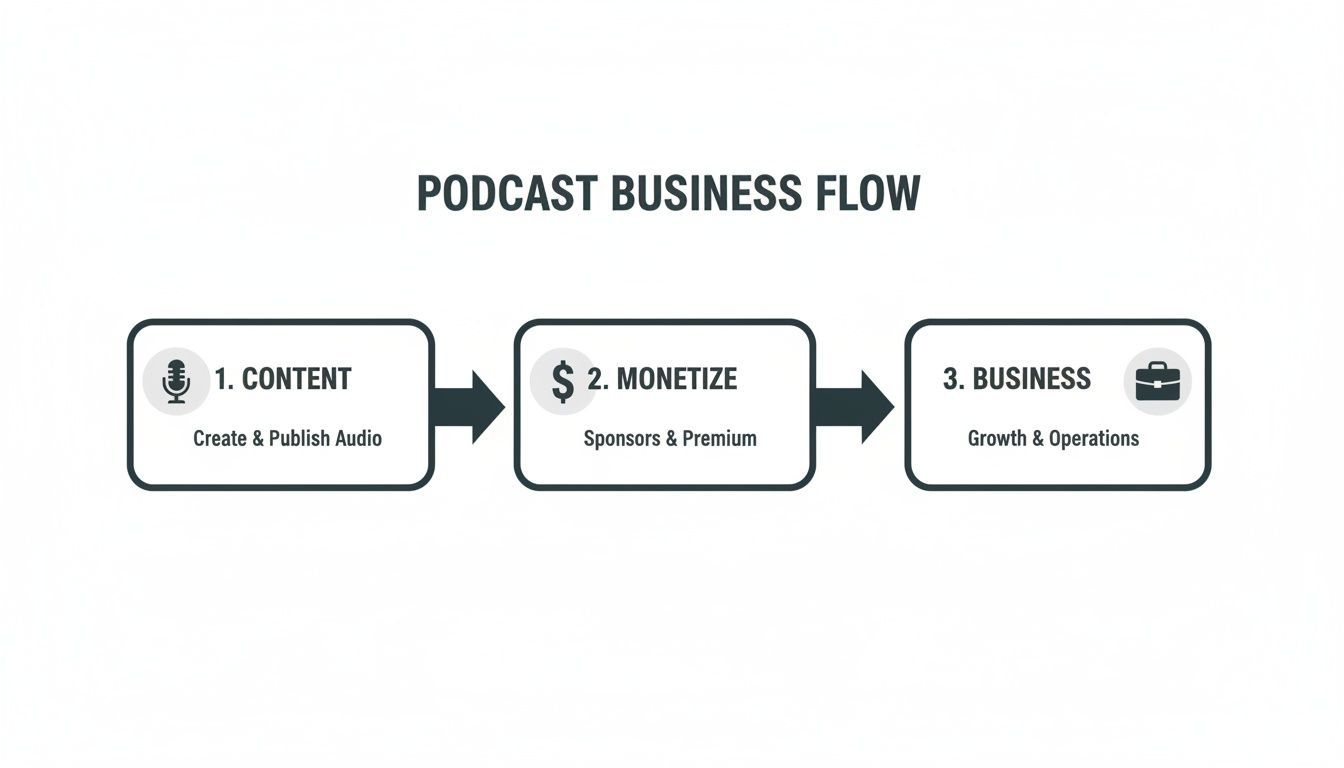
The key takeaway? Success isn't a straight line. It's a cycle where great content fuels monetization, which in turn supports the entire business structure.
Mastering the Launch Sequence
A fantastic approach that builds excitement is what I call the "soft open." Instead of promoting an empty feed, you quietly publish your first three to five episodes all at once.
This gives brand-new listeners a backlog to binge, increasing their engagement and the odds they’ll hit "subscribe." It also sends a clear message that you're committed to this for the long haul.
Once your first few episodes are live, it’s time to submit your RSS feed to all the major directories.
Apple Podcasts: Still a major player, accounting for over 32% of all podcast downloads. The approval process involves a human review, so it can take up to 24 hours. You'll submit your show through Apple Podcasts Connect.
Spotify: The biggest directory out there with 34.4% of downloads, so getting listed is non-negotiable. This process is usually much faster, often listing your show almost immediately after submission.
Other Directories: Don't stop there. Push your show to Amazon Music, iHeartRadio, and Podcast Index. A good hosting provider makes submitting to multiple platforms a simple, one-click process.
With your show officially listed everywhere, you can finally pick a "launch day" and start the big promotional push. This coordinated effort drives a wave of traffic to a feed that's already populated with great content, creating the best possible first impression.
Sustainable Growth Strategies That Actually Work
After the initial launch buzz dies down, the real work of audience growth begins. This is a marathon, not a sprint. It’s all about discoverability and community building, so forget chasing viral moments and focus on these reliable tactics instead.
One of the most underutilized tools is search engine optimization (SEO) for your show notes. Seriously. Think of each episode's description as a mini blog post. Pack it with relevant keywords your target audience is searching for. Detailed, helpful show notes don't just serve your current listeners; they make your content discoverable to entirely new audiences through Google.
Your podcast doesn't exist in a vacuum. The most effective growth happens when you treat your show as the central hub of a larger content ecosystem, with every piece of marketing pointing back to it.
Another killer method is strategic collaboration. Don't just think about having guests on your show; actively seek out opportunities to be a guest on other podcasts in your niche. This is one of the most direct ways to get in front of a pre-qualified audience that's already interested in your topic. It’s a personal endorsement from a trusted source.
Turning Listeners Into a Community
Growth isn't just about download numbers—it's about building genuine connections. You want to create a space where your listeners feel seen and heard, transforming them from a passive audience into an active, engaged community.
Get in the trenches and engage directly with your audience on the social media platforms where they already hang out. Don't just drop links to new episodes and disappear. Share behind-the-scenes content, ask for their opinions on future topics, and start real conversations. A simple poll can generate more engagement than a dozen promotional posts.
Also, be smart about your call to action (CTA) at the end of each episode. Instead of just asking for a rating, invite listeners to join your email list or a private Facebook group. This moves the relationship off the podcasting app and into a space you actually control, allowing you to nurture that connection on a much deeper level.
Building these relationships is a key part of networking, and for more insights, you can review these 10 actionable small business networking tips for growth. When listeners feel like they're part of something, they become your most powerful marketing asset.
Managing the Business Operations of Your Podcast
If you want to build a real podcast business, you have to start treating it like one. That means stepping away from the microphone for a minute to handle the less glamorous, but absolutely essential, operational details that protect you, your brand, and all your hard work.
It's easy to get lost in the creative flow of recording and editing, but ignoring the backend is a rookie mistake. A little bit of legal and financial housekeeping now can save you from massive headaches down the line and give you a stable foundation to actually scale this thing.
Choosing Your Business Structure
One of the first real-world decisions you'll make is how to legally structure your podcast. This choice affects everything from your personal liability to how you handle taxes. It sounds intimidating, but it really comes down to a couple of common paths.
Sole Proprietorship: This is the default for most people just starting out. It's simple because you and the business are legally the same. The big risk? Your personal assets aren't protected if the business runs into debt or legal trouble.
Limited Liability Company (LLC): Forming an LLC creates a separate legal entity for your podcast. This is the go-to for serious creators because it puts a wall between your business and your personal life, shielding assets like your home and car.
Setting up an LLC, especially for a venture based somewhere like Jenks, Oklahoma, sends a clear message that you're a professional, not just a hobbyist. It’s a crucial first step.
Protecting Your Content and Brand
Every episode you create is a piece of valuable intellectual property. You have to protect it. This isn't just a suggestion; it's non-negotiable. We're talking about content ownership, the legal use of music, and formalizing your relationships with guests.
A guest release form is an absolute must. Think of it as a simple contract where your guest gives you permission to use their recording in your podcast and for any related promotions. Without one, a guest could theoretically demand you take down an episode later, and you'd have no leg to stand on.
Don't ever rely on a verbal agreement. A simple, signed guest release form is your best defense against future disputes. It's standard professional practice that protects both you and your guest by making sure everyone is on the same page from the start.
Music licensing is another minefield. You can't just grab a popular song because it sounds good—that's a fast track to a copyright strike. Stick to royalty-free music libraries where you can buy a license for specific tracks. It's a small investment that ensures you're 100% in the clear.
Financial Fundamentals for Podcasters
Running your podcast like a business means managing its money like one. Mixing your personal and business funds is a recipe for a nightmare come tax season.
The very first thing you should do is open a separate business bank account. This simple act draws a clean line between your podcast's income and expenses and your personal finances. It makes bookkeeping infinitely easier and gives you a real-time snapshot of your business's financial health.
Next, get a simple system in place to track every dollar in and every dollar out. This doesn't need to be fancy. A basic spreadsheet or an affordable accounting software like QuickBooks or FreshBooks is perfect. You'll need to track:
Income: Sponsorships, affiliate commissions, product sales, memberships.
Expenses: Hosting fees, equipment, marketing spend, software subscriptions.
This financial discipline is what allows you to understand your actual profitability and makes tax prep a breeze. And for those building a professional presence without a physical office, a virtual office and receptionist is a modern business guide to streamlining operations and looking professional. Nailing these fundamentals gives you the confidence to grow a show that’s both sustainable and profitable.
Common Questions About Building a Podcast Business
If you're thinking about turning a podcast idea into a real business, you're not alone. It's a well-trodden path, but a few key questions always pop up for aspiring creators. Let's tackle some of the biggest hurdles head-on.
What’s the Real Cost to Start a Podcast?
Your startup costs can be whatever you need them to be. Honestly, you can get a solid start for under $100 with a good USB mic and free editing software like Audacity.
Once you've got some traction, you might want to level up. A more professional setup with an audio interface and better headphones will probably land you in the $400 to $700 range. But remember, the gear is just one piece of the puzzle. You'll also have monthly costs for hosting (usually $12-$20), maybe some licensed music, and whatever you decide to put into marketing.
The smartest move? Start lean. Prove your concept, get some revenue coming in, and then reinvest in better equipment.
How Do Podcasts Actually Make Money, Anyway?
Sponsorships are what everyone thinks of, but they're rarely the first or even the most profitable way to make money. The real power is in the trust you build with your listeners.
Many of the most successful podcasters I know made their first dollar selling their own products or services, not from a big brand deal. When an audience already trusts your expertise, that direct path to monetization is often faster and more sustainable.
Here are the most common ways people build a profitable show:
Affiliate Marketing: You earn a commission by recommending products you genuinely use. It's a natural fit if you're already talking about tools or resources you love.
Premium Memberships: Think bonus episodes, behind-the-scenes content, or an ad-free feed. Platforms like Patreon make it easy to offer this for a monthly fee.
Direct Sales: This is the big one. Your podcast becomes the ultimate lead magnet for your high-ticket coaching, consulting, or online courses.
Physical Products: From t-shirts to coffee mugs, branded merchandise can be a great way for your biggest fans to support the show.
Can I Really Start a Podcast With Zero Experience?
Absolutely. You just need a plan. The number one mistake beginners make is hitting "record" and just rambling. Your experience level doesn't matter nearly as much as your preparation.
Before you do anything else, get laser-focused on your niche and map out your first ten episode ideas. Aim to launch with at least three to five episodes already in the can. This gives new listeners plenty to binge on and a compelling reason to hit "subscribe."
From there, consistency is everything. Sticking to a reliable publishing schedule is how you build trust and turn casual listeners into genuine fans who can't wait for your next episode.
Ready to take your podcast from a side project to a serious business? Free Form House is a premier, membership-based club in the heart of Jenks, Oklahoma's 10 District downtown. Comparable to the renowned SoHo House, it offers more than just a social club. Members can take advantage of co-working spaces and a dynamic community hub designed for collaboration and connection. It's a central gathering spot aimed at fostering a creative and cooperative spirit within our local community, complete with a fully equipped, sound-treated podcast booth. It's the perfect place to record professional-quality audio and network with ambitious entrepreneurs and creatives just like you.
Learn more about becoming a member and see how our premium amenities can help you grow.
Comments