Podcast Studio Rental Near Me: Find, Compare, and Book Today

Let's face it: recording a podcast in your closet can work in a pinch, but it's rarely going to give you that crisp, professional sound that makes listeners stick around. When you find yourself Googling "podcast studio rental near me," you're taking the first real step toward turning your show from a hobby into a high-quality production that actually stands out. This is more than just an upgrade to your audio; it’s a smart investment in your brand.
Why Renting a Podcast Studio Elevates Your Content
The barrier to starting a podcast is incredibly low, but the bar for keeping an audience is sky-high. Listeners have endless options, and one of the fastest ways to get them to skip your show is bad audio. Renting a professional studio isn't just about finding a quiet room—it’s about tapping into an environment built from the ground up for audio excellence.

A dedicated studio instantly gets rid of all those annoying background noises you might not even notice until you hit playback. No more barking dogs, passing sirens, or the low hum of your refrigerator. In a controlled, sound-treated setting, every word gets captured with crystal clarity.
Access Professional Gear Without the Upfront Cost
Honestly, one of the biggest perks of renting is getting your hands on thousands of dollars' worth of high-end equipment. You can use professional-grade microphones, audio interfaces, and mixing boards without the huge price tag or the headache of maintaining it all.
This frees you up to focus completely on your content. With all the technical stuff handled, you and your guests can sink into the conversation. The professional vibe elevates the entire experience, almost always leading to a more engaging show and a much better final product.
Renting a studio isn’t just an expense; it's a shortcut to a higher production value that helps you compete in an increasingly crowded market and boosts your brand’s authority from the very first second.
Compete in a Growing Market
The podcasting world is exploding, and with that comes a higher demand for polished content. The global podcasting market, valued at USD 32.54 billion in 2025, is on track to hit a staggering USD 173.49 billion by 2032. With over 3.55 million podcasts out there, you need every advantage you can get to grab and hold a listener's attention. That's where a professional space becomes essential. You can explore more insights on podcasting market growth and see how other creators are leveling up.
For creators here in Oklahoma, finding a space that truly inspires creativity is everything. Free Form House is envisioned as a premier, membership-based club in the heart of Jenks, Oklahoma's 10 District downtown. Comparable to the renowned SoHo House, it offers more than just a social club. Members can take advantage of co-working spaces and a dynamic community hub designed for collaboration and connection. It's a central gathering spot aimed at fostering a creative and cooperative spirit within our local community.
How to Find the Best Local Podcast Studios
When you first decide to rent a studio, your immediate reflex is probably to punch "podcast studio rental near me" into Google. That’s a decent start, but the real gems—the studios with the best gear and vibe—are usually found when you dig a little deeper.
Think beyond the obvious search terms. Get specific. Try searching for "video podcast studio," "soundproof recording booth," or even something tailored to your project, like "audiobook recording studio [your city]." This simple trick can help you filter out the noise and uncover specialized spaces that a generic search will almost always miss.
Look Beyond Standard Search Engines
Instead of wrestling with Google's algorithm, head straight to platforms built for creative rentals. These sites are essentially marketplaces that let you get granular with your search, filtering by location, budget, and the exact amenities you need.
Peer-to-peer rental websites like Peerspace are an absolute game-changer here. They connect you with studio owners and, more importantly, feature real photos and unfiltered reviews from other creators who have used the space.
Here’s a look at what you can expect to see on a platform like Peerspace when you're browsing for studios in your area.
This kind of visual layout, complete with pricing and user ratings, makes it incredibly easy to compare your options at a glance.
Tap Into Your Local Creative Community
Sometimes the best leads don't come from a website at all. Don't sleep on the power of your local network.
Jump into local filmmaker, musician, or podcaster groups on Facebook or LinkedIn. Asking for recommendations in these communities can give you honest, off-the-cuff feedback you’ll never find on a polished booking site. People are usually more than willing to share their good—and bad—experiences.
A critical part of vetting a studio is looking for authenticity. Be wary of listings that only use stock photos or give you a vague, generic equipment list. A professional studio will be proud to show off its actual space and will specify the exact models of microphones, mixers, and cameras they have on hand.
How to Read Between the Lines of Reviews
Customer reviews are gold, but you have to know how to sift through them. Look for patterns. If three different people mention that the soundproofing is bad or the on-site engineer was unhelpful, that’s a major red flag.
Also, pay attention to what isn't being said. If every review raves about the convenient location but no one mentions the audio quality, that might tell you everything you need to know. The most helpful reviews get into the specifics of the recording experience, from the condition of the gear to the attitude of the staff.
For anyone weighing different types of rental spaces, from professional studios to corporate boardrooms, understanding which amenities are non-negotiable is key. Many of the same principles apply, which you can see in our detailed guide on what to look for when booking a meeting room rental.
Comparing Studios: What Really Matters
Alright, you've got a shortlist of potential studios. Now for the real work. On the surface, most spaces can look pretty similar—a few mics, a table, some sound panels. But the details are what separate a frustrating, waste-of-time recording session from a flawless one. It's time to dig in and compare what truly counts before you book.
This simple decision tree can help you quickly filter your options.
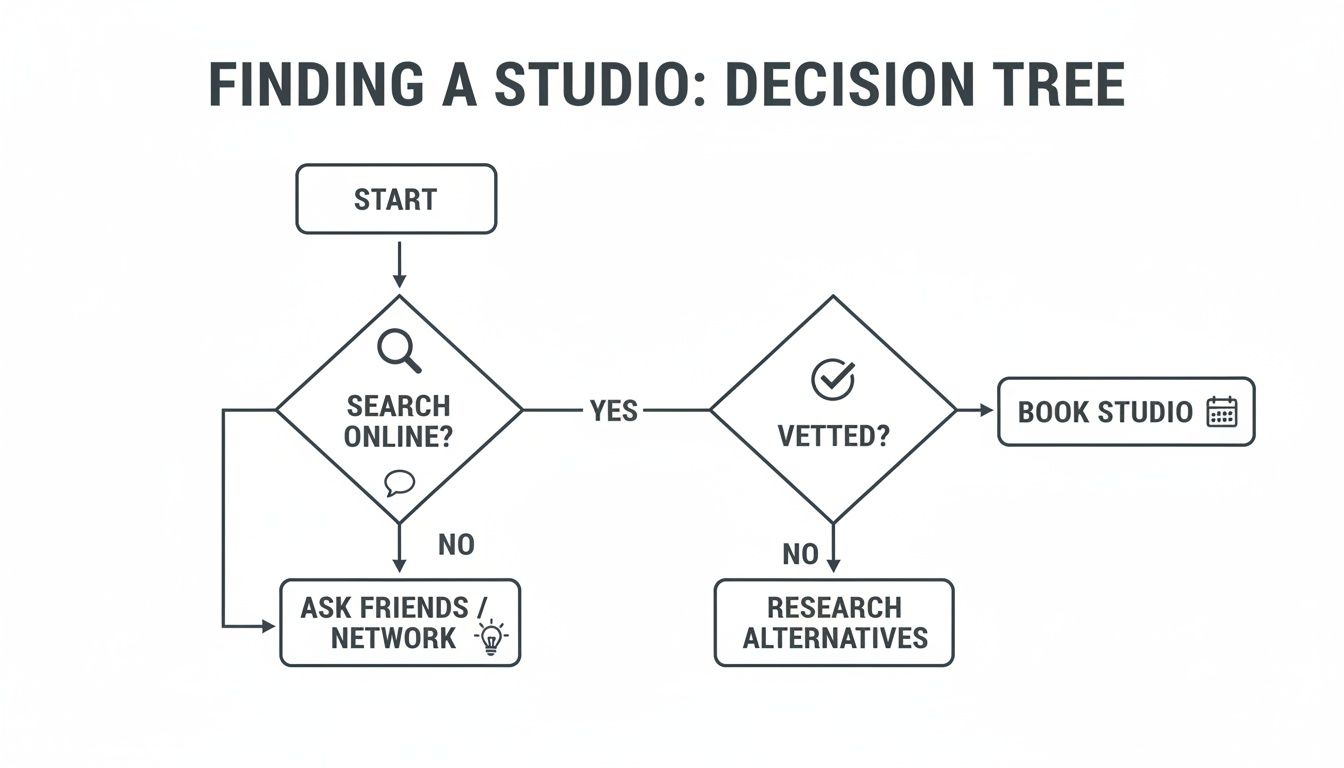
Think of it as a quick visual guide, breaking down the process into three core moves: searching, vetting, and booking.
Audio Gear and Acoustics
The first thing to zero in on is always the audio equipment. Don't let a studio get away with a vague "professional microphones" description on their website. Ask for specifics. Are they running industry-standard Shure SM7Bs, known for that warm, broadcast vocal tone? Or are they just offering basic USB mics that won't give you much of a quality boost over your home setup?
Just as important—if not more so—is the room itself. Real sound treatment is a science, and it involves a lot more than just sticking a few foam squares on the wall. Look for signs of proper acoustic engineering: bass traps tucked into the corners, diffusion panels to scatter sound waves, and thick, insulated walls. These are the things that kill echoes and block out the delivery truck rumbling by outside, ensuring your audio is clean and crisp.
A studio’s true value isn’t just in the equipment it owns, but in how the space itself has been engineered for sound. A perfectly treated room with mid-range mics will almost always produce better audio than a noisy, untreated room with expensive gear.
Video Capabilities and On-Site Support
With video podcasts basically becoming the standard, a studio's camera and lighting setup is a huge differentiator.
Lighting: Do they have a professional three-point lighting setup, or are you looking at a single, lonely ring light? Good lighting is completely non-negotiable for a polished video.
Cameras: Ask what they're shooting on. Are they high-quality DSLRs or mirrorless cameras that can capture 4K video, or just basic webcams? The difference is night and day.
Backdrops: Check out their backdrop options. Do they have a custom branded wall, a versatile greenscreen, or a more casual lounge setting to fit your vibe?
Beyond the tech, think about the human element. Is there an on-site engineer or technician available to help you set up and troubleshoot? Having an expert on hand can be a lifesaver, preventing you from burning through your paid studio time trying to fix a technical glitch. It lets you focus on what you're there to do: create great content.
This demand for high-quality, full-service spaces is completely reshaping the industry. With podcasting revenue projected to shoot past $4 billion globally by the end of 2025, the need for professional rental studios has exploded. In some creative urban hubs, demand for these spaces has spiked by 40%, with hourly rates typically falling between $50 and $150. It's a major trend, and you can learn more about how flex spaces are adapting to this trend to meet creator needs.
Podcast Studio Feature Comparison Checklist
When you're weighing your options, it's easy to get lost in the details. This table breaks down what you can typically expect from different tiers of studio rentals, from a simple booth to a full-blown production house.
Feature | Basic Booth (e.g., in a co-working space) | Mid-Range Studio (Dedicated rental) | Full-Service Production House |
|---|---|---|---|
Microphones | Basic USB Mics (e.g., Blue Yeti) | Industry-Standard XLR (e.g., Shure SM7B) | High-End Condenser Mics (e.g., Neumann U87) |
Sound Treatment | Minimal foam panels, some sound dampening | Professional acoustic panels, bass traps | Fully engineered, soundproofed room |
Mixing Board | Simple USB interface or small mixer | Multi-channel audio interface (e.g., Rodecaster) | Professional-grade mixing console |
Video Cameras | BYO or basic webcam | 1-2 4K mirrorless/DSLR cameras | 3+ cinema-quality cameras, switchers |
Lighting | Basic ring light or panel | Professional 3-point lighting setup | Advanced, multi-point cinematic lighting |
On-Site Support | Usually none; self-service | Technician available for setup/troubleshooting | Dedicated audio/video engineer for the session |
Editing Services | None | Basic audio editing offered as an add-on | Full post-production services (audio & video) |
Ideal For | Solo podcasters on a tight budget | Established podcasts needing pro quality | Brands & creators needing a turnkey solution |
Use this checklist as a starting point. Your needs might fall somewhere in between, but knowing the landscape helps you ask the right questions and find the perfect fit for your project and budget.
Understanding Studio Rental Costs and Packages
When you start looking for a podcast studio, the prices can feel like they're all over the map. Let's cut through the noise and break down what you should actually expect to pay. This way, you can budget properly and sidestep any last-minute sticker shock.
The cost isn't just a random number; it’s a direct reflection of the gear, the space, and the level of professional support you're getting.
The most common model you’ll run into is a simple hourly rate. For a basic, no-frills recording booth, you're likely looking at something in the $40 to $75 per hour range. Step up to a more established, mid-range studio with better acoustics and higher-quality mics, and that rate typically climbs to $75 and $150 per hour.
For the full-service production houses—the ones with an on-site engineer and high-end video gear—prices can easily top $200 per hour.
Decoding Pricing Models
While booking by the hour is straightforward, it isn't always the smartest financial move, especially if you plan to record regularly. Smart studios know this and offer packages or memberships that deliver much better long-term value.
Multi-Session Packages: Many studios will sell you a block of time—say, 10 hours—at a discounted rate. This is perfect if you like to batch-record your content for the month.
Monthly Memberships: Some spaces, particularly creative hubs or coworking spots like Free Form House, run on a membership model. This gets you a set number of studio hours each month, plus access to a broader community and other perks.
Full-Production Packages: These are the all-inclusive deals. They bundle your recording time with post-production services like audio editing and video mixing, basically handing you a finished product.
Podcasting is blowing up—the market is forecasted to grow by a staggering USD 33.44 billion between 2025 and 2029. This explosive growth means that while hourly rates in major cities can be steep, studios are getting creative with flexible packages to lock in consistent clients. You can read the full research on podcast market trends to see just how big this is getting.
Uncovering the Hidden Costs
Be warned: what you see isn't always what you get. That attractive hourly rate might not cover everything you actually need for a smooth session.
Before you book, always ask for a clear breakdown of what’s included. Hidden fees for essential services like an on-site audio engineer, specific microphone requests, or even file transfers can quickly inflate your final bill.
Make sure you get clarity on these points with the studio manager ahead of time. It's a simple, proactive step that ensures you're comparing your options accurately. You can book your session with total confidence, knowing exactly what your investment covers. It’s the same kind of due diligence modern professionals apply when weighing flexible work solutions, a topic we dive into in our guide on the benefits of a virtual office and receptionist.
Your Recording Day Preparation Checklist
Your booked studio time is a valuable, finite resource. Trust me, walking in prepared is the difference between a productive, creative session and a frantic, stressful one. To really make every minute count, you need a solid plan before you even step foot in the door.
This isn't just about showing up on time; it's about front-loading the work so your recording session is purely for performance and creation. A little bit of prep goes a long, long way.

What to Finalize Before You Go
Long before you pack your bag, your content needs to be locked and loaded. Trying to finalize scripts or brainstorm questions while the clock is ticking on your rental is a recipe for wasted money and mediocre content.
Finalize Your Script or Outline: Your episode's structure should be totally complete. Whether you use a detailed script or a simple bullet-point outline, have it printed out or loaded onto a tablet.
Confirm Guest Details: Shoot your guests a final confirmation with the studio address, your contact info, and a copy of the questions or topics. This gets everyone on the same page.
Prepare Your Tech: Charge every single device—your laptop, phone, and tablet. Make sure any notes or files are downloaded for offline access. You just can't count on studio Wi-Fi being perfect.
The Essential Day-Of Packing List
Forgetting one critical item can completely derail your session. Treat this like a professional gig and pack a dedicated bag with everything you could possibly need.
Here’s what should be on your packing list:
An External Hard Drive: Never, ever rely on the studio to store your files. Bring your own high-speed external drive with plenty of free space to take your raw audio and video files with you when you leave.
Water and Snacks: Recording sessions are surprisingly draining. Having water on hand keeps your voice from getting scratchy, and a quiet snack can prevent those dreaded energy dips.
Necessary Props or Branding: If you're recording video, don't forget any branded mugs, signs, or other props that are part of your show's visual identity.
Headphones: Sure, the studio will have them. But bringing your own familiar pair can be way more comfortable and helps you better judge your own audio levels.
Arriving 15-20 minutes early is non-negotiable. This buffer gives you time to get settled, meet the engineer, and perform a proper sound check without eating into your valuable recording time.
A thorough sound check is absolutely crucial. Use this time to speak at your normal volume, test levels with your guests, and make sure everyone sounds balanced and crystal clear. Talk openly with the studio engineer—they're there to help you get the best possible sound, so don't be afraid to ask questions or voice concerns. This one simple step sets a calm, professional tone for the entire session.
Oklahoma's Hub for Creators: Freeform House
If you're in Oklahoma searching for a "podcast studio rental near me," you should know there’s an option that offers so much more than just a recording booth. Free Form House is a premier, membership-based club in the heart of Jenks, Oklahoma's 10 District downtown. Comparable to the renowned SoHo House, it offers more than just a social club. Members can take advantage of co-working spaces and a dynamic community hub designed for collaboration and connection. It's a central gathering spot aimed at fostering a creative and cooperative spirit within our local community.
More Than Just a Studio
A membership at Free Form House unlocks access to top-tier recording facilities, but it also gets you into our collaborative co-working spaces and a vibrant network of local professionals. Imagine finishing your episode and jumping straight into a brainstorming session in a sophisticated lounge, or grabbing a coffee with other ambitious entrepreneurs just steps away. The entire environment is designed to foster a spirit of creativity and cooperation.
Free Form House isn’t just a place to work; it’s a central gathering spot designed to simplify how local creators connect, create, and grow together.
This integrated approach is perfect for anyone who sees content creation as part of a bigger professional picture. To really grasp the value of a multi-functional space, you can dive deeper by finding the perfect office space for rent in the Tulsa area, which explores similar ideas around community-rich environments. For the modern Oklahoma creator, it’s a truly holistic solution.
Still Have Questions? Let's Clear a Few Things Up
Jumping into the world of studio rentals for the first time can bring up a lot of questions. That’s totally normal. Here are some quick answers to the things podcasters ask us most often, so you can book your next session with total confidence.
How Much Should I Expect to Pay for a Podcast Studio?
This is a big one, and the honest answer is: it varies—a lot. The cost really hinges on the studio's location, the quality of the gear, and what services are bundled in.
You can probably find a basic recording booth in a shared space for around $40-$75 an hour. If you're looking for a dedicated, mid-range studio with some seriously professional equipment, you're more likely in the $75-$150 per hour range. For the full-service production houses that throw in an on-site engineer and video gear, prices can climb from $150 to over $300 an hour.
Pro-tip: Always ask if they offer multi-session packages. Booking in bulk can often get you a much better hourly rate if you know you'll be recording regularly.
Do I Need to Lug My Own Equipment to the Studio?
Generally, no. That's one of the best parts about renting a professional space—you get to play with their high-end toys. Microphones, mixers, and audio interfaces should all be ready and waiting for you.
What you should bring is your own laptop with all your notes and, most importantly, a reliable external hard drive. You'll need it to save your raw audio and video files. If you have a favorite microphone you just can't record without, it’s always a good idea to call the studio ahead of time to make sure it's compatible with their setup.
Remember, the studio provides the tools, but your content is your responsibility. Never, ever leave without a copy of your raw files safely on your own personal drive.
What’s the Difference Between "Raw Audio" and a Finished Episode?
Getting this straight is key to managing your time and budget after you've finished recording.
Raw audio is exactly what it sounds like: the untouched, unedited recording straight from the session. It has all the "ums," the coughs, the long pauses, and the flubbed lines.
A fully edited episode is the polished, professional final product. This is where the magic happens—errors are cut, audio levels are balanced, background noise is cleaned up, and your intro/outro music, ads, and sound effects are all mixed in.
Some studios will offer post-production as an add-on service, which can be a lifesaver. Many others will simply hand you the raw files, and the editing is all on you. Make sure you know which one you're getting!
At Free Form House, we provide more than just a professional podcast booth—we offer a collaborative environment where creators thrive. If you're ready to move beyond a simple rental and join a community built for people like you, come see what we're all about. Discover our membership options and book your tour today.
Comments