Finding the Right Recording Studio Tulsa for Your Sound

Finding the right recording studio in Tulsa is about more than just finding a room with a microphone. It’s about plugging into a deep, vibrant history of sound that has shaped American music for decades. From legendary spaces that hosted rock-and-roll royalty to sleek, modern hubs for today's creators, this city has a spot for every sound.
This guide will walk you through Tulsa's dynamic scene, helping you find the perfect space to capture your next project, whether you're laying down tracks, recording a podcast, or cutting a voiceover.
Exploring Tulsa's Rich Recording Studio Scene
Tulsa's reputation as a music mecca isn't just a nostalgic echo from the past; it's a living, breathing force built on a legendary foundation. The city’s recording studios have always been the heart of its sound, pulling in creative talent from all over the world. To really get it, you have to go back to the beginning.
The story really catches fire in 1972. That’s the year music icon Leon Russell bought a beautiful old 1915 church in the Pearl District and turned it into The Church Studio, the birthplace of the famous "Tulsa Sound." It didn't take long for it to become hallowed ground.
Think about it—artists like Eric Clapton, Willie Nelson, and even Bob Dylan recorded inside those walls. Tom Petty and the Heartbreakers cut their very first demos there, a session that kicked off a monumental career. This wasn't just a studio; it was an epicenter of creativity that put Tulsa firmly on the music map.
The Modern Sound of the City
Today, that legacy is alive and well, but it has evolved. While the historic studios are still thriving, the scene has broadened to welcome a new generation of artists and creators with different needs. Modern Tulsa is home to a whole spectrum of audio production facilities, each with its own vibe and gear.
This shift mirrors what's happening everywhere in the creative world. The demand for great-sounding audio has exploded beyond just making records.
Podcasters need acoustically treated rooms to get that crisp, professional sound that keeps listeners hooked.
Voiceover artists need dead-silent booths to deliver clean takes for commercials, audiobooks, and animation.
Musicians are looking for everything from massive live-tracking rooms for a full band to intimate, cozy project studios for solo work.
This guide will break down all the options out there, so you can find the perfect match for your project. And if you want a head start, you can check out our list of the top 7 recording studios in Tulsa to elevate your sound.
Choosing Your Ideal Type of Recording Studio
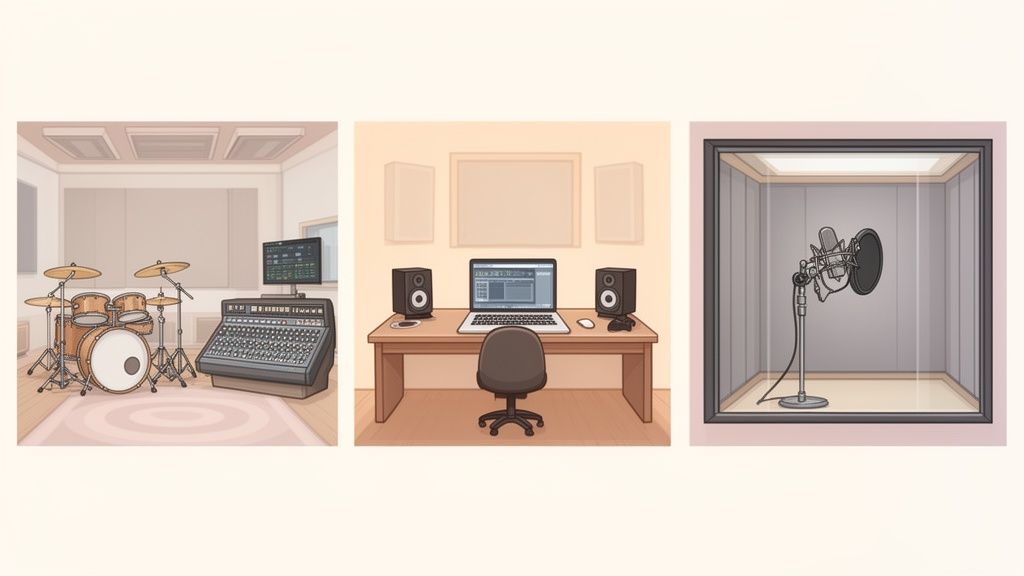
Not every recording studio in Tulsa is created equal. Finding the one that actually fits your project is the first—and most important—step toward a great session.
The right choice makes the creative process feel seamless, but the wrong one can be an exercise in frustration. It's a lot like picking the right kitchen to cook a meal.
A big commercial studio is the equivalent of an industrial kitchen built for a Michelin-star restaurant. It's got all the gear and space to handle a full band tracking live. On the flip side, a private project studio is more like a high-end home kitchen—cozy, efficient, and perfect for a solo artist or producer layering tracks.
Then you have the specialists. A dedicated podcasting suite or vocal booth is like a top-tier espresso bar, perfectly dialed in to do one thing exceptionally well. These rooms are all about capturing crystal-clear spoken word for podcasts, audiobooks, or voiceovers.
Major Studio Categories Explained
Let's break down the main types of studios you'll run into. Knowing the lingo helps you narrow your search and find a space with the right environment, gear, and workflow for what you're trying to accomplish.
Commercial Studios: These are the big guns. Think multiple recording rooms, massive microphone lockers, and those huge mixing consoles you see in documentaries. They’re the go-to for full bands who need to capture that live, in-the-room energy.
Project Studios: Smaller, more personal spaces, often run by a single producer or engineer. They're a fantastic fit for solo artists, songwriters, and electronic musicians who need a focused environment for writing and overdubs without the hefty price tag of a commercial facility.
Specialized Content Studios: This is a newer breed of studio built for the modern creator. We're talking dedicated podcasting booths and voiceover rooms designed for one purpose: pristine vocal audio. They’re perfect for anyone who needs broadcast-quality sound without the complexity of a full-blown music studio. If you're launching a show, our guide on booking a podcast studio rental near you is a great place to start.
So, how do you pick? Here's a quick cheat sheet to help you find your match in Tulsa's recording scene.
Tulsa Recording Studio Types at a Glance
Studio Type | Best For | Typical User | Example Vibe |
|---|---|---|---|
Commercial Studio | Live band tracking, large ensembles, orchestral work | Professional bands, established artists | Large live room, isolated booths, professional staff |
Project Studio | Songwriting, vocal overdubs, beat making, mixing | Solo artists, producers, songwriters | Intimate, focused, often run by a single engineer |
Specialized Studio | Podcasts, voiceovers, audiobooks, ADR | Podcasters, entrepreneurs, voice actors | Acoustically treated, soundproofed vocal booth |
Ultimately, the best choice depends entirely on your project's specific needs and your creative goals.
Finding Your Fit in the Tulsa Scene
Choosing the right studio is all about matching the space's strengths to your goals. A rock band is going to feel claustrophobic in a tiny vocal booth, and a podcaster would just be burning cash on gear they don't need in a massive commercial studio.
The key is to match the environment to the ambition. Your choice of studio directly impacts not only the technical quality of your recording but also the creative energy and efficiency of your session.
For so many modern creators in Tulsa—from business owners recording a brand podcast to professionals needing a quiet space for voiceover work—a specialized studio is the smartest move.
Spaces like the Rise loft studio and podcast booth at Freeform House in Jenks deliver this focused, high-quality experience. It’s the best of both worlds: top-tier audio production inside a dynamic community hub, creating natural opportunities for collaboration and connection.
What Professional Studio Equipment Really Matters
Walking into a professional recording studio in Tulsa for the first time can be a bit like stepping onto the bridge of a spaceship. All those knobs, glowing lights, and endless faders on a giant console look incredibly intimidating. But really, all that gear is just a collection of tools, each designed to do one thing: capture your sound perfectly.
Knowing what the most important pieces do is the secret to asking the right questions. It ensures the studio you choose actually has what your specific project needs. Think of it this way: the equipment isn't the art itself, but it's the canvas and the brushes. In the right hands, quality gear is what separates a pretty good recording from a truly phenomenal one.
The Unsung Heroes of Great Sound
That massive mixing board might be the first thing you notice, but some of the most critical pieces of gear are way less obvious—and they have a much bigger impact on how everything turns out. Getting these right is absolutely non-negotiable for professional sound.
First up is the microphone locker. This is a studio’s version of a master photographer’s lens collection. You don't just have one microphone; you have a whole closet full of them. Each one captures sound in a unique way, adding its own color, warmth, or clarity. A vintage Neumann U 47 might be the go-to for a rich, intimate vocal, while a pair of Coles 4038 ribbon mics could be the perfect choice for the warm, natural sound of drum overheads.
Next, and maybe most importantly, is acoustic treatment. This is the real unsung hero of any great recording space. It’s not about soundproofing a room so the neighbors don’t complain. It's about meticulously controlling how sound behaves inside the room. Bass traps, diffusers, and absorption panels are strategically placed to kill nasty echoes, unwanted reverb, and weird frequency buildups. This makes sure the microphone is capturing the pure, direct sound of your performance—not the chaotic sound of it bouncing off the walls.
A well-treated room is the absolute foundation of a clean recording. No amount of expensive gear can fix audio that was captured in a bad acoustic environment. It’s the difference between recording in a cathedral and a padded cell—each has its place, but only a controlled space gives you a truly blank slate to work with.
The Brain and The Ears of The Studio
Once you’ve captured a clean sound at the source, the next set of tools comes in to shape and refine it. The audio console, or mixing board, acts as the studio's central nervous system. It's where the signals from all the microphones come together to be processed through preamps and equalizers before being sent off to the recording device. A high-end console gives you clean amplification and flexible routing, which are key for a smooth, efficient session.
Finally, you have the studio monitors. These aren't your average bookshelf speakers; they're designed to be brutally honest. Their job is to give you a flat, uncolored frequency response so the engineer can hear exactly what was recorded, warts and all. They’ll instantly reveal if the bass is too boomy, if a vocal is too harsh, or if there's a tiny bit of background noise you missed. Good monitors are the brutally honest friend every artist needs, ensuring their mix sounds great everywhere, from a car stereo to a pair of expensive headphones.
For anyone looking to build out their own space, these principles are just as important. You can learn more in our guide on how to set up podcast equipment for studio-quality sound.
How to Select the Perfect Studio for Your Project
Choosing the right recording studio in Tulsa is a lot like picking a creative partner. It goes way beyond just finding a room with impressive gear. The best studio for your project won't just capture your sound—it'll elevate it. Getting this decision right means balancing your technical needs with your artistic vision and, of course, your budget.
You have to think past the equipment list. What’s the sonic character of the studio? What's the atmosphere like? And who are the people you'll actually be working with? All these pieces come together to create an environment where you can truly do your best work.
Evaluate the Vibe and Sonic Signature
Every studio has its own unique sound and feel. Think of it like a painter's workshop—the light and mood of the space absolutely influence the final piece. A musician or podcaster is no different. You have to ask yourself: does this space feel inspiring and comfortable, or is it sterile and intimidating? A relaxed artist is always a better artist.
Just as important is the studio's sonic signature. The absolute best way to check this is by listening to their portfolio. You wouldn't hire a film director without watching their movies, right? Same principle. Listen to the work that's come out of the studio. Do the recordings sound polished and modern, or raw and vintage? Warm or crisp? If their sound doesn't align with your goals, it's not the right fit, no matter how fancy the gear is.
This little guide breaks down the core components of studio gear to help you understand what goes into crafting that final sound.
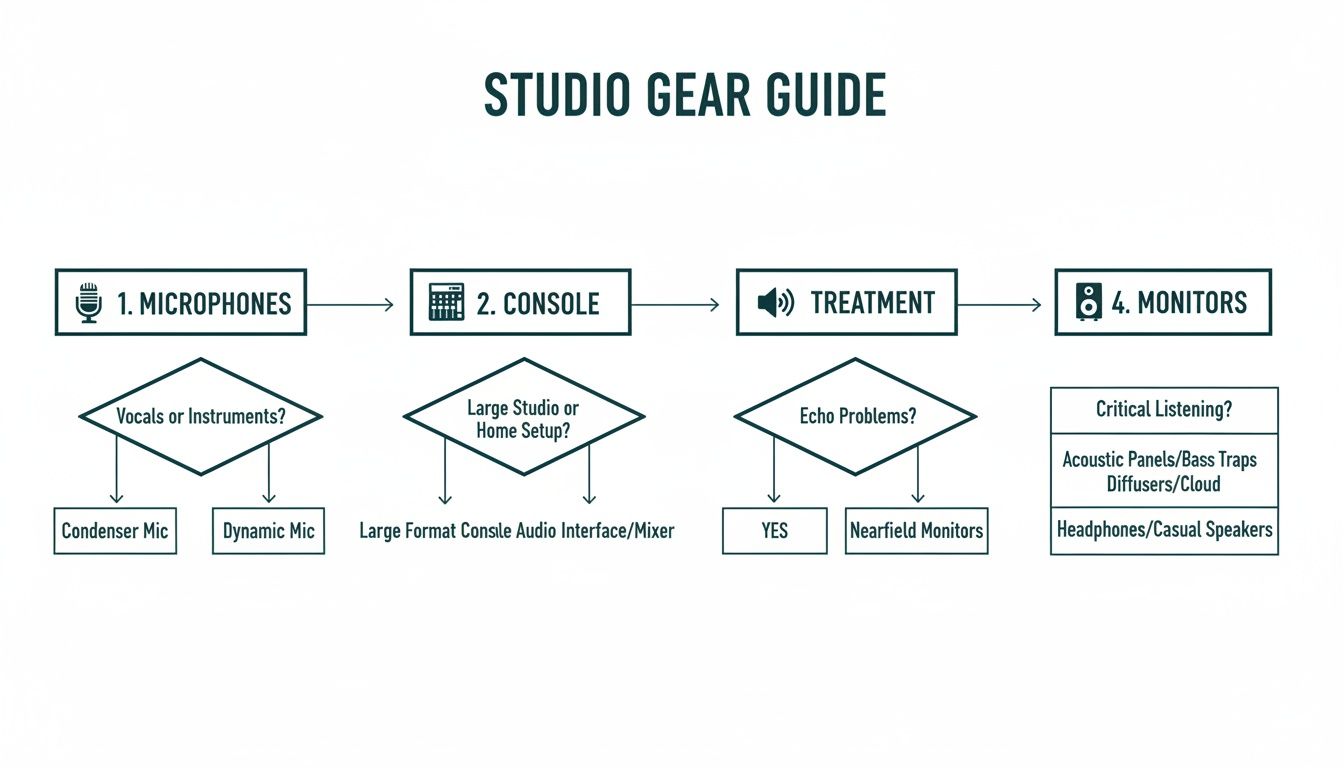
As you can see, every piece of equipment, from the microphone you sing into to the monitors you listen back on, plays a critical role in shaping the audio.
Consider the Engineer's Role
Here’s a pro-tip: the audio engineer is arguably more important than any single piece of equipment in the room. They're part sonic scientist, part creative collaborator, and part project manager, all rolled into one. A seasoned engineer knows how to translate your creative vision into a technical reality, fix problems before you even know they exist, and keep the session moving along.
When you're checking out a studio, always ask about their in-house engineers. Try to find someone with real experience in your genre, whether you're making indie rock, hip-hop, or a narrative podcast. A great engineer brings out the absolute best in your performance and becomes an essential part of the creative team.
The relationship between an artist and an engineer is built on trust and communication. A skilled engineer doesn’t just press record; they listen, interpret, and contribute to the final product in ways that technology alone cannot.
Budgeting and Logistics
Finally, you have to get practical. Things like your budget and the studio's location are huge factors. Studio rates here in Tulsa can vary pretty widely, so it's vital to know exactly what your money is getting you.
Hourly Rates vs. Block Bookings: If you're doing something short, like a voiceover, an hourly rate gives you flexibility. But for bigger projects like an entire album, booking a block of time or a full day rate will almost always save you a good chunk of cash.
Included Services: Always clarify if the rate includes an engineer. Some places charge for engineering separately, and that can be a surprise that really hits your budget hard.
Location and Accessibility: Pick a studio that’s easy for you to get to. A stressful commute is the fastest way to kill your creative energy before you even step foot in the door.
By carefully weighing these things—the vibe, the portfolio, the engineer, and the logistics—you can confidently pick a recording studio in Tulsa that doesn’t just meet your technical needs, but genuinely supports your artistic journey.
Freeform House: A Modern Hub for Tulsa Creators
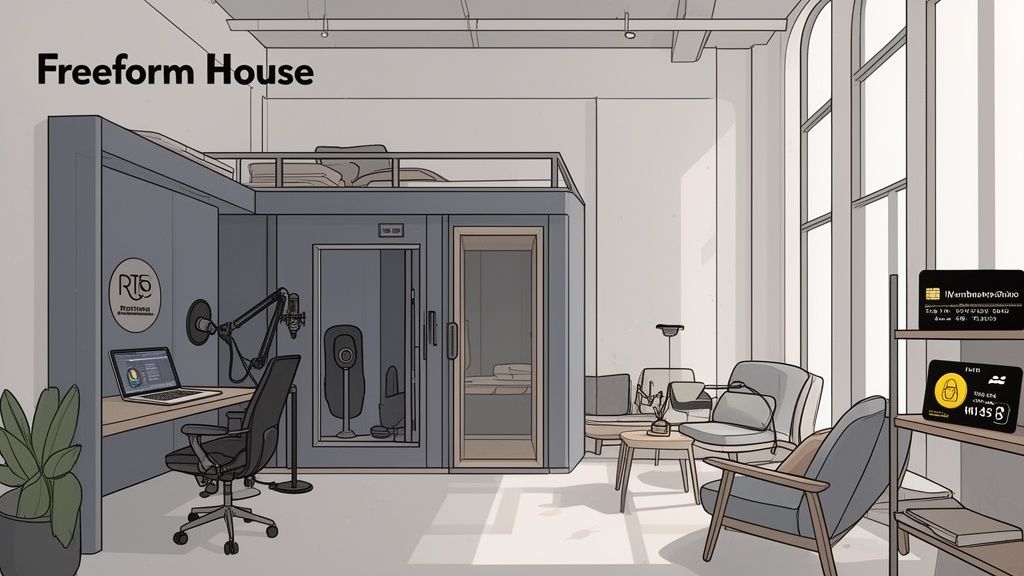
Let's face it: for a lot of today's podcasters, entrepreneurs, and content creators, the old-school recording studio model just doesn't quite click. Not every project needs a giant mixing console and a maze of soundproofed rooms. There’s a new kind of creative space popping up, one that blends top-notch production gear with a vibe that’s all about collaboration.
That's where Freeform House comes in. Freeform House is envisioned as a premier, membership-based club in the heart of Jenks, Oklahoma's 10 District downtown. Comparable to the renowned SoHo House, it offers more than just a social club. Members can take advantage of co-working spaces and a dynamic community hub designed for collaboration and connection. It's a central gathering spot aimed at fostering a creative and cooperative spirit within our local community.
We’re rethinking what a recording studio in Tulsa can be, moving away from a simple pay-for-time service to a full-blown creative experience. The whole setup is built for professionals who need both quality and efficiency. Members can bounce from a focused recording session straight into a team meeting or a quiet work block, all in the same building.
Production Meets Professional Community
At the heart of it all are the Rise loft studio and a professional podcast booth. Both spaces are decked out to give you that pristine, clean audio you’re after, but with tech that’s actually easy to use. It’s perfect for pros who need to crank out high-quality content without wrestling with the technical headaches of a massive studio.
Freeform House isn't just a place to record audio; it's a creative hub where high-quality content creation meets professional networking in an authentic, inspiring setting.
But the real magic happens outside the studio doors. The club is a genuine community for connection and collaboration. When you look at the local scene, this is a game-changer. The Tulsa Music Census found that 69% of local pros are music creatives, with thousands more working in related fields. For members, that means a massive opportunity to tap into a deep pool of local talent. You can dig into more of the findings shaping Tulsa's music scene to see just how vibrant it is here.
A Hub for Tulsa's Creative Economy
By mixing co-working spaces, high-end production facilities, and a dynamic community, Freeform House creates a unique ecosystem. Picture this: you wrap up a podcast recording, then walk over to the Thomas Room to host a workshop for local entrepreneurs. Or maybe you bump into a potential collaborator over coffee in one of the lounges.
This integrated approach gives you a clear edge:
Flexibility: Get your hands on professional-grade tools exactly when you need them, without being locked into a pricey studio lease.
Networking: The club atmosphere makes it easy and natural to connect with other ambitious people from all sorts of industries.
Efficiency: Having your workspace and production space in one spot streamlines your entire workflow, which is huge for busy creators.
For the modern Tulsa creator, Freeform House is a forward-thinking solution—a place where the right tools and a supportive community come together to help great ideas take flight.
Your Pre-Session Checklist for a Flawless Recording
Studio time is an investment, plain and simple. Walking in prepared is the single best way to make sure every dollar and every minute counts. A great session isn't just about what happens when the red light is on—it's about all the focused work you put in beforehand.
Getting your ducks in a row transforms what could be a stressful day into a smooth, productive, and genuinely fun creative experience. Without a plan, sessions drift, you lose focus, and you end up wasting time trying to figure out your vision while the clock is ticking. Think of preparation as the bridge between a good idea and a polished final product.
Have Your Vision and Materials Ready
Before you even think about booking time at a recording studio in Tulsa, you need to know exactly what you’re trying to accomplish. That means getting all your creative assets organized and ready to roll.
Demos and Reference Tracks: Have rough recordings (demos) of your songs or content. You should also bring two or three reference tracks—songs by other artists that have the kind of sonic vibe you're aiming for. This gives the engineer a clear target to work toward.
Organized Digital Files: Seriously, don't be that person. Put all your lyrics, scripts, chord charts, and session files into one clearly labeled folder on a hard drive or cloud service. This simple step can save you from the headache of hunting for a missing file mid-session.
A Clear Session Plan: Outline what success looks like for this specific session. Is the goal to track drums for three songs? Record and edit a single podcast episode? Knowing your primary objectives keeps everyone focused and on track.
Master Your Performance Before You Arrive
The studio is the place to capture a great performance, not to practice one for the first time. The more dialed-in you are as a performer, the more you'll get done.
Think of it this way: the recording studio is the camera, but you are the actor. An actor wouldn’t show up to set without knowing their lines. Rehearse your parts until they're second nature.
This goes for everyone, from singers to voiceover artists. Musicians should practice their parts with a metronome to nail down their timing. If you’re a podcaster or speaker, read your script out loud a few times to catch any awkward phrasing or tongue twisters.
And maybe the most important tip? Get a good night's sleep. Fatigue is the enemy of a great take. Showing up well-rested is one of the most professional things you can do.
Got Questions About Tulsa Recording Studios? We’ve Got Answers.
As you get closer to booking a recording studio in Tulsa, a few questions always seem to pop up. Getting these details sorted out ahead of time means you can walk into your session feeling confident and ready to create, not stressed about the small stuff.
Let's start with the big one: cost. The truth is, rates are all over the map, and it really depends on the studio's gear and reputation. You might find a smaller project studio for $40-$75 per hour. On the other end of the spectrum, Tulsa’s premier commercial studios can run from $100-$200 per hour or even more, but that price almost always includes a professional engineer to run the session.
Do I Need to Bring My Own Audio Engineer?
For most artists and creators, the answer is a simple no. Using the studio's in-house engineer is almost always the smart move. These folks know their room and their equipment inside and out, which saves a ton of time and usually gets you a much better result. They know exactly which microphone pairs best with a certain preamp for a specific vocal tone—that's experience you can't fake.
Bringing your own engineer is really only common when you have a long-term relationship with a producer who is already shaping your sound from the ground up.
Quick Tip: "Mixing" and "mastering" aren't the same thing. Mixing is the art of blending all your individual recorded tracks into one cohesive song. Mastering is the final step, where that single song is polished to sound amazing and loud enough on every speaker, from an iPhone to a club system. They're two distinct, crucial stages.
Then there are unique models like Freeform House. We offer something different by bundling high-end studio time into our memberships. It’s perfect for podcasters, musicians, and creators who need consistent access to professional gear without the per-hour sticker shock. This gives you a predictable cost for all your ongoing projects.
Ready to create in a space that blends top-tier equipment with an inspiring community? Check out the creative tools at Freeform House, including our Rise loft studio and professional podcast booth. You can learn more about our memberships and book a tour on our website.
Comments