Downtown Business District: A Complete Guide

You're probably thinking about downtown while doing something ordinary. Maybe you're looking for office space that doesn't feel isolated, scouting a venue for a client event, or wondering why one stretch of Main Street feels alive while another feels vacant by lunch. That question matters more than it seems.
A downtown business district isn't just a cluster of storefronts or a few office buildings near City Hall. It's a compact ecosystem where work, spending, civic life, and everyday relationships overlap. When it works, a few blocks can support restaurants, meetings, services, creative work, public events, and the kind of chance encounters that help local businesses grow.
That's why downtowns deserve to be understood block by block, not just parcel by parcel. In places like Jenks and Tulsa, the most useful question isn't only whether a building can lease. It's whether the district can keep people coming back at different hours, for different reasons, over many years.
What a Downtown Business District Really Means
At 9 a.m., a healthy downtown sidewalk tells you a lot. Someone's carrying coffee into a meeting. A shop owner is opening the front door. A founder waves from an upstairs workspace. A delivery driver is trying to get in and out before the lunch rush starts.
That scene captures what a downtown business district really is. It's a walkable area where business activity is concentrated, but where commerce isn't the only thing happening. Civic life, public space, social routine, and local identity all share the same few blocks.
More than offices and retail
People often reduce downtown to one land use. Some think “office district.” Others think “shopping street.” Neither is enough. A downtown business district usually works because several functions overlap:
Commerce: shops, offices, restaurants, studios, and service businesses
Civic use: public streets, events, parades, meetings, and shared gathering spaces
Social use: places where people linger, reconnect, and build trust over time
Movement: sidewalks, parking, transit access, and short walking distances between stops
That overlap is the point. If a district only serves one purpose, it usually goes quiet when that purpose pauses.
Practical rule: If you can only describe a downtown by what happens there from 9 to 5, you're probably missing what makes it resilient.
Why this matters to owners and operators
A downtown business district shapes more than rent. It affects who sees your storefront, how often people return, whether workers can meet clients easily, and whether neighboring businesses help create shared momentum.
In large cities, this concentration becomes unmistakable. Toronto's Downtown area contained 664,650 jobs in 2025, representing 40.9% of the city's total employment, and 447,310 of those jobs were office work, or 67.3% of Downtown jobs, according to the City of Toronto Employment Survey Bulletin 2025. That doesn't just describe office demand. It explains why downtowns influence transit, leasing, service businesses, and the wider regional economy.
A local downtown works on the same principle at a smaller scale. The names change. The mechanics don't. Concentration creates opportunity, but only when the district gives people reasons to be there throughout the day and into the evening.
How Downtowns Differ from Neighborhoods and CBDs
People use several terms as if they mean the same thing. They don't. A downtown business district, a central business district, a shopping strip, and a residential neighborhood may all contain businesses, but they operate very differently.
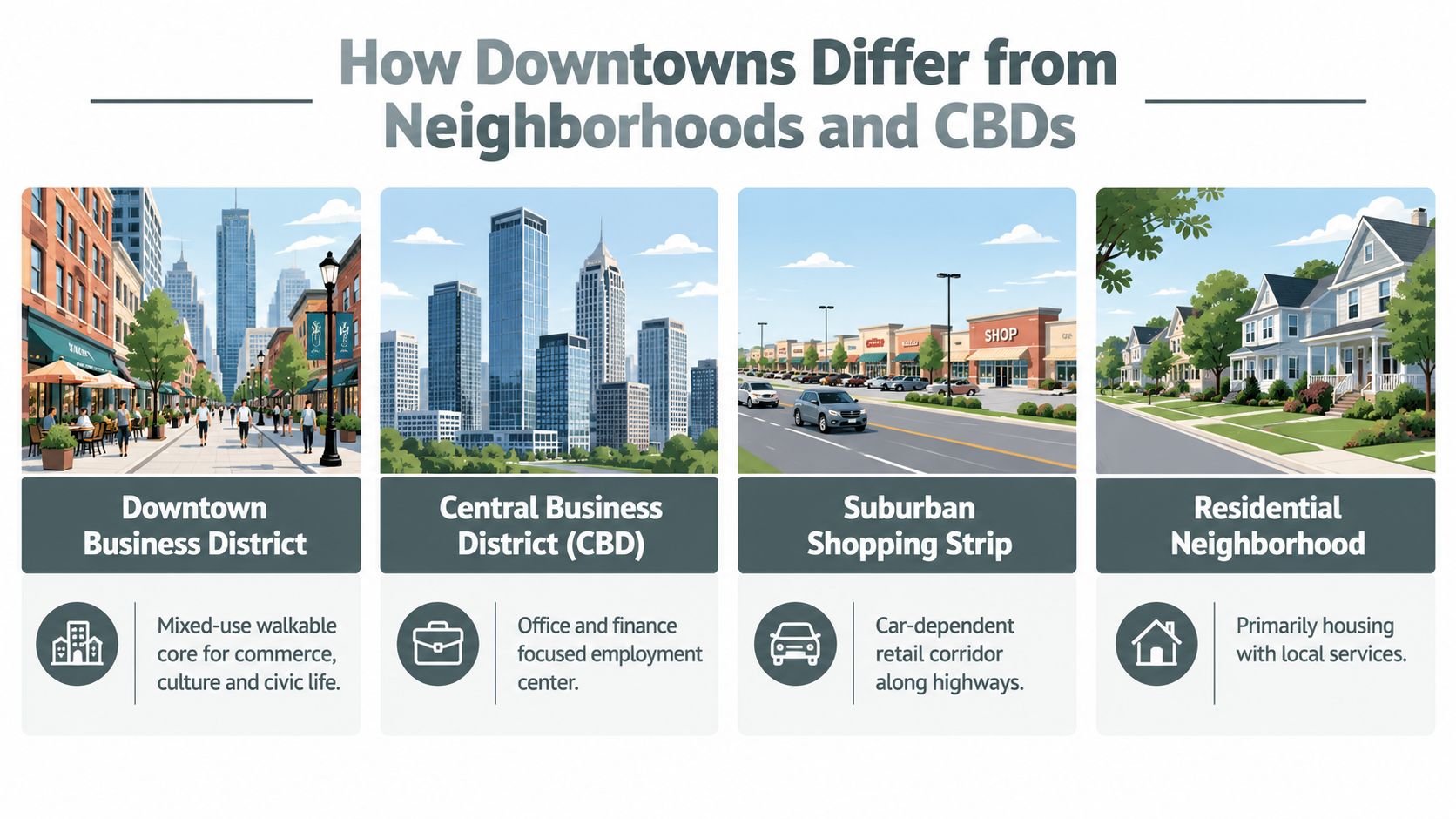
The easiest way to tell them apart
A central business district, or CBD, is usually the most employment-heavy core of a city. It tends to lean toward office towers, finance, government, and large employers. It may include retail and housing, but work is the dominant function.
A downtown business district can include a CBD, but it often has a broader street-level mix. It's where business activity shares space with restaurants, culture, events, local services, upper-floor offices, and sometimes housing.
A suburban shopping strip is different again. It's usually arranged for cars first. Buildings sit apart from one another, parking dominates the frontage, and most trips happen as separate stops rather than as a walkable chain of errands.
A residential neighborhood is built around housing first. It may have a corner café, small retail node, school, or church, but the district's identity comes from where people live, not from concentrated commerce.
A block people can picture
Think about one two-story block. On the ground floor, there's a coffee shop, a boutique, and a salon. Upstairs, there are studios, offices, or meeting rooms. Across the street, a small plaza hosts a market on weekends and people eat lunch there on weekdays.
That's much closer to a downtown business district than to a pure CBD or a shopping strip.
A downtown isn't defined only by what's inside the buildings. It's defined by how the buildings, sidewalks, and public routines work together.
Why the distinction matters
This difference affects everything from zoning to leasing strategy. In Jenks, the city's DC District is intended to accommodate commercial, office, entertainment, institutional, and multifamily uses, with residential uses above the ground floor in a pedestrian-oriented environment, according to the Jenks zoning ordinance for the Downtown Core district. That's a useful example because it shows downtown as a layered place, not a single-purpose zone.
The Ten District in Jenks as a Modern Example
Jenks gives us a concrete way to see how a downtown business district gets defined in real life. Instead of treating downtown as a vague idea, local leaders gave it a shape, a boundary, and a recognizable identity.
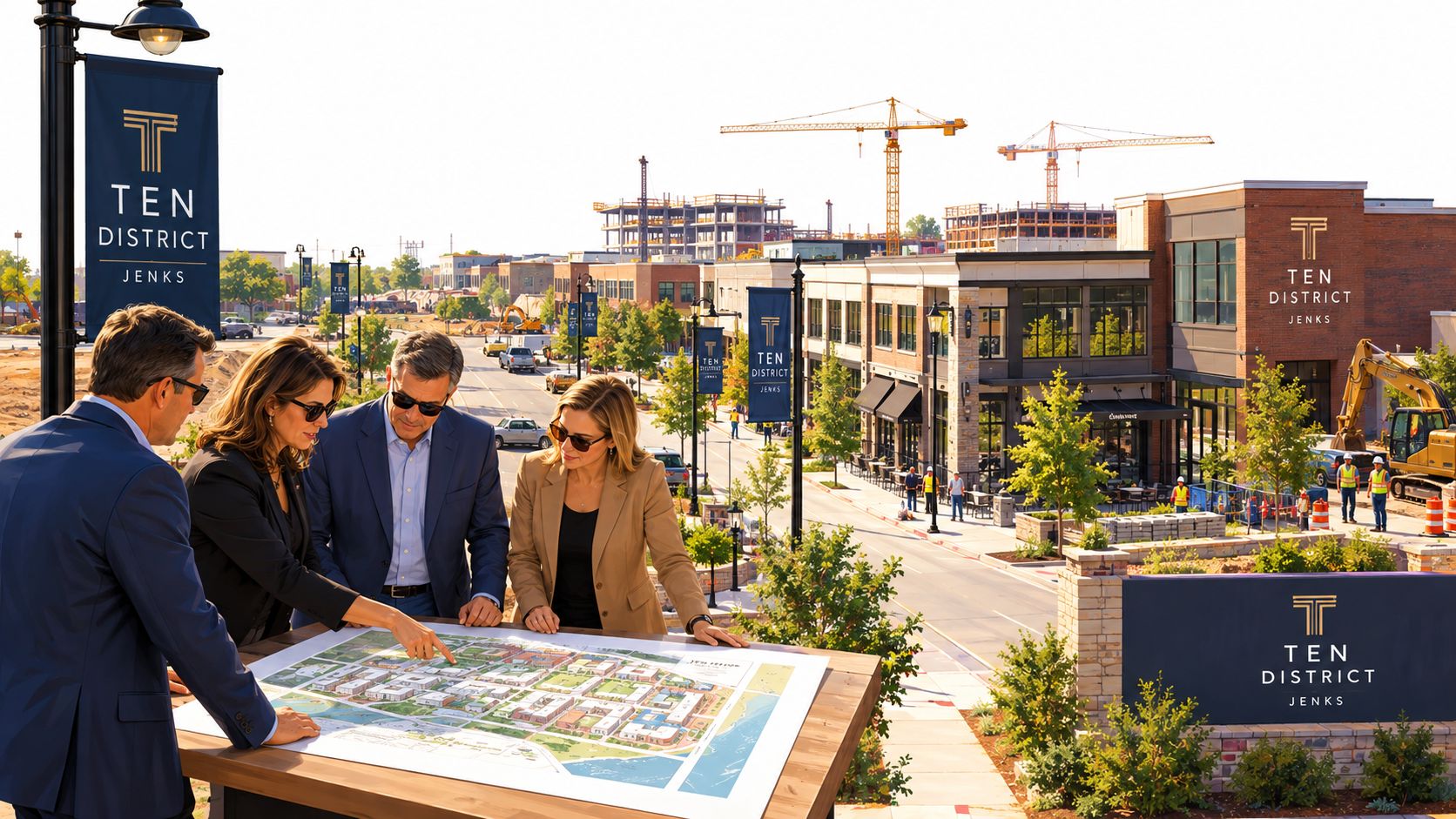
The Ten District in downtown Jenks is defined as exactly 10 blocks west of the Arkansas River until the old Midland Valley railroad tracks, and the initiative was founded in late 2021, as described on the Jenks Downtown site. That matters because successful districts usually become durable when people can answer a simple question: where does downtown begin, and what is supposed to happen there?
A district becomes real when people can use it
Branding alone doesn't make a district. But branding helps residents, investors, business owners, and visitors treat a set of blocks as a shared place instead of a pass-through.
Jenks shows the sequence many downtowns follow:
Draw the edges. People need a mental map.
Set the land-use pattern. Mixed-use rules allow different daily rhythms to coexist.
Improve the public realm. Walkability, frontage, and public gathering matter.
Recruit or support anchors. A few dependable destinations help smaller operators.
Program the place. Events turn occasional visitors into repeat users.
That sequence is practical because downtowns aren't finished products. Operators test ideas, owners renovate older buildings, and the district gets stronger when more uses overlap well.
Why people study Jenks
Jenks is useful because it's not trying to imitate a giant metro core. It's building a smaller-scale downtown where identity, access, and mixed use do the heavy lifting. That's often a smarter model for suburban-edge or small-city districts than chasing a pure office strategy.
This video gives a feel for how place identity and district momentum get communicated to the public.
A lot of readers get confused here. They assume a district becomes successful once a few nice buildings go up. In practice, the harder part is repeated use. A district has to keep earning visits.
The Economic and Social Roles Districts Play
Downtowns do at least three jobs at once. They create economic concentration. They provide a civic stage. They give people a social routine that smaller, scattered commercial areas struggle to reproduce.
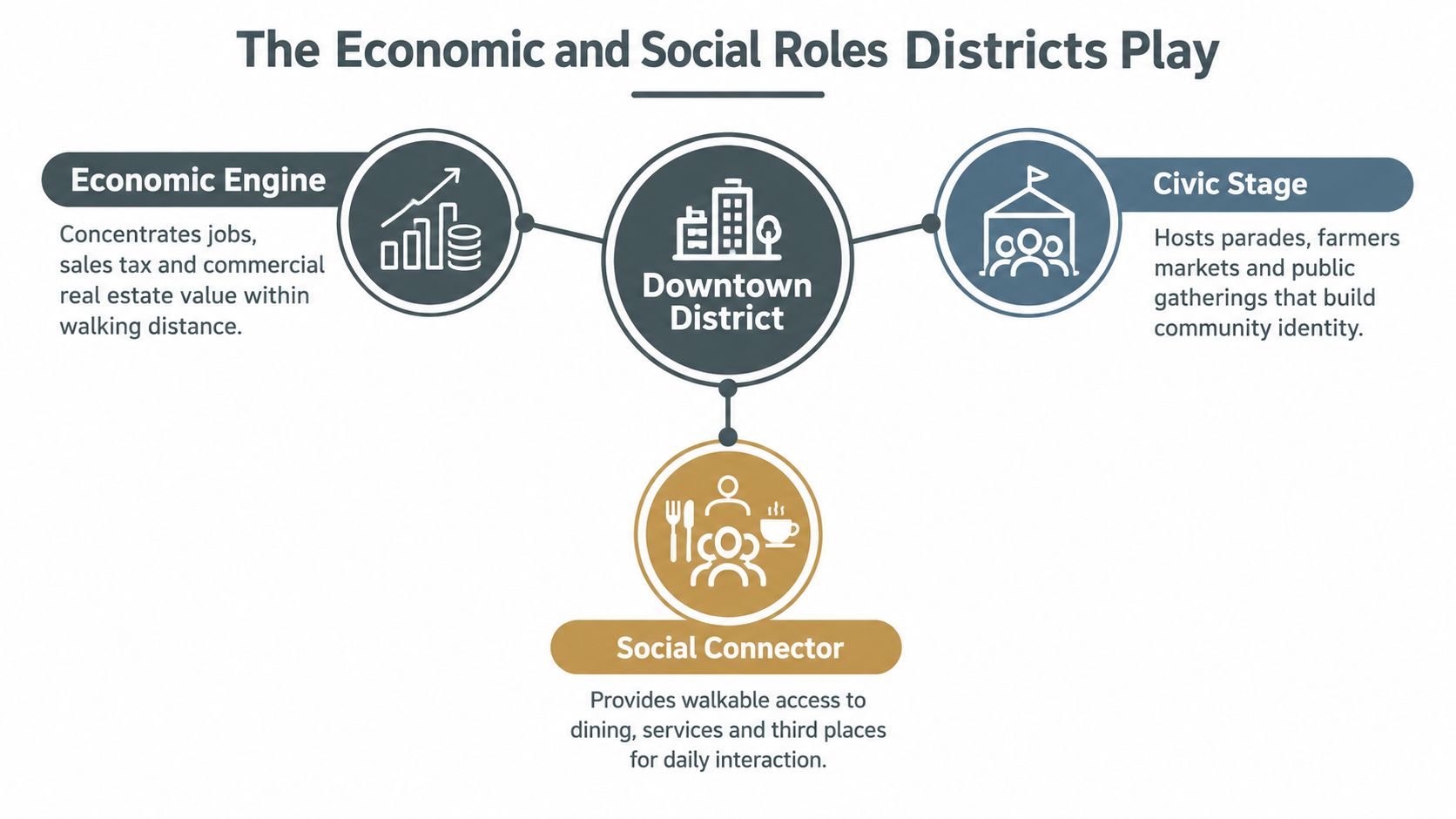
Economic engine on a small footprint
A district doesn't need to cover much land to matter a lot. In Washington, DC, Downtown accounts for about 2.7% of the District's total land area, yet a downtown report described it as the city's economic powerhouse. A 2019 district report said Downtown hosted 188,600 jobs in just one square mile, making it the region's largest job center with 5.6% of regional employment and 24% of District employment. The same report noted 98 million square feet of built space across 526 properties, including 74.6 million square feet of office space and 6.5 million square feet of housing, and a separate district fact sheet reported that the average large downtown commercial office building brings in about $1.5 million per year in city taxes, according to the Downtown DC key facts and trends update.
That concentration changes how a local block performs. A coffee shop next to offices, services, meeting rooms, and events isn't relying on a single customer type. It's serving overlapping trips.
Civic stage and social connector
Downtown also hosts public life. The same sidewalk can handle a weekday errand, a ribbon cutting, a market, and a holiday parade. That shared visibility matters because people don't just spend money downtown. They also learn what their community values there.
A useful way to think about this is through community entrepreneurship in local ecosystems. In strong districts, entrepreneurs don't operate as isolated tenants. They become part of a visible network of routines, referrals, and shared audiences.
Downtown works best when one person's destination becomes another person's accidental stop.
Why activity by hour matters
A district can't depend on daytime office traffic alone. Downtown Boston offers a clear signal of how street activity and occupancy relate. Its district report shows vacancy fell to 25.3% in 2Q26 from a 28.5% peak in 2Q24, while pedestrian volumes recovered to nearly 3 million visitations in June, according to the Downtown Boston Alliance quarterly report for 2Q26.
That doesn't mean foot traffic solves everything. It means activity, leasing, retail health, and public life are connected. A strong downtown business district keeps changing character by hour without losing momentum.
Benefits and Challenges for Local Businesses
For a business owner, a downtown lease is rarely a simple real estate choice. It's an operating model choice. You're deciding how much of your success will depend on adjacency, walk-in traffic, shared visibility, and the rhythm of the district itself.
Where downtown helps
The upside is easy to see when the block is active. Nearby businesses create marketing gravity. Customers can combine errands. Teams can meet clients without sending them to a hard-to-find office park. Event spillover can become retail demand.
Some operators also benefit from the district's built-in credibility. If your business sits in a recognized downtown, customers tend to understand the location immediately. That clarity lowers friction.
For businesses comparing formats, it helps to review local amenity patterns that shape daily convenience and customer behavior.
Where downtown creates pressure
The same features that make downtown appealing can also create strain. Parking may be less convenient. Loading can be awkward. Public works improvements can disrupt access before they help it. If the district overrelies on one daytime audience, lunch traffic can thin out quickly when work habits change.
Recent reporting from Denver highlights that uneven recovery. One 2026 report said downtown office vacancy remained high at 38.6% overall and 44% in the central business district, while evening visits had surpassed pre-pandemic levels, daytime foot traffic was still 20% to 30% below pre-pandemic levels, and overall corridor visits were down 3.3% year over year in Q2 2026, according to the Denver Gazette report on downtown office and visitation patterns. That's a useful reminder that nightlife recovery and office recovery aren't the same thing.
On-the-ground test: Visit the block at opening time, lunch, late afternoon, and evening before you sign anything.
Downtown Business District Benefits vs. Challenges
Factor | Benefit | Challenge |
|---|---|---|
Visibility | Shared foot traffic and nearby destinations can increase discovery | Your storefront competes with many others for attention |
Customer behavior | People can bundle trips and stay longer in the area | Demand may vary sharply by hour or day |
Hiring and meetings | Central locations are easier for clients and collaborators to reach | Access frustrations can affect staff and guests |
Brand identity | A downtown address can signal credibility and relevance | Rising interest in the district can push costs upward |
Operations | Nearby businesses may create referral loops and event spillover | Deliveries, parking, and street work can complicate logistics |
The lesson isn't that downtown is risky or easy. It's that downtown rewards operators who study the district as carefully as they study the floor plan.
How Anchors Like Freeform House Revitalize Main Street
Walk down a healthy main street at 10 a.m., then again at 2 p.m., then after dinner. If the same few blocks still feel in use across all three visits, an anchor is usually part of the reason.
An anchor works like a steady engine for the district. It does more than fill a lease. It creates repeat reasons to come downtown, which helps nearby businesses rely on more than one rush period or one type of customer.
That matters because a downtown is an ecosystem, not a single property play. One restaurant can bring dinner traffic. One office can bring weekday workers. An anchor brings overlapping activity by serving several uses from one address.
What an anchor actually does
The practical job of an anchor is rhythm. It helps a district keep a daily pattern of arrival, stay time, and return visits.
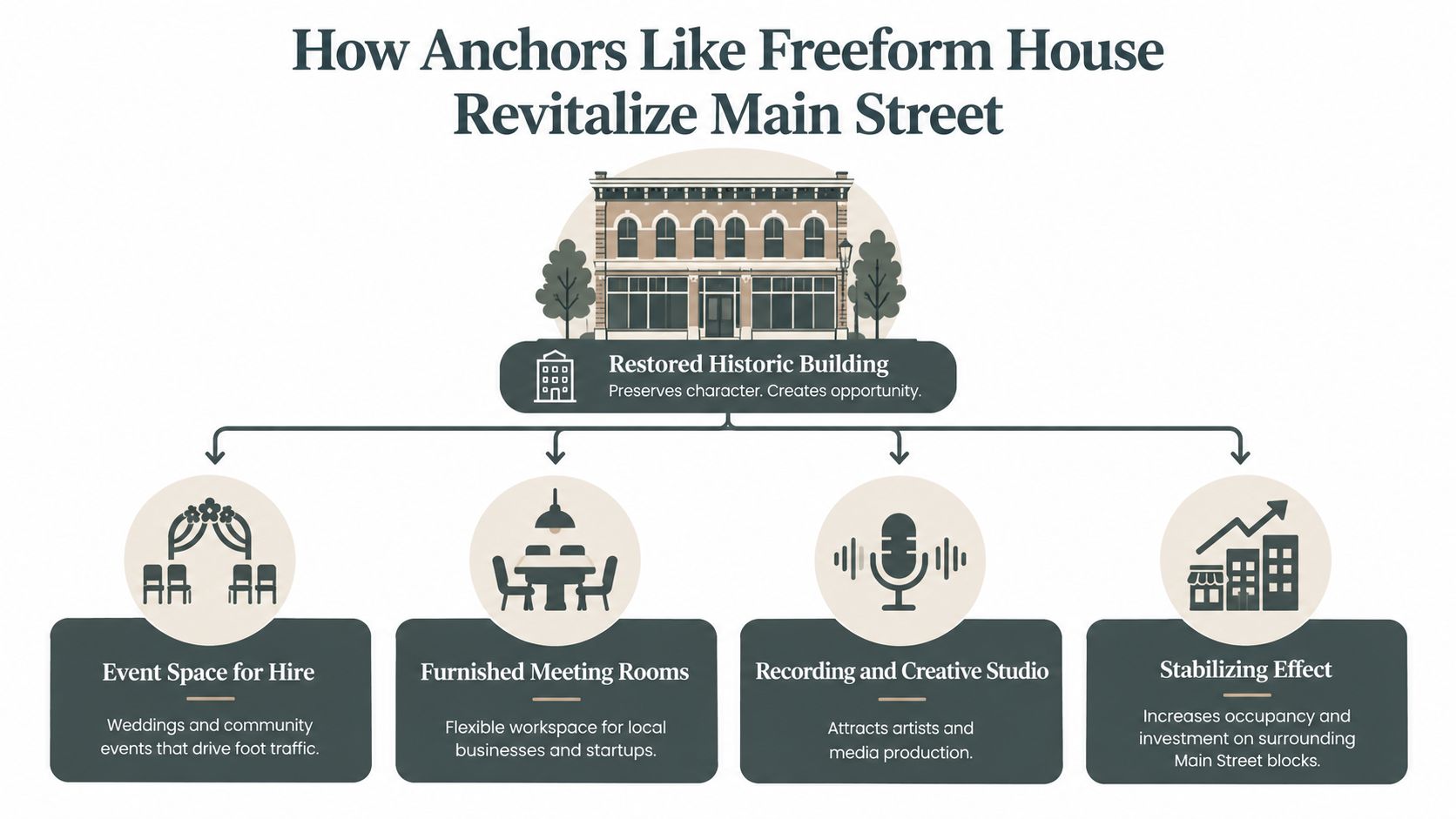
Freeform House is a members-only club and workspace in the Ten District in downtown Jenks.
That single example is useful because it points to the larger concept. A place that supports work, meetings, and social gathering can pull in different users at different hours. Morning members may grab coffee nearby. Afternoon guests may book a meeting and then walk to lunch. Evening attendees may stay in the district instead of driving elsewhere for the rest of the night.
A downtown with that kind of layered use is usually more stable than one built around a single demand spike.
Why historic buildings often become anchors
Older downtown buildings often fit this role well because they were built for visibility and flexibility. A former bank, lodge, or department store may have large rooms, a prominent corner, and a street presence that newer suburban-style spaces rarely match.
Reuse also takes money and patience. One example from downtown Hamilton involved renovation of a 26,000-square-foot historic bank building, where the project sought a 50% property tax abatement for 10 years and restoration costs were expected to be nearly $8.7 million, according to the Journal-News report on the Hamilton rehabilitation proposal. The lesson is straightforward. When a community restores a central building for mixed use, it is investing in a long-lived district asset, not just updating a facade.
The amenity stack matters
Anchors succeed when they give people more than one reason to show up. That mix often includes quiet work areas, meeting rooms, and places for informal connection.
For comparison, Soho Works membership includes amenities such as Wi‑Fi up to 110 Mbps, breakfast, tea and coffee, private phone booths, lockers and showers, 200 pages of printing per month, podcast equipment and a recording studio, and meeting rooms with 55-inch to 98-inch screens, as listed on the Soho Works membership page.
Those details help explain the anchor effect. One person comes to work for three hours. Another records a podcast. Another hosts a client meeting. Another attends an evening event. Separate trips, same building. For nearby shops and restaurants, that creates a steadier stream of potential customers than a space with only one use and one peak hour.
Practical Next Steps for Entrepreneurs and Professionals
At 8 a.m., a downtown can look calm and full of promise. By 2 p.m., the same block may tell a different story. One coffee shop is busy, a nearby storefront is quiet, and the sidewalk traffic only makes sense once you notice where people are coming from and where they go next.
That is why the first step is not signing a lease. It is learning the district's daily rhythm.
Read the district before you commit
Approach downtown the way a shopkeeper or property manager would. Walk it more than once. Go early, come back at lunch, return after work, and if the area has nightlife or events, visit then too. A healthy district works like a relay team. One group of users hands activity off to the next, so the place does not go silent between peaks.
As you walk, pay attention to a few practical signals:
Storefront posture: Do businesses face the sidewalk with visible entrances and active windows, or do they feel turned inward?
Neighbor fit: Do nearby uses strengthen your customer flow, or are several businesses chasing the same small slice of demand?
Street friction: Check parking, pickup space, crossings, shade, and how comfortably someone can move from one stop to another.
Repeat patterns: Look for regular lunchtime workers, standing meetups, and returning customers, not only event crowds.
A festival can fill a block for a few hours. Daily habits are what support rent.
Solve for a missing function
Strong downtown businesses usually do one of two things. They serve an existing flow of people, or they create a new reason for people to stay longer.
That sounds abstract, so it helps to picture downtown as a small ecosystem. A restaurant feeds the lunch crowd. A salon brings in appointments. A professional office generates weekday visits. A club, studio, or shared workspace can connect all three by giving people a place to meet, work, or gather between other stops. The opportunity is often less about finding empty square footage and more about spotting a missing layer in the district.
If you are comparing formats, use the district's maturity to guide the choice:
Traditional lease. Works best when customer demand is consistent and your hours match the area's strongest traffic.
Pop-up or short-term space. Useful for testing whether your offer fits the block before you invest in buildout.
Flexible workspace or shared venue. Useful for consultants, creatives, and hybrid teams whose schedule changes week to week.
Choose a base that matches how you actually work
This matters for professionals as much as retailers. A lawyer who needs quiet client meetings has different space needs than a designer who benefits from casual collisions and occasional production space. Downtown succeeds when people can plug into it at the right level, not only through full storefront leases.
In Jenks, one local example is Freeform House, a members-only club and workspace in the Ten District. The larger lesson is the important part. Places like that can help keep skilled professionals present in the district, spending time and money nearby, building relationships, and adding weekday stability between major events.
So ask a plain question before you choose space: does this setup support the way your week really unfolds?
If the answer is yes, you are not just renting a room. You are joining a working downtown system that depends on repeated presence, overlapping uses, and people who give the district life block by block.
Building a Downtown That Lasts Beyond One Boom
A downtown that survives one economic cycle isn't necessarily healthy. Plenty of districts look strong when incentives are fresh, a few new tenants arrive, or one property owner is doing heavy lifting. The harder test is whether the place still works when habits change, office demand softens, or the original novelty fades.
What resilience looks like on the ground
Lasting downtowns usually share a few traits. They have more than one kind of ownership. They reuse older buildings instead of depending only on new construction. They support businesses with different hours, price points, and customer bases.
They also keep programming the district. A downtown can't rely on leasing alone to create loyalty. People return because the place keeps giving them practical reasons to show up.
Canada's office market offers a useful signal here. CBRE data in Canada found national downtown office vacancy declined only 60 basis points in Q1 2026, with Class A improving faster than Class B/C, according to CBRE Canada Office Figures Q1 2026. That points to a split recovery, not a broad one. Cities are increasingly pairing leasing concerns with storefront activation, small-business support, and mixed-use management.
Jenks points toward the stronger model
Jenks is compelling because the district identity isn't based on a single office play. It's based on layered use, local presence, and a defined downtown geography people can recognize and participate in. That's a sturdier foundation than hoping one asset class carries the whole district.
If you want a deeper local read on this approach, this perspective on downtown revitalization and Main Street reinvestment gets at the same long-game principle. Downtowns last when people treat them as community infrastructure, not just as a short-term real estate cycle.
A durable downtown doesn't ask one building type to do all the work. It spreads the load across local operators, public space, events, and adaptive reuse.
Your starting move doesn't have to be dramatic. Visit a downtown in person. Spend money at an independent business. Attend a community meeting. Book space where you can work in the district instead of driving past it. Those small decisions help determine whether a downtown business district becomes a temporary upswing or a lasting local economy.
Freeform House brings together workspace, meeting rooms, event space, and creative amenities inside downtown Jenks, which is exactly the kind of layered anchor a strong district needs. If you want to experience how a downtown ecosystem works from the inside, visit Freeform House and see how a well-used building can support connection, work, and Main Street activity in the same place.
Comments