What Is Community Entrepreneurship and How It Works

You're standing on a downtown block where the coffee shop is busy, the storefront beside it is empty, and several talented people are working alone from kitchen tables or spare bedrooms. Each person has useful skills, local knowledge, and ideas for improving the area. What's missing isn't always ambition. Often, it's a reliable way for those people to meet, share resources, find customers, and build something together.
That's the practical starting point for understanding what community entrepreneurship is. It isn't a local business, and it isn't a solo founder adding a charitable project to a company. It's a way of creating economic activity through relationships rooted in a particular place. A shared workspace, a local event, a cooperative, or a business incubator can become the infrastructure that helps many ventures move forward at once.
Introduction to Community Entrepreneurship That Builds Places
An empty storefront can change its role without changing its address. In the morning, a freelancer might use the front table for a client call. At lunch, a shop owner could meet a supplier nearby. Later, a photographer, designer, and nonprofit director might compare ideas for a neighborhood event. No single person owns all the activity, but the space helps each person do work that would be harder to do alone.
That scene captures the spirit of community entrepreneurship better than a dictionary definition. The value comes from repeated local connection. People exchange introductions, recommend one another, share practical knowledge, and notice needs that outsiders might miss. Over time, a building becomes more than a place to sit. It becomes a dependable meeting point for local opportunity.

Policy and academic literature commonly frames community entrepreneurship as place-based enterprise. The OECD describes entrepreneurship as a central pillar of economic development, job creation, and social inclusion, as well as a catalyst for urban regeneration in deprived areas. A literature review published in 2022 found that community enterprise and community entrepreneurship had been studied for three decades, showing that this is a recognized area of local-development research rather than a passing label. The OECD's work on entrepreneurship and local development connects enterprise with the wider health of places.
For a downtown district, that distinction matters. A business can generate private revenue while also helping a neighborhood retain talent, reuse existing buildings, and strengthen local relationships. The approach is especially relevant to Main Street revival, where the challenge isn't only filling storefronts. It's creating places where residents, professionals, creatives, and small businesses can keep finding one another.
If you're planning a gathering, a shared workspace, or a local business program, practical choices matter. This guide to hosting a community event can help turn a vacant or underused place into an active point of connection.
What Community Entrepreneurship Really Means
Start with a simple comparison. A private backyard garden belongs to one household. The household decides what to plant, who can enter, and how to use the harvest. A community garden still needs individuals to do the work, but the land, rules, and benefits are shared by a wider group.
Community entrepreneurship works more like the community garden. A local member may identify an opportunity, but the opportunity is shaped by residents, relationships, institutions, and the needs of the place. The venture might sell goods or services, yet its purpose includes strengthening the surrounding community.
A useful definition has several parts:
Local people identify a need. They may notice that entrepreneurs lack meeting space, families need a useful service, or local producers have no dependable route to customers.
The community organizes resources. Those resources can include local knowledge, available buildings, professional skills, trust, associations, and relationships with public or private institutions.
People create and use an opportunity together. The result may be a business, cooperative, shared facility, program, or network that provides value beyond one owner.
The work stays connected to the place. Geography, culture, history, and local relationships influence what gets built and how it operates.
Core idea: Community entrepreneurship turns local relationships and knowledge into coordinated action that addresses unmet needs and keeps more value connected to the place.
This is why doing business locally isn't enough by itself. A retailer located downtown may serve local customers without sharing decisions, building partnerships, or contributing to a wider network. Community entrepreneurship asks a broader question: how can enterprise help residents solve problems and create durable opportunity together?
The process also depends on shared governance. People need ways to decide priorities, manage resources, resolve disagreements, and revisit what isn't working. Strong initiatives usually move through repeated problem-solving cycles. Residents recognize a need, test a response, learn from participation, and adjust the model.
Social capital makes those cycles possible. It includes trust, associations, familiarity, and the confidence that others will contribute in good faith. Without it, even an attractive building can remain an underused room. With it, a modest space can support introductions, collaboration, and locally relevant solutions.
The most important shift is from “Who is the entrepreneur?” to “What can this community create through coordinated effort?” That question opens the door to many contributors, including business owners, residents, civic groups, educators, investors, and members of shared hubs.
How Community Entrepreneurship Differs From Related Ideas
People often confuse community entrepreneurship, social entrepreneurship, community enterprise, and community-based enterprise because all four can address public needs. The clearest way to separate them is to ask three questions:
Who acts?
Who owns or governs the venture?
What outcomes receive priority?
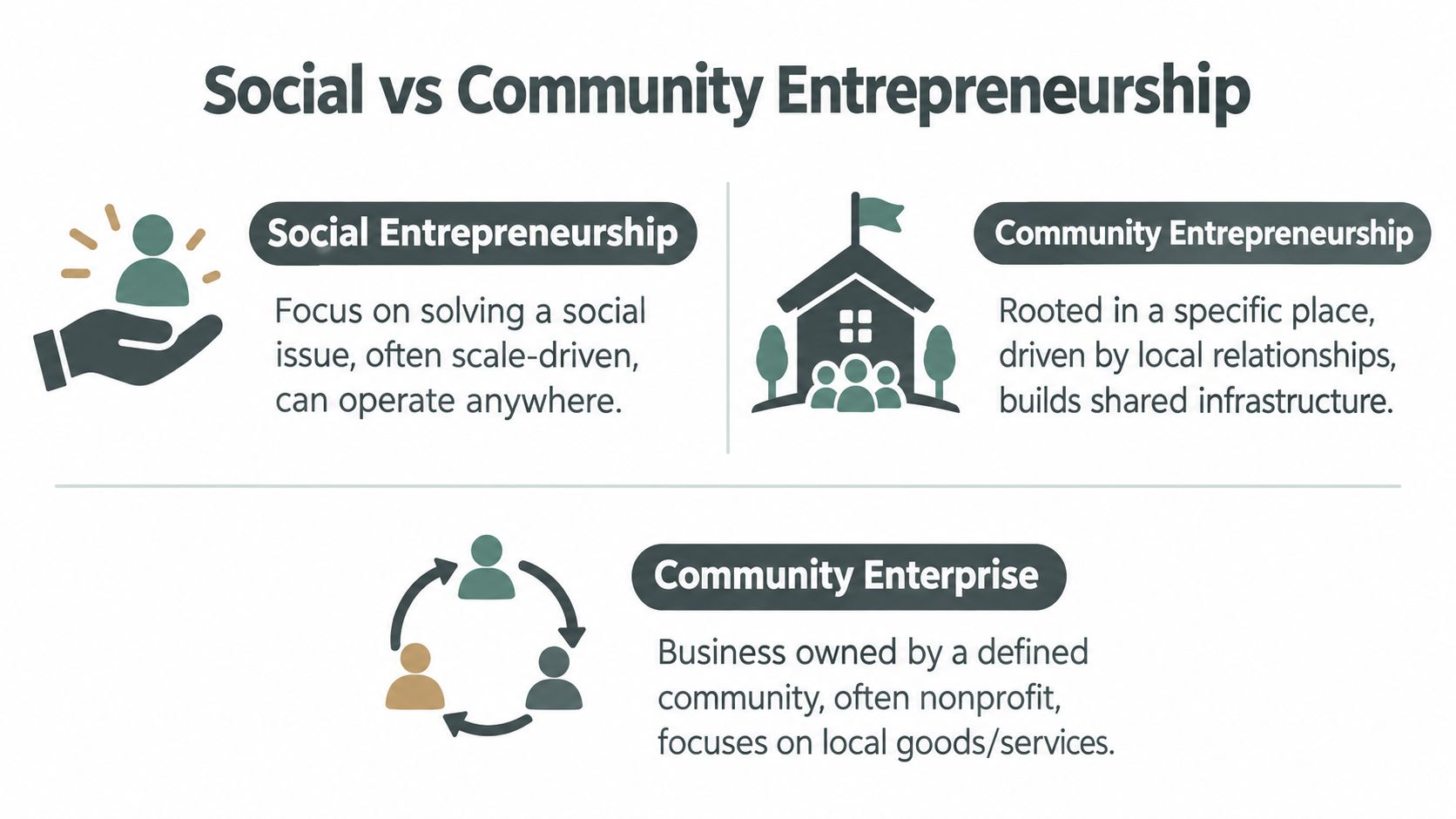
Social entrepreneurship usually begins with a social or environmental problem. A founder or organization develops a solution that may operate across many locations. The central concern is the issue being addressed, while the venture's geographic roots and ownership structure can vary.
Community entrepreneurship begins with a specific place and its relationships. Local members identify opportunities, combine resources, and coordinate action around economic, social, environmental, or cultural needs. The venture may have one operating organization, but the broader process depends on community participation and local legitimacy.
Community enterprise is more specific in its organizational form. It generally refers to a commercial organization that is owned or governed by a defined community, often with a strong local-service purpose. A cooperative grocery store, resident-owned facility, or community-controlled service can fit this model.
Idea | Who acts | Ownership and governance | Main priority |
|---|---|---|---|
Social entrepreneurship | A founder, nonprofit, company, or mission-led team | Varies by organization | Solving a social or environmental issue |
Community entrepreneurship | Local members and connected organizations | May be shared, cooperative, nonprofit, or privately operated with community participation | Regenerating a particular place |
Community enterprise | A defined community or member group | Community ownership or formal community governance | Providing local goods, services, and benefits |
Community-based enterprise | Residents, local groups, or a place-based organization | Depends on the enterprise | Meeting local needs through enterprise |
The boundaries can overlap. A community-owned food market might be a community enterprise and part of a wider community entrepreneurship process. A social enterprise might partner with a neighborhood but remain controlled by an outside organization. The labels matter less than the operating reality.
A literature-based definition describes community entrepreneurship as a collective process in which local members identify, create, and exploit opportunities to regenerate their community through economic, social, environmental, and cultural activity. This comparison of community entrepreneurship and related concepts is useful because it highlights the questions that many explanations leave blurred.
Use this decision lens:
If the place itself is central to the opportunity, local people help shape the response, and shared community outcomes matter, you're probably looking at community entrepreneurship.
That definition leaves room for different ownership structures while keeping the focus on place, participation, and outcomes.
Why Place and Shared Value Drive Lasting Impact
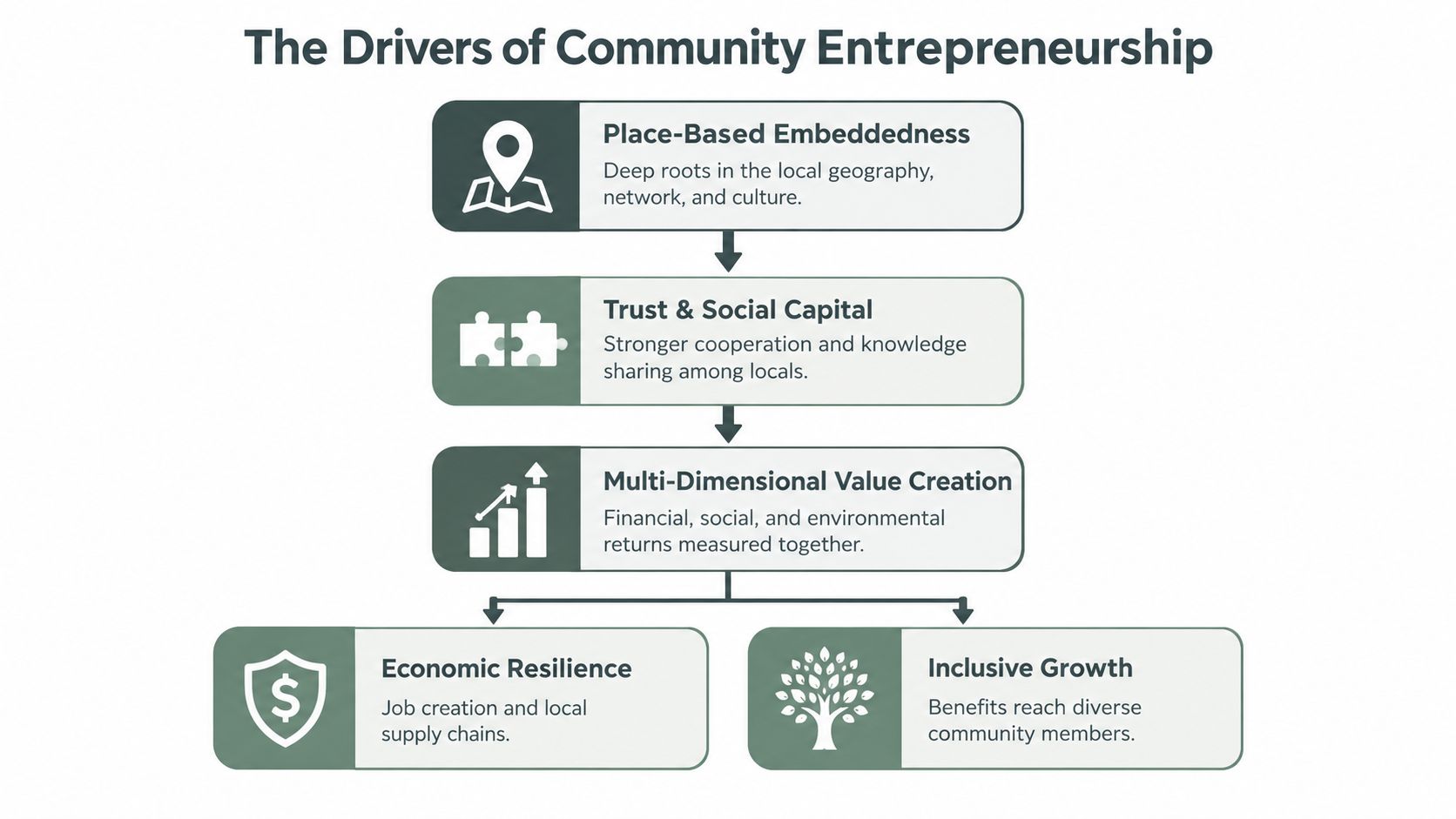
A community venture gains strength from what already exists in the area. That might be a historic building, a trusted local organizer, a network of shop owners, or knowledge about what residents need. Place-embeddedness means the venture is not portable in the way a generic online business might be. Its relationships and credibility come from being part of a specific geography.
Embeddedness also changes how value moves. A venture that hires locally, buys from nearby suppliers, shares knowledge with other businesses, and creates opportunities for residents can help retain value within the local ecosystem. The business still needs revenue, but revenue isn't the only measure of whether the model is working.
Three dimensions of value
Community enterprises pursue several forms of value at the same time:
Economic value: Revenue, employment, business formation, and stronger local supply relationships.
Social value: Participation, trust, inclusion, and access to useful services or networks.
Environmental value: More responsible use of local resources and decisions that support long-term resilience.
A 30-year literature review identifies this hybrid structure as central to community enterprise, not as an optional extra. The review of community enterprise research explains why place-embedded ventures can recycle local assets into locally retained value rather than extract value from the community.
This creates a different kind of competitive advantage. A large organization may have scale, but a locally rooted venture can have legitimacy, trust, and a dense network of relationships. Those assets help people share information, coordinate projects, and respond to changing needs.
Measuring the wider result
Revenue remains essential. Without financial viability, a community project can't pay staff, maintain space, or continue serving members. Yet operators should also monitor:
Local participation in programs and decisions
The strength and variety of member relationships
Introductions that lead to partnerships or opportunities
Non-financial community outcomes
The ability of the local network to adapt during disruption
The OECD connects local entrepreneurship with job creation, social inclusion, and urban regeneration, which gives downtown projects a broader purpose than commercial occupancy alone. This resource on downtown revitalization offers a place-based perspective on how shared infrastructure can support the renewal of Main Street.
A strong community venture doesn't merely attract activity. It helps residents and businesses build the relationships that allow activity to continue after one event, one grant, or one founder's initial enthusiasm has passed.
Models Frameworks and Real World Examples That Inspire
Community entrepreneurship can take several forms. The common thread isn't a particular legal structure or building type. It's the deliberate creation of a system in which people can share resources, make decisions, and pursue opportunities that benefit a defined place.
A practical menu of models
Cooperative ownership gives members formal control. A food market, workspace, or service organization can let users participate in governance and share responsibility for the asset.
Community-owned enterprise places a local facility or business under the control of a defined resident group, nonprofit, or civic organization. This model can protect important services and keep decisions accountable to local priorities.
Community hubs focus on shared infrastructure. They provide rooms, equipment, programming, and places to work or meet. Their impact depends on active programming and intentional introductions, not on desks or event space alone.
Network-facilitated entrepreneurship supports independent businesses without requiring them to share ownership. A hub operator, local development group, or business association can connect entrepreneurs to partners, mentors, customers, finance, and technical assistance.
A study of local development in Sweden found that community entrepreneurs often facilitate entrepreneurial events rather than build individual ventures. Their fundamental mission is to develop and maintain a socioeconomic network that serves as a resource pool for autonomous entrepreneurs. The study on community entrepreneurs and socioeconomic networks supports an insight: the building matters because of the connections it repeatedly enables.
In Jenks, Oklahoma's 10 District downtown, Freeform House illustrates the community-hub model. The membership-based club and workspace combines co-working and meeting areas with the Hall of Fame Room, Freeform Room, Executive Room, Thomas Room, The Rise loft studio, and an in-house podcast booth. Its role as connective infrastructure comes from helping professionals, creatives, executives, and small businesses work, host, create, and meet in one local setting.
Model Type | Who Owns and Governs | Core Value Created | Best Fit Scenario |
|---|---|---|---|
Cooperative ownership | Members share ownership and formal decisions | Shared control and retained local value | A community needs a service members will use and govern |
Community-owned enterprise | A defined resident group or local organization | Local control of an important asset or service | Residents want long-term accountability to the place |
Community hub | An operator manages space, services, and programming | Shared infrastructure and repeated connection | Entrepreneurs need places to work, meet, and collaborate |
Network-facilitated entrepreneurship | Independent ventures retain ownership while a coordinator builds relationships | Partnerships, referrals, knowledge exchange, and support access | Many small businesses need coordination more than a shared legal structure |
A hub becomes more useful when it curates introductions instead of waiting for chance encounters. A photographer may meet a business owner who needs content. A consultant may find a local organization seeking workshop support. A remote executive may discover a nearby venue for a team gathering. Those connections create the connective tissue that lets separate ventures thrive together.
How to Build Community Entrepreneurship in Your Own Town
Start with the network, not the building. A polished facility won't solve a coordination problem if local people don't trust the organizers, understand the purpose, or see a reason to participate. Research on community and entrepreneurship identifies social capital as a community-level resource built through trust and associations, which helps explain why some places mobilize quickly while others struggle. This discussion of community and entrepreneurship is a useful reminder that entrepreneurial spirit alone isn't enough.
Begin with local listening
Talk with shop owners, freelancers, residents, civic groups, educators, property owners, and service providers. Ask what people need, which resources already exist, and where current connections break down. Look for repeated problems rather than the loudest single proposal.
Then map the network. Note who introduces people, who has access to useful spaces, which organizations can provide training, and where entrepreneurs seek finance or professional advice. This map will show whether the community needs a shared workspace, a business program, a cooperative, a regular event series, or a combination.
Build trust through small commitments
Create low-risk ways for people to contribute. Host a local problem-solving session, invite businesses to share a workshop, or organize a structured introduction between two people with complementary needs. Each successful interaction gives participants evidence that the network is useful and that organizers follow through.
A coordinator should also establish clear governance. Decide who can use the resources, how programming priorities are selected, how conflicts are handled, and how community members can provide feedback. Shared infrastructure needs visible rules and dependable stewardship.
Connect people to practical support
A network becomes valuable when it opens doors beyond conversation. OECD local-development guidance highlights support structures such as access to finance, mutual credit guarantee associations, and business-angel networks. Local programs can also connect entrepreneurs with accountants, lenders, mentors, training providers, and procurement opportunities.
Use events as working sessions, not only social occasions. A useful gathering might pair a local founder with a potential supplier, give a creative professional a chance to demonstrate a service, or help a small business prepare for a financing conversation.
Measure connection as well as commerce
Track participation, repeat involvement, new partnerships, referrals, local purchasing relationships, and access to support. These indicators show whether the network is becoming denser and more useful. Revenue and employment still matter, but they won't reveal every way a community hub strengthens local capacity.
A community workspace can simplify several of these functions by giving members a consistent place to work, meet, host, and encounter one another. The key is to pair the space with active programming and thoughtful connection.
Your Next Step Toward a Stronger Local Economy
Community entrepreneurship is a long-term investment in place, people, and shared prosperity. It asks residents to treat local relationships as infrastructure, not as a pleasant side effect of doing business. A storefront, workspace, cooperative, or event can become valuable when it helps people build the trust and coordination needed for future action.
The possible outcomes reach beyond individual ventures. Development literature links community-based entrepreneurship with employment, poverty reduction, income growth, quality of life, and stronger community resilience. Research on community-based entrepreneurship and local development describes local enterprise as a way to connect communities with wider economies while building local wealth and opportunity.
That doesn't mean every project will succeed automatically. Communities need clear governance, patient relationship-building, practical support, and measures that reflect both financial and non-financial value. They also need people willing to take different roles. One person may start a business. Another may provide a meeting room, make introductions, mentor a founder, organize an event, or join as a committed member.
A stronger downtown isn't created by one remarkable business alone. It grows through the connections that help many local people contribute, collaborate, and remain invested.
The empty storefront from the opening scene becomes useful when people return to it repeatedly. They come to work, share a meal, record a podcast, meet a client, host a workshop, and discover a partner. That pattern of connection is what turns commercial space into community infrastructure.
Visit Freeform House to explore a members-only club and workspace in downtown Jenks with co-working areas, meeting rooms, creative resources, and opportunities for local collaboration. If you're building a business, leading a team, creating professional content, or looking for a place to connect with other local professionals, visit Freeform House and see how membership could support your next project.
Comments