Dedicated Desk vs Hot Desk: Which One Fits How You Work

You're looking at workspace plans with your calendar open beside them. The hot desk costs less, but you're already wondering where your monitor goes, whether you'll find a quiet seat, and what happens when a client calls before you've unpacked. The dedicated desk looks reassuring until you count the days you'll use it.
The dedicated desk vs hot desk decision isn't about buying the better-looking workstation. It's about paying for useful working time without taking on space you don't need. For many hybrid professionals, the strongest arrangement combines a reliable base with shared spaces, meeting rooms, and the freedom to work somewhere else when the task changes.
Dedicated Desk vs Hot Desk Side by Side
Dedicated desk vs hot desk on nine criteria
Criterion | Hot desk | Dedicated desk |
|---|---|---|
Seat ownership | Any open seat, first come | The same seat every visit |
What you pay for | Access to the floor | One specific desk |
Setup time each visit | Allow 5–15 minutes in a trial-day budget to find a seat and rebuild the setup | No daily rebuild if monitors and cables may stay |
Storage | Day locker or carry-in bag | Drawer, shelf, or locker at the desk, subject to the plan |
Privacy | Open sightlines, shared table | Your own territory, still open plan in most clubs |
Personalization | Only what you carry | Photos, keyboard, chair, whiteboard, within house rules |
Switching plans | Look for day passes, bundles, and cancel-anytime terms | Monthly commitment, with changes on written notice |
Meeting room access | Check for lower booking priority or hourly charges | Check for included hours and booking priority |
Best for | 1–2 visits a week, mobile work, networking | 3+ visits a week, calls, equipment |
A hot desk is a workstation used by different people at different times, without individual seat ownership. A dedicated desk is reserved for one member on every visit.
The asymmetry is straightforward. Dedicated seating offers more control over setup, storage, and personalization, although it doesn't create acoustic privacy by itself. Hot desking offers a smaller commitment and more freedom to move around the floor.
Treat the table's setup allowance and attendance bands as planning guides, not measured averages or universal membership terms. A well-equipped shared station can be ready quickly; an assigned desk with unsuitable furniture can still be uncomfortable.
Count actual attendance, not good intentions
Start with your recent calendar. Separate days when you needed a workplace from days when you merely liked the idea of leaving home.
A consultant who spends most working days at client sites shouldn't buy a permanent workstation for an imagined office routine. A remote executive who repeatedly leaves home to find quiet space shouldn't keep buying occasional access while effectively working full time from a club.
Frequency is the first filter, but task fit can override it. Equipment, accommodation needs, and confidential work can justify continuity even when attendance is irregular.
Practical rule: Buy for the working week you already have, not the one you hope a membership will create.
Shared seating isn't a recent invention
A review published by Italy's National Institute of Statistics traces modern coworking to 2005 in the United States, well before pandemic-era hybrid work. Hot desking belongs to a longer shift toward shared offices, not a temporary response to remote working.
What the comparison can't reveal is the actual experience: conversation levels, overnight storage permissions, and whether meeting-room access is equal across plans. Those details can outweigh an attractive monthly rate. The useful starting point is still the same: divide the price by the days you'll attend.
What Each Desk Costs per Workday
The U.S. median monthly price in Q4 2024 was $149 for a hot desk and $300 for a dedicated desk, according to CoworkingCafe's 2025 Coworking Price Report, as summarized by The Hacker Street. These are national benchmarks, not our membership prices.
For the worked example below, assume a $25 day pass. That's a hypothetical comparison rate, not a verified live offer; confirm actual day-pass pricing before using this calculation to buy.
Monthly cost by attendance level
Visits per month | Day passes at an assumed $25 | Hot desk membership | Dedicated desk membership | Cheapest option |
|---|---|---|---|---|
4 | $100 | $149 | $300 | Day passes |
8 | $200 | $149 | $300 | Hot desk membership |
12 | $300 | $149 | $300 | Hot desk membership |
16 | $400 | $149 | $300 | Hot desk membership |
20 | $500 | $149 | $300 | Hot desk membership |
Under these assumptions, day passes win below roughly six visits a month. Above that point, the hot desk membership is cheapest at every attendance level shown. The dedicated desk's extra $151 a month never pays for itself on membership price alone.
At eight visits, the calculated cost per workday is $18.63 for hot desking versus $37.50 for dedicated seating. At twenty visits, it becomes $7.45 versus $15.00.
Price the working hours you can actually use
Suppose each visit produces six focused hours. Eight visits then provide 48 productive hours, putting the illustrative hot desk cost at about $3.10 per productive hour and the dedicated desk at $6.25.
That calculation assumes both arrangements deliver equal productive time. If one arrangement repeatedly interrupts your work, use your actual focused hours as the denominator instead.
Cost per productive hour = total workspace spending ÷ focused hours completed.
The dedicated premium buys continuity rather than a mathematical discount: a monitor that can stay connected, a locking drawer if included, a familiar chair, and no search for a suitable workstation. Pay for those benefits when they support your work, not because a permanent desk feels more established.
Check the costs outside the membership
Before comparing totals, include:
Storage: Locker rental, overnight permissions, and equipment restrictions.
Business services: Printing, mail handling, and meeting-room charges.
Travel: Downtown parking and the cost of reaching the building.
Setup time: In a hypothetical routine, rebuilding for ten minutes on three visits consumes half an hour weekly.
Our guide to coworking prices and finding true value offers a broader way to compare inclusions. Choose on cost per productive hour, not the lowest number on the pricing page.
Privacy, Focus and the Setup Tax
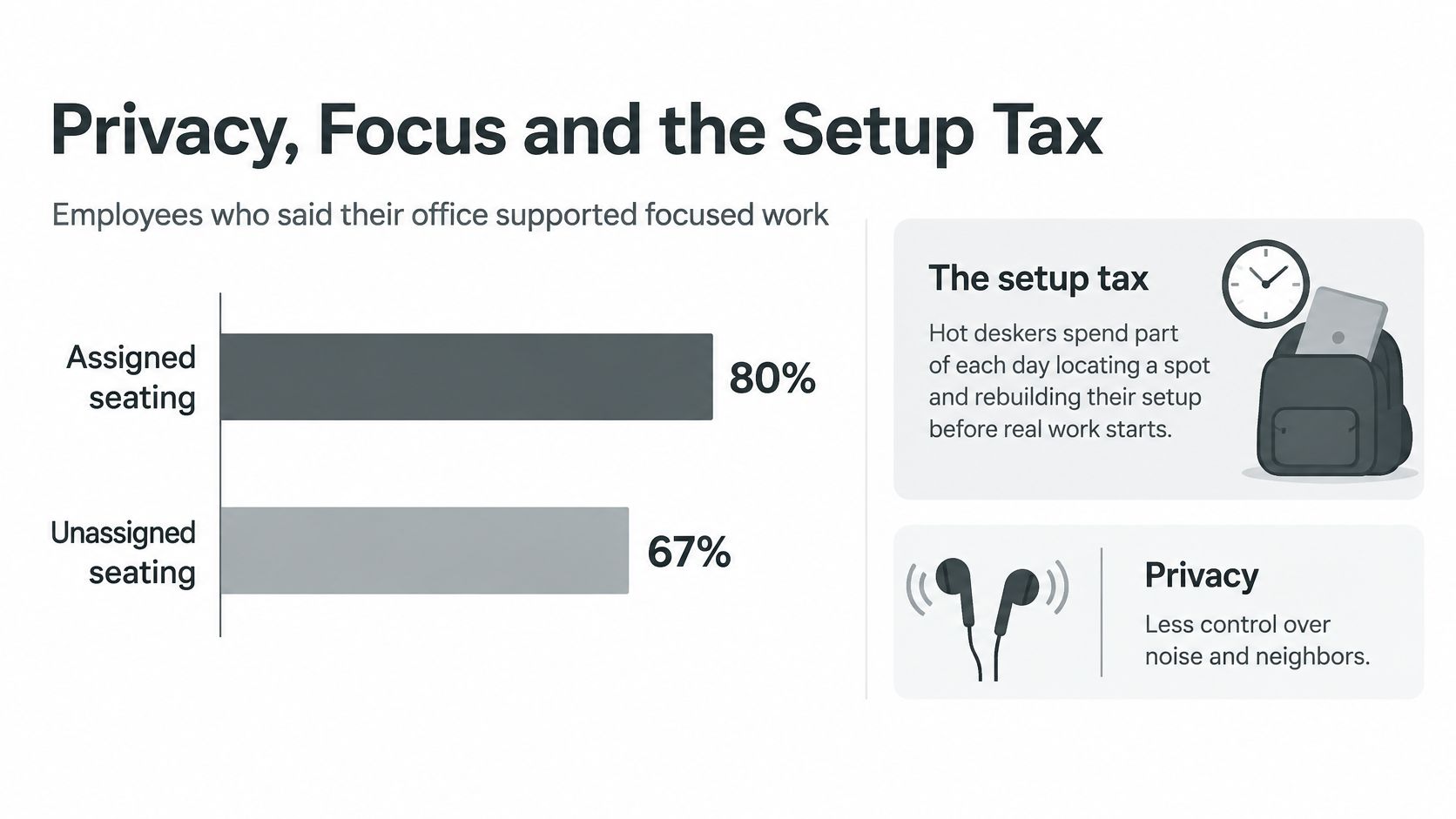
Only 67% of employees in unassigned environments said their office supported focused work, compared with 80% with assigned seating, according to workplace evidence summarized in Habit Action's office-zoning guide. The same summary reports belonging at 74% versus 87%, respectively, and says nearly 60% of workers without assigned seating would prefer a dedicated workspace.
Those are employee-reported experiences, not proof that assigning a desk automatically improves performance. They do challenge the assumption that removing personal territory has no consequences.
The focus comparison makes the trade-off visible.
Time the work before the work
Use a stopwatch during a trial visit. Don't estimate from memory after a pleasant tour.
An illustrative setup log might contain:
Seat search: Three minutes finding a suitable station away from conversation.
Locker trip: Two minutes retrieving a laptop, charger, and notebook.
Connections: Four minutes checking the monitor cable, power, and peripherals.
Ergonomics: Two minutes adjusting the chair and screen.
That hypothetical visit loses eleven minutes before the first task starts. Your result could be shorter or longer; the point is to measure it.
An occupancy-sensing desk-allocation study improved seating-location outcomes by approximately 2.8 times compared with traditional allocation methods. That's not a productivity multiplier, but it demonstrates that operators can reduce avoidable friction through better allocation.
A hot desk doesn't remove territory. It moves territory into a locker and a search.
Identify who carries the burden
People using specialized equipment, accessibility adjustments, or carefully controlled sensory environments need more than an available chair. If every visit requires rebuilding an accommodation, freedom of choice becomes repeated unpaid preparation.
Confidential work creates a different problem. A dedicated desk provides continuity, not permission to discuss client information within earshot of neighbors. Pair it with an enclosed room and review our workspace security features alongside your own confidentiality requirements.
Use this video as another prompt for evaluating the shared-workspace experience.
I would reconsider a pure hot-desk arrangement if your trial log shows more than ten minutes lost per visit, or if confidential calls happen more than once a week. Those are decision thresholds, not research findings. The alternative might be dedicated seating, a private workspace, or dependable room reservations rather than a more expensive open-plan desk.
Flexibility Is Not the Same as Community
Moving between desks can introduce you to people. It doesn't guarantee they'll remember your work, trust your judgment, or recommend you to a client.
A study of allocated seating and hot desking found that hot desking encouraged knowledge exchange among teams with shared knowledge bases and complex skills, largely through brief incidental interactions. The same proximity exposed workers to interruptions, audible conversations, and uncertain team boundaries.
An exchange about a proposal can be useful. Hearing someone else's proposal discussion while preparing your own may not be.
Authentic community looks like ordinary professional conversation, not staged enthusiasm around a shared table.
Look for relationships, not just proximity
A systematic review of coworking reports more than 34,600 coworking spaces worldwide in 2023 and examines them through patterns of use, workplace differentiation, surrounding ecosystems, and commercial property dynamics. The useful local lesson is that a workspace earns its value from the business community around it.
In the coworking survey summarized by Harvard Business Review, 82% of respondents said coworking expanded their professional networks, 80% turned to members for help or guidance, and 64% considered coworking networking an important source of work or business referrals. The survey also found 87% met members for social reasons and 79% expanded their social networks.
Those responses describe coworking members. They say nothing guaranteed about what unassigned seating will do for you.
A hot desk helps you meet new people. A dedicated desk helps you become known.
Judge the hosting as carefully as the furniture
A useful introduction connects people with a reason to speak. Recurring gatherings give them a reason to continue the conversation. Neither requires everyone to change seats daily.
Freeform House is a premium, members-only club and workspace in downtown Jenks, housed in a restored 1920 building and created to help rejuvenate Main Street America. Membership combines workspaces with dining and social events. The club hosts exclusive culinary evenings, including candlelight dinners with special meals by guest chefs in the Hall of Fame Room, and members can book that room for charitable events or small weddings.
Our approach to a community workspace treats professional relationships as part of the membership's purpose. For a newcomer, I'd start with hot desks for a month or two, then add a stable base when repeat clients, standing meetings, and a regular lunch group make continuity worth more than constant introductions. A hybrid plan usually costs less than dedicated seating bought too early, and it keeps your options open while your circle is still forming.
Checklist for Your Site Visit
A tour should produce answers you can compare, not a collection of adjectives. Quiet, premium, and flexible mean little until someone explains the rules behind them.
Bring your normal work bag and ask these questions. Where a feature matters to your decision, get the answer in writing.
Ask questions that reveal daily friction
Is the locker day-use only or overnight, and will my bag fit? Test the depth with your laptop bag and charger. Our Freeform Room has lockers for deliveries or personal storage; confirm the applicable storage permissions before planning to leave equipment.
Are monitors, arms, chairs, and desk depths consistent? Sit at an ordinary available station, not just the display desk. Check the cable connection your laptop uses.
Are quiet-zone rules written down, and what is call-booth capacity relative to membership? Our Thomas Room's main area has a no-call-or-picture policy for enhanced focus. Keep calls out of that space and establish which alternative room you can reserve.
Is availability live and bookable, or first come, first served? Ask what happens when every suitable shared workstation is occupied. A clear overflow procedure matters more than an assurance that the floor rarely fills.
How many meeting-room hours are included, and where does my plan rank in the booking queue? We offer reservable conference rooms. Confirm your plan's hours, booking window, and additional charges rather than assuming access means unrestricted use.
Are guest passes and mail handling included? Our Freeform Room can serve as a secondary address. Establish the relevant terms separately from guest access.
How are members selected, and what programming runs each month? Ask how introductions happen and who hosts them. An events calendar should distinguish professional gatherings from private bookings.
What are the exit and downgrade terms, in writing? Get the notice period, effective date, and treatment of unused credits before committing.
Expect mechanisms, not promises
Community participation can be deliberately designed. Soho House's public filing states that members admitted from April 4, 2022 had to purchase House Introduction Credits, with unused credits expiring after the first three months where legally permitted.
That's an example of explicit membership mechanics, not a policy to assume every club follows. Curation is a design choice; the practical question is whether members understand what they're buying.
Ask us the same questions you ask other operators. A useful answer names dimensions, hours, permissions, and procedures.
I'd schedule the visit for 10 a.m. on a Tuesday rather than 6 p.m. on a Friday, then confirm that it represents a busy working period locally. Test an actual seat search while members are working, not just an empty room after hours.
Match the Desk to Your Work Style
Choose the space that supports the task, then choose the membership that gives you reliable access to it. A desk can anchor a working day, but it can't replace a recording booth, a confidential meeting room, or a photography set.
Which desk fits which work style
Work style | Better fit | Why | Watch for |
|---|---|---|---|
Remote executive with daily video calls | Dedicated desk | Same backdrop, same chair, monitor stays plugged in if permitted | Book a phone room for client-confidential calls |
Podcaster or photographer with gear | Dedicated desk plus studio time | Equipment can stay put under agreed storage rules | Locker depth and studio booking limits |
Sales rep on site 1–2 days a week | Hot desk | Lower commitment for intermittent attendance | Availability on peak days |
Consultant between client sites | Hot desk plus overnight locker | Flexibility with somewhere to leave materials | Locker size and overnight permissions |
Two-person startup | Two adjacent dedicated desks | Team identity and a shared whiteboard, where permitted | Included meeting-room hours |
Parent working school hours, 3 days a week | Hot desk | Flexible access for shorter working days | Mid-afternoon noise in the quiet zone |
Creative needing styled sets or lighting | Bookable studio, not a desk | Props, backdrops, and lighting serve the actual task | Studio availability and prop storage |
These are recommended fits, not guarantees of particular plan inclusions. The school-hours member, for example, should compare the actual partial-day or monthly offer rather than assume shorter attendance automatically earns a discount.
Build a hybrid arrangement around different tasks
Consider someone on site three days and travelling two. A dedicated base combined with shared collaboration space and guest access can be more useful than either a permanently isolated workstation or entirely unassigned seating, provided the membership terms support that combination.
For a small team, compare adjacent desks with a private office quote. Four dedicated desks in a row may cost less than an enclosed office, but there's no universal saving; include meeting rooms and the cost of handling confidential conversations elsewhere.
Members at Freeform House have access to three floors of curated spaces. Our private workspaces, hot desks, open collaboration areas, and reservable conference rooms allow the workspace decision to extend beyond one chair.
For content production, our podcast booth provides professional-grade microphones, soundproofing, and editing software. The Rise offers original hardwood floors and a drapery wall with changeable colors, so a photographer needing a styled environment should evaluate studio access rather than pay extra for an unsuitable desk.
“Freeform House offers Jenks executives a refined, upscale environment essential for impactful client meetings and strategic business discussions, projecting professionalism and success.”David D., freeform.house
That testimonial describes the meeting environment. It shouldn't substitute for checking whether the daily workstation fits your own routine.
Use four rules to settle the choice
Frequent attendance or confidential work: More than three days on site points toward dedicated seating. Any week involving confidential calls also requires a dependable enclosed-space plan.
Occasional laptop work: For one or two days of email, writing, and routine non-confidential calls, start with hot desks or a day-pass bundle.
Equipment-heavy work: Price secure storage and preparation time before comparing membership totals. Get permission to leave gear rather than treating a reserved desktop as secure storage.
Uncertain attendance: Try a month of shared seating. Upgrade when your actual schedule, recurring clients, or equipment needs justify a stable base.
A hybrid membership isn't automatically the cheapest arrangement. It's often the better practical choice because you don't have to force every task into the same type of space.
Book a trial day at the hour you'd work. Sit where you'd sit, put your bag in the locker you'd receive, and take a call in the room you'd be directed to use. After four hours, ask the decisive question: Did you get work done?
Freeform House offers hot desks, private workspaces, reservable conference rooms, and creative facilities within a members-only community in downtown Jenks. Visit Freeform House to explore the spaces, discuss your working routine, and compare flexible access with the continuity your work needs.
Comments