Corporate Event Space Rental: A Jenks Executive's Guide

You've booked the speakers, invited the team, and set an agenda that matters. Then the venue quote arrives. The room rental looks manageable, but setup time, Wi-Fi, AV support, cleaning, insurance, catering charges, parking, and overtime sit elsewhere in the paperwork. By the time your first vendor arrives and the last attendee leaves, the “affordable” corporate event space rental has become a difficult expense to defend.
For Jenks and Tulsa executives, the smarter decision isn't just finding a room with enough chairs. It's choosing a venue that understands the full operating day, supports the event's business purpose, and gives you a clear total cost before you sign.
Why Traditional Venues Fail Local Executives
A Jenks entrepreneur recently described the familiar situation. The venue had an attractive room, a convenient date, and a reasonable base rate. The trouble began after booking. One vendor handled furniture, another managed catering, and a third supplied AV equipment. Each company had its own arrival window, invoice, cancellation terms, and definition of “included.”
The executive became the project manager for a meeting that was supposed to help the business grow. Staff spent time confirming microphone compatibility, coordinating food delivery, checking whether the room could be accessed early, and finding out who would clean up after the final session. None of those tasks appeared in the first conversation about rent.
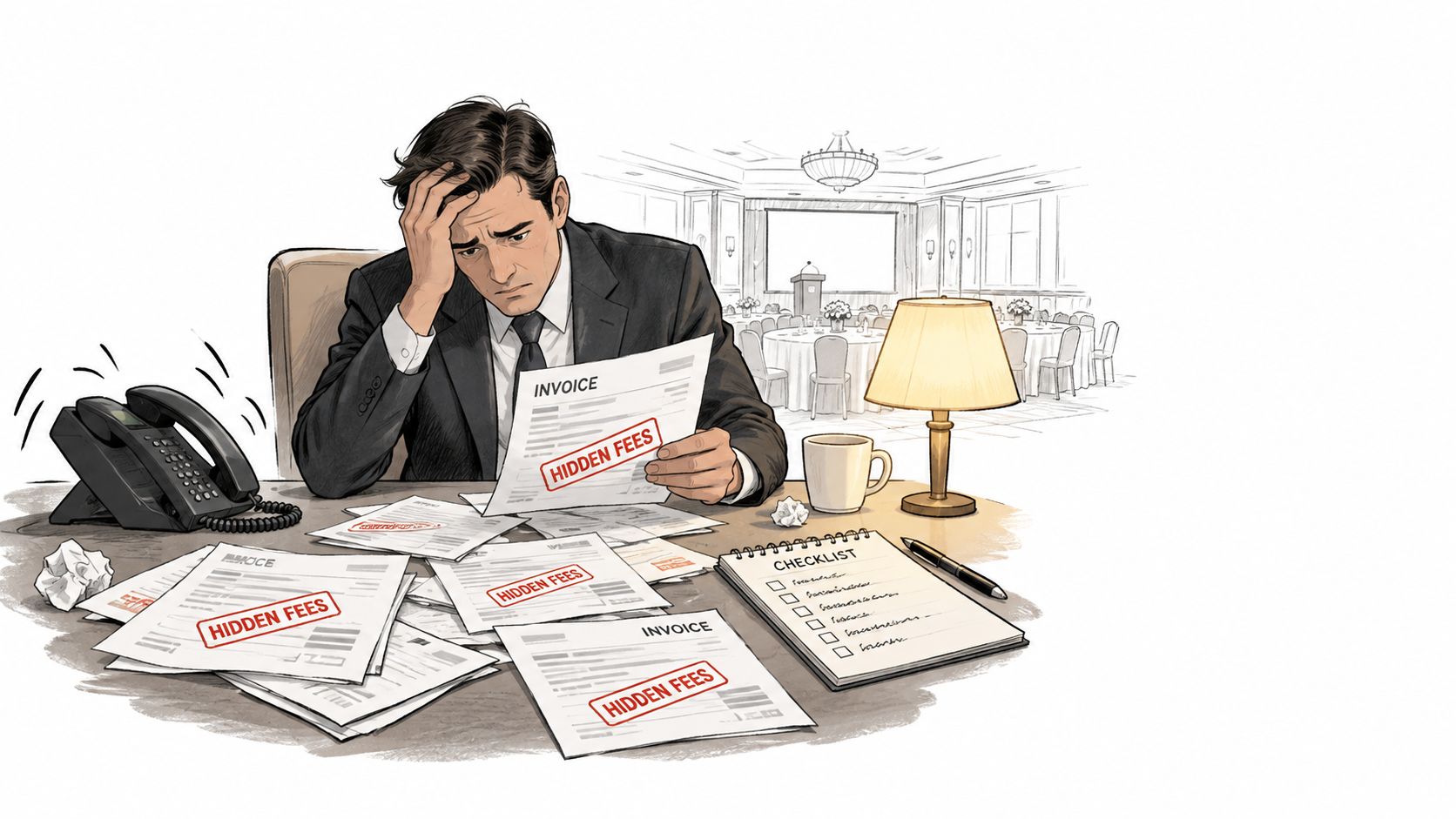
The room is only one part of the purchase
Traditional halls often sell square footage first and operational support second. That approach works for some large receptions, but it can frustrate an executive hosting a workshop, leadership meeting, client presentation, or networking event.
The venue may provide a beautiful shell, while you remain responsible for:
Vendor coordination: Separate arrival times can create delays before attendees enter.
Technology troubleshooting: A rented projector or sound system may require an outside technician.
Food and beverage decisions: A flexible catering promise can become restrictive once dietary needs and timing are confirmed.
Access and teardown: Earlier load-in or later departure may trigger hourly charges.
Communication: Multiple contacts make it harder to establish accountability when something fails.
That fragmentation creates more than inconvenience. It distracts your team from the outcome the event should produce, whether that's alignment, training, relationship development, or a stronger local presence.
Location changes the operating equation
A venue's address matters because attendees, vendors, and local partners all interact with it. The Ten District in downtown Jenks consists of exactly 10 blocks extending west from the Arkansas River to the old Midland Valley railroad tracks, combining historic structures with newer development, according to Jenks Downtown. That setting gives a corporate event more connection to the community than an isolated room with no useful surroundings.
The broader meetings economy also shows why venue decisions affect more than the rental invoice. In the United States, approximately 1.9 million meetings in 2016 attracted 251 million participants and generated $325 billion in direct spending, while supporting about 5.9 million jobs, according to the International Congress and Convention Association's summary of meetings industry economic data. Transportation, lodging, food service, professional services, and nearby retail all participate in that ecosystem.
A modern business hub treats the event as part of a working community. It can support the meeting, the conversations around it, and the business relationships that continue afterward. That's the difference between renting a room and selecting an operating environment.
Assessing Your Event Needs and Budget
Start with the event's job, not the venue's floor plan. A board meeting, training workshop, client presentation, and founder gathering may have similar attendance but completely different requirements.
Step one, define the working format
Write down the decisions the event must support. Then answer four practical questions:
Who needs to attend? Separate confirmed attendees, likely attendees, speakers, staff, vendors, and remote participants.
What must happen in the room? Identify presentations, breakout work, meals, private conversations, recording, networking, or demonstrations.
What must the venue provide? List tables, chairs, screens, microphones, reliable internet, power access, catering support, parking, accessibility, and staffing.
What schedule will vendors follow? Record the time for load-in, setup, guest arrival, programming, breakdown, and final departure.
The headcount should include the people who make the event function, not just the people on the invitation list. A room that fits attendees but leaves no space for registration, equipment, food service, or movement will feel overcrowded.
For a more detailed planning checklist, use this guide to venue requirements for an event before requesting quotes.
Step two, build the all-in budget
Never compare base rent against another venue's all-in package. Use the same worksheet for every candidate and label each line item by how it's charged.
Budget line | What to confirm |
|---|---|
Base rental | Room, furniture, standard access, and included hours |
Access time | Load-in, setup, rehearsal, and teardown windows |
AV | Equipment, installation, operation, technician, and replacement costs |
Staffing | Event manager, security, servers, registration support, and cleanup |
Food and beverage | Menu, delivery, service charges, taxes, minimums, and outside-vendor rules |
Insurance | Required coverage, certificate deadlines, and provider requirements |
Parking and transportation | Guest parking, vendor parking, shuttles, and accessibility |
Cancellation | Deposits, refund schedule, rescheduling, and force majeure |
Contingency | A reserve for schedule changes, extra labor, or attendance changes |
Commonly overlooked costs include overtime, AV technicians, liability insurance, parking, cleaning, catering service charges, power, and outside-vendor fees. Some venue guidance cites overtime charges of $300 to $1,000 per hour, so confirm the exact trigger and rate in writing through this event venue cost guide.
Practical rule: Ask for the cost from the first vendor arrival through final departure, not the price of the room during the guest-facing program.
Step three, test the budget against changes
Run three versions of the estimate. Use the expected attendance, a lower attendance scenario, and a higher attendance scenario. Then test a longer setup period, an extended networking window, a catering adjustment, and a technology change.
This exercise reveals whether the venue is financially flexible or merely inexpensive at the starting point. Executives should also identify which charges are fixed, per-person, hourly, refundable, or triggered only by exceptions. A transparent quote makes those distinctions obvious.
Comparing Venue Types and Halls Against Modern Hubs
A traditional hall and a modern business hub can both host a corporate event, but they solve different problems. The hall typically prioritizes a defined event package and a recognizable presentation. The hub prioritizes adaptable work, integrated services, and interaction among people using the space.
Decision factor | Traditional event hall | Modern business hub |
|---|---|---|
Room use | Often optimized for a standard event format | Adaptable for meetings, workshops, presentations, and smaller gatherings |
Technology | May require outside rental or technicians | Often designed around built-in connectivity and collaborative work |
Service model | Event-specific coordination | May include ongoing member or concierge support |
Community value | Attendees generally arrive for one event | Members and guests can connect before, during, and after the event |
Pricing logic | Frequently organized around fixed packages | Can support flexible booking or membership-based access |
Best fit | Large formal functions with predictable requirements | Executive meetings, workshops, private events, and relationship-driven gatherings |
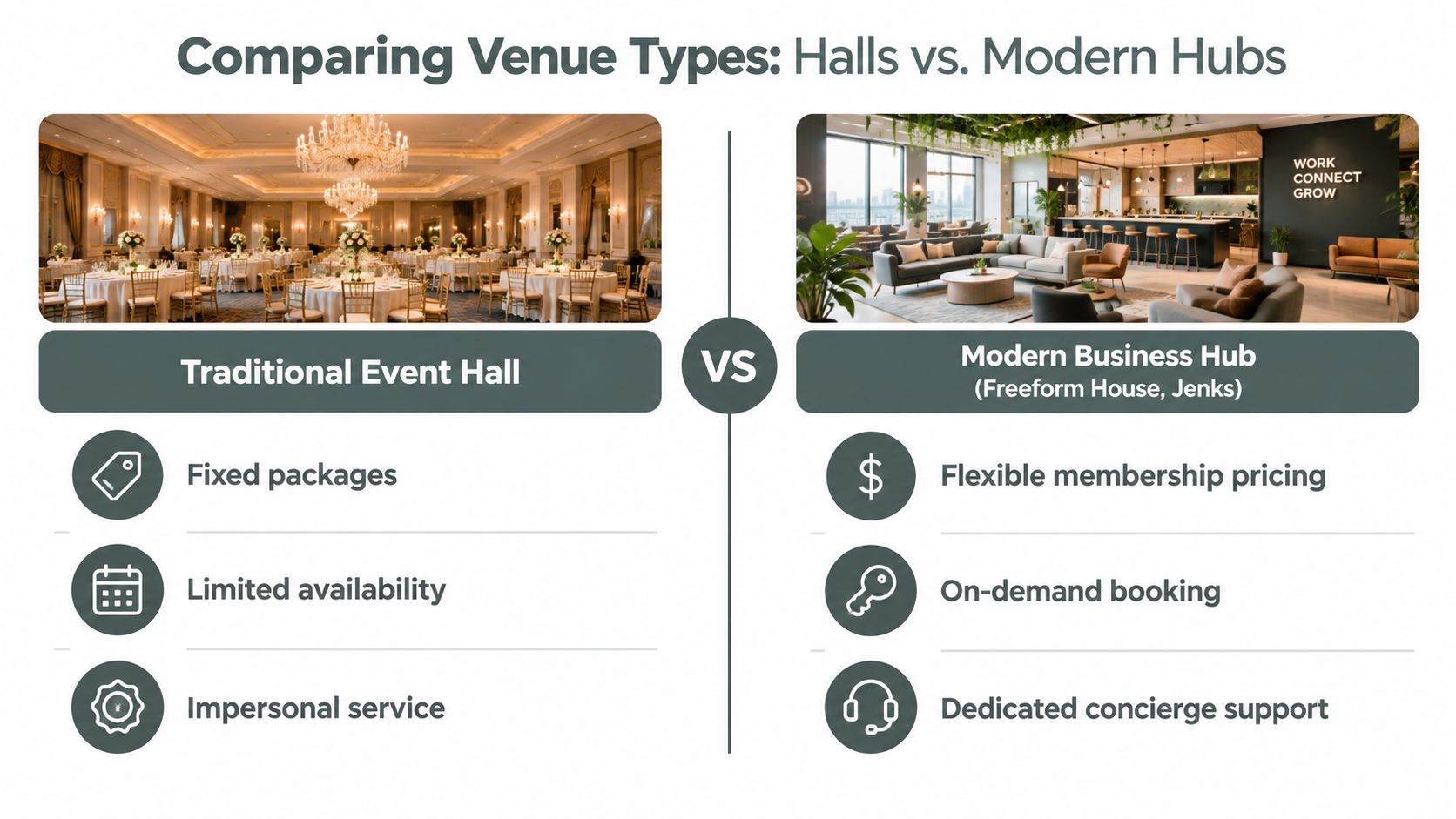
Choose the format that matches the business objective
A ballroom can create presence, but presence isn't the same as usefulness. If attendees need to collaborate, move between activities, record content, or hold private conversations, a room designed only for seated viewing can create friction.
A modern hub is usually stronger when the event depends on interaction. Four distinct rooms can support separate formats without forcing every activity into one oversized space. A board meeting needs privacy and concentration. A workshop needs surfaces, movement, and shared visibility. A client presentation needs polished technology and a controlled environment.
The venue should also support the working material around the event. Freeform House is positioned as a membership-based club and workspace in downtown Jenks, with the Hall of Fame Room, Freeform Room, Executive Room, and Thomas Room, plus The Rise loft studio and an in-house podcast booth. Those facilities make it possible to combine a formal meeting with content production or smaller conversations without sourcing every capability from another provider.
Community is an operational asset
Coworking research consistently connects these spaces with community and collaboration, while also warning that those outcomes require deliberate programming, shared norms, and organized interaction, according to research published in SAGE Journals. A room full of independent professionals won't automatically become a useful network.
The business value becomes clearer when the venue actively supports collaboration. A 2025 study of 11 corporate and coworking collaborations found that coworking spaces can host and coordinate open-innovation activities such as scanning, scouting, community building, co-development, and learning, as reported in Research Policy.
For a Jenks entrepreneur, that means the venue can contribute before the event starts and after it ends. The right choice depends on whether you need a formal container for an occasion or a business environment that keeps creating useful connections.
Key Questions for Your Site Visit
A site visit should feel like an operational test, not a decorative tour. Watch how the staff answer precise questions. If they can't explain access windows, technology ownership, or cancellation terms, assume the quote is incomplete until proven otherwise.
Ask about capacity and movement
Confirm the usable capacity for your actual layout, not the venue's maximum standing count. Ask whether the room supports boardroom, classroom, U-shape, theater, workshop, and reception configurations, and how much time each change requires.
Then inspect the practical details:
Entry flow: Where do guests register, wait, and store coats or bags?
Breakout privacy: Can smaller discussions happen without sound bleeding into the main program?
Furniture: Are tables and chairs included, and can staff reposition them during the event?
Accessibility: Are entrances, restrooms, routes, seating areas, and technology controls accessible?
Parking: Where do attendees park, and where do vendors load in?
Emergency planning: Who explains evacuation procedures and handles an incident?
Test technology instead of accepting a promise
Ask whether the venue owns, maintains, and operates its AV equipment. Test the exact connection your presenter will use, then check microphone coverage from the rear and side of the room.
Confirm:
Internet reliability: Ask how the network is managed during busy events and whether a private connection is available.
Presentation support: Check HDMI, USB-C, screen sharing, display resolution, and backup options.
Audio: Test handheld microphones, lapel microphones, speakers, recording, and hearing support.
Hybrid participation: Verify camera position, room microphones, echo control, and the platform your team uses.
On-site help: Identify who troubleshoots a failure and how quickly that person can respond.
If your event depends on an executive presentation or sensitive client conversation, review the boardroom rental option as a useful benchmark for privacy, furniture, and presentation readiness.
Treat catering as a contract issue
Ask for a sample menu, service timing, dietary substitution policy, minimums, taxes, service charges, and outside-food restrictions. Confirm where meals are served and whether food service will interrupt the program.
Finally, evaluate the staff. Do they take notes? Do they answer directly? Do they identify risks before you raise them? A responsive venue team reduces the chance that you'll discover limitations after deposits are paid.
Negotiating the Contract and Avoiding Traps
The contract should convert every verbal promise into an observable obligation. If the proposal says “full AV,” the agreement should identify the equipment, operator, setup, testing, and backup responsibility. If it says “access included,” state the exact arrival and departure times.
Lock down the money
Request a line-item schedule that separates fixed costs, hourly costs, per-person charges, taxes, service charges, deposits, and refundable amounts. Ask whether the final invoice can change because of attendance, menu adjustments, extra labor, or extended access.
Overtime language deserves special attention. Define:
The exact end of paid access.
Whether teardown counts as event time.
The hourly rate and billing increment.
Who can authorize additional time.
Whether a late vendor arrival creates a venue charge.
Whether the venue can extend the event without written approval.
A vague overtime clause gives the venue control over the most expensive part of your schedule.
Protect flexibility
Review cancellation, rescheduling, force majeure, insurance, damage, and vendor provisions. Make sure the contract explains what happens if attendance changes, a speaker becomes unavailable, severe conditions affect travel, or the venue cannot deliver a promised service.
Catering restrictions also deserve negotiation. Ask whether you may bring specialty items, use a preferred supplier, or adjust a menu for dietary needs. If the venue requires approved vendors, ask for the complete fee schedule before signing.
Contract advice: If a charge matters enough to discuss on the phone, it matters enough to appear in the agreement.
Have the venue provide a final event order that matches the signed terms. It should include room layout, furniture, technology, meal timing, staffing, access periods, and contact names. Keep the quote, revisions, and final order together so your team can resolve disputes quickly.
Day-of Logistics and Layout Planning
The best event day starts with a schedule that treats setup as real work. Confirm vendor arrival times, access instructions, equipment needs, meal delivery, speaker check-in, and the person authorized to approve changes.
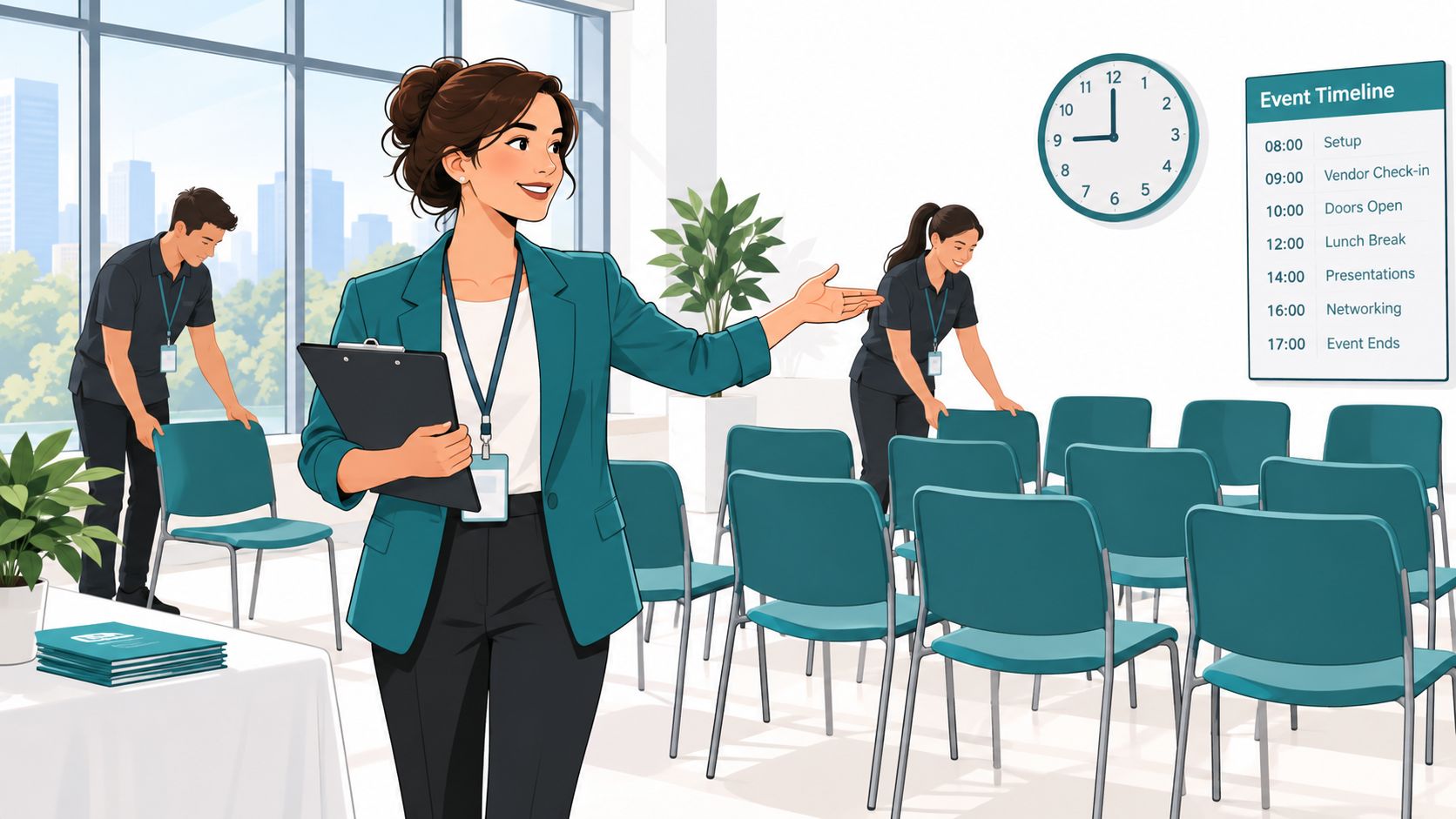
Match the layout to the interaction
Use a boardroom arrangement for confidential decisions, leadership reviews, and client negotiations. Use a classroom layout when attendees need to write or work from a presentation. Choose a U-shape when the facilitator needs eye contact with every participant. For workshops, use smaller clusters with clear walkways and a central point for instructions.
The layout should also account for registration, refreshments, power, cameras, and accessibility. Put food away from the presentation entrance so late arrivals don't cross the speaking area. Keep cables out of walking paths, reserve accessible seating without isolating attendees, and place the screen where every participant can see it.
Use the venue's on-site team for the work they're equipped to handle. Assign one person from your organization to approve decisions, one person to support speakers, and one person to monitor attendees and vendors. Don't make the executive leading the meeting chase a missing microphone.
Before doors open, run the presentation from the actual speaker position. Confirm audio, lighting, internet, room temperature, signage, catering timing, and the transition between formats. Resources such as AV equipment rental guidance can help you prepare the equipment checklist.
A short run-through gives everyone a shared operating picture.
After the event, assign teardown responsibilities before the first attendee arrives. Confirm who returns rented equipment, collects materials, checks for damage, and signs the final venue report. That small amount of planning prevents a successful meeting from ending with a confusing handoff.
Building Community Through Strategic Events
A corporate gathering can create useful business connections after the agenda ends. An executive hosting a workshop in an active business hub might meet a local designer who can improve the company's brand, a founder seeking a strategic partner, or a professional suited to a future project.
Freeform House is a membership-based club and workspace in the heart of Jenks, Oklahoma's 10 District downtown. Its approach resembles the network model associated with Soho House, where members receive access to locations, club spaces, and events through Soho House membership information. For Jenks businesses, the practical lesson is access to a community that supports introductions and repeat collaboration.
A local membership club can bring coworking, executive meetings, workshops, private gatherings, and professional content creation into one setting. A Jenks entrepreneur might meet a photographer at a workshop, then hire that person for product imagery after the event. Another attendee could introduce the company to a local supplier or referral partner the following week.
That relationship-building capacity makes the venue part of the company's local operating network. Evaluate corporate event space rental on two measures: whether the event can run without hidden friction and whether the setting can support useful connections afterward.
Freeform House offers members and guests flexible rooms for executive meetings, workshops, presentations, and private events, supported by coworking amenities and a community hub in downtown Jenks. Visit Freeform House to review the space and plan a corporate gathering with clearer operations and stronger local connections.
Comments