Team Building for Remote Workers: A Practical Guide

Your remote team's calendar is full, yet people still hesitate to ask for help. A project manager discovers a decision buried in chat, a designer learns about a change after the handoff, and two departments solve the same problem independently. The team is busy, but collaboration feels strangely narrow.
That pattern is why team building for remote workers needs a more practical definition. The objective isn't to fill another video call with games. It's to create the trust, contact, shared context, and psychological safety that help people exchange information, challenge assumptions, and coordinate work when nobody shares an office.
The Real Challenge Behind Remote Team Building
A distributed product team can look connected on paper. Everyone attends the same all-hands meeting, posts in the same channels, and appears in the same project tools. Yet the people doing the work may interact almost entirely within their existing groups. Engineering talks to engineering, marketing talks to marketing, and cross-functional contact happens only when a deadline forces it.
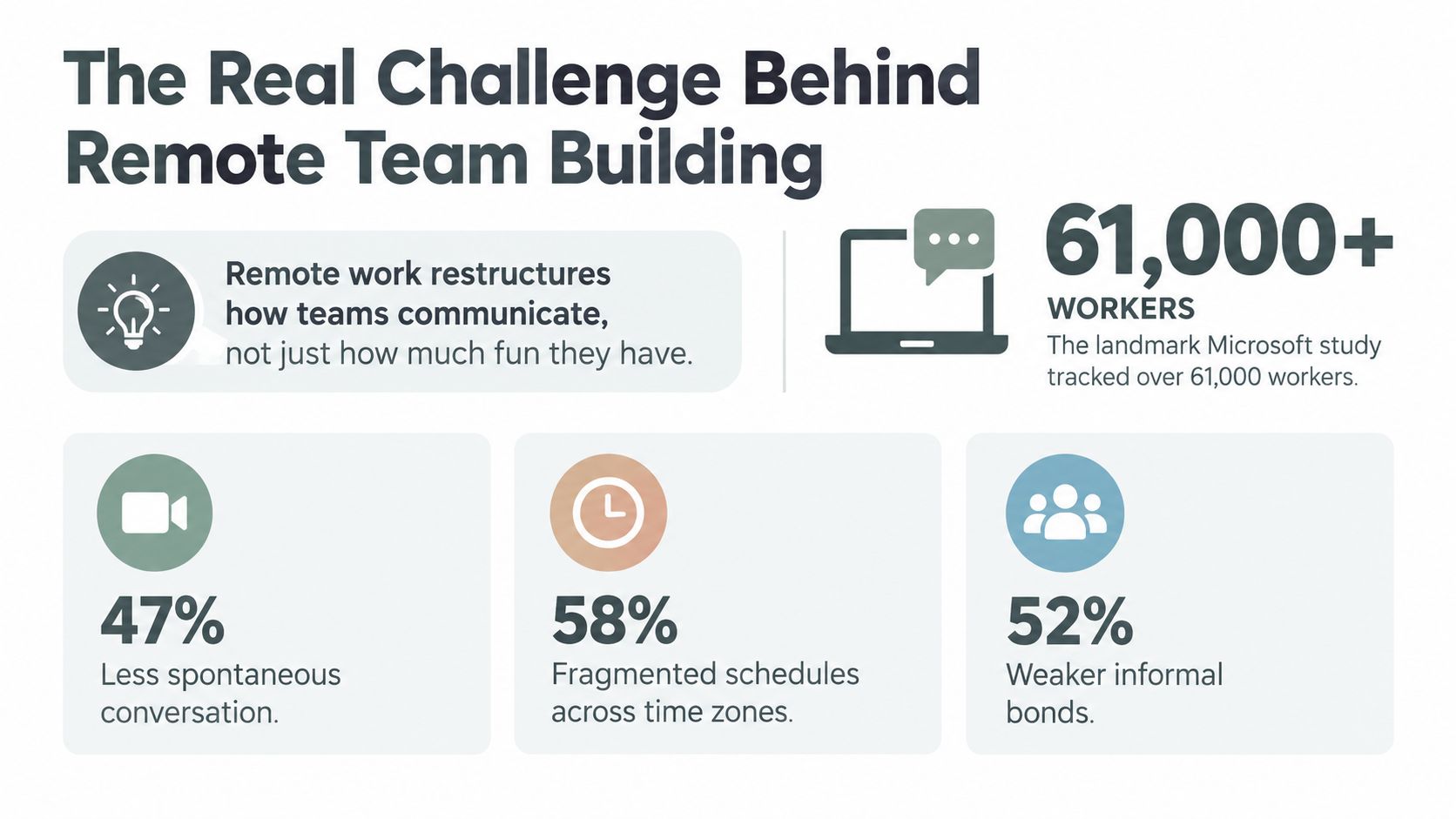
That isn't a hypothetical communication problem. A 2022 study of 61,182 Microsoft employees examined emails, calendars, instant messages, video and audio calls, and workweek hours during the first six months of the company's shift to firm-wide remote work. The researchers found that collaboration networks became more static and siloed, with employees forming fewer connections across otherwise separate parts of the organization. Communication also moved away from synchronous interaction toward asynchronous channels such as email and instant messaging, as documented in the Microsoft remote-work collaboration study.
Presence doesn't equal connection
A team can have plenty of messages and still lack useful contact. Informal conversations often reveal a dependency, surface an emerging risk, or help someone understand how another department thinks. When those connections disappear, employees may still complete assigned tasks, but they have less access to the context that supports innovation and problem-solving.
That distinction changes how leaders should evaluate activities. A trivia session might help colleagues learn personal details, but it won't automatically create a habit of sharing early drafts with another function. A casual coffee chat might feel pleasant, but it won't clarify who owns a decision or how a disagreement should be handled.
Operational test: If an activity doesn't influence how people exchange information, make decisions, or ask for help afterward, it's a social event, not a complete team-building intervention.
The practical response is to mix functions, create live interaction where ambiguity matters, and give people repeated opportunities to build familiarity. Remote employees need structured chances to meet outside their usual work groups, but those chances should connect to real operating behaviors. Team building works when it improves the conditions under which people collaborate, not when attendance becomes the main success measure.
In-Person, Virtual, and Hybrid Approaches Compared
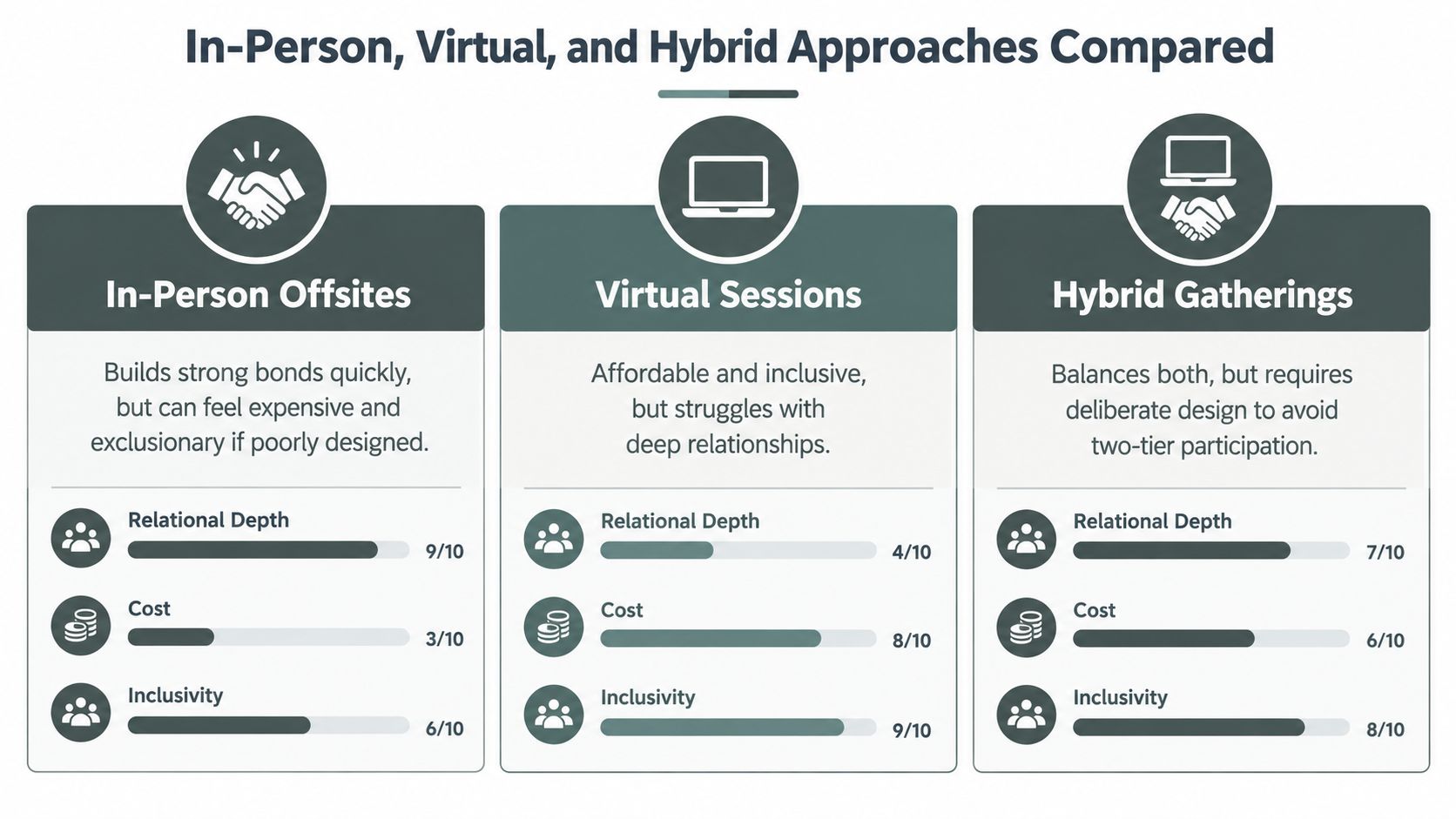
No format solves every team problem. In-person offsites create concentrated time and richer conversational cues. People can notice hesitation, continue a discussion over lunch, and build rapport through unplanned contact. That depth comes with trade-offs. Travel can exclude people who can't attend, and a poorly designed retreat can become an expensive sequence of presentations with little effect on daily work.
Virtual sessions are easier to repeat and can include geographically dispersed employees without requiring travel. They work well for short problem-solving workshops, facilitated introductions, retrospectives, and follow-up conversations. They struggle when the design depends on forced energy, constant camera use, or a game that has no connection to the team's work.
Hybrid gatherings offer a physical anchor while preserving access for remote participants. They also create the most demanding facilitation problem. If people in the room can speak over one another while remote attendees watch a single camera feed, the organization has created two participation tiers.
Choose the format by the work
Research on virtual teams identifies trust as a central predictor of effectiveness. A meta-analysis covering 52 studies and 12,615 individuals found that the relationship between trust and performance was stronger in virtual teams than in face-to-face teams, as summarized in the virtual team trust meta-analysis. That finding doesn't mean every remote team needs an in-person retreat. It does mean leaders should treat trust-building as a deliberate design requirement.
Use a simple decision rule:
Choose in-person when the team must repair strained relationships, establish a new identity, or resolve complex disagreement that depends on rich interaction.
Choose virtual when the objective is recurring practice, broad access, or a focused session that can produce a shared document.
Choose hybrid when some people need physical collaboration but the organization can fund equal participation through dedicated remote facilitation, individual audio access, visible shared notes, and explicit turn-taking.
Team size and geography matter, but purpose matters more. A small cross-functional group may gain more from a virtual workshop with a clear decision than from a large social gathering. A hybrid format earns its complexity only when remote participants receive the same information, influence, and opportunity to contribute.
For teams that need a controlled environment for distributed participation, a purpose-built virtual meeting room setup should support shared materials, reliable audio, and remote-first facilitation rather than treating online attendance as a broadcast.
Planning a Remote Team Offsite That Actually Works
Treat an offsite as an operational intervention, not a reward trip. Before choosing a venue or writing an agenda, define the behavior that needs to change. The problem might be unclear handoffs, slow decisions, weak cross-functional contact, or reluctance to raise risks early.
Establish a baseline before people meet
Use a short anonymous survey to measure trust, psychological safety, information sharing, role clarity, and perceived team effectiveness. Keep the questions practical and repeat the same measures after 6 to 8 weeks, following the methodology described in this evidence-based remote team-building framework. The point isn't to create a perfect score. It's to learn whether the gathering changed the conditions that affect work.
Ask participants where collaboration currently breaks:
Handoffs: Which inputs arrive late, incomplete, or without context?
Decisions: Which decisions lack a named owner or remain hidden in private messages?
Access: Who isn't included in informal conversations that shape priorities?
Voice: Where do people avoid disagreement, questions, or unfinished ideas?
Share the themes before the session. Participants contribute more effectively when they understand the problem they're being asked to solve.
Design the working session around real friction
Start by clarifying shared goals and decision rights. Put disputed responsibilities on a visible board and let the people doing the work identify gaps. Then run a collaborative problem-solving exercise based on an actual failure, such as a missed handoff or an unclear approval path. Remove confidential details if needed, but don't replace the issue with a fictional puzzle that carries no operational consequence.
Reserve social time for relationship-building that supports the work. Pair people from different functions for short conversations about how they prefer to receive context, what makes a handoff useful, and where they need earlier involvement. This creates personal familiarity without asking employees to disclose private information.
Finish by establishing communication norms. Specify which issues require a live conversation, what belongs in an asynchronous brief, who records decisions, and how owners communicate changes. Document the agreement in a shared workspace while everyone is present.
Follow through after the event
Within the follow-up period, review trust and psychological-safety responses alongside work indicators such as action-item completion, rework, decision-cycle time, and cross-functional response time. Don't use attendance or enjoyment as the main outcome. A well-liked session can still fail if the team returns to the same hidden decisions and ambiguous ownership.
A useful strategy offsite agenda should end with named owners, deadlines, and a review date. Without that last layer, the energy of the gathering stays in the room instead of entering the operating system of the team.
Why More Social Time Is Not the Solution
Leaders often respond to remote isolation by adding mandatory video happy hours. That response sounds reasonable until you examine who gets access to live conversation and under what conditions.
Global belonging research found that 63% of fully remote workers reported going an entire workday without a real-time conversation at least weekly, compared with 35% of fully in-office workers in the research on belonging and real-time workplace conversation. The gap points to a structural problem, not a shortage of entertainment. A single social call doesn't repair a workweek in which remote employees rarely encounter spontaneous, low-stakes conversation.
Replace the universal event with a participation menu
A mandatory event at one time can disadvantage caregivers, employees working across time zones, neurodivergent colleagues, and people who find public socializing draining. Cameras and rapid turn-taking also reward the most confident speakers, while quieter employees may attend without contributing.
Use several low-pressure paths instead:
Rotating small-group problem-solving: Mix functions and give each group a concrete, bounded question.
Optional local meetups: Let nearby employees connect in person without making geography a condition of belonging.
Short peer introductions: Pair colleagues for a focused conversation about work preferences, expertise, or current challenges.
Asynchronous follow-up: Capture useful insights in a shared document so people who couldn't attend can contribute later.
Structured retrospectives: Discuss what made work harder, what the team learned, and what behavior should change.
The most valuable activities create a bridge from familiarity to voice safety. People should be able to disagree with a senior colleague, admit a mistake, and share an incomplete idea without expecting social punishment. A 2025 review identifies psychological safety, inclusive culture, leadership, communication-technology quality, and self-efficacy as important influences on virtual collaboration, with stronger psychological safety associated with broader knowledge sharing and more efficient task completion, according to this review of virtual-team collaboration factors.
Design principle: More interaction isn't automatically better. Better interaction gives more people a credible way to participate.
Measure cross-team contact, inclusion in informal decisions, knowledge sharing, and participation by quieter employees. Attendance can tell you who showed up. It can't tell you whether people feel safer speaking, sharing, or asking for help.
Choosing the Right Venue for Hybrid Gatherings
The venue affects how people behave before the first agenda item begins. A generic conference room signals presentation and hierarchy. A flexible, purpose-built setting can make it easier to move between focused work, small-group discussion, informal conversation, and creative production.
Freeform House is envisioned as a premier, membership-based club in the heart of Jenks, Oklahoma's 10 District downtown. Comparable to the renowned SoHo House, it combines co-working spaces with a community hub designed for collaboration and connection. The restored 1920 building includes four distinct rooms and creative resources, giving teams options for executive meetings, workshops, private gatherings, and content production.
Evaluate the space as part of the operating design
Start with the remote experience. Can online participants hear every speaker clearly? Can they see the working surface rather than a distant room? Is one facilitator responsible for monitoring chat, hands, questions, and technical issues? Hybrid equality requires deliberate ownership, not just a screen at the front of the room.
Then examine how the space supports the session's phases. A large room may work for shared context, while smaller rooms support candid discussion and cross-functional pairing. Creative resources can help a team produce a shared artifact, such as a recorded explanation, a visual workflow, or a decision document. The physical environment should serve the work rather than distract from it.
The venue should also fit the team's community strategy. Downtown Jenks's Ten District is a defined redevelopment area extending 10 blocks west from the Arkansas River to the old Midland Valley railroad tracks, with revitalization focused on historic buildings, local businesses, and renewed downtown activity, as described in reporting on the Ten District's redevelopment. That context can support gatherings that connect team collaboration with local commerce and authentic place.
The practical team-building venue guide should help leaders assess access, room transitions, technology, privacy, catering, and follow-up space instead of comparing venues by square footage alone.
A short visual reference can help leaders assess whether a location supports both focused work and community interaction.
Choose a venue that makes the desired behavior easier. If the team needs trust and knowledge sharing, provide settings where people can speak in smaller groups, document decisions, and reconnect informally without forcing every interaction into a plenary meeting.
Next Steps for Leading Remote Team Building
Start with an audit, not an event. Review the team's recurring meetings, project channels, handoffs, and decision records. Look for repeated signs of conversational inequality: the same people dominate live discussions, cross-functional questions arrive late, important context stays in private messages, or remote colleagues learn about decisions after they happen.
Turn the audit into a repeatable practice
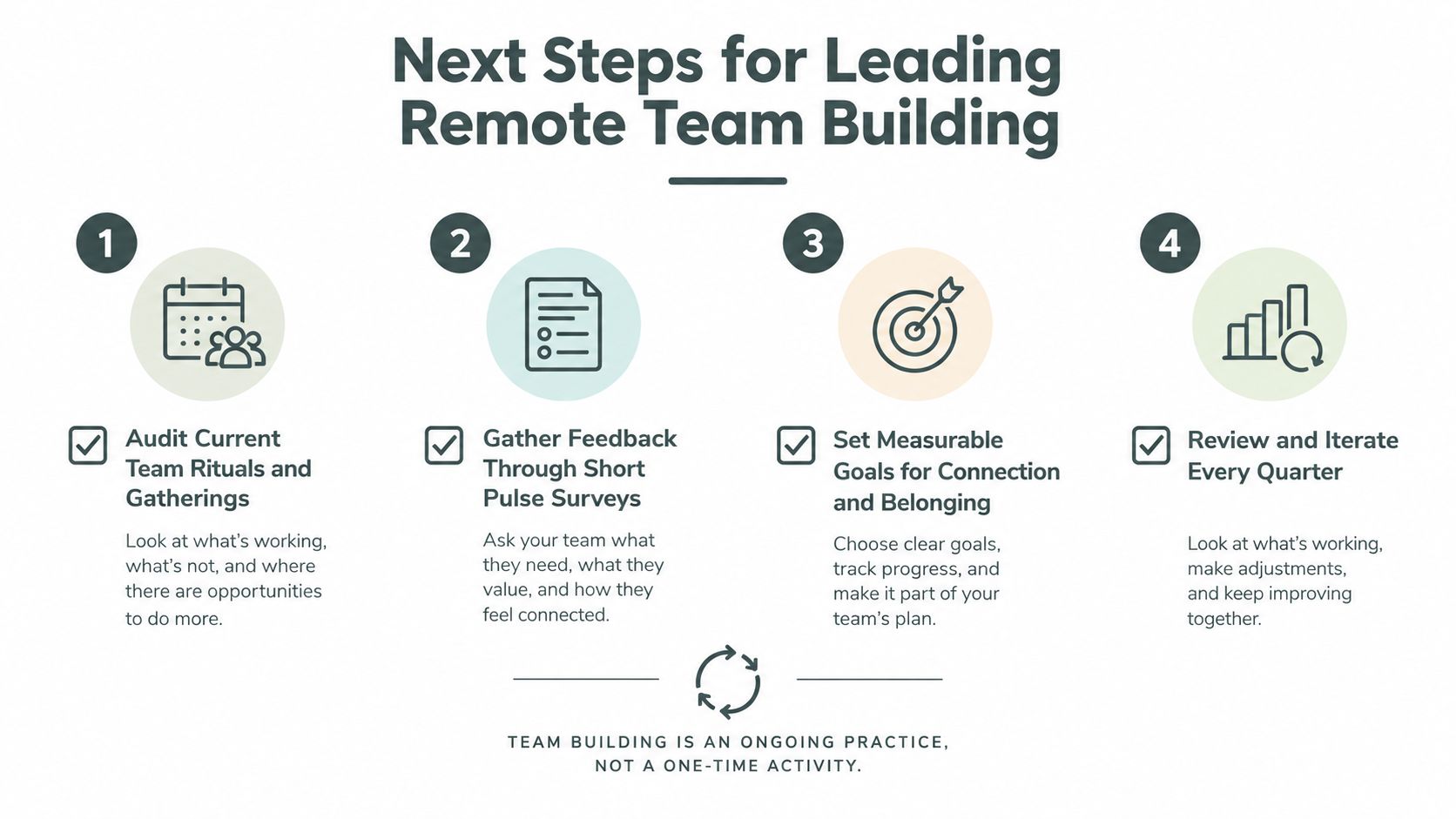
Use this decision checklist:
Audit current rituals: Identify which gatherings create useful contact and which only consume attention.
Gather focused feedback: Use short pulse surveys that ask about trust, psychological safety, role clarity, information sharing, and access to decisions.
Set measurable goals: Track indicators such as cross-team contact, named decision ownership, blocked-work resolution, rework, and participation by quieter employees.
Review and iterate: Revisit the measures after the intervention and adjust the format, facilitation, venue, or communication norms.
The research base supports this emphasis on psychological safety. Teams collaborate more effectively when leaders create conditions for people to exchange expertise, challenge ideas, and report problems early. That requires manager behavior after the event, including responding constructively to bad news, inviting dissent before decisions close, and recognizing useful contributions that don't arrive in polished form.
Make the first intervention small enough to execute well. Select one recurring collaboration failure, invite the functions involved, and design a session that produces a shared operating agreement or decision artifact. Give remote participants equal tools and facilitation. Schedule the follow-up before the session ends.
Review the results rather than defending the original format. If a virtual workshop produces clearer handoffs, repeat its structure. If a social event creates friendly conversation but no change in information sharing, keep the relationship benefit and redesign the work connection. If a hybrid gathering leaves online participants quiet, change the facilitation and room setup before repeating it.
Team building for remote workers becomes durable when leaders treat it as part of team operations. The standard is not whether everyone had fun. The standard is whether more people can reach one another, share what they know, raise concerns, and coordinate work with less friction.
Freeform House offers co-working spaces, four distinct rooms, and creative resources in a restored 1920 building in Jenks's 10 District for focused workshops, executive meetings, private gatherings, and hybrid team sessions. Visit Freeform House to explore a physical setting that can give remote and local professionals an intentional place to work, connect, and build stronger operating relationships.
Comments