Podcast Booth Rental: A Practical Guide for 2026

You arrive at the booth with a laptop, a guest release, a sponsor brief, and a plan that sounded simple in the car. Record a conversation, capture clean audio, film a few clips, and leave with something publishable. Then you notice the room has one camera, harsh ceiling light, no clear file-delivery process, and nowhere to put the guest's coat. The microphones work, but the session you planned doesn't.
I've rented booths in three cities and now run one. The expensive lesson is consistent: a podcast booth rental succeeds or fails as a production workflow, not as a room containing microphones. In Jenks and Tulsa, that workflow also depends on what surrounds the booth. A restored downtown club with meeting rooms, work areas, food access, and a creative community can remove friction that a technically competent standalone studio leaves untouched.
Walking Into Your First Rental
Your first rental often starts with overconfidence. You've watched enough podcasts to understand the basic rhythm: host, guest, microphones, conversation. You bring a polished outline and assume the room will handle the rest.
The first warning sign appears when the operator asks whether you want audio or video. You say both. They point to a single locked-off camera, explain that vertical clips aren't included, and mention that the raw files will be transferred “later.” Your guest has driven from Tulsa, your sponsor expects a clean host read, and the two-hour booking is already shrinking under setup time.
That booth may produce usable sound. It still may be the wrong rental.
Producer's rule: Book the deliverables first, then choose the room that can produce them.
A workable session has a clear chain from arrival to distribution. The room should support the conversation, isolate each voice, frame the people attractively, light faces consistently, and preserve files that an editor can readily use. If you're recording a founder interview, you may need a wide two-shot, individual angles, separate audio tracks, a sponsor-safe segment, and short clips that don't look like accidental crops from a horizontal video.
The environment matters, too. A guest who arrives stressed, hungry, or unsure where to wait won't perform like a prepared guest. Freeform House places its in-house booth inside a restored downtown Jenks building rather than treating recording as an isolated transaction. That context doesn't replace technical standards, but it can make the session feel more deliberate and useful.
The right question isn't, “Does this booth have microphones?” Ask, “Can this place turn my recording day into publishable content without making my guest or team solve the studio's problems?”
What a Podcast Booth Actually Is
Your guest arrives from Tulsa, the host needs a clean sponsor read, and the session must produce more than one audio file. A podcast booth is the controlled production room that makes those deliverables possible. It combines acoustic treatment, microphones, recording hardware, monitoring, cameras, and lighting in one bookable setup.
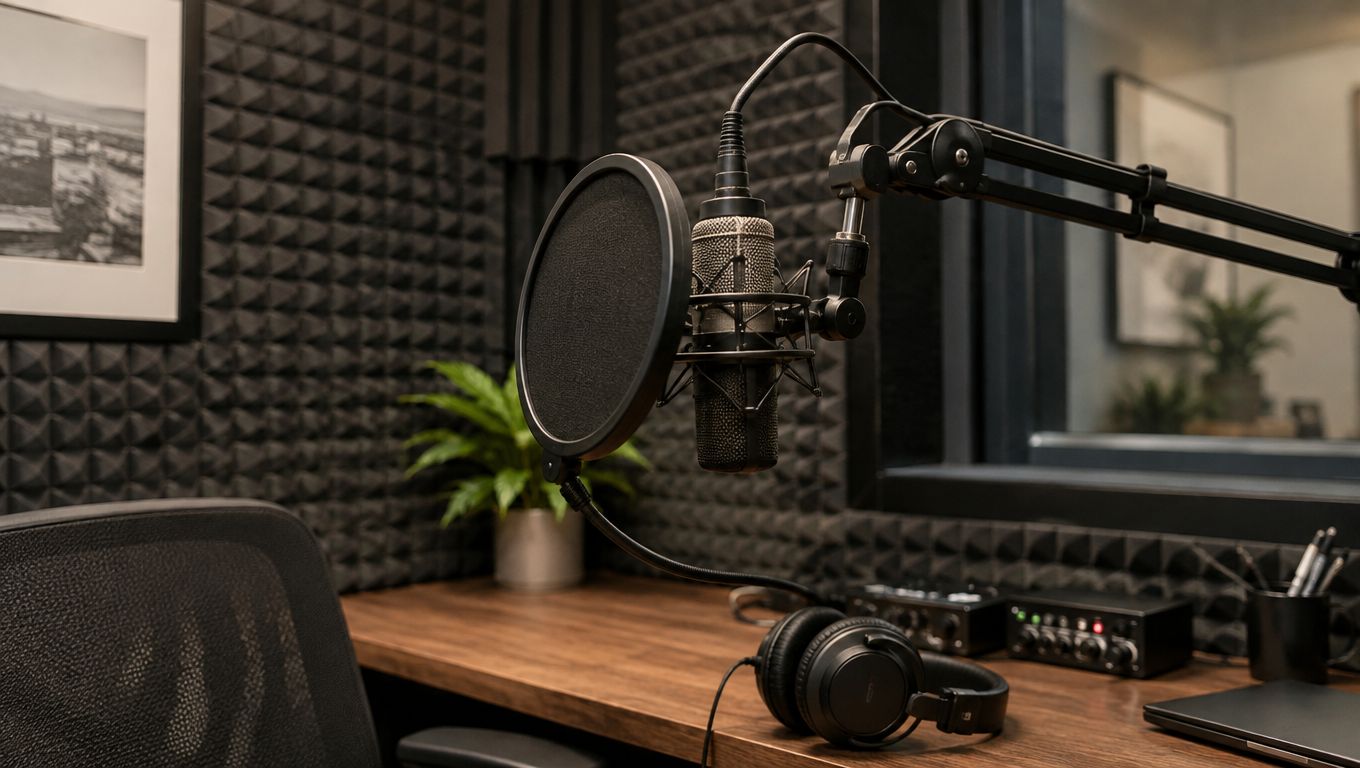
The booth sits between a home office and a full-service studio. A home setup leaves you responsible for room sound, equipment compatibility, troubleshooting, backups, and guest comfort. A large studio may bring more space and crew support than your interview needs. A booth gives you a repeatable production environment without requiring you to build and maintain one.
Podcasting now reaches beyond audio. Edison Research's 2025 Podcast Consumer study reported that 73% of Americans aged 12 and older had consumed a podcast at least once, while monthly listeners reached 158 million in 2025, up from 46 million in 2015. A room that captures only clean audio leaves part of the publishing job unfinished.
What the booth replaces
A useful rental takes several technical tasks off your schedule:
Room engineering: You avoid guessing whether office echo will survive editing.
Signal management: The booth supplies microphones, interfaces, headphones, cables, and recording software.
Guest preparation: The operator can seat guests, position microphones, and confirm monitoring before recording.
Visual production: Cameras, lighting, framing, and a consistent background can turn one conversation into video and clips.
Repeatability: You return to a known setup instead of rebuilding the room for every episode.
The booth does not supply editorial judgment. You still need a strong premise, prepared questions, releases, and a distribution plan. Its value is practical: it protects those decisions from avoidable technical failures.
Judge the room by its workflow. Ask whether it supports a solo frame, a two-person composition, multiple angles, vertical crops, and lighting that works for every face. “There's a camera” is not a production plan.
In Jenks, Freeform House places its booth inside a restored downtown club. That setting gives a guest somewhere intentional to arrive, wait, and connect, while keeping the recording experience tied to the local community rather than a generic office suite. The room still needs proper technical control, but the surrounding amenity can shape how prepared and comfortable people feel.
Specs and Features That Actually Matter
Start with the room, not the microphone brand. A costly microphone in a reflective room still captures reflections, room tone, and consonants softened by reverberation. The operator should be able to explain how the booth was treated and how its performance is checked.
A practical target is an RT60 of roughly 0.2 to 0.35 seconds, substantially shorter than the 0.4 to 0.6 seconds commonly tolerated in classrooms or meeting rooms, according to acoustic guidance on podcast room echo. RT60 measures how long sound takes to decay by 60 dB after the source stops. Ask whether the operator has verified the room with an impulse-response or swept-sine measurement, rather than relying on the phrase “sound treated.”
Broadband absorbers handle early reflections, while thicker 100 to 150 mm panels or corner traps help control lower frequencies, where thin decorative panels do less. The best spoken-word rooms sound controlled, not unnaturally dead.
Evaluate the whole signal chain
Microphones matter, but placement and gain structure matter just as much. Each speaker should have an appropriate microphone, a stable position, and a separate recorded track. Closed-back headphones should let the host hear problems while they're still fixable, without leaking enough sound to contaminate the microphones.
Cameras introduce a different set of trade-offs. Check whether the room offers:
A wide establishing shot and individual close-ups
Lens choices that don't distort faces
Space for natural hand movement
Consistent framing for repeat episodes
A clean path to vertical clips
A teleprompter when scripted delivery requires one
Lighting should handle more than brightness. Look for soft, even illumination across multiple people, controlled background separation, and a setup that doesn't turn glasses into reflections or create hard shadows under the eyes. Remote guests also need a reliable connection, clear monitoring, and a recording plan that doesn't depend on one unstable call.
For a deeper equipment reference, review Freeform House's professional podcast equipment guide, then ask the operator what's included in the actual booking.
Match the booth to the content
Content type | Mic count | Cameras | Lighting | Best for |
|---|---|---|---|---|
Solo commentary | One | One close frame | Single-person soft light | Short educational episodes |
Host interview | Two | Two angles plus wide shot | Balanced multi-person setup | Thought leadership and guest shows |
Branded conversation | Two or more | Multi-angle video | Controlled faces and branded background | Sponsor-safe content |
Video-first series | Two or more | Horizontal and vertical capture | Flexible, consistent coverage | YouTube, TikTok, and Instagram reuse |
Treat every specification as a production decision. More cameras don't help if nobody can operate them. Premium lighting doesn't help if the framing can't accommodate a guest. Acoustic treatment doesn't help commercially if the room produces no usable video.
What You Leave With After a Session
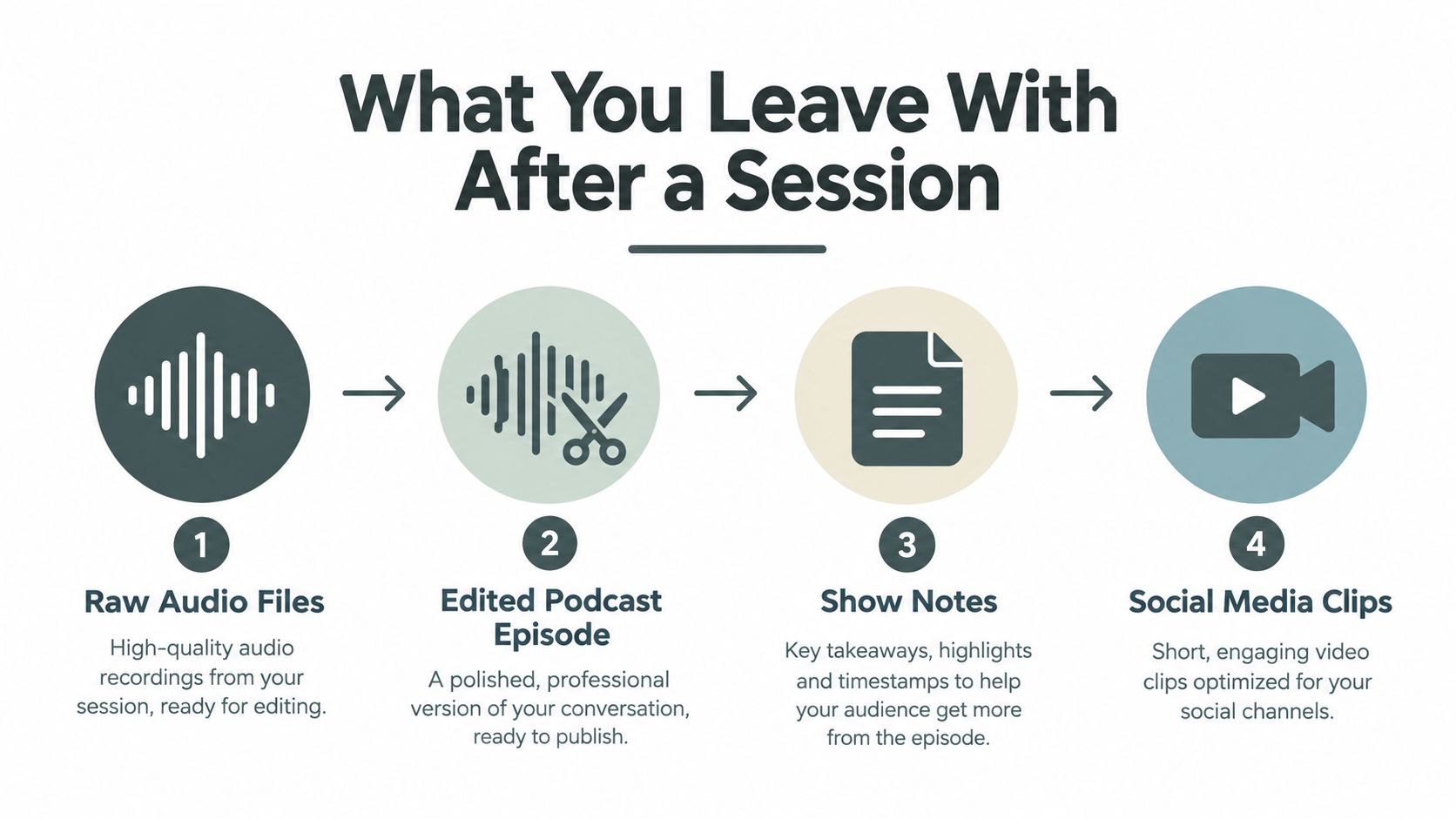
A founder leaves a Jenks booth after one conversation. The booking should produce more than a folder of recordings. Ask for the complete deliverables list before paying, because the room is only valuable if it supports a repeatable video-production workflow.
Confirm whether the package includes isolated audio tracks, a mixed audio file, raw camera files, an edited episode, and a transfer link. Get the file formats, retention period, backup process, and ownership terms in writing. If an editor receives only a flattened mix, they cannot rebalance a quiet guest or remove a cough without changing everyone's audio.
Design the session around output
A productive booking can create:
One long-form audio episode
One edited video episode
Three short-form clips framed vertically
A clean sponsor read recorded apart from the interview
Separate audio tracks for later editing
A thumbnail frame or branded still
That result depends on planning before the first take. The host should know where the sponsor segment belongs. The camera operator should identify moments that could become clips. The editor should know whether captions, logos, or other overlays are expected.
Ask the booth operator in Tulsa whether the room supports horizontal and vertical reuse, or whether you will receive one camera angle and handle the rest yourself. A restored downtown club can offer more than a quiet room. It can function as a community anchor, a recognizable setting for local guests, and a practical content station for businesses that need regular material.
Solo creators should also test the self-service process. Can you start recording, monitor levels, mark takes, and stop safely without a technician? If an operator is required, confirm whether that support is included or billed separately. A simple-looking booth that needs specialist help for every step may suit a campaign, but it limits a creator's flexibility.
Confirm ownership and timing
Write ownership into the booking terms. Confirm who owns raw audio, raw video, edits, graphics, and project files. Ask how long the facility keeps backups and whether you receive a duplicate copy immediately after recording.
Turnaround matters for a launch, event, sponsor placement, or recruiting campaign. Get a specific delivery window instead of accepting “soon.” If editing is included, define the revision rounds and confirm whether short clips are included or sold separately.
Audiences consume podcasts in multiple formats. Your Jenks rental should produce assets for the channels where people discover content, not just a clean master file stored on a hard drive.
Pricing Models and the Costs Nobody Quotes
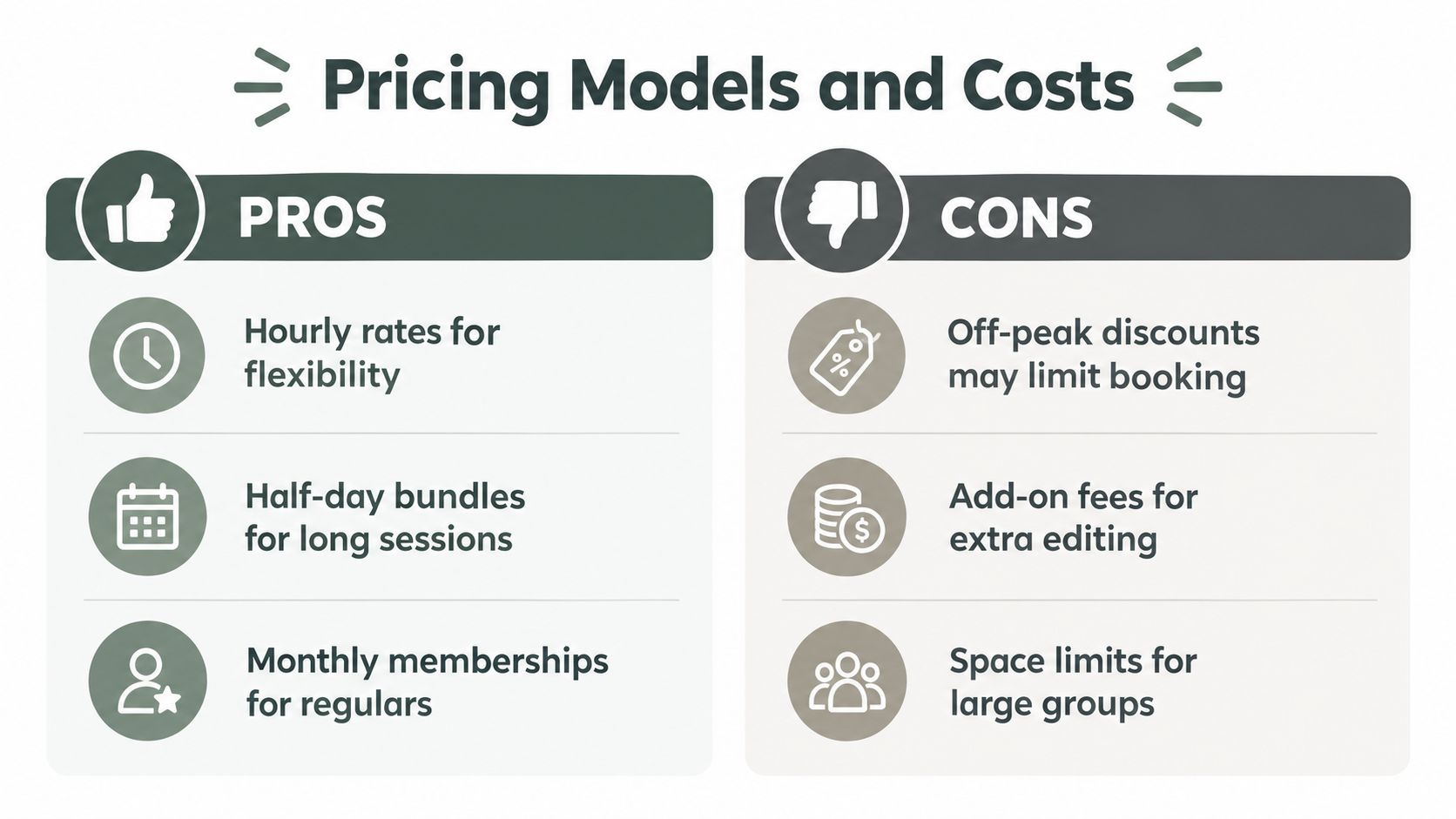
The lowest hourly rate rarely represents the lowest total cost. Studios commonly sell time by the hour, half day, or recurring bundle. Memberships may add priority access or a lower booking rate, while off-peak pricing can reduce the fee at the cost of inconvenient scheduling.
The comparison starts with the clock. Does your booking begin when you arrive, or when the first take starts? Setup, mic placement, camera checks, guest arrival, and teardown all consume usable time. A session that looks affordable on paper can become expensive when the published rate excludes the work required to make the room ready.
Ask about the complete booking
Before paying a deposit, get written answers to these questions:
Time rules: Is setup included, and is there a minimum booking?
Guest costs: Are additional people, remote guests, or support staff billed separately?
Post-production: Are editing, captions, clips, thumbnails, and branding overlays included?
Cancellation: What happens if a guest is late, sick, or unable to travel?
File delivery: Are raw files included, and how long are backups retained?
Access: Can you book evenings, weekends, or recurring slots?
Content terms: Are branded or sponsored sessions subject to special requirements?
Room limits: How many people can fit comfortably without compromising framing or sound?
A rental contract should also address confidentiality, release forms, music and image rights, and responsibility for lost or corrupted files. These aren't glamorous line items, but they matter more than decorative furniture when a sponsor or executive appears on camera.
For a useful local comparison, review podcast studio rental rates at Freeform House and compare the complete scope, not just the headline price.
The commercial context supports investing in predictable production. The Interactive Advertising Bureau reported that U.S. podcast advertising revenue rose 26.4% year over year in 2024 to more than $2.4 billion, an increase of roughly $500 million. That doesn't mean every show needs a premium room. It does mean businesses should evaluate a booth as production infrastructure when the content supports sales, recruiting, education, or sponsorship.
How Freeform House Fits the Picture
A Tulsa founder arrives with a guest, needs a polished conversation on camera, and has a team meeting scheduled afterward. A standalone booth can handle the recording. Freeform House is built for the full production day, including the work around the session that often determines whether the final footage gets reused.
Freeform House serves that use case in Jenks, Oklahoma. It is a premium, members-only club and workspace created by freeform in a restored 1920 building in downtown Jenks, with four distinct rooms, creative resources, and an in-house podcast booth for professional content production, as described on the Freeform House site.
That setting matters for Tulsa-area teams. You can host a guest, prepare for the interview, record the conversation, and continue working without sending everyone across town between appointments. The booth becomes part of a video-production workflow rather than a room rented for one isolated file.
The booth benefits from its neighbors
The in-house booth sits alongside the Hall of Fame Room, Freeform Room, Executive Room, and Thomas Room, plus creative resources such as The Rise loft studio. A team can prepare in a meeting room, record the main discussion, capture stills or behind-the-scenes footage, and keep working in the same building. That combination makes it easier to produce a podcast episode, short clips, photos, and supporting material during one visit.
Day-to-day amenities also reduce production friction. Members can access meals and beverages from local restaurant and coffee partners on demand, use Amazon Hub Lockers, and rent golf carts. None of those features repairs poor audio or replaces a good editor. They do reduce errands, delays, and unnecessary location changes during a busy recording day.
The community model adds practical value for Jenks and Tulsa professionals. A host may meet a future guest, client, collaborator, or sponsor in a space designed for business and creative connection. That network does not replace audience planning, but it gives the booth a role beyond recording.
Review The Podcasters Studio at Freeform House for details about the booth itself. Choose this setting when the day includes meetings, team work, guest hosting, or content beyond one audio file. For a quick voice track, a standalone studio remains the cleaner, lower-scope option.
The Real Business Case for Renting Instead of Buying
Buying equipment makes sense when you record often, control a dependable room, and have someone responsible for maintenance. It makes less sense when your office changes, your guests vary, or your team needs video, lighting, backups, and editing without becoming a production department.
Renting converts ownership problems into an operating decision. You pay for access to a controlled environment and avoid maintaining acoustic treatment, replacing failed cables, configuring interfaces, updating software, and explaining a complicated setup to every guest. The value isn't the gear alone. It's the reduction in failed takes, setup friction, and post-production rescue work.
The market also gives business owners a reason to demand usable output. WARC forecasts global podcast advertising spend above $5 billion in 2025 and $5.5 billion in 2026, while projecting annual growth to slow from 13.2% in 2024 to 7.9% in 2025 and 6.5% in 2026. Slower growth makes efficiency more important. A premium room that produces one polished file but no reusable clips may be less valuable than a simpler workflow that produces a complete content package.
Protect the recording before it starts
Local sessions with guests and sponsors create operational obligations:
Confidentiality: Decide who can access raw files and unpublished conversations.
Releases: Obtain guest permissions before recording, especially for commercial content.
Rights: Confirm ownership and licensing for music, logos, photographs, and background elements.
Accessibility: Make sure guests can enter, wait, sit, hear, and participate comfortably.
Backups: Record redundant audio when possible and establish who preserves the originals.
Sponsor safety: Capture approved host reads separately and label files clearly.
The rental decision is easy to defend when it buys a repeatable workflow and reduces identifiable risks. It's harder to defend when you're paying for attractive equipment that your team still has to operate, monitor, edit, and back up alone.
Choosing the Right Booth for Your Next Session
Choose the booth by answering three questions before you compare rates.
What are you producing? Audio-only interviews need controlled acoustics and isolated tracks. Video-first shows need camera coverage, flattering multi-person lighting, reliable framing, and a plan for vertical clips. Branded content needs sponsor-safe recordings, rights documentation, and files that an editor can revise without rebuilding the session.
Who is in the room? A solo creator can tolerate a simpler setup if the controls are clear. A host interviewing an executive needs fast onboarding, comfortable seating, clean monitoring, and a room that makes the guest feel prepared. A team may need a nearby meeting room before or after recording. Remote guests need stable connectivity and a backup plan.
What must you leave with? Write the answer as a delivery list. That may include an edited audio episode, raw video, isolated tracks, short clips, captions, show notes, thumbnails, or a sponsor read. If the booking page doesn't state what happens to those files, ask before you reserve the room.
Use this pre-booking test
Content fit: Does the booth support your format and number of speakers?
Visual fit: Can it produce the angles and crops your channels require?
Audio fit: Can the operator explain room treatment and separate-track recording?
Workflow fit: Can a solo creator operate it, or is a technician required?
Business fit: Are rights, backups, cancellation, and delivery terms documented?
Location fit: Will the Jenks or Tulsa setting make the guest and team's day easier?
For a creator who wants a video-first workflow inside a community-anchored environment, Freeform House is a relevant option to investigate. A standalone rental remains sensible for purely transactional sessions. The mistake is choosing either one by appearance or hourly rate instead of matching the room to the content you need to publish.
Video podcasting will keep pushing booths toward complete production systems. Rent the space that gives you control over the final assets, not merely access to a microphone.
Freeform House offers an in-house podcast booth inside a restored, members-only club and workspace in downtown Jenks, with adjacent rooms and creative resources for recording, meetings, and collaboration. If you want your next podcast booth rental to produce more than a polished audio file, visit Freeform House and explore whether the space fits your recording workflow.
Comments