A Virtual Address for Business The Ultimate Explainer

In a world where business happens everywhere, your address still says a whole lot about you. Think about it: a virtual address for business is a real, physical street address that gives your company a professional presence, but without the eye-watering cost of actually leasing an office. It becomes your company's permanent, prestigious headquarters—a signal of legitimacy that builds trust with clients, banks, and partners from day one.
Your Professional Front Door in the Digital Age
Let's be honest, the line between home and office has gotten pretty blurry. For many entrepreneurs, working from a home office or a favorite coffee shop is the dream. It offers incredible freedom, but using your home address for your business? That can open up a can of worms, from serious privacy risks to undermining the professional image you've worked so hard to build.
This is where a simple, strategic solution comes into play.
Picture a virtual business address as a digital front door to a real, professional location. It’s so much more than a mailbox. It’s a foundational tool that projects stability and credibility. This service gives you a legitimate commercial address you can use for everything, from registering your LLC to opening a business bank account.
Establishing Credibility from Day One
First impressions are everything, and your business address is often one of the first things a potential client or partner sees. An address in a recognized commercial district instantly elevates how people see your brand. It separates the pros from the hobbyists and signals that you're a serious, established company.
For local entrepreneurs right here in Jenks, Oklahoma, having a prestigious address in the 10 District downtown can make a powerful statement before you've even said a word.
This immediate credibility boost is a game-changer for a few key reasons:
Building Client Trust: A professional address immediately reassures clients they’re dealing with a legitimate business, not a fly-by-night operation.
Securing Financing: Banks and lenders almost always require a commercial address. They see it as a sign of a stable, well-planned business.
Protecting Personal Privacy: This is a big one. It keeps your home address off public records, safeguarding you and your family from unwanted attention.
A virtual address isn't just a logistical tool; it's a strategic branding decision. It anchors your business in a physical, professional space, even if your team is spread out across the globe.
Throughout this guide, we’ll dig into how a virtual address can unlock new growth opportunities, protect your privacy, and build the credible foundation every modern entrepreneur needs to succeed.
Alright, let's break down what a virtual business address actually is.
In short, it’s a real, physical street address at a commercial building that your business can use for everything official. You get the professional image and the legal legitimacy without the massive overhead and long-term lease of a dedicated office. Think of it as your business’s professional home base in the real world.
This service gives your company a stable, credible footprint right from the start. You can use this address to register your LLC, open a business bank account, and plaster it all over your website and business cards. It’s the front door that builds instant trust with clients, partners, and even the bank.
More Than Just a Mailbox
It's super important to understand this isn't just a fancy P.O. Box. A Post Office Box is just that—a numbered box at the post office. A virtual business address, on the other hand, is tied to an actual commercial property.
This distinction is a big deal. Why? Because many government agencies and banks flat-out reject P.O. Boxes for official business registration or account setup. A virtual address gives you a verifiable commercial street address that meets those strict requirements, keeping your business compliant and professional from day one.
A prestigious commercial address signals stability and seriousness. It separates the established professional from the casual hobbyist in the eyes of potential clients and financial partners.
Clarifying Key Service Differences
As you start looking around, you'll probably bump into terms like "registered agent" and "virtual mailbox." They sound similar, but they do different jobs. A registered agent is your official point of contact for receiving legal notices and government mail. It’s a legal requirement, but it’s not the same as a full-service business address.
To clear things up, let's put these options side-by-side.
Comparing Your Business Address Options
Here's a quick comparison to help you see the distinct advantages of a virtual business address over the common alternatives.
Feature | Virtual Business Address | P.O. Box | Registered Agent |
|---|---|---|---|
Address Type | Real Commercial Street Address | Post Office Box Number | Commercial or Residential Address |
Primary Use | Mail, Marketing, Business Registration | Personal & Business Mail Receiving | Receiving Legal & State Documents |
Bank & LLC Friendly | Yes, widely accepted | No, often rejected | Required for LLC/Corp formation |
Professional Image | High, projects credibility | Low, seen as less professional | Neutral, purely a legal function |
Ultimately, a virtual business address gives you the most complete package for building a professional presence. It blends the mail-handling convenience of a mailbox with the legal and financial legitimacy of a real commercial location.
For serious entrepreneurs here in Jenks, Oklahoma, going with a premium option like Freeform House means you get a sought-after address in the 10 District downtown, giving your company’s prestige and local credibility an immediate boost.
The Strategic Advantages of a Virtual Address
Opting for a virtual address isn't just about getting a place for your mail to land. It's a strategic move that can impact everything from how potential clients see you to your bottom line. Let's dig into the real-world ways this service can give your business a serious leg up.
The first, and maybe most obvious, perk is an instant upgrade to your professional image. Let’s be honest, using your home address can unintentionally signal that your business is a small side-hustle. A proper commercial address in a known business district immediately projects stability and credibility.
This is especially powerful for local businesses. Imagine you're an entrepreneur in Jenks, Oklahoma. Having an address in the prestigious 10 District downtown tells clients and partners you're serious before you've even had a conversation. It builds a foundation of trust from day one.
Protecting Your Privacy and Slashing Overhead
Beyond looks, a virtual address puts a critical wall between your work life and your home life. When you list your home address on public business registries, you're opening the door to junk mail, unexpected sales pitches at your front door, and some pretty big privacy issues. A virtual address keeps your personal space private and secure.
You get this professional separation without the crushing weight of a traditional office lease. The costs for commercial rent, utilities, insurance, and upkeep pile up fast. A virtual address delivers the professional punch of a physical office for a tiny fraction of the price, which frees up your cash to pour back into actually growing your business.
This graphic breaks down how a virtual address really compares to the other common options out there.
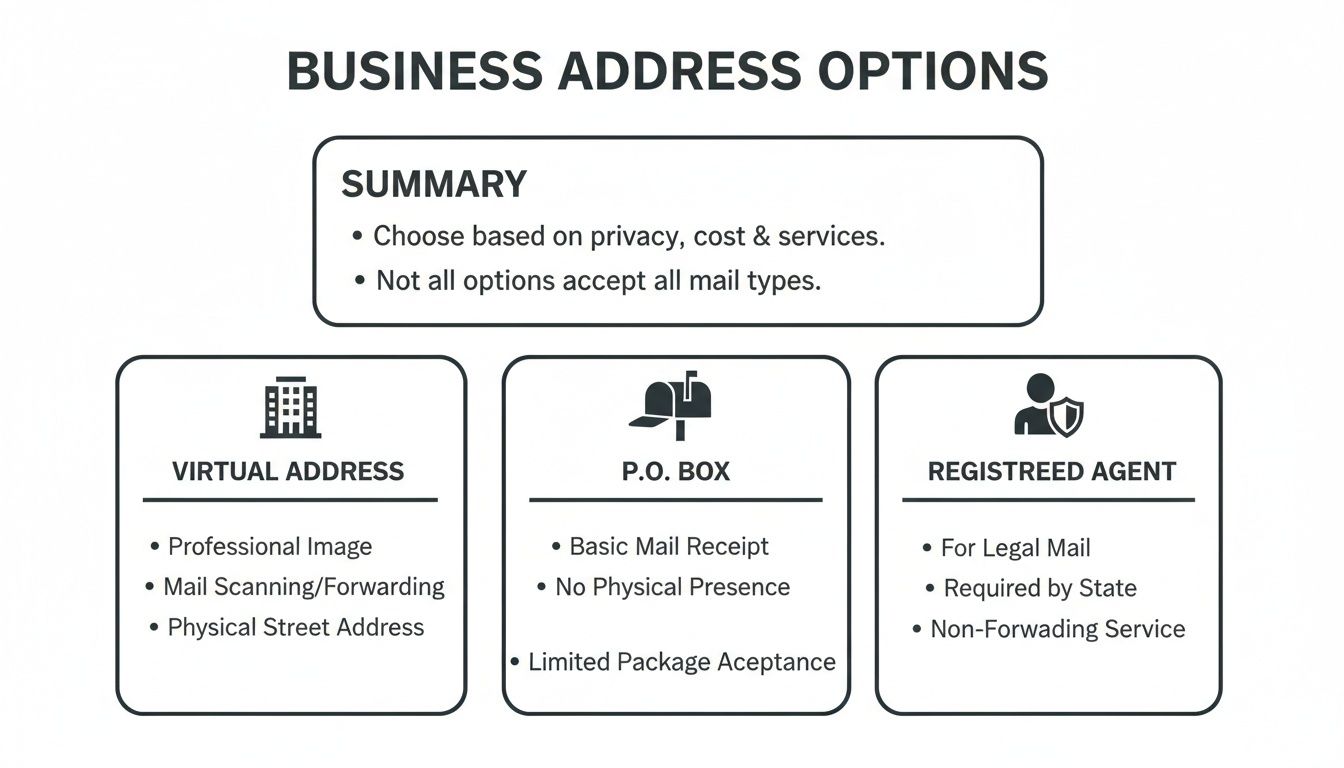
As you can see, the virtual address is the only one that truly checks all the boxes: a professional commercial address that's also accepted by banks and for official business registration.
Boosting Local SEO and Plugging Into a Professional Scene
A physical address in your target city is a huge signal for local search engine optimization (SEO). Google and other search engines use this to decide who shows up in location-based searches. A virtual address helps you plant a legitimate local flag, making it much easier for customers in your area to find you online.
This isn't just a niche trend; it's a massive shift in how business gets done. The global virtual office market was valued at $22.79 billion and is projected to keep growing, which shows just how many businesses are embracing this model. You can learn more about the growth of the virtual office market and how it’s changing modern business.
Finally, premium providers like Freeform House offer something more than just a mailbox. You're getting access to an entire professional ecosystem.
A top-tier virtual address provider doesn’t just forward your mail; they offer a physical hub for your business with on-demand access to meeting rooms, coworking spaces, and a community of like-minded professionals.
This gives you a flexible physical footprint when you need it. You can book a private office for a day of deep work or grab a conference room to impress that high-stakes client. It’s the perfect mix of digital ease and real-world professionalism.
Meeting Key Legal and Financial Requirements
A virtual business address is more than just a nice-to-have for your brand's image—it's a critical piece of your company's legal and financial foundation. When it’s time to take that big step of opening a business bank account, you’ll quickly discover that banks play by a strict set of rules. For them, a residential address or a P.O. Box just doesn’t cut it.
They have this requirement for a simple reason: to verify that your business is legitimate and to comply with federal regulations. Using a real street address from a provider like Freeform House ensures you can establish those vital banking relationships without a hitch, paving the way for managing cash flow, accepting payments, and building your business credit.
Staying Compliant and Registering Your Business
The need for a legitimate physical address doesn't stop with the bank. It's front and center when you’re actually forming your business. To register an LLC or corporation here in Oklahoma, the state requires a physical location to be on file. This isn't just a formality—it's the address that goes on public record and serves as your official point of contact.
Using a virtual business address cleanly satisfies this requirement, all while keeping your home address private and off the public record. It keeps your business compliant with state regulations from day one, helping you avoid the delays or even rejections that can pop up when you use a non-compliant address. For a deeper look at this, check out our detailed guide on the differences between a physical and mailing address for your business.
Plus, a virtual address gives your business a stable, consistent home base, no matter where you or your team happen to be working from. That consistency is key for staying in good standing with state agencies and building a solid operational history.
A legitimate virtual address is the key that unlocks formal business structures and financial services. It bridges the gap between your flexible work style and the concrete requirements of the business world.
Passing Verification and Scaling Your Operations
In today’s economy, verification is everything. The virtual address market has grown into an essential part of the compliance puzzle, with services often starting around $199 annually. Providers now have to meet the same strict Know Your Customer (KYC) standards that neobanks, payment processors, and huge online marketplaces demand.
This has become especially critical for e-commerce entrepreneurs. If you want to sell on a platform like Amazon Seller Central, you have to pass their identity audits to get your store approved and running. They need to know you're a real, verifiable business. This video from industry experts breaks down exactly how virtual addresses fit into these modern compliance frameworks.
Choosing a provider that follows these high standards isn't optional—it's non-negotiable. It’s what guarantees your address will be accepted by modern financial services and e-commerce platforms, letting you grow your business without hitting frustrating compliance roadblocks. Having an address in a recognized business hub like Jenks' 10 District also adds a serious dose of credibility to client proposals and partnership talks, solidifying your professional reputation as you scale.
Who Really Needs a Virtual Business Address?
A virtual business address is one of those wonderfully versatile tools that works for almost everyone, from the freelancer just starting out to an established company that’s gone fully remote. It’s not a one-size-fits-all solution, but rather a flexible key that unlocks different benefits depending on who’s using it.
For some, it’s about projecting a polished, credible image from day one. For others, it’s a smart, low-risk way to test the waters in a new city or establish a local presence without the eye-watering cost of a physical lease.
Solo Entrepreneurs and Creative Professionals
If you’re a solo operator—a photographer, designer, writer, or consultant—the biggest win here is privacy. Plain and simple. A virtual address puts a solid wall between your home life and your business identity, keeping your personal address off public records and out of the hands of clients. It lets you swap your home address on your website and business cards for a professional one, giving you an instant credibility boost.
At a place like Freeform House, this goes even further. You don't just get a prestigious address in Jenks' 10 District; you also get access to professional meeting rooms on demand. It’s perfect for those client meetings where the local coffee shop just won't cut it.
A virtual address is the foundational tool that allows a one-person operation to project the stability and professionalism of a much larger enterprise, building client trust from the very first interaction.
Growing Small Businesses and Remote Teams
For small and medium-sized businesses (SMBs), a virtual address is less about image and more about smart, strategic growth. It's no surprise that SMBs are the biggest users in this space, making up 44.4% of the market. Why? Because it allows them to scale quickly without their overhead costs ballooning at the same rate.
Think about it: businesses can redirect huge savings—sometimes averaging $11,000 annually per remote employee—back into things that actually grow the company, like product innovation and hiring top talent. You can dig deeper into these virtual infrastructure trends and see the financial impact for yourself.
A virtual address also acts as a central hub for mail, which is a lifesaver for remote-first companies. No more worrying about important documents getting lost in the shuffle.
And for businesses that need flexibility above all, pairing a virtual address with options like month-to-month office space rentals is the perfect hybrid approach. You get the efficiency of a virtual setup with access to a physical workspace exactly when you need it, supporting your growth every step of the way.
Choosing the Right Virtual Address Provider
Picking a provider for your virtual business address is a huge decision, and it’s about way more than just finding the cheapest option online. Not all services are the same. The right partner becomes a seamless extension of your brand, while the wrong one can cause major headaches.
First things first: you absolutely have to confirm you’re getting a real commercial street address. You’re not looking for a P.O. Box or a generic mail center number that could get your bank account application or state registration tossed out.
Your choice here directly shapes your company's image and how smoothly your operations run. A low-quality address can immediately raise red flags for potential clients, making you look like a fly-by-night operation. On the other hand, a premium address in a known business district like Jenks’ 10 District instantly projects credibility and stability. It tells the world you’re a serious, legitimate enterprise.
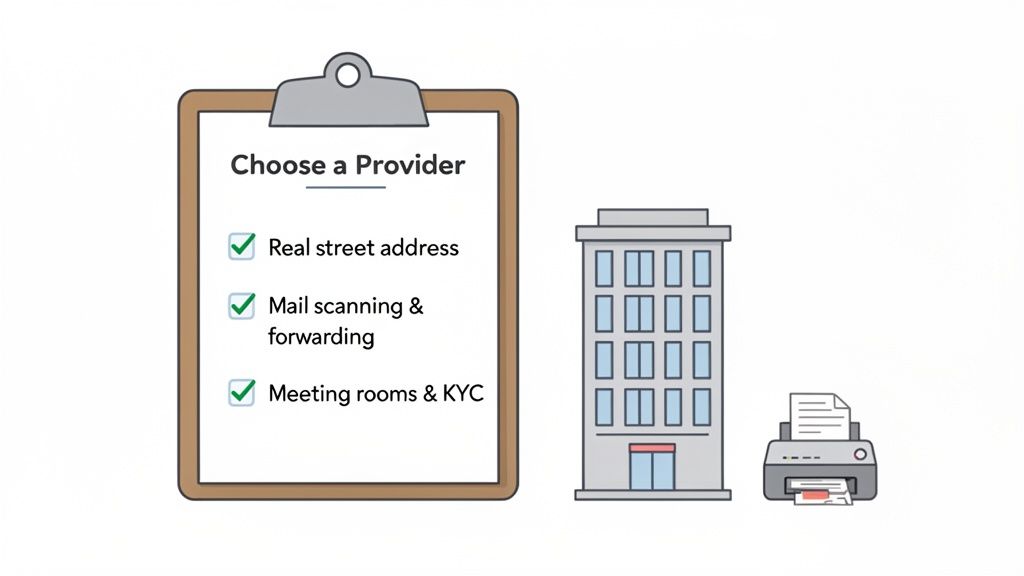
Key Factors to Evaluate
Before you sign on the dotted line, you need to look beyond the address itself and see what you're really getting. A truly valuable provider gives you more than just a place to get mail; they offer a flexible home base for your business.
Use this checklist to get started:
Mail Handling Services: How do they actually manage your mail? Look for practical options like secure mail receiving, forwarding to your home, and digital mail scanning that drops PDFs of your documents right into your inbox.
On-Demand Physical Amenities: Can you use the space when you need it? The ability to book a professional meeting room, a private day office, or even a coworking desk is a total game-changer for client meetings or just getting some focused work done.
A Professional Environment: If a client ever decided to pop by your "office," what would they find? A top-tier provider like Freeform House ensures they walk into an impressive building with a professional reception area, not a bland and unattended mailbox store.
A top-tier virtual address provider doesn't just forward your mail; they offer a physical hub for your business with on-demand access to meeting rooms, coworking spaces, and a community of like-minded professionals.
The right partner provides a flexible footprint that can grow right alongside you. Our guide on the perks of a virtual office and receptionist service dives deeper into how these integrated solutions work.
At the end of the day, your virtual address should be a strategic asset that supports your business's growth and professionalism, not just a line item on your expense report.
Unpacking Common Questions
Let's tackle a few of the questions we hear all the time from business owners thinking about making the switch to a virtual address.
Can I Really Use a Virtual Address to Register My LLC?
Absolutely. This is a big one, but the answer is a straightforward yes. You can use a legitimate virtual business address to register your LLC in Oklahoma. The state requires a physical street address for official paperwork—no PO Boxes allowed. A quality virtual address from a commercial building like ours ticks that box perfectly.
It’s all about staying compliant with state rules while keeping your home address off the public record.
What Makes This Better Than Just Getting a P.O. Box?
Think of it this way: a P.O. Box is just that—a numbered box at the post office. It’s a dead end for a lot of critical business functions. Banks, lenders, and even government agencies will often reject a P.O. Box when you're setting up official business accounts.
A virtual address, on the other hand, gives you a real, physical street address at a verifiable commercial location. That single distinction is huge. It builds the credibility you need to open business bank accounts, apply for loans, and register your business properly. One signals legitimacy, the other can look a bit temporary.
Using a real commercial street address isn't just about appearances; it's a foundational step that unlocks access to essential financial and legal services, ensuring your business is built on solid ground.
How Does This Help My Business Show Up on Google?
Having a verified physical address is like gold for local SEO. It's a massive signal to search engines like Google that your business is a legitimate, local operation. This dramatically boosts your chances of showing up when people in your area search for what you do, especially on Google Maps.
This is non-negotiable if you want to set up a Google Business Profile, which is the key to getting found by customers in Jenks and the greater Tulsa area. By anchoring your business to a real location, you’re not just getting an address—you’re getting visibility.
Free Form House is envisioned as a premier, membership-based club in the heart of Jenks, Oklahoma's 10 District downtown. Comparable to the renowned SoHo House, it offers more than just a social club. Members can take advantage of co-working spaces and a dynamic community hub designed for collaboration and connection. It's a central gathering spot aimed at fostering a creative and cooperative spirit within our local community.
Comments