10 Powerful Local Business Marketing Strategies for 2026

In today's competitive landscape, thriving as a local business means going beyond traditional tactics. It requires a sophisticated, community-first approach that blends digital precision with authentic, on-the-ground connection. This definitive guide moves past generic advice to deliver a comprehensive roundup of 10 actionable local business marketing strategies, specifically designed for ambitious entrepreneurs who understand that real growth is rooted in the community they serve.
This is not a list of vague tips; it's a playbook. We will provide a step-by-step roadmap for implementation, outline the key performance indicators (KPIs) you need to track for each strategy, and share real-world examples to inspire your next move. From mastering your digital storefront with hyper-local SEO to fostering strategic alliances within community hubs like Jenks' own Freeform House, these insights will equip you to build a powerful and enduring local presence.
You will learn how to:
Dominate local search results and turn online visibility into foot traffic.
Forge powerful co-marketing partnerships with complementary local businesses.
Host community events that generate buzz and build genuine customer loyalty.
Execute targeted digital advertising that reaches your ideal local customers without wasting your budget.
This guide provides the tools you need to not just compete, but to become a recognized and indispensable cornerstone of your local economy. Let's dive into the strategies that will help you achieve local dominance.
1. Local SEO and Google Business Profile Optimization
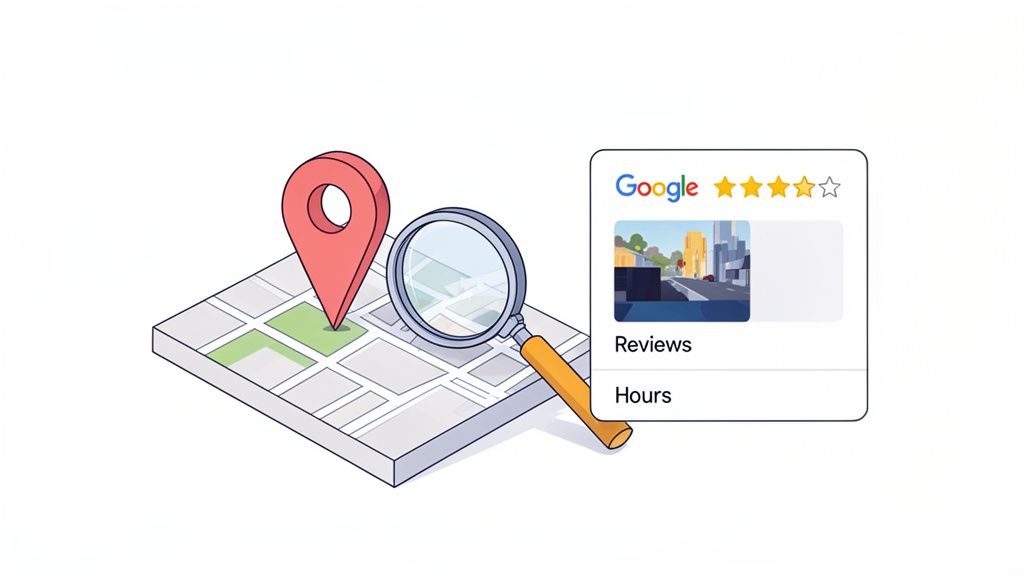
For businesses with a physical location, local Search Engine Optimization (SEO) is a non-negotiable cornerstone of any modern marketing plan. This strategy focuses on increasing your visibility in localized search results, particularly on Google Search and Google Maps. When potential customers search for "podcast studios near me" or "upscale event venues in Jenks," a well-optimized presence ensures your business appears at the top of their results, capturing high-intent traffic at the precise moment they need your services.
The heart of local SEO is your Google Business Profile (GBP), a free tool that acts as your digital storefront. It’s often the first interaction a customer has with your brand. A complete and active profile builds trust and provides critical information that converts searchers into visitors. For a premier, multifaceted venue like Freeform House, this means showcasing every aspect of the space, from its collaborative coworking areas to its elegant event rooms.
Actionable Implementation Steps
Optimizing your GBP is one of the most effective local business marketing strategies because it directly targets customers actively seeking your offerings. Consistent management is key.
Complete Every Section: Fill out every field available in your GBP dashboard. This includes services, amenities, accessibility information, business hours, and precise location data.
Encourage and Respond to Reviews: Actively ask members and event hosts to leave reviews. Respond to every single one, good or bad, within 24-48 hours to show you value customer feedback.
Leverage Google Posts: Use the "Posts" feature weekly to announce upcoming workshops, share member spotlights, or highlight special offers. This keeps your profile fresh and engaging.
Upload High-Quality Visuals: Regularly add professional photos and videos of your spaces, events in action, and happy members. For a venue like Freeform House, showcasing each of its distinct rooms is crucial.
Utilize the Q&A Feature: Proactively populate the Questions & Answers section with common inquiries. Answer questions about membership costs, booking availability, or parking to remove friction for potential clients.
2. Strategic Partnerships and Co-Marketing
No local business operates in a vacuum. Strategic partnerships and co-marketing are powerful local business marketing strategies that leverage the power of collaboration over competition. This approach involves teaming up with non-competing local businesses that share a similar target audience to cross-promote services, share audiences, and create bundled offerings that provide enhanced value to customers. It’s about building a supportive local ecosystem where each business amplifies the others.
For a multi-faceted hub like Freeform House, this means creating a network of trusted partners that enhance the member and event experience. Collaborating with a local caterer to offer seamless event packages or partnering with a nearby photography studio for member-exclusive headshot sessions builds a web of community value. These relationships not only generate direct referrals but also solidify your business's position as a central, well-connected player in the local Jenks economy.
Actionable Implementation Steps
Building a strong partnership network taps into established customer bases, instantly expanding your reach and credibility. The key is finding the right fit and creating mutually beneficial arrangements.
Identify Complementary Partners: Brainstorm businesses that serve your ideal client but don't directly compete. For an event venue, this includes florists, event planners, photographers, and A/V specialists.
Create a Value Proposition: Don't just ask to cross-promote. Propose a clear, valuable arrangement, such as a referral commission, a bundled package discount, or a co-hosted networking event.
Develop Co-Branded Materials: Create joint flyers, social media graphics, or email campaigns that highlight the partnership. This presents a unified front and makes the offering more attractive to customers.
Host Joint Events: Collaborate on a workshop, an open house, or a community gathering. This strengthens the partnership and introduces both of your audiences to the other business in a low-pressure, engaging setting.
Track Referral Success: Use unique discount codes or a simple "How did you hear about us?" question to track which partnerships are driving the most valuable leads, allowing you to focus your efforts. Building an effective network is a crucial skill, and you can learn more about how to find business partners to elevate your vision to get started.
3. Content Marketing and Thought Leadership
Beyond direct advertising, content marketing is one of the most powerful local business marketing strategies for building lasting customer relationships. This approach focuses on creating and distributing valuable, relevant, and consistent content to attract and retain a clearly defined audience. By positioning your business as a trusted authority, you build credibility and foster a community around your brand, moving beyond simple transactions to create genuine connections.
The goal is to provide expertise that solves your audience's problems, not just to sell your product. For a community hub like Freeform House, this means producing content that empowers local entrepreneurs and creatives. By offering genuine value through blog posts, videos, or podcasts, you establish your venue as the go-to resource and physical center for business excellence in the community, earning trust and loyalty long before a customer ever needs to book a space.
Actionable Implementation Steps
Thought leadership turns your business from a service provider into an indispensable local guide. It nurtures an audience that views you as an expert, making them more likely to choose you when the time is right.
Create a Localized Content Calendar: Plan your content monthly around themes relevant to your audience. A venue could focus on topics like "How to Host a Successful Team Offsite in Jenks" or "Tips for Productive Coworking."
Leverage Your Unique Assets: Use your physical space to create content. Freeform House can use its in-house podcast booth to feature local business leaders, creating authentic stories that resonate with the community. You can learn more about how to turn your voice into a venture on freeformhouse.com.
Showcase Customer Success: Feature your members or clients in spotlight blog posts or video testimonials. This provides social proof and shares authentic success stories that your target audience can relate to.
Repurpose Content Intelligently: Turn one long-form piece of content into many smaller assets. A single podcast interview can become a blog post, several short video clips for social media, a quote graphic, and an email newsletter highlight.
Optimize for Local Search: Weave location-specific, long-tail keywords into your blog content, such as "best event venue for a small wedding in Jenks" or "quiet podcast studio near Tulsa," to capture highly specific search intent.
4. Community Events and Experiential Marketing
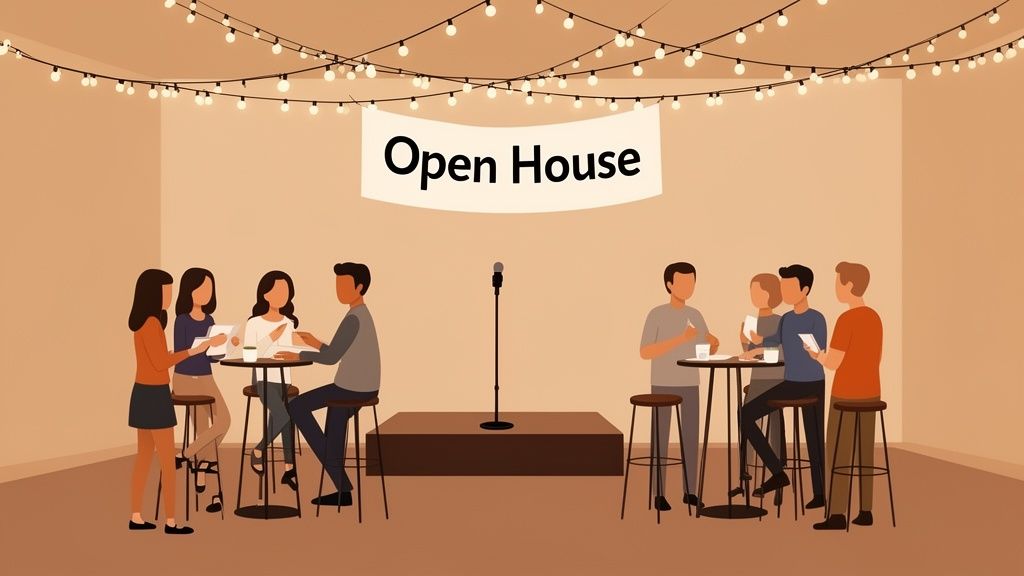
Instead of just telling potential customers what your business offers, experiential marketing lets them feel it firsthand. This strategy is about creating tangible, memorable experiences that build genuine connections. For a multifaceted venue like Freeform House, this means transforming the space into a living demonstration of its value, hosting events that allow people to experience the ambiance, versatility, and community spirit directly. It’s a powerful way to convert prospects into advocates by creating an emotional bond with your brand.
This approach moves beyond passive advertising, turning your location into a destination. By hosting workshops, networking mixers, or open houses, you’re not just showcasing a space; you’re building a community hub. This is one of the most effective local business marketing strategies for generating authentic word-of-mouth buzz and demonstrating your value proposition in a way no advertisement can.
Actionable Implementation Steps
Events give people a reason to walk through your door and a story to tell afterward. Consistency and partnership are crucial for making this a successful, ongoing marketing channel.
Establish a Regular Cadence: Host events on a consistent schedule, such as a "First Friday" networking mixer each month. This builds anticipation and makes it a regular part of the local community calendar.
Partner with Local Experts: Collaborate with local professionals to lead workshops on relevant topics like social media or small business accounting. This provides value to attendees and cross-promotes both businesses.
Encourage Social Sharing: Create a branded event hashtag (e.g., #MeetAtFreeform) and encourage attendees to share their experiences on social media. Feature their posts to amplify your reach.
Capture Leads for Follow-Up: Use a simple registration process to collect contact information. Follow up with attendees via email to thank them and offer a special incentive for booking a tour or becoming a member.
Document Everything: Invest in professional photography and videography for your events. This high-quality content can be used across your website, social media, and Google Business Profile to showcase your vibrant community.
5. Email Marketing and Member Engagement Sequences
While many local business marketing strategies focus on attracting new customers, retaining and nurturing existing relationships is equally, if not more, profitable. Email marketing is a direct and personal channel to achieve this, allowing you to build a loyal community around your brand. It moves beyond one-off promotions, creating a consistent line of communication that delivers value, builds trust, and keeps your business top-of-mind.
For a relationship-driven venue like Freeform House, email is the primary tool for transforming a one-time visitor into a dedicated member and advocate. Through segmented campaigns, you can deliver highly relevant content, from onboarding sequences that introduce new members to its unique spaces, to exclusive offers that encourage deeper engagement with the community. This targeted approach ensures every message resonates, fostering a sense of belonging and maximizing member lifetime value.
Actionable Implementation Steps
A well-executed email strategy delivers one of the highest ROIs in marketing. It’s a direct link to your most engaged audience, providing a platform to share news, promote events, and gather feedback.
Segment Your Audience: Don't send the same message to everyone. Create distinct lists for prospective members, current members, event-only clients, and past members. This allows you to tailor your content for maximum impact.
Develop a Welcome Sequence: Automate a series of 3-5 emails for new subscribers or members. Introduce your brand story, highlight key amenities, explain how to book spaces, and invite them to an upcoming community event.
Create Valuable Newsletter Content: Send a monthly or bi-weekly newsletter that isn't just a sales pitch. Feature member spotlights, share news from the Jenks community, and offer tips relevant to your audience, such as productivity hacks or event planning guides.
Use Personalization: Go beyond just using their first name. Personalize emails based on membership tier, interests, or past event attendance to show you understand their specific needs and relationship with your business.
Include a Clear Call-to-Action (CTA): Every email should have a purpose. Whether it’s "Book a Tour," "RSVP for Our Workshop," or "Read the Latest Blog Post," make the next step obvious and easy for your reader to take.
6. Social Media Marketing and Community Building
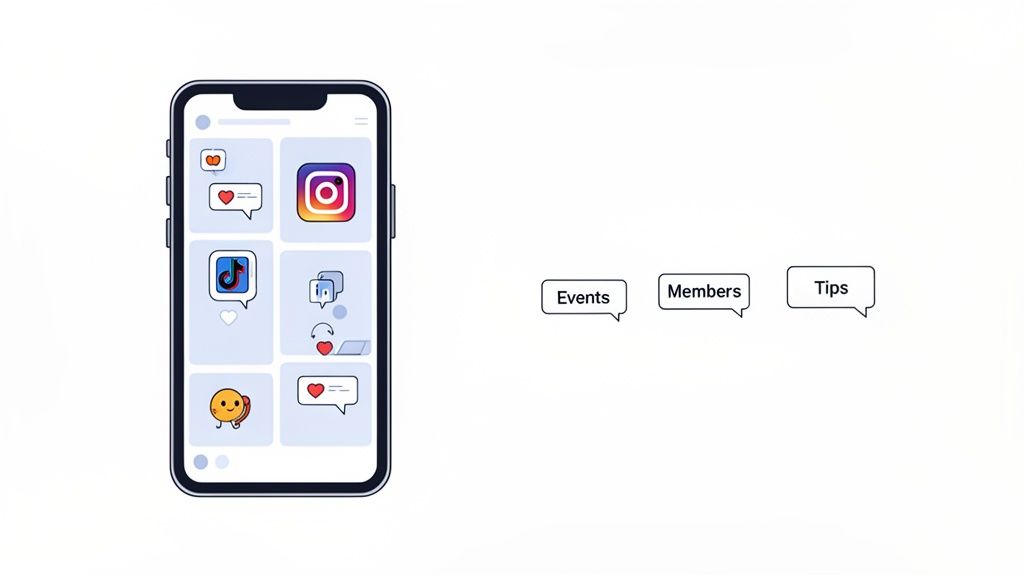
Social media is no longer just a platform for connection; it's a powerful engine for local community building and customer engagement. This strategy involves using platforms like Instagram, Facebook, and LinkedIn to tell your brand’s story, showcase your offerings, and foster a loyal following. For a membership-based venue like Freeform House, social media transforms a physical space into a vibrant digital community, connecting members, promoting events, and attracting new patrons by showcasing the unique culture and high-end atmosphere.
Actionable Implementation Steps
Implementing a localized social media plan is one of the most effective local business marketing strategies for building brand affinity and driving foot traffic. Consistency and authentic engagement are your keys to success.
Choose Platforms Wisely: Focus on where your audience spends their time. Use Instagram to visually showcase Freeform House’s stunning architecture and event setups. Leverage LinkedIn for thought leadership and to connect with local executives, while Facebook is ideal for event promotion and building a community group for members.
Develop Content Pillars: Create a content strategy based on key themes. Your pillars could be Member Spotlights, showcasing the professionals in your space; Event Promotions, highlighting upcoming workshops; Partnership Features, celebrating local collaborations; and Behind-the-Scenes content, offering an authentic glimpse into daily life at the venue.
Engage Proactively: Don't just post and walk away. Respond to comments and messages quickly, ideally within a few hours, to encourage conversation. Ask questions in your captions and run polls in your Stories to boost interaction.
Utilize Platform-Specific Features: Post professional video tours and member testimonials as Instagram Reels. Share daily member moments and event setups on Instagram Stories. Use Facebook Events to manage RSVPs for workshops and networking nights.
Amplify with Paid Ads: Allocate a modest budget ($200-$500/month) to boost your top-performing organic posts. Use location-based targeting to ensure your content reaches professionals and potential clients specifically within Jenks and the greater Tulsa area.
7. Referral Programs and Word-of-Mouth Marketing
Leveraging your existing customer base is one of the most powerful and cost-effective local business marketing strategies available. A formal referral program incentivizes your most satisfied customers to become active brand advocates. By offering tangible rewards for spreading the word, you can systematize and scale the organic trust of word-of-mouth recommendations, which remains one of the most credible forms of marketing.
This approach turns happy clients into a motivated, commission-free sales team. For a membership-based venue like Freeform House, this means encouraging members to invite colleagues and friends who would also benefit from the space. The built-in trust from a peer's recommendation significantly shortens the sales cycle and attracts high-quality leads who are already a good fit for your community culture. A structured program makes it easy for them to share and rewarding for them to do so.
Actionable Implementation Steps
A successful referral program feels less like a transaction and more like a thank-you for being a valued part of the community. Simplicity and genuine appreciation are the keys to making it work.
Offer Dual-Sided Incentives: Reward both the referrer and the new customer. For example, the referring member gets a free month of membership, and the new member they referred gets 50% off their first month.
Make Referring Effortless: Provide members with a unique, one-click referral link or a simple email template they can forward. The easier it is to share, the more likely they are to do it.
Track and Acknowledge Every Referral: Use unique codes or a simple CRM to track where new business comes from. Promptly thank the referrer personally, even before the reward is issued, to reinforce their positive behavior.
Gamify the Process: Create a "Top Referrer" leaderboard, perhaps posted in a common area at Freeform House, and offer a grand prize each quarter, like an exclusive event hosting credit.
Ask at the Right Time: The best time to ask for a referral is right after a positive experience, such as a successful event or positive feedback. This directly supports local businesses by building a self-sustaining growth engine. You can learn more about how community advocacy helps businesses thrive on freeformhouse.com.
8. Local PR and Media Outreach
Securing coverage in local media outlets like newspapers, radio stations, and online publications is one of the most powerful local business marketing strategies for building credibility. Local Public Relations (PR) focuses on telling your brand’s story in a way that journalists and their audiences find compelling. Unlike advertising, this earned media coverage acts as a third-party endorsement, building a level of trust and authority that paid placements cannot replicate.
The goal is to generate newsworthy angles that align with community interests. For a venue like Freeform House, its unique position as a premium hub in the heart of Jenks, Oklahoma's 10 District downtown, inherently creates media interest. Stories about its role in local revitalization, partnerships with other businesses, or member success stories provide tangible proof of its community impact, attracting positive attention and establishing it as a local leader.
Actionable Implementation Steps
A strategic local PR effort can transform your business from just another storefront into a recognized community cornerstone. Consistency and relationship-building are the keys to success.
Build a Media List: Identify and create a contact list of 5-10 local business journalists, editors, and podcast hosts who cover your industry or community. Follow their work to understand their interests.
Create Newsworthy Angles: Develop compelling stories beyond just your products or services. Focus on community impact, trend commentary, significant partnerships, or human-interest stories. A feature on how a local entrepreneur used your space to launch their business is far more interesting than a simple service announcement.
Draft and Distribute Press Releases: For major announcements like a grand opening, a new partnership, or a significant event, send a well-written press release to your media list 1-2 weeks in advance.
Offer Expert Commentary: Position yourself or your team as local experts. Offer to provide commentary on trends relevant to your industry, such as the future of work or downtown economic development.
Submit for Local Awards: Actively apply for local business awards and recognition programs. Winning or even being nominated provides an excellent reason for media outlets to feature your business.
9. Targeted Paid Advertising (Google Ads, LinkedIn, Facebook)
While organic strategies build long-term momentum, targeted paid advertising provides immediate visibility and accelerates lead generation. This approach allows you to place your business directly in front of specific, high-intent audiences across platforms like Google, LinkedIn, and Facebook. By investing strategically, you can capture prospects actively searching for your services, reach specific professional demographics, and build brand awareness with visually compelling content, complementing your other local business marketing strategies.
Paid advertising enables a multifaceted venue like Freeform House to connect with distinct audiences simultaneously. A Google Ad can capture an entrepreneur searching for "premium coworking Tulsa," while a sophisticated LinkedIn campaign targets executives looking for offsite meeting spaces. Meanwhile, an elegant Facebook or Instagram carousel ad can showcase the venue's unique spaces to individuals planning intimate events, delivering the right message to the right person at the perfect time.
Actionable Implementation Steps
A well-managed paid advertising budget is one of the fastest ways to drive qualified traffic and generate measurable results. Success requires precision targeting, compelling creative, and continuous optimization.
Set a Test Budget and Goals: Start with a modest budget ($500-$1,000 per month) to test platforms and audiences. Clearly define your goal, whether it’s tour bookings, membership inquiries, or event leads.
Implement Hyper-Local Targeting: Use geographic targeting to focus your ad spend on relevant areas like Jenks, Tulsa, and specific surrounding zip codes to avoid wasted impressions.
Install Tracking Pixels: Before launching, install the Meta Pixel (Facebook/Instagram) and set up Google Ads conversion tracking on your website. This is crucial for measuring your return on ad spend (ROAS).
Create Platform-Specific Campaigns: Tailor your ads for each platform. Use search ads on Google for high-intent keywords, professional imagery and messaging on LinkedIn for B2B audiences, and stunning visuals in carousel or video ads for Facebook and Instagram.
Develop Dedicated Landing Pages: Send ad traffic to a specific landing page that aligns with the ad's promise, rather than your homepage. This page should have a clear call-to-action, such as "Book a Tour" or "Inquire About Event Hosting."
Test and Optimize Relentlessly: A/B test different headlines, images, and audience segments. Monitor performance weekly and reallocate your budget to the campaigns and platforms that deliver the best results.
10. Website Optimization and User Experience
Your website is the central hub for all your local business marketing strategies, the digital equivalent of your front door. Website optimization and a seamless user experience (UX) ensure that when potential customers arrive, they are impressed, informed, and guided smoothly toward a conversion. For a high-end venue like Freeform House, the website must immediately communicate its premium value, from its historic character to its modern, multifaceted amenities.
A poorly designed website creates friction, causing visitors to leave before they understand what you offer. In contrast, an optimized site acts as your best salesperson, working 24/7 to showcase your space, answer questions, and capture leads. It transforms traffic generated from other marketing efforts, like social media or local SEO, into tangible business opportunities, such as tour bookings, membership inquiries, and event reservations.
Actionable Implementation Steps
Optimizing your digital storefront is crucial for converting interest into action. A user-centric approach builds trust and simplifies the customer's decision-making process.
Clarify Your Value Proposition: Your homepage must instantly answer three questions: What do you offer? Who is it for? Why should they choose you? For Freeform House, a headline like "Jenks' Premier Membership Club, Coworking Space, and Event Venue" is crystal clear.
Showcase with High-Quality Visuals: Invest in professional photography and video. Create detailed galleries for each unique space. A virtual tour can be a powerful tool to let visitors experience the venue's distinctive architecture and modern interior design.
Prioritize Mobile-First Design: With over 60% of web traffic coming from mobile devices, your site must be flawless on a smartphone. Test every button, form, and page on mobile to ensure a smooth experience.
Implement Clear Calls-to-Action (CTAs): Use prominent, action-oriented buttons like "Schedule a Tour" or "Inquire About Membership." Place them in highly visible locations, such as the header and above the fold on the homepage, to guide visitors.
Build Trust and Credibility: Feature member testimonials with photos, logos of companies that use your space, and any local awards or media mentions. This social proof is essential for validating your premium positioning.
Optimize for Speed: A slow-loading website is a major deterrent. Use tools like Google PageSpeed Insights to test your site's performance and aim for a load time of under 3 seconds.
Local Business Marketing: 10-Point Comparison
Strategy | 🔄 Implementation Complexity | ⚡ Resource Requirements | ⭐📊 Expected Outcomes | 💡 Ideal Use Cases | ⭐ Key Advantages |
|---|---|---|---|---|---|
Local SEO and Google Business Profile Optimization | Moderate — initial setup + ongoing maintenance (3–6 months to show) | Low–Medium — time for photos, reviews, basic SEO tools | ⭐⭐⭐ — improved local visibility & steady organic leads | Capture “near me” searches, map-based event bookings | Cost-effective; builds trust via reviews; mobile visibility |
Strategic Partnerships and Co‑Marketing | Medium — partner selection, agreements, coordination | Medium — staff time, co‑marketing budget sharing | ⭐⭐⭐ — extended reach, referral leads, shared cost savings | Bundled offers, co‑hosted events, cross‑promotion | Access to partner audiences; differentiated offers; lower spend |
Content Marketing and Thought Leadership | High — editorial planning, consistent production | Medium–High — writers, video/podcast production resources | ⭐⭐ — long‑term authority; SEO gains over 6–12 months | Building brand authority, SEO, member storytelling | Evergreen assets; shareable content; trust building |
Community Events and Experiential Marketing | High — event logistics, operations, quality control | High — staffing, production, partner coordination | ⭐⭐⭐ — strong word‑of‑mouth, trials, community loyalty | Showcasing space, member acquisition, local engagement | Memorable experiences; strong retention; UGC generation |
Email Marketing and Member Engagement Sequences | Low–Medium — setup automation & segmentation | Low — email platform + content time | ⭐⭐⭐ — high ROI; measurable conversions & retention | Onboarding, re‑engagement, promotions for off‑peak | Cost‑effective; personalized at scale; highly measurable |
Social Media Marketing and Community Building | Medium — platform strategies, content cadence | Medium — content creation + paid amplification | ⭐⭐ — increased awareness & engagement; variable conversions | Visual showcase, event promotion, younger demographics | Broad reach; authentic storytelling; real‑time engagement |
Referral Programs and Word‑of‑Mouth Marketing | Low–Medium — program design & tracking | Low — reward costs, tracking system | ⭐⭐⭐ — high‑quality leads; low CAC; stronger LTV | Member-driven growth, partner referrals, advocacy campaigns | Lowest acquisition cost; social proof; higher retention |
Local PR and Media Outreach | Medium — relationship building & story pitching | Low–Medium — PR time or agency fees | ⭐⭐ — earned credibility & wider awareness; timing uncertain | Major announcements, community impact, human‑interest stories | Third‑party validation; high perceived value; shareable coverage |
Targeted Paid Advertising (Google, LinkedIn, Facebook) | Medium — campaign setup, tracking, ongoing optimization | High — continuous ad spend (start $500–1,000/mo for testing) | ⭐⭐⭐ — immediate visibility & scalable lead generation | Rapid awareness, event promotion, geo‑targeted offers | Fast results; precise targeting; measurable ROI |
Website Optimization and User Experience | Medium–High — design, dev, CRO testing | Medium — professional design/dev + maintenance | ⭐⭐⭐ — higher conversion rates; central hub for channels | Converting traffic, event bookings, membership signups | Removes friction; builds credibility; supports all channels |
Putting It All Together: Your Integrated Local Marketing Engine
You now have a comprehensive playbook of powerful, actionable local business marketing strategies at your fingertips. We've navigated the digital terrain of Local SEO and targeted paid advertising, explored the human-centric power of community events and strategic partnerships, and detailed the foundational importance of a seamless website experience. Each strategy, from content marketing to referral programs, represents a vital component in the machine of local market dominance.
But the real magic isn't in executing just one of these tactics flawlessly. True, sustainable growth emerges from the integration of several strategies into a cohesive, self-reinforcing engine. A thriving local business doesn't just find customers; it builds a loyal, engaged community that becomes its most powerful marketing asset. This is the core principle that drives community-centric hubs like Freeform House-the understanding that connection is the ultimate currency.
Your Path from Strategy to Staple
The journey from a new local business to a beloved community staple is built on a foundation of consistent, integrated effort. Think of it as creating a flywheel. Your initial efforts to optimize your Google Business Profile might feel slow, but they attract your first wave of local searchers. These customers have a fantastic experience at a community event you host, prompting them to leave a glowing review, which in turn boosts your SEO further.
They then join your email list, where they learn about your new referral program. They tell a friend, who then discovers your business through a trusted recommendation-the most potent form of marketing. This cycle, where your digital presence fuels real-world engagement and vice-versa, is how you build unstoppable momentum. It’s how a business becomes woven into the very fabric of its community.
Actionable Next Steps: Building Your Integrated Engine
Feeling overwhelmed by the sheer number of options is natural. The key is to start small, be strategic, and build from there. Don't try to implement all ten strategies at once. Instead, follow this focused approach:
Audit and Prioritize: Review the ten strategies and identify the two or three that offer the biggest potential impact for your specific business right now. A new B2B consultant might prioritize LinkedIn ads and local PR, while a retail boutique might focus on Instagram community building and strategic partnerships with neighboring shops.
Commit and Implement: Dedicate your resources to executing these chosen strategies with excellence. Follow the implementation steps outlined in this guide and set up the KPIs to track your progress meticulously. Give these initial efforts enough time to generate meaningful data before making any major pivots.
Measure and Refine: Consistently analyze your results. Is your local SEO driving more foot traffic? Are your community events leading to measurable sales spikes or email sign-ups? Use this data not to judge success or failure, but to learn and refine your approach for better results.
Layer and Integrate: Once your initial strategies are running smoothly and delivering a positive return, it’s time to layer in the next one. Crucially, find ways to connect the new tactic to your existing efforts. For example, use your thriving social media community to promote your next co-marketed event, creating a powerful synergy.
Mastering these local business marketing strategies is about more than just increasing revenue. It’s about building a resilient, respected brand that becomes a pillar of your local economy. It’s about creating meaningful connections, fostering a loyal following, and securing your place as an indispensable part of your community's identity. The path requires dedication and strategic thinking, but the reward is a business that doesn't just survive-it thrives.
Ready to build powerful local connections and take your marketing to the next level? Explore how a membership at Freeform House can put you at the center of Jenks' creative and professional community, providing the perfect venue for your next event, workshop, or strategic partnership. Discover your new local hub at Freeform House and start building the relationships that grow your business.
Comments