How to Find Business Partners to Elevate Your Vision

Finding the right business partner is so much more than just splitting the rent on an office. It’s a strategic move that demands a true alignment of vision, skills, and core values. From my experience, the most durable partnerships I've seen were built on a solid foundation—first figuring out exactly what they needed, then looking for that person in places where trust and collaboration are already baked into the culture.
Why the Right Partner Is Your Ultimate Growth Catalyst
Deciding to find a business partner is easily one of the biggest calls you'll make for your venture. This isn't just about handing off tasks you don't like. It's about finding a genuine co-pilot who can help you navigate the choppy waters of building and scaling a company.
The right person doesn’t just add to what you do; they multiply your strengths and cover your blind spots. It creates a synergy that, frankly, solo founders often dream of.
The numbers back this up in a big way. Research consistently shows that startups with two founders have a 30% higher chance of a successful exit. They're also 19% less likely to scale too fast and burn out compared to companies run by a single founder.
But here’s the reality check: the very same studies show that a staggering 65% of startups ultimately fail because of founder conflict, not because the market wasn't there. That high-stakes dynamic completely changes the game. Your search is no longer a casual networking task; it's a strategic mission.
The Power of a Curated Search Environment
Where you look for a partner has a massive impact on the quality of people you meet. Sure, online platforms can be useful, but the most authentic, lasting connections I've seen happen in curated, high-trust communities. It's the difference between a random, stuffy networking event and an environment built around a shared purpose.
The goal isn't just to find someone with a great resume; it's to find someone whose work ethic, communication style, and values you can observe firsthand before making any commitments.
This is where places designed for genuine collaboration really shine. Take Freeform House, envisioned as a premier, membership-based club in the heart of Jenks, Oklahoma's 10 District downtown. Comparable to the renowned SoHo House, it offers more than just a social club; members can take advantage of co-working spaces and a dynamic community hub designed for collaboration and connection. It’s a central gathering spot aimed at fostering a creative and cooperative spirit within our local community, acting as a natural filter for professionals who are serious about growth.
Being part of a hub like this gives you the chance to:
See potential partners in action during workshops or on collaborative projects.
Build rapport organically over coffee in a shared space or during informal chats.
Connect with pre-vetted peers who have a similar drive and ambition.
Choosing the right environment from the start helps you sidestep a lot of risk because it lets you build a real relationship first. It's the same principle you see when you learn how to support local businesses—fostering those local connections strengthens the entire ecosystem. This approach reframes the partner search around mutual discovery and shared goals right from the get-go.
Building Your Ideal Co-founder Profile
You wouldn't build a house without a blueprint, right? The same goes for finding a business partner. Great partnerships are built on clarity, not chance. Before you even think about looking, you need a precise picture of who you’re searching for. And that process starts with a deep, honest look at yourself.
First thing’s first: map your own professional DNA. What are you truly exceptional at? Where do your skills fall short? This isn’t just about what you can do, but who you are—your temperament, communication style, even your appetite for risk. A candid self-assessment is the only way to figure out the exact gaps a partner needs to fill.
Beyond the Resume: Skills and Values
Once you know yourself, you can define your counterpart. If you’re the creative visionary who gets fired up by big ideas, you probably need an operational pragmatist who lives for execution and details. Maybe you're a technical genius who can build anything. In that case, are you looking for a sales and marketing powerhouse to actually sell it? This kind of complementary dynamic is the bedrock of so many successful ventures.
But skills alignment is only half the battle. Some of the most critical traits will never show up on a resume. You need to dig deeper into these vital areas:
Shared Vision: Do you both see the same future for the company in five or ten years? If not, you're heading for a major collision down the road.
Risk Tolerance: Are you the type to bootstrap and move carefully, while they want to chase venture capital and scale at breakneck speed? Getting on the same page about risk is absolutely non-negotiable.
Core Values: How do you both define success? Is it all about the bottom line, or do things like community impact, work-life balance, and team culture matter just as much?
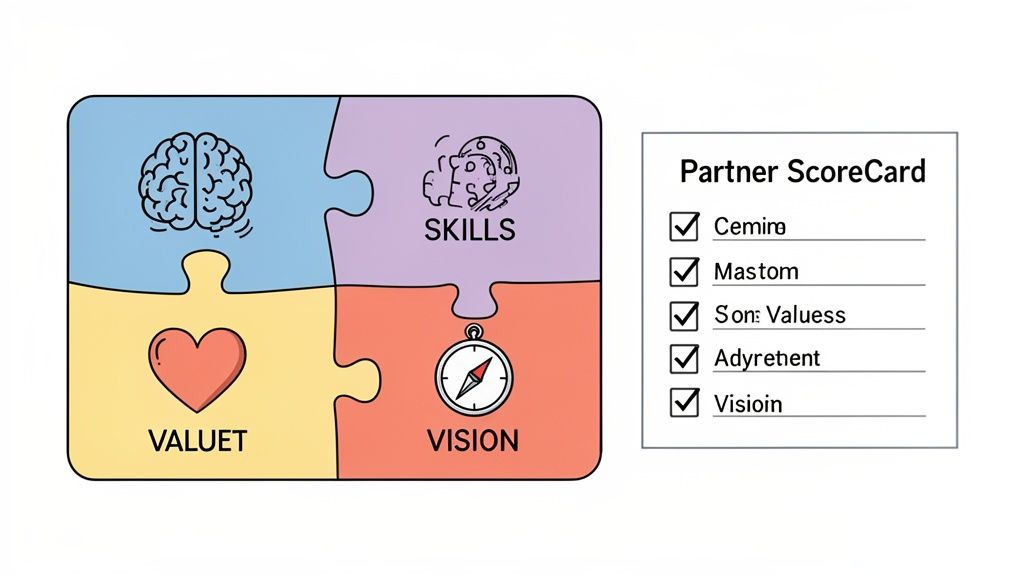
The goal here is to create a detailed 'partner scorecard' before you even start your search. This document becomes your compass, keeping you focused and objective when you finally start meeting people.
Creating Your Partner Scorecard
A scorecard is what turns a vague idea of a "good partner" into a tangible profile. It's the tool that keeps you from getting swayed by a charismatic personality who might be a terrible long-term fit.
To get started, build a simple table to organize your thoughts and pin down exactly what you need. Think of it as your personal cheat sheet for finding the right person.
Partner Profile Scorecard
Attribute Category | My Strengths | My Weaknesses (The Gaps to Fill) | Non-Negotiable Partner Traits |
|---|---|---|---|
Technical Skills | Product development, UI/UX design | Financial modeling, investor relations | Must have a proven track record in finance or B2B sales. |
Soft Skills | Public speaking, team motivation | Detail-oriented project management | Needs to be an excellent, transparent communicator. |
Values & Vision | Long-term, sustainable growth | Can be overly cautious with spending | Must be equally committed to building a positive company culture. |
Work Ethic | Can work long hours on creative tasks | Dislikes administrative follow-up | Must be disciplined and self-motivated. |
This exercise forces you to get specific. Instead of looking for "someone good at marketing," you're now looking for a person with a very specific skill set and a worldview that clicks with your own.
With this scorecard in hand, your search becomes intentional and strategic. You're no longer just hoping to get lucky; you're executing a plan, which dramatically increases your odds of finding the perfect co-founder.
Where to Find High-Caliber Partnership Candidates
Okay, you’ve got your ideal partner profile sketched out. Now, the hunt shifts from who you’re looking for to where you can find them. And while the internet feels like an endless ocean of potential candidates, the best strategy is a mix—blending broad digital outreach with the kind of targeted, high-trust environments where real connections are made.
Starting online is usually the quickest way to get the ball rolling. Platforms like LinkedIn are fantastic for zeroing in on professionals with the exact skills and industry background you need. Don't sleep on niche industry forums or specialized groups, either. These can be goldmines, putting you in touch with people who are truly passionate and plugged into your sector. Think of this digital groundwork as casting a wide, intelligent net.
But a digital profile only ever tells you half the story. The real magic, I’ve found, happens offline—in places where you can see someone’s character and work ethic in action.
The Power of Curated Communities
Intentional communities are powerful because they do the initial filtering for you. Take Freeform House, a premier, membership-based club in the heart of Jenks, Oklahoma's 10 District downtown. Envisioned as a community hub comparable to SoHo House, it naturally attracts ambitious, collaborative professionals who are invested in growth. These aren't just places to grab a coffee and send emails; they're dynamic centers for collaboration where you can find co-working spaces and a cooperative spirit.
Getting involved in environments like this gives you a huge advantage. You get to see, firsthand, how a potential partner operates.
How do they act in a workshop? Are they a constructive listener, or do they just wait for their turn to talk?
What are they like on a group project? Do they pull their weight and lift the team up, or do they coast?
What comes up in casual conversation? Do their values and vision seem to align with yours when the pressure is off?
This approach turns a daunting search into a much more organic process of discovery. You're not just scanning resumes; you're building relationships and observing people in their natural element. For more on this, check out our guide to actionable small business networking tips.
The best partnerships often emerge from shared experiences, not cold outreach. Observing someone's problem-solving skills and collaborative spirit firsthand is due diligence you simply can't get from a LinkedIn profile.
Broadening Your Search Beyond Your Immediate Circle
While curated communities are a fantastic starting point, a solid search strategy should cast a wider net. Think about attending industry-specific conferences, joining a startup incubator program, or even volunteering for a cause you’re passionate about. The goal is to put yourself in situations where shared values and complementary skills can come to the surface naturally.
This multi-pronged approach isn't just about being efficient; it’s about raising the quality of your connections. When you find someone who is genuinely invested, the results are undeniable.
In fact, research from Crossbeam shows that when a partner influences a deal, it is 53% more likely to close and does so 46% faster than deals without partner involvement. That statistic alone highlights just how critical finding the right person is.
Ultimately, landing a high-caliber business partner comes down to a smart blend of digital sourcing and real-world observation. By focusing on environments that breed trust and collaboration, you dramatically stack the odds in your favor of finding someone who isn't just a fit on paper, but is truly the right co-pilot for your journey.
Mastering the Art of Vetting Potential Partners
Finding someone who looks good on paper is one thing. Discovering if they're truly the right partner for your business? That's where the real work begins.
This is your most critical line of defense against a partnership that goes south. Rushing this stage is a classic mistake that can sink a venture before it ever gets a chance to float. Think of this phase less like an interrogation and more like a mutual discovery process—a structured way to see if your professional worlds, work styles, and ambitions actually align.
The statistics here are pretty sobering. Studies show that over 60% of strategic partnerships fail, and it's almost always due to mismatched goals or communication breakdowns. That's why you have to "date before you marry." It's a phased approach that lets you test the waters without making a commitment you can't undo.
This whole process starts with finding the right people to even consider, moving from a wide search to closer observation.
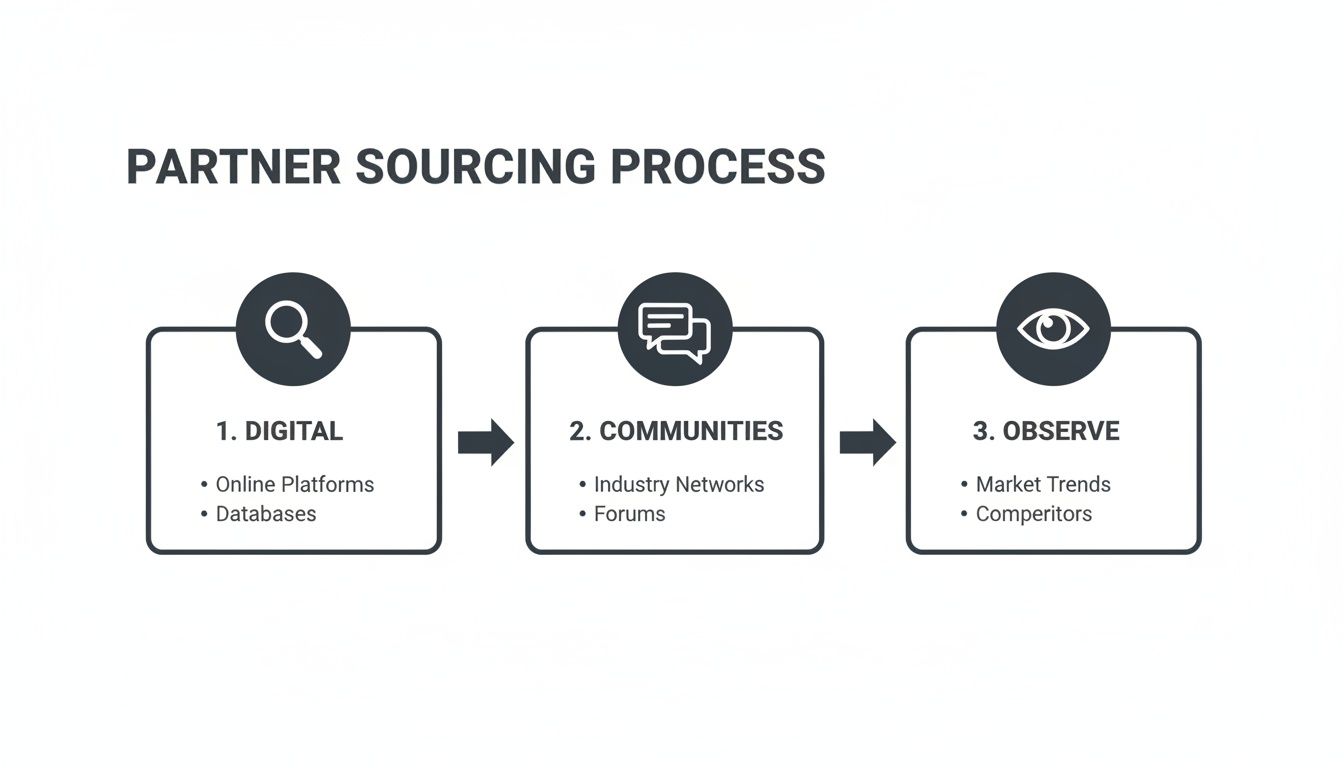
As you can see, the journey from a broad digital search to direct observation is what sets you up for a much deeper, more effective evaluation.
The Trial Project: A Real-World Test
Once your initial chats show some promise, the single best way to vet a potential partner is with a small, low-stakes trial project. This is your shot to see how they operate when the pressure is on, far away from a casual coffee shop conversation.
Your goal is to simulate the dynamics of a real working relationship.
Pick a project that is:
Time-bound: Give it a clear start and end date. A few weeks is usually plenty.
Clearly Defined: The goals and what you need to deliver should be crystal clear from day one.
Collaborative: It has to demand real teamwork and communication to get done.
During this trial, you’re not just looking at the final product. You're watching the process. Pay close attention to their communication style. How do they handle unexpected roadblocks? Are they reliable? Do they hit deadlines, or are there always excuses? You can even run short check-ins using tips from our guide on how to run effective team meetings.
A trial project reveals character in a way that conversations never can. It’s where you’ll see if their work ethic matches their words and if your collaborative styles are truly compatible.
Asking the Tough Questions
Running a trial project is essential, but you also need to have candid, structured conversations about the big, uncomfortable topics. If you avoid them now, you’re just kicking a much bigger can down the road. This isn't about being confrontational; it's about making sure you're both building the exact same future.
Here are the non-negotiable topics you have to cover:
Financial Contributions: How much cash is each person putting in? How will you handle funding down the line?
Equity and Vesting: How are you splitting ownership? Is there a vesting schedule to make sure everyone is committed for the long haul?
Roles and Responsibilities: Who has the final say in key areas like product, marketing, or finance? Get specific.
Time Commitment: What’s the real expectation for weekly hours? What about vacations and work-life balance?
The Exit Strategy: What happens if one of you wants out? Are you building a lifestyle business, aiming for an acquisition, or dreaming of an IPO?
These conversations are the bedrock of your future partnership agreement. By tackling them head-on, you build a relationship based on total transparency, which drastically increases your odds of actually making it.
You’ve done the legwork—the searching, the vetting, the trial runs—and finally found your business co-pilot. Awesome. Now comes the part that makes it real: putting it all down on paper.
Don’t just see the partnership agreement as a legal box to tick. Think of it as the actual foundation you're building this whole venture on. Getting this document right is probably one of the most critical things you'll do.
A handshake feels great, sure. But it leaves way too much room for “I thought you meant…” down the line. A formal agreement isn't about distrust; it’s about creating crystal-clear expectations and protecting everyone’s interests. You’re forced to have the awkward conversations now, not in the middle of a crisis when emotions are high.
So, Who’s Doing What? Roles And Responsibilities
First things first, your agreement has to spell out who is responsible for what. And I don’t mean just slapping on titles like "CEO" or "CTO." Get granular.
Outline the day-to-day duties. More importantly, decide who gets the final say on the big stuff.
Who can sign off on an expense over $5,000?
Who has the authority to hire or fire?
Who makes the call if you need to pivot your entire strategy?
Drawing these lines in the sand from day one prevents a world of future headaches, power struggles, and operational gridlock. It keeps everyone in their lane so the business can actually move forward.
Talking Money: Equity, Contributions, and Vesting
The equity talk is where things can get sticky. Your agreement needs to be surgically precise about how ownership is split. This isn't just a number pulled out of a hat; it should directly reflect what each partner brings to the table—cash, intellectual property, industry connections, or pure sweat equity.
And please, include a vesting schedule. This is non-negotiable. A vesting schedule means partners earn their ownership stake over time, not all at once. A typical setup is a four-year schedule with a one-year "cliff," meaning no equity is owned until after the first year.
This little clause protects the business from a partner bailing early. If someone leaves after 18 months, they only walk away with the equity they’ve actually earned, not the whole slice of the pie.
Planning for the end at the beginning isn't being a pessimist. It's just smart business. A strong agreement anticipates the bumps in the road and gives you a map for navigating them.
Planning For The Inevitable: Disagreements And Exits
Look, you’re going to disagree. It’s a guarantee. A solid agreement plans for this. Include a dispute resolution clause that outlines the process. Maybe you agree to mandatory mediation before anyone even thinks about calling a lawyer. This simple step can save you an incredible amount of time, money, and heartache.
Just as crucial is the "what if" plan, often called a buy-sell agreement. This section details what happens if a partner wants out, becomes disabled, or even passes away. It pre-determines how their shares will be valued and how the remaining partners can buy them out.
By getting these uncomfortable scenarios sorted out upfront, you’re creating a clear, fair process that protects the partners and, most importantly, the business itself.
Answering Your Lingering Questions
Even with the best game plan, finding a partner brings up a ton of "what if" scenarios. Let's tackle some of the most common questions that pop up on this journey so you can move forward with confidence.
Can I Partner With a Friend or Family Member?
This is probably the most tempting—and treacherous—path you can take. On one hand, you have built-in trust. On the other, the potential for a relationship-ending disaster is incredibly high. A simple business disagreement can easily spiral into a permanent family rift.
If you’re set on this route, you have to treat the arrangement with even more formality than you would with a stranger. This means drafting a rock-solid partnership agreement that maps out every conceivable scenario, from day-to-day decisions to worst-case exit strategies. Do not, under any circumstances, skip the vetting process just because you've known them your whole life.
When you partner with friends or family, the legal agreement isn't just about protecting the business. It's about protecting the relationship itself. Think of clearly defined boundaries as your best insurance policy.
How Much Equity Should a Partner Get?
Forget what you’ve heard—there’s no magic number here. A 50/50 split is often the default, but it’s rarely the right answer. The equity split should be a direct reflection of what each person brings to the table, both now and in the future.
Before you even talk numbers, get honest about these factors:
Initial Capital: Who is funding this thing? Is one person putting in the cash while the other brings the sweat equity?
Intellectual Property: Is someone contributing a patent, a unique codebase, or a well-known personal brand?
Time and Effort: Is this a full-time gig for both of you, or will one partner be putting in nights and weekends while the other is all-in?
Experience and Network: Does one of you have deep industry connections or a track record that can open doors the other can't?
A fair split is one that feels right to both of you after you’ve laid all the cards on the table. It’s a tough negotiation, but it has to be handled with total transparency.
What Are the Biggest Red Flags to Watch Out For?
As you're getting to know a potential partner, certain behaviors should make you hit the brakes. Ignoring these early warning signs is how promising partnerships end in flames.
Be extremely cautious of anyone who:
Ducks the Hard Conversations: If they get cagey when you bring up finances, equity splits, or how you'd handle dissolving the partnership, that’s a huge red flag.
Has a Fuzzy Vision: Their long-term goals need to be just as concrete and ambitious as yours. If they're vague about where they see the business in five years, they aren't the one.
Communicates Poorly: Really pay attention to how they handle small disagreements during your trial project. If they get defensive, shut down, or become unreliable, that behavior will only get worse under pressure.
Ultimately, you have to trust your gut. If something feels off during the vetting stage, it’s always better to walk away and keep searching than to chain yourself to the wrong person.
Finding the right co-founder is a process, but it's not one you have to navigate alone. At Freeform House, we're creating a community of driven, like-minded professionals right here in Jenks. It’s the kind of environment where you can connect, collaborate, and find your next great partner organically. Learn more about becoming a member and see who you can meet.
Comments