Business Networking Club: What It Is and How to Choose One

A Jenks entrepreneur can spend a morning weighing three very different ways to build a network: a chapter referral group downtown, a private members-only club in the Ten District, or a coworking space that adds occasional social events. All three promise connection. Only one may fit the way that entrepreneur sells, collaborates, and follows up.
That distinction matters because a business networking club isn't valuable merely because people gather there. Its value comes from the mechanics behind the gathering, especially repeated proximity, deliberate introductions, useful programming, and access to professional circles that don't already overlap with your own. For Jenks and Tulsa professionals, the right choice isn't the room with the most impressive amenities. It's the format that turns consistent participation into trust, referrals, and practical business opportunities.
What a Business Networking Club Actually Is
A business networking club is a recurring, structured community for professional relationship-building. Members return regularly, meet people outside their immediate circles, exchange referrals, and participate in programming designed to create useful conversations. That makes it different from a one-off meetup, a casual coworking drop-in, or a generic Chamber mixer where attendance may be high but follow-through is mostly left to chance.
The central mechanism is repeat proximity plus intentional introduction design. Seeing the same people repeatedly gives a relationship time to develop. Curated introductions add purpose by connecting a commercial real estate professional with a business owner considering a new location, or a creative director with a company that needs brand production. Without both elements, networking usually becomes a collection of pleasant conversations and forgotten business cards.
The difference between access and structure
A local BNI chapter represents the structured referral end of the spectrum. Members meet with a defined business purpose and build familiarity through repeated participation. SoHo-style members clubs sit closer to the premium social and professional end, with curated membership, hospitality, and events. Community-forward coworking spaces add a third model, combining desks and meeting rooms with informal lounge interaction and member programming.
Those formats overlap, but they don't produce the same experience. A referral chapter is optimized for accountability and lead exchange. A private club is optimized for relationship depth, access, and a broader professional community. A coworking hybrid is optimized for daily proximity, which can create useful connections when the operator actively mixes members rather than renting desks.
Research on club networks supports this design logic. Stable memberships can form highly connected structures held together by weak links, and those weak links help members reach non-redundant information and professional circles outside their immediate group. The practical lesson is straightforward: a club needs more than a member directory. It needs rooms, routines, and programming that make low-friction encounters normal.
Practical rule: If members only meet when they deliberately register for an event, the club hasn't yet built a networking system. It has built an event calendar.
The trade-off is cost versus time. A more structured club may require dues, scheduled meetings, and deliberate participation. A flexible coworking space may offer easier access but demand more personal effort to create meaningful connections. Choose the environment that saves you the most wasted time, not the one with the lowest price.
Types of Business Networking Clubs and How They Meet
Jenks and Tulsa professionals generally encounter three formats. Each solves a different networking problem, so comparing them by membership price alone produces bad decisions.
Chapter-based referral groups use high structure. A BNI-style group typically centers on recurring meetings, defined professional categories, referrals, and accountability between members. The model suits an insurance agent, attorney, mortgage professional, or service provider who can clearly explain an ideal referral and consistently follow up. Its strength is focus. Its limitation is that a narrow category structure can restrict the range of people you meet.
Premium members-only clubs use curation and hospitality. They may combine work areas, meeting rooms, dining, social gatherings, and professional events under one membership. The business case depends less on one weekly referral exchange and more on access to a trusted environment where executives, founders, creatives, and clients can interact over time.
Coworking-plus-community hybrids add networking to a workspace. Members may use desks, lounges, conference rooms, content studios, and community events. This format works well for remote professionals and small teams that want daily access, but the operator must create intentional mixing. Without programming, a coworking space can remain a collection of isolated individuals working near one another.
The scale of organized referral activity shows why chapter-based networking remains commercially relevant. BNI reported 355,000-plus member-businesses across more than 11,800 chapters in 77 countries in 2025, alongside 17.8 million member referrals and $26.9 billion in member-generated business during the last 12 months. BNI market context and referral data also lists more than 73,000 U.S. members and over 2.1 million referrals. These figures describe BNI's reported activity, not every networking club, but they demonstrate the power of a repeatable referral structure.
Format | Structure | Cost Model | Meeting Cadence | Typical Outcome |
|---|---|---|---|---|
Chapter referral group | Defined categories, referral rules, accountability | Dues and participation requirements | Structured weekly | Warm referrals and category-specific lead flow |
Premium members-only club | Curated roster, hospitality, social and professional programming | Recurring membership dues, sometimes with event fees | Curated monthly, plus informal access | Deeper relationships, client hosting, and cross-industry introductions |
Coworking-plus-community hybrid | Workspace combined with events, lounges, and collaboration areas | Membership tied to workspace and amenities | Flexible daily access, supported by events | Ongoing proximity, collaboration, and peer support |
If you're comparing formats in greater detail, review this guide to professional networking event formats. The best option is the one whose cadence matches your sales cycle and whose member mix gives you access to people you wouldn't otherwise meet.
Member Benefits and Where ROI Comes From
A Jenks entrepreneur choosing between a weekly referral chapter and a Tulsa members-only club should start with the revenue path, not the furniture. The referral chapter may create a predictable introduction schedule. The club may produce fewer immediate leads but stronger access to adjacent industries, client hosting, and repeated conversations. ROI depends on how the format supports the way you sell.
Membership perks matter only when they support business activity. Coffee, attractive interiors, status, and a convenient address improve the experience, but they do not justify dues by themselves. The business case becomes clearer when membership gives you meeting rooms, podcast booths, event space, and a professional place to host clients without booking another venue.
Where value sits between people
The strongest returns usually come from weak-tie density, repeat proximity, and curated programming. A club should place you near people outside your existing circle, including complementary industries, company stages, and professional functions. Those connections create warm introductions that cold outreach rarely matches.
Curated programming makes that access useful. Facilitated introductions, workshops, roundtables, and focused events help members find relevant expertise without searching a large directory and guessing who can help. The programming must give people a reason to return, because a single visit rarely creates enough trust for a referral.
Repeated exposure changes how members assess one another. One conversation can create interest. Several useful interactions demonstrate reliability, judgment, and follow-through. That familiarity makes an introduction safer because the referring member is attaching their reputation to it.
BNI's U.S. materials claim referred-in customers have a 37% higher retention rate than other customers. Treat that figure as an unverified vendor claim about BNI's referral model, not as established evidence or a guarantee for every business networking club.
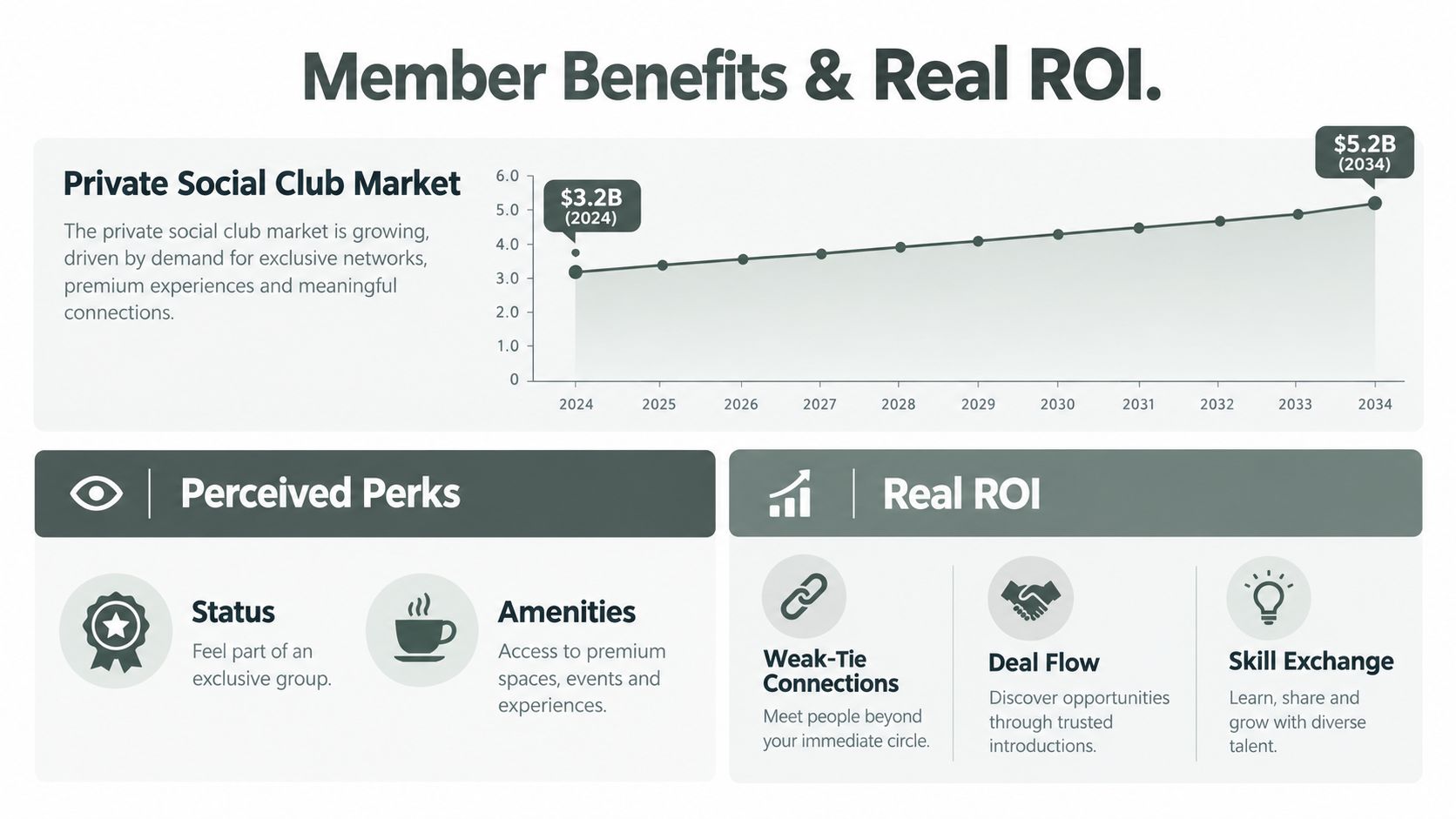
Use a scorecard before renewing:
Qualified introductions: Did the club connect you with people who fit your target market?
Follow-through: Did conversations become meetings, proposals, partnerships, or referrals?
Relationship depth: Do members understand your work well enough to contact or recommend you?
Asset utilization: Are you using the rooms, workspace, production facilities, and hosting access?
Net contribution: Do measurable pipeline and practical utility justify dues, event charges, and your time?
For a clearer explanation of what a professional membership includes, examine both access and expected behavior. The right question is whether your activity inside the club creates value you can recognize in your pipeline and operating day. If you only attend open events, the membership may remain an expense. If you build repeat proximity, make targeted introductions, and use the facilities for revenue-producing work, the return becomes easier to evaluate.
How to Choose the Right Club for Your Goals
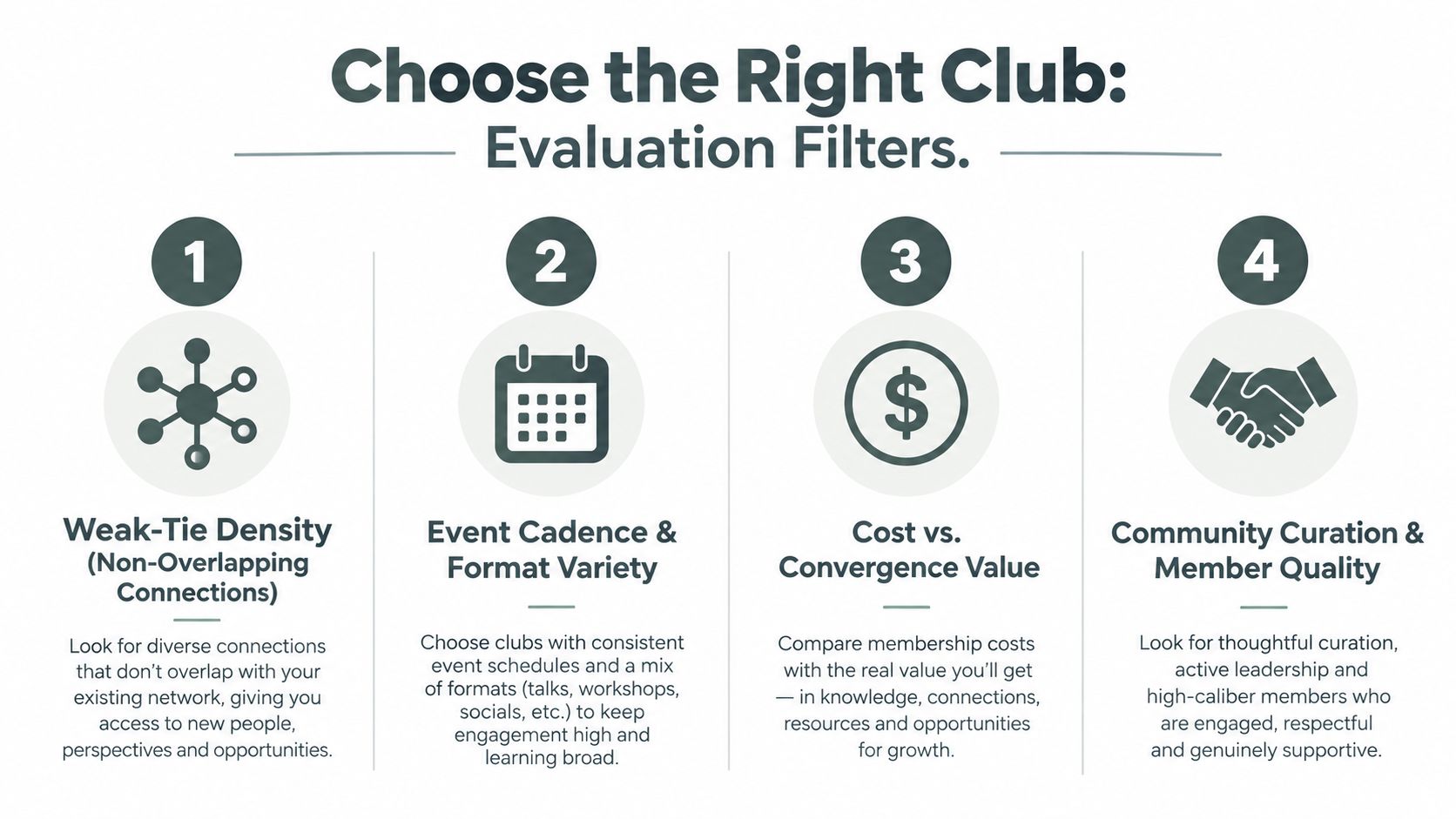
Start with your objective, then inspect the club. A founder seeking referrals needs a different environment from an executive seeking a private meeting venue or a photographer seeking production space. Don't tour a club and let the décor make the decision for you.
First, measure weak-tie density
Ask how many non-overlapping professional circles you'll realistically touch through the club. A room full of people who already resemble your existing contacts may feel comfortable but add little reach. Look for members from complementary functions, industries, and company stages.
Ask the operator: “Which members would I meet here that I wouldn't meet through my current network?” If the answer is vague, the club may have a large roster but low bridging value.
Next, inspect the programming
Open mingling is easy to schedule and difficult to measure. Strong programming gives members a reason to return and a structure for meeting the right people. Look for curated speakers, facilitated introductions, workshops, roundtables, and working groups. Current B2B events coverage points toward more intimate networking, smaller in-person formats, workshops, and structured networking, while only 18% of teams planned more large-hosted events in the cited 2026 report. Forrester's B2B events outlook supports a practical conclusion: small rooms with a clear purpose deserve priority over crowded mixers.
Ask: “What happens after I arrive, and how will someone help me meet the right person?”
Then test geographic fit
Location affects participation. The Ten District comprises exactly 10 blocks of downtown Jenks, stretching west from the Arkansas River to the old Midland Valley railroad tracks, and local descriptions identify it as the heartbeat of Jenks. The Ten District offers a walkable setting that can support meetings, meals, and informal encounters within the same downtown environment.
Ask: “Can I use this club naturally between client meetings, work blocks, and evening events?”
Finally, calculate total participation cost
Add dues, event fees, travel, parking, preparation, and follow-up time. The cheapest membership can become the most expensive if it produces few new connections or requires a commute that makes attendance irregular.
Ask: “What must I attend and follow up on each month for this membership to pay for itself?” Write down the answer, score every club consistently, and choose the one that supports your actual operating rhythm.
How to Maximize Your Membership Once You Join
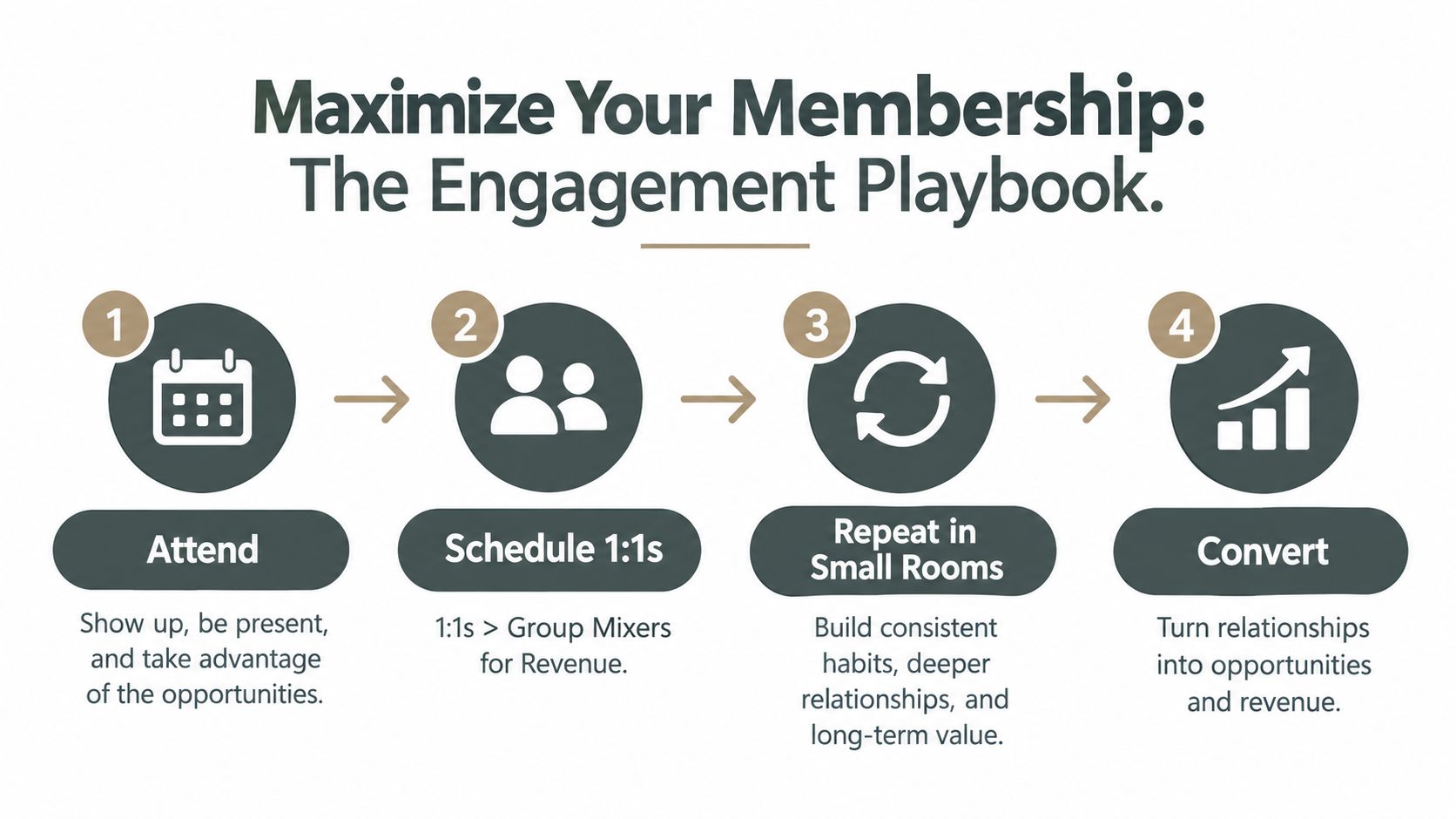
Large mixers create visibility. One-to-one meetings create understanding, and understanding is what makes a referral specific enough to act on. Join a club with a small-room strategy, then make your own participation even more deliberate.
Build a repeatable engagement cadence
Before each event, select two target conversations. Don't walk in hoping to meet “interesting people.” Choose one person who could become a referral partner and one person whose expertise could solve a current problem. Ask the host to facilitate the introductions if the room doesn't naturally create them.
After the event, schedule a structured 15-minute follow-up within 48 hours. Use the time to confirm what each person does, identify a relevant need, and decide whether a longer conversation makes sense. A quick follow-up is more useful than a vague promise to stay in touch.
Schedule one recurring one-to-one each month with every high-value contact. Keep the format simple: a morning coffee block, a walk through the Ten District, or a focused meeting in a private room. Consistency turns recognition into working trust.
Bring a referral-ready offer into every conversation. Explain who you help, what problem you solve, and what signal should prompt an introduction. “Anyone who needs marketing” isn't referral-ready. A clear description gives the other person a chance to recognize an opportunity.
Use the space as a relationship tool
A podcast-booth introduction can create both a conversation and a professional content asset. A Rise loft dinner can give a small group a reason to spend sustained time together. A morning-coffee block can make informal contact repeatable without requiring a major event.
The point isn't to use every feature. It's to choose a setting that matches the relationship stage.
Early relationship: Use a short coffee or lounge conversation to test relevance.
Shared expertise: Invite the contact into a working session or recorded discussion.
Potential referral: Host a focused meeting where both parties can define a useful introduction.
Established partnership: Create a small dinner or workshop around a shared audience.
The current events environment favors this approach. Coverage of 2026 B2B events reports that a majority of teams planned more intimate networking events and sub-200-attendee gatherings, while two-thirds planned more workshops, roundtables, and structured networking. The B2B events shift toward smaller formats aligns with what local operators see in practice, fewer shallow exchanges and more conversations with a reason to continue.
Audit your membership weekly:
Attendance: Which gatherings did you attend?
Introductions: Who did you meet, and why did the connection matter?
Follow-up: Which conversations received a timely next step?
Pipeline: Did any meeting produce a qualified opportunity, referral, or partnership?
Contribution: What did you give the community this week?
A club can't manufacture discipline. It can provide the setting, structure, and people. You still have to convert access into action.
Why Location and Design Change Everything
A club's floor plan either supports networking or works against it. Large ballrooms make it easy to disappear into noise. Smaller rooms create the conditions for depth, while lounges, hallway nodes, and common tables make low-pressure encounters more likely.
Research on coworking environments links social interaction and collaboration with productivity, work engagement, and well-being. A 2024 scoping review identified positive associations between productivity and social support, flexible physical environments, and convenient locations, while inadequate technology infrastructure and limited access hours reduced productivity. The coworking design review supports a direct operating principle: reliable technology and intentional social architecture belong in the same design brief.
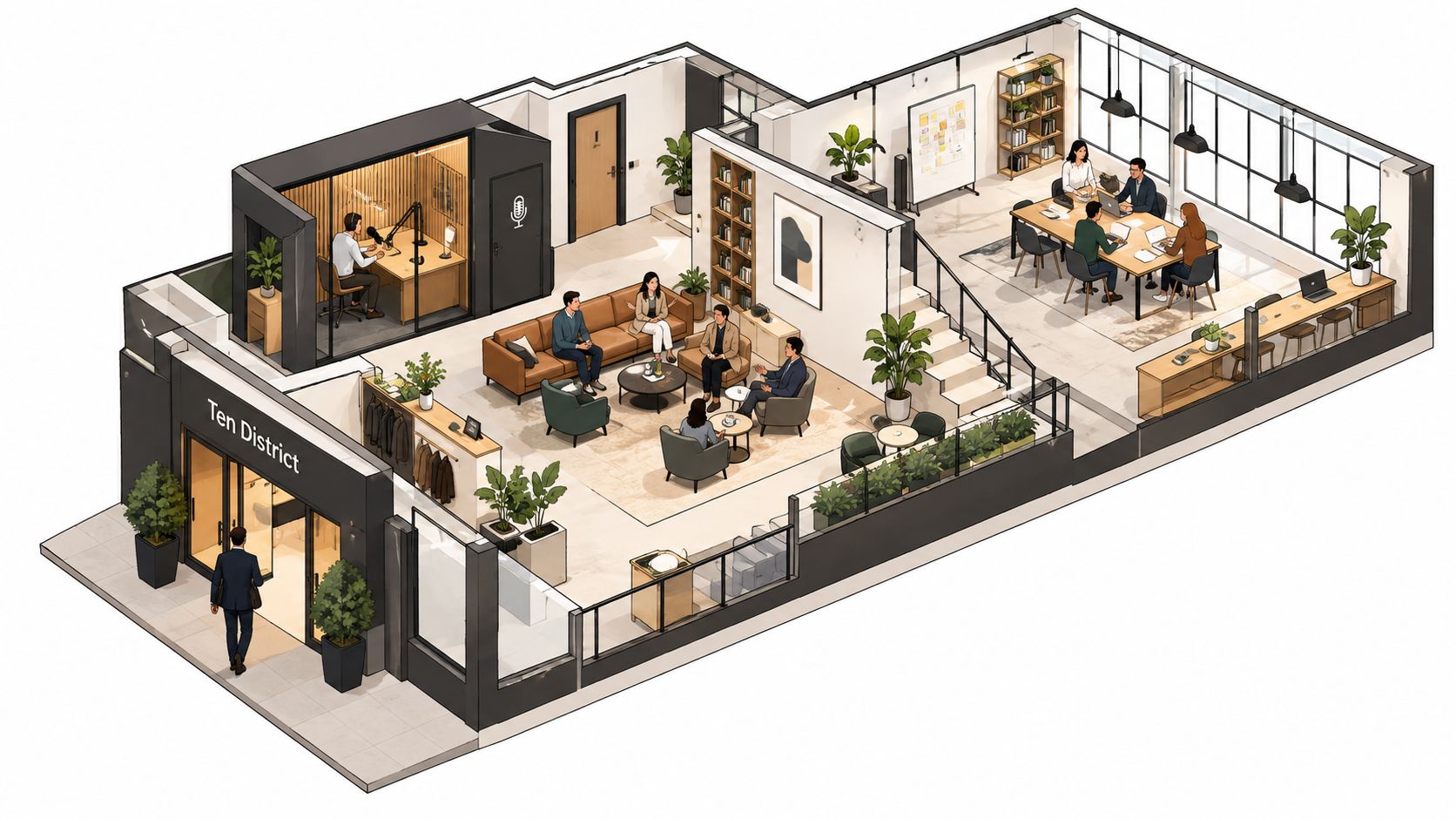
The rooms inside Freeform House illustrate how space can shape the interaction. The Hall of Fame Room, Freeform Room, Executive Room, and Thomas Room can support different levels of privacy and formality. A small meeting room helps two professionals move from introduction to problem definition. A larger room supports a workshop without forcing participants into the impersonal feel of a ballroom.
The podcast booth adds another layer. Recording a conversation gives members a reason to prepare, share expertise, and produce an artifact that can continue the relationship after the meeting. The Rise loft serves a different purpose, it can support a more curated dinner or creative gathering where a small group spends enough time together to discover shared opportunities.
Freeform House is located in the heart of The Ten District, a downtown Jenks area defined as 10 blocks between the Arkansas River and the old Midland Valley railroad tracks. The downtown core is officially zoned as a pedestrian-oriented mixed-use district that accommodates commercial, office, entertainment, institutional, and multifamily uses, including residential space above ground-floor uses. Jenks mixed-use zoning makes the location compatible with a club-workspace model rather than isolating it in a conventional office park.
The district's walkability can support cross-pollination between work blocks, client meetings, restaurants, coffee shops, and events. Freeform House's site reports $1 billion in new development over roughly three years in the district, positioning the club within an active downtown renewal rather than a generic suburban office setting. Freeform House and The Ten District provides the local context for that relationship between place and professional activity.
For a visual look at the design philosophy behind spaces that connect people with their surroundings, explore biophilic design in professional environments.
Common Misconceptions and Your Next 30 Days
The biggest event isn't automatically the most productive. Larger rooms can increase exposure, but they also make it easier for attendees to exchange names without learning what one another does. Research on club networks points to the importance of weak links, while current B2B events coverage favors intimate gatherings, workshops, roundtables, and structured networking over a simple return to large mixers.
Attendance alone doesn't equal return on investment. You can attend every event and generate nothing if you don't identify useful contacts, follow up quickly, or make yourself valuable to other members. A business networking club works when you build a rhythm of meeting, helping, following up, and repeating.
Use the next 30 days as a controlled test:
Choose two or three referral goals. Define the exact type of client, partner, or introduction that would matter to your business.
Attend one curated local gathering. Judge the quality of introductions, the mix of professional backgrounds, and the amount of useful conversation.
Schedule three one-to-one conversations. Give each meeting a specific purpose, such as learning the person's referral criteria or exploring a joint offer.
Document outcomes weekly. Record introductions, follow-up meetings, proposals, referrals, and next actions.
Review the economics. Compare measurable pipeline contribution and practical workspace value with membership dues, event fees, and time spent participating.
Don't confuse a short pilot with a guarantee. The purpose is to test whether the club's member mix, programming, location, and tools fit your business. A club that produces no relevant conversations after deliberate participation may be the wrong format, even if the building looks impressive.
For a Jenks entrepreneur, the decision should now be clearer. Choose a chapter if you need strict referral accountability. Choose a premium club if you need a trusted setting for meetings, hosting, and cross-industry relationships. Choose a coworking hybrid if daily access and flexible collaboration matter most. Then measure behavior and pipeline, not attendance badges.
Freeform House combines members-only coworking, meeting rooms, event spaces, a podcast booth, and the Rise loft in downtown Jenks, giving professionals a physical setting for repeated proximity and curated connection. Visit Freeform House to explore the spaces, attend a gathering, and test whether its tools support your next 30 days of relationship-driven business development.
Comments