What Is Business Networking? a Practical Guide for 2026

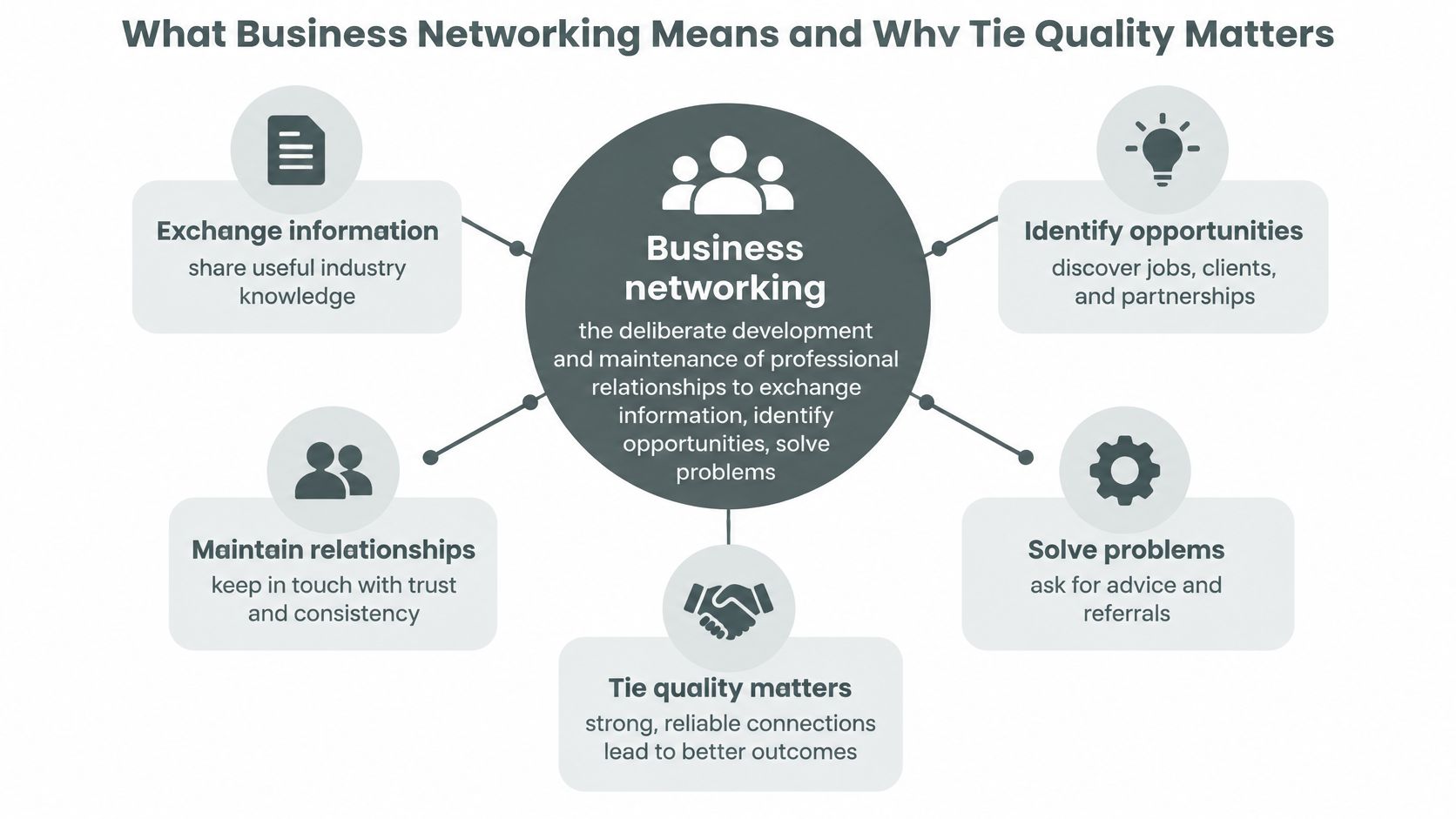
Business networking is the deliberate building and maintenance of professional relationships to exchange information, find opportunities, solve problems and create economic or career value.
If networking were only about knowing more people, wouldn't the person with the longest contact list always get the best results? A crowded address book tells you little about who understands your work, who'll return your message or who can introduce you to a different professional circle.
For entrepreneurs in Jenks and Tulsa, the more useful question isn't how to meet everyone. It's how to build relationships that are relevant, reciprocal and worth maintaining, without turning every conversation into a sales pitch.
What Business Networking Means and Why Tie Quality Matters
Business networking is deliberate relationship-building, not accidental mingling. You might meet someone by chance, but remembering their needs, offering useful help and staying in contact are choices.
Say you run a small catering business. Your closest friends know your food, but they may not know an office manager who books company lunches. A packaging supplier who understands your reliability might know exactly that person.
That supplier doesn't need to become your best friend to make a valuable introduction. They need enough familiarity to recommend you, plus access to people you don't already know.
Why acquaintances can open different doors
Sociologist Mark Granovetter's 1973 study of 282 men in the United States found that loose professional contacts and casual acquaintances were more helpful in obtaining jobs than close friends, as explained by Stanford's account of the strength of weak ties. The explanation is straightforward: close friends often know the same people and hear the same news, while acquaintances connect you to different circles.
For a business owner, the practical application is access. A customer might understand a neighboring market. An adviser might recognize a problem you haven't encountered. A fellow professional might know the decision-maker you've been struggling to reach.
The relationship itself is only part of the picture. Where that relationship leads matters too.
This diagram summarizes the activities that turn an introduction into a useful professional connection.
Familiar enough to trust, different enough to help
A five-year randomized LinkedIn study involving more than 20 million people found an inverted U-shaped relationship between tie strength and job mobility: moderately weak ties performed best, with 10 mutual friends more effective than one, while connections with 25 or more had lower incremental benefit; in one comparison, the 10-mutual-friend tie nearly doubled the probability of changing jobs, according to the Harvard Business School research summary.
That isn't a formula for managing your own mutual-friend count. It's evidence about job mobility, not a promise that a particular connection will generate customers.
The useful lesson is the middle ground. Someone who barely remembers you may struggle to recommend you. Someone who works beside you daily may have little new information to share. A moderately familiar supplier, former colleague or customer can sometimes offer both credibility and a different perspective.
Practical rule: Build enough familiarity for someone to describe your work accurately, without limiting yourself to people who already share your world.
A drawer full of business cards is a record of meetings. A short list of people whose work you understand, and who understand yours, is a working asset.
Before your next event, write down:
Who you want to know: Name a role or community, not just an impressive title.
Why the relationship matters: Identify a problem, knowledge gap or possible collaboration.
What you can contribute: Offer relevant experience, a resource or a thoughtful introduction.
Networking Formats and Where Each One Fits
In-person events, virtual sessions and structured groups solve different networking problems. Compare them by the access they provide, the attention they require and the opportunity to continue a conversation.
Business networking formats compared
Format | Best for | Typical commitment | Main limitation |
|---|---|---|---|
In-person industry event | Meeting many people quickly | Plan for 2–4 hours per event | Short conversations, little follow-up |
Virtual networking session | Remote and hybrid professionals | Set by the host | Harder to build trust without face time |
Structured peer group | Owners who want accountability and repeat contact | Plan for monthly or weekly meetings of 1–2 hours | Requires consistent attendance |
One-to-one coffee or lunch | Deepening a key relationship | Set by both people | Slow to scale |
Members-only club or workspace | Repeated contact with the same community | Ongoing membership | Cost and access rules limit who joins |
The time blocks above are planning suggestions, not industry averages. Check the actual agenda before committing, especially when travel or preparation adds to the time away from your business.
Choose a format for the job
In-person industry events suit discovery. You can hear unfamiliar questions and identify people worth meeting again, but a brief conversation rarely gives either person enough context for a substantial recommendation.
The appeal remains strong: Freeman reported in 2025 that 58% of attendees said networking motivated them to attend in-person business events in 2024, up from 39% in 2021, according to BizBash's coverage of the Freeman findings. When comparing local networking events, look beyond the attendance list to the discussion format and opportunities for introductions.
Virtual sessions remove travel and can connect remote professionals across markets. Choose a facilitated discussion or working session when you need more than names on a screen.
Structured peer groups are useful when you want people to understand an ongoing business challenge. Their limitation is the obligation to participate, prepare and contribute even when you're busy.
Coffee or lunch gives a promising relationship room to develop. Bring a clear topic rather than an undefined request to pick someone's brain.
Membership clubs and workspaces provide a recurring setting. Freeform House in downtown Jenks is a local membership-club example; when evaluating this format, look for recurring dinners, workshops or other programming that gives people reasons to return, rather than assuming those activities are included.
Pick a format for reach and another for depth. Don't expect a crowded reception to do the same job as an attentive conversation.
Membership Clubs and Coworking in Practice
A coworking membership is more than a desk key. Its value depends on how the space supports work and what the membership makes possible. A shared setting can give people a regular place to meet, while separate rooms help them focus.

A 2025 academic case study of Soho House describes a members-only model that combines access to spaces with paid in-house services. The useful lesson is structural: membership can create a recurring setting, while different services give members reasons to use it in different ways. The model's value depends on whether those features suit your needs, not on the club's name or price.
A local setting needs an intentional community
Freeform House is a premium, members-only club and workspace in downtown Jenks, housed in a restored 1920 building. Its four rooms support different uses, from focused work to meetings and events. Members also have access to creative resources, including The Rise loft studio and an in-house podcast booth, along with curated restaurant and coffee-shop partnerships.
A space can bring people into the same building without making them a community. An account of coworking research from Atlantic Technological University discusses how workspace design, active community facilitation and professional development can support participation. For a member, those details shape whether repeated visits lead to useful conversations or occur alongside other people's work.
Before choosing a coworking membership, check how access and services fit your routine. Prospective Freeform House members can book a personalized consultation to learn about pricing structures, opening dates and how to become a member. Ask who can use the space, what each membership includes, and what opportunities there are to meet people whose experience complements your own.
Common Misconceptions About Business Networking
The biggest myth is that networking is a numbers game. A large contact list can still leave you without anyone who understands your problem or can make a relevant introduction.
An analysis of employee-network research in Network Law Review explains that network size alone doesn't improve innovation; direct collaborators and connections between otherwise separate groups matter more. It also describes how remote and hybrid work can leave collaboration networks smaller and more fragmented.
The better practice is to build a balanced set of relationships, rather than chase a larger total:
Strong ties provide context, candid feedback and dependable support.
Weak ties expose you to unfamiliar information and opportunities.
Broker ties connect communities that don't normally interact.
A conversation isn't a purchase order
Another myth is that every conversation should produce business within weeks. That expectation can push you to pitch before you understand whether there's a genuine fit.
A useful conversation might clarify a hiring mistake, reveal a supplier issue or help someone avoid an unsuitable partnership. If you dismiss every interaction without an immediate sale, you're overlooking those outcomes.
A third myth is that every online connection carries the same weight as repeated face-to-face contact. Neither medium guarantees trust. A thoughtful virtual collaborator may know your work better than someone you regularly greet across a room.
Reality check: Ask what the person has learned about your judgment and reliability, not just where you met.
Keep a simple record in a spreadsheet or your customer relationship management tool. Note relevant referrals, useful advice, introductions and partnership discussions, alongside the next action you agreed to take.
A warning sign is a growing contact list with no meaningful exchanges. Another is repeatedly explaining your work from scratch because previous conversations never progressed beyond introductions.
Networking can't replace product quality, a clear offer or disciplined follow-through. It can help the right people discover your work, but it can't make an unsuitable service suitable.
How to Become a Bridge Between Groups
A bridge is someone who connects professional circles that otherwise don't talk to each other. A designer might introduce a bookkeeper to a manufacturer, not because either requested a sales lead, but because the manufacturer needs clearer project-cost reporting.
Your role is to recognize a relevant fit and make an introduction with permission. You're not guaranteeing the outcome or taking responsibility for their future work together.
Map the gaps before making introductions
List your communities. Include industry associations, civic groups, alumni circles, creative communities and neighborhood connections. Use a notebook or spreadsheet to keep the map simple.
Look for groups that rarely overlap. You might know independent retailers through your business and photographers through a creative project. Ask what practical problem someone in either group could help the other solve.
Choose a manageable introduction habit. Try a specific introduction each month, provided there's a genuine reason. Explain the fit to each person separately before connecting them.
Stay neutral and reliable. Don't forward personal contact details, add someone to a group message or imply endorsement without permission. Afterward, check whether the introduction was useful without demanding private details.
Protect your time. Set a monthly limit on introductions and unpaid coordination. Reciprocity can mean useful advice or thoughtful help, not necessarily a matching referral.
For remote and hybrid professionals, bridging can happen through a small cross-group video discussion or an invitation to an appropriate in-person event. A local club can also provide shared context, making it easier to notice complementary skills among people from different trades.
An introduction you can make this week
Suppose a retailer you know needs product photographs, and a photographer you trust wants to understand retail clients. Ask each whether they'd welcome an introduction, then explain the retailer's immediate need and the photographer's relevant specialty.
Keep the message specific and let them decide whether to proceed. A good introduction creates a choice, not an obligation.
Network Without Feeling Like a Salesperson and Start This Month
Reluctance to network doesn't necessarily mean you dislike meeting people. You may dislike being cornered by a pitch, entering an unfamiliar room or spending time without a clear purpose.
The 2025 Freeman trends report on networking found that nearly one in four attendees felt anxious or skeptical when an activity was called networking; among younger NowGen attendees, 28% reported that reaction, while 40% said networking felt too sales-oriented and 40% found it awkward. Those reactions are a reason to make participation clearer and less pressured, not to tell people to be more outgoing.
Start with a nearby venue, a defined finishing time and an activity that gives you something to discuss. Newcomers can ask a host for an introduction; introverts can choose a smaller discussion instead of an open reception. No one should have to tolerate intrusive questions or a hard sell to participate.
Replace the pitch with a useful conversation
The following guide illustrates a lower-pressure approach.
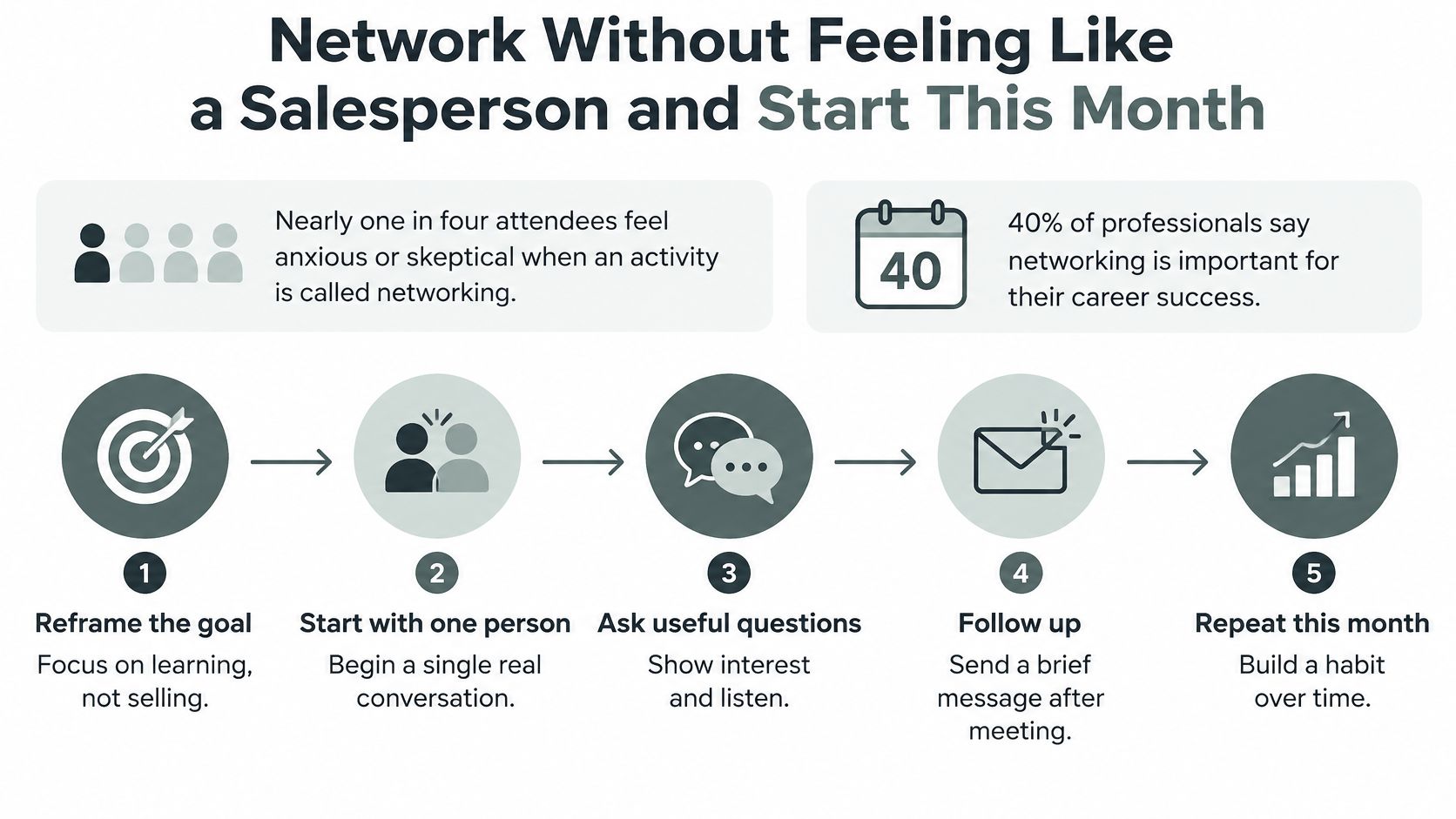
Use this routine as a practical starting point, not a performance target:
Choose a non-sales goal. For example, aim for three useful conversations about a business challenge instead of counting potential buyers.
Prepare a short introduction naming who you help and what you do. A bookkeeper might explain that they help independent shop owners understand cash flow, then ask what has been taking up the other person's attention.
Ask before explaining. Learn about the other person's work and listen for specifics. Don't turn every answer into a reason to describe your service.
Offer something relevant. That could be a resource, a permission-based introduction or a useful question. Don't promise help you can't deliver.
Follow up within 48 hours as a working habit. Mention the topic you discussed, deliver anything promised and suggest a next step only when it makes sense.
After four weeks, review your notes. Identify conversations that led to useful advice, an introduction or a reason to reconnect, and stop pursuing exchanges that feel one-sided.
Make the first month manageable
As a starter exercise, list five people from different industries. Schedule two contacts: an introductory meeting and a follow-up with someone you already know. These are suggested planning targets, not a formula for results.
Record the person's current priority, your promised action and the next appropriate contact in Google Sheets, Outlook or your existing CRM. The habits behind professional relationships that actually last are easier to maintain when you don't rely on memory.
Suppose a café owner meets an operations manager who explains how they organize supplier deliveries. The owner leaves with a practical idea, sends a thank-you and later shares a relevant local contact. Nobody buys anything, but both have a reason to welcome another conversation.
In a club setting, shared meals can provide a natural conversation context. Exclusive Food Partnerships is one of our member services, but an amenity is a setting for connection, not a guarantee of it.
Consistent follow-up turns a meeting into a relationship.
Freeform House offers a members-only club and workspace in downtown Jenks designed to support focused work, collaboration and professional connection. Visit Freeform House to book a personalized consultation about pricing structures, opening dates and how to become a member, and discuss whether the community fits the relationships you want to build.
Comments