Co Working Space Private Office: Costs, Privacy and Booking

A consultant is halfway through a client call in a busy café when the grinder starts, a nearby table gets louder, and the person across from them can see the presentation on their screen. They don't need a whole office building. They need a door they can close, reliable space for focused work, and access to shared amenities when they're useful.
That's the appeal of a private office in a co working space. But the monthly rate alone won't tell you whether it's the right fit. The important questions are how private the room is in practice, how often your team will use it, and which costs appear on top of the advertised price.
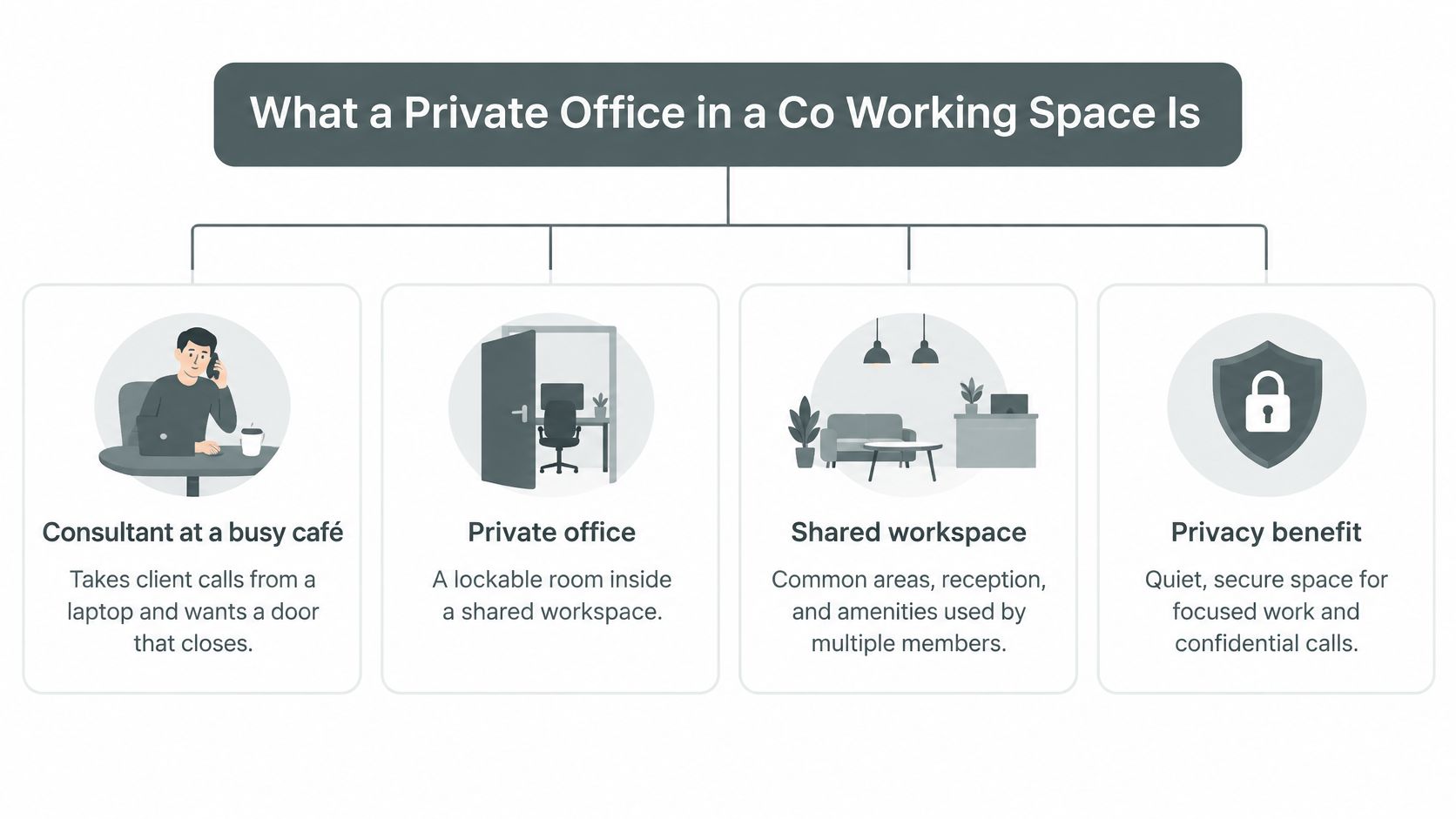
What a Private Office in a Co Working Space Is
A private office in a coworking space is a lockable room inside a shared workplace, rented by one person or a small team. The room is yours to use under your membership terms, while areas such as the lounge, kitchen, reception, and meeting rooms are shared with other members.
Think of the options like seats on a train. A hot desk is an open seat you choose when you arrive. A dedicated desk is your own seat in a shared carriage. A private office is a compartment you can lock, while a meeting room is a separate space you reserve for a particular session.
Compare the options
Option | What You Get | Privacy Level | Relative Cost |
|---|---|---|---|
Hot desk | Any open seat in the common area | Low | Lowest |
Dedicated desk | Same desk each day, optional lockable storage | Low to medium | Low to mid |
Private office | Lockable room for one person or a small team | High, subject to verified soundproofing | Higher than desks |
Meeting room | Bookable by the hour or half day | High for the session only | Pay per booking |
Read each row from left to right: the first column names the arrangement, the second tells you what you can use, and the last two help you weigh privacy against relative cost. A meeting room can provide a private setting for a call, for example, but it won't give you a permanent place to leave your work setup.
The format serves a practical need, not just a preference for a nicer desk. A 2024 estimate valued the U.S. coworking and co-sharing office market at approximately $2.37 billion, and reported that private offices were the second-fastest-growing space category, with an estimated 11.9% compound annual growth rate from 2025 through 2034, according to Research and Markets' U.S. co-sharing office market forecast. That forecast points to demand for the combination of a dedicated room and a flexible membership.
Two assumptions can cause trouble. First, a private office isn't automatically soundproof. Ask how well the walls and door block conversation, and don't treat a lock as proof of acoustic privacy. Second, a coworking office isn't necessarily a conventional lease with its own entrance. Reception and common areas remain shared, and your access, use, and fees are governed by the membership agreement.
Why Private Offices Earn Their Premium
A consultant works from the kitchen table, takes a client call while a laundry load runs, and loses the afternoon to interruptions. Working from home costs less in rent, but distraction can make it harder to concentrate, and a household backdrop may not feel right for every client conversation.
A private office can earn its higher price when it solves a real working problem. A closed door gives you a stable place to focus, keep your work setup ready, and take calls without relying on a quiet corner of a café. That doesn't make every room confidential, but it does give you more control over what's visible and who's nearby.

Focus, credibility, and connection
Focus matters when a task needs sustained attention. If you keep losing time to interruptions in open space, a room you can return to each day may be more valuable than a larger desk or a better coffee machine.
Credibility matters when clients visit. A consistent, professional room can be easier to prepare than arranging every meeting around a café table or an available shared room.
Community matters too. A private room doesn't have to mean working alone all day. You can step into the shared lounge or attend member activities after a confidential call, keeping opportunities for conversation without giving up a place to work privately. Harvard Business School research reports that shared, member-based workspaces can substantially reduce the loneliness associated with remote work. It also found that most coworking members reported improved engagement and motivation, and a greater ability to concentrate than when working from home or in coffee shops, as described in Harvard Business School's research on coworking.
The trade-off: Pay for a private office when confidentiality, concentration, or client presence matters often enough to justify it. If you mainly need a seat and internet access, a desk membership may be the more sensible choice.
Take a minute and answer three questions: Do you take confidential calls? Do clients need to see you in person? Do you lose focus in open space? A “yes” to one doesn't automatically settle the decision, but several “yes” answers are a strong reason to compare private-office options.
Matching a Private Office to Your Attendance Pattern
An office can be empty on some days and crowded on others. JLL reported global office utilization of 56% against a 74% target in 2026, while the share of employees attending three to four days a week rose to 55%, according to JLL's report on structured hybrid work. For a small team, the practical lesson is to plan for both typical attendance and the busiest day, not just the average.
Track two numbers before you ask for a quote:
Average days used per week: How often will people come in?
Peak headcount: How many people might need space on the same day?
A room that fits the average may fail on a day when everyone comes in. Use the table to identify the cost driver and the fee or rule that could change your total.
Attendance Pattern | Best Fit | Cost Driver to Model | Hidden Charge to Check |
|---|---|---|---|
One full-time user | Fixed-rent private office for one | Monthly rent against a hot desk equivalent | Mail handling and after-hours access fees |
Two-person hybrid team, office three days a week | Shared private office with guaranteed days | Days used against days paid | Additional-user fee for the second person |
Five-person team sharing two days a week | Team office on core days plus reservable overflow | Peak-day headcount, not the average | Guest limits and booking cutoffs on busy days |
Client-heavy firm needing rooms by the hour | Private office plus meeting-room credits | Hours booked per client meeting | Overrun rates and recording permissions |
Podcaster or photographer | Office or studio with storage | Session length and equipment storage | Rules for leaving equipment overnight |
A five-person team that meets together on two days may not need five seats every day. It does need a clear plan for those core days, access to overflow when more people attend, and a booking rule that doesn't leave someone without a place to work. A client-heavy consultant should calculate meeting-room hours separately from the time spent working in the private office.
A good team arrangement combines guaranteed capacity on core days, reservable overflow, and clear charges for irregular use. For help comparing membership structures and access, see this guide to coworking memberships.
Before agreeing, ask one direct question: What happens when everyone arrives on the same day, and who gets the room? The answer should spell out booking priority, capacity, and any extra fees, not rely on a vague promise that the space will work it out.
How Private Office Pricing Models Work
The advertised monthly rate is only the starting point. Your actual cost is base rent plus add-ons plus the flexibility you buy. A low headline price can lose its advantage if you need extra access, storage, room hours, or additional seats.
Pricing Model | How It Is Billed | Works Best When | Watch For |
|---|---|---|---|
Fixed monthly rent | One flat fee for a named room | Use is steady and predictable | Extra-user, mail, and after-hours fees added later |
Per-person office | Fee scales with the number of people in the room | Team size changes each quarter | Seat fees stack quickly as the team grows |
Guaranteed days plus overflow | Base fee for core days, extra days billed separately | Hybrid teams with predictable core days | Overflow rates rise on peak days |
Meeting-room credits | Monthly block of hours, extra hours at a set rate | Client meetings happen on fixed days | Unused credits may expire at month end |
Annual lease | Fixed term at the lowest monthly rate | Team is committed for 12 months or more | Exit costs and no flexibility if headcount falls |
Compare the same month, not the same headline
Here's a hypothetical calculation for one full-time user. Suppose Provider A quotes $900 for a private office, then adds $40 for mail handling, $60 for after-hours access, and $30 for storage. If a peak month also requires $50 in extra guest charges, the total is $1,080. Provider B quotes $1,000 and includes mail, access, and storage, but charges $50 for the same extra guest use, bringing the total to $1,050.
Those figures are an example, not market prices. The point is to use your own expected use and place every known fee on the same monthly comparison. Ask each provider to explain what's included, what triggers an additional charge, and whether those rates can change during your membership.
For one person, the base rate can rise once mail handling, after-hours access, storage, and guest use are billed separately. For a team, check whether the office price includes every named user or whether each additional person adds a seat fee.
A credit is a block of hours you pay for in advance. An overage is the charge for using more than that block. A guaranteed day is a day when your seat or office capacity is reserved for you even if other members are booking.
Ask for the fee schedule in writing. Compare the total monthly cost at your real attendance, and check what happens after the first month. This guide to coworking prices and finding true value can help you frame the comparison.
Privacy and Access Checks Before You Sign
A lockable door doesn't guarantee confidentiality. Someone may still hear a sensitive call through a shared wall, see your screen from the corridor, enter the room under the provider's access rules, or find printed documents left out after you leave.
Ask for specific answers in writing. Data privacy and security were identified as the leading barrier to workplace technology adoption, cited by 70% of organizations, in CBRE's analysis of the hybrid workplace. For a member choosing a private office, that's a reason to check how the space handles information, not an assumption that a private room automatically makes work secure.
Privacy Layer | What to Ask | Verified Signal |
|---|---|---|
Acoustic privacy | Can conversations be heard through the door or shared wall? | Sound-rated walls or door seals, plus sound masking |
Visual privacy | Is the room glazed, and can screens be seen from the corridor? | Frosted glass, blinds, or a screen-facing layout |
Physical access | Who holds keys or cards, and are guests logged? | Individual credentials and a visitor sign-in record |
Network security | Is there a separate guest network? | Segmented Wi-Fi with a guest network |
Records handling | Where do printed documents go overnight? | Lockable bins, a shredding service, or locked storage |
Test the claims in the room
A financial adviser taking a client call should ask whether the walls or door are designed to limit sound transmission, whether sound masking is available, and whether guest Wi-Fi is separate from the member network. Then check that the provider's answer is written down, rather than accepting a general promise of privacy.
For visual privacy, sit where you'd normally work and look toward the corridor: can a passerby see your screen? For physical access, ask who can open the room and how visitors are recorded. For records, find out whether there's secure storage or a shredding option before you rely on leaving paperwork behind.
A quiet-hours rule can reduce interruptions, but it isn't the same as a confidentiality standard. For example, the main area of The Thomas Room has a “no call or picture” policy for enhanced focus. That kind of focus rule doesn't, by itself, tell you how a different room handles sound, access, or documents. These security features to ask about can help you prepare questions for a provider.
A smaller room with written safeguards may suit a law firm, financial adviser, or health professional better than a larger office marketed around luxury finishes but offering no clear access or records protocols. Verify what matters to your work before you pay for extra space.
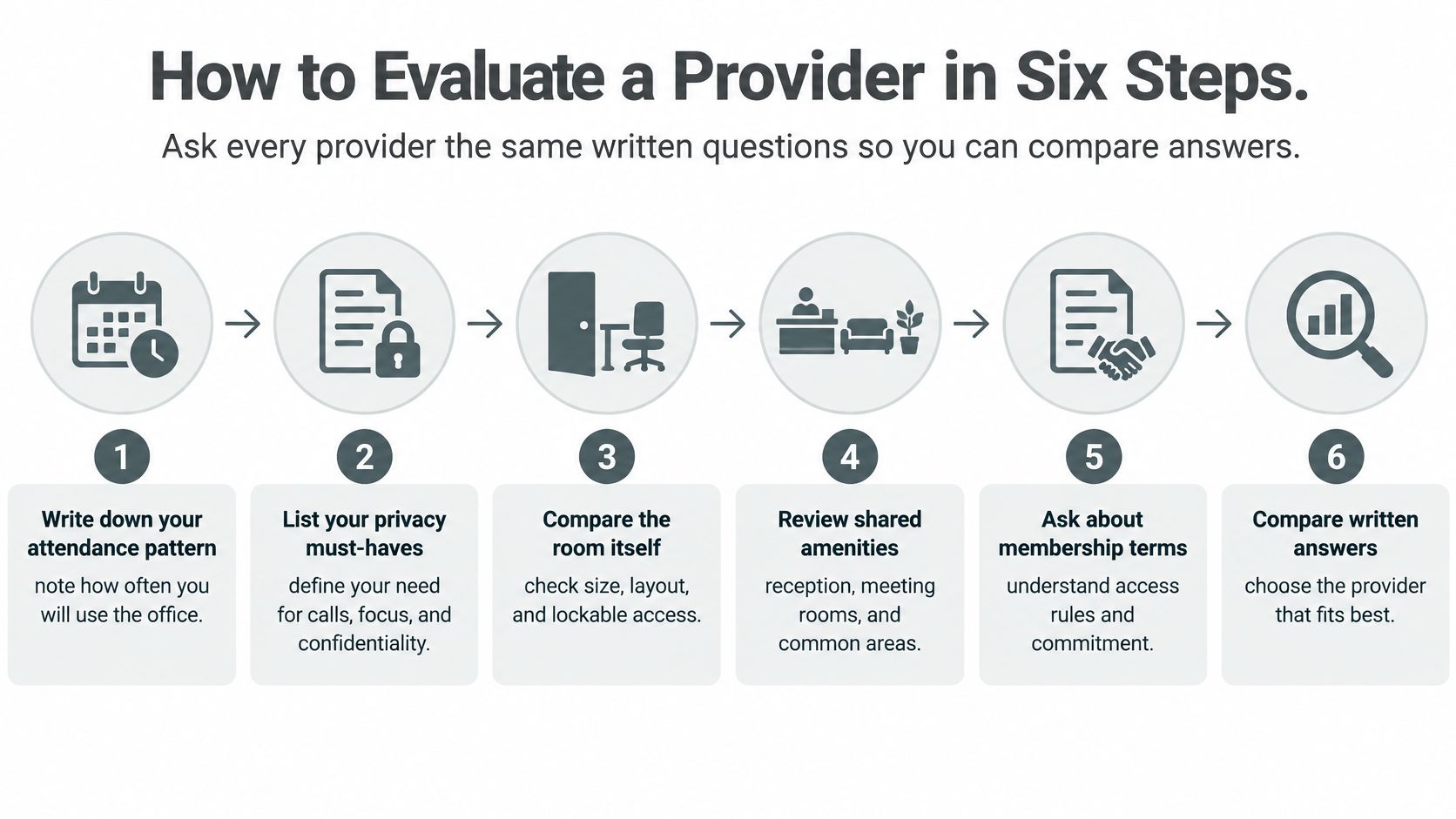
How to Evaluate a Provider in Six Steps
Ask every provider the same written questions so you can compare answers. That makes it easier to spot the difference between a room that looks right during a tour and an arrangement that works for your routine.
Write down your attendance pattern. Note the usual days you'll come in and the busiest day your setup must support, so you can request a realistic arrangement. A red flag is a quote based only on the number of people on your team, with no discussion of when they attend.
List your privacy must-haves. Decide whether your work requires quiet calls, confidential conversations, secure storage, or a separate guest network, then use that list to compare rooms. Vague assurances such as “the office is private” aren't a substitute for specific answers.
Request an itemized fee schedule. Ask for the base rate, add-ons, extra-use charges, and fees that may apply after the first month. If a provider won't put the charges in writing, don't treat the headline price as a complete quote.
Check privacy safeguards in person and in writing. Ask who can access the office, how guests are logged, and how the provider handles network and records security. A tour that avoids those questions or only shows the space when it's quiet leaves important points untested.
Test the community and operating rules. Visit during a busy period and ask how quickly staff address problems, how early rooms must be booked, and what happens on peak days. Gallup reported that teams with a formal hybrid collaboration plan were 66% more likely to be engaged and 29% less likely to experience burnout than teams without one, in its guidance on hybrid work and productivity. Ask whether the meeting rooms support planned collaboration, not just occasional calls.
Book a consultation before committing. Use the meeting to review pricing structure, opening dates, membership steps, guest limits, mail, and storage. A useful consultation should answer those questions clearly; pressure to commit before you understand the terms is a reason to pause.
Prospective members can book a personalized consultation meeting to learn about pricing structures, opening dates, and how to become a member. Bring your attendance pattern and written questions so the conversation can focus on the details that affect your decision.
Booking at a Premium Local Hub Like Freeform House
A membership club with workspaces and social events works differently from a standard office block. The office sits within a larger shared venue, so an executive planning a client call should first ask which rooms remain private, which areas are shared, and which rooms may be used for events or other bookings.
Check four details before choosing a room:
Booking rules: Can you reserve your private workspace and meeting space separately, and when do bookings close?
Access during events: Can members reach their workspace while an event is underway?
Guest arrangements: Where do clients check in, and which spaces can they use?
Confidentiality on busy days: Will social activity nearby make sensitive calls difficult?
For example, an executive hosting a board call on a Thursday evening should confirm in writing that the room won't be reserved for a reception that night. A podcaster or photographer should also ask whether recording is allowed in the workspace and whether equipment can remain there overnight.
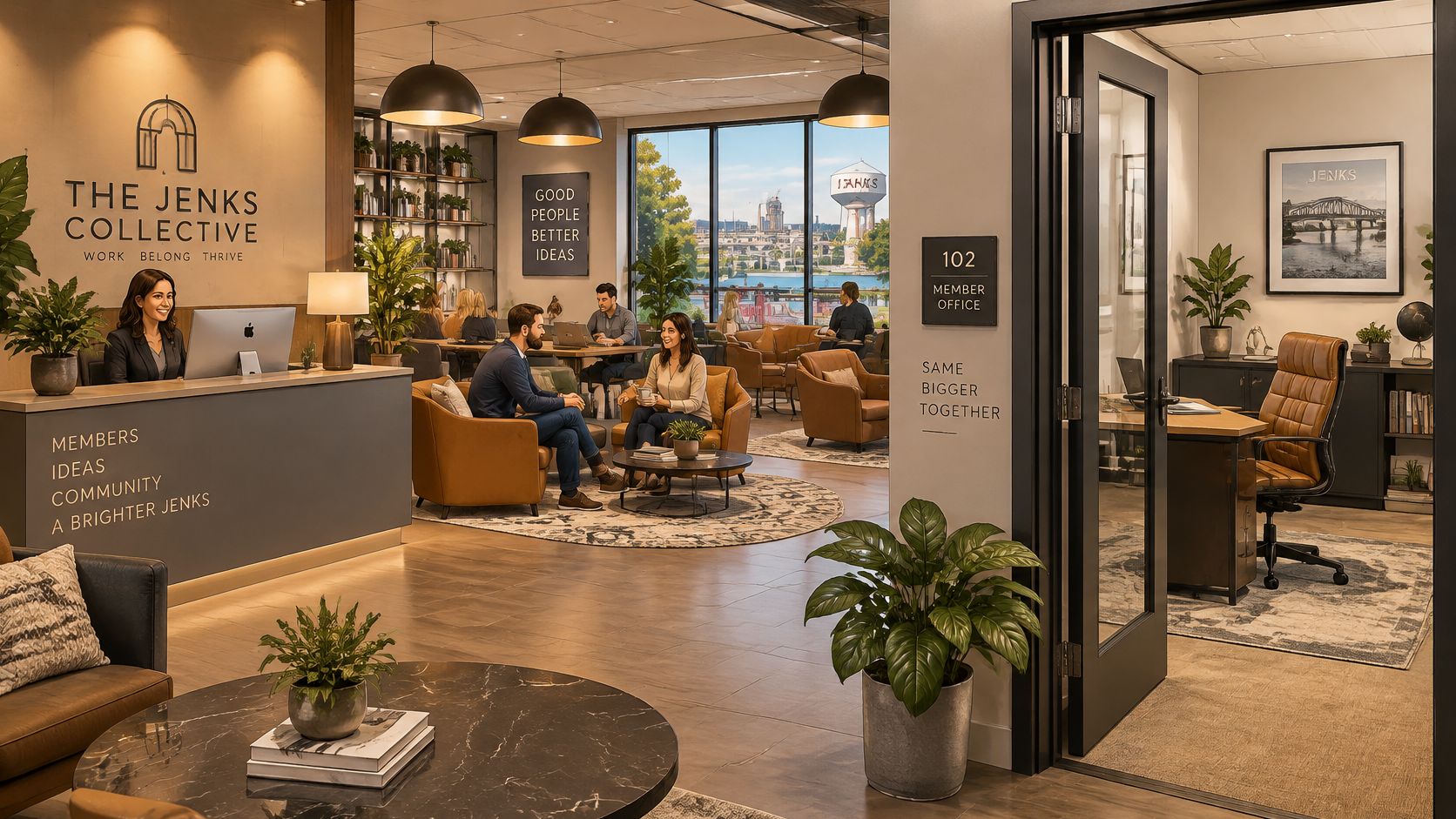
Freeform House is a premium, members-only club in downtown Jenks' Ten District, with workspaces and reservable conference rooms alongside social and event spaces. Its creative facilities include The Rise loft studio and an in-house podcast booth for professional content production. Ask how a particular room can be booked for your work and what membership terms apply.
For a closer look at the atmosphere and workspace, watch this video before arranging a visit.
The first practical step is a consultation. Bring your preferred workdays, guest needs, and questions about room bookings, then discuss pricing structure, opening dates, and how to become a member.
Confirm the Office Fits Before You Book
Use a three-part test before signing:
Attendance: How many days will you use the office, and how many people may arrive on the busiest day?
Privacy: Are the safeguards you need confirmed in writing?
Total cost: Does the monthly total include the add-ons and extra use you expect?
A solo professional with steady, confidential work may prefer a fixed-rent private office. A hybrid team with unpredictable attendance may fit a guaranteed-days arrangement with overflow space. A client-heavy firm may get more value from a private office paired with meeting-room credits.
Freeform House offers private workspaces, open collaboration areas, hot desks, and reservable conference rooms. It's a three-story, 10,000-square-foot members-only club, so ask in your consultation which spaces are available, how shared and reservable areas are booked, and what the membership steps and pricing involve. Bring your attendance numbers and privacy questions, and request the written fee schedule before signing.
The cheapest office is the one you use well.
Freeform House brings private workspaces, open collaboration areas, hot desks, and reservable conference rooms together in a members-only club in downtown Jenks. Visit Freeform House to arrange a consultation and discuss which workspace and membership fit your attendance, privacy needs, and budget.
Comments