24 Hour Office Space: Who Needs It and What It Costs

Your client can only take a call after dinner, your home is too noisy to record, and the nearest coworking space closes before you're ready to start. A workspace you can enter whenever you need sounds like the obvious answer. But an open door won't help much if the meeting rooms are unavailable, the air conditioning has stopped, or nobody answers when your entry app fails.
24 hour office space is worth judging by what works after hours, not just the hours on the door. The right choice gives you a usable place to work, a clear safety plan, and costs that make sense for your actual schedule.
What 24 Hour Office Space Includes and Its Main Formats
24 hour office space is a workspace members can enter and use at any hour, usually through a keycard, mobile app, or individual access code. That describes entry permission, not necessarily the availability of staff, guests, meeting rooms, or hospitality services.
24-hour access and 24-hour staffing aren't the same thing. A building may welcome members overnight while operating without an on-site receptionist. Remote monitoring or an on-call contact may provide support, but you need to know exactly what that support covers.
24 hour access formats compared
Format | Access pattern | Best for | Main trade-off |
|---|---|---|---|
Hot desk | Any open seat, usually all hours the building is open | Freelancers and remote staff with irregular schedules | Shared seat, no fixed desk |
Dedicated desk | Same seat available at all hours, subject to after-hours rules | Regular users who want the same seat each session | Costs more than a hot desk |
Private office | Full access for the office holder, often with after-hours entry | Small teams that need confidentiality | Longer commitment and fixed cost |
Meeting or production room | Bookable by time slot, sometimes evenings only | Podcasts, client calls, photo shoots | Advance booking and limited availability at peak times |
Membership club with workspace | Entry governed by membership tier and guest rules | Members seeking networking, events, and work in one place | Admission criteria and access rules differ by club |
Hybrid schedules, freelance assignments, and cross-time-zone teams create reasons to use an office outside conventional hours. The office can serve as a place for a specific task rather than somewhere everyone attends on the same schedule. A broader flexible office space comparison can help you distinguish schedule flexibility from flexibility in seating or contract length.
Decide what access needs to accomplish
Before comparing buildings, answer these questions:
When do you work? Identify the sessions you can't accommodate during ordinary opening hours.
Do you need a fixed seat? A shared desk may be enough unless you need to leave equipment set up.
Do you need privacy or just a desk? Confidential calls and recording require more than an available chair.
Many round-the-clock spaces are members-only. Eligibility, application steps, and credential activation matter as much as the advertised opening hours, particularly if you need somewhere to work immediately.
Who Round-the-Clock Access Suits and Where It Falls Short
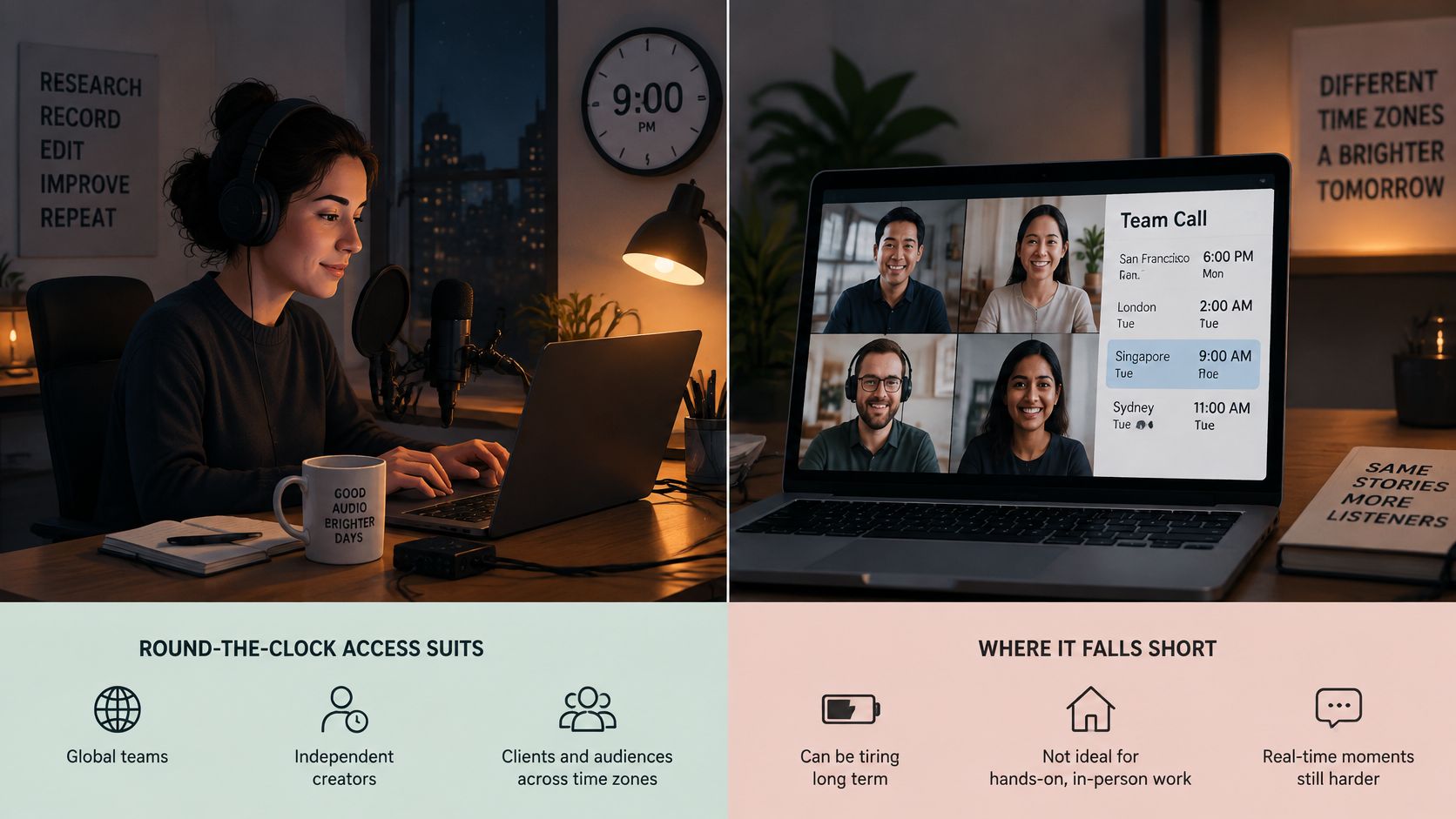
A podcast producer finishes preparing an interview after dinner, but the guest is only available later that evening. A founder needs a quiet place for a dawn call with colleagues in Singapore. Both need access outside the usual workday, but neither necessarily needs a permanent private office.
Working patterns are more varied than a standard office schedule suggests. The International Labour Organization's working-time report puts the global average workweek at approximately 43.9 hours in 2019, with 35.4% of workers working over 48 hours and 20.3% working fewer than 35 hours.
Different schedules call for different settings.
Who gets practical value
Freelancers and remote professionals may need separation from a busy household, especially when shared living space makes concentration difficult. Their priority might be a comfortable desk and dependable internet rather than a dedicated room.
Entrepreneurs and startup teams may need occasional deadline sessions. For them, access is useful only if teammates can enter together and use the equipment or rooms the project requires.
Creative producers need to distinguish quiet from production-ready. An empty office doesn't automatically provide sound isolation, suitable recording equipment, or permission to conduct a photo shoot.
Executives and consultants may need a predictable workplace between travel commitments or international calls. People managing childcare, commuting, health needs, or religious observance may also benefit from choosing when to complete focused work.
Test flexibility, not endurance
Count the time you work before 8am, after 6pm, or on weekends. Use those as personal tracking boundaries, not a definition every operator follows. A substantial share of off-hours work makes round-the-clock access worth pricing.
Then ask whether moving those sessions would improve your day. Could you finish concentrated work before a commute, avoid interrupting family time, or stop taking confidential calls from your kitchen?
In JLL's 2025 Workforce Preference Barometer, which surveyed 8,700 office workers across 31 countries, 57% believed flexible working hours would improve quality of life, while 49% had access to that benefit. Access to a building can support that flexibility, but it can't substitute for an employer's permission to change your schedule.
Practical rule: Buy control over when you work, not permission to keep working indefinitely.
Rooms can fill up, neighboring activities can interrupt recording, and technical support may be limited overnight. Set an intended departure time so unrestricted entry doesn't become an expectation of unrestricted availability.
If you only need a desk during standard business hours, extended access may add little value. The same applies when your work depends on clients attending at fixed daytime appointments. A daytime membership or suitable home office may meet the need more directly.
How Safe Overnight Access Works in Practice
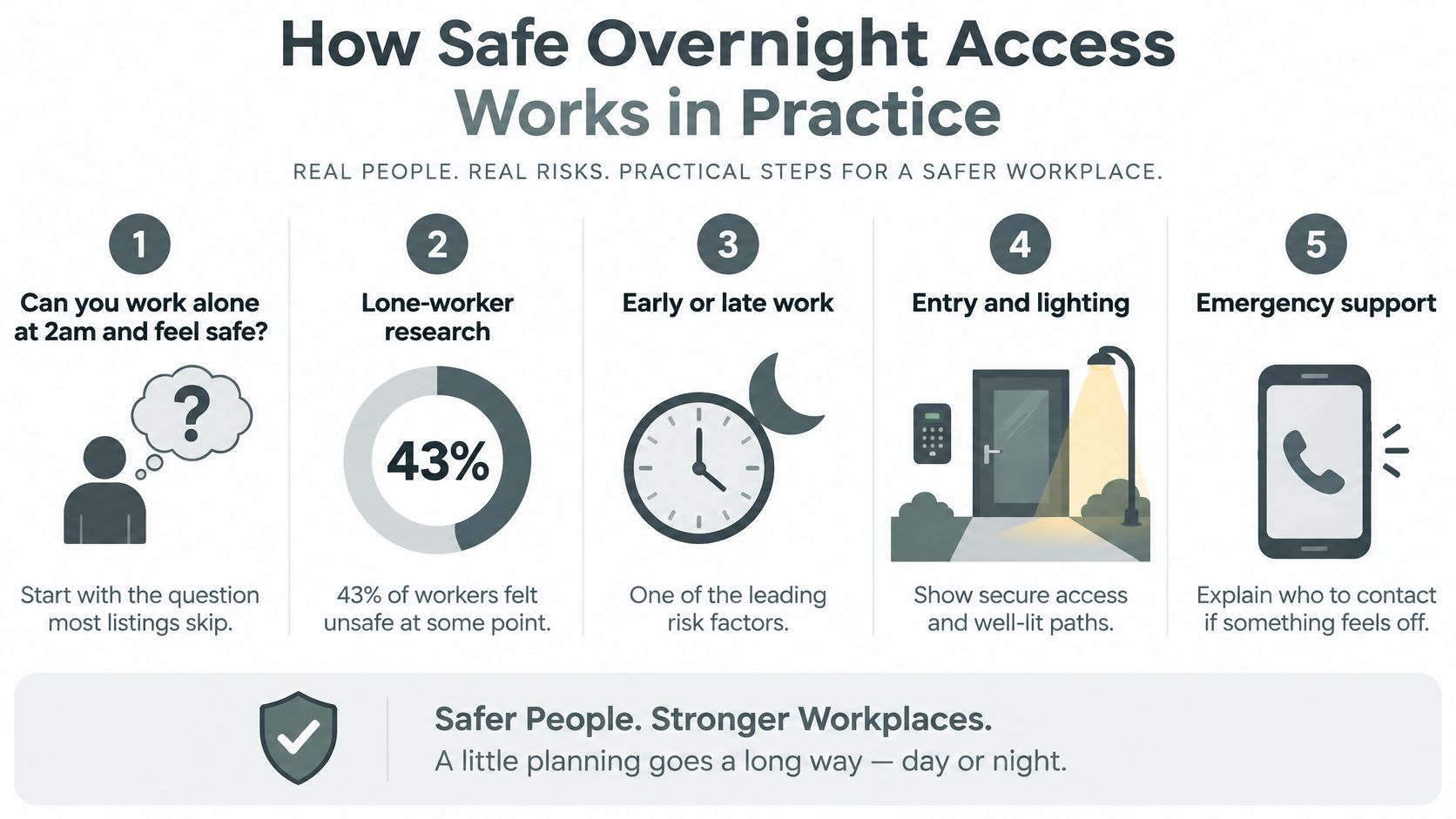
Can you work alone in the early hours and feel safe? That question deserves a better answer than a reference to cameras or a reassuring description of the neighborhood.
In Peoplesafe's lone-worker research announcement, 43% of workers felt unsafe at some point, early or late work was among the leading concerns, and safety worries reduced productivity for 18% of respondents and harmed mental health for 47%. Those findings concern lone workers, not coworking members specifically, but they identify questions an overnight workspace should answer.
Verify the whole arrival-to-departure route
A credible setup should explain each of these elements:
Individual entry credentials. Members should use their own access method, with a record of entry and a process for disabling lost credentials. Shared door codes make accountability harder.
Visible approaches. Inspect the entrance, parking area, walkway, and return route to your vehicle. Look for dark corners and doors that don't close properly.
Reachable support. Save the after-hours contact before your first visit. Ask whether that person handles access failures, disruptive behavior, and building alarms.
Written escalation. The policy should distinguish a routine maintenance problem from an urgent threat. Immediate danger calls for emergency services, not waiting for a community manager.
Guest boundaries. Learn who may enter after staff leave, who takes responsibility for visitors, and how an unfamiliar person is refused entry.
Usable essentials. Confirm nighttime access to restrooms, permitted storage, and delivery areas without entering restricted sections of the building.
Use a workspace security features checklist to turn broad assurances into items you can inspect.
Know who is actually available
Staffed access means someone is physically present during specified hours. That can suit members who need assistance with visitors or unfamiliar equipment.
On-call or monitored access means help is remote. Ask who receives an alert, what triggers it, and how someone responds if the issue requires a person on site. Fully unstaffed access requires greater independence and may not suit someone uncomfortable working alone.
On a tour, ask what happens if an alarm sounds at midnight, how an unknown visitor is kept outside, and where the nearest usable exit and parking are. Request a walkthrough rather than accepting a general assurance.
A useful safety answer names the procedure, the responsible contact, and the limits of the service.
Air Quality and Lighting for Overnight Use
A desk may remain accessible after midnight while its ventilation and lighting follow a daytime schedule. Check whether occupied rooms stay comfortable as people come and go, from a nearly empty floor to a busy meeting room.
Demand-controlled ventilation adjusts airflow using occupancy-related signals, such as carbon-dioxide readings. Variable-speed fans can respond as rooms fill or empty, but ask whether the system continues serving occupied areas after hours.
Overnight comfort benchmarks to check
These are building and lighting benchmarks, not promises about any particular venue.
Measure | Benchmark | Why it matters overnight |
|---|---|---|
Outdoor air, office example | ASHRAE guidance uses 5 cfm per person plus 0.06 cfm per square foot, or approximately 850 cfm for 50 people in 10,000 square feet, before applicable adjustments | Provides outdoor air as headcount changes |
Relative humidity | Generally below 65%, under the same ASHRAE guidance | Limits conditions favorable to microbial growth |
Bright white light at eye level | A NIOSH-linked lighting review reports that approximately 1,000 lux between 18:00 and 04:00 can delay circadian timing | Helps identify when intense overnight light may be unnecessary in lounges and circulation areas |
Daytime white light | The same review discusses approximately 300 lux of circadian-effective white light before noon for office workers | Supports appropriate daytime light exposure and alertness |
The outdoor-air figure is an example calculation, not a design specification for a particular property. Local code, occupancy, and system adjustments affect the required delivery. Outdoor air is also different from total supply airflow.
Look for room-level control
Ask whether meeting rooms have an after-hours ventilation override. A room booking and a heating or cooling schedule may operate separately, so a reservation does not necessarily activate environmental controls.
Lighting should suit the task and the time: low-glare desk lamps for focused work, lower and warmer ambient light in overnight lounges, and adjustable settings in meeting or production rooms. Occupancy sensors can dim unused areas, provided occupied routes remain well lit.
Brighter is not automatically better. The lighting review does not offer a universal prescription for shift work, and a reading measured on a desktop is not the same as light exposure at eye level.
Ask to see the ventilation design values, overnight control settings, and room lighting controls. During a visit, check for screen glare, uncomfortable temperature changes, and whether you can adjust your immediate workspace without changing conditions for everyone else.
Membership and Pricing Models Explained
After a late shift, the last thing you want is a surprise charge for staying past the hours covered by your plan. Compare memberships by what they let you use, when you can enter, and what costs extra. A day pass and a round-the-clock membership are different products, even if both include a desk.
Membership and pricing structures compared
The club prices below are historical examples reported in Eater's Soho House membership guide. They are not current quotes, and separate coworking access may not be included. The other rows describe common membership formats; their prices vary by venue, so request a quote before comparing.
Structure | Typical access | How to compare the price |
|---|---|---|
Day pass | One day, hours set by the venue | Compare the per-day rate with the hours you can use |
Hot desk | Any open seat during published hours | Compare the monthly rate and the hours included |
Dedicated desk | Same seat, during the hours included in the plan | Compare the monthly rate and minimum term |
Private office | Private space for the office holder or team | Compare quotes for the same team size and access hours |
Club membership, local tier | Local club; workspace access depends on the tier | $1,950 in Portland and $2,850 in New York annually, Soho House reported |
Club membership, multi-club tier | Network access under the selected tier | $4,500 for Every House and $5,200 for all Houses annually, Soho House reported |
Eater also describes an application process that includes a headshot, career and interest details, an application fee, and committee approval. If admission requires an application, allow for that process before planning your first session.
Compare the bill you would actually pay
Add the costs you expect to incur:
Monthly membership cost + expected room bookings + guest charges + necessary extras = expected monthly spend.
Divide that total by the hours you realistically expect to work there. For an annual contract, convert the fee to a monthly equivalent so you can compare it with a monthly offer.
Check whether meeting-room credits, printing, mail, lockers, guest passes, coffee, food, and events are included or charged separately. Location, contract length, and after-hours permissions can all change the value of a co-working membership.
Ask each operator for a written quote covering the same hours, commitment period, and inclusions. A lower headline rate may cost more if the sessions you need require a higher membership tier.
How to Evaluate a 24 Hour Workspace Near You
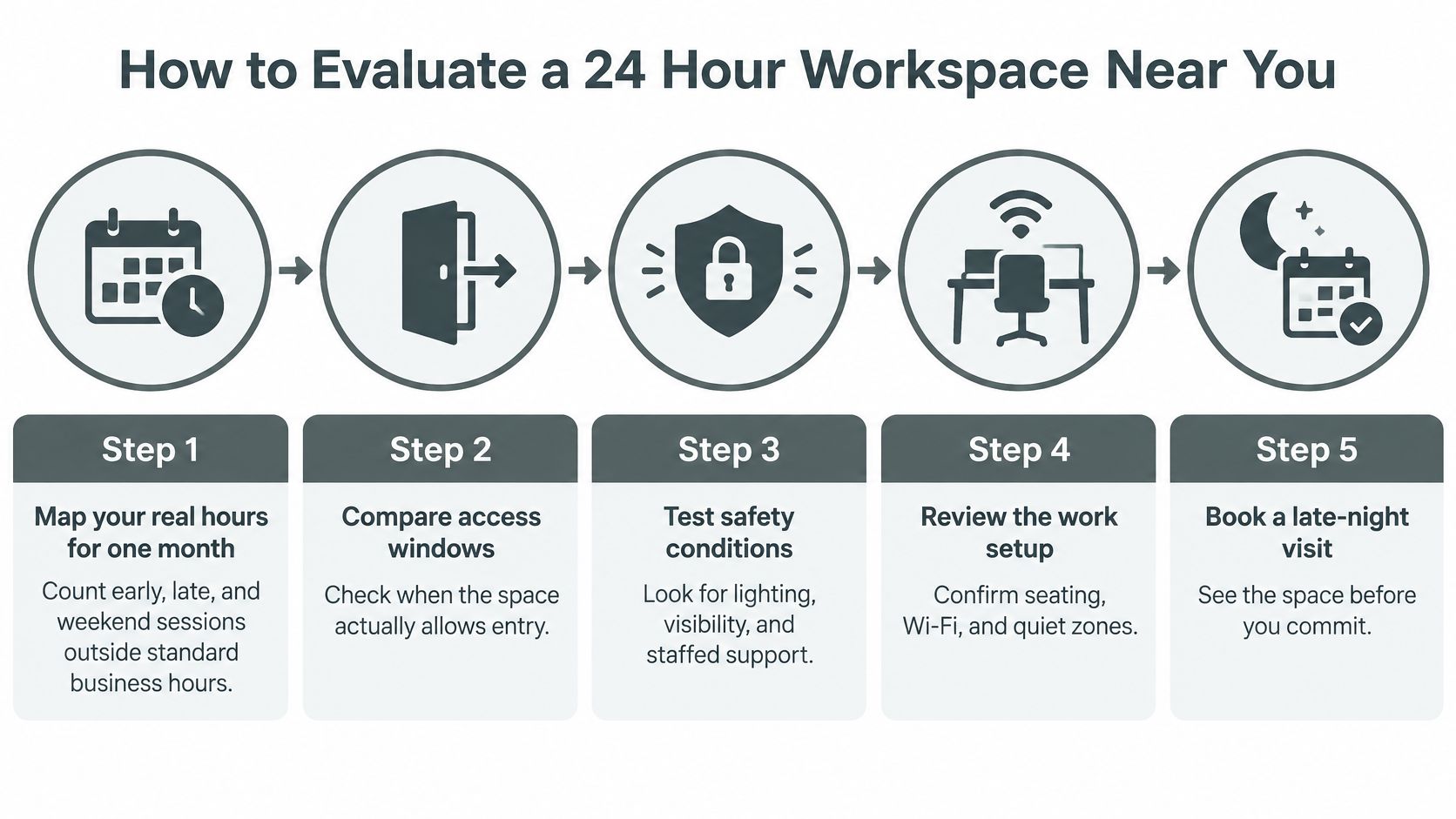
Start with your calendar, not the building's photographs. A good evaluation connects your real tasks to a specific seat, room, arrival route, and monthly bill.
The goal is to test the service you'd use, rather than the version presented during a quiet daytime tour.
Follow the work from calendar to workspace
Map your real hours for one month. Record early, late, and weekend sessions, including what you needed to accomplish. Memory can miss short evening tasks, so use calendar entries and a simple work log rather than estimating how often you work late.
Request the after-hours policy in writing. Match your likely arrival and departure times to the actual access entitlement. Check entry restrictions, guest conditions, and the scope of staffing or monitoring. The common mistake is treating a verbal yes to overnight access as a complete service agreement.
Test a room booking you would genuinely make. Request an evening focus room, client-call room, or production slot that matches your work. Check setup time and equipment access as well as the booking itself. An open building doesn't mean a suitable room is available.
Visit when you would normally work. Follow the route from your parking spot to the desk, then inspect restrooms, seating, lighting, noise, and Wi-Fi. If you need to upload media or join video calls, test that task with permission. A daytime visit won't reveal the evening event noise or arrival conditions you may encounter.
Compare total monthly spending and try the service. Put equivalent offers side by side, including the extras your work requires. If a trial is available, use it for a normal work session rather than a quick look around. Comparing different access windows by headline price alone produces a misleading result.
Decide what would make you leave
Before signing, identify your priorities. These might include a private call space, a well-lit walk to your car, or a dependable way to resolve access problems.
Choose the space that matches your working hours, not the one advertising the longest opening hours.
A trial should resolve uncertainty, not create an obligation to join. If the operator can't explain an important restriction clearly, leave that item unresolved in your comparison rather than assuming it will work out.
Book a Late-Night Visit Before You Commit
A workspace can look inviting during the day and feel very different after dark. If you work late, judge the setting by how it supports an actual evening visit, not just by its advertised hours.
Match the setting to your work
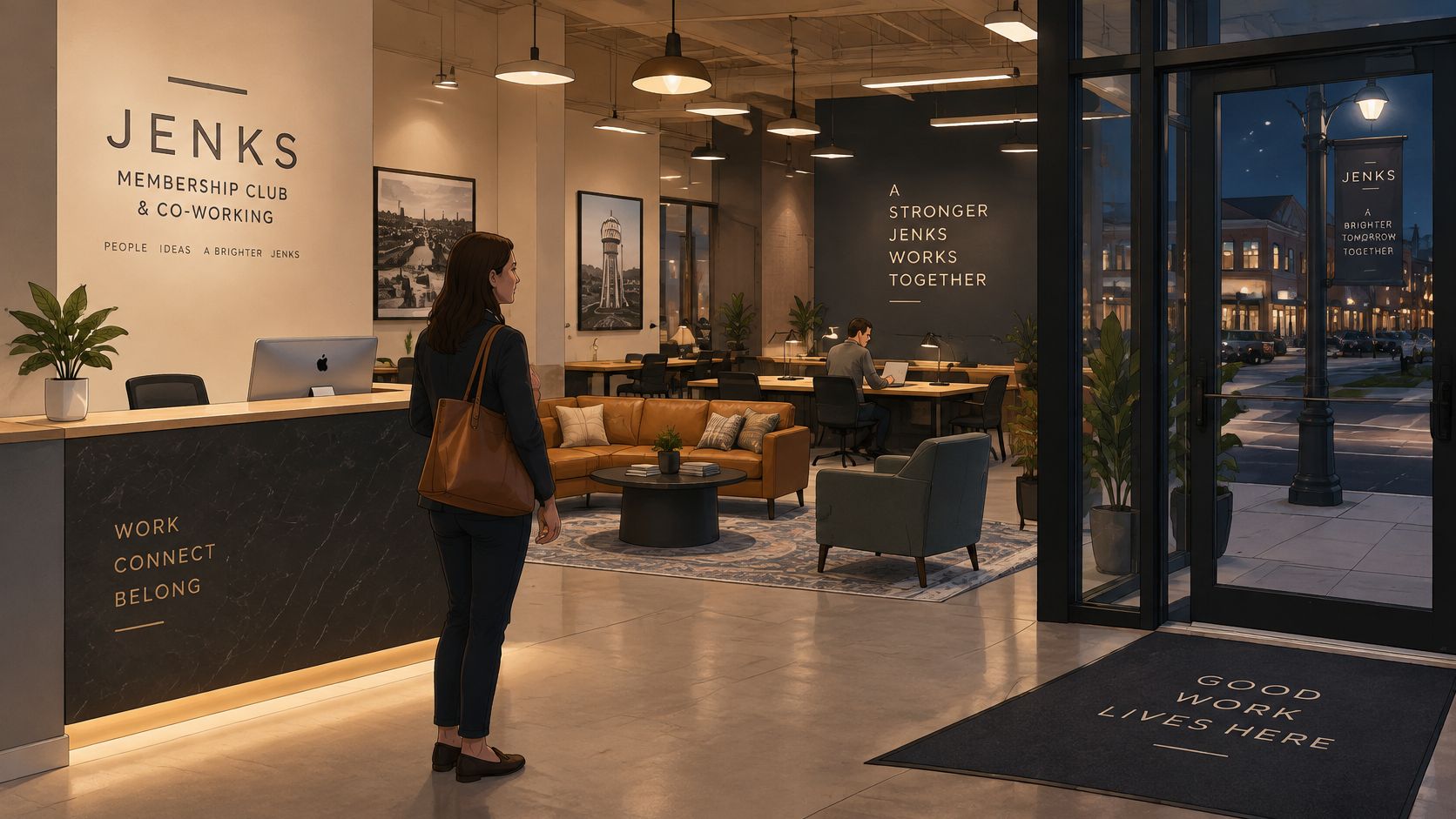
Freeform House is a premium members-only club in downtown Jenks, Oklahoma. Its three floors bring together private workspaces, open collaboration areas, hot desks, and reservable conference rooms. Members also have access to a secure, self-serve Amazon Hub Locker system. Arrive with a task in mind, such as focused work or a meeting, and consider which type of space would suit it.
For visual evaluation, look for realistic photographs of the actual building, rooms, and work settings. Images can help you understand the space, but an evening visit will show you more about the atmosphere at the time you plan to work.
Confirm the terms directly
Before arranging a late-night session, ask the Freeform House team to confirm overnight hours, staffing, guest policy, and room availability. Clarify membership criteria and any application steps, too. Access hours alone do not tell you what support or spaces will be available.
Bring these questions:
What happens after staff leave? Ask how members enter and get support if an access issue comes up.
How are guests admitted? Explain whether you plan to bring a client, collaborator, or recording guest.
Can I book a suitable room for my intended evening? Give the team your date, task, and equipment needs.
Request a tour at the hour you would normally work, subject to available visiting times. Use the visit to see whether the setting suits your work, then review the membership terms before committing.
Freeform House offers workspaces and reservable conference rooms within a membership community designed for work and connection. Visit Freeform House to request a tour and confirm the access, support, and room arrangements you need after hours.
Comments